Category: MEDIA

  • Naysayers silenced. BARC to go rural from next week

    By A Correspondent


    Stability is a bad word to use in the Broadcast Audience Research Council (BARC) office. You may well get barked at. As one top media agency honcho discovered at an event when s/he tried to raise it with a BARC official.


    The decision to publish rural ratings didn’t happen with ease, we are told. There was at least one influential player who aggressively opposed it. There were some others who simply wondered: Shouldn’t we wait for the ratings to settle down?


    The Board members were convinced on Tuesday evening that all will be well. The #1 channel will not tumble and turn #5. Yes, some free-to-air re-run channels will gain a bit, but, heck, if that’s what India watches, what can BARC do about it. A presentation was made in a Board meeting, and the decision was taken.


    With this, BARC India, which currently reports about 55 million households representing C&S universe of 1 Lac+, will expand its reach to 153.5 million TV households, representing All India and all modes of signal. Of this 77.5 million are urban TV households and 76 million are rural TV households.


    BARC India, which had recently announced a joint venture with TAM Media to form a meter management company, is working on the dynamics of it and will soon announce its integration plan.


    “With the board giving us the go ahead to release the rural data, one will see ‘What India Watches’” said BARC India CEO Partho Dasgupta.


    According to an analyst, the big beneficiaries of this would be broadcasters who have worked on their reach to the hinterland, and have traditionally been strong. The dynamics are dramatically different for urban and rural India. Among these channels, Zee TV will be a big gainer, we are told as will be the free-to-air re-run channels of the key networks. Doordarshan officials are also reported to be jubilant about the rural numbers coming in, as that, they feel, will help highlight their popularity vis-à-vis others.


  • Meanwhile, TAM, IMRB launch combined TV + Internet audience measurement

    By A Correspondent


    TAM Media Research and IMRB International have jointly announced the launch of a cross-media consumption behaviour data service. Called ‘TeleWeb Audience Measurement’, it is being billed as the first ever service available in the Indian media industry. This new service will provide data and analytics on the consumption of content across TV and Online platforms like desktop and mobile websites, YouTube and even apps for devices like phones and tablets. TeleWeb Audience Measurement was officially launched on Tuesday and the service has started with a sample across six metros and will be reported on a monthly basis.


    L V Krishnan

    Commenting on the launch, L V Krishnan, CEO, TAM Media Research, said, “Content consumption has been transitioning across media platforms, especially television and online. Hence, understanding cross=media consumption patterns at one go and planning advertising investments was imperative. This is what makes TeleWeb Audience Measurement the most awaited service for the Indian Media Industry. It is a win-win situation for both the mediums as it will create mutual pull of advertising investments.”


    Highlighting the value that TeleWeb Audience Measurement would bring to the Industry, Hemant Mehta, Senior Vice President, IMRB International said, “We are delighted to partner TAM Media and bring to the industry the first measurement of two screens. With content increasingly becoming platform agnostic, we believe this is an important step in measuring the total reach across platforms. Besides providing the content owners an understanding of the size and profile of their audiences across Digital and TV, the TeleWeb Audience Measurement service will also help advertisers identify new, interesting and cost efficient communication opportunities. For Digital publishers with video content, TeleWeb Audience Measurement would help in benchmarking themselves   vis-à-vis TV channels”.


    It may be noted that TAM is a joint venture of Kantar Media and Nielsen. IMRB is part of Kantar Media, which is fully owned by WPP.


    Presently, WAM’s five-year-old internet panel-based audience measurement platform tracks usage behaviour amongst active internet users in India and has a sample size of 6075 respondents across six metros (Mumbai, Delhi, Kolkata, Bengaluru, Chennai and Hyderabad) which will be fused with TAM viewership data of 10936 individuals from the same  6 Metro Markets (across 2500-odd panels). WAM tracks URLs surfed from user machines and mobile handsets to provide a complete view of consumption habits of audiences across digital properties.


    The WAM data from six metros above will be fused with the TAM TV Viewing data from the same markets. The fused output will be made available through a Client Software Interface called Video Xpress.


  • Sagnik Ghosh likely to head marketing at Star Plus

    By A Correspondent


    Why should a top marketer from a top private bank like Axis want to join the big, bad world of media? Because it’s got all the excitement. It’s the ultimate fast moving consumer good, we are told.


    Ask the various folk from Hindustan Unilever, Whirpool and the like and they aren’t complaining. In fact they seem to be enjoying every bit of it. Or so we are told.


    Anyway, the news is that Sagnik Ghosh, Senior VP and Head of Marketing at Axis Bank has quit and is all set to join Star India as head of marketing at Star Plus, a position left vacant after Nikhil Madhok moved to be Business Head of Life OK.


    Star Plus is already the #1 Hindi GEC, but its supremacy has been questioned in the recent past. Now that’s a turf that Ghosh will enjoy playing on.


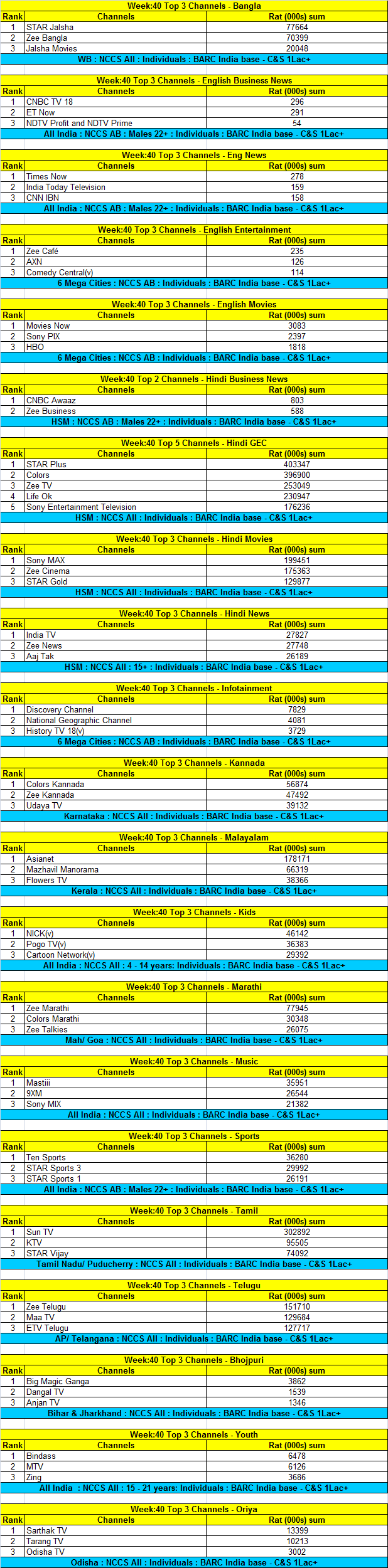
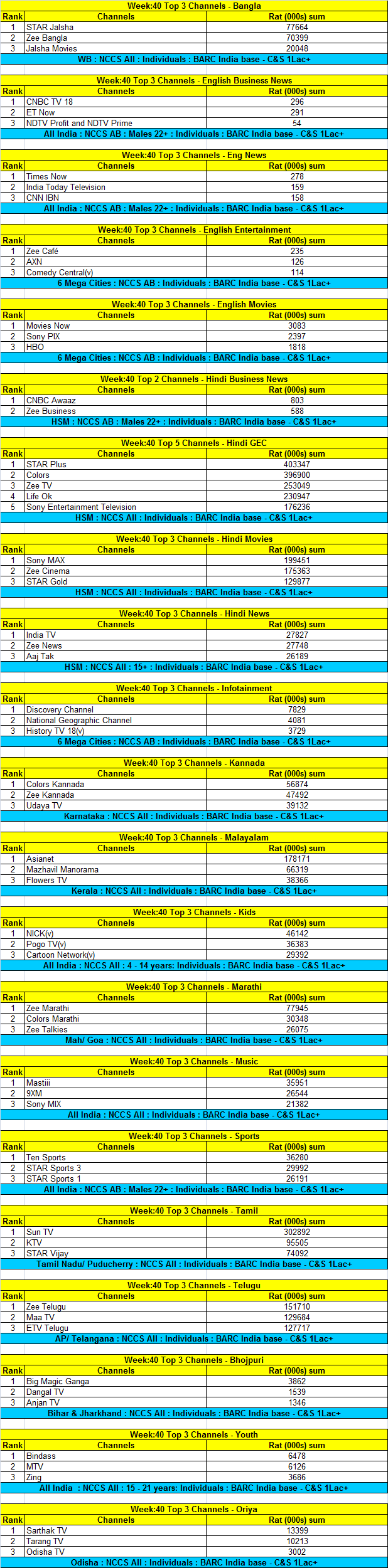
  • BARC Data for Week 40 (Oct 3-9, 2015)

    Here’s BARC data for Week 40 (Oct 3 to 9, 2015) for general entertainment channels and and more!​


  • Shailesh Kapoor: Prime Time News Is Facing Spokesperson Crisis

    By Shailesh Kapoor


    If you are a regular primetime news viewer, you will be familiar with the various “official spokespersons” that represent their political parties on these shows. The debate format, which will be associated with Arnab Goswami for years to come, is now a standard format across most channels, Hindi and English.


    Being an official spokesperson is not an easy job by any stretch of imagination. You have to be on upto four shows on the same day, for an average duration of 30-45 minutes each. So that’s potentially three hours of on-air time. Add the preparation time during the day and it’s a full-time job. It’s also a job of superhero proportions. Sometimes, you are “live” on two channels at the same time, saying different things!


    It would still be a rewarding job, but for the obvious problem. Spokespersons speak for less than 30% of the time that they are on-air. And of the time they speak, not more than 30-40% is actually audible in the perpetual din.


    To improve their player stats, they exercise their need to speak more, interrupting others and talking over them. It seems like a party boss is watching and evaluating their performance in real-time (very likely too) and there’s the pressure to perform.


    What it has resulted in is a perpetual degeneration of the quality of spokespersons. No self-respecting and intelligent man or woman would want to subject oneself to this futility night after night. What we get, hence, is second-rung talent.


    However, it’s not just the lack of quality that worries me. There’s a lot of arrogance at display every night. Spokespersons, taking a cue from each other and sometimes from the anchors (who are under their own pressures to be Arnabs), often talk in offensive tone and body language, sometimes talking down to unsuspecting non-politicians and even citizens invited on the show.


    If this style of talking is a party brief, then it reflects very poorly on our political class. Though I suspect political parties have left their spokesperson free to figure out their life on-air. In which case, the arrogance of behaviour displayed on TV reflects their character. In either case, it makes the citizen viewer feel more disillusioned about the political class.


    Not very long ago, the likes of Ravi Shankar Prasad, Manish Tewari and Jayanti Natarajan used to be party spokespersons. While they too had their bouts of impudence, there was certain stature and grace that came with their personas. At least one heard them seriously, even if the content was not credible on many occasions.


    Why are parties not sending better talking heads on TV, or at least training those being sent to project a dignified image of the party on-air? Is dignity not in vogue, or are news channels too irrelevant in our politics for parties to worry about? I suspect it’s the former.


    Many of us comment on social media that we are losing interest in news television because of journalism in general, and the quality of anchoring in particular. What about the quality of political representation? For me, that’s the problem with more social gravity attached to it.


  • Micromax initiative to accelerate smartphone adoption

    By A Correspondent


    To accelerate the smartphone adoption in the country, Micromax Informatics launched a 360 degree marketing campaign to encourage the 70 million new age consumers using feature phones to switch to smartphones. With a strong portfolio, the company is committed to deliver value to the consumers by focusing on three key levers: faster internet connectivity, large display, speedy processors at extremely affordable price points. To take its message to the nook and corner of the country and reach out to the first time smartphone users, the company has roped in popular stand-up comedian Kapil Sharma for North and the Bahubali sensation, Rana Daggubati for South. The two stars will be seen in a series of films that give very tangible, easy to comprehend benefits of switching to a Micromax smartphone.


    Currently, the Indian mobile market is dominated by feature phones with smartphone penetration at just about 15 per cent. Micromax has identified three core barriers hindering the faster smartphone adoption which include the total cost owning the smartphone and data packages, hesitancy around using touchscreen and an evolved Android experience and English language UI making it difficult for consumers to make the shift. Based on these insights, Micromax, has developed a full business initiative comprising key components such as affordable devices with big screen size, regional language support, customized data package and a fully developed customer education program– including printed material, digital content available over phone in local languages to empower first time users of smartphone to set up and use basic functions like email, social networking and other basic utilities.


    In line with this, Micromax’s new Bolt series phones offer big screen experience and cuts across various price points to suit the pockets of diverse consumer sets with models like Bolt S302: ₹ 3199/-, Bolt D303: ₹ 3199/-, Bolt Q331: ₹ 4999/- and Bolt Q338: ₹ 6499/-. All the Bolt series smartphones will now come pre-loaded with Firstouch, a patented translator functionality app that will help people translate from English to their local languages and vice versa and access apps in App Bazaar in their preferred language. Additionally, Micromax Bolt customers can also opt for either free WhatsApp or avail talk time worth Rs. 40 per month on Airtel for the first five months. Micromax has also initiated a tech buddy program which includes trained retail representatives and customer care executives across 850 Micromax service centres to help consumers in seamless transition. To take the message across the length and breadth of the country, a 360 degree marketing campaign has been launched to promote the entire initiative and explain the benefits of making the switch to smartphones with Micromax Bolt range.


    Commenting on the launch of the new campaign, Shubhajit Sen, CMO, Micromax Informatics, said, “Around 70-80 million Indians convert from their feature phones to smartphones every year and more and more consumers will use a smartphone for their initial computing and Internet needs leapfrogging the PC and laptop generation. We believe that smartphones will play a significant role in meeting PM’s ‘Digital India’ vision to connect the next billion. Micromax, being a front runner in the sub 7.5k mass segment handsets, has taken a step ahead in its philosophy of democratizing technology to the masses and has come up with a special program to enable the consumers to take the next technological leap towards the smartphones from feature phones.”


    “WhatsApp is excited to partner with Micromax as it continues to offer affordable innovations that enable connectivity. With over 900 million active users around the world and India being an important part of that, we remain focused on helping people communicate in a way that has become a part of everyday life. We are pleased to be working together with Micromax in this unique offering so that people in India can stay connected with their friends and family both in India and abroad,” said, Brian Acton, Co-Founder of WhatsApp.


    The entire campaign is designed to make the consumers more comfortable to approach Micromax to hand-hold them through all the apprehensions and inhibitions of using a smartphone for the first time. The campaign will act as a trigger for the consumers to be connected to their friends and family in a better way. The TVC campaign is conceptualized by Lowe Lintas Delhi, and includes a series of three films, each shot with Kapil Sharma and Rana Daggubati. The communication, in a very tongue-in-cheek manner, talks about Micromax differentiators that come with switching to the Micromax Bolt Smartphone range, which are – free data for use on WhatsApp, regional languages, affordability and big screen. The TVCs will showcase both the brand ambassadors in a double role which is a first for both of them.


  • Ranjona Banerji: The reaction from the BJP to writers returning their awards has been weak and petulant

    By Ranjona Banerji


    The week on TV news in India has been nothing if not breathless and exciting. Okay. I concede. That sounds like any week on TV news in India. There is no TV news person in this wonderful nation who cannot make a simple nail found on the road into an international incident. Forget Shakespeare and Richard Whatever’s kingdom for a horse. We did it here first and we do it better.


    But this week, I am unfair. Barely had we recovered from the Shiv Sena defending our western border with Pakistan by assaulting Sudheendra Kulkarni’s face with black paint, than we jumped into the next attack of excitement. We had the prime minister express some little bits of sadness (dukkhojonok in Bengali sounds so terribly ponderous, as translated by Indian Express from an interview Narendra Modi gave to the Bengali newspaper Ananda Bazaar Patrika) about incidents like the Dadri murder and the cancellation of the Ghulam Ali concert, thanks again to the Shiv Sena’s Border Defence Force.


    These writers seem relentless in their movement against the shrinking space for dissent and keep giving away their awards. This has deeply upset the government so much that the Union Finance Minister Arun Jaitley took to Facebook to tell us that this was a dukkhojonok occurrence. However, he expressed more dukkho (sadness) for his own party and government than for what the writers are trying to convey. It is interesting that Facebook posts are now an established form of public expression, on the same level as an interview, an opinion piece or a blog. Some of us use Facebook to share cat videos with our friends and maybe “friends of friends”; others think of it as a public platform.


    On India Today TV, Karan Thapar held a compelling discussion on Jaitley’s comments on awards being returned, between writers Shashi Deshpande and Mridula Garg, actress and playwright Maya Krishna Rao, journalist Siddharth Vardarajan and journalist and BJP sympathiser Swapan Dasgupta. Deshpande and Garg have not returned their awards but are distressed by the assaults on writers and feel that dissent is being killed or squashed. Rao has returned her Sahitya Natak Award and made some powerful arguments debunking the accusation that she was politically motivated by pointing out that all art makes political statements.


    Vardarajan took issue with Dasgupta who defended the government and launched a side attack on everyone who is not in favour of the BJP’s way of majoritarian thinking. It is not a shrinking of space for dissent said Dasgupta but a truncating of an intellectual position. A fine piece of sophistry if there ever was one. Dasgupta even tried to separate writers like Nayantara Sahgal and Ashok Vajpayi from the other writers, implying that they were politically motivated and the others were just protesting. Deshpande put him right on that.


    Dasgupta then selectively quoted Deshpande’s letter of protest to the Sahitya Akademi, twisting her meaning, while she was sitting there. The purpose served by this deliberate attempt to lie which could so easily be debunked was not clear. It looked either like an attempt to demonstrate that you have reading skills or actually just like desperation.


    But it was Garg’s statement that she was disappointed in Jaitley who she had always considered one of the few intellects in the current dispensation that really upset Dasgupta. He took off on a diatribe on a class war being fought in the country and that ended the discussion. Perhaps Dasgupta was insulted that because he felt he was one of the main intellects in the BJP but apart from big words and coherent English, not much of intellect was on display. Quite tragic in fact.


    The BJP perhaps needs to find better spokespersons on TV who can put forward their position on such tricky issues. It was unfortunate that Thapar ended the show with Dasgupta.


    **


    Comic relief came from Times Now where Anand Narasimhan and guests ganged up on politicians who were defending the closing of dance bars in Mumbai. For a change, politicians were bleating weakly and everyone else was laughing or shouting at them.


  • Can these three save the MRUC (& print)?


    By A Correspondent


    The deed was done in an AGM last month, but on Thursday, it was made official.


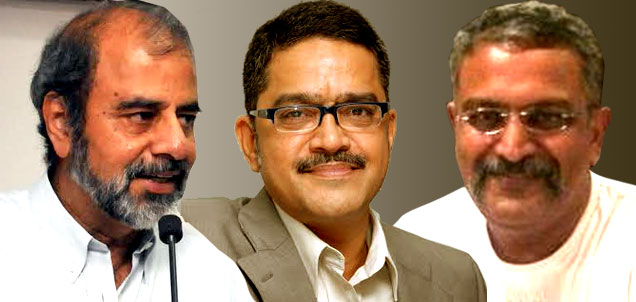
    The all-important Media Research Users Council announced the formation of a new top deck. It elected I Venkat, Director, Ushodaya Enterprises as Chairman for the next two years. It has also appointed Radhesh Uchil, formerly with Madison’s Platinum Media, as CEO.


    Venkat takes over from GroupM South Asia CEO CVL Srinivas, and Uchil comes in with the exit of Shaswati Saradar.


    To be fair to Srinivas, he took charge only in May 2015, taking over from Ravi Rao of Mindshare who had moved out. Rao helmed the MRUC from early 2014.


    The all-important position of Chairman of the Technical Committee, held by top media consultant Paritosh Joshi, will now be taken up by NP Sathyamurthy, Executive Director, DDB MUdra Group. Sathyamurthy, it may be remembered, successfully led the MRUC secretariat as Director General from March 2003 to September 2005. Nikhil Rangnekar, CEO, Spatial Access is the new Chairman of the Marketing Committee. Sanjay Tripathy, Senior EVP at HDFC Life is the new Vice Chairman of MRUC, taking over from Rohit Gupta of Multi Screen Media.


    Both Srinivas and Joshi will continue to mentor the Council, a statement added.


    Venkat and Uchil are seasoned players, but the MRUC job possibly requires the two to have the skills of a police commissioner and a High Court judge. Be just and tough.


    Given the rapid rise of the digital media and steady growth of all other media, print will surely not die, but advertisers could well lose faith in the reach. So even if you think this bit of ‘print is dying’ is bunkum given the large number of ads in The Times of India these days and the reliance of even big digital players on print, the growth of digital is decidedly going to impact print, especially in the all-important urban centres.


    But, as many professionals tell us, the enemy for the print sector, lies within. If print players do not invest in audience research and work towards growing the sector, these three men (and the various others) could be the last officebearers of the MRUC. Finito!


    Earlier this year, we saw The Times of India and Hindustan Times leaving no stone unturned in putting each other down. If better sense had not prevailed, they could well have been talking ill of their stakeholders. MxMIndia had taken a conscious decision then not to solicit any of these advertising as it wasn’t even worthy of cooler conversation.


    But if BCCL and HT Media got out in the open, there were others too who were flexing their muscles, if not in the open, at least in the trade.


    What now? There are only two ways the MRUC can go? Up or down. No status quo. In fact, may we advise the powers that be who have taken charge that if they do not wish to employ missionary zeal to cleanse the sytem, they should opt out.


    Yes, yes, we said that. You read it right.


    Since we are in Mumbai, let’s use a line inspired from Bollywood: agar dar gaya, toh print mar gaya!


    We are told that there are some big and bit players who have been playing bully. There is also this confusion about who is accountable for the readership study: the MRUC or the RSCI (the Readership Studies Council of India, which is formation of a group and not a legal entity).


    Thankfully, some of the officebearers at other key organisations like the Audit Bureau of Circulation (ABC) are progressive in their outlook. Venkat himself is associated with the ABC, and has done his bit for almost every industry association.


    It’s time for all print players to bury their differences and save their own future. These three men have it in them to make the difference.  While the ball lies in their court, it’s also lies in each of ours too.


    Some lessons may be learnt from the Broadcast Audience Research Council (BARC) which had equally killers sharks amongst its stakeholders. It need a strong secretariat and a committed Board to effect the changes.  Print is lucky that the I&B ministry is too scared to take on the biggies. Had the same happened in news television, all hell would’ve broken loose.


    Can the printwallahs do it? Yes, they can. The question is: do they want to do it.


    In all of this, they shouldn’t forget the not-so-poor advertiser.  For, the stick is finally in her/his hands.

     

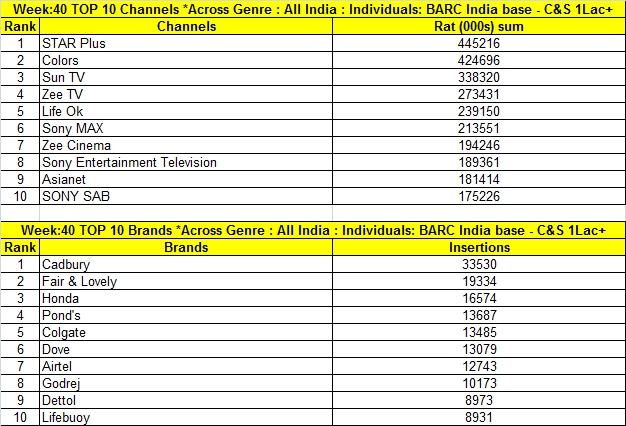
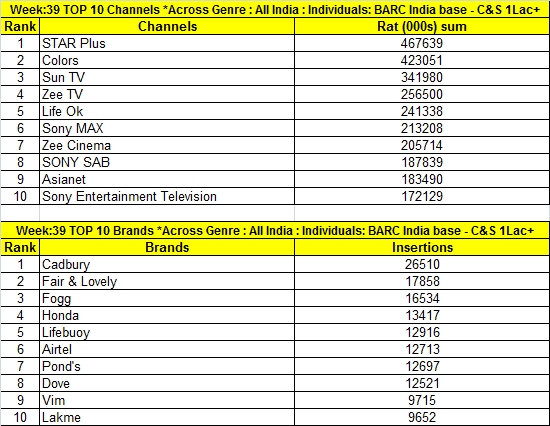
  • BARC Data for Week 39 (Sept 26-Oct 2, 2015)​

    Here’s BARC data for Week 39 (Sept 26-Oct 2, 2015)for general entertainment channels and and more!


  • BankBazaar.com entrusts Enormous with creative mandate

    By A Correspondent


    BankBazaar.com, a leading financial market place, has awarded the creative mandate to Enormous, after a multi-agency pitch in Mumbai. As part of the scope of engagement, Enormous will work towards further strengthening Bankbazaar.com’s brand positioning as an online financial marketplace offering end-to-end financial services catering to the country’s growing tech-savvy customers. The account will be serviced from Enormous’ Mumbai office.


    Established in 2008, BankBazaar.com has been a pioneer and a one-stop provider of hassle-free solutions for all personal finance products including insurance policies, bank loans and credit cards.


    Commenting on the development, Adhil Shetty, CEO of BankBazaar.com, said, “The e-commerce segment of the country has successfully spearheaded interesting communication campaigns to enable it as a high involvement sector. On the other hand, financial services, being an important aspect of our lives, remains a low involvement category due to complexities in information dissemination. We are delighted to have Enormous partner with us to simplify financial services through unique creative communication campaigns and to offer optimized benefits to our audience.”


    Ashish Khazanchi – Managing Partner, Enormous, “We are delighted to be appointed the agency for Bankbazaar.com. It was a hard-won pitch with Enormous being the only mid-sized agency as part of the process. It is a delight to be working with a team that is driven to effect a large behavior shift in the country. I always believe that ambitious clients help develop ambitious campaigns. Glad to be a small part of the process.”


  • Thinking beyond 2020: Viacom18 Group CEO Sudhanshu Vats at CII’s Big Picture Summit


    Sudhanshu Vats

    Text of the welcome address by Sudhanshu Vats, Viacom18 Group CEO and Chairman, CII National Committee on Media & Entertainment


    Honourable Minister of State for Information & Broadcasting, Shri Rajyavardhan Rathoreji, respected panellists on the dais and valued members of the audience. It is my pleasure to welcome you all to this year’s edition of the Big Picture Summit.


    To start with, I have a disclosure to make. Disclosures are important, no? Particularly for media organisations. I have been in an extremely introspective mood and therefore what you’re about to hear might sound like a discourse on philosophy. The good news, however, is that I’m going to be extremely candid. It’s always a challenge to address a gathering of this nature. A gathering where leading minds from the private, public and academic sectors converge to paint the ‘Big Picture’.


    This event is one of the first events that I attended after entering our sector and it’s particularly close to my heart. If I can make an honest confession, I’d say that I spend much more time thinking about my speech for the Big Picture Summit that I do for other conferences. This time however, I took the exercise one step further. I went back and looked at almost all the speeches I’ve delivered since the turn of this millennium, first as an FMCG veteran and then as a media professional. You’ll be surprised to know what I found! One of the very first speeches I can recall was at HUL in 2000, my former organisation. I was addressing a bunch of analysts and spoke with great gusto about the organisation’s vision for 2020. There were a few more that I made around 2003-2005 – including some at my alma mater – IIM Ahmedabad and I referred to 2020 again as a benchmark year. Finally, since 2012, whichever industry event I’ve been a part of- Big Picture, FICCI, CASBAA, IDOS- you know the grind- 2020 has been the year at which most predictions stop.


    This got me thinking. Thinking hard. I wondered: Have my colleagues and I run out of imagination? Have we become too old to see beyond 2020? Has the internet made us all ‘intellectually lazy’?


    Trust me, my mind looked in several directions. Finally, the answer struck me. As ironical as it sounds, the future has become shorter. For the sake of clarity, look at it this way: 20 years ago, it took maybe 15 years for ‘x’ number of disruptions, 10 years ago it only took, maybe 10 years for the same number i.e. ‘x’ number of disruptions. Today, it only takes 5 years for the same number of disruptions. So, in a manner of speaking, our definition of the future has become more ‘condensed’.


    This very reality has enormous implications for all of us. 


    For private sector organizations, we need to improve our time-to –market for new products and services, we need to be able to quickly take aim, fire and reload, before repeating the process.


    For the world of academia, the sheer amount of throughput needs to increase. R&D cycles need to have shorter durations and allow for mid-way course correction. Inter-disciplinary learning is another area of focus. Several worlds are converging and academic disciplines should be no exception.


    For the government, and Rathoreji can shed more light on this, the public want the entire government machinery to be able to deliver on its expectations, sooner than they did before. This also means that policy roadmaps have to get shorter. Given the complexity of the Indian market, if we can’t crunch these roadmaps we need to at least ensure that we stick to them. The duration of political lifecycles generally hover around five years, now you see news channels looking at one year, 100 days and even one-month report cards! Sometimes I feel that the government faces more pressure from the electorate than public companies face from their investors for quarterly targets!


    It’s very important to understand these implications because when the public, private and academic worlds align, magic is created. We talk of USD ABCD billion as a target and so on and so forth. It’s simply a fictional goal post if we can’t get different stakeholders to work together. I understand the theme of this conference is aiming for a 100 billion USD target for our industry, but I’d like to challenge the status quo by asking a fundamental question that I hope you can ponder over these two days: what defines our industry? If our audience is empowered to buy the dupatta worn by Ragini while watching Swaragini on Colors on their mobile phones, how will it impact our target?


    I’d like to leave you with a way of thinking that I believe can be applied to any M&E organisation, irrespective of the sub-sector i.e radio, TV, digital etc.. It’s arguably a much simpler definition of our value chain. There are only three participants in this value chain: creators of content, content platforms and communities. Advertisers don’t need to be called out separately as they too are a community. All of these sit on the foundation of a regulatory framework created by the government. What’s even more interesting is that this value chain is no longer, necessarily linear. All three participants can interact with each other in different ways. An organisation’s understanding of where it fits in this value chain has a lot of bearing on the capabilities it needs to build and invest in.


    Content creators have to look at nurturing a dispersed universe of storytellers that is talented, loyal and always engaged. Platforms have to make investments in technology that allow them to reach out to communities. Communities are almost the reason as to why most of us exist, whether it’s our audiences or our advertisers. We have to figure out way of getting them closer to one another and developing a constant feedback loop mechanism to make our engagement more fruitful. Most importantly, we have to look at a voluntary, self-regulation framework in terms of what should be allowed and what shouldn’t – for advertisements and content.


    Thank you all for making it here today and for your undivided attention. You have invested valuable resources to be present for Big Picture 2015. The team from CII has curated an extremely insightful set of sessions for you. Ladies and gentlemen, I urge you, do take this unique lens as you participate in these sessions. The world of ‘realisable possibilities’ has just exploded. The Future has become shorter and our canvas has gotten bigger. Welcome to Big Picture 2015!


  • Print still rules for advertisers (including internet start-ups)


    By Hari Krishnan


    India counters the rest of the world’s media-evolution-pattern of traditional media de-growth. And this is evident from the mushrooming of daily newspapers in the country, including regional ones. The Hindi and other vernacular print media markets performed exceedingly well on the back of low media penetration, high population growth and rising income and literacy levels. FMCG, retail and real estate want to reach these new audiences. In urban India, e-commerce and internet businesses are driving the growth. No wonder the forecast for ad spends in dailies is a growing 13 per cent (next only to digital), and in magazines it is a positive projection of five per cent growth.


    Let’s look at some of the key reasons that makes press still a dependable vehicle that advertisers are betting on, especially the new-age, internet, smartphone and app- enabled ecosystem players. Of course the generic advantages of newspaper ads being more informative in a credible environment, carrying content with greater shelf life than a TVC and the audience being a bit more involved, still apply, as they did ever since the medium was invented. However the altered market landscape offers a few new answers.


    Over 2000 first-time advertisers in 2015

    The total number of first-time advertisers on mass media, is a staggering 2,250 in 2015 alone, implying the need for creating basic brand awareness for over 2,000 new brands in the market. The press offers the advantage of quick and high reach to create mass awareness levels on Day One, because it’s the best ‘announcement medium’.


    E-commerce action is date-specific

    As the e-commerce war heats up, brands are betting on specific ‘sale days’ to drive a huge surge of traffic and transactions. While TV, too, is used to build up the stress and anticipation, the print media does the job best on specific dates earmarked for the shopping event, additionally offering the benefits of a ‘catalogue effect’ of individual products and pricing. The same applies to major brick-and-mortar retail players too.


    TV time inventory has shrunk

    The year-and-a-half-old cap on TV ads (10+2 rule) has resulted in a shortage of supply of TV advertising time, the added number of new advertisers and growing budgets of existing players have created an excess demand that has been diverted to the next high-reach, high-impact medium: Print. E-commerce player spends have doubled in 2015 (over last year), standing at a staggering Rs 1,600 crore. The online category will overtake cars to become the third-biggest spender in 2015.


    Hari Krishnan is Managing Director, ZenithOptimedia Group, India