Category: MEDIA

  • Rediffusion Y&R bags creative duties of Everest Building Solutions

    By A Correspondent


    Building solutions company Everest, has awarded its creative duties to Rediffusion Y&R. The mandate will be handled out of the agency’s Delhi office.


    Everest Building Solutions is a trusted name in the construction industry today. A strong presence in the country for over 79 years to Everest provides complete building solutions for all. Everest products are retailed in 6000 points across India and exported in high volumes to Asia, Africa, Australia and Europe.


    Speaking about the development, Manish Sanghi, Managing Director, Everest Industries Ltd. said, “In depth domain knowledge and innovative ideas of the team at Rediffusion Y & R made us choose them as our creative agency. The agency’s understanding of our business gave us the confidence on their plans and commitment to take brand Everest to the next level. Together, we hope to make Everest a high value brand in all categories of the building solutions space that we operate in.”


    Dhunji Wadia

    Commenting on the Win, group President, Rediffusion Y&R, Dhunji Wadia, said, “It is always exciting when new clients put their faith in our agency. The team is proud and looking forward to do some exciting work.”


  • CNN-IBN appoints Anuradha Mathu Agrawal as National Revenue Head

    Anuradha Mathu Agrawal

    By A Correspondent


    CNN-IBN has announced the appointment of Anuradha Mathu Agrawal as National Revenue Head. In this role, Anuradha will be responsible for the overall sales and revenue generation of the channel. She will work closely on creating new revenue streams and opportunities to drive growth and further consolidate the channel’s leadership position.


    Anuradha comes with 17 years of experience in sales, strategy and senior leadership and has worked with renowned television channels and publication houses. She started her career with The Times of India and has subsequently worked with India Today, Star India, NDTV and Turner India. Anuradha also has an entrepreneurial stint to her credit wherein she co-founded a real estate brokerage and advisory firm.


    Avinash Kaul

    Speaking on Anuradha’s appointment, Avinash Kaul, CEO – IBN Network, said, “Anuradha comes with rich experience across multiple media brands. We are confident given her background that Anuradha will play a stellar leadership role in breaking new ground as we embark upon the next phase of growth.”


  • News channels come together to form All India News Broadcasters Association

    By A Correspondent


    Several Indian news channels have tied up with the government and various agencies to put together a unified platform for ensuring ethical journalism and to look at a collective solution for ridding the industry of the various problems that continue to plague it. Christened All India News Broadcasters Association, this group comprising heads / owners of small and medium news channels held its election meeting in Hotel Lalit, Delhi under the interim chairmanship of Anil Gaba of Total TV.


    The first committee with a tenure of two years was elected and put in place to take the agenda of the association further. The new committee comprises:


    Chairman – SK Gupta (Uttarakhand and Himachal Pradesh’s Leading channel TV100); Vice Chairman – ID Garg (Khabarein Abhi Tak) and Vikram Nevar (Tazaa TV, Kolkata); Gen. Secretary – Tejinder Pal Singh (Patiala based Channel 2); Secretary -  SMBC Insight’s Dr. Prakash Sharma; Treasurer – ID Garg (Khabarein Abhi Tak); Member-Working Committee          – AK Samaa (Khabar Fast), MS Walia (Azad News).


    Dr. Prakash Sharma

    This is the first such association or representative body of regional news players in the country. Speaking on the Association, Dr. Prakash Sharma, Secretary, said, “The association will work towards creating a level playing field in the country at par with the national news channels. Apart from focusing on the problems of the industry, the association will work towards ensuring clean and ethical journalism, and work towards curbing paid news and ensuring guidelines for self-regulation. The association will also work towards creating a platform for news syndication and exchange amongst member organisations, collective marketing and distribution.”


    All India News Broadcasters association will also act as a unified body working in conjunction with the government and representing the views, issues and concerns of the broadcasting industry, and play an exemplary role in finding workable solutions.


  • Ranjona Banerji: Non-stop Salman, as if everything else came to a standstill

    By Ranjona Banerji


    For the Indian media, the shame of Nepal tweeting: Go Home after our shamelessly insensitive and jingoistic coverage of April’s earthquake was quickly put behind us. Salman Khan’s seemingly shameless behaviour was far more appealing and come on, this is a big Bollywood star how can we not cover him?


    And that is undoubtedly true. Everything about the Salman Khan case was important and we got everything there was: the judgment, the sentence, the star, the fans, the tweets, the victims, the affected people… The question that remained however was: did we have to get quite so much of it? It was as if, on television at least, everything else came to a standstill. The only news was Salman Khan and his sentencing and then bail in a 2002 hit-and-run case.


    However, some good did come of it. We realised (at least those who had been kidding themselves) how stupid Bollywood can sound when it speaks in one voice. We realised (those who pretended they did not know it) how much poor people are hated by the privileged in India. We saw how miserably accident victims and people who do not have access to lawyers are treated by the system.


    We also saw that it is not correct to talk about cases no one wants to talk about. Like that Aston Martin accident on Peddar Road one dark night in Mumbai. Even when it happened, only a handful of newspapers carried it. The car belonged to the Ambani family you see. Nuff said, eh?


    **


    We’re coming up to one year of the Narendra Modi government at the Centre and media organisations are gearing up with their surveys and report cards. Some pro-Modi columnists have hit the ground running and decided that Modi’s first year would have been perfect if it wasn’t for people like Jawaharlal Nehru (died 1964), bureaucrats, Arun Jaitley, farmers and so on. There will be others more critical. The Economic Times I hear from the grapevine has planned some 20-odd pages. Talk about overkill…


    **


    The coverage of results day of the UK general elections was a fascinating lesson in how we in India have developed our own unique Indian way of covering results. Of course, there is no question that an Indian general election is bigger in size and scale even if the number of seats to the Lok Sabha is less than those to the House of Commons.


    But we have also managed to instil a wonderful dose of tamasha and gymnastic to our results coverage. There was something soothing I’ll admit about the BBC or CNN screens, with party seats scrolling at the bottom and informed discussions happening above. But what about our predilection for colourful graphics that burst all over the screen and our prancing anchors and our breathless reporters? Not to mention the countless studio guests all yelling at each other?


    The closest to such drama one supposes comes during the US presidential elections when CNN has Princess Leia and R2D2 holograms all over the place.


    **


    Meanwhile, and this is nothing to do with the media, the media has decided that British politicians give the best resignation speeches. And the media is right.


  • Vishal Bhatnagar joins BBC as Sales Director

    By A Correspondent


    Vishal Bhatnagar

    BBC Advertising, part of BBC Worldwide, announced the appointment of Vishal Bhatnagar as Sales Director for South Asia.


    Vishal will lead the advertising sales teams across BBC Worldwide’s three South Asia sales offices in Mumbai, Delhi and Bangalore, with immediate effect.  He will be based in Delhi and will report to John Williams, Vice President Advertising Sales, ASEAN & India.


    Vishal will be responsible for domestic and international advertising sales for BBC Advertising’s digital and broadcasts assets in South Asia, including the multi-screen product offer around the world-renowned website BBC.com and the global TV channel BBC World News.


    Vishal joins BBC Advertising from Network18 News Media, for whom he has worked for since 2004, most recently as National Revenue Head for CNN-IBN and Head of Focus-IBN 18 News Network. In that role, Vishal led a cross-functional team spanning Sales, Marketing, Content and Digital to create, execute and monetise award-winning initiatives like IBN18-Microsoft Election Analytics Centre and Network 18-Tata Tea “Power of 49”  among others. Prior to that, he was Senior Vice President, CNBC TV18 and CNBC Awaaz, where he launched CNBC Universe as a sales platform. Before working for Network18 News Media, Vishal held roles at Times Television and Bennett, Coleman & Co. Ltd.


    Commenting on his appointment, John Williams said: “Vishal brings with him a proven track record in business development across traditional and new media in the highly dynamic and fast moving Indian national market, and we are delighted to welcome him to BBC Advertising. As we look to drive future growth across South Asia, Vishal’s experience in leading teams, coupled with the premium content opportunities offered by the BBC, will be invaluable.”


  • Times of India bags INMA Global Innovation regional award

    By A Correspondent


    The Times of India group was among the seven companies rewarded for excellence in innovation by the International News Media Association (INMA), with social media curation company Storyful taking home worldwide first place in the Global Innovation Awards.


    The awards were presented on May 11 at the 85th Annual INMA World Congress held in New York City with nearly 300 media executives in attendance. The second annual INMA Global Innovation Award competition rewards media company programmes that encourage ideation and incubation, change the corporate culture, attract young talent, and incentivises innovation mindsets.


    “This year’s winners exemplify the breathtaking pace at which media companies are investing in innovation as a process that leads to more new products, more revenue, more efficiencies, a modern workforce, and better business outcomes,” said Earl J. Wilkinson, executive director and CEO of INMA. “That Storyful took home the global prize as a non-print, non-legacy media company shows that the ‘news media tent’ is expanding.”


    The seven regional winners are:

    Best in Africa: Independent News & Media, South Africa, for “Inspired by Change.”

    Best in Asia/Pacific: Fairfax Media, Australia, for “Brand Discover.”

    Best in Europe: Sanoma, Finland, for “Get Started.”

    Best in Latin America: El Colombiano, Colombia, for “ECOlab.”

    Best in North America: The New York Times, United States, for “Digital Innovation 2.0.”

    Best in South Asia: Times of India for “Rewarding Excellence in Media Company Innovation.”

    Global/At-Large: Storyful, Ireland/international, for “Innovation Is a Culture.”


    From the seven regional winners, the three-judge panel of innovation experts selected Storyful as the worldwide winner.


    Founded in 2010, Storyful is a social media news agency that curates relevant tweets, posts, and video from people in the center of news events worldwide. Storyful also provides social media dashboards, real-time discovery tools, feeds and analytics to customers. The company’s headquarters are in Dublin, with offices in New York and Hong Kong.With innovation already a part of its young culture, Storyful faced the challenge of scaling its efforts when acquired by News Corp. in late 2013. Integrating scale with culture, Storyful created a manifesto:


    Full-stack teams, no silos.

    Clear focus with teams focused on News, Video, and Discovery.

    Fail-fast mentality with two-week sprints and an adherence to the Agile methodology.

    Create time to collaborate: planning, research, UX design, and user engagement.

    Diversification of workforce to provide a more rounded approach to problem-solving and speed innovation.

    Be data-driven across all tools – from user loyalty to feature development, and more.

    Breed culture: maintain it and help new employees to assimilate through team activities and onboarding.


    With those principles, Storyful set out to build three new teams, re-build its core product, overhaul internal tools, and launch a new product into the market.


    Ultimately, judges focused on the processes behind Storyful’s objectives. They described Storyful as a company with a “super interesting innovation culture” integrated throughout the organisation, led by data-driven insights and full-stack teams. They lauded Storyful as a “strong start-up on its own” that has “leveraged new corporate ownership’s resources without bogging down.”


    Regional Winners

    Colombiano, Colombia: With creativity as its strategic weapon, El Colombiano created ECOlab, an internal media lab to launch and maintain business units, research and implement new business models, develop new activities to grow the business, diversify its portfolio, transform creativity into corporate culture, and be systematic agents of change. ECOlab has led to a Web site redesign, a redesign of neighbourhood newspapers, and created new magazines and projects while providing employees borrowed from departments new skill sets.


    Fairfax Media, Australia: Brand Discover is Fairfax’s response to bring incremental revenue and to create new product streams that leverage its content. Since launch, the programme has achieved more than A$2 million in revenue. The Digital Innovation Services team is tasked with developing new advertising products around rich media and content marketing.


    Independent News & Media, South Africa: Embracing change on many fronts, the company shifted from a regional to a national structure, created an editors’ forum, rewarded staff ideas through pitch sessions, digitally trained teams, sought new talent to bring Digital Natives into the storytelling process, making editorial and sales departments compatible, and pushed 360—degree custom content solutions.


    The New York Times, United States: Reaching 910,000 paid digital subscribers was spurred by the development of new editorial and advertiser solutions. A wide array of new products with refined features aims to elevate the reader experience and provide a deeper emotional connection to the Times, which aims to consistently drive its most engaging content to grow audiences and deepen advertiser relationships through exclusive paid posts. Products to emerge include NYT Now, a cooking app, Paid Posts, and Times Premier.


    Sanoma, Finland: SanomaLab is an accelerator designed to develop new internal ventures, create open innovation programmes, accelerate cultural change to reach business goals, and identify “superstar” talent. More than 1,700 employees have been trained to use the lean methodology. The slogan for all its product activities is: “Can we find a repeatable and scalable business model?”


    The Times of India: Its systematic innovation approach has implemented 85+ breakthrough performances in the past three years. The Times’ innovation-focused strategy aims at execution speed, interactive innovations with young readers in mind, culture and revenue as key drivers in the process. It involves teams across all levels, leading to an ongoing process of ideation and incubation. Its reviewing system tests reader ideas before being scaled.


     

  • Samyak Chakrabarty quits DDB Mudra, to start social enterprise. May join Pratap Bose

    By A Correspondent


    Samyak Chakrabarty

    Joining in the flurry of activity at DDB Mudra is Chief Youth Marketer Samyak Chakrabarty who is also reported to have quit the network  along with his team.


    He has been working with DDB Mudra since 2011 when the agency decided to partner and eventually acquired his start-up Electronic Youth Media, billed as India’s first youth marketing & communications agency.


    So what’s next for Samyak: Setting up Social Quotient, a social cause marketing and communications enterprise. Social Quotient has signed a jv with Cineyug to Launch “SamajScope” which will create online content/ conversations for brands around social causes – another first in the industry.


    In addition, he is also looking at taking the youth marketing concept to the next level with former DDB Mudra COO Pratap Bose.


    The recipient of the Young Emvie of the Year 2014 by the Advertising Club, he has figured in Impact magazine’s ‘Top 30 under 30’ list for two years in a row. He has bagged awards for the Tata Nano Student Brand Manger Programme and was associated with Operation Black Dot which enabled 40,000 students to vote for 2014 general elections. He produced the DDB Mudra Group Youth Report and built an “offline social network” of insight seekers and conversations seeders in campuses for clients spreading across 6 metros


  • DMAi brings ECHO to Asia

    By A Correspondent


    DMAi, from 2015, will be the exclusive association to enjoy an expanded affiliation with the DMA International ECHOâ„¢ Competition to funnel entries from across Asia. ECHOâ„¢ Awards honors exceptional creative work that has delivered results. The DMA International ECHO competition began in 1929 as the first direct mail awards show and is currently the oldest direct response awards program in the world.


    Speaking on the occasion, Thomas Benton, CEO, Direct Marketing Association (DMA), US said “Marketers around the world and the ecosystem that supports them benefit when their trade associations collaborate and put a spotlight on innovation and success.  In that spirit, the Direct Marketing Association is very pleased to be partnering with the DMAi to increase participation in the ECHOâ„¢ awards from DMAi’s breadth of creative and innovative members.  We celebrate this partnership and look forward to seeing DMAi and its members at our annual conference in Boston, Massachusetts in October.


    The DMA International ECHO Awards celebrate the best and the brightest data-driven, direct response marketing campaigns from around the world. Those that are honored by receiving an ECHO Award have demonstrated superlative marketing strategy, exceptional insight into audience behavior, a responsible use of data and the ability to conceive and execute inspired creative that delivers an overwhelming return on marketing investment.


    DMA India has brought this credible awards program to India since 2012. The DMA India ECHOâ„¢ Awards in 2014 had over 383 entrants from over 150 brands and 70 top agencies in fray locally. Globally India has had an unrivaled run for last two years beating all international participating countries and having won the highest tally of metals at the International Edition.


    In an added development, both Vatsal Asher, CEO DMAi & Shelly Singh COO, DMAi, have been appointed as an official International ECHO™ Envoy, for all the hard work they have put into the ECHO’s over the past five years. As an Envoy, they will join the DMA International Ambassador Committee, which is responsible for unifying all of the local international DMA’s as well as being a liaison to the DMA in New York. Vatsal and Shelly join a dignified group which includes ECHO™ Board of Governors, Mark Allen (also a member of the DMA Board of Directors), Debbie Roth, Henry Hoke and Tedd Aurelius.


    All entries can now enter simultaneously for both awards, 2015 DMA Asia ECHOâ„¢ Awards and The DMA International ECHOâ„¢ Awards 2015 at a single subsidized entry fee. All qualifying DMA Asia award-winning campaigns will enter into the prestigious International ECHOâ„¢ Awards 2015 bypassing the first round of judging and fast track to the semi-finals of the competition.


    The entries are judged on the basis of the regular 15 Business Categories viz, Automotive, Business & Consumer Services, Communications/Utilities, Consumer Products, Education, Financial Products & Services, IT, Insurance, Not-for-Profit and so on. Starting 2014 the expanded DMA ASIA Awards has introduced a new sub-category “Creative Effectiveness” under a new program called “CREATEFFECT” which covers the Direct Response, Craft and Interactive elements of the campaign too.


    Grand Jury Chairperson for 2015, Rakhshin Patel, Managing Director, Pi Communications said “For an athlete, the Olympics are the ultimate stage. Data driven marketers share the same feeling about the ECHO™ program. There is indeed no bigger stage to showcase ideas and work that have yielded measurable, tangible, real results. There are many reasons why creative and marketing professionals should be excited about this year’s ECHO™ awards. The most compelling of them is: They deserve to! Their hard work and smart thinking has resulted in many memorable experiences for audiences far and wide. It’s now time to send in those entries, and then wait for the applause to echo in their ears.”


  • Bloomberg TV India introduces new programming line-up

    By A Correspondent


    Bloomberg TV has announced a slew of new programming for India. The new and compelling content will keep the viewers updated with the latest market news and stories. The current market-hour shows have also been revamped, to offer the latest business news and analysis of the stock and financial markets.


    The comprehensive market show line-up will be presented by the channel’s best minds in financial markets. The shows will demonstrate best-in-class insights, exhaustive analysis, detailed company reports and in-depth interviews with market movers.


    Alok Nair

    Speaking on the market shows’ revamp, Alok Nair, Executive Vice President and Business Head, Bloomberg TV India, said, “As the country’s leading English business news channel, we have launched new market-centric shows in tandem with our growth strategy. With these programs, we aim to add immense value for the avid market viewer. By reinforcing the markets time-band, the market & business audience will be exposed to cutting-edge proprietary Bloomberg charts and analysis; exclusively on Bloomberg TV India.”


    Market Hours Show Details:


    Weekdays, 8 am – 9 am:

    Street Smart, sets the moment before the market opens. The show highlights the US markets, Asia opening, commodity & money market outlook, stocks in focus, along with experts tracking the market & most importantly, the day ahead with respect to the stock market action.


    Weekdays, 8.30 am – 9.00 am:

    Market Guru a segment with Street Smart captures in–depth perspective of A-list experts on markets, companies, Government policies & the economy that affects the markets.


    Weekdays, 9.00 am – 9.30 am:

    Dealing Room, the show puts focus on the market movement with focus on large cap, mid cap & small cap stocks, rupee outlook analysis with expert & market talk from a known brokerage house or independent market expert focusing on important aspects of markets.


    Weekdays, 9.30 am – 10.30 am:

    In Business, this show will focus on business & market movements related to the business environment of the country and world in general. The viewers will get to know the most influential voices –up, close & personal with corporate India, FII’s who matter, policy makers & influential voices from the globe.


    Weekdays, 10.30 am – 11.00 am:

    Market Movers, the show captures the morning trade actions in stock market with many stocks winging up or down with analysis of stocks news from both fundamental & technical point of view with experts who give the reasons behind the rise or fall along with their opinion.


    Weekday, 11.00 am – 11.30 am:
    The world of Mid Caps, gives a detailed insight on all the mid-cap and small-cap stocks of the day and an advertising and marketing show.


    Weekday, 11.30am – 12.30pm, 2pm -2.30 pm:
    Market Pulse tracks all the market action- as it happens with detailed analysis & opinion. The show takes a look at large cap to mid cap to small cap along with management interaction, expert opinions, views and analysis along with all the action in money market, commodity & F&O space.


    Weekdays, 12.30 pm – 1.00 pm:
    F&O Spotlight, analyses the F&O segment in depth with the channel’s research team as well as expert analysis in getting the trends as well as perspective.


    Weekdays, 1.00 pm – 2.00 pm:
    Lunch Money, is a mid-day wrap that highlights the big stories from the markets. The show highlights the stocks to watch for, action taking place in companies, in-depth interviews and stories that affect the economy, company, Govt. action or international impact affecting our markets.


    Weekdays, 2.30 pm – 4.00 pm:
    Countdown, a comprehensive view covering day’s trade & all the action taking place on Dalal Street. Get to know all the market action in the last hour of trade where new positions are taken or old squared off resulting into lot of action. Getting you view from Europe as well as our market experts who dissect & decode every action in detail.


    Post Market Hour show:

    Weekdays, 4.30 pm – 5.00 pm:
    Market Rewind, encapsulates all the day’s action with market movement, experts take & analysis of the market & things to look out for the day ahead with our in house research team giving comprehensive insight of the day gone by.


  • Now Pakistanis too would turn Bigg Boss voyeurs

    By Nandini Raghavendra


    Pakistani television networks are the biggest buyers of Indian content, spending close to Rs 35-40 crore and contributing around a fourth of the total Rs 170-180 crore syndication revenue. Reality shows such as Bigg Boss and soaps like Jodha Akbar or Saath Nibhaana Sathiyaare popular across the border.


    “The thumb rule is- almost everything that works in India, works in Pakistan,” said Jerjees Seja, CEO, ARY Digital Network, which has been around for 15 years and is the leading channel in that country for the last five years. Seja spends anything from $25,000 to $2 million buying Indian content. The spike comes when he adds big award shows to his shopping bag. While reality shows are aired on the main ARY Digital channel, the rest of the Indian content is aired on the fledgling Zindagi, launched a year back.


    Asif Raza Mir, chief operating officer at Geo TV, said almost all Indian content is aired on the group’s general entertainment channel (GEC) Geo Kahani, with the main Geo Entertainment channel airing mostly Pakistani content.


    “Indian content forms 15-20% of Geo Kahani, while the rest is either local or from Turkey and Egypt. We are also exploring Japanese and Korean content lately,” Mir said. Since Indian soaps are mostly about the saasbahutheme they offer less variety.


    Pakistani content is more realistic, while Indian serials are less so, though well mounted, he said. This is also because Indian producers use studios while their Pakistani counterparts use locations. “Our content is more issue-based rather than politics in the family, so we pick up subjects like CID, Bhoot Aaya, though there are some love stories that stand out as well,” said Mir who, like Seja, sources content from all the four leading Indian GECs- Zee, Colors, Sony and Star Plus. He spends close to $2.5 million on his purchases.


    The advantage of Indian content is that it does not need to be translated, dubbed or subtitled and can be telecast almost simultaneously. There are exceptions like Bigg Boss, which is shown after a week because of logistical issues. Pakistani networks are hobbled by a cap on foreign content. Around three years ago, when Urdu 1 launched and was issued a licence that allowed more than 70% foreign content, it changed the game, according to Pakistan television veterans.


    The only factor they watch out for while picking Indian content is anything that might national and religious sentiment, Seja said. This is the reason he didn’t buy Code Red from Colors, he said. For Indian broadcasters, the syndication pie has been growing.


    From Rs 60-70 crore three years ago, the market is now Rs 170-180 crore and could be worth Rs 500 crore soon. “Pakistani channels already license Rs 30 crore plus of Indian content every year from India,” said Gaurav Gandhi, COO of IndiaCast, a content asset monetisation entity.


    Source:The Economic Times

    Copyright © 2015, Bennett, Coleman & Co. Ltd. All Rights Reserved

    Licensed to republish


  • RBNL consolidates digital biz with ZO’s Performics

    By A Correspondent


    ZenithOptimedia India has been appointed as the digital partner for the entire digital mandate with Reliance Broadcast Network Limited. ZenithOptimedia’s Performics won the business after a competitive pitch amongst key digital agencies.


    Ashwin Padmanabhan

    Confirming the appointment, Ashwin Padmanabhan, Executive Vice President & Business Head, Reliance Broadcast Network said,“As our brands 92.7 BIG FM, BIG Magic and BIG Magic Ganga continue to expand their digital footprints, it was imperative that we work with a partner who understands our brands and is ahead of the curve in the design and execution of digital and social media communication, Performics fits this bill perfectly for us.”


    “We are really excited to partner with a diverse content producer client like Reliance Broadcast Network Limited. We believe that the Performics global playbook on media technology that drives planning across platform and channel were our key differentiators.” said Tanmay Mohanty, MD, Performics.


  • Why Sun shines more in Bengaluru


    By Our Research Editor


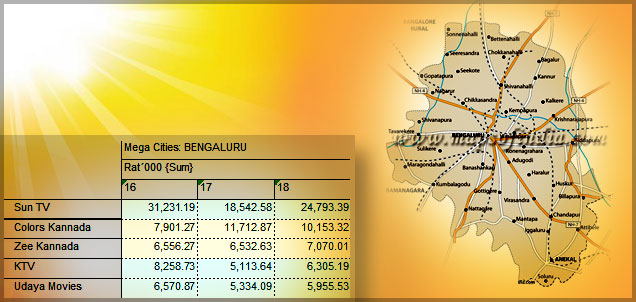
    This is the kind of news which could spark off some wild statements from political formations if it were to happen in a city like Mumbai. But we weren’t really very surprised when we heard that Garden City Bengaluru had such a significant viewing of Sun TV as per BARC data.

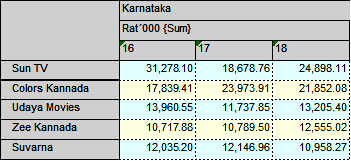
    First, let’s take a look at the pecking order of non-Hindi/English channels in Karnataka.


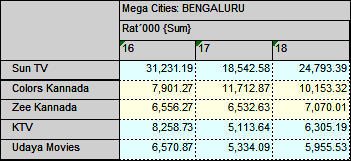
    Let’s re-look at the table above in the main image, sans the shining sun 🙂 :


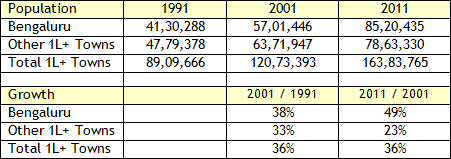
    Surprised? Well, for those who’ve been to cities like Mumbai and Bengaluru would know the large influence of Gujarati and Tamil in these two cities. The decadal growth in Bengaluru has been much faster compared to the Rest of Karnataka (1L+), as per the Census of India 2011. Bengaluru had 52% share of total 1L+ population of Karnataka in Census 2011, up from 47% in 2001.


    The population and growth numbers for the past two decades are as follows:


    As per BARC India estimates of TV owning households as on March 2015, Bengaluru has 58% share of the 1L+ population of Karnataka.

    As compared to an approximate 3% Tamil-speaking population in Karnataka, around 21% of the total population in Bengaluru speak Tamil. This leads to a significant viewing of Sun TV in Bengaluru.

    The viewing details of Sun TV in Bengaluru and the Rest of Karnataka are as follows:

    We posed this question to a Bengaluru-based media analyst and he said that while it’s not true that Kannada channels aren’t doing well in the city, it’s just that as a single channel Sun is ahead. If the content improves, one can be sure Kannada programmes will go ahead of Sun.

    Until then the sun shines for Sun in Bengaluru.