Category: MEDIA

  • MakeMyTrip looks to get close to consumers with ‘Dil toh roaming hai’

    By A Correspondent


    MakeMyTrip unveiled its new brand-advertising campaign that has been conceptualized with the objective to strengthen the brand’s connect amongst travellers and drive its adoption among new consumers. Through this brand repositioning exercise and the new tag-line ‘Dil Toh Roaming Hai’, MakeMyTrip intends to be travel partner that fuels the growing travel ambition of customers at large.


    The campaign reflects the company’s strong connect and deep understanding of Indian consumers along with the width of its travel solutions. The film also integrates MakeMyTrip’s service offerings that enable a seamless and hassle-free travel experience. The voice over for the TVC has been given by the acclaimed Indian film and stage actor and director Naseeruddin Shah. The brand film will be promoted on TV, social media and digital platforms from 27th April.


    Commenting on the new avatar, Saujanya Shrivastava, CMO, MakeMyTrip said “MakeMyTrip has been instrumental in changing the way India travels. With the widespread adoption of Online Travel, it was imperative for us as the category leader to unearth a deep-rooted customer motivation and strengthen our association with customers. Leisure travel today is part of lifestyle discourse and there is a strong customer need to come across as “interesting”. Travel is a via media to increase the “interesting” quotient. Like financial or career ambition, people today have a Travel Ambition. The brand repositioning campaign seeks to partner the emergent customer in their growing travel ambition….”


    The story of the characters, in the ad campaign, has been brought to life by Joy Mohanty, National Creative Director, Publicis Capital. Talking about the creative concept, Joy said, “There was a time when it mattered if you were well-read. Today, it is of great importance to people to be well-travelled, and to have a repository of experiences to draw from. It is this that creates the ambition, or a khwaish, that every person wants to fulfill. Our new commercial is about these little stories behind the journeys, the desire to travel for oneself, or for someone else. It is this ambition that drives a son to take his 65-year old mum to see snowfall for the very first time, or for deadline-chasing dinks to lose themselves in the middle of nothingness. MakeMyTrip is the catalyst that helps fulfill these varied travel ambitions that are fast-growing in every corner of the country. And what better time to do this than the holiday season.”


  • Zoom takes off in Sri Lanka

    By A Correspondent


    Zoom – the popular Hindi Entertainment channel has announced its entry into Sri Lanka. Zoom TV will be available on Dialog Television on channel no. 47 on Gold , Emerald, Diamond and Thee packages.


    Dialog Television’s Head of Business, Chirantha De Zoysa, said “Bollywood has a huge following in Sri Lanka, and Zoom will serve as an ideal outlet for the very latest in music, movies and information on the latest action. This is another example of Dialog Television adding significant value to its viewership across all segments via a pioneering partnership, and we look forward to growing this segment in time to come.”


    Commenting on venturing into a new international market Naveen Chandra Head- International Business – Times Network said, “With this launch Times Network is now present in 78 countries and we are happy to see the initial positive feedback from the market. We have recently launched in Seychelles and Mauritius. Dialog Television is the largest pay direct-to-home satellite service provider in Sri Lanka and with their help; we look forward to growing our audience and market in the time to come.”


    Zoom is already present on 4 continents in major diasporic countries like United States of America, Canada, Malaysia, Mauritius, etc.


  • As industry gets set for a new measurement regime, TAM gears for new innings!


    The new BARC television viewership measurement service is scheduled to kick off tomorrow (Wednesday, April 29). While there have been multiple measurement providers in the past, for over a decade, TAM, a joint venture of the WPP-owned Kantar Media and Nielsen has been in existence.


    There has been some resentment against TAM over the years. Not all the reasons though were well-founded. The sample size was one, but stakeholders were unwilling to pay more for increasing the sample size then. Part of the problem these imported and hence attracted a customs duty. The other peeve was the integrity of data. And another was the frequency in which data was disseminated, a cause of great concern to the news channels.


    However, what can’t be denied is the contribution of TAM and its team to the broadcast ecosystem over the years. L V Krishnan, CEO of TAM for the last 15 years, took time off to chat with Pradyuman Maheshwari about life after BARC data gets released… which is tomorrow.


    So what happens to TAM after BARC starts releasing its data?

    Whether BARC exists or not doesn’t really impact TAM. There are two databases allowing users to look at information and analyis for decision-making. It’s a measure of what one wants depending on business needs. I believe the market is large enough for a BARC and TAM to co-exist as long as we provide service or information that covers the essential needs of a consumer…


    But most of your key, high paying clients like Zee and Star have opted out and you obviously need monies to run a service like TV viewership measurement.

    Clients can move out of the business and come back again later if the service is crafted back to what their requirements are. There’s no permanency in the evolving, constantly changing marketplace. When you become the only provider of data, bringing in change may be a little slower because there’s a large constituency of users you need to take into consideration before you make changes on a continuous basis. Yet, I think the productiveness of time during the digitisation phase as well as during the-ever changing environmental space of homes moving from analogue to digital in a non-DAS market reflects the fact that as the market has changed, the system has evolved by itself. If a customer feels that there’s another system that provides a better value, they’re all free to go and subscribe to that system. That doesn’t mean that TAM has to close its offices and cannot deliver information that it’s designed to deliver. What TAM needs to do is to re-craft its business because as of today there are different scales of thought that come into play.


    One, the mass volume game where I measure every corner of the country and try to deliver that information back to the user’s homes which is what BARC’s mission is…. cover urban, rural, J&K to Kerala, North East to Gujarat. That’s not TAM’s endeavour, we don’t have those kind of funds to do that kind of an enlarged exercise. But, we also realise what’s happening in the environment today. From 2001-11, the number of towns with a one million population has almost doubled from 35 to 55 towns. And if you do the projection for 2015, you’re talking about 62-plus towns in the 1 million market. We believe that you don’t need to reach out to the population, the population is reaching out to markets and areas where there’s growth happening and sustained possibility exists and at the same time where they believe that fundamentally the growth prospects for them and family are much more stronger. Migration is one of the biggest elements here.


    So what you’re saying is that TAM will continue as an urban index?

    We believe that urbanisation is going to continue to progress which is what we see in the overall data. When you look at the census data of 2011, it talks about a 65-35% of urban to rural where rural has come down from 2001 from 72 to 65%. Either the population is migrating to big urban markets or more and more markets are becoming urban in nature. In that kind of a situation, given the diversity of the population existing in the 1 million plus markets, does that create an opportunity for segmenting of audiences & bringing in understanding of the behavior of audiences toward media?


    Will your ownership pattern (of being a Kantar-Nielsen 50:50 jv) change when you adopt this new approach?

    Yes, very much, the ownership continues the way it is actually. The service may undergo a sea change. The urban places will be the focus, not the small towns.


    So, will LC1 will go off your serice?

    Possibly. LC1 may not be in the radar, as also rural. It’ll be a permanent urban market. With the focus on the 1 million plus markets which is where we feel segmentation and targeting are becoming more and more easier


    Will GroupM subscribe to this urban-centric service… given that despite being a sibling (owned by WPP),  it unsubscribed to your service?

    We’ve always looked at GroupM as a customer as much as a Star and Zee. From our perspective if they want to try out a new service, they’re welcome to do so. At the same time, we believe that there are opportunities in the market where we can craft the service to the needs of a new customer and we continuously have a dialogue with the old customers too and as and when they feel the new crafted service is important for the old customers, we’ll make it useful for them too.


    When are you announcing the new service?

    There need not be an announcement. It’s a gradual evolution. It’s not like one day we announce this and next day stop it. The way we graduated from analog to digital… it’s a continuous process of evolution.


    You’re not going to be switching off…

    There’s no switching off.. we’re in the data providing area and there are enough customers in the market.


    We’ve had heard rumors of TAM selling its service to BARC… some talks initiated by Sir Martin Sorrell…

    I’m not aware of it. If that’s so, I’ll go with what the industry wants. If they seek a combination of services provided by TAM with an existing talent pool to assist  BARC, I don’t see any reason why we shouldn’t.


    Would you recommend that as…

    I don’t see a wall between us and BARC. There’s always a bridge that can be constructed between two service providers if it’s in the benefit of the industry. Ultimately the customer needs to decide.


    It’s not just the benefit of the industry, it’s the ego too.

    We don’t have any egos that rule. We think it’s the customer and his needs that rules.


    As you see the industry rallying around BARC and as you look back on your 15 years, do you think you should’ve also got the same amount of industry attention and monies?

    TAM is an industry-supported service.


    But it was a joint industry body that endorsed it, right?

    I mean price or spend supported. When it was created, it was a formulated idea. There was  no seed funding for the formation of TAM. It was primarily from subscription itself. When ownership doesn’t exist and it exists with two multinational research firms, then obviously one expects the fact that they will fund and push the services ahead. The difference between the TAM and the BARC system is that in the latter the industry has put money behind it to fund it, and that’s why they are standing behind it. It ultimately comes down to stakeholders. If they are two giant international research companies, they’d want to put the money behind it, make it run and they’ve done that. From where we were with 750 meter and five cities in 1999-00 to a 12,000 meter running the urban panel, it’s a huge milestone that’s being covered. If the subscription money was higher, we could’ve increased it to even higher levels, but frankly speaking there are no regrets to that now. At the end of the day, the stakeholders of BARC believe that they’ll be able to take it to a much more higher level. No regrets at all.


    Do you think that this wouldn’t have happened had the various stakeholders been more actively involved?

    There are two parts to involvement. One is from a technical perspective and the other is a price or a value perspective. When you involve yourself in a technical perspective, some recommendations help in making the measurement sharper. When it comes to price or value part of it, it becomes an investment yield question, in respect to sample size. In the case of TAM, the joint industry body took a call in late 1999 saying they won’t involve themselves in the price or value part of it at all. They only wanted to be the advisory technical perspective. There’s nothing TAM can do about it. It had to then depend on the two parent companies to see how much funding can be possible to keep expanding on a continuous basis. There has been all kind of involvement from a technical perspective into even as late as in 2012 when digitisation was around the corner when the AAAI, ISA and IBF appointed a three-member technical committee to work with TAM to work from analogue to digital. From a financial perspective, could there have been better involvement from them? I don’t think we could’ve rejected it if they wanted to come into it. At the same time, they took a call they didn’t want it. So, we couldn’t push them…


    Do you think they should’ve taken you as one of the components of BARC’s new measurement system.

    We welcomed BARC right from the time they announced it and we also participated in the RFI and then RFP. We’ve no biases on not wanting to be a part of BARC or any industry movement.


    There was no response to RFI or RFPs and we expected the fact that there’ll be a discussion on some of the proposals we put forward.


    Perhaps there was an issue that the then government had about the ownership of TAM, given that GroupM is owned by one of your co-owners?

    I don’t know where the government got involved because it had no role to play on an industry issue. If that’s so then today the way BARC stands, they shouldn’t have allowed that till the information was an all-India service.


    Do you think the industry should’ve continued with TAM and let the BARC system settle in?

    Well, some of the small and medium level users of data are not taking calls at this time. They believe that both systems have their merits or demerits and they want to look at it from their business perspective at what’s important and what’s not. Many of them are taking a call saying there is a new measurement system coming up which will provide the same measurement that TAM has but will have a larger sample and may have more number of markets to cover up in future.


    What could you’ve recommended?

    3 to 6 months is a good time frame.


    What about the dialogue with AAAI and IBF?

    I was never given an opportunity. I was surprised more with the letters even before I could ask for a meeting with the industry body.


    Moving on to one of the fears we’ve expressed in MxM, we’ve seen a joint industry body like MRUC which is populated by key newspapers and publications having a problem like IRS. Here you have an industry populated body and when the results came out the members were up in arms. Do you think that’s a fear for the numbers that are going to come up in BARC? You yourself in a sense faced it. Very recently after LC1 and digitization there were some very dramatic shifts of data. Given that and given the IRS example, do you think there’s a reason for fear?

    One needs to reflect back on the industry and where it stands. Media is a very peculiar category which isn’t an industry but actually a power centre. It’s close what a government or judiciary is. When you look at it in from that perspective, the key factor governing these sectors is power. If power is the centre, nothing else other than remaining at the top or growing continuously matters. And sometimes you tend to know what the ground reality looks like, but at the same time you don’t have anybody to tell you what that ground reality is. It’s in negativism, demoralizes people, runs into quite a few other conundrums that you don’t want to think about at that point of time. From that perspective, measurement is a harsh reality. Whether it’s for the government and the government doesn’t like it, whether it’s for a judiciary who at least gives it a thought and sees how it can overcome that with some way or the other and for media, definitely it’s not something they’d like to see again and again. The only reason why media needs measurement is fundamentally because 50% of the money in print or 75% of the money in television or 100% of the money in radio all runs through advertising. Or else, I don’t think measurement will exist at all in a public, common platform.


    Given the experience that you’ve had in the recent past, reactions to LC1 etc, is there some kind of piece of advice that you would like to give to the BARC folks, as to how they should possibly tackle the media/

    Frankly the fact that it’s a service that is funded by industry bodies should take care of things….


    But in the case IRS that didn’t happen?

    But I don’t think over there, the funding happen with everybody.  The stakeholders were only the publishers.


    Did it upset you at all that TAM has over the years become the favorite whipping boy of everybody, whether it is members of Parliament, industry folks etc. And the whole degradation of content and television, the sensationalism of news television, everything is blamed on TRPs?  

    No, it doesn’t bother me because it was expected, because you are the only one who are providing that particular data. What bothered me was the politicization of that particular exercise…


    Politicization by the politician or by the people in the industry?

    I could say anyone who is doing it.


    Who was a tougher evil, industry folks or the politician?

    The politicisation couldn’t have happened just because of the fact that the government was interested in the measurement exercise…


    So the industry folks…?

    Now one can’t easily draw a line, because at the end of the day some of the broadcasters, owners are also politicians and some of the politicians have also become broadcasters, specifically, if you look at the regional level. So, it’s a very difficult to say where the politicization happened.


    What are your sentiments like as the transition to the new service happens? TAM and you were after all a hugely influential factor in broadcasting over the last 15 years!

    I need to set the emotional aspect of this business aside and look at it very rationally. I can get carried away with emotions of the past but what needs to be look at is the present and the future.


    Well, the fact is that it’s about emotions. I have seen you over the last few years and your contribution to the ecosystem has been tremendous but and you have been the the lone and the sole voice of the rating business… in fact things couldn’t have progressed so far without you!?

    I’ve been lucky to be in this particular phase, of how the industry has taken shape, and I’m thankful to God for giving me a team that actually saw the same objective as me in driving the industry through a measurement exercise. The team has done a herculean task in the last fifteen years and we have worked very well with the industry for whatever misses that we might have had with them or missiles they might have fired at us, that’s part and parcel of the game. On May 1, I’ll still be in business and there is never an end-of-the-road for anything. There will be a new kind of a craft that we will create…


    Any personal high, you would like to look at? Would like to do go on a holiday now?

    There was a high point whenever we came out from a meeting, having heard the client, and we offering our perspectives with the client accepting and implementing it and seeing results getting delivered. Beyond that, I don’t think there is any other major high point. For us it’s always been the fact that there is a customer at the other end, we’ve got to listen to him/her and resolving issues. That’s what finally mattered and matters.


     

  • Twitter now the medium of choice for world leaders, notes Twiplomacy study

    By A Correspondent


    Over the past four years, Twitter has become the social media channel of choice for world leaders to reach large audiences with key messages and sound-bytes, according to Burson-Marsteller’s Twiplomacy study, an annual global survey of world leaders on Twitter. Twiplomacy aims to identify the extent to which world leaders use Twitter and how they connect on the social network.


    The study notes that Governments are putting more effort into their social media communication and are including more visuals and videos in their tweets. The study analyzed 669 government accounts in 166 countries and revealed that 86 percent of all 193 United Nations (UN) governments have a presence on Twitter. One hundred and seventy-two heads of state and government have personal Twitter accounts and only 27 countries, mainly in Africa and Asia-Pacific, do not have any Twitter presence.


    “The Burson-Marsteller Twiplomacy Study has become an essential gauge of the power and reach of social media,” said Donald A. Baer, Worldwide Chair and CEO, Burson-Marsteller. “This fourth annual Burson-Marsteller Twiplomacy Study provides critically valuable insights about the communications practices and needs of leaders around the world.”


    While @BarackObama is the most followed world leader, he is also dwarfed in terms of retweets per tweet by Pope Francis who averages almost 10,000 retweets for each tweet sent on his Spanish account, against 1,210 for each tweet sent by @BarackObama.


    “This study illustrates that governments are becoming savvier and more professional in the use of social media,” said Jeremy Galbraith, CEO of Burson-Marsteller Europe, Middle East and Africa and Global Chief Strategy Officer. “It is interesting to see how foreign ministries have honed their social strategies and built substantial dedicated teams to manage their online channels. We believe corporations can learn a lot from governments and their leaders on Twitter.”


    More than 4,100 embassies and ambassadors are now active on Twitter. In New York, Washington, London and Brussels, most diplomatic missions use Twitter to have a voice at the digital table. Canada, the EU, France, Israel, Mexico, the Netherlands, Poland, Russia, Spain, Sweden, Turkey, Ukraine, the UK and the U.S. have put most of their embassies and missions on Twitter. The UK Foreign Office in London also encourages personal engagement by its ambassadors, and it is virtually impossible to become a Foreign Office diplomat without using digital tools.


  • Snapdeal appoints Idi Srinivas Murthy as Sr VP-Marketing

    By A Correspondent


    Snapdeal has announced that it has appointed Idi Srinivas Murthy as Senior Vice President – Marketing. Srinivas joins Snapdeal after a string of successes in Marketing at The Coca-Cola Company and GlaxoSmithKline.


    His last role was at GlaxoSmithKline (GSK), where as Regional Director, Marketing – Africa based out of Johannesburg, he spearheaded GSK’s portfolio expansion, innovation, and consumer and medical marketing across 44 countries. Srinivas’ work has also been widely recognized with multiple industry awards. In 2009, he featured in Brand Equity’s Indian Marketers League which covered the country’s brightest marketers. Prior to his appointment at Snapdeal, Srinivas has been a part of sales and marketing success stories of multinational brands like Coca-Cola and GSK.


    At The Coca-Cola Company, he worked across different roles in Marketing and Operations. There, in his last role as Marketing Director India + South West Asia BU, he was responsible for leading Sprite to the number one beverage brand in the country. Srinivas’s expertise lies in leading global initiatives, building iconic brands and executing strategies to tap into emerging market opportunities across countries.


    He is an electrical engineer from Vivekanand Engineering College, Mumbai and an MBA from Indian Institute of Management (IIM) –Calcutta.


    ‘We are very excited to have Srinivas join the Snapdeal family. He comes with rich experience in leadership roles across various markets and I am sure his vast knowledge will add tremendous value and further fuel the Snapdeal growth story”, said Kunal Bahl, co-Founder and CEO, Snapdeal.


  • Gozoop sets up third international office in New York

    By A Correspondent


    Leon and Mike in Gozoop's NY office

    Gozoop, a digital services and products company head quartered in Mumbai has launched its operations in New York. After expanding its presence to the UAE in 2011 & Singapore in 2013, Gozoop opens its third international office in the USA. The New York operations are geared to tap into the growing potential of the digital market as well as cater to the agency’s global roster of clients which includes brands such as Dell, Lipton Ice Tea, Mashreq Bank, Xpress Money, Ferrari, Cold Stone Creamery & Kate Spade NY.


    At the helm of operations in New York are Chief of Operations, Leon Rose and Chief of Strategic Development, Mike Moskovits. Both Rose and Moskovits come from successful entrepreneurial backgrounds with immense experience in the online industry.


    While a string of Indian digital marketing agencies are being acquired by big multinational advertising agencies, Gozoop has stayed independent and focused on enhancing its global footprint. The agency also acquired social media agency Red Digital in 2013 and tech start up iThink Infotech in 2014.


    “The New York expansion is in line with our mission of creating a world class digital presence for worldwide brands. The sheer size of the American market brings immense opportunities for not only our digital services but also our suite of products. In Leon & Mike we have found entrepreneurs who are a perfect fit for Gozoop and its values,” stated Rohan Bhansali, Founding Director, Gozoop.


    On the ambitions of this expansion, Head of US operations Leon Rose says, “Although the digital arena in New York is already crowded and competition is fierce, what Gozoop brings to the table is disruptive products like Zozolo Social ROI and a unique approach to servicing. We are excited to carry over the company’s success overseas to the North American market.”


  • Ranjona Banerji: News TV’s ‘how did you feel when the world ended’ question

    By Ranjona Banerji


    The terrible earthquake that ravaged Nepal on Saturday brought out the worst and the best of Indian news television. On Saturday, since it happened in the morning and most channels get into weekend programming, it took time for the enormity of the event to sink in. We will never, it now seems clear, escape from the tyranny of the breathless ingénue TV reporter who gets into “Wow Awesome” mode. Can there be a sentence more offensive than “The breaking news we are now covering is an earthquake in Nepal”?


    As is the norm these days, the internet and Twitter got the news first, so if there has to be one-upmanship in human tragedy, the credit goes to the Net and not to television. And of the channels on offer in India, CNN won hands down on Saturday. The coverage was sober and informative. And the best of all is their met section which explained as much as was known about the earthquake and the weather in the area as the day unfolded.


    Soon after the earthquake struck, CNN-IBN had the chance to broadcast the met update for Nepal but chose instead to switch to a press conference given by a minister. In India, when a politician speaks, all attention has to go to him or her, regardless. The minister made some anodyne remarks about a fast unfolding situation that added nothing substantial to the news. How I long for the days when the junior most or most incompetent reporters were sent to press conferences…


    While on CNN-IBN, it was painful to watch an anchor pointing to a map of Northern India on Monday evening and saying, “This area has had many many earthquakes” many many times. We got it the first time. We would have been better informed if the many many had been replaced by numbers. We would have been even happier if the Indian plate pushing under the Asian plate had been discussed many many times with many many details.


    However, it was not CNN-IBN alone which faltered. NewsX, Headlines Today and Times Now launched into their usual competition of nationalistic triumphalism. Oh India is the greatest, India set the most aid, India sent the best aid and so on. One should get used to this but it remains disgraceful and distasteful.


    By Monday, most Indian channels had sent reporters to Nepal and coverage had improved. Sadly, though, whether it is CNN or the BBC or any Indian channel, the “how did you feel when the world ended” question just cannot be replaced or rephrased. They have to ask it, no matter how stupid and senseless they sound. One BBC anchor even asked an eyewitness to describe how people around him reacted after the earthquake. You really desperately want them to reply, “Oh, the people looked around at their broken homes and lives and injured and dead family and friends and went off and ate cucumber sandwiches.”


    Surely, surely, there is a better way of doing it?


    **


    Incidentally, dear TV-wallahs, “PM chairs expert panel on aid for Nepal” qualifies as a news headline. It provides information. “PM tweets about Nepal earthquake” is not “breaking news”. It is not anything but your own desire to become a PR person being made public for the world to see.


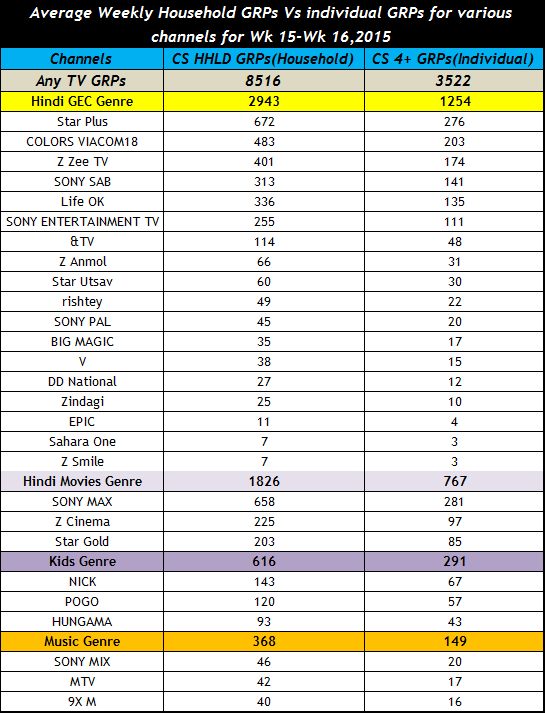
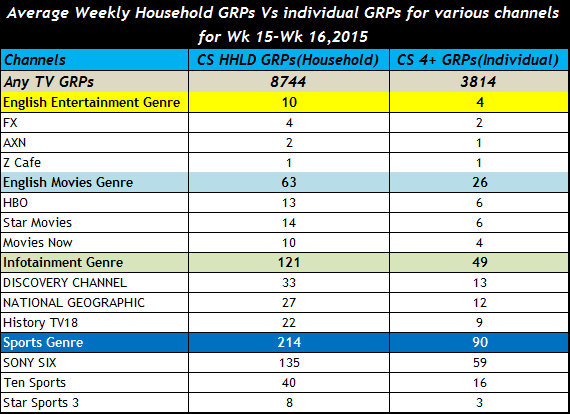
  • TAM data for Household & Individual GRPs for Week 15-16

    Here’s data sourced from TAM giving us Average Weekly Household GRPs Vs individual GRPs for various channels for Wk 15-Wk 16,2015, without LC1.


  • Ketchum Sampark reports robust Q1 new biz growth

    By A Correspondent


    Ketchum Sampark announced a slew of new business wins across key sectors including hospitality, e-commerce, pharmaceuticals, private equity and corporate & finance. Besides several market leading financial & corporate businesses, some of the brands that have chosen Ketchum Sampark include Earnest Towers Pvt. Ltd., Indian Metals & Ferro Alloys Limited (IMFA), Netmeds Marketplace Limited, AM International Holding Pvt. Ltd. (SPIC), InnoVen Capital, a division of Temasek, Synopsys India Pvt Ltd., Stylori.com, and Eagle Boys Pizza.


    Ketchum Sampark will provide strategic advisory, brand building, content development, reputation management and crisis & issues management.


    Hina Jafri

    Commenting on the new business wins, Hina Jafri – Vice President & Brand Custodian, Ketchum Sampark said, “2015 has started on a good note for us and we are excited to partner with some of the best brands in the business. We see that more and more clients in India are looking to partner with consultancy firms that offer a holistic communications approach, moving beyond the execution capabilities. This is a reflection of the growing confidence of large Indian and multi-national corporations in the firm’s ability to conceptualize and execute PR campaigns that deliver a strategic advantage in the marketplace.”


    Knowledge Studio, the specialized thought leadership and content division of Ketchum Sampark (India) also won three new prestigious assignments – CFA Institute and microsite for the AM International Holding Pvt. Ltd. (SPIC) and one of India’s leading Asset Management companies. Knowledge Studio provides cutting edge content & publishing services, online solutions and information consultancy & research to clients across the globe.


  • BARC is ready, but IBF?


    By A Correspondent


    Update @ 1.49pm: The fears have been allayed. BARC’s future-ready TV audience measurement data will be released today

    The coconuts were ready to be broken. A new sun was rising today. Data analysts made it to their offices early. There was indeed much anticipation. We almost didn’t sleep. Okay, that last bit was an exaggeration. We did catch some winks. But you know why all this tamasha:  the first data from Broadcast Audience Research Council (BARC) was scheduled to be released today.


    Till late last evening though, the BARC big bosses were grappling with a new problem, and this didn’t concern set-top boxes, the technology, etc etc. Some members of the Indian Broadcasting Federation, the apex body of broadcasters, wanted the release of data to be delayed. They reportedly wanted some more stability.


    When we teased whether it was BARC’s IRS moment, given all the madness that happened (and is still playing out) with the print readership study IRS, we were told it wasn’t that bad. These were just reservations. Niggling problems. And no it wasn’t raised by a network whose sporting activity is getting many numbers. In fact all the GECwallahs are pretty happy with the way BARC is going about its task. It’s the smaller channels, specifically some news channels who are upset. There is a conference call scheduled at 12.45pm today to deliberate on the issue.


    Meanwhile, TAM, which was until recently subscribed by most broadcasters, still exists, but key stakeholders – television channels, media agencies and advertisers – and have in fact released data comparing household versus individuals. It may be noted that BARC is currently only due to publish household viewership data.


    Partho Dasgupta

    The diversity in cultural and media consumption in the country makes the work of the Broadcast Audience Research Council (BARC) India the most challenging service governed by a single joint industry body for the entire country, said BARC CEO Partho Dasgupta on the eve of the release of data. With the number of TV-viewing households likely to go up from 20,000 to 50,000 in four years, the process will become even more complex, he added.


    Over 300 channels having ordered for the watermarking technology, and with over 272 channels already live, BARC India’s stakeholders – broadcasters, media agencies and advertisers  have, got together some of the top vendors from across the globe offering technology and solutions.  BARC India, has invested 76% of its budget on technology, it is learnt.


    According to Dasgupta, around 3000 professionals have been trained with the BARC India Media Workstation (BMW). NCCS, or the new SEC system, will be the norm to follow for accurate classification and data analytics. The pre-launch and post-launch audit processes were conducted by Ernst and Young’s  Florida team.


    Meanwhile, TAM, a joint venture of Nielsen and WPP-owned Kantar Media, is considering an urban-centric audience measurement service. There have also been rumours that BARC could well either buy over TAM’s TV audience measurement facility or turn its sole subscriber. When asked what TAM and he plan to do after BARC data is released, CEO LV Krishnan, who has helmed TAM since 2000, told MxMIndia in an interview yesterday: “On May 1, I’ll still be in business and there is never an end-of-the-road for anything. There will be a new kind of a craft that we will create…”


    So what happens to BARC now? We’ll know for sure by 1.30pm what course the conversation takes. Hmmmm.


  • Hungama Digital unveils app for celebrity chef Sanjeev Kapoor

    By A Correspondent


    Chef Sanjeev Kapoor announced the launch of an app containing his recipes along with delectable delights. The app named ‘Sanjeev Kapoor’s Recipes’, features cuisines from India and the world. It is a complete cookery manual that goes everywhere and helps one in the kitchen. It includes exciting features like ‘Shopping List’, ‘In Your Fridge’, ‘My Khana’, ‘Recipe Box’ and many more.


    The app offers a wide range of features developed by Hungama Digital Media Entertainment. With the ‘Sanjeev Kapoor’s Recipes’ app, users can access detailed recipes with pictures, special notes by Sanjeev Kapoor himself and some innovative new features. Users can also learn more about Sanjeev Kapoor in the ‘About Chef’ section of the app; they can locate the nearest Sanjeev Kapoor restaurant with the ‘Restaurant Locator’ feature. The ‘How to Use’ and ‘FAQs’ sections contain a plethora of information and tips regarding the exciting features of the app.


    Adding to the list of existing features, Hungama Digital Media Entertainment has included some industry-first special features called ‘In Your Fridge’ and ‘My Khana’. When you have only a few cooking ingredients to choose from, the ‘In Your Fridge’ feature allows users to select a category, add a list of ingredients they possess and look for recipes only as per the ingredients and category selected. The ingredient-based search is an innovation like no other. ‘My Khana’ allows users to submit recipes to the app and follow each other once they sign up. The app carries a gamification feature; users receive points on the recipes submitted. Users can view the top scores on the ‘Leaderboard’.


    Sanjeev Kapoor
    Neeraj Roy

    Commenting on the launch of the app, Sanjeev Kapoor said, “If you ask me what’s happening in my world today, I would say it’s my new mobile app – Sanjeev Kapoor’s Recipes. With this app cooking becomes easy and fun. The app has everything from recipes for every day dining or festive dining or just cooking up a meal with whatever’s available in your fridge! Cherry on the cake, you can win points and thus exciting gifts by logging in. Now you and I come even more closer, with our common love, cooking!”


    Commenting on the features of the app, Neeraj Roy, MD and CEO of Hungama Digital Media Entertainment said, “We are delighted to partner with Indian culinary guru Sanjeev Kapoor to launch the ‘Sanjeev Kapoor’s Recipes’ app, which will assist users access scores of recipes with detailed descriptions and pictures. With the app we hope that we can make routine cooking a more fun and enjoyable experience for our consumers. The app will be available across Android, iOS and Windows platforms.”


  • Bloomberg TV lines up innovative content for 2015

    By A Correspondent


    Bloomberg TV India started the year with comprehensive show line-ups for the Union Budget 2015 which showcased the best-in-class insights, analyses, reports, debates and interviews appealing to a large spectrum of audience. The Pre-Budget programming started early January, by capturing the perspectives of leading Indian corporate leaders from across the sectors, policy experts, farmers, social sector representatives and economists on their expectations from Budget 2015.


    With a two-month run-up to Budget 2015, the channel broadcasted innovative large scale programs like Ideas for Transforming India where the country’s top experts discussed ideas for India’s growth while focusing on issues like Infrastructure, Integrated Energy Policy, Connecting India, Housing, Agriculture, etc. While on Invest in India, a first-of-its-kind initiative where Indian policy makers connected with global investors and decision makers to take note of what do global investors want. The Budget 2015 programming comprised of a comprehensive & exhaustive list of market gurus, corporate leaders and policy makers; influencers who move markets and impact business. The channel also implemented the most innovative and viewer friendly interface for the Budget day.


    Living by the defining principles~ First, Factual, Fastest, Final and Future; some of the high-impact news which was delivered by the channel in the recent past are questioning the Spice Jet deal opacity, India’s deal of 36 Rafale Jets with France, Decoding the Rolta stock crash, Interview of Mr. Manohar Parikkar as Defence minister, where he spoke about blacklisting arms suppliers & Make in India in defence sector, the cabinet’s decision to give a nod to the land ordinance, Finance Minister’s  announcement of  1% additional  levy in GST for 2 years,  amongst others.


    Alok Nair

    Commenting on the exciting line-up for 2015, Alok Nair, Executive Vice President and Business Head, Bloomberg TV India, said, “We have consistently sought to bring content of value to our viewers and this is what has reinforced our position in the business news broadcasting market. Our Union Budget coverage was a reflection of our proficiency and experience. Key influencers not only follow us on social media but value our perspective with the PMO re-tweeting us. Following our signature style, this year we have designed programming with sharper and innovative content. To strengthen our content delivery, we have launched a host of new shows and segments targeted at corporate India and market viewers like Street Smart has new segments – Trading Day and Dealing Room which capture the essential insights and early morning market trends when trading begins; Lunch Money, a mid-day wrap that highlights the big stories from the markets along with Deal Street – a segment thattalks about the world of Venture Capitalists, Private Equity, Funding, Acquisitions and everything in the world of Finance ; Market Movers, gives the sharpest and insightful analysis on the biggest stock the market is talking about; The World of Midcaps, gives a detailed insight on all the mid-cap and small-cap stocks of the day and an advertising and marketing show,From Logo to Impact, the inaugural episode of which featured legends like Shashi Sinha – Chairman, BARC India Technical Committee & CEO, IPG Mediabrands India and Partho Dasgupta – CEO, BARC India talking about BARC and how it is poised to redefine the ratings game.The mood is upbeat and going forward we plan to launch more than 20 new shows this year.”