Category: MEDIA

  • dna unveils brand campaign highlighting new positioning

    By A Correspondent


    In the recent past, dna has come out with breaking news, some of which has been the reason for intense debate in the Parliament of India, leading to proactive steps taken by the Government to address the issues raised by the newspaper. Be it at national or state level to city level, dna strives to publish news which is of high reader value for an emerging, busy India.


    Going with this thought process, dna launched a brand campaign focusing on the major news stories first broken by the newspaper. The new dna strives to be proactive and agile with many firsts being offered to its readers. Some of them being JBM – Just Before Monday, Celebrity Columnists, Special Interest Pages like Zeegnition, dna of Career, dna of Luxury, dna of Wealth, and many more.


    A second in series, dna recently positioned itself as ‘News for the Busy Indian’. dna continues to provide news which is relevant, unbiased and factual to its core reader which can be defined as “increasingly inquisitive” wanting to have a stake and pay a proactive role in the fast emerging socio-politico-economic scenario.


    The key thought behind the campaign is that newspaper should be able to offer perspective to its reader, news which impacts their own day-to-day life. Apart from being breaking news, it should also be waking news so much as to provide a perspective to the news that helps readers to wake up, react, and act.


    The campaign was launched on Thursday, October 21st 2014 and covers Mumbai.


  • Indians can’t live without gadgets: Expedia study


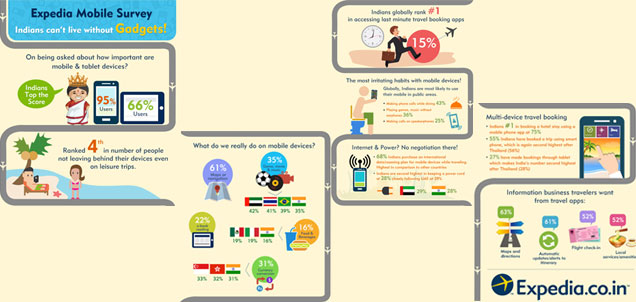
    Leading online travel firm Expedia released the results of its mobile survey. The survey highlights the maturation of the Indian traveller who is fast moving up the ladder of travel apps and is no longer hooked with conventional modes of bookings. This study was conducted on behalf of Expedia by Northstar, a strategic insights consulting firm.  This survey was conducted online from August 25 to September 17, 2014 across North America, Europe, South America and Asia Pacific using the Kantar-owned GMI (Global Market Insite) and Lightspeed Research amalgamated group of panels. The study was conducted among 8,856 employed adults aged 18 years of age and older across 25 countries.


    Commenting on the insights of the survey, Vikram Malhi, MD, Asia, Expedia said “We decided to conduct this survey to understand the booking behaviour of the neo Indian traveller. The findings clearly suggest an increasing dependency on the mobile platform.  95% Indian respondents feel that their smartphone is very or of critical importance to their daily life.  Further Indians lead in app booking and data roaming plans globally. In fact, 75% of Indians who have used their smartphone or tablet to book a hotel have booked a hotel stay using a mobile app (the highest of any country) and 68% of Indians say they purchase an international data or roaming plan for their mobile device(s) while traveling away from their home network. With the rise of the smartphones, desktop is becoming an obsolete instrument, with only 28% using it for travel booking, second lowest globally” he added.


    Here are findings of the survey:

    Indians high on tech gadgets

    :: India has the highest number of Smartwatch owners globally, with 18% of them owning/using the device

    :: India has the second highest number of Google Glass owners (6%) after South Korea (8%)
    :: 85% of Indians currently have and use a laptop (Fourth highest in the world after Denmark (89%), Austria (86%) and Norway (86%)
    :: 86% of Indians have and use a smartphone


    Because we can’t live without gadgets!

    :: On being asked about how important are these devices, Indians scored the highest with 95% saying that their smartphone is very or of critical importance for them, 90% saying it for laptops and 66% seeing tablets as very or critically important


    How about leaving them at home when travelling for pleasure? No way!

    :: India ranked 5th in number of people saying they always bring their smartphone with them on leisure trips, with 88% of Indians who have at least one mobile device saying they always travel with their smartphone on leisure trips, and 38% say they always travel with a tablet.

    :: Indians rank second highest in carrying laptops with them on leisure trips (47%) after UAE (48%)
    :: Indians are the most likely globally to travel with a Smartwatch on leisure trips (9%)


    For work trips, laptop most important!

    :: 74% of Indians carry a laptop on work trips, second highest after Mexico (79%)


    Work life balance? Thumbs up!

    :: Indians use their mobile devices more frequently when travelling than when at home. Only 35% Indians say they use their mobile device most frequently when at home vs. 80% of Canadians


    Office giving tech perks? Big yes!

    :: 55% of employed Indians who have a mobile device have a work paid phone, tablet and / or laptop, the highest globally
    :: 75% of Indians who have a work-paid phone, tablet or laptop, take their device with them on vacation, second highest after Norway (82%)


    What do we really do on mobile devices? Food, travel, entertainment…we want it all!

    :: India has the highest number of travellers saying they frequently use their mobile devices for maps or navigation when travelling (61%)
    :: Indians are in the top 4 in terms of using their mobile device for entertainment (games, music, movies, tv shows) when travelling (35%) – Top three – UAE (42%), Thailand (41%) and Brazil (39%)
    :: Indians rank third highest in terms of using their mobile devices for travel assistance, translation, currency conversion, travel guides,with 31% of Indians using their mobile device for these purposes when travelling (Top two countries are Singapore (33%) and Hong Kong (32%)
    :: 22% of travellers from UAE, Ireland, Mexico and India read e-books/ magazines on their mobile devices when travelling, far higher than travellers from other regions.
    :: Indians are among the most likely in the world to use their mobile devices for dinning related purposes (reservations, reviews, recommendations) when travelling (16%), surpassed only by Mexicans (19%) and Italians (19%)
    :: India has the highest number of travellers using their mobile devices to access last minute travel booking apps (15%) and fitness /weight loss apps as well (11%)


    We care too much for our mobile device

    :: Indians are more anxious than travellers from other countries about losing their mobile device, with 34% ranking it 1st or 2nd in terms of  what would make them most anxious if unexpectedly lost.


    Why so scared? We feel insecure and wrecked!

    :: 43% of Indians say they would feel insecure, isolated or ship-wrecked if their mobile device was lost or stolen while travelling, a feeling surpassed only by travellers in South Korea (47%)
    :: After Brazil (41%), Indians (35%) are most likely to say losing their mobile device while on vacation would make them feel anxious  because all their apps, music and social networks are on their device.


    Texting! E-mailing! Clicking! Gaming – we don’t care about the public!

    Globally, Indians are most likely to use their mobile technology in public areas in the following ways when travelling…

    :: Making phone calls while dining – 43%
    :: Playing games, music without earphones – 36%
    :: Entertaining children with games/apps – 34%
    :: Making calls on speakerphones – 25%


    Internet? No negotiation there!

    :: 68% Indians say they purchase an international data or roaming plan for their mobile device(s) while traveling away from their home network – the highest globally


    Phone is all we need!

    :: Indians are second highest in keeping a power cord with them at all times to be used in case of dead battery. UAE is at top with 29% where as 28% Indians do so


    All-rounder users

    :: 79% of Indians use laptops to make travel bookings, which is second only to Norway (81%)
    :: 55% of Indians use their smartphone to make travel bookings, again second only to Thailand (56%)
    :: 27% have made bookings through a tablet which makes India’s number second highest after Thailand (28%)


    Desktop not for us anymore!

    :: Only 28% use a desktop for making travel booking which is the second lowest after Norway (25%)


    We know how to use it the best!

    When asked what they have done on a Smartphone for business purposes, categories that Indians surpass all other countries include:

    :: Receiving  flight alerts – 47%
    :: Documenting /capturing travel expenses -40%
    :: Booking a hotel – 36%
    :: Shopping for ground transportation- 34%
    :: Booking ground transportation – 31%
    :: Checking into a hotel – 29%


    Leisure travellers are no less!

    In terms of activities done on a Smartphone for leisure travel, India was highest globally for…

    :: Receiving flight alerts – 45%
    :: Booking a hotel – 43%
    :: Checking in for a flight – 37%
    :: Booking ground transportation – 33%


    Leisure travellers pro in booking hotels and ground transportation

    :: When travelling for pleasure, Indians are more likely than travellers from other countries to use their tablets to book hotels (45%), shop  for ground transportation (30%) and document / capture travel expenses (30%)


    Booking with the swipe of their finger

    :: 75% of Indians who have used their smartphone or tablet to book a hotel have booked a hotel stay using a mobile app (the highest of  any country)
    :: Of Indians who have used a mobile app to book a hotel stay, online travel agent such as Expedia, Hotels.com and Booking.com are  the most popular (69%)


    Free Wi-Fi? Definitely counts?

    :: 62% of Indians say, WI-FI availability or pricing (e.g., free Wi-Fi vs. not having to pay for Wi-Fi) impacts their purchase decisions when  searching for and booking flights or hotels.


    All prim & proper!

    :: 86% of Indian travellers always book their hotel before they arrive at their travel destination whereas only 49% plan their activities  ahead.


    What if not well prepared?

    Among Indian travelers who don’t always book their hotel in advance…

    :: 47% book their hotel using a mobile app (highest of any country)
    :: 36% just walk into a hotel to book their room
    :: 30% use the local travel agent/tourism office to book


    Travel accompaniments expected

    :: When booking a hotel for personal travel, 43% of Indian travellers say complimentary Wi-Fi in guest rooms and public areas is very  important
    :: 37% of Indians say access to high-speed Internet (at least 15Mbps) is very important. In fact, along with travellers from Thailand  (38%) and the US (37%), Indians place more importance on high-speed internet than travelers from other countries.
    :: Indian travelers also place more importance than travellers from most other countries on business centers with computers and printers (28% say is very important) and a dedicated mobile app with special digital features or offers (24%) when booking a hotel for personal travel.


    Important considerations when booking a hotel for business travel

    :: Wi-Fi: The APAC region places more importance on Complimentary Wi-Fi in guest rooms and public areas, with travellers from Singapore placing the highest importance on this amenity than travellers from any other country (62% rate it as very important when booking a hotel for business travel)
    :: High speed Internet: Malaysians place the highest importance on high-speed Internet (57% rate it as very important), followed  travellers from the US (5%), Thailand (54%), Brazil (53%) and India (53%)
    :: Wired Internet in room: Malaysians place the highest importance on a wired Internet connection in-room (51% rate it as very important), followed by travellers from  Mexico (50%)  and Singapore (48%)
    :: Business Centre: Thai travelers place the most importance on a cusiness center with computers and printers available for guest (45%rate as very important), followed by travellers from Mexico (44%) and India (42%)
    :: Dedicated Mobile App: 34% of Indian business travellers say a dedicated mobile app with special digital features or offers is very important, the importance Indians place on this amenity is surpassed only by travellers from Thailand (36%) and Singapore (35%)


    Why use mobile during a business trip?

    :: While 38% of Indian business travellers say they are only likely to use a mobile device to book a business trip if they do not have  access to their laptop or desktop, almost three-in-ten (29%) say they would use a mobile device to book a business trip any time


    What’s your device?

    :: If using a mobile device to book business travel, 60% of Indians would prefer to use a smartphone (the highest of any country)


    What’s your personal pick?

    :: If booking a hotel for business using a mobile device, Indians place the most importance on a list of amenities available at the hotel  (49% say this is very important), followed by details about the location of the hotel (48%) and adherence to company’s travel policies (45%) – with Indians placing more importance on the latter than travelers from any other country


    Information travelers want from travel apps:

    When traveling for business, Indians feel it is most essential for a travel app to provide maps and directions (63%), automatic updates to an itinerary (61%), the ability to check into a flight (52%) and the location of local services / amenities (52%).  Indians also place more importance than travelers from other countries on automatic updates to travel manager (39%)

     

  • What Ticks for Indian Consumers/ Men – Satbir Singh and Monica Tata

    Continuing with our extracts from the second edition of the MxMIndia Annual, we present contributions by Satbir Singh and Monica Tata.


    Advertisers need to pay heed to the changing man


    By Satbir Singh


    While women and children are major influencers in the buying decision in many categories, most advertising is still aimed at men. Leave alone traditional men-oriented categories like automobiles, newer ones like skin whitening or lightening facewashes and the much abused deodorants are all over various media.


    The laziest thought that many marketers and their agencies still work on when they’re targeting men is it’ll get you attention from the opposite sex. Cars have used it. Bikes do it. Deos are the most in-yourface with it. Suitings & shirtings have kept it at their core. However, society is changing. There’s a lot more equality between the sexes today (though we still have miles to go).


    Multiple content consumption platforms to drive growth by 2020


    By Monica Tata


    By 2020, I see technology playing a huge role in the way consumers will consume content. Consumers will switch to HD television and technology enabled platforms. And that combined with the growth of ad-free channels, viewing experience for consumers will improve by leaps and bounds. I’m a true believer in specialised content and its growth in India as digitisation has opened up subscription revenues.


    Advertising has always constituted a humungous share in revenue, but we’re slowly and gradually seeing distribution revenue for broadcasters in India increase. By 2020, I see a huge growth in subscription revenue and a lot of this growth will come from ad-free pay channels.


    Men are no longer shy to come across as thoughtful and caring. They are delighted to be in the kitchen. With the kids. Men are socially and environmentally more aware and conscious. The need to do good is at the forefront. Political correctness is yet another facet that can be observed around men nowadays. Taking up causes aggressively is taking up a lot more of men’s time.


    Men are fitter and trimmer than ever before. They have started taking care with their appearance. They are more experimental. They are no longer afraid to wear red trousers. Or yellow ones. If we look around us, we’ll see men are mostly changing for the better. Advertisers need to wake up to this.


    Consumers will be more than willing to pay a premium to view content of their choice. In the case of English movies, the core TG – 16+ male audience – they are a loyal set of viewers who would stick to a channel brand provided there is quality content to be had on a daily basis.


    I also see a lot of content consumption on different devices such as mobile phones and tablets. That, I think is going to be a challenge for broadcasters; to launch content on multiple platforms and therefore reaching out to a much wider audience. Consumers today, irrespective of their location-whether at home, office or on the move-are consuming content from websites and social platforms such as Facebook and YouTube. Net-net, by 2020, I see consumers evolving in terms of consuming content from different platforms enabled by technology, and not just TV. 


    Tomorrow: Wednesday, October 29: Women – Jasmin Sohrabji and K V Sridhar


  • What Ticks for Indian Consumers/ Women – Jasmin Sohrabji and K V Sridhar

    Continuing with our extracts from the second edition of the MxMIndia Annual, we present contributions by Jasmin Sohrabji and K V Sridhar.


    Are marketers targeting today’s woman right?


    By Jasmin Sohrabji


    Yes they are! Women as a marketer’s target group appear deceptively easy to reach. A lot of TV GRPs, and a bit of multi-media was considered a fairly acceptable template for a long time. Today, a lot more insight and instinct goes into understanding how best to target her; and the answer is not to take away from TV but to make the medium work harder, better and more engagingly for our most targeted, sort after consumer.


    Previously a lot of our TV discussions stayed around how much prime, non-prime for more effective use of communication funds. Today, it’s more about content and integration rather than time slots. It’s more about in the show than on the show. One of the key changes we have seen over the years is how we define our women consumers. Earlier, the definitions were very broad based (women, 20-44 years ABC) and that in itself was deceptively comforting.


    Telling a new story about the Indian woman


    By KV Sridhar


    A few days ago, twitter was abuzz with people exchanging, not NaMo quips, but an ad film. An ad-film that became the trending topic because it not just warmed the hearts of the people who watched it, but also created excitement born of possibilities and hope. The film produced by leading jewelry brand – Tanishq, broke two stereotypes that advertising often paints Indian women with – that of the fair bride and the first marriage. The wedding jewelry film instead told a riveting story of a dusky young mother and her little daughter as they cross the delicate threshold of a new life through the young mother’s marriage.


    You thought you had covered all bases, and reached all your potential women consumers, but in fact you had possibly done very little justice to any specific consumer within this broad statistic. We were unable to call out any relevant, sensitive changes in media trends because of a much clubbed audience. Today, the definitions we operate on are more focused, narrowing both the age and SEC bands and allowing for subtle shifts in media consumption trends to be captured and built into the media plan.


    But the biggest change of all is today we no longer put the cart before the horse. We are no longer given a fixed set of creative assets to plan around. So while TV continues to be the mainstay media of choice for this consumer, the starting point is no longer a TV+ recommendation, but a communication plan that’s built from base zero and then embraces mediums in size and number relevant to the task and the target. The annual plan discussions are more about what all rather than what else!.


    At a time when the idea of the ‘Indian woman’ is changing at a fast pace and new imaginations are being embraced in its very definition, it is important to understand the new sensibilities of the ‘Indian woman’ and imperative that these sensibilities be reflected in the work we put out. We have started seeing insightful work that portrays women in fresh, positive ways gain the confidence of consumers, especially female consumers. The Girl Child film for ‘Kaun Banega Crorepati’ was one of the few messages that touched upon the dignity required to treat our girl children with.


    Even when not addressing social issues and stereotypes directly, advertising needs to reflect the values of the modern Indian women. Brands like Whisper and Hero Pleasure have taken new and interesting dimensions to values of freedom and independence for young girls, underlining their determination to achieve things on their own terms. These brands have found creative ways of celebrating womanhood.


    Even categories such as banking and financial services which are often alien by virtue of their information-laden messages have managed to strike a chord with women consumers through their portrayals of sensitive spouses and fathers, setting an example of respect and empathy even in simple, everyday, domestic situations. Brands like Idea have found interesting ways of showcasing equality in the daily grind that the husband and wife realize by exchanging their phones. Brands like Bournvita have ushered in new portrayals of parenting and motherhood as well.


    However, in this process of change, some things still call to be approached with caution. Indian women might have private admissions about a lot of things but can be uncomfortable when a public form is given to it. The furor over certain female-hygiene products is a case in point. Another thing to note is that while harmless ‘masti’ is always welcome, brands stand the risk of looking down on women when the message is exaggerated.


    A lot of deodorant ads fall prey to this. Nonetheless, the more we push our imagination, the more we will find real, relatable stories to tell; stories that capture the true spirit of Indian women and communicate it with creative expressions that are mindful of respect and dignity.


    Tomorrow: Thursday, October 30: Teens – Kartik Sharma and Venke Sharma

  • What Ticks for Indian Consumers/ Teens – Kartik Sharma and Venke Sharma

    Continuing with our extracts from the second edition of the MxMIndia Annual, we present contributions by Kartik Sharma and Venke Sharma.


    Living life online


    By Kartik Sharma


    “If you’re not online, you are completely out of the loop – you don’t have a life, you don’t really exist,” this is what my 15-yearold niece told me when I enquired about her being online all the time! For teens, it seems as if online is the new real world. Teens spend an average of 85 hours per week online and more than one-third of that time is devoted to social networking*. The time spent in a week by teens on social media is almost 10 times more than that on TV**!


    Marketers are programmed to be present where their target group spends most of their time and social networking sites represent a huge component in the battle to win teenage eyeballs. The speed of information exchange, the feeling of community and the viral aspect of widgets, quizzes, contests and videos perfectly position these media to be seen by teens and share within their social spheres.


    Smartphones to woo marketers in the next five years


    By Venke Sharma


    80 per cent of social media in India is consumed from mobile phones. Secondly, there is a very high use of What’sapp and other messengers. I believe a large part of content consumption will shift to mobile especially when there is faster speeds and much better mobile internet experiences. Feature phones still form a large segment in India and it is the feature phones where the discovery of Internet happens.


    Many people in India are starting to discover internet through a feature phone and entry point of internet will be via platforms such as Facebook and Youtube. Another segment is smart-phone users and the mid segment which is in transition from feature phones to smart phones, and light internet user to a heavy internet user – where users will use their mobile phones to tweet and explore other social media platforms.


    Facebook, is only second to Google by total visitors and reach, making it the second most visited website in India. However, the average time spent per visit on Facebook (17 min) is more than 5 times than that on Google (3.8 min)*! Marketers have welcomed social media for its ability to see dynamic, real-time results captured via metrics like ‘likes’ and ‘fan count’.


    However, in the past two years, social media has moved beyond these metrics. This has also been validated by Maxus’ proprietary study, which was conducted to understand the value of a fan on Facebook. In this study, we had studied 13 brands catering to youth in the 18-35 years bracket and found that WOM plays a very important role for brands to build a strong relationship with the fans. We have also found that fans of a page, make for more loyal consumers than non-fans and they keep coming back to know more about the brand’s product offerings and other schemes.


    Hence, it is evident that social media continues to be an important and effective medium in building the brand-fan relationship story.


    William Wordsworth, in the early 19th century predicted that “The Child is the Father of Man”. This adage holds true today in the 21st century especially against the backdrop of social media.


    * Source: Comscore, Sept’13 TG: MF 15-34

    |** Source: IRS Q4’12 TG: MF 15-34. Maxus Proprietary Research.


    Consumption of video is likely to increase and it comes with huge opportunities for broadcasters and stakeholders of the entertainment business. I also see time spent on TV going down as consumption of video content on mobile rises. That however, is not a threat to TV as a medium, but certainly the TV viewing time will go down. From a channel point of view providing content on multiple screens is going to very important as many people will use mobile devices to participate in social conversations, surf internet, download data, live streaming etc.


    Over the next five to six years, I see consumers from tier 2 and tier 3 cities switching from feature phones to smart-phones – and from light internet mobile users to heavy internet mobile users. That is going to be a paradigm shift and a huge opportunity for marketers.


    Tomorrow: Friday, October 31: Men – Ajay Trigunayat and Sanjay Tripathy

  • BCG report maps journey of innovative companies in India

    By A Correspondent


    In the 2014 list of most innovative companies released by the Boston Consulting Group, technology and telecommunications companies once again lead the pack, holding down all of the top 5 spots in 2014, 7 of the top 10, and 21 of the top 50-the most since 2010. The consumer products industry holds 14 of the top 50 spots, also the most since 2010.


    BCG has surveyed more than 1,500 senior executives in a wide range of countries and industries since 2004 to help cast light on the state of innovation in global business. In its new report, ‘The Most Innovative Companies 2014: Breaking Through Is Hard to Do’, the firm reveals the 50 companies that international executives ranked as the most innovative. Many of these companies have demonstrated impressive staying power over the years: Apple has been number one every year since 2005; Samsung and Google switched places again at numbers two and three; Microsoft and IBM round out the top five and TCS amongst the Indian companies has entered the list.


    The biggest change in the 2014 top 50 list is the decline in the number of auto companies. Only 9 auto companies are in the top 50 in 2014, and only 4 ranked in the top 20. This compares with 3 automakers in the top 10 places in 2013, as well as 9 in the top 20, and 14 in the top 50 spots. Automakers also reported both a 26 percent decline in innovation priority, with 62 percent assigning it a top-three position, down from 84 percent last year.


    In 2014, BCG again asked respondents to name up-and-coming companies-companies that are still relatively young or have yet to reach the scale of the top 50 global giants but are making themselves known for innovation. WhatsApp, Square, Rakuten and Wipro lead this list. There was 50 percent turnover on the up-and-coming list, with only four companies returning from 2013. Last year’s up-and-comers all leveraged mobile platforms in one way or another; this year’s list comprises more varied innovators: consumer products, auto, media, and big-data companies.


    The 2014 report examines the factors that separate breakthrough innovators from other companies. It found that breakthrough innovators are strong innovators first-they excel at the fundamentals that define successful innovation programs. But they stand out from strong innovators in three ways: they cast a wider net for ideas, they use business model innovation more, and they have cultures geared toward breakthrough success. Almost half of breakthrough innovators reported generating more than 30 percent of sales from innovations over the past three years, more than twice the average for all companies.


    Neeraj Aggarwal

    “Innovation isn’t getting any easier. Too many companies want to shoot for the moon while their innovation programs are barely airborne,” said Neeraj Aggarwal, a BCG Senior Partner & Director. “It is no longer enough to be good at incremental innovation. Breakthrough innovators are especially effective at bringing together the pieces required for radical innovation such as management, governance, and organizational design that can have a major impact on any company’s innovation program. Breakthrough innovators corral them all.”


    The 2014 survey found that only 13 percent of respondents have a significant ambition to deliver radical innovation. More than 40 percent of these would-be disruptors indicated that their companies’ innovation capabilities are average at best. Executives from companies with strong innovation capabilities-and disruptive ambitions-represent just 7.6 percent of the sample.


    While technology companies lead the list of those seen as most innovative, respondents in multiple sectors said that there will be limited impact from digital technologies in their own industries in the next three to five years. Less than half of the respondents in the telecommunications, financial services, pharmaceuticals, consumer products, retail, energy, and manufacturing sectors, among others, said that big data and mobile will have a big impact. Less than a third in each sector said that their companies are targeting big data and mobile in the innovation programs.


  • Help the under-resourced with your time. Inviting volunteers for Green Batti Project

    By A Correspondent


    The Green Batti Projecthas already enabled some 500 young professionals to mentor children that are a part of the Teach for India community in Mumbai. Children from under-resourced communities often lack inspiring adult relationships and the Green Batti programme is designed to fill that void


    The pairs are chosen based on similar locations, gender and interests. With a fixed curriculum developed in collaboration with Tata Institute for Social Sciences and inspired by Big Brother Big Sister USA, the mentoring programme focuses on life skills and social skills that will take place over the course of Four months starting December 2014, where the pair meets once a week for two hours at a mutually convenient time. The venue for such meetings will be pre-authorized public places such as coffee shops, parks and culture spaces.


    MxMIndia is actively supporting the Green Batti Project and we invite young advertising and media professionals to apply to mentor. Details: http://www.thegreenbattiproject.in/


  • Baddies turn scared in Taproot’s new film for Mumbai Mirror

    By A Correspondent


    After having made waves and won some critical acclaim (and many awards), Mumbai Mirror has unveiled an all-new television commercial. (Link: http://youtu.be/2iTWJiEeCuI)


    So what’s the insight behind this campaign, we asked Rahul Kansal, Executive President, Bennett, Coleman and Company Limited. “Criminals and corrupt people have got away with impunity in India for way too long,” he said, adding: “The average citizen is impatient to bring an end to this impunity. We decided to show these bad elements in  society being finally brought to book, thanks to the fearless exposes done by Mumbai Mirror.”


    Fundamentally, this film is actually saying the same thing as the first film, said Mr Kansal. “However, its totally inverted the prism through which the story is being told. The last time around, we showed it from the point of view of the citizen, who had been hurt by the system and was fighting back. Now we are showing it from the point of the ‘baddies’, who are running scared.”


    Taproot was the creative agency for the film and the brief from BCCL to the agency was clear: “To continue to portray Mumbai Mirror as a fearless voice of the common citizen of Mumbai.”


    Client: BCCL:  Rahul Kansal, Sandeep Singh Arora, Amiteshwar Kukreja, Pooja Bala and Sana Arora

    Agency: Taproot: Umesh Shrikhande, Santosh Padhi/Agnello Dias – Chief Creative Officers

    Production House: Ramesh Deo Production (RDP)

    Writer: Agnello Dias

    Director: Abhinay Deo

    Music: Ram Sampath

    Producer: Apurba Sengupta

    Cinematographer: Kartik Vijay


  • The Hindu’s November Fest scheduled next month

    By A Correspondent


    The Hindu Friday Review November Fest is scheduled to start from the first weekend of November in Kochi and Coimbatore, and will be followed by Chennai, Bangalore and Hyderabad. The November Fest was launched in Chennai in 2005 as a curtain-raiser to Margazhi, the famed December music season, and is noted for its eclectic mix of genres and for premiering performances by well-known musicians from across the world.


    This year, the fest features musical heavyweights such as Shenkar (formerly L Shankar), Indian Ocean, Bickram Ghosh, Clinton Cerejo, Thaikkudam Bridge, Shillong Chamber Choir and Vidya Shah. For those who enjoy instrumental music, performances by Korean percussionist NoreumMachi and Indian National Orchestra are a must-see. The fest also features a concert that brings together Pandit Sanjeev Abhyankar and Dr AshwiniBhide, and a performance by Simon Thacker’s Svara-Kanti in the Indo-Western genre.  This year too, Bose is the presenting sponsor of the Friday Review November Fest.


  • Logicserve Digital unveils digital inventory service LTD

    By A Correspondent


    Accredited digital marketing agency Logicserve Digitalhas launched Logicserve Trading Desk (LTD). The service aims at disentangling the tedious job of digital media buying and planning, with expertise in choosing the right inventory.


    Armed with a comprehensive understanding of the latest technology, global expertise, performance-driven insights into the digital market and healthy relationships with the publisher network; LTD is an essential service for anyone looking at digital media buying around the world. It aids in identifying and allocating the inventory at competitive rates. LTD is a combination of tapping market’s nerve, categorizing media buckets and analysing the performance in real-time.


    The advantage that LTD provides ranges from access to the best DSP/RTB platforms, assistance in digital inventory buying, comprehensive multi-media approach, retargeting, optimisation, creative assistance etc. With a 360 degree service, inclusive of impressions across display, mobile, video etc, LTD becomes a single platform for multiple media buying.


    “With each media buying platform reciprocating in a unique manner- identifying, tracking and optimising can be a cumbersome task. Hence, we have introduced Logicserve Trading Desk where the client’s life is simplified and spends optimised,” Prasad Shejale, Co-Founder & CEO (India), Logicserve Group.


  • Shailesh Kapoor: The Art Of Mass Entertainment: Oh My Dog!

    By Shailesh Kapoor


    Performance of Bollywood films on television is a fascinating topic. It’s well-known that no direct correlation exists between box-office and television performance. Yet, a lot of movie-buying happens based on box-office collections. If one dig deeper, there are box-office measures that can be used to predict the ratings of a film’s premiere telecast. The single screen to multiplex box-office collections ratio is one such measure. Films that tend to get a higher percentage of their collections from single screens tend to work better on television, despite their overall collections being much lower than certain other multiplex-centric film.


    It is not very difficult to see why this should happen. Television audiences, especially the film-viewing ones, are skewed towards lower SECs and the smaller towns. They represent a mindset that’s closely mirrored by the single screen theatre audience. Their entertainment choices are more escapist in nature, with comedy and action being the driving genre, though a dose of traditional family values is always desirable.


    Last week, Akshay Kumar’s recent release Entertainment premiered on Zee Cinema and scored a whopping 5.5 TVR. To put it in perspective, this number is higher than the ratings of Kick and Singham Returns, the two biggest box-office grossers of this year, both in the mass action genre. It is 60% higher than the ratings of Dhoom 3, the biggest Bollywood grosser at the box-office till date. Ratings of hits like Queen and 2 States dwarf in front of Entertainment’s 5.5.


    Entertainment performed miserably at the box-office. It opened below par for an Akshay Kumar film and had no takers at the end of its first week, going on to be a certified flop. If you have seen the film, you would understand why. It’s a long 140-min slapstick comedy about the relationship between a man and a dog (playing the titular role). It could have been fun, but the jokes are all heard-before, and the film takes itself too seriously and tries to tell a story around an incredulous, spoofy premise.


    In one of the many nonsensical scenes, when the dog’s pulse drops to zero on the operation theatre table, Akshay Kumar magically revives him by a giving him a hard thump on the chest. It’s almost as if someone else made a good film about a man-dog relationship and this film decided to spoof it out.


    Yet, on television, all this and more is, indeed, Entertainment. Akshay Kumar is a very popular star with the masses, but his better work in recent times (e.g. Special 26) does not rate too well. But a film like Entertainment doesn’t even need a star. It has this element of sheer idiocy that is not worth the price of a movie ticket, but a good freebie for a mind that perpetually feels the need to de-stress.


    There has been a lot of talk in recent years, about how some films are designed for you to ‘leave your brains at home’ when you come to watch them in the theatre. I wonder where you are supposed to leave your brains when you are watching such films at home itself!


    In a parallel universe, in the same industry, the infotainment genre, which was largely driven by one type of programming for a long time (survival genre shows led by Man Vs. Wild) is now espousing more intelligent (though entertaining in no less measure) content. National Geographic has been actively pursuing its ‘Entertain Your Brain’ proposition with good success, with shows like Brain Games and Science Of Stupid.


    But even as television gets smarter on that side, mass numbers continue to baffle you at times. The irony is not lost on me. Neither is the dichotomy of it all.


  • In India, Amazon persists with Junglee in cart


    By Shelley Singh


    It’s been 16 months since Amazon, the $75 billion American e-tailer, launched a full-f ledged online marketplace in India. It’s been three months since its founder Jeff Bezos committed $2 billion of investments to its Indian operations. Even as those operations add new products, suppliers, warehouses and employees, Bezos is not letting go of the earlier life that marked Amazon’s entry into India.


    Amazon made a soft launch in India in February. It dusted out a property it had bought in the US way back in 1998, Junglee, and launched it in India as a price-comparison website: users could compare the price of, say, a washing machine across not just online stores but also offline ones. As it waited on regulations, as it prepared the ground for a hard launch, Amazon used Junglee to test the waters, and observe online habits of Indians. Amazon is now immersed in those waters, but it’s not giving up Junglee.


    In fact, it’s taking its sister site — the two share infrastructure – to the next level, tailoring it to flank its main marketplace (amazon.in). Amazon has not adopted this double-play strategy in any of its other 12 markets. It’s a strategy none of its rivals in India have adopted. “Comparison shopping sites have not worked globally,” says Niren Shah, managing director, of Norwest Venture Partners, a venture-capital fund. “But Amazon faces tough competition from local players and is now using Junglee as a flanking strategy – a test platform to try out categories and products before offering them on amazon.in.”


    Some of the progress made by Junglee in the past few months offers a glimpse into Amazon’s larger gameplan for it. From just Yellow Pages kind of listing and price comparison, Junglee now also enables transactions, including from websites that compete with amazon.in. From leaving the buyer and seller to connect with each other, beginning October 8, Junglee began offering them Amazon’s payment gateway to make things easier. And a big – and visible – lister of products on Junglee is its big brother, amazon.in.


    The Bigger Picture

    Junglee has 102,300 sellers – about eight times the number on amazon. in. Of these, only about 2,300 have an online presence and most compete with amazon.in: for example, Jabong, Myntra, Limeroad, Quikr and Lenskart (Flipkart and Snapdeal are absent). Amazon accommodates its online rivals on Junglee because it adds to its value proposition, it gives it a vantage point to observe and make some money out of them (5-15% of the sale price). For online retailers, Junglee is another window for potential buyers. In fact, a seller of baby products who did not want to be named says Junglee’s comparison-shopping feature makes “being on it a necessity” even though under 5% of his sales came from here.


    Of the 250,000 visitors who come to the website of online furniture retailer Fabfurnish daily, about 5,000 come via Junglee. “Our referrals have tripled in the last one year. But in absolute terms, it’s very small,” says Vikram Chopra, co-founder & CEO. “We believe Junglee will become relevant as more furniture players enter the market.”


    For Amit Agarwal, country manager of Amazon and who also oversees Junglee, the offline piece is what gives Junglee its main relevance. He trots off statistics: more than 90% of retail in India is unorganised; e-commerce accounts for less than 1% and organised retail is just 8% of the $500 billion Indian retail sector. “Via junglee. com, we are trying to organise retail in India, and bring offline stores to list online,” he says. “(The idea is) to eventually help consumers buy anything, anytime, anywhere and for sellers to expand their market reach.” The big marketplaces like amazon. in, Flipkart and Snapdeal allow only those sellers who are capable of doing business online. Junglee is different in that it also allows sellers who operate only in the offline mode.


    Typically, they are very small and uninitiated in the business ways of the Internet. Being on platforms like Junglee gives them additional reach and a feel of the online space. Say, a buyer in Koramangala in Bangalore, after some comparison-shopping on Junglee, decides to buy a Micromax A116 phone. Junglee presents him a list of sellers — online, offline and individuals – stocking this model, their prices and location. “He will be directed to online stores and physical stores in his locality (Koramangala)”, says Mahendra Nerurkar, who heads Junglee in India and reports to Agarwal. “He will have the option to connect directly with the physical store via contact details on the site.” Both Mr Agarwal and Mr Nerurkar hope, in time, such offline buyers will come online.


    The Amazon Picture

    Even as that happens, there’s plenty for Amazon India to leverage from Junglee. “Junglee is an ideal place for a first-time online shopper and a first-time online seller to experience e-commerce,” says Ankur Bisen, senior vice-president, retail & consumer products, Technopak, a consultancy. Adds Sanchit Vir Gogia, chief analyst and CEO, Greyhound Research: “It’s a de-risk strategy for Amazon to try out new portfolios and products before offering them on Amazon.” Mr Nerurkar says, unlike Amazon.in, Junglee shares user data and analytics with other sellers as well, via weekly reports.


    “This creates an open and neutral marketplace,” he adds. Last month, Junglee launched an Android app to enable mobile transactions; it claims 650,000 downloads so far. Mr Nerurkar declined to share details on business generated from the site. But what is clear is that with transactions, Junglee comes closer to amazon. in. The central difference is that in how they facilitate a transaction, amazon.in is a far more active intermediary than Junglee.Yet, Amazon does not want to mix up the two. “There are sellers with no online presence,” says Mr Nerurkar. “They can’t be on Amazon.in and Junglee is a platform for them. If you start clubbing the two, it will pollute the experience on the other.”


    In an online market that is expanding at rapid speed, Amazon is keeping Junglee. “Junglee was a great entry strategy for Amazon,” says Mr Shah of Norwest. “Now, e-commerce is growing in India. I don’t see them shutting it down – at least for another couple of years. After that if they don’t get traction, they could take a re-look.”


    Source:The Economic Times

    Copyright © 2014, Bennett, Coleman & Co. Ltd. All Rights Reserved

    Licensed to republish