Category: MEDIA

  • Piyush Pandey, Sunil Alagh & Sam Balsara to contribute in government’s save-power drive

    By Mitul Thakkar & Pritha Mitra Dasgupta


    The power ministry is tapping the imagination of advertising gurus to hammer home the message that India can save 25,000MW of energy every year by being prudent.


    The Piyush Goyal-led ministry has roped in Ogilvy & Mather India executive chairman Piyush Pandey, Madison World chairman and MD Sam Balsara and Sunil Alagh, a marketing consultant, for a compelling campaign around saving and efficient use of electricity. “We are all helping the committee as individuals. We are now waiting for the brief,” Pandey said. “The idea is to bring awareness on saving power and ways of using power in the correct way.”


    Despite having an installed power generation capacity of over 250,000 MW, about 5% of India’s close to 600,000 villages remain deprived of electricity, while power supply in most rural areas is erratic, mainly due to high consumption in urban areas.


    Some experts say the government’s efforts to cut electricity wastage need to be supplement strategies to reach out to the industrial and agriculture sectors where energy conservation potential is estimated at over 23%.


    As per the ministry’s estimates, close to 25,000 MW of energy can be saved annually.


    The ministry, sources say, may rope in prominent faces as brand ambassadors to energise its “saving electricity” campaigns which, thus far, are perceived to have not achieved much. An efficient power sector tops the priority list of Narendra Modi, who as chief minister had turned around Gujarat’s utilities and showcased them as a development model.


    In its election manifesto earlier this year, the BJP promised uninterrupted power supply for all. Government agencies like the Bureau of Energy Efficiency have taken several steps to improve energy efficiency and promote power saving.


    Ogilvy’s sister agency, Soho Square and Madison, helped the BJP with its Lok Sabha poll campaign, which too was led by Union minister Piyush Goyal, Mr Pandey and Mr Balsara, and the trio continue to work on campaigns for state assembly elections. Asked if he is open to joining more committee’s within government, Pandey said, “I am open to helping out on any call. But I can’t spread myself too thin and then fail to deliver the work.”


    Meanwhile, there are talks that Mr Modi wants Mr Pandey to lead communications for both the government and the party. Although Pandey denied having received any such offer, several top executives at WPP said the offer includes maintaining agency relations and supervising government projects like ‘Swachh Bharat Abhiyan’, ‘Clean Ganga’ and ‘Jan Dhan Yojana’, among others.


    Source:The Economic Times

    Copyright © 2014, Bennett, Coleman & Co. Ltd. All Rights Reserved

    Licensed to republish


  • No change in rankings in Hindi GECs as Big Magic leads amongst newer lot

    By A Correspondent


    There was no change in the rankings of Hindi GECs in Week 43 as Big Magic shows a consistency in the rise of viewership over the last few weeks as per TAM data.


    TAM Ratings in GVTs in Week 43

    Channel

    GVT 000s

    Star Plus

    594810

    Zee TV

    393501

    Colors Viacom18

    432202

    Sony Ent TV

    247617

    SAB

    287077

    Life OK

    256520

    Sahara One

    11314

    Big Magic

    59042

    Rishtey

    55664

    Zindagi

    26625

    Pal

    26221


    It may be noted that TAM does not supply data to the media. The data provided above is sourced from a subscriber.


  • What Ticks for Indian Consumers/ Men – Ajay Trigunayat and Sanjay Tripathy

    Continuing with our extracts from the second edition of the MxMIndia Annual, we present contributions by Ajay Trigunayat and Sanjay Tripathy


    Technology to drive popularity for the genre

    By Ajay Trigunayat


    In the coming seven years, we foresee a tectonic evolution in technology and the way consumers will consume the genre.


    Consumer evolution

    As we see it, in the next seven years India will see the emergence of a large consumer base that’ll be consuming content in English. Even reach of the English Movie Channel category which is about 70 million/ week currently will more than double to approximately 200 million+ viewers/week. While currently the appeal for the genre is more prevalent in the eight prominent metros, this will shift to higher consumption in the 1 million+ and All India markets.


    Also, consumers will be more quality conscious and technology enabled. The consumer market which is currently dominated by CTVs, Plasma TVs & LCDs will move to LEDs, projection screens and flexible screens. Screens will also get larger and will be the key driver to improve viewing experience.


    ‘Need to understand the TG first to be able to market effectively’

    By Sanjay Tripathy


    It is not entirely accurate to say that men have not evolved. Even though it is still a metro phenomenon, gender conventions are slowly blurring. Men are formulating a nuanced idea of what it means to be a man. The “manly man” has also been portrayed with a wink these days (e.g. recent Mahindra Verito TVC) and men are putting their own masculine stamp on child care, housework and even skincare thus changing trends.


    To state a recent example, consider the Tanishq advertisement that has broken the stereotype by celebrating the idea of remarriage and portraying the acceptance of a woman with a grown-up daughter by the man. While some men are welcoming the new options that a less prescribed model of masculinity opens up, for others, there is probably no choice. With changing socioeconomic status of households wherein the family is nuclear and both husband and wife earn the livelihood, it becomes imperative that the responsibilities be fulfilled interchangeably.


    Technological evolution

    While the current TV landscape is predominantly SD, it is expected to be dominated by HD technology that’ll witness multi-fold penetration in the country in the future. Also, by 2020, the country will also see the advent of Ultra HD & 4K TV services which shall redefine viewing experience (Note: the television sets are already available)


    With advanced technology and increasing bandwidth, storage and home video options will cease to exist. There will be an explosion of VOD services i.e. SVoD, AVoD and NVoD. Viewers will have more choices and also the ability to exercise their choices. They will be able to stream and watch content on the move.


    By 2020, although television shall remain the biggest reach platform, digital will converge into mobile platforms to facilitate brands to engage and interact directly/more personally with audiences.


    With greater influence from western world, people now prefer smaller families and lesser dependence on extended family members. Such a change in equation is reflected in advertisements and television programming. Research shows that man has changed with the changing familial and social structure. In addition to his role as the provider, there are now additional expectations from him on responsibilities considered earlier as the woman’s domain (e.g. child care, household responsibilities etc).


    If we look at men in various town classes, they do differ in terms of aspirations, behaviour, motivations and notions of masculinity. In some ways, we marketers understand the metro male completely, because we are them and we live amongst them and we interact with them on a daily basis. But that does not reflect the entire universe of population.


    The male population in non-metros has the money and often the exposure to global brands almost comparable to a metro male. Today, it is important to understand them first to be able to market effectively. Men across geographies cannot be reached through similar marketing strategies. One size does not fit all. Marketing activities need to factor this in.


    Tomorrow: Monday, November 3:  Women – Karthik Srinivasan and Suman Srivastava


  • Siddharth Zarabi to Join Bloomberg TV India as Exec Editor

    By A Correspondent


    Bloomberg TV India has announced the appointment of  Siddharth Zarabi as Executive Editor. Mr Zarabi has overall experience of 17 years in print and TV business journalism, and he will assume responsibilities from Vivek Law effective tomorrow, November 1, 2014.


    Mr Law has meanwhile decided to pursue his personal interests after a stint of four years as Editor. Mr Zarabi in his prior assignment was National News Editor of CNBC TV18, with the responsibility of driving reporting teams nationally, apart from leading special news programming initiatives on the channel. He was earlier the Economic Policy Editor and Delhi bureau chief for CNBC-TV18. Prior to his employment with CNBC TV18, he has worked with Business Standard and The Indian Express.


    Assuming charge of his new responsibilities, Mr Zarabi said, “I am extremely excited to take on this new role as Executive Editor of Bloomberg TV India. I am confident that with the credible platform already created by Vivek and the entire editorial team, and with the strong support of Bloomberg,the world’s most influential news organization, the channel and its related products will further strengthen their leadership position in India, and deliver increasing value to their target ‘Influencer” audience.


    As Executive Editor, Mr Zarabi will be responsible to lead the editorial function across all verticals, and he will work closely with the entire team to further enhance Bloomberg TV India’s strong and influential platform for coverage of all aspects of the Indian economy, banking and finance, trade and industry, capital and FX markets, etc.


    Commenting on his transition, Mr Law said, “It is exactly four years since I came to this organisation with the mandate to head the editorial operations. I am extremely grateful to the shareholders for having reposed the faith in me to lead this fabulous team. These have been the four most amazing years of my 21-year journalistic career. We have together created an outstanding business channel. I have no doubt in my mind that this great product will only grow and grow in the coming months and years.”


  • Havas wins integrated media duties for OCM India

    By A Correspondent


    Havas Media Group India has won the integrated media business of the OCM brand in India in a multi-agency pitch. The account includes traditional and digital media duties.


    Speaking on the appointment, Debashis Paul, Head of Marketing, OCM India Limited said, “The new brand positioning and the identity of OCM is crucial to the forward path of the brand. The OCM repertoire of products has been expanded to include ready-to-wear this winter and women’s wool based executive wear. OCM has to communicate to the new generation customers across the country and build traction in the offline and online space.  There is also the task of creating niche suiting brands like Piacenza from Italy and Burlington from USA brought to India by OCM.  We were looking for a media agency team that would be passionate about the fashion space and keen to build a strong brand. The Havas Media team understood our needs. Their category expertise and attitude toward value creation in media made them our agency of choice.”


    Anita Nayyar
    Mohit Joshi

    Commenting on the win, Anita Nayyar, CEO, Havas Media Group India and South Asia said, “We are very happy that OCM has entrusted us with their media mandate. We at Havas Media share the same drive to create a differentiated space for OCM and stand out in a cluttered market. We believe in building Meaningful Brands and we are confident that we will be able to make solid contribution in building the OCM brand with its new target customers.”


    “The win is another feather in our cap – a strong Indian brand and another integrated media win. The year has been great for us with a series of integrated wins. We look forward to working with the OCM team”, added Mohit Joshi, Managing Director, Havas Media India.


  • Facebook announces rollout of India Client Council

    By A Correspondent


    Facebook has announced the next step in its efforts to better serve its partners – the India Client Council. Comprised of a diverse group of leading client and agency partners, the India Client Council is a forum where some of India’s leading marketers can listen, inspire and share ideas about the future of marketing.


    Sachin Bansal

    “Facebook has been one of the key growth partners for Flipkart and the e-commerce industry at large. As a Council member, I’m really keen on engaging in an open and transparent idea sharing platform with other people in the Indian ecosystem to find ways in which we can grow not just our business, but trade and commerce in general.” – Sachin Bansal, Flipkart


    In India and around the world, the rate of people with access to digital services and devices is skyrocketing, and for many here the mobile phone has already become a true lifeline, providing information about market prices, healthcare, banking, employment and entertainment.


    This rapid acceleration of mobile presents businesses with unprecedented opportunities to reach their customers, but also new challenges. Facebook is committed to helping businesses navigate this changing landscape, and the Client Council makes our clients and agency partners a key part of this journey.


    The India Client Council list comprises Delna Avari – Head of Marketing and Communication Services, Tata Motors; Sam Balsara – Chairman and Managing Director, Madison World; Sachin Bansal – CEO, Flipkart; Mohit Beotra – Head of Brand, Airtel; Sonali Dhawan – Director of Marketing, South Asia, Procter & Gamble India; Sujit Ganguli – Head of Corporate Brand and Communications Group, ICICI Bank; Ashish Kashyak – Founder and CEO, ibibo Group; Heavent Malhotra – Managing Director, Jabong; Daniel Meynen – Marketing Director, RB India; Ronita Mitra – Senior Vice President, Brand and Consumer Insights, Vodafone India; Vishal Sampat – CEO, SMG Convonix; Samir Singh – Executive Director, Hindustan Unilever; Jasmin Sohrabji – Managing Director, India and Southeast Asia, OMG; CVL Srinivas – CEO, GroupM; Vineet Taneja – CEO, Micromax; Sandip Tarkas – President of Customer Strategy, Future Group.


  • CP Surendran: Are media’s fortunes linked to Vir’s and Shekhar’s?

    By CP Surendran


    CP Surendran

    This is a piece I must write with some caution, because it involves the performance of two icons at the concluding session of the very well-organised Tata Literature Live! Vir Sanghvi and Shekhar Gupta were discussing the survival of Indian media as an independent entity. The session, chaired by Siddharth Bhatia, also featured a mostly smothered Samar Halarnkar.


    While the great camaraderie and the heart-warming uniformity of opinion Sanghvi and Gupta displayed brought tears to the eyes, to say the least, it was, in passing, also a measure of how self-rationalising and mutually compromising their basic position was.


    Their apocalyptic conclusion was that the media had gone to the dogs since their relative exit from primarily operational positions. And how did this happen, someone in the audience asked. Because both print and TV journalists suffered from greed and need for fame, according to Gupta, and because the chase for TRP ratings had overwhelmed reportage, according to Sanghvi.


    Gupta said journalists have come down to a point where they were competing to take selfies with prime minister Narenda Modi. Those naive among the audience laughed uproariously in seeming agreement. Never mind that during, say, Indira Gandhi’s time, Steve Jobs was probably still a wayward wanderer and the Apple had not yet fallen on his head. Sanghvi said the future of journalism was doubtful; he didn’t specify it was post-Radia tapes, which, he said, were doctored. Both said they had no problem ever with proprietors. Why would they? They were the proprietors– more or less.


    Gupta prefaced the discussion by saying he was not “defending Vir”, though what was on show was a mutual endorsement love fest of two evidently embittered veterans suddenly finding themselves at the broad end of the table.


    Sanghvi set out his vision for the media in his concluding remarks: print would be dead soon except for a clutch of players who would find a new revenue and content model; in that bleak and near future, “only people like Shekhar” will have the credibility to pull off individualistic forays in terms of social media dissemination of news. Both trashed TV.


    This writer, who was one of the hapless audience, tried to get the mike but was denied because he had already remarked — rather loudly — that Sanghvi and Gupta were victims of post-diluvian syndrome.


    Are these Delhi heavyweights for real? Both had been in top management positions of the print industry for close to three decades. They were at the centre of the highly incestuous media discourses in the capital. They were — and are still — TV show anchors and guests. They have wrung riches and fame — the two things they seem to hold against a lot of regular, salaried journalists with half a roof over their heads — to the last sad drop from the media. And factually, too, they were too hasty in writing off good reporting.


    Only recently this paper did with meticulous research and rigour the 2 Janpath Diaries, exposing the nexus between CBI director Ranjit Sinha and giant private company representatives.


    Both Gupta and Sanghvi had a seminal role to play in the structuring and shaping of the contemporary media. Surely, if the model of reportage and edit writing they introduced has led to the decline and fall of the media, how ironic that it coincides with their own slow slide into the trash bin where in their good days they must have consigned so many stories and secrets?


    The author is the Editor-in-Chief of dna.


    Republished from dna with permission of the author. The article is also available at: http://www.dnaindia.com/india/report-are-media-s-fortunes-linked-to-vir-s-and-shekhar-s-2031604


  • Brands consumer love. And why.


    By Pradyuman Maheshwari


    What’s the X-Factor that keeps consumers hooked to brands? How do consumers relate with the products and services? Are their expectations being met with by the brand-owners?


    Edelman, the world’s largest PR firm, is ready with findings of its second Brandshare study which was conducted in 12 countries including China, Japan, Australia and India in the Asia-Pacific region.


    An online study was conducted with 2029 people polled, across 19 states in India. As many as 48 multinational and 11 local brands in 11 industry sectors were under the scanner.


    Recommendations to Brands based on the Brandshare findings:

    – Carve out space for consumers when you shape your brands. They want to participate - or at least have the opportunity to. Whether it is taking their suggestions for food recipes, letting them drive the campaign of a new car (Ford Ecosport), make them the heroes of your ad campaign, let them co-create a new show or fashion item, let them debate issues online - all of that matters.


    – Brand promise is not enough. Don’t just focus on meeting peoples rational needs or even emotional needs. Many brands spend so much time with their product innovations, that they end up believing it is the most unique innovation since the invention of sliced bread. In most cases consumers do not perceive it that way. The innovation is helping the brand - not the consumer. Radical transparency is an important behaviour. Brands need to let go. Corporate communications people should be less obsessed by controlling the “message”. They have lost that battle already. The message doesn’t matter. What matters is what people say about the brand, when it is not in the room. Brand purpose is a must.  A brand manager should ask himself every single day: What does my brand stand for beyond a cleaner bathroom, a smoother skin or a lower-calorie drink? Why am I in this world beyond making profit? If he is successful with that, then he can successfully ask people to share their private information or to jump to his rescue when he has an issue.


    – And the last recommendation is about speed of action. Brands must act “real-time”. 91% of participants said this. There is no value in a carefully crafted lawyer response to a consumer, who is waiting for two weeks to hear an answer. This will just lead to trust decline - and make consumers feel less good about the brand. Creative newsrooms are growing, brands who have thought about their processes and culture and adapted those to a whole new environment.


    Cornelia Kunze


    “Consumers not only behave incredibly differently in each country,they also value brand actions to a very different extent,” says Cornelia Kunze, Vice Chairman – APACMEA at Edelman, while sharing findings of the survey exclusively with dna of brands.


    “In India and China, a little more than half of respondents acknowledge that brands are committed to mutually beneficial value exchange with consumers,” Kunze noted, adding: “Although a large majority still wish for more meaningful actions from brands, one of the greatest differences seems to appear when we compare them to their counterparts in Australia and Japan: 24 per cent of respondents in China and 17 per cent of respondents in India say brands are already meeting expectations – while only 12 percent of respondents in Australia and 11 percent of respondents in Japan say the same.”


    The rewards for brands go beyond increased sales or recommendations, she adds. “They include highly desired social actions like consumers standing up for brands in case of issues such as for Flipkart which recently had to apologize after major performance glitches on its Big Billion Day Sale.”  The success of Tata Tea with its Jaago Re and Power of 49 campaigns taking a stand for women empowerment and encouraging them to vote demonstrates how brands are rewarded by addressing the emotional, rational and societal needs of people, Kunze said, with a disclosure that Tata is an Edelman client.


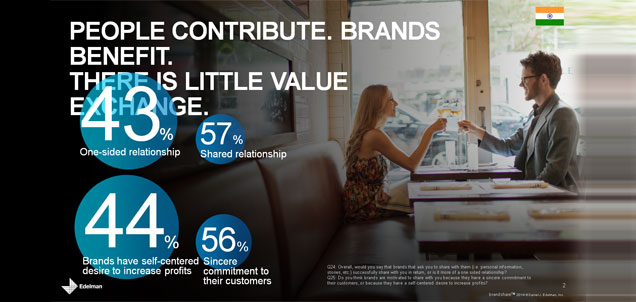
    Glass half full or half empty? About the relationship between brands and consumers

    43% in India believe the relationship is one-sided. 57% believe it is a shared relationship. 44% say, brands have only a self-centered desire – and 56% say there is a serious commitment to customers.


    The global results though show a much more cynical consumer. The Indian participants may seem brand-friendly but once you go into specifics, they see the same gaps in terms of brands delivering to their needs than the global average. Only China shows similar results. There seems to be some satisfaction with what brands give to them in terms of value.


    Brand relationships are not really “meaningful” – also in India

    There are huge delivery gaps. Only 30% say, brands deliver. 73% say they want more “meaningful” relationships.


    So what are they missing?

    – Brands are not great in responsiveness. 79% say it’s important, that brands respond quickly to their concerns and complaints – but only 30% think brands perform well in that respect.

    – Brands don’t involve them. 72% find it important, that brands communicate how products are sourced and made – only 30% believe they are doing that well. 65% want brands to invite them to be part of development (of products, services, campaigns) – but only 33% deliver.

    – And lastly, people want brands to take some position beyond their own business: 58% want to see brands having a clear mission and purpose at its core – only 21% think they perform. And half of them (52%) want brands to use their resources to also change the world – only 15% believe they do that well.


    There are big gaps between expectation and delivery. These gaps indicate how brands can have happier customers. Those gaps are consumer commands.


    Brands that score on emotional and rational needs perform better than those who just deliver on one of them.

    The study sees a 5-7% lift on purchasing, recommendation and defence behaviour for brands who score high in both need states.


    Brands that take care of the world are raising more consumer support and contribution

    The study noted that the consumer’s willingness to share their own private information and their readiness to share content was relatively moderate with those brands who “only” fulfil their emotional and rational need states. But as soon as brands were also making the world a better place in, took a stand at some concrete issues, or acted with a clear mission – the willingness to share information or content goes up.


    It’s clear that what’s desired eventually is the move from a transaction-based value equation to one that’s dynamic and multi-dimensional.  And the only way one can achieve it is by creating a true value exchange.

     

  • What Ticks for Indian Consumers/ Women – Karthik Srinivasan and Suman Srivastava

    Continuing with our extracts from the second edition of the MxMIndia Annual, we present contributions by Karthik Srinivasan and Suman Srivastava.


    Look at women as an evolved audience segment


    By Karthik Srinivasan


    Google, earlier in 2013, said that there are 60 million women in India who are online. Even with a conservative assumption of 40 per cent of that number as working women who have access to one or more internet-enabled device, it gives us 24 million. Latest numbers from Facebook are on similar lines too – about 20 million female Facebook users in India.


    If 20-30 million was the addressable target audience, how is India doing, talking to and engaging this fairly sizeable segment via digital channels and social media? The first consideration would be the growing power and influence of this segment. National Sample Survey Organization (NSSO), India’s official agency for gathering key statistics, released its last numbers in 2010, where it mentioned that India has 112 million female workers (out of 586 million women, according to the last census).


    So, the potential of this segment growing in number is obvious, and immense. The second consideration would be around how women, not just working women, have been addressed in marketing communications in general, in India. A large portion of the communication still seems to be hovering around women as a gateway to the family. If you see product categories such as toilet cleaners and dish washing bars\liquids from the perspective of a working woman who is as busy professionally as the man, she is less likely to be bothered by such trivial tasks.


    What a decade for women


    By Suman Srivastava


    The media is full of stories about rape and violence against women. There are imbecilic statements by some politicians about how the only way to avoid crimes against them is for women to return to the medieval era. In this context, I would like to use this piece to highlight the spectacular achievements of women in India over the last decade or so.


    The big narrative about women is that they no longer define themselves with reference to men. No longer are they merely wives, mothers, sisters and daughters. Many have reached the top in their respective professions on their own merit. If you work in banking or finance, chances are high that the CEO of your company is a woman. Naina Lal Kidwai at HSBC, Chanda Kochhar at ICICI Bank, Shikha Sharma at Axis Bank are the best known. Less known perhaps, are Roopa Kudva of Crisil, Aisha De Sequeira of Morgan Stanley and Chitra Ramakrishna of the National Stock Exchange.


    While the rise of women in finance has been talked about, the rise of women in technology firms has not been noticed as much. Chances are you have heard of Kiran Mazumdar Shaw, Chairman and MD, Biocon. You may not, however, have heard as much about Vanitha Narayanan the MD of IBM India, or Kumud Srinivasan the President of Intel India and Aruna Jayanthi, CEO, Capgemini India. The list isn’t over yet. Add Kirthiga Reddy, Head, Facebook India and Neelam Dhawan, MD, Hewlett Packard India.


    That brings marketers an opportunity to see this from a fresh new light and appeal differently to working women. So, instead of a dish-wash bar that is supposed to care for the hands of women in general, things would change to a working women caring for her domestic help and hence opting for the better, safer dish wash bar! Digital and social media communication enable a bigger, better canvas for one-to-many and many-to-many communication, but they need to stay on course with brands’ overall messaging. The fact that this ‘many’ now includes a sizeable, growing and highly vocal working women segment is a tremendous opportunity to appeal to their specific sensibilities and win them over.


    The challenge is, of course, to let go of older attitudes and prejudices against women in general, and working women in specific, and start looking at them as an evolved audience segment, with a fresh outlook towards life, family, men and work, driven by economic empowerment. It’s almost like discovering a new planet. No… not Venus. This is a different planet!


    Turn to sports and again you find that women have been doing really well. At the London Olympics, two of our six medals were won by women. Saina Nehwal and Mary Kom became household names if they weren’t already that. A surprising area where women have stood up to be counted is in the village panchayat. Chhavi Ragout made news because she has an MBA, wears jeans and is the sarpanch of a village. But she is not the only one. Several states have reserved between one-third and one-half of all sarpanch positions for women.At the other end of the spectrum are, of course, women Chief Ministers. I can’t possibly write a piece on women and not talk about Mamta Banerjee, Mayawati, Jayalalitha and Sheila Dixit.


    So what do you make of Indian women then? Yes, there are ultra regressive diktats being issued by khap panchayats, some religious leaders and politicians. And this is violence and discrimination against women. But on the other hand, we are fortunate that we have some spectacular successes too. Maybe the best way to reduce the negatives is to celebrate the positives. Indian women deserve more than just three cheers.


    – The author is Founder & Innovation Artist at Marketing Unplugged, a firm that helps firms create marketing innovations. Contact him via his website: www.MarketingUnplugged.in.


    Tomorrow: Tuesday, November 4:  Teens – Ashwani Singla and Aditya Swamy

  • Uninor appoints Anurag Prasad as Head – External Communications

    By A Correspondent


    Anurag Prasad

    Uninor has announced the appointment of its new Head External Communications – Anurag Prasad. He takes this position in the corporate office of Uninor in Gurgaon from his former responsibility as the Senior Editor at Fortune India. In his new role, Anurag will be broadly responsible for handing media relations and editorial for all external messaging for Uninor.


    Anurag brings with him more than 15 years of experience in journalism and a sharp media insight as well as editorial skills. He joined Fortune India in April 2010 and was working as the Senior Editor. Through the path of his professional life, apart from Fortune he has worked with some of the finest and leading periodicals in India such as Outlook Business and Voice and Data.


    “I welcome one of the seasoned and veteran journalists to Uninor family. With his set of skills and experience in journalism, he will be an asset to the Uninor team.We are delighted to have him on board,” said Pooja Thakran, Chief Communication Officer and Head of Corporate Responsibility, Uninor.


    A graduate in Political Science from Delhi University, Anurag also holds a post graduate diploma in Journalism from Indian Institute of Mass Communication. In initial phase of his career he worked with Voice and Data magazine from 2003 to 2005. Later in 2006 he joined Outlook Business where he spent 4 years working as the Assistant editor, post which he joined Fortune India.


  • What Ticks for Indian Consumers/ Teens – Ashwani Singla and Aditya Swamy

    Continuing with our extracts from the second edition of the MxMIndia Annual, we present contributions by Ashwani Singla and Aditya Swamy.


    Look at the world through our eyes to get the picture


    By Ashwani Singla


    Information and education through entertainment is the way teenagers learn. The ‘Network of friends’ is their support system, whether online or in the real world. Borders are only for politicians as teens live in a borderless world. Home is a sanctuary to rest and recuperate and parents are ATMs. Teens are adept at multi-tasking, easily able to process multiple streams of information. They can do homework whilst watching their favourite TV programme or research for a paper whilst chatting with their friends online.


    The mobile phone is but an extension of the hand. I could go on. Teenagers today are also perhaps a bigger influence on family’s purchase decisions. The famous “pester power” of a teenage consumer is more than his or her purchasing power, which in any case isn’t insignificant any longer and before you think this is it. Brand loyalty is an archaic concept. Here and now works. Brands are bought and discarded as if they were a seasonal fashion statement. Bottom-line. Ignore them at your own peril.


    So where do you begin? This mind boggling complexity has left many a communicator bewildered about the choices they need to make to be able to grab their attention enough to engage them in a dialogue. Let me attempt and try to do the impossible – establish a brand in the mind of a teenager. I believe that in order to capture the mind and heart of a teenager, the brand needs to become a crucial link in their identity and must inculcate a sense of empowerment and achievement amongst their network.


    This means not only do we need to grab their attention but also create a presence across their ecosphere of influence. So how do PR professionals do that? The answer lies in using what I call – The science of persuasion. PR practitioners need to ‘get under the skin’ of the teens. They need to generate ‘Eureka moments’. PR has for too long focussed on just promoting and publicising but has played little or no role in understanding how the teens act or behave in relation to the category and the brand.


    The open letter generation


    By Aditya Swamy


    Keep Calm and Carry On – exactly captures the sentiment of the generation. This is the most practical, optimistic and a happy generation; and Millennials rarely waste time crying on their imperfections. About one-third of them agree that life has become too busy, competitive and difficult to cope; yet, 94 per cent declare they are shiny happy people. At an age where they are barely eligible to vote, they do have strong philosophies of life and are mighty vocal about the same too.


    MTV Roadies, the biggest property in the genre, is not just a show. Roadie is an attitude that has come to signify the surviving and winning skills. The series is the most watched show in the genre on television and also the most followed / viewed show on web; and garners more than 100mn views in one season. Millennials are not a homogeneous bunch of people. They live in one world of many worlds. It is aggregation of many sub-cultures that are united together by their overlapping interests.


    Their attention spans are miniscule and they’re awed by very little. Marketing to these youngsters need one to start thinking like one. It is about starting interesting conversations, and keeping it a two-way street. This generation is anything but linear. Take a minute to think about how does a youngster today introduce himself or herself ? Sample the twitter handles and descriptions or Facebook covers and display pictures or tumblr profiles. Their intro lines don’t always have their names and coordinates.


    Rather, they are a play of words that captures their theories of life. Step into a college and you will bump into a bunch of youngsters – they all look beautiful. Looking at the group in a college cafe or going through one’s playlist on iPod, one cannot decode their socio-economic class. What strings them together are their interests in music, sports, movies, humor etc. These interests fuel conversations. Today conversations are more meaningful than lectures, therefore, monologues are lost. Millennials love to share their thoughts, and ‘memes’ are the new ammunition.


    The impact of brand on their self-esteem, perceived benefits, enhanced utility in their lives etc. These insights will provide a clue about the storyline that would be most compelling; the storytelling format that would be most effective and the advocates who would be most persuasive. Most importantly, these insights will help you understand the best way to engage. I could say use Facebook, Twitter or Myspace. But that is like suggesting that one size fits all strategy works for this group in entirety. Rather, it is absolutely the opposite.


    Different stroke for different folks is the key here. PR practitioners need to look at the best ways to deliver their story, which not only makes it relevant and compelling but also makes it most believable. But before I am pronounced guilty of being ignorant, here is how I manage to win the hearts and minds of the teens:


    The ABC of Teen PR:

    1. A for Authenticity. The brand has to deliver real benefits or utility. Performance pays. So understand your product well before you communicate.

    2. B for Believability. Talk only what you can walk. Puff does not work. Show & tell works better with teens. Comparisons are effective.

    3. C for Credibility. If you don’t have advocates, you have lost the battle before it has begun. Work hard to get the “tribal leaders”.


    Last, but not the least, when you are in the 13-18 year age bracket, 23-25 years looks like old age. So don’t look at them with your lenses. Put on the ones which make you look at their world through their eyes.

    Happy hunting.


    Memes are ready to share idea / symbol that is ubiquitously understood by everyone in their circle, is easy to personalize and share and yet strictly young. The fact that an internet meme is not easily decoded by parents makes it a potent tool for expression by the Millennials. Simply having a celebrity tell you what soap to buy isn’t going to cut it anymore. Only 10 per cent of youth actually look up to a public figure as an icon. Youth don’t want to be talked down upon, rather they love a dialogue.


    In fact, they crave for constant dialogue. On an average, 85 per cent of them connect to social media thrice a day. They not only surf for new happenings, they also share their POV with their social circle. Hence, there is a continuous need for fodder for their conversations with their circle. And, that’s the opportunity today for brands. A property like Coke Studio@MTV creates conversations around the fusion music that lets one discover new sounds, new artistes, new music… It continues to be one of the most buzzing topics on social media.


    The first ever MTV Bloc Party presented an immersive on-ground experience of seamless partying across multiple hubs like jiving to music by the beach, relaxing by the beer garden with live bands and interacting with their favourite artistes etc. Everyone who partied went back with a bagful of memories and stories. MTV Nano Drive, the social road trip, allows the audiences to interact with the contestants and help them complete their tasks within the cities. In sum, this is the open letter generation.


    They love dialogues and conversations about the good and also the bad. 57per cent use social media to complain about brands that do not meet their expectations. Therefore, the challenge for the brand is to always toe the line; else face the music from the audience. On a brighter side, this is also a rare opportunity for brands to dig into consumer feedback, and a genuine one at that. So, listen in to consumer conversations to course correct campaigns and initiatives. Keep Calm and Carry On.


    Tomorrow: Wednesday, November 5:  Men – Kevin Vaz and Saurabh Yagnik


  • Myntra Fashion Incuabtor to boost careers of young fashion designers

    By A Correspondent


    Myntra has announced the launch of Myntra Fashion Incubator that will provide young aspiring fashion designers a once-in-a-lifetime opportunity to build and scale their brand idea into a sustainable business venture.

     

    Talenthouse India has partnered on this initiative as an outreach partner and will reach out to its 10,000+ registered fashion community pan India on its platform to encourage young talent to leverage from the programme. The aim is to inspire young budding talent and Talenthouse is using all its resources through its digital and on-ground efforts.


    The one-year ‘Designer in Residence’ program will provide mentorship, infrastructure and capital support to the selected applicants and give them the unique opportunity to showcase their work at various platforms of relevance. The selected candidates will receive financial support to create merchandise for one full season and get an opportunity to retail their merchandise nationwide on the Myntra platform.


    Abhishek Verma, SVP, Myntra Fashion Brands said, “This fashion incubator initiative is an attempt to strengthen our commitment of building sustainable and aspirational fashion brands within the country. With the help of Talent House, we will unearth hidden talent from every part of India and give them a platform to make it big in the Indian fashion space.”


    Niloufer Dundh

    Commenting on the launch, Niloufer Dundh, Sales Head, Talenthouse India said “India has over 1500 fashion institutes that churn out over 200,000 graduates each year. This budding talent has a lot of potential and we at Talenthouse India like to associate with endeavours that convert classroom learnings to create business for the artist community and add value to their life. We are delighted to partner with Myntra on this project as it provides a dynamic opportunity to aspiring fashion talent.”