Category: MEDIA

  • What Ticks for Indian Consumers/ Family – Ambika Srivastava and Ajit Thakur

    Continuing with our extracts from the second edition of the MxMIndia Annual, we present contributions by Ambika Srivastava and Ajit Thakur.


    ‘Brands need to navigate the new media landscape well’


    By Ambika Srivastava


    As a starting point, one cannot look at women as a homogenous group and define their media consumption habits. To understand the media consumption habits of women, it is important to segment them not just on the basis of demographics but also on the basis of their values and lifestyles. Depending on the lens that you use to understand women, media consumption will differ quite significantly. For middle class women and women in smaller towns, television rules the roost, and it will continue to do so for some time.


    However, use of mobile is changing life for these women – and in no small measure. Having said that, to leverage mobile from an advertising perspective, a lot needs to be done. For brands targeting masses, television would continue to drive reach. They might need to look at mobile more seriously though for more personalised communication with this target group. The role that media plays in the life of a woman depends on her life stage as well as her aspirations.


    ‘It is time the industry goes beyond entertainment’


    By Ajit Thakur


    Despite the rise of specialty channels in India, the youth of India is consuming a lot of general entertainment content. On any given day, youngsters are watching at least one hour of TV content out of which a majority share goes to general entertainment. The youth can be divided in two groups: 25 years plus and the below 25 years audience. These are audiences who are either pursuing higher studies or have just started their professional careers.


    The 25 plus audience have a sense of responsibility towards their company/profession and towards their family. They are hungry for knowledge, are intelligent and have an opinion on issues affecting the country and the world around. This is the segment that will drive the change, not only in terms of the kind of content that will be produced but also in terms of how the content will be consumed.


    If we evaluate the media consumption habits of working and nonworking women or stay at home moms vis-à-vis career makers we will see a different pattern emerge. For working women, newspapers are a major source of information, and hence their importance is increasing for marketers as well. One would notice that FMCG brands targeting women have increased their exposure in newspapers. The internet especially on the mobile is helping them make more informed decisions. For entertainment, in terms of appeal and content, Hindi serials and films rule the roost.


    Subtle changes in television content are already seeping in. There are quite a few serials on air today where one sees the characters dealing with issues both at home, and at workplace. Working women find an association there as they can relate to the adjustments being made. For urban woman of today, anything that helps her cope with her new lifestyle and new demands that society is imposing on her is of relevance. Good examples here would be mobile, emails and social networking.


    Today, television as well as the internet is the women’s window to the world –TV more for those without a smartphone. Both these media keep her entertained and well informed and connected. To make an impact, brands need to navigate the new media landscape well. Socio-economic status as well as the emotional needs of women are perhaps the most important criteria to consider while looking at media consumption.


    I see this audience moving from unconnected world to the connected world and vice-versa, led by a higher proliferation of smart-phones and internet enabled devices. From a content standpoint, it is critical for broadcasters to offer contemporary, fast-paced shows that carry an image of India’s youth. Content that not only inspires to address problems, but one that also aspires the youth in achieving personal or career related goals.


    It is time that the industry goes beyond entertainment to inspire and aspire people in the country. The youth of India is also the single largest consumer segment and it is this segment that will drive the change in the country. A lot of advertising is geared toward this consumer group. Channels that will offer differentiated, modern and relevant content will emerge victorious in engaging with this TG.


    Tomorrow: Thursday, October 16: Men – Prema Sagar and Arvind Sharma



  • Maarten L Albarda to speak on ‘World Goes Digital’ at IAA webinar series

    By A Correspondent


    The International Advertising Association (IAA) India Chapter, has organised its next webinar on ‘World Goes Digital’ which will be addressed by Maarten L Albarda, renowned Marketing Consultant, former Global Director of Media & Communication Innovation, Coca-Cola on October 16, 2014 at 4pm.


    Maarten L Albarda has around 30 years of experience in advertising and marketing and started his career at JWT Amsterdam as a media planner. He moved to Leo Burnett and later to Coca-Cola, Japan where he developed the first integrated marketing campaign for Coke around the FIFA World Cup 2002. He moved to Coca-Cola Germany to share his World Cup learnings with the German marketing team for World Cup 2006.  In late 2005, Maarten relocated to Coke’s global HQ in Atlanta and then took on the responsibility for Media and Communication Innovation across all brands and key markets.


    In 2009, Albarda joined AB-InBevas as VP, Global Connections, with responsibility for all aspects of Media, Digital, Sports & Entertainment Marketing, CRM and Licensed Merchandise. In October 2012, he left the company to pursue entrepreneurial opportunities.


    “We are delighted to have someone of the stature of Maatren L Albarda to address the IAA Mentorship Webinar. I am sure brand managers and digital media practitioners would use this opportunity to interact with him,” said Srinivasan K Swamy, IAA India Chapter & Vice President, Development Asia/ Pacific Region of IAA.


    Abhishek Karnani

    Abhishek Karnani, Director, Free Press Journal and Manish Advani, Head – Marketing and Public Relations, Mahindra Special Services Group, are co-chairing the IAA Webinar series.


    The Webinar will be aired live on the IAA YouTube channel – www.youtube.com /iaaindiachapter on October 16, 4pm onwards.


  • What Ticks for Indian Consumers/ Men – Prema Sagar and Arvind Sharma

    Continuing with our extracts from the second edition of the MxMIndia Annual, we present contributions by Prema Sagar and Arvind Sharma.


    The Indian male consumer is well-rounded


    By Prema Sagar


    As in the rest of the world, in India too, the male consumer is often represented as a two-dimensional stick figure, and again like the rest of the world, the reality is very different. The Indian male consumer is multilayered and doing his best to cope with a rapidly changing world. Increasingly, men are being asked to step up and be more aware of their responsibilities as one half of the population. The ‘metrosexual’ male has to not only be the bread-winner but often compete with his partner and also be the ‘good’ husband, father, brother figure and ‘look good’ and ‘feel good’ all at the same time.


    In the end it seems to come down to these two basic insights. Marketing to men has to stimulate a reaction that makes them think that what’s on offer will make them either ‘look good’ or ‘feel good’ and this is no different than say marketing to women. What is different, however, is the context, language, tonality and imagery that appeals to a man. Indian men are not a homogenous group— there are many sub-segments.


    The most obvious being the rural-urban divide and the various age groups that marketers classically divide their target audience segmentation into. This needs to be taken into consideration by brands. For instance, the kind of television show that will interest a 20-year-old urban male will be different from what appeals to a 40-year-old rural male. Obviously, each brand has to find its own niche in this complex mind of the Indian man, but a brand that takes these complexities into cognizance enjoys a better resonance with the consumer base today.


    From a pheasant to a peacock


    By Arvind Sharma


    Twenty years ago, men tried hard to look alike – like ordinary pheasants. One discovered a man’s worth only when a friend told you in whispers, ‘He is Kapoor of Kapoor Reality’. An average Indian man used to say, ‘I work for my wife and children and extended family. Personally, all I need is daal roti every evening (perhaps with a drink?). How much money does one need for that!’ No longer. In the last seven years or so, a number of trends have converged to transform consumption patterns among men.


    Firstly, the growing importance of service economy has made presenting oneself in a stand out manner a professional necessity. Tech has been a huge driver of innovation across all sections of the population. At a more sociocultural level, increasing proportion of men want to find the woman of their dreams on their own- rather than have their moms arrange one. All in all, from an ascetic culture, we have moved to a culture of conspicuous consumption.


    You’re what you own and what you consume. Marry these trends with the economic affluence that the past decade has spawned and together they have transformed men’s consumption landscape. They have made many a men’s categories explode. Men’s grooming is one of fastest growing segments in personal care. This includes deodorants as a category which every FMCG player wants to enter. And sub-categories within established categories like men’s fairness creams and hair care.


    Public relations gives a brand the space to address this multidimensional view. It also gives the brand the breadth of formats to engage with the Indian male consumer at different levels. There are men-oriented platforms, like men’s magazines and newspaper supplements, which give brands a forum to engage with men in a more focused way. With lifestyle taking centre-stage in the Indian male consumer’s consciousness, he is also looking at new product categories like grooming.


    Brands need to look beyond the traditional mediums, and create conversations on new platforms, like digital and mobile. For any brand to be successful, messaging has to be on-target. The Indian male’s narrative is evolving and PR helps build that messaging for brands. In the automobile sector, for instance, the Indian male, which is the main TG, the messaging isn’t just for macho pride, but of pushing boundaries, projecting safe, responsible behaviour, an enterprising streak and more. Through the potent combination of messaging, storytelling, formats and reach, PR can help brands not just connect with the Indian male consumer, but even drive his preferences.


    Branded apparels provide assurance of contemporary fashionableness and they are fast replacing the himself-not-so-well-groomed local tailor. Ready-made garments as a category is thriving. Of course, a motorcycle or a car is no longer a means of transportation. It is a signifier of a family’s success and most importantly of a man’s status. Everybody has a music system the question is how advanced is yours. Everybody has a colour TV. Now it is about HD TV’s and smart TV’s that are connected to home WiFi. A man’s stature is defined by exactly what kind of a smartphone he carries.


    Sub-Rs. 500 IMFL is something you drink if you are not well off. It is the age of knowing your wine and your single malt. Luxury brands are not just about women’s bags. Tag Heur is the watch to own among a section to urban males. The phenomena may be very niche for the moment but the trend is growing. Decked with all his special, premium and luxury brands, the Indian male is increasingly like a peacock.


    Tomorrow: Friday, October 17: Women- Nikhil Rangnekar and Madhukar Sabnavis


  • Sale of Tablets to remain below 10 percent in 2014, notes Gartner study

    By A Correspondent


    Tablet sales growth is slowing in 2014 as new hardware buyers turn to alternative devices and existing users extend the lifetime of their tablets. Gartner, Inc. estimates that tablet sales worldwide will reach 229 million units in 2014, an 11 percent increase from 2013, representing 9.5 percent of total worldwide sales of devices in 2014. In 2013, tablet sales grew 55 percent.


    Worldwide combined shipments of devices (PCs, tablets, ultramobiles and mobile phones) for 2014 are estimated to reach 2.4 billion units in 2014, a 3.2 percent increase from 2013. “The device market continues to evolve, with the relationship between traditional PCs, different form factor ultramobiles (clamshells, hybrids and tablets) and mobile phones becoming increasingly complex,” said Ranjit Atwal, research director at Gartner.


    In the tablets segment, the downward trend stems from the slowdown in basic ultramobiles – new sales of iPads and Android tablets – and the lifetime extension of current tablets to three years by 2018. Gartner projects over 90 million fewer new tablet purchasers and 155 million fewer tablet replacements through 2018.


    “Some tablet users are not replacing a tablet with a tablet, they are favoring hybrid or two-in-one devices, increasing its share of the ultramobile premium market to 22 percent in 2014, and 32 percent by 2018,” said Atwal.


    Worldwide device shipments by segment (Thousands of Units)

    Device Type 2013 2014 2015
    Traditional PCs (Desk-Based and Notebook) 296,131 276,457 261,005
    Ultramobile Premium 21,517 37,608 64,373
    PC Market Total 317,648 314,065 325,378
    Tablets 207,082 229,085 272,904
    Mobile Phones 1,806,964 1,859,946 1,928,169
    Other Hybrids/Clamshells 2,706 6,462 8,609
    Total 2,334,400 2,409,558 2,535,060

    Source: Gartner (October 2014)


    The mobile phone segment will continue to grow in 2014 due to strong sales of lower-end smartphones. Sales of basic smartphones (including midrange Android devices) are projected to grow 52 percent in 2014, while utility smartphone units (including low-end Chinese white box devices) will double.


    “The market is clearly favoring those vendors offering value in lower-priced smartphones. This trend has become more apparent, especially in the second quarter of 2014 when most of the top Chinese smartphone vendors grew volume and market share,” said Roberta Cozza, research director at Gartner. “As smartphones reach lower prices, Gartner expects nine out of 10 phones to be smartphones by 2018.”


    The expansion of affordable mobile phones that are attracting replacements in many emerging countries has contributed to the increase in the global market share of smartphones, which is set to reach 71 percent in 2014, up 17 percentage points from 2013. Android and iOS have further entrenched their market positions in the global phone market, making it difficult for alternative ecosystems to become more than niche players.


  • Aaj Tak to host Salaam Cricket

    By A Correspondent


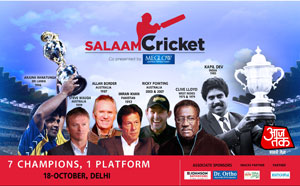
    Aaj Tak seeks to celebrate cricket by hosting the show Salaam Cricket. As the countdown to the World Cup 2015 begins, 7 World champions and 14 Captains will converge on one stage to usher in the battleground 2015.


    Speaking of the event, Supriya Prasad – Managing Editor – Aaj Tak said, “Aaj Tak will bring together the greatest legends of the game in this definitive event. The inspiring discussions and expert opinions from the stalwarts will surely have the cricket viewers asking for more.”


    Ashish Bagga, Group CEO – India Today Group added, “The India Today Group is a leader in the space for creating benchmark News Events. Salaam Cricket with its inspiring line-up of legends on one platform is an Industry first that is a reflection of Aajtak’s commitment to being Sabse Tez.”


    The World Cup winning captains who will be part of the daylong event are – Clive Lloyd, 1975 & 1979 Champion, Kapil Dev, 1983 Champion, Allan Border, 1987 Champion, Imran Khan,  1992 Champion, Arjuna Ranatunga,  1996 Champion, Steve Waugh, 1999 Champion, Ricky Ponting, 2003 & 2007 Champion. The greatest Indian Captains including Sinil Gavaskar, Saurav Ganguly, Bishen Singh Bedi, Mohammed Azharuddin and Ajay Jadeja will also be part of the event. Key members of the Indian World Cup winning squad including Yuvraj Singh, Harbhajan Singh, Piyush Chawla and Ashish Nehra will be among the many superstars who will take centre stage.


    The day will start with session – “Winning the World Cup – Start of a Revolution” by world cup winning captains- Kapil Dev & Clive Lloyd. This will be followed by the session “Thunder Down Under” addressed by the former Australian World Cup Winning Captains- Allan Border, Steve Waugh and Ricking Ponting. The next session will have Yuvraj Singh sharing his thoughts in – Story of a Winner.


    Emotions will run high around the session- India V/s Pak which will witness former Indian and Pakistan captains like- Sourav Ganguly, Kapil Dev, Mohammad Azharuddin, Ajay Jadeja, Inzmam-Ul-Haq & Aamer Sohail discussing the excitement and the high expectations when the two cricketing rivals go on to play.


    The day will close with the World Cup winning captains sharing the stage in the “Seven Wonders: All WC Winning Captains on One Platform”. The session will have Clive Lloyd, Kapil Dev, Allan Border, Imran Khan, Arjuna Ranatunga, Steve Waugh & Ricky Ponting sharing their views.


  • ‘Ehsaan Mat Lo, Discount Lo’, says Yatra.com in new TVC

    By A Correspondent


    Yatra.com has launched their new campaign that aims to create awareness amongst customers about the wide array of choices for hotel bookings. Titled, “Ehsaan Mat Lo, Discount Lo”, the underlying message in the commercial promises travellers the best stay at the best price wherever they go Yatra has the largest inventory of hotels in India and abroad and this commercial aims to apprise customers on the bouquet of offerings from yatra’s basket. The new campaign comprises two TVCs which have been on air across leading channels.


    Crafted by McCann Erickson India Ltd. under the creative direction of Kapil Batra, the new advertisements showcase how favours can be called upon, in any way possible. Where one ad opens with the protagonist unpacking at the acquaintances’ house, he overhears a conversation of the owners of the house and their plan to ask him to marry their daughter. Which in turn causes him to start packing right away, with the tagline being displayed – “Ehsaan mat lo, discount lo”.


    The second advertisement builds on the same premise that nothing in the world is free. The advertisement begins with the protagonist showing up at the doorstep of his relatives in the hope of a free stay; overhearing their conversation of being asked to donate a kidney for a relative in return for the hospitality provided, causes him to flee. The voice-over in the brand ambassador, Salman Khan’s voice says “Ehsaan mat lo, discount lo!”.


    Commenting on the launch of the new ad campaign, Sharat Dhall, President, Yatra.com said, “Yatra.com has always been at the helm of change; we are constantly reinventing and adapting ourselves to suit the sensibilities of our customers. The latest TVC’s by Yatra.com focuses on hotel and highlights the range of   offers/discounts that Yatra.com has on its assorted inventory of hotels. Based on our internal findings that 36% of our customers stay at their friends or relatives place instead of booking a hotel , the message ‘Ehsaan mat lo, discount lo’ aims to drive greater adoption of online hotel bookings with travellers.”


  • Milind Pathak joins Madhouse India as COO

    By A Correspondent


    Mobile marketing and communications company Madhouse announced the appointment of Milind Pathak as COO. He will be reporting in to Joshua Maa, Founder and CEO, Madhouse and Tushar Vyas, Managing Partner, GroupM Interaction, South Asia, and will be based in Gurgaon. Milind comes on board with vast domain knowledge and experience in mobile VAS, marketing & advertising, content, mobile CRM and m-Commerce.


    Prior to joining Madhouse, Milind was a part of the One97 Communications’ leadership team and held various roles like the Global Head- New Business & Head – Mobile & Enterprise Marketing. He has over two decades of experience in sales, business development, marketing, strategy and P&L Management. Milind moved to digital domain in 2005 as Co-CEO and Country Manager for Buongiorno and was responsible for setting up the company’s successful operations in India. He has been an active digital evangelist in the Asian market for Mobile Content, Marketing, m-Commerce and Internet.


    Joshua Maa, Founder and CEO, Madhouse Inc. said, “India continues to be a priority market for us and we look forward to working closely with Milind as he steers Madhouse India into its next phase of growth.”


    Commenting on Milind’s appointment, Tushar Vyas, Managing Partner GroupM Interaction said, “We are excited to have a senior leader from the industry in the Madhouse team. Milind comes with a rich and in depth experience from the telecom industry with depth of experience in Mobile marketing, content and commerce across consumer and enterprise segment. We are confident he will help our clients to seamlessly integrate mobile advertising into their marketing strategies.”


  • INMA to host 8th Annual Conference in New Delhi

    By A Correspondent


    The International News Media Association (INMA) will host its 8th Annual South Asia Conference November 12-13 at Eros Hotel, Nehru Place, New Delhi.


    The conference will be held under the theme: “Print: Transform, Diversify, Grow” specifically for news media companies in India, Bangladesh, Sri Lanka and Pakistan, and will bring together more than 200 delegates from the sub-continent. The conference is a fast-paced tour de force of ideas and innovations to grow newspaper advertising, circulation, brand and revenue by addressing key current issues in the print + digital ecology of the South Asia market.


    More than 25 speakers, several partners, press and 200+ delegates from newspapers across India, Pakistan, Bangladesh, Europe and the United States will be attending this conference.


    INMA is the only industry association that is able to pull together South Asia’s top publishers and specifically executives charged with growing advertising, circulation and brand. There will be excellent opportunities to network and share the “INMA conversation” among this exclusive fraternity of the world’s most innovative newspaper executives.


    The International News Media Association (INMA) is the world’s leading provider of global best practices and marketing ideas. It provides its members thought leadership and practical ideas to grow audience, advertising, brand and profit. Currently INMA has nearly 6,000 members in 82+ countries world-wide, which include several members from Indian and now Bangladesh and Pakistan newspapers.


  • SRK appointed brand ambassador by Yepme

    By A Correspondent


    Online fashion brand Yepme has roped in superstar Shah Rukh Khan as its brand ambassador. This makes Yepme the first ever online fashion brand in the country being endorsed by Shah Rukh Khan. Yepme will introduce the actor through an extensive television campaign for its upcoming Autumn-Winter collection’14.


    Speaking on the announcement, Sandeep Sharma, Co-founder and COO, Yepme.com, said, “We are thrilled to have Shah Rukh on board. This association will definitely help build a strong connect between the brand and his fans across the country.  Shah Rukh commands a huge fan following across all age groups in India and abroad and his presence will drastically increase the aspirational value of Yepme. He is the King of hearts, extremely hardworking and well read and carries himself with a sense of style that is a class apart. His style is effortless and casual and that is what we, at Yepme are all about.”

    The company has built its business around the Fast Fashion Model on the lines of leading global peers. The talented team of in house designers hand-picked from the top design institutes operates on high agility to create fresh and new designs on an everyday basis. The team drives its inspiration by real-time research and analytics on latest fashion trends running in the global fashion markets. This model operates by keeping the online store exciting with Fresh Fashion merchandise showcased daily.


    The brand will widely promote the association with SRK through a TV Commercial across leading TV Channels and will associate with top performing TV Shows, along with print media campaigns with leading newspapers and magazines. The brand will widely run social media campaigns on Facebook, Twitter and Google Plus and the digital launch will include a YouTube campaign.


  • What Ticks for Indian Consumers/ Women- Nikhil Rangnekar and Madhukar Sabnavis

    Continuing with our extracts from the second edition of the MxMIndia Annual, we present contributions by Nikhil Rangnekar and Madhukar Sabnavis


    ‘Women are emotional beings who need constant attention’


    By Nikhil Rangnekar


    A woman’s guess is much more accurate than a man’s certainty.

    – Rudyard Kipling, author


    When you’re talking to a target group with a strong emotional quotient (EQ) and extremely strong purchasing power, you need to be a careful marketer. Here are some things to remember when marketing to this ever-evolving power tribe:


    • Stay away from claims that can’t be supported with data, research, consumer experience or any other tangible evidence:

    Women are less likely to fall for unsupported claims or marketing gimmicks. I remember a shampoo ad in India that showed research done in Thailand as proof of their claim. Not only do these kind of gimmicks show the marketer in poor light but they also have a negative ruboff on the brand.


    • Understand emerging segments within women and cater to them differently:

    The emerging class of “single urban working women” is buying products like cars, 2-wheelers, insurance etc. and taking these decisions on their own. It’s time marketers recognized this segment and actively created strategies to target this audience. This could start from conceiving/developing new products/brands designed specifically for these women to advertising and media usage based on insights and media-analytics.


    Targetingworking women


    By Madhukar Sabnavis


    According to the National Sample Survey, 30.7 per cent of the labour force in the age group 15-59 is female; and 19.9 per cent of organized sector employees are women. So, working woman is a significant segment. What does it take to address this segment? Why do Indian women work? In the lower income class, it’s often for sustaining the household- many men in this group are sponges. In middle class households, it’s often to supplement income to help live the lifestyle family members aspire for.


    In fact, it is in this segment that many educated women are socially dissuaded to work post marriage- the men folk think it’s an ‘insult’ to have the woman work. This is changing albeit slowly- largely because double income means more comfortable life. In upper income segments, women work as hobbies- to fill the free time from home duty and when other folk in the house are out doing their own things. This could sound an oversimplification; but it is perhaps close to the truth. Many researches among the lower and lower middle income groups have revealed that women who work before marriage do so not to get a better bridegroom or for self fulfillment but to give their family- parents and siblings- a better life!


    There are the ‘odd’ middle class women who work before marriage to fulfill their personal dreams before marriage settles their life forever- however, they remain small. It’s instructive to understand two classes of women who don’t work post marriage. If the choice is personal and the relationship with the husband is one of mutual respect, there is little angst. Where the choice is enforced and the relationship is one of duty, there is angst. The angst is often about the lack of respect that she feels she would have got if she had been working.


    • Recognise the changing shopping behaviour of women:

    Gone are the days when advertising on mass media alone was the mantra for success. Shopping, especially in metros and mini metros, has shifted from the grocer to the local super market. What are the implications of this changing behavior? Firstly, it is likely that the role of the grocer/shop-keeper would have diminished significantly and peer group, friends and relatives are the new source of information about brands. Marketers need to keep existing consumers happy and have a robust WOM strategy in place. Engagement – thy name is woman:


    Women are emotional beings who need constant attention… 🙂 Most of the advertising we see still depicts the woman in a stereotypical role e.g. mother, wife, sister-in-law etc. To make matters worse, communication is a one-way street where the brand talks and the woman listens.


    It’s time to move away from this monologue and start a dialogue with the consumer. With the proliferation of digital media, successful brands will be the ones that engage with their audience.


    What does this all mean? ‘Working’ woman or ‘house wife’ the core driver of the Indian woman remains family and nurturance- the need to be a fantastic homemaker. So, what do brands need to do to target them right? Clearly these women, when part of double income families, can afford better products and services for the family. However to manage their lives, convenience, time management and stress reduction are good product benefits.


    Guilt reduction is a good brand statement that helps the working woman feel better. However, deeper what she will cherish most is brands that get family and society realize, understand and appreciate the ‘two’ jobs a working woman is doing, show her respect and provide her help for doing the same. This is a big gap in the working woman’s life. In fact, celebrating a ‘housewife’s full time job is an implicit tribute to the ‘higher’ value a ‘working’ woman is bringing to a family.


    More than celebrating her ‘superwoman hood’, the working woman can be more powerfully activated and engaged by driving greater social consciousness about her challenges and her contributions. Something worth thinking about.


  • Shailesh Kapoor: The Death of Festive Programming?

    By Shailesh Kapoor


    We are a week away from Diwali, the biggest festival in the North of India. Dassera just went by and the New Year is not too far away. The classical ‘festive season’ has started. In the ’80s and the ’90s, these festivities were accompanied by a bonus – special made-for-festival television programming.


    There would be a Hasya Kavi Sammelan on Holi every year. New Year’s Eve was famous for Doordarshan’s special three-hour show. Independence Day and Republic Day had special programmes and movies to celebrate the occasion. Channels would dress up for the festivals, through specially-designed packaging variants. Celebrities would wish you through 10-second spots peppered across television. Channels would also acquire rights to Bollywood concerts to air on such occasions. And of course, the festivals will be integrated into the running shows, via special episodes or story integration.


    Over the last decade, many of these thematics have disappeared. There’s a token film telecast to sync with an occasion like Independence Day, but that is a library repeat anyway. I suspect someone would have kept count of how many times Gadar has been shown on TV to celebrate India’s freedom, from the time of the film’s release in 2001. Some channels have attempted special events around Holi and Eid, but most such attempts come across as hurriedly-created sales properties.


    But there is an overkill of integration of festivals in running programmes, especially the daily soaps. In 2012, a show took to celebrating KarvaChauth so seriously that it was being celebrated on the show even after we had celebrated Diwali in the real world.


    If a ‘General Entertainment Channel’ was to take its ‘generality’ seriously, it should be tapping in on each big festive occasion to provide content that’s specially designed and produced for it.


    My interest doesn’t lie in watching festive programming, but more in understanding why it’s largely disappeared. Someone could come up with the ratings argument, that many such attempts have not rated well in the past. But if a lazily or half-heartedly created show doesn’t rate in regular primetime, does the channel stop making primetime shows?


    The truth is that the entire approach to festive programming has shifted hands in most broadcasters (and I include the radio industry here) – from programming to ad sales. We are in the busiest advertising season too, and content is put together with a clear eye on the money available in the marketplace. The premiere of a Bollywood Blockbuster or a brand integration on a running show is what the ad sales guys would do well to take as ammunition into the market, to get a big slice of the spending pie available.


    Creating a new property makes the selling job so much more complex. You have to sell a new idea, and there is always a chance that it won’t sell well enough for make the money it needs to make. The quick fix of patching up existing programming as a ‘special’ keeps all the involved parties secure – the programmer, the sales guy and the advertiser.


    But it’s laziness at the end of the day, isn’t it? If a Diwali special event was created by a leading GEC with all its heart and soul, it could rate higher than most running shows and films. And it’s a property for the channel to cherish and telecast periodically during the year, before bringing it back the following year again as a second edition.


    But that would be heterogeneity on display. And I believe that, however unknowingly, our mainstream television fraternity may have got addicted to homogeneity far too much to like a change.


    PS: I still celebrate my festivals and this column would be on a Diwali break next week, to be back on October 31.


  • Ruchir Joshi appointed Head of Content at FoodFood

    By A Correspondent


    FoodFood has appointed Ruchir Joshi to head the content of the channel. Ruchir Joshi, a creative media professional, with over 17 years experience, will be responsible for conceptualizing and executing cutting-edge content that speaks to a global audience.


    Prior to joining FoodFood, Ruchir, was a co founder & promoter –Via Earth that made TV shows that have aired on broadcasters like BBC, CNN and Discovery. He has also done shows for Zee TV/ Zee Cafe, Star One, Sahara Filmy among others.


    Commenting on his appointment, CEO, SK Barua said, “We are extremely happy to have attracted a talented executive like Ruchir for programming, overlooking on air promotions, supporting new media…He comes with a proven track record of leadership and we are extremely pleased to have a content head with his experience to drive the channel’s growth and profitability. We look forward to his success in this new role.”