Category: MEDIA

  • Indonesian copywriter collapses at work, dies. Overwork alleged

    By A Correspondent


    Mita Diran, a young copywriter, tweeted of working 30 hours, and still “going strong”. Alas, that was not to be as she collapsed soon after and died the following day, reports Advertising Age.


    The social media was scathing in its criticism of young Ms Diran’s employers though there have been some reports of an over-consumption of a local energy drink as having contributed adversely to her health.


    A post on an unverified Facebook page of Y&R Indonesia read:


    Dear Friends and Colleagues in the Advertising & Marketing community,

    It is with a heavy heart and deep sadness that we have to inform you we have lost our friend, sister, and work colleague, Mita Diran, earlier this evening. Mita was a talented copywriter with a gentle smile who will always live on in our hearts.

    We have been to Mita’s family residence tonight and expressed our sincere condolences on behalf of Y&R Group Indonesia. It is a great loss and we wish Mita’s family the faith and strength in each other in going through this extremely difficult time.

    Tomorrow, December 16, we will close the office for the day to pay our last respects to Mita at her funeral at Jeruk Purut cemetery at 10 AM. Let us all take a day of silence tomorrow and give Mita’s family the support and prayers that they need, from the bottom of our hearts.

    Sincerely, Y&R Group Indonesia


    The post led to even more outrage. The incident also reminds the fraternity of a public relations professional based in Beijing who was said to have died of overwork. The agency where the young exec worked denied that it was due to overwork and cited newspaper reports on his medical condition.


    While we will never what the real reasons for the deaths of the two professionals, if overwork is indeed one of the causes for promising careers being cut short, then there is need for a review.


    Our view: The working conditions may not be as grim here in India, but staying back after office hours is considered a virtue, and a failure to spend time till late in the night is often frowned upon. Time to rethink, time for moderation.


  • Femina forays into B2B segment with Femina Salon & Spa

    By A Correspondent


    Bestselling women’s magazine Femina  has announced its its entry into the Business-to-business (B2B) magazine sphere with the launch of Femina Salon & Spa.  The magazine will target beauty professionals across the country. It will have 10 issues a year.


    Speaking about the launch, Tarun Rai, CEO, Worldwide Media said, “Beauty is a booming business in India. The numbers of salons and spas across the country are increasing every month. And so are the professionals in the space. Femina, has been in the beauty business itself for the past many decades. It has been advising its readers about the latest trends and products. We decided to leverage Femina’s knowledge of the industry and the Indian woman and produce a specialist magazine for the specialists in the beauty industry.”


    Tanya Chaitanya, editor, Femina , added, “When it came to launching a beauty manual, a go-to guide for all those in the salon and spa business, it became Femina’s prerogative to introduce to the industry a high-quality product that focuses on all trends and techniques that are tried-and-tested for the Indian market.”


    Femina Salon & Spa was launched in Mumbai recently. Other than the flagship English edition, Femina is also published in Hindi and Tamil.


  • Mobile adspends grow 10% of total online spends in 2013: IAMAI-IMRB

    By Our Research Associate


    With Over 930 million mobile users in India and the figure increasing by 8.35 million every month, there is a huge opportunity for small and big brands to explore mobile for marketing their products and connect to consumer in a more efficient way, notes the Internet and Mobile Association of India [IAMAI]. The ability to leverage mobile to target and reach out to the right audiences in the best possible manner is what will make the difference and determine the success or failure and the future seems to be inclined towards mobile marketing, IAMAI adds.


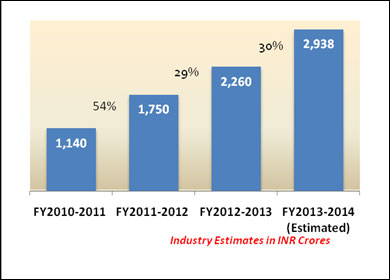
    The online advertising market in India is projected to reach Rs 2,938 crore by March 2014, according to the findings of ‘Digital Advertising in India’ report, jointly published by the Internet and Mobile Association of India (IAMAI) and IMRB International. It is to be noted that during 2012-2013, online adspend amounted to Rs 2,260 crore and advertisements on mobile phones and tablets grew from a 7% share in FY 2011-2012 to 10% of the Indian online ad market in FY 2012-2013, totaling to spends of around Rs 230 rore.


    Figure 1: Indian Digital Advertising Market Growth

    Source: IAMAI & IMRB International


  • Dainik Bhaskar returns with second edition of ‘Brain Hunt’

    By A Correspondent


    The Dainik Bhaskar group has announced ‘Brain Hunt 2- Challenge your Imagination’ your Imagination as a nationwide initiative to stimulate and encourage the imagination of young minds to a new high of free and constructive thinking.


    Said Vinay Maheshwari, Vice-President, Sales and Market Development, Dainik Bhaskar group: “As an organisation, innovation and new thinking continues to be one of the key pillars of our growth. The youth have always been one of our key audiences with we whom we truly enjoy engaging with. What better way to harness and nurture the potential of this huge force and align it with our philosophy of innovation and change!”


    “We truly believe that Brain Hunt 2 will be another wonderful experience for students and the school community at large while also being a welcoming stress buster”. In 2010, the DB Group created the Bhaskar Champs Club to provide a creative platform to students to interact with other students on a common ground of exciting activities to foster intellect, acumen and brainpower. The Club now has about 10 lakh student members and 4,500 partner schools across the group’s geographical spread.


  • Doordarshan-UNICEF celebrate 10 years of Navjyoti Awards

    By A Correspondent


    Had it been a private broadcaster, it would’ve gone to town about it. But this is pubcaster Doordarshan and not many of us in the trade media watch it. But having read the release which came in, we thought this deserves pride of place.


    A joint venture of UNICEF and Doordashan Mumbai Kendra, the Navjyoti programme aims to recognize initiatives taken by girls despite adverse circumstances. Started in 2003, Navjyoti celebrated its tenth year in a colorfully decked studio in Mumbai’s Doordarshan centre last weekend.


    Stories of ‘girl power’ unfolded and stunned the audience as nine girls from remote Maharashtra were felicitated for resisting child marriages and also helping other girls fight the scourge. They had one common message to share – “Girls are not any less.”


    They received honours from nine eminent and inspiring personalities like Nirmala Sawant Prabhawalkar, Dr. Jamuna Pai, Neela Satyanarayan, Manisha Goel, Priyanka Sinha Jha, Rajeshwari Chandrasekhar, Kiran Juneja, Sucherita Hegde and Grace Pinto. Other dignified personalities present were Dr Jagannath Hegde, Udai Gupta, Ulhas Wagh, Abuzar Zakir and DD Mumbai’s very own Mukesh Sharma.


    DD Sahyadri will get telecast a programme based on this on December 28 and 29 from 10am onwards.


  • Envies 2013 | Industry’s Envy. Ogilvy’s Pride

    By A Correspondent


    When Ogilvy backed out of the Abby last year, the Oscars for the Indian advertising fraternity, the awards show had surely lost some sheen. But then Lowe, the agency headed by R Balki, had been skipping the Creative Abby for some years and the show had continued without a break.


    In June this year, Mr Balki held an internal awards called the True Show, celebrating 10 years of “not giving a damn about awards”. On Monday, Piyush Pandey and his core team of Abhijit Avasthi and Rajiv Rao played host to the Envies. Billed as Ogilvy’s finest, the entries were judged by a cross-section of industry seniors. The underlying message was clear: the winning commercials were not just the agency’s best, but also that of the entire Indian advertising industry.


    If Goafest had the seawaves, the Envies were held in a hotel overlooking the calm Powai Lake waters. The event started at 3pm and went on till past midnight. Adpersons-turned-artists Jiten and Sumer from the label ‘BoseDK’ showcase their works and rise to superstardom, followed by awardwinning journalist and radio storyteller Neelesh Mishra. There was fashion designer Sabyasachi Mukjerjee who was in his element in a Q&A. “Travel in the 3-tier compartment of a train to get a feel of India,” he said. Or this: “Convince large corporates to make Friday Dressing into wearing Indian woven clothes.” There was a stand-up comedy act by Tanmay Bhat and Rohan which had the audience in splits. After the bulk of the awards were done, Chief Guest Amitabh Bachchan made an appearance and was interviewed by former Storyboard anchor Anuradha Sengupta. Mr Bachchan was felicitated with a ‘Beyond Envies’ award.


    The Envies were internal awards of Ogilvy India, but the jury comprised biggies like DDB Mudra’s Sonal Dabral, BBDO’s Josy Paul, Taproot India’s Agnello Dias, CreativeLand Asia’s Sajan RaJ Kurup, Wieden+Kennedy’s V Sunil, McCann’s Akshay Kapnadak, Lowe Lintas’ Arun Iyer, Contract’s Ashish Chakravarty, Grey’s Malvika Mehra and Strawberry Frog’s Raj Kamble.


    Said Mr Pandey: ” I think Envies have to be interpreted in two different ways: the dictionary meaning of it is jealousy, which sounds a bit negative. In my mind, the Envies are about appreciating what others are doing and saying I wish I had done that kind of work.”


    And he added: “Normally in the industry awards you end up winning 60 or more trophies but at the Envies, we have confined  them to 25 per year. We are kind of being harsh on you but that is only to being in the spirit of self-improvement and raising our creative bar further.”  But this year, the organizers were more accommodative. Thirty-five awards awards were given away, but from next year, it will only be 25. The ceremony happened briskly, sans any speeches. Google’s Reunion ad won the Grand Prix or ‘Most Envied’ honour.


    The highlight of the evening was the presence of several industry veterans. When asked about internal versus external awards, Sam Balsara, CMD, Madison World said: “It’s a good thing to have them, but according to me it should not preclude them from participating in other industry awards.” Said Shashi Sinha, CEO, IPG Mediabrands: “They are not mutually exclusive. There is an internal awards that Group M does but they still participate in industry awards. So it’s an internal call but according to me they are two different things.” Sonal Dabral, Group CEO & MD, DDB Mudra too was of the view that external and internal awards are mutually exclusive. “Why an agency does not enter an external industry award is a decision that’s best taken by the agency itself.”


    When he announced Ogilvy’s decision to not participate in the Abby last year, Mr Avasthi, Ogilvy’s National Creative Director, had said the Abbys weren’t energizing his team as they would earlier.


    So does the conduct of the Envies mean that Ogilvy will not participate in the Abby at next year’s Goafest? Said Mr Avasthi: “There are certain changes that we are looking for at the Abbys and till the time they do not happen, we definitely would not be thinking about it.” And should the changes happen? “We will think about it then.”


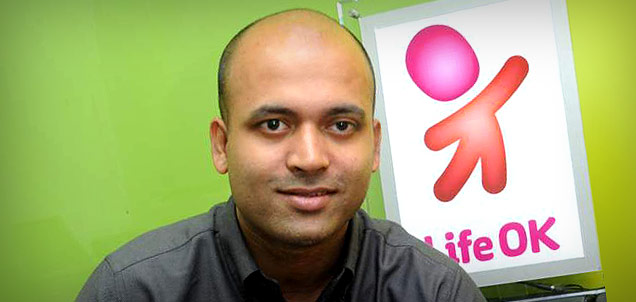
  • Life OK will be #1 Hindi GEC in 18 months: Ajit Thakur


    When the media heard Ajit Thakur was returning to the country to join Star India and relaunch its second Hindi GEC, it didn’t require Star bosses to tell us that it wasn’t just a flanking strategy. As General Manager and Business Head of the channel, he was sure to make it formidable force. Although the start may have been slow for Life OK, there appears to have been a method to the growth, says Mr Thakur in this extended interview with MxMIndia. As it happens, today (December 18) is when Life OK completes two years of existence. And on the eve of this milestone, Mr Thakur told us he wants Life OK to be the No 1 Hindi general entertainment channels in a year-and-a-half. May sound ambitious, but look what’s happened at Multi Screen Media with Sab TV consistently ahead of Sony! There are of course many content plans up his sleeve, and a refresh and brand-push is also on the anvil. Excerpts from the interview:


    Two years on, how has the Life OK journey been?

    I think it’s been a rollercoaster in the truest sense of the word. Because we’ve had as many downs as ups. For me, that’s been the joy of it. We said we’ll aim to make a place for ourselves without following the code of conduct of GECs – target the woman, do soaps and pitch these women protagonists – as the only way to grow a GEC channel. We didn’t do any of the three. So the good thing is 14% market share, 2 years later without following the three GEC codes. I’m very satisfied. And the bonus has been we’ve broken even.


    At the time of Life OK’s launch, we spoke with Sanjay Gupta and some others on the one reason why your predecessor Star One didn’t work was the attention given to it, or rather the lack of it. It was always Star Plus that was getting primary attention. Obviously your personal existence here has, kind of, changed that. Would you say the primary channel’s got more prominence even now?

    I think the big difference that has happened from Star One to Life OK is that the flanker strategy has changed to a full-blown challenger strategy. And that’s important in many ways than one, but to answer your question directly, the way it works right now is that Life OK is seen as sometimes the best, sometimes a star, sometimes as the younger sibling who wants a lot more attention in all forms.


    So everything – from internally emotionally blackmailing to whatever it takes for us to get attention, we do that. And the great thing is that the attention has been coming both in terms of softer aspects as well in terms of harder ones. Which was in terms of investment that we needed. And we’ve got it. And to the extent that now, every time I’ve met Uday in the last six months, after we’ve kind of, managed to establish: there’s only one thing he says. So when are you beating Star Plus? And that is unheard in the corridors of the Star network in the last few years. That’s the only question he asks me. And I think for that we had to make sure we put our feet firmly on the ground… which we have done in the last six months.


    Did this change happen mid-course in these two years or was it there from the very beginning?

    I think in terms of the intention and investment, it was there right from when I joined in August of 2011. That’s the reason why they wanted pretty much a separate management to the extent that we were told to run out of an independent office.


    I’ll tell you what the last 12 months has seen. And it is linked to a couple of things that happened in the universe. As we were going into digitization and LC1, there was a lot of uncertainty of what’s going to happen. By then we already had 10% marketshare. We were doing fine and all that stuff. But what it gave us in that entire churn of both LC1 and digitization and metros first and the next tier towns was that suddenly the share of the Top 3 channels in terms of absolute numbers was declining and from the lower three, two channels, one of which was Life OK was clearly growing and then six months back, we broke away from the pack. And as that has happened, it’s given us the third reason which is a tangible proof of saying that yes, it can be a good long-running GEC to saying oh, we have a serious chance at becoming No 1.


    For a long period after launch, you were not among the Top 5

    Yes, we were No 6.


    So, it took it’s time?

    Yes.


    And in the past, we’ve had GECs which turned No 1 in a year!?

    Yes.


    As mediawatchers, one wasn’t very sure whether Star India was walking the talk on making Life OK strong enough to be the No. 1?

    I’ll give you very clear answers on this. I could substantiate the numbers but because of reasons of confidentiality, I won’t. But I’ll give you a very clear answer on this. Because nobody has asked me this question so directly. There are three things.


    First and foremost, among the many channels that have launched in broadly the GEC or Hindi category, there’s been only one before us that has sustained for a good run. And all credit to that launch.


    But when we started, we said we’ll fund ourselves. So we’re not going to lose a lot of the company’s money in the first 3 years to see where we land to get that marketshare. And I’m very, very proud of that fact that we broke even at the end of our first full year of operations. At the end of June last year, we were breaking even. This year, we will turn profitable. And that nobody can claim including the one channel we’re talking about.


    There are many who’ve come, not wanting to be called GEC. And some have come and said they’ll be GECs. One has succeeded long-term, yes, full credit to them and become No 1 overnight, like you said. But nobody’s broken even or turned profitable within the first two years of operations which is important because in today’s market, as we’re getting into digitization and more and more fragmentation, the quick win doesn’t equal to sustainable, profitable growth. Today somebody can create a No 1 GEC at three times programming investments and not make money and somebody can be a No 3 GEC at 1.5x programming investments and make money. Which one would you choose? I would go for the latter.


    Hmmm.

    These are two different channels among the current Top 5 where the 3x and 1.5x is very relevant and say we’re at 1x of investment. But the 1.5x may not be a No 1 but significantly more profitable than the 3x. So that is important. Right? And then comes the third factor, which is where I think may be we are wrong, but we won’t change it. Which is that the kind of genres and programming strategy we’ve taken on, there are two things that are happening. One, there’s a faster burn in our stories. So when you pick up a show which is a family drama but rooted in domestic violence and you want to treat it like a thriller. Today, what did we come and do?


    Our first hit which was ‘Saubhaagyavati Bhava’ was treated like a thriller, not a regular kitchen soap. We exhaust our stories much faster. Second is that there’s a certain kind of viewership that is happening in middle India where there’s familiarity with the ‘Saas-Bahu’ type of shows. I have nothing against dramas, I have a predominance of dramas set in the kitchen. Right? The familiarity of that means that anything new that you want to push, either you manage to get it right but you exhaust the story fast, you don’t get noticed at all. It has happened to every two of our three launches. Because the DNA of the show is so different that you just don’t land it there. This is not for me. And for whatever it’s worth, the dominant viewer in the household on weekdays is still the housewife. The dominant viewer, I’m not saying the exclusive viewer. And that changes on the weekend. Which is why our programming changes so much.


    So every time we leave a show which you know is a sure takeoff point because it’s set in the kitchen, we have a little moment of ‘we should’ve done it’. But we haven’t done it. And we’re happy for that because now when we go back and talk about it, they’re very clear that amongst the Top 3 there’s nobody who offers them variety. There are other people who offer them variety but not the Top 3. And Life OK is definitely one of those channels that offers them the variety where there’s something for everybody in the family to watch, including kids. We have a very conscious kids strategy. At 8 pm, our next launch, ‘Hatim’ is purely designed for kids. But enough of a narrative like any of the good animations from Hollywood. Adults can watch it.


    Was the intent of Life OK being a Star Plus killer in existence from the very beginning or did it change as you moved on?

    I won’t use the word killer but I would say a serious challenger to the No 1 position. It was there right from the beginning. Both in terms of investment and intent. What the last 12 months or 6 months in particular have done is that it has given a tangible proof of that we can achieve it.


    I was telling you the three things that make us stand out is One, turning profitable, having sustained a two-year run and looking to continue consolidate, which has been the case with one more channel, but, I think no one has turned profitable so quickly. Second is that, in two years now, it seems like the journey is only 25% done. So we know the plan ahead. So we know where we want to go. And, third, and most important is that we’ve still not given into the temptation of doing the same.


    Given that there’s a Star Plus already wouldn’t it have been better for Star India to offer a channel with a similar content strategy so that advertisers can be given a better packaged deal?

    If the corporate strategy was to bring in Life OK to fill in the gaps or get whatever is left after Star Plus, we would’ve continued to be a flanker channel and we wouldn’t have been where we are today. What we’ve been told is chart your own destiny, find a space for yourself that’s distinct from Star Plus but still big enough to challenge it and cross it. So we’ve never had a brief of saying what is the best way to monetize the two channels together? If that was the brief, we would’ve remained an 80 GRP channel and at 8% share and it would still have made a lot of sense for the corporate.


    Has LC1 helped you or been a shot in the arm for you?

    What has helped us a network is that we have been aware of the power of the smaller markets much before the others and without giving details we’ve gone and activated that for all three channels… for Star Plus, Star World and Life OK. And that we did before the measurement came in. I think too often in the industry we’ve been guilty of chasing the measurement matrix to market and plan content. And I think every time somebody does that you’re always behind the trend. So we’ve taken the leap of faith and I can tell you that we’ve just gone town by town, village by village and taken the message of the network with a very unique programme that we’ve created. So much so that now there are some clients who now want to come on board on that programme. Saying hey listen, we went there and we saw a poster of Nayi Soch and Life OK Mahotsav… what have you guys done?


    So, being aware to the smaller market did help. Did digitization help? I don’t think it helped Life OK. All it did was it made an even playing field for everybody for content to finally win.


    When you started out, you had this huge digital thing. Your name was Life Ok. The fonts used in your identity were cool. You had a Madhuri Dixit as the ‘sutradhaar’ So it had a fairly urban as against a middle India feel. Did you at that point of time feel there was a bit of a disconnect?

    When I say middle India, I mean middle class India. For me that exists as much in Mumbai as in Moradabad. So for me that was never a disconnect. Over time, as the content has been consumed differently, without any intentional push, some markets have become stronger than others. So our first market that became strong was completely intentional, which was UP and Delhi. But after that an MP nad Punjab came to us much faster than Mumbai and people started saying you’re more small town India than big town India! But digitization happened and now in Mumbai we’re growing as fast as any other market.


    What about the all-important Gujarat market.

    There are so many people are competing for it, I’d rather leave it for now. The only way to cater to Gujarat is to create content for them. Unfortunately in two years I haven’t found a single show which is set in Gujarat which I’ve liked.


    In a city like Mumbai you don’t find Gujarati content?

    I found a lot of Gujarati content which is set in the kitchen. But by definition we won’t do it. So, in April we’ll do our first content targeting them and which is a musical. I can’t tell you anymore.


    We’ve had a situation where you’ve had a flanking channel which is become the No 1 in the network. You’ve been yoyo-ing with that channel – Sab TV – for a while in terms of the ratings. When can we expect a Life OK displacing Star Plus to be the No 1?

    You know I wish I knew the answer. But jokes aside, I’d give ourselves 18 months to make it happen.


    To be the No 1 Hindi GEC in the country?

    Yes. I mean, you can’t have a longer timeline then that! So I’d give ourselves 18 months.


    You have a background of having achieved a fair bit of success at Sony

    Yes, but the glass was half full. I would’ve loved to finish that. Not a fair comment to say on a LifeOK interview but family came first and I wanted to move to Singapore so all that happened. But I must tell you, I’m a big fan of what Sab TV does and that I can say officially.


    It’s a channel which stands out for me. I’m very happy for them. My personal attachment is to Sony because I’ve worked there. But for us, our destiny is not there, because nobody is trying to target the whole family. And we’re trying to make this big statement that we must in the Indian context allow the family to come together and watch TV. And not divide them and make them watch their programs.


    And by doing that if we can come to 14% and No 4, we’ll have to work much harder, but we can become 24% and No 1. And that’s what we want to do. But we’ll do it by keeping the family together.


    In terms of programming hours, is it going to change? You’ve done your share of reality shows. Not a good share but some reality shows. You’ve not had too much success with them.

    Yes, I’ll tell you on reality shows and then I’ll come back and answer in terms of programming hours. That’s why I told you that every two of the three new ideas we do, fail. And I enjoy our failures because there’s so much to learn from each one of them. On reality shows my brief to the team is don’t bring me a singing-and-dancing idea. We’ve tried a show about making people find love, which is ‘Bachelorette’ or a show about finding talent beyond just adults which was ‘Kids: Hindustan ke Hunarbaaz’ or ‘Saavdhaan’ it’s fiction, non-fiction, it’s about crime or we did ‘Come Dine with Me’..


    Did you think ‘Mahadev’ would be such a success?

    No, not at all. No clue. We had no clue.


    But you kind of put many eggs in a basket.

    On three shows.


    You also had a whole concert around Mahadev?

    Because he was a unifying hero. I have this big thing that all content must unify. So we’d think who’s the one hero who unifies? But our highest investment was on ‘Saubhaagyavati Bhava’. The second was ‘Meri Maa’ which failed. Sach ka Saamna Bhrashtachar ke khilaf: failed! Because nobody wants to see a show on voyeurism around corruption.


    Are you looking at Sach ka Saamna again?

    Yes, we’re trying to find the right take on it. Then the last one was Mahadev. Mahadev was a No 4 at that time. And by the way Mahadev didn’t take off till four months of launch. It was kind of hovering. Saubhaagyavati Bhava became a big hit. A show we didn’t promote at all called ‘Main Lakshmi tere aangan ki’ became our second big hit. A simple thing about a girl’s choices between money and love.


    So tell me, now that you’ve mentioned about the 18-month window …

    I just made it up.. but, yes, that’s it.


    … which is just a year-and-a-half away. What are the specifics you’ve thought of for what you’ve to achieve over the next one year?

    Obviously I can’t talk about specific plans but I’ll tell you things that are a part of the DNA of the team. So the first specific and it’s an important one is that we’ll continue to be modest. The problem with some of our predecessors who’ve had a good start and failed is that at some stage you start thinking that you know it all. This audience is evolving fast. The market is fast-changing. With digitization we don’t know how many more dynamics will come into it.


    An integral part of that modesty is knowing that we’ll still continue to fail more often than we’l; succeed. If we don’t keep failing, we won’t do the next thing better. This thing that we’ll have zero failure rate doesn’t exist in my dictionary.


    The second thing is that I think we’ve to take our content play to the next level. For a number of reasons. So, with advertisers now, we’re full. Our inventory is full even in the leanest months now. Because they can see the efficiency with which Life OK delivers for them. We are going to do a big award show for which we’re going to make a formal announcement around Christmas.


    Is it the Screen Awards?

    I wouldn’t confirm it right now, but the reason I’m telling you this is so that you understand there’s a method to the madness. One is about humility and continue to learn from failures. Second is about creating impact. In fact on reach in some weeks, we’re No 2 if you’ve been tracking it in the last few months. That message to advertisers has completely gone through. That Life OK has some impact properties which are not regular ‘Saas-Bahu’ shows, they also know that. But now we want to give them the impact properties as big as any channel. The only difference is that for us impact doesn’t equal to the next big dance or singing show. After the award show, we’re going to open up from March to June with impact in fiction. And there you’ll see the method to madness.


    Hmmm….

    If you realize after launch, we’ve been lying low on the brand. There’s no point going and saying this is the brand that’s gonna change your life! Until enough people are watching it. So come Quarter 1 next year, by the end of it, on the impact of the changes and stuff we’re doing in ficiton and the award show, we’re going to refresh the brand and this time we’re going to say what we want to say. A brand that wants to go more with entertainment, a brand that wants to keep the foundation.


    Have you started working on that already?

    Yes, we’re ready with it but we won’t launch it yet. Because we want to launch it along with our content.


    With the award show or later?

    First quarter, we don’t know the timing yet, but between January and March.

     

  • Impact of tech & techcos on consumer & advertiser behaviour: GroupM report


    Presenting extracts from GroupM’s observations of the impact of technology and technology companies on consumer and advertiser behaviour. This is a preview of the final report, which, complete with media investment data from around the world, will be published in the early part of 2014:


    This year twenty five years have passed since March 1989 when Sir Tim Berners-Lee, a Fellow at CERN, wrote a paper that proposed connecting ‘…the hypertext idea and connecting it to the transmission control protocol and domain name system ideas…’ The quote finishes ‘…ta da.’


    The ‘ta da’ became the World Wide Web. The rest, as they say, is history.To be clear the web created at CERN is not the web of today. For the first time tablet sales exceed PC sales and the sales of smartphones exceed both comfortably. Few of the next billion online users will use a PC-like object as the principal method of access. Additionally much of today’s digital experience is driven by the app universe in which the wire frame of the web is largely invisible. To paraphrase an Oldsmobile commercial of similar vintage, ‘This is not your father’s internet’.


    By some means of access or another it is estimated that one third of the world’s population is online. In August Mark Zuckerberg announced the foundation of Internet.org, a partnership between Facebook, Nokia, Samsung, Qualcomm, Ericsson, Opera and MediaTek to close that gap at a faster rate than the current annual growth rate of 9%.


    AdvertIsIng Was Broadcast

    Advertising as we understood it in 1989, and for at least another decade, was a function of the broadcast age. From the mid-1950s and the mass penetration of television and peaks in print circulation to the middle of the last decade when broadband became pervasive first to the PC and now to mobile devices advertisers had a reliable supply of large and mostly attentive audiences. Screen based entertainment with the exception of video games, was, in broad terms, a passive activity that became a key driver of popular culture and conversation. In this environment,marketers had few challenges in capturing the attention of audiences, which is not to say their efforts always provoked the desired action.


    In the broadcast age the short history of marketing from packaged goods to politicians was characterized by applying maximum pressure to as many people that funds and optimization allow, and pursuing share of voice which is hoped to translate over time to share of mind, wallet and,  ultimately, loyalty. The targeting of advertising used context, day-parts and geography as proxies for audiences, that everyone knew to be only modestly accurate.


    Advertisers have always built reach through the aggregation of audiences from multiple channels but this is far harder to do amid the precipitous decline in the reach of non-live individual units.


    The challenge is magnified by extreme fragmentation, ad avoidance (albeit often overstated); adblindness (often understated); time shifting; multi-tasking; active screen time and the increasing adoption of over-the-top and often ad-free or ad-light media.


    Less attention, fragmented audiences and even more fragmented channels create financial pressure on advertisers to deliver effectively in more places and on more platforms with little additional available resource.


    They are doing this by:

    # Aggregating ever more fractured audiences in an effort to recreate simultaneous and time-specific reach by matching time spent with media with the funds allocated


    # Leveraging more engagement from the premium reach they do invest in by activating against media properties in ways similar to sponsorship – this may not save money in the short term but might hedge against diminishing effectiveness


    # Rebalancing investments to increase the volume and value of owned assets (content and utilities) earning an organic dividend by successfully executing in the new stream or feed based marketing forms like Facebook and Twitter


    # Redefining audiences and realigning their planning around revenue events or proxies for them by applying better, faster, data to increase the precision of targeting and the value of outcomes


    All these strategies have two things in common. All require expertise in digital marketing and require deep data skills and both the ability and desire to leverage the creative application of technology to increase audience engagement. They also require proof that engagement pays as well as the old-fashioned, less surgical approach to advertising.


    Aggregation of audiences and Allocation of Budgets

    Mary Meeker, a partner at Kleiner Perkins Caulfield & Byers, has long been a leading commentator on the digital economy. She has been a consistent and persistent observer of the apparent disconnect between time spent with media and the allocation of marketing investment by channel.Her expectation is that eventually the eyeballs and the advertiser dollars reach parity. To a degree Ms Meeker’s view is coming true: the usage-to-spend ratio on online display, desktop and mobile, is increasingly proportionate to user time allocation. The falsehood inherent in this is that time spent is not an accurate proxy for utility nor the allocation of advertising dollars. Search is the highest utility activity but hardly the greatest consumer of time. Further, much online time is spent on activities in which advertising is either not permitted or is simply inappropriate.


    Ms Meeker also believes technology to be a catalyst of wholesale industrial disruption. This is certainly true of media. Around the world broadcast audiences are not so much in decline: rather, they are fragmenting at speed. Hours spent with traditional broadcast channels are in decline, yet linear TV hours as a whole are stable and total video consumption is rising. Last year we discussed in some detail the redistribution of long-form programing via full episode players and over-the-top TV including Netflix, Hulu and Amazon Prime, and the rise of YouTube and its global analogs. The growth of these channels continues and accelerates as the penetration of tablets, which outsold PCs in 2013, and video-capable smartphones become favored video consumption devices. 25% of YouTube’s views are to mobile devices, yet the idea of the  best available screen persists.


    As last year however a comparison with television offers useful perspective. According to Nielsen’s September US Q3 2013 Cross Platform Report 7% of all viewing is now online; the top quintile of internet video and streaming video users consume 25% of their video minutes online; and the second quintile 13%. These quintiles represent 23% of the US population. Incidentally the top quintile of all TV users is also the heaviest-consuming group of online video. The lean-back TV experience is very much alive, and often enhanced by a second screen, as we explored in this report last year. We now spend over a third of our waking time interacting with screens.


    Video usage is geographically inconsistent. Television supply is restricted in many markets and as we commented last year we expect to see viewing minutes by screen and by delivery mechanism vary significantly by market. Share of online tends to be higher where one finds ample bandwidth,device penetration and sensible ad loadings.


    The search for practical metrics between and across channels continues. Thus far, despite the progress made on viewability and cross-channel rating currencies the industry remains far from aligned. Nielsen OCR is a huge step forward but it requires all the owners of inventory to agree on the metric as a common and comparable currency.


    Click here to download complete report


  • In Week 50, Colors is No 2 Hindi GEC

    By our Research Associate


    It’s a game of yo-yo at the top.


    So, last week, Zee was No 2 and Colors has marched ahead in Week 50 of the calendar year.


    Star Plus is still the numero uno Hindi GEC. All of this is as per TAM ratings revealed to us, not directly by TAM which has been restrained by the powers that be to give the media get a first-hand update on weekly ratings. Instead we have to get it from our friends who share the info. It’s reliable but, then, we haven’t got it from TAM.


    The following are the numbers:

    Star Plus              579 {561} (548)

    Colors                   449 {456} (479)

    Zee TV                  439 {480} (449)

    Life OK                 313 {325} (334)

    SAB                        291 {260} (269)

    Sony                       267 {241} (239)


    Figures in brace brackets indicate viewership numbers for last week {Week 49} and in regular brackets for the previous week (Week 48).


  • LiveTweets of Maurice Levy presser from 3.50pm @mxmindia

    As Maurice Levy gets set to say “Bonjour” to mediapersons at a presser today (Thursday, December 19), there has been much speculation on his visit.

     

    Will it mean the announcement of an acquisition of Sam Balsara’s Madison World? Or a smaller agency… Law & Kenneth? Or is it just a coffee-and-cookies meet-the-press our friends in Mr Levy’s PR agency MSLGroup say it is?


    We spoke to a few Publicis Groupe captains and they said Mr Levy is in Mumbai and Delhi purely for reviews and meeting with major clients.


    Perhaps. But it’s not always that the bossman of one of the world’s largest advertising conglomerates comes calling to India. It’s not one of the various Exchange4media group conferences.  It’s not for a Storyboad special interview session. And there’s no FICCI/CII/IAA conclave at this time.


    Whatever be the reason, we’ll bring you a ringside view. No breaking news mailers, until there’s something major. You know we don’t like to intrude into your all-important moments at work.


    Follow our livetweets at @mxmindia from 1550 HRS. We’ll bring you text and pictures. All the khabar in under 140 characters.


    Until then, go and watch this gathering some people around you. Ensure you have a machine with a working webcam: http://www.publicisgroupewishes2014.com/


    And, yes, it takes 1487 balloons to cover Monsieur Lévy.


  • Shailesh Kapoor | Bigg Boss 7: The Coming-Of-Age Season

    By Shailesh Kapoor


    Since its start in 2006, Bigg Boss has acquired cult status in certain sections of the Indian audience, driven by youth and the urban elite. In today’s age of paid news, the programme gets sizeable free publicity in mainstream media, and has been a runaway hit with the social media in the last 3-4 years.


    Historically, Bigg Boss has not been a high-rating show, with the 3-TVR mark being considered a very good result. But there are many other factors that compensate for this, none less than the huge opportunity the programme offers for in-programme product placements and integrations. Colors has also invested well in the property over the last six seasons, upping the scale every time. The big leap, of course, was in Season 4, when they brought in Salman Khan as the host.


    If Season 5, which started with Shakti Kapoor in the house with a dozen women, was the worst Bigg Boss season till date, the current season (7) is what I’d call the coming-of-age season for the Bigg Boss franchise. It may lack a pivot like Dolly Bindra or Imam Siddiqui, who can single-handedly deliver content, but it breaks new grounds, which may impact Indian television itself, not just Bigg Boss.


    The biggest coming-of-age aspect in Bigg Boss 7 comes in the form of two very real love stories that have unfolded this season – Gauhar-Kushal and Tanisha-Armaan. In the past, Bigg Boss seasons have only hinted at romance, without much meat to chew. An episode in Season 1 ended with Aryan Vaid kissing Anupama Verma on her forehead. That, and a few massages apart, there hasn’t been much else in the name of love (or lust, for that matter) that registered.


    But the public display of affection this season has been heart-warming. Some may argue that it’s done on purpose to garner mileage and propel careers, but as an avid viewer, I’d pass that off as baseless cynicism. When Kushal proposed to Gauhar on screen, rather spontaneously, and she accepted, it was for real. They lived like a couple thereafter, till Kushal’s eviction this week.


    Armaan and Tanisha may not have formally announced their status, but it’s there for all to see. And the element of lust is apparent too, with rumours of their lovemaking in the house doing the rounds on social media. Both couples have also used the camera-free washroom rather brazenly at times. Full credit to the channel for telecasting at least some such portions.


    For me, this is a far cry from the kid-glove handling of romance and man-woman relationships that we are used to seeing on our television. Bigg Boss 7 pushes the envelope, and in a smart way that doesn’t allow for any silly protests or moral policing. After all, who can object to consensual love? (Oh wait!)


    In many of our serials, the hero and the heroine may well have been brother and sister, the way they maintain safe distance from each other, even in private moments. Perhaps Bigg Boss 7 will embolden the channels and producers to relook at what comes across, at least at times, as a playing-it-safe strategy.


    Only time will tell if this season was a real trendsetter, or just a flash in the pan when the channel got lucky because real people fell in real ishq wala love on the show. But for those who complained that Bigg Boss was way too sanitized compared to Big Brother, we have now officially moved on.


    Signs of a changing India?


    Shailesh Kapoor is founder and CEO of media insights firm Ormax Media. He spent nine years in the television industry before turning entrepreneur. The views expressed here are his own. He can be reached at his Twitter handle @shaileshkapoor


  • HT gets aggressive in Mumbai, replaces TOI as Kala Ghoda festival partner

    By A Correspondent


    The Hindustan Times is finally exerting itself in Mumbai via various city-linked activities. First it was promoting the various editorial features on improving Mumbai’s infrastructure. Then it was the awards for public-spirited citizens and organizations. And, now, there’s partnering the Kala Ghoda festival which has been a property The Times of India has supported for the last 8 years.


    The festival will now be titled ‘Hindustan Times Kala Ghoda Arts Festival’.  The theme of this year’s festival is ‘Momentum’ and the festival will also have a new section on Urban Design and Architecture.


    Speaking on the collaboration with Hindustan Times, Maneck Davar, Chairperson of the Kala Ghoda Association, said: ” Starting with its 16th edition in Feb 2014, the Kala Ghoda Association is proud to be associated with HT. In the period that it has been in Mumbai, HT has been aware of the aspirations of citizens and has instituted many campaigns that reflect the needs of the city.”


    Commenting on the collaboration, Nitin Chaudhry, Business Head, HT Mumbai said, “It is a great moment for Hindustan Times to be hosting one of the biggest traditions in Mumbai city. It reiterates our belief in the city and gives us a great opportunity to offer more to the city.”


    Speaking on the Kala Ghoda Festival’s role in building the HT brand in Mumbai, Shantanu Bhanja, VP Marketing said: “The true goal for us in Mumbai is to bring meaningful change in the city – change that is socio-economic, infrastructural and cultural. Hosting Kala Ghoda Arts Festival is a significant step in that direction since it integrates us with the arts and culture of the city.”


    The Hindustan Times Kala Ghoda Arts Festival (HTKGAF) will be held over nine days from Feb 1- 9, with 450 programmes conducted across 15 venues in South Mumbai.