Category: MEDIA

  • FoodFood adopts new lifestyle positioning of ‘It’s Sizzling…’ with 11 new shows

    By A Correspondent


    Leading food channel FoodFood has launched 11 new shows in sync with its new lifestyle positioning of  ‘It’s Sizzling…’ focusing on young urban audiences while continuing to serve its broader traditional audience base. With a whole new feel, look, colour, logo in its fresh, new repackaging, the channel aims to be a differentiator in the category of food lifestyle channels. The content is put together in tune for the discerning viewers.


    While the new seasons of some of the existing popular shows like Cook Smart, Turban Tadka, Style Chef, Mummy Ka Magic, High Tea… will reflect the change in the repositioning ,the channel  aims to woo and build a connect with today’s busy, yet health-conscious men and women who are looking for indulgence and adventure when it comes to their palette, notes a communiqué.


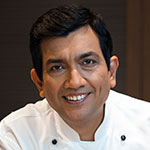
    Sanjeev Kapoor

    Said celebrity chef Sanjeev Kapoor who helms the channel: “I’m using food as a way to communicate with people that I never would have known otherwise. While we will continue with some of our extremely popular shows, all now in their new seasons, our content will be in tune with our loyal consumers enjoying the diversity in taste. Our focus is to deliver in multicultural cities, quality content that is compelling and entertaining irrespective of its origin. The channel   with its new shows and repositioning will ensure that the bouquet offered is complete and sizzling for today’s busy generation.”


  • Digitization will help broadcast economics: ZenithOptimedia forecast


    By A Correspondent


    This is the season for annual adspend forecasts and global media agency network ZenithOptimedia unveiled its Advertising Expenditure Forecasts predicting a year-on-year growth in ad spends in India of 11.5 per cent in 2014. The growth number for 2013 (over 2012) is 8 percent. The global ad expenditure growth from 3.6% in 2013 to 5.3% in 2014.


    Anupriya Acharya

    Said Anupriya Acharya, Group CEO, India, ZenithOptimedia group: “Our outlook for 2014 is cautious, though we expect the growth to happen mid-year onwards.” According to Ms Acharya, there appears to be an upswing in the mood since the Assembly election results on Sunday. Added Satyajit Sen, CEO, India, ZenithOptimedia: “All policy-making has been in a limbo, but we expect a spurt in the second half with digitization happening in full-swing.”


    According to the agency’s research team, 2013 has “overall been a turbulent year for the media industry”. “In March/April we saw changes to the TAM panel following the second stage of the digitization process (of which more underneath), followed by changes in the TAM data reporting period from a weekly to a monthly format and finally the flip-flopping over the new 10+2 advertising regulations (a cap on advertising minutage set at 10 minutes of advertising and 2 minutes of programme promotion per hour), which was supposed to take effect from Oct 2013 onwards. However, some channels have been slow to comply.”


    “Growth will be driven by inflation measures and pricing actions due to the 10+2 advertising regulations, as the restriction of supply will lead to rising prices,” it notes. “All of which means that advertisers are looking seriously at redistributing budgets to other media. On the whole, quality of content will improve on TV and we expect a consequent ratings boost thanks to 10+2 regulation. The change comes at a cost, however. There was a two-week stand-off between TAM, broadcasters and advertisers when data reporting formats were in flux. During this period, the top seven advertisers pulled their ad spots from all TV channels.”


    The ZenithOptimedia research notes that digitization will help the broadcast sector: “Following the second phase of digitization of distribution in Q1 2013 in 38 cities, the TV broadcast industry has achieved approximately 77% digitization and expects to reach 100% within the next two years.” The report adds that even though viewership ratings have been impacted, in the long term, digitization is expected to improve broadcast economics significantly.


    Internationally, the research has been bullish on adspends in the mobile sector. Mobile is going to take off big time and has already crossed television in terms of number of units, said Ms Acharya. “The internet consumption is going to increasing on the mobile and even though the smartphone number is not very high, it’s rising rapidly.”


    “The increase in mobile phone connections continues to drive growth of mobile internet penetration in India,” notes the study. “Cheaper mobile handsets and affordable mobile data packages are helping increase content downloads, and millions of users are engaged with wireless internet on a daily basis. FM Radio listenership is rising and it is a key feature used by mobile phone brands to sell handsets,” the report adds.


    On activation and BTL, the report says: “Along with changing lifestyles and the emergence of modern trade and malls in India, there has been an increase in consumption of outdoor advertising. Brands are keen to connect with consumers via experience zones and activations to ensure greater recall and amplification of brand values.


    Activation/Events are becoming more and more of a key offering in the radio and print channels. Live Music Events/Festivals have been successful in attracting widespread audience and engaging youth across key cities. Hand in hand with proliferation has come the challenge of fragmentation among audiences. Hence, advertisers are increasing the number of touchpoints to cater to addressable audiences and are selecting media beyond TV, print and radio.”


    Government advertising spend has begun ramping up as a precursor to the 2014 general elections, the report adds even as the final quarter of 2013 has “seen lower levels of investment than usual because of the soft economic environment”


  • Amitabh Bachchan is ‘Shahenshah’ of Twitterverse

    By A Correspondent


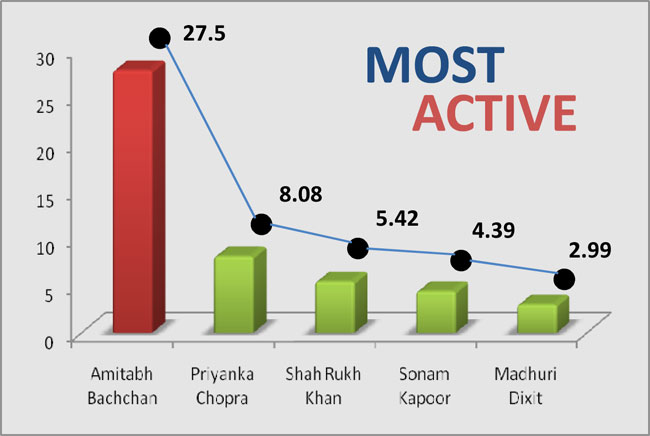
    Amitabh Bachchan has been crowned the king of Twitter among his Bollywood counterparts, as per the ‘Bollywood Twitter Index’, a social media analytics report released by To The New, a digital services network in India (which has Ignitee Digital in its fold). The report is based on research by ThoughtBuzz, the social media analytics’ arm of To The New. The Bollywood Twitter Index reveals that Amitabh Bachchan continued to reign over the microblogging site with the highest number of followers, clocking a growth of 87% over the last year. He is followed in the list by the Khan-brigade – Shahrukh Khan, Salman Khan and Aamir Khan. Making an appearance at #5, Priyanka Chopra is the only actress in this top five Indian movie celebrities’ list.
     

    Despite gaining the maximum number of followers over the last one year with 151% increase, Madhuri Dixit narrowly missed making it to the list this year. She was nudged out by the fashionista of B-town, Sonam Kapoor, who hung on to the Number 10 position with an 87% increase in followers since last year. Other significant gainers include Akshay Kumar with a 99% increase and Deepika Padukone with an 82% increase in the number of followers over the last year.


    It is interesting to note that with virtually no activity in the year, Aamir Khan has continued to gain significant numbers, having amassed nearly 2 lakh new followers in the last 2 months alone. Aamir’s only tweets in the current calendar year are about narration of his experience of meeting David Cameron, Prime Minister of United Kingdom and #ThankYouSachin during the cricketer’s last test match in Mumbai.


    The majority of conversations (around 27%) that Bollywood celebrities indulge in are about promoting their work or films. Stars also like to share their personal experiences or interact with their fan base using Twitter, about 24% of the tweets are contributed towards both of these activities. The rest of the Twitterverse discussions are based around promoting their own brands (9%), favourite quotes (7%), opinions about specific issues (6%) and social causes (4%).


    Commenting on the Bollywood Twitter Index, To The New managing director Puneet Johar said, “Movie stars have always been held in awe and treated as demi-gods by Indian audiences. The rise in popularity of social media platforms, particularly Twitter, has broken down barriers allowing fans to gain personal access into the lives of the stars that they may never have had the opportunity to interact with otherwise. Bollywood stars, who have taken to micro-blogging to engage with their fans, have gained millions of followers and emerged as powerful social influencers.”


  • SC ruling on homosexuality: Steps by India Inc to end discrimination may be hit

    By Shreya Roy & Saumya Bhattacharya


    A slew of measures rolled out by leading companies such as IBM, Google, Infosys, etc, to ensure that employees with an alternate sexual orientation are not disrespected, harassed or discriminated against, may be undone by the Supreme Court ruling on Wednesday, HR, legal experts and gay rights activists say.


    The top court pronounced that gay sex is illegal, overturning a 2009 Delhi High Court judgement that had decriminalised homosexuality.


    5-10% of India Inc’s workforce

    “With Section 377 being upheld, companies will find it even more difficult to have the tough conversations that are required in order to be fully inclusive,” said Saundarya Rajesh, founder-president, Avtar Career Creators & Flexi Careers India.


    “This gives leeway to discriminate against colleagues from the LGBT community, and more room for taunts, and harassment,” Anjali Gopalan, founder, Naz India Foundation added. “In the minds of people, this criminalises the homosexual individual and sets back years of work companies have done for inclusion.”


    “The focus at Infosys has been to ensure employees have a safe and harassmentfree workplace irrespective of their sexual orientation or gender identity,” an Infosys spokesperson said via email. “We do not foresee any changes to the policies that we have.” Infosys Gay Lesbian employees and You (IGLU) aims to create a safe and respectful work environment for employees from the LGBT community.


    It conducts awareness programs and exclusive events to create awareness and foster inclusion. “We are reviewing the situation and will want to understand the full legal implication of the ruling,” a Google spokesperson said. The company set up it Gayglers network aimed at creating an inclusive work environment by sensitising staff and increasing awareness on LGBT issues in India in 2010.


    The LGBT community makes up about 5-10% of India Inc’s workforce, according to a LGBT Resource Guide created by Google, IBM, Goldman Sachs and Community Business last year. Nearly a third of 455 LGBT employees reported facing harassment in the workplace, according to ‘Out’ number in India, LGBT Workplace Diversity and Inclusion Survey 2011-2012, conducted by Mingle (Mission for Indian Gay and Lesbian Empowerment).


    As many as 80% report hearing homophobic comments, jokes or anti-gay rhetoric at their workplace.


  • News, music channels to petition High Court on 10+2

    By A Correspondent


    With the Telecom Disputes Settlement Appellate Tribunal (TDSAT) dismissing the pleas of broadcasters against the TRAI ruling on the 10+2 minutes ad cap given the Supreme Court ruling that it (the TDSAT) cannot hear cases challenging TRAI regulations, the News Broadcaster Association and music channels are reported to getting set to approach the High Court on the issue.


    Although an NBA member we spoke with wouldn’t come on record, the decision on approaching the High Court had been taken immediately after the Supreme Court decision as the TDSAT decision of dismissal was imminent.


    However, given that the TRAI’s 10+2 regulation is in force, there is an urgency to file petitions in the High Court. News and music channels believe that the ad curtailment regulation will drive them out of business, and while they are in broad agreement of bringing down the ad duration, they believe 10+2 minutes is unachievable.


  • Kahaani Mein Twist: Nielsen cuts costs 20%+ for BARC TV measurement contract


    By A Correspondent


    In entertainment television, it’s called ‘kahaani mein twist’. In cricket commentary, you hear of ‘glorious uncertainties until the last bowl is bowled’. But in the course of business deals too, we often see twists in the tale. Or is it case of people getting real? Or is it too little, too late?

    For, the Broadcast Audience Research Council (or BARC) bosses are seeing a real-life soap opera playing out for them.

    Readers of MxMIndia would recall the reports that the BARC board had selected French joint industry body Mediametrie (along with watermarking tech provider Civolution and one or more set-top box providers) as the vendor for television measurement.

    It was a done deal. We even carried a ‘Big Story’ on Mediametrie. BARC representatives had visited France and the Frenchmen were in turn in India. The papers were getting readied, with a back-and-forth between the legal eagles.

    But after the news on Mediametrie was published, at least one other contender for the coveted contract got into action. As we know, TV measurement is currently managed by TAM, a joint venture of the research specialists Nielsen and Kantar. The latter is owned by WPP, which also runs GroupM, Ogilvy, JWT and several other media entities.

    The proposed government regulations are clear on cross-ownership – that the measurement company can’t be owned/co-owned by anyone with stakes in some media businesses. Sound logic, but then given ownership patterns of research companies, it rules out some firms. Also, cross-ownership rules have still not been administered in other media sectors.

    Given this although Kantar had made a bid for the all-important hardware tech partner phase of the BARC-ruled measurement business, there was a cloud on whether it would get the contract given the TRAI guidelines which are set to be notified soon.

    But cross-ownership wasn’t the reason why BARC ruled out Nielsen. It was dosh. Nielsen was charging the moon. Or so we were told.

    Pardon us for the looong backgrounder. But, this is television, and like the various soaps and sitcoms, some foreplay is a must. Okay, so let’s get to the point.

    Nielsen has now written to BARC saying it’s cutting price.

    Yes, you read it right. Nielsen has shaved off over 20 percent of the annual cost. President – India Piyush Mathur has reportedly written a letter bringing down the cost by Rs 13.1 crore per annum. This is thanks to the research major striking a deal with a large business conglomerate (rumoured to be the Tatas) to produce set-top box/meters and a few other components locally. The move saves Nielsen vital monies on custom duties and affords them another shot at the multi-million dollar contract.

    The rest of the scope of the project stays: 20,000 households, 25,000 meters, data, metering and collection systems and software. The all-important technology factor is a non-issue since Nielsen too is employing audio watermark knowhow. Nielsen Watermarks using audio signatures will ensure non-stop daily ratings. Given infrastructure issues in India, the crediting approach becomes critical which Nielsen has ensured it will administer very strictly.

    What Nielsen has also assured BARC is that the service ownership will be BARC’s.  Also, at the end of five years, the ownership of the meters will be transferred to BARC.

    So what does all of this mean? BARC has another Board meeting coming up next week and before that some of the technical/ commercial committee members may meet.

    What’s important to note is that the Nielsen pricing is in the region of what will have to be paid for the Mediametrie++ alternative. An industry observer told us this could only have happened with the Mediametrie number leaking out from someone in the BARC Board.

    While MxMIndia couldn’t reach BARC officials to confirm or deny these developments, according to the information available, there is a view that Nielsen may be excellent option in the short run and is a more tried-and-tested vendor, but there are many concern over costs escalating over time. The worry is that even though Nielsen has assured that the service ownership is that of BARC, in actual terms this may not be the case and BARC may have to fork out more. A lot of what Nielsen offers is proprietary, for which it could charge a royalty.

    Will TAM co-owner Nielsen be the new hardware/technology/data collection vendor for television measurement? It’s not going to be an easy decision for BARC. Like the soap opera on the GECs, we have already seen many twists and turns with television measurement. Watch this space for what happens next.


  • In Week 49, Zee is at #2

    By our Research Associate


    While Star Plus continues to be numero uno, Zee gets ahead of Colors for the #2 slot in Week 49 amongst Hindi GECs.


    The following are the numbers:

    Star Plus            561197 (548331)

    Zee TV               479878 (448553)

    Colors                456302 (478534)

    Life OK               325066 (334327)

    SAB                     260862 (269269)

    Sony                   241395 (238987)


    Figures in brackets indicate viewership numbers for the previous week. Note these numbers have not been sourced from TAM but they are sourced from a TAM subscriber which is very reliable.


  • India TV gets sent for polls, refreshes new top deck for newsroom

    By A Correspondent


    This is what news channels would call a ‘Diwali’. The big day is coming up and before the festivities begin in right earnest, it’s get to clean up the house and make it sparkling and bright.


    QW Naqvi

    After bringing in QW Naqvi, India TV has announced a round of senior-level announcements. First off is Amitabh, who after spending 18 years with Aaj Tak, joins as Senior Executive Editor. Then there’s Pranay Yadav coming in as Executive Editor. He returns to India TV after a stint at TV 9 and Shivendra Kumar, who was earlier with ABP News, joins as Deputy Executive Editor.


    The newsgathering team of India TV is now led by Executive Editor Rahul Choudhry who also comes from Aaj Tak. The team is supported by Political Editor Sukesh Ranjan who was with IBN 7. Choudhry is also joined by his Aaj Tak colleagues Shamsher Singh as Editor – Current Affairs, Prateek Trivedi as Associate Editor and Sundeep Sonwalker as Deputy Editor.


    The content style of the leading channel has changed to in-depth coverage and deep-delving analysis, informs a communiqué.


    Rajat Sharma

    Editor-in-chief Rajat Sharma will now be on primetime with ‘Aaj Ki Baat – Rajat Sharma Ke Saath’. Mr Sharma, who resumes a daily news show after a gap of over four years, said: “The India TV newsroom is fully charged to capture the excitement of upcoming general elections. Extensive plans have been made to report, analyse and present the battle for the next Lok Sabha to our viewers.”


    “Our viewers can rest assured of most accurate and responsible news reporting, which will further cement our leadership position in Hindi News genre,” said Editorial Director QW Naqvi.


    Ritu Dhawan

    Commenting on the new appointments, Ritu Dhawan, MD & CEO, India TV said: “When the channel announced the appointment of QW Naqvi as the Editorial Director in October, it was always on cards that the content team will be further strengthened to gear up for the biggest event in news genre, the general elections slated for 2014, to begin with.”


    “All such efforts are a testimony to our commitment to broadcast a perfect mix of news, views and analysis to our ever-evolving audiences and we are sure that we will be able to create and maintain a perfect content mix,” she added hinting at more defining announcements, beyond appointments, to follow soon.


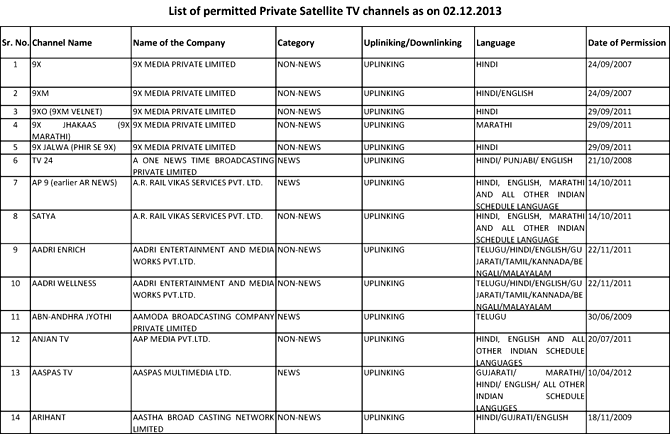
  • Vital Stats: Status of Permitted Private Satellite TV Channels in India as on Dec 2

    This is the status of permitted private satellite TV channels in India as on December 2, 2013 as per the Ministry of Information and Broadcasting, Government of India


    Permitted Satellite TV Channels in India: 784

    News and Current Affairs Channels: 389

    Non-news and Current Affairs Channels: 395

    TV Channels permitted for uplink from India and also to downlink into India: 693 (News: 373, Non-news: 320)

    TV Channels permitted for uplink from India and not permitted to downlink in India: 31 (News: 4, Non-news: 27)

    TV Channels permitted to only downlink into India (uplinked from abroad): 91 (News: 16, Non-news: 75)


  • India TV refreshes look. New studio, mike ids greet viewers

    By A Correspondent


    Leading Hindi news channel India TV has given itself a full scrub. The channel greeted viewers this morning (Monday, December 16) with an all-new look. The logo which was unveiled last Friday is now housed in a refreshed channel.


    The new look has been designed by Renderon Broadcast Design, a US-based packaging firm has Fox News and NBC amongst its clients. India TV’s new logo has been designed by brand strategy firm DY Works.


    The India TV news presentation moves to a highly sophisticated double storey set, designed and executed by Broadcast Design International (BDI). Mike Baker, former Lighting Director, BBC was flown in for lighting the new set. The new look for India TV mikes has been designed by Germany’s Schulze-Brakel that specialises in collateral design for microphone IDs.


    Ritu Dhawan

    Talking of the revamp, India TV Managing Director and CEO Ritu Dhawan said: “It is the result of months of seamless planning and execution. The channel will soon launch a 360-degree marketing campaign to promote and reinforce the rejuvenated programming and packaging. The campaign will elaborate and capture the thought and philosophy behind the revamp across mediums,” she added. It may be recalled Eleven Brandworks was retained as the channel’s creative agency a few months back.


    Rajat Sharma

    As is known, Editor-in-chief Rajat Sharma has revived his popular show Aaj Ki Baat- Rajat Sharma ke Saath.  Mr Sharma’s nightly programme will lead the refreshed look. Meanwhile, Editorial Director QW Naqvi, widely credited with the success of Aaj Tak and a team of experienced editors, producers, presenters and creative writers have recently joined the channel to execute changes in the content.


  • NDTV turns 25 at Rashtrapati Bhavan, recognises 25 legends

    By A Correspondent


    We weren’t physically present or invited to give you a first-hand view, but given the significance of the occasion, we bring you a report nevertheless. On Saturday (Dec 14), NDTV marked 25 years of news broadcasting by acknowledging 25 Indian living legends for their outstanding contribution. They were acknowledged and felicitated by the  President Pranab Mukherjee at an awards ceremony held by NDTV at the Rashtriyapati Bhawan.


    Amitabh Bachchan, Anish Kapur, Amartya Sen, A R Rahman, CNR Rao, Ela Bhatt, Fali Nariman, Indira Nooyi, Hari Prasad Chaurasia, Kapil Dev, Leander Paes, M S Swaminathan, Mukesh Ambani, N R Narayanmurthy, Rajinikanth, Ratan Tata, Sachin Tendulkar, Dr SS Badrinath, S H Raza, Shahrukh Khan, Venkatraman Ramakrishnan, Vikram Seth, Waheeda Rehman, Y K Hamied and Zubin Mehta were the ‘living legends’ recognized.


    Presenting the awards, Mr Mukherjee, said, “What is needed today and what we can draw lessons from the  outstanding performance of these 25 great Indians is that we cannot have a shortcut or a bypass to achieve the success, to reach the top, to be the models of others.”


    Addressing the ceremony, Dr, Prannoy Roy, Executive Co-chairperson, said, When we started the first private news on Indian television we were a bundle of nerves, you gave us strength at that time. When we produced India’s first 24 hour news channel 15 years ago, you trusted us then too and we value that trust till today. Tabloidization is a worry but I feel there is a back lash now. We hope and pray that sponsors and advertisers will give greater weightage to content and avoid promoting tabloidization. The time has come to launch India’s version of CNN or BBC or Al Jazeera. NDTV as a truly global channel in our sights, we need your faith, your support and trust in this venture too.”


    Partnering NDTV and Tata Consultancy Services in the 25 years celebrations were UFO Media and Hotel Taj Palace.


  • Nitin Kukreja: Role of broadcast in growing sports in India

    Nitin Kukreja

    Nitin Kukreja, President – Sports, STAR India spoke at the India Pro Leagues Forum 2013 last Friday elaborating on the ever-growing interest in sports in the country and this interest is directed towards sports other than cricket. Extracts from the keynote:


    I’ll start with a few questions: Does ‘sport’ in India really begin and end with ‘Big Boys’ Cricket’? Or do we just see it that way? Across the length and breadth of India, there are strong communities and pockets of interest where people are passionately engaged with local sports and local players – football in Bengal, hockey in Punjab and Orissa, badminton in Hyderabad, basketball played in schools and table tennis played in clubs, colleges & offices across the country.


    But if a tourist landed in India and turned on the television or turned to the sports page of a newspaper, we could forgive him for thinking that India cares only about international cricket when Team India is playing.


    Why then, has this rich diversity of interest and talent not been harnessed? Why is it that in the media, on television and in the public mind-space, sport equals international cricket? How is it that the English Premier League enjoys such a phenomenal following within the UK when the English national football team has not won an international competition since 1966! Why is it that an average 18-year-old in South Delhi or Bandra is more emotionally connected to the fortunes of Manchester United or Chelsea than say the Mumbai Ranji side (40-time winner of Ranji trophy) or the Indian National Kabaddi team (winner of all 4 World Cups played so far)? You may argue that not many nations play Kabaddi other than India and Pakistan; well – you could say the same about Baseball! The US is the best example of a country that thrives on local sports and leagues – some of their sports are played in no other country – yet they call it “World Series Baseball” and Babe Ruth is an American hero and legend.


    Americans follow their city and college teams with a passion – across baseball, American football, basketball and ice hockey; Italy, Spain, Turkey – all follow their local soccer teams with a fanaticism; tourists visiting Galatasaray are advised not to wear rival team colours while visiting! And note that all these nations consume their sport in their own respective languages.


    In the last 15 years in India, entertainment and movie channels have gone local with a vengeance; the number of regional channels has gone up from just a handful pre-2000 to over 300 today; while Hindi accounts for ~55% of TV viewership; regional language content accounts for ~30% of viewership share; and it’s not just about language; a Bengali, Marathi or Tamil show is rooted in the local culture and ethos with participation from the local creative fraternity


    It is only the sports genre in India that has remained aloof from localization – until 2008 there was no IPL, and until 2012, telecast of cricket was limited to English, a language spoken by less than 10% of India.


    In India then, how can we take local sports and leagues to the next level? Broadcasters have a big role to play in this but more importantly the entire ecosystem – the sports federations, the government and the news media and advertisers need to come together to ensure that our home grown leagues get the money, resources, infrastructure and coverage that they deserve;


    Look at the quality of television coverage for International cricket over the years – the evolution has been amazing – the production quality, the camera work, the graphics, the slow-motion replays and the immensely talented people who narrate the action – all these elements really take the television viewer closer to the game; it is immersive, engaging and a pleasurable experience even for casual viewers who are not dyed-in-the-wool fans; television coverage has played a huge role in growing the fan base and support for cricket; this is despite the fact that for all these years, all coverage was in English.


    But even in cricket – the more local forms of the game – be it Ranji trophy, Irani Cup or university cricket have so far been treated as the poorer cousin – the benchmark for coverage that has been set for international cricket needs to be duplicated in the local forms of the game. The fact remains all the international heavy weights – from Tendulkar to Yuvraj Singh to Kohli – have cut their teeth on and emerged from these local level tournaments;


    The task is even greater for other sports – where even the national level game has not got the coverage it deserves. Consider the coverage that an average hockey or football match gets – you see some indifferently placed cameras and a disinterested narrative; there has been no attempt to make the viewer experience the thrills, the speed or the skill involved; when you watch a badminton match live – it is astounding to see the speed of the game and the agility of the players. The current standard of television coverage does not even begin to capture that excitement and skill;


    In a pre-digitized world with limited bandwidth, TV broadcasters were forced to follow a one-size-fits-all approach and therefore focused on only saleable national-level content at the expense of local content and language; but in a digital world the consumer has ability to access a variety of content in multiple languages and on multiple platforms; broadcasters would be doing a great disservice if they continued to use a cookie-cutter approach and did not use this opportunity to go deeper and serve the interest of all pockets of interests whether by sport, region or language.


    Great production values are not enough, the on-ground event also needs to be organized and mounted like a spectacle – this is where the sports federations have a key role to play. They must enable and nurture talent, and promote and market the game at least in the locales of affinity if not in the whole country. They must do their part to ensure that the sports page carries interesting stories and coverage of the game and the players- and not only controversies! But most important, they need to partner with the other stakeholders in the ecosystem with the long term vision of growing the sport – without the spirit of partnership and the vision; the league or the sport will not grow.


    The government has a huge role to play – by allocating adequate monies, developing stadiums and infrastructure and putting in enabling policies in place. The government allocates around Rs. 1000 Cr. to Sports (and Youth Affairs) which is the budget for the current year. That number is less than what we will be paying only for one tournament -the ICC T20 world cup – that number is less than the number that STAR invests in sports each year. It means that Star is a bigger investor in sports in India than the government of India itself!


    The scale of magnitude of the government’s investment should be at least 10x of that number! Why do you ask? More than half of India’s population is below the age of 25 and 65% below 35; Sports has a crucial role to play in youth development and can even be a huge generator of employment. IPL has opened up career options for 120 players; not just 15. Hockey players can now make up to 60 lacs for one month of play in the HIL; badminton players can make 50 lacs for 3 weeks of work; not to mention the production, support and service staff that works on these leagues. When the hockey union went on strike in Canada a while ago, the prime minister of the country got involved because his fear was that a prolonged strike would have an adverse impact on the GDP of Canada! More than anything, it showed the power of sports and its ability to be a huge economic growth engine.


    Forget about investment, even simple hygiene factors such as easing procedures can go a long way – it cannot take 38 different permissions just to host a hockey match in a certain venue; increase venues and the number of permissions multiplies!


    It’s a vicious circle, since there is no investment, there is no growth and no popularity for local leagues and sports – therefore they attract no money! The common man (or woman) in India does not view “sport” as a viable career option or life choice; it remains a “hobby” to be pursued in free time;


    Star has thrown its weight behind building an enduring viewer proposition around local leagues and sports- and in the language of the people. Our tryst with these local sporting leagues has thrown up some interesting results:

    • We partnered with Calcutta Football League, one of the oldest leagues in Asia and in the world with 157 kolkata based clubs and units to air their league matches on our Bengali movie channel. In the core national male audience, the TV viewership is 4-5x higher than your average EPL match! Even with the current quality of football and coverage, an East Bengal-Mohan Bagan match attracts crowds up to 70000 in the stadium!
    • We also partnered with Hockey India League the first edition of which was held in January 2013. The excitement on grounds was to be seen to be believed. For e.g. grounds in Ranchi were completely packed to support their Ranchi Rhinos team which went on to win the league; there was a lathi-charge 2 days before the match when demand for tickets got out of hand and in fact when the match was on – even the neighbouring stadium that simply had a big screen projecting the match – was full! The excitement rivalled that seen in Wankhede stadium or Eden gardens during high-octane international cricket;
    • University cricket is another great example – during the Jamia vs Bangalore’s Jain university match, stadium was so packed that it took 40 mins to enter; and the crowd was chanting – not “Sachin Sachin”, not “India India” but “Jamia Jamia”!


    The pockets of passion exist; it is on us collectively to harness and magnify them


    The IPL has shown the way in how to mount a successful local league; granted that it was built on an already popular sport – but all the stakeholders have done a great job in coming together to mount it like a spectacle – it is no longer a game but entertainment and a serious alternate to any other movie or television show. Clearly, a “manoranjan ka baap”


    There is a lot more to be done and many challenges to overcome. It will take a spirit of partnership with federations and people with vision to get there – for the benefit of sports, for the benefit of the country and for a healthier and fitter society!