Category: MEDIA

  • A request from MxMIndia: Please go out and Vote!

    It’s Wednesday, December 4, 2013, and it’s Voting Day in Delhi for 70 Assembly seats (and 40 Assembly seats in Mizoram).


    Although there have been announcements of a paid leave in Delhi, given that a large number people – especially in the media – flock to Gurgaon and Noida where there are no elections, it’s business as usual.


    There have been concessions given on coming in a few hours late allowing people to vote. We think it’s important to not just give these concessions but also some incentives. Show the indelible ink and get a scoop of ice cream or beer. Or some such.


    Do whatever, but vote one must. We keep cribbing about how the corruption. The rising prices. The general decay.


    Participating in the polling process is a good way to help make our country a better place to live in. So, go out and cast your vote.


    And await the exit poll results from this evening and the final counting on Sunday, December 8.


  • 40% preferred COD in their online Diwali shopping: IAMAI

    By A Correspondent


    While credit card usage took precedence over cash in online shopping during Diwali 2013 as per a survey by the Internet and Mobile Association of India (IAMAI), the COD delivery is not insignificant at 40 percent giving an indicator of confidence levels over sharing vital credit card info online. The dipstick study conducted from October 30 to November 4 in 15 cities, to understand the online shopping trends during the festive week, finds that majority of the transactions took place through credit card, debit card or net banking. The survey finds that 59% of the respondents used credit card to shop online, while 28% used debit card, reflecting the maturing of consumer behaviour in urban markets. 40% of the respondents however, mentioned that they opted for cash on delivery as their payment mode. A total of 3480 responses were received to the survey.


    Source: IAMAI, 2013


    The survey also revealed that electronics and accessories topped the list of items for online shoppers during Diwali. 41% respondents said they purchased travel tickets online, while 39% said they purchased garments.


    Source: IAMAI, 2013


    29% of the respondents mentioned that they purchased products in the range of INR 3000 to INR 5000. Interestingly, 20% of the respondents said that they purchased goods worth more than INR 10,000 and above. A mere 5% said they purchased goods worth INR 100 to INR 500.


    According to the survey, Flipkart was the most frequented e-tailing site followed by ebay, Snapdeal and Jabong. Among the booking sites, IRCTC was the top followed by Bookmyshow, MakeMyTrip, Yatra and Cleartrip.


    Source: IAMAI, 2013


    According to the survey, 31% of online shoppers were from Delhi NCR followed by greater Mumbai with 22% respondents. Bangalore was third with 12% respondents.


    Source: IAMAI, 2013


  • Pharma giant GSK’s sign-on bonus demand leaves adland divided

    By Pritha Mitra Dasgupta


    UK pharma major GlaxoSmith-Kline’s demand for sign-on bonus from advertising firms to do business with it seems to have divided the Indian advertising and marketing fraternity into two camps on the social media.


    While GSK’s move is being condemned by international advertising agencies that have termed it ‘scandalous’, ‘lazy’ and ‘bullying’, some industry veterans in India support the rebate, saying it will put a leash on media agencies that, they allege, discreetly charge over 10% commission and show 2-3% on record.


    Following an Economic Times story on the matter on Monday, advertising veteran Preet Bedi, who has worked with Rediffusion Y&R and Lintas, wrote on his Facebook wall, “The concept of a sign-on bonus payable by agencies to clients is a masterstroke. As an agency man, I would obviously have opposed it but from the outside, I know it’s a great idea.”


    His reasons – “one, it forces agencies to pitch only for brands they really wish to be associated with and vice versa. Secondly, it forces agencies to make upfront investment in the new business; currently agencies spend peanuts on new client acquisition. Thirdly, it will force transparency in agency remuneration.”


    He also says that the move will lay bare a fraud, media agencies often perpetrate. “U (sic) will find media agencies agreeing to pay more than one or two year’s declared revenue as sign-on bonus. How? Because the actual margins are often double or even triple the declared margins. Quite brilliant; Martin has met his match,” Mr Bedi posted on Facebook.


    This sparked a virtual debate on Mr Bedi’s Facebook wall. Harit Nagpal, managing director and CEO, Tata Sky, supported GSK’s move saying, “Why are agencies complaining? If none of them is willing to pay, it won’t happen. And if even one of them is willing, and the client goes for it, disregarding the agency’s merit, he deserves it.”


    Kedar Anil Gadgil, principal consultant at Druid System, however, called the concept “an oligopoly of rich, established agencies creating a moat around their castle to protect it from the outsiders” and added that agencies should knock the door of competition lawyers to safeguard their interest.


    Mr Bedi, however, opined that nothing can stop sign-on bonus from getting implemented. “…don’t waste your money trying to fight it. If clients want it. (sic) It will happen,” he commented.


    He also wrote that while a client contributes an average of Rs 10 crore to an agency’s revenues, “the input on winning a brand is miniscule.”


    Vikas Mehta, head of Euro RSCG, Oman, countered it, “The average client does not give an average revenue of (Rs ) 10 crores. Even in the top 5 Delhi agencies, average client revenue will be less than (Rs ) 5 crores and average brand revenue still less. Not workable.”


    The fear of many advertising agencies is that if GSK is successful in implementing this, then other marketers may follow suit. In the UK, before GSK made its demand for sign-on bonus, Premier Foods that owns brands like Bisto and Hovis had parted ways with its media agency Starcom MediaVest over “investment payment”, head of an advertising agency said. “So it seems more and more marketers are warming up to it,” the person added, requesting not to be named.


    Industry bodies have come out against the sign-on bonus concept. While the Advertising Agencies Association of India has already said it should be “discouraged strongly”, International Advertising Association’s India chapter president Srinivasan K Swamy, said it is an “impractical concept.”


    “No marketer or a right thinking person would ask an agency to pay a sign-on bonus. A buyer has to pay for the goods and services he buys and it could not be the other way round,” said Mr Swamy who is also the chairman of RK Swamy BBDO. “If I have signed a contract with my client that says that if sales drop then I will have to pay a penalty then that could be worked out. Otherwise, why should an agency pay a penalty?” A mail sent to Indian Society of Advertisers chairman Hemant Bakshi, who is also the executive director, home & personal care at Hindustan Unilever, remained unanswered till late on Tuesday.


    R Ramesh Chandran, co-founder at Xtravision Media Associates, wrote on Mr Bedi’s Facebook wall that Reckitt Benckiser had tried something similar three years ago, with some tough demands such as fee to pitch for the business and penalty for not meeting CPRP targets.


    “…nobody pitched…it fell into ZOD’s lap due to international alignment… the situation at ZOD is quite a common knowledge now…Reckitt account is up for grabs again,” Mr Chandran wrote.


    Source:The Economic Times

    Copyright © 2013, Bennett, Coleman & Co. Ltd. All Rights Reserved

    Licensed to republish


  • Kyoorius about Digital & D&AD: Interviews with Laura Jordan Bambach & Tim Lindsay

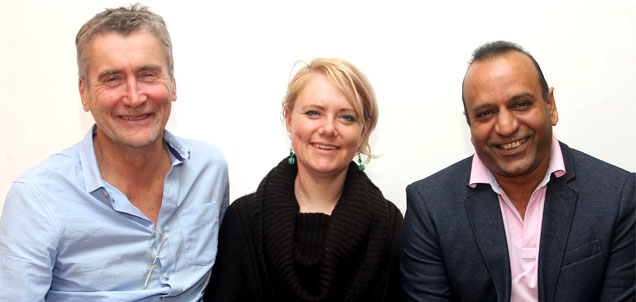
    Laura Jordan Bambach and Tim Lindsay with Rajesh Kejriwal, CEO and founder, Kyoorius


    Laura Jordan Bambach, Executive Creative Director of Mr. President and president of D&AD, and Tim Lindsay, CEO, D&AD,  were in Delhi and Mumbai last week for Kyoorius FYIdays and to evangelise the D&AD awards. The Kyoorius FYIdays is going to be held on a regular basis, presented by &pictures in partnership with CNBC-TV18’s Storyboard (Disclosure: MxMIndia is a media partner of the event).  The 100-plus audience in both cities (who paid Rs 1500+taxes) to get there is testimony to the success of the effort.  Good content ensures good, interested crowds, says Rajesh Kejriwal, founder-CEO, Kyoorius, matter-of-factly. Pradyuman Maheshwari and Johnson Napier caught up with Ms Bambach and Mr Lindsay at the Mumbai leg of Kyoorius FYIdays and a D&AD-hosted evening for the ad frat.


    It’s harder to win a D&AD award than any other award: Tim Lindsay With 4G, I hope to see a real shift to digital: Laura Jordan Bambach
    D&AD needs no introduction to the creative fraternity in India. But, as with the craft that it evangelises, the only way to move ahead is to refresh and grow. Earlier this year, it inked an agreement with design specialists Kyoorius to conduct the Kyoorius Awards. And now D&AD has yet again partnered with the Rajesh Kejriwal-led Kyoorius to promote the coveted D&AD awards.

    Tim Lindsay, CEO, D&AD was in Delhi and Mumbai to meet with the industry and reaffirm its commitment to give back to the industry, especially the young, in terms of providing quality training and education. Lindsay underscores the difference that D&AD brings to the table as a not-for-profit initiative.


    We hear D&AD has big plans for India

    Yes we do have big and important plans for India. We are not going to get everything done overnight; it’ll take us some time.


    But India is Cannes-country

    Well, everyone is a Cannes-country but we are different from Cannes. If I could put it crudely, the money that we generate we put it back in the industry mainly supporting new creative talent coming into the industry. While Cannes is a wonderful effort – and I love going there –it takes money out of the industry and invests little through training, seminars etc but D&AD is there to stimulate support and inspire creative excellence.


    It’s not that D&AD is new to Indian creatives. You’ve been getting a fair number of entries for your awards. So what’s going to be different?

    Yes we have been getting entries from here. Where India is concerned I’d like to share some personal experience here: I used to be president of Lowe Worldwide and while Lowe and Lintas were going through that global merger and when I was coming here in India for the Board meetings, i started to get a very healthy respect for high quality of Indian advertising particularly the stuff that was intended to change behaviour of a product…but given the level of talent and quality of work from design and advertising I think India is under-represented at D&AD so we would like more D&AD jurors, we would like more entries from India…


    R Balki, you know, doesn’t send entries to awards. Will you convince him to take part in your award show?

    I doubt that will happen but I have a healthy respect for his standard of work. The work that they have done for Lifebuoy is fantastic.


    What’s the one thing that should convince the fraternity to send in more entries to D&AD

    D&AD operates at a number of levels. In terms of the awards, it is the global yardstick for creative excellence. We are not ashamed to say that it is harder to win a D&AD award than any other award; the quality and integrity of the judging process at D&AD is better than any other awards show and what makes that the case is the quality of jurors that we have. We have around 200 fantastic people from around the world and about 60 per cent from outside the UK… so to be awarded a Pencil and be judged by that set of people is a huge accolade. The more important thing is that we reinvest all the money we make from our award show and the commercial activities. And because our awards income, which is the main part of our revenue, comes from all over the world including India we want to support creative industries in those places from where we derive our income.


    So from the entries that you have been getting from India thus far, have you reinvested in India?

    Not in the direct sense but more in terms of setting a standard and being an inspiration to the creative industry we have. But we have made some changes in the last 2-3 years where we have a D&AD Foundation and we want to spend the money we make in the most effective way to support creative excellence around the world. Also, there are key centres of excellence and India is in the process of becoming a great creative superpower of the future.


    In terms of the number of entries, what is the growth that you expect from last year?

    Through our partnership with Kyoorius and because of the footprint they have in the design and advertising industry, we would certainly help raising awareness of D&AD and that will certainly help having a positive impact on the awards entries. We should be happy to get over 500 entries as a start this year.


    The Indian ad industry has been faced with two issues for long: one is scam ads and the other one is plagiarism. How do you handle that at D&AD?

    The plagiarism thing is easier to answer. A lot of ideas get borrowed and sometimes ideas come up simultaneously in different places and have no connection with each other. What we do to tackle plagiarism is we choose the jurors and we do not interfere in any way and they make their own decisions. Also, at D&AD we do not have to give an award to any category so usually we do not give awards in 2-3 categories because the jury does not find the standard of work high enough.


    Scam advertising is a completely different thing. The questions we ask are: is it for a real brand, is it for a real client brief, did it run (in case of advertising), did it sell (in case of design) and did the client pay for it. The things that we think are not right we research and if the jury expresses any doubt on a piece of work,  we check it out further. I think the level of awards for scam ads has gone down in the past 5-7 years because the shows have been more stringent and systematic about checking things out.


    Does the D&AD award show also entertain creative entries from media agencies?

    The twin-core of D&AD when it started was advertising and graphic design and it has expanded to include other digital categories and also product design, retail design etc.


    What has been your experience with the Kyoorius Design Awards this year?

    I have only heard good things about the Design Yatra and I think we can surely help as we know how to run an awards show be it the entries, judging process etc we can only make it a smooth affair. I am sure that it would grow only further.


    Would you like to look at organising an advertising award here in India?

    Yes, certainly. We want to.


    How soon?

    It is still early days to talk about that.


    Laura Jordan Bambach has been to India before, but so impressed was she in her last visit to the Kyoorius Designyatra, that she chose to come in for the inaugural Kyoorius FYIdays initiative held in Delhi and Mumbai.

    Bambach, Executive Creative Director of Mr. President and current president of D&AD, spoke on how brands can survive in a digital world. To drive home the point, Bambach provided examples and ideas that companies could adopt to make their way into the hearts of their consumers.


    MxMIndia caught up with the digital diva and got her to share experiences and digital mantras that brands can be adopted here in India. That, and also the possibility of getting her agency Mr. President to launch operations in India. Excerpts:


    There’s so much being said about how digital is changing the way companies are going about doing their business. Is it for real? Is digital really as big as we think it is? Or just a lot of talk and less action?

    I think in terms of the actual consumer behaviour and in terms of the changes it brings about in the society ,it is very real and also very powerful. I think what entities like Twitter and others have done is that they have changed the equation between consumers and brands. If you love a brand, you almost expect to be a fan of the brand and you expect the brand to participate in the conversation and communication that happen on the platform…


    But ‘likes’ are not necessarily a true indicator of what’s going on out there, is it?

    Yes it’s not but if someone has a like on Facebook and if they are a real fan of the brand and if they are really talking to you about things that they find interesting and you are building a community then it’s great. Like, for example, I worked on a big project for a telecommunications company and they did a fantastic television commercial where you could chose the outcome for the main characters involved on Facebook…they ended up getting around 1 million likes because the story was really engaging for people watching the television ad. But they found it impossible to translate that into conversation for brands because the people that liked the television ad aren’t necessarily the same people that buy their products so it’s not used in the right way as it should.


    One of the reasons that there is not much work happening on digital is because agencies work on commissions. And while they make more money from television commercials which they can’t out of work on digital. Do you think this is the reason why there isn’t much evangelisation of the medium and there’s not much quality original creative work?

    I think what you’ve said is right and the budgets we have to work with for a digital campaign compared to those for television commercials always shock us, but I think there are great examples of integrated work where big budgets are going towards connected campaigns with social and digital thinking being at the heart of it.


    While we talk of integrated work the reality is that most of the work is being done for the medium of television which is then redirected to digital…

    It’s the common way of doing things, but it is the wrong way. If you can unlock the digital strategy first and not the medium then it could work. So it does not matter what medium it is expressed in but I think having a digital strategy at the heart of a brand is what is going to make it more successful.


    So we shouldn’t feel too bad about the state of digital affairs here in India. It’s essentially the same problems that are faced in the more developed markets like Europe as faced here.

    Yes, it’s kind of the same but we shouldn’t feel too bad about it.


    Is it also an issue of talent, especially in digital agencies that are not able to find good talent…

    Sometimes you need to have the good old-fashioned thinkers and planners, which is not impossible to find. There are plenty of agencies out there who are more digital-centric and who have great talent to handle everything.


    What is your view on the kind of work that gets produced out of India?

    In general I think the work out of here is just fantastic. Digitally I think we are not seeing loads of work atleast at D&AD from India. I think with the rollout of 4G internationally I am hoping to see a real shift to digital…


    Talk of performance at award shows and India has put up a bad show where digital is concerned be it at Cannes, Spikes or the recent Digital Fest. What according to you should the agencies be doing to spruce up their digital tally?

    What I have observed elsewhere from small agencies is that it takes a disruption between the agency-client process. You will find some really good integrated digital work coming out of countries like New Zealand and Australia and it has to do with their attitude of being different.


    But given that India has long history of storytelling and folklore still doesn’t put us up there in terms of creative wizardry…

    Yes I agree. I think India’s design work is comparable to some of the best that there is…even traditional advertising. It’s just the digital category has not produced enough top-notch work as yet…


    If you were to offer pointers for marketers or agencies on what the approach they should have towards digital, what would they be?

    Firstly, they need to find stories that people want to hear not what they want to tell. Also, how you launch something is also important as what you launch so you need to have a good strategy on how you are going to do that. Be brave; look two things at social for – insight and inspiration. Digital agencies need to channelize their focus on strategy as if they are to become big in the future then they should have proper strategic direction or else they’ll end up becoming production houses.


    Lastly, when do we see Mr. President in India?

    Yes, we are working in that direction but I cannot disclose the finer points on who is going to be our partner or things like that. But it’ll happen very soon.


  • Bloomberg TV India asks viewers to upgrade in new brand campaign

    By A Correspondent


    Leading English business news channel Bloomberg TV India will launch a new brand campaign that invites viewers to ‘upgrade’ from their current choice of business news channel.


    Said Ms. Amrit Rai, Business Head – Bloomberg TV India, on the new brand campaign: “As the nation’s leading English business news channel, our viewers have had the opportunity to watch and listen to some of the biggest names in business share their perspectives and insights. The new brand campaign emphasizes these key attributes of the channel and the inherent advantages that a viewer can enjoy by being with the world’s largest financial news network.”


    Vivek Law

    The campaign created by Triton Communication will reflect the inherent benefits that a viewer will get, given the strong content that the channel presents, backed by a strong Indian editorial team led by Vivek Law, Editor Bloomberg TV India and the advantage of its global network, noted a communique. The Triton creative team is headed by Renton D’Souza.


  • Former Hindu CEO Arun Anant moves to Hindustan Times

    Arun Anant

    By A Correspondent


    He faced the axe at Chennai-based newspaper company for doing his job well. And in less than two months of the controversial coup that saw editor Siddharth Varadarajan and his exit, CEO Arun Anant’s next port of call has been announced.


    Mr Anant, the affable media former CEO of The Hindu, is all set to join HT Media this month. He is to take place in the Leadership Team of the group and will report to Executive Director Benoy Chowdhury. Although the nitty-gritty of his role has not been revealed, Mr Anant is likely to be taking up a top media marketing responsibility.


    Having successfully fought the onslaught of The Times of India in Chennai and also launched the Hindu’s Tamil edition, Mr Anant has had rich experience in multiple media entities. He was part of the launch of what is now Bloomberg TV India from 2007-08 and for two years with Myiris.com, a B2C financial markets portal. He had a decade-plus stint with Lintas India in various functions and in a start-up advisory for a few years post the UTV job.


    Mr Anant is an engineer from IIT-Varanasi (BHU) and a postgraduate in management from IIM Ahmedabad.


  • Mumbai to get new Urdu daily ‘Avadhnama’ from Jan 9

    By A Correspondent


    Mumbai has a 35 lakh Urdu-reading population, and hoping to reach out to as many of them as possible with his new Urdu daily Avadhnama is senior media professional Yunus Siddiqui. Mr Siddiqui, who has spent a bulk of his career with the Mid-Day group which included the Urdu daily Inquilab, is Director (Editorial & Printer-Publisher).


    Avadhnama daily is already in existence with editions in Lucknow, Faizabad, Aligarh, Azamgarh, Saharanpur and Kanpur. Launching on January 9, the Mumbai edition will the seventh, and other language editions are set to follow – specifically Marathi, Hindi and English, notes a communiqué.


    According to a note circulated to advertisers, 44 lakh Muslims in Mumbai constitute 20% of the population with all major Muslim groups well-represented in the diverse population. More than 35 lakh of these 44 lakh Muslims are native readers and speakers of the Urdu language.


    The launch edition of the Mumbai edition will see 50,000 copies and Mr Siddiqui hopes to double it “very soon”.


  • Re-run Hindi GEC genre could see some action as Colors tests signals for Rishtey & Pratik Seal moves to Star Utsav

    By A Correspondent


    The re-run Hindi general entertainment channel genre has met with limited success in the country. Doordarshan had DD Bharati, Star India has Star Utsav and earlier this year, Zee launched Zee Anmol. But now comes the news that Colors is set to launch Rishtey. How well Colors is able to rewrite the rules of the game remains to be seen, but the action in the genre has begun. According to industry circles, some revving up with news on Rishtey is being seen. Star has already moved former Life OK marketing head Pratik Seal to the role of the Star Utsav business head. Mr Seal was marketing head of Micromax before he moved to Star India.


    Pratik Seal

    Rishey is an existing Viacom18 entertainment channel from the Colors bouquet. It was launched as the second entertainment channel from Viacom18 in the UK market and has met with much success.


    Now Colors hopes to extend this relationship with viewers to India with the free-to-air GEC. In fact Doordarshan’s DD Direct DTH service website already has this post: “DD Direct Plus added a new general entertainment channel Rishtey to its channel line up by replacing Test 308 channel. Rishtey is a new Entertainment channels from Viacom18 group. The channel is a test feed and it is going to be officially launched soon.”


    When asked, a Colors spokesperson said “Rishtey, the second entertainment channel from the Colors bouquet that was launched in UK last year has had a very successful run. This free-to-air channel has reached out to a much wider audience base and has held a strong No 2 position in the Hindi GEC category in UK. We are currently testing the signals for Rishtey in India and will launch the channel at an appropriate time.”


    Media planners are meanwhile happy to see the revival of the re-run genre. According to a planner who preferred anonymity, television has various new entrants, and re-runs can do very well if packaged and marketed well. “What we have seen right now is shovelware – just dump some old hits. If there’s a good programming strategy and if marketed well and even if there’s some new content put in as a teaser, it could easily cross the 100 GRP mark,” he said adding: “We have seen a classic case of CID re-runs on Sony. The channel has made hay with them.”


    Hmmm. Watch this space.


  • Sony’s slide unabated. Now Colors at #2 is twice gross viewership of SET

    By A Correspondent


    It’s a story that saddens our heart. Sony Entertainment Television, the Hindi general entertainment channel with spunk, the channel that’s got in some really top programming like CID, Indian Idol, Crime Patrol and even Kaun Banega Crorepati (though not this season), continues to have awful ratings.


    Its gross viewership ratings in Week 48 of this calendar year, as per TAM, is at a lowly 239 million. To be precise 238987. Colors is at 479 (or precisely 478534). And Star Plus way ahead at 548 (548331).


    This is how the ratings numbers stood (in million)

    Star Plus              548         (560)

    Colors                479         (513)

    Zee TV                 449         (433)

    Life OK                 334         (335)

    SAB                       269         (308)

    Sony TV                239         (269)


    The figures in brackets are those for last week (Week 47). It may be noted that TAM does not (or is not allowed to) share viewership numbers with the media. So we rely on what is dished out to us by some subscribers. Consequently, we can’t vouch for the authenticity for these numbers with a ‘sar pe haath rakh kar’, but we trust the source reasonably.


  • Shailesh Kapoor | Live Election Results: A Reality Show Like No Other

    By Shailesh Kapoor


    In more than 30 years of active television viewing, no content has fascinated and captivated me more than live election results coverage. It’s the biggest reality show ever, unfolding in real time, with aftermath that can last for years, if not decades. One such reality show will play out this Sunday. And then there will be an even bigger one some time in the summer of 2014.


    In the good old Doordarshan days, General Election results were four-day long affairs, interspersed by Manoj Kumar films. When the Electronic Voting Machines (EVMs) were introduced in 1999, it meant that four days of excitement would crash into about four hours. Initially, I detested the EVMs for doing this to me. But over time, I have grown to love this new rapid-fire, T20 format of election results.


    Election results coverage is now all about thinking on your feet. As new data flows into the system in real time, it is impossible to rehearse this coverage out. From shifting between politicians and experts on one hand and between various states on the other, the anchor of such a show can find his plate too full for his own liking. Hosting live election coverage has to be the most challenging camera-facing job on TV today. The post-analysis leading upto government formation, which may last anything from one day to upto two weeks, is the more familiar news part, albeit nail-biting at times.


    Much as I enjoy it immensely, I have two pet peeves related to live election coverage that I hope are addressed soon. The first one is about the use of technology. There is just too much focus on portraying the technology as the hero of the coverage. Many channels run promos of their election results shows highlighting how their touchscreen-based technology or their graphics software are the best in the business.


    I fail to see the point. Good technology, unless it is a technology program we are talking of, should always be invisible. It is meant to seamlessly enhance the viewing experience, than become the star in the room. Live sports do it so well. Perhaps, they get more practice. And with so much talk about ‘high-end’ technology in live results coverage, if you still can’t ensure basics like your cameramen are not visible all over the show, you haven’t done your technical rehearsals right!


    My second pet peeve is more psephology-led in nature. With 63 years of elections history behind us, out of which about two decades have involved active use of computers, one would have expected news brands to have created some concrete metrics and indices to capture insights in a more structure and predictive form. This has not happened, and as a result, rarely are learnings from past elections used to analyze current results, except an odd anecdotal comment by an expert, which is often biased to lead to a pre-decided conclusion in his mind anyway.


    Psephology is a science before it’s an art. Yet, it unfolds on our television more like the latter, with wordsmithery being its primary form of execution, instead of any robust data-led indicators. In fact, such indicators, and not technology, can become true differentiators of a news channel’s election results coverage.


    But these are only minor irritants in what is the most enthralling television content for me. Come Sunday, and I shall be all eyes and ears from 7 am onwards.


    Shailesh Kapoor is founder and CEO of media insights firm Ormax Media. He spent nine years in the television industry before turning entrepreneur. The views expressed here are his own. He can be reached at his Twitter handle @shaileshkapoor


  • Matrimonials rise 202% in wedding season: IAMAI-IMRB report

    By A Correspondent


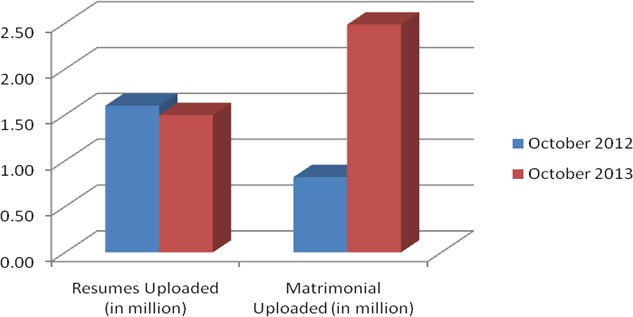
    According to the latest Internet Economy Watch, published jointly by the Internet and Mobile Association of India (IAMAI) and research firm IMRB, the number of uploads of matrimonial ads rose to 2.49 million in October 2013 as compared to 0.82 million in October 2012, registering a y-o-y growth of 202%. The number of resume uploads though has decreased to 1.50 million in October 2013 as compared to 1.60 million in October 2012.


    Fig: 1

    Source: IAMAI/ WAM Data October 2013


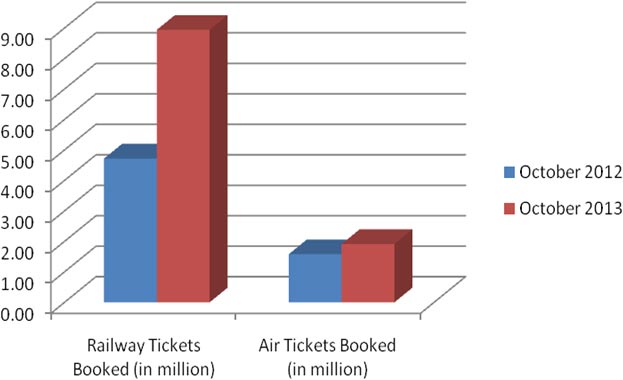
    Online bookings of railway tickets registered a y-o-y growth of 90%. Railway tickets booked online in October 2013 were 8.94 million as compared to 4.72 million in the corresponding month last year. The online bookings of air tickets witnessed a marginal increase with 1.91 million online bookings in October 2013 as compared to 1.58 million bookings in October 2012.


    Fig: 2

    Source: IAMAI/ WAM Data October 2013


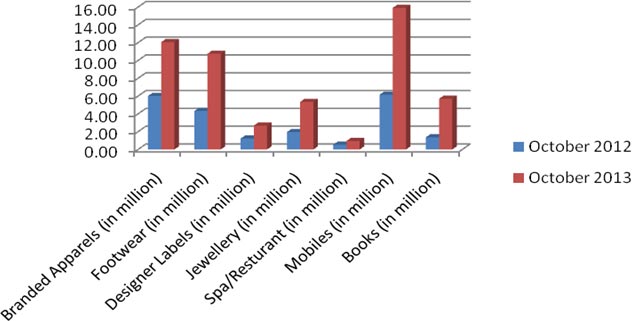
    According to the data captured from major e-tailing sites online user visits to jewellery segment increased to 5.35 million in October 2013 as compared to 1.95 million in October 2012 registering a y-o-y growth of 174%. The mobile segment has registered a significant increase with 15.91 million online hits in October 2013 as compared to 6.15 million hits in October 2012.


    Fig: 3

    Source: IAMAI/ WAM Data October 2013


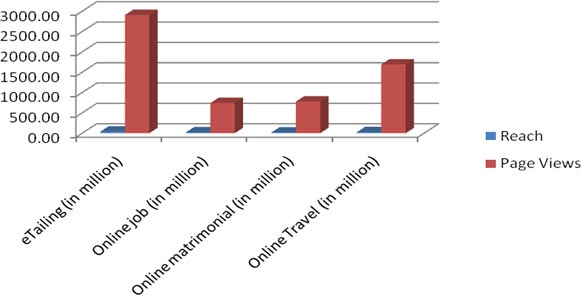
    The monthly tracker further indicates 41.16 million people accessed various e-tailing sites. There were 2906.78 million page views in the category. The user reach for job and matrimonial websites is 20.59 million and 18.03 million respectively with 741.60 million and 777.16 million respective page views. Online travel segment has reach with 24.51 million reach and 1691.095 million page views.


    Fig: 4

    Source: IAMAI/ WAM Data October 2013


    Sourced from all India active internet data, the monthly internet tracker is based on WAM data captured from various relevant sites, and encapsulates online usage for E-tailing, Online Travel and Vertical Classifieds.


  • Mediaah! Who will be the Impact Person of the Year 2013 + Why Uday Shankar is the Mediaperson who created maximum impact this year

    By Pradyuman Maheshwari


    As I write this, I have been inundated with calls and smses asking me who the Impact Person of the Year is for this year. I was associated with the exchange4media group for nearly three years, but I am not much in touch with people from the group. So I don’t really know.


    And I am not invited for the IPOY event ever since I quit. Nothing alarming about it. This is how things work in the media. You will not find the Filmfare editor at the Screen awards or vice versa. You will not find the Overdrive boss at the Auto Car India awards. This isn’t how it works in advertising… many of Lowe’s competitors assembled for its internal awards earlier this year.  And you can be sure to find rival film-makers at each other’s film release.


    But that’s not the reason for writing this. The question is who will win the Impact Person of the Year to be presented this evening (Friday, Dec 6). Since IPOY is based on voting monitored by IMRB, the award-winner is selected as per voting from the fraternity. There have been rumours that it is Vineet Jain, Vice-Chairman of Bennett, Coleman & Co, and a little birdie has told me who the winner is, but let’s look at the nominees (in alphabetical order of their last names):


    Rajan Anandan Managing Director, Google India

    Punit Goenka, MD and CEO, Zee Entertainment Enterprises Limited (ZEEL)

    Vineet Jain Managing Director, Times Group

    Bharat Patel, Former Chairman, ISA and Hemant Bakshi, Chairman, ISA

    Rahul Sharma, Co-founder, Micromax Informatics

    CVL Srinivas, CEO, GroupM South Asia

    Sameer Suneja, Global CEO, Perfetti Van Melle


    Let’s start with the process of elimination. Messrs Patel and Bakshi have done some splendid work in their own professional lives and they need to be commended for the ISA to the stand up to the IBF in the controversy on the television measurement boycott, but I am not very sure whether they would quality for the IPOY.


    Sameer Suneja goes out next. His ascent is noteworthy, but he’s not the first Indian corporate honcho to go overseas. Rahul Sharma’s rise is well-known, but 2013 was not the year of Micromax. In fact, Nokia has been shining high.


    The four nominees in balance are Rajan Anandan, Punit Goenka, Vineet Jain and CVL Srinivas. Google has done great work for the last few years, but nothing buzz-creating in 2013. So the choice has to be from amongst Punit Goenka, Vineet Jain and CVL Srinivas.


    All three are good contenders, but the buzz around the time the voting is done was maximum for Vineet Jain, especially since The Times of India is celebrating 175 years.


    My vote though for the Person of the Year who created maximum impact in 2013 is Uday Shankar. The year has been clearly his – given Star’s major foray in sports, consolidating Star Plus, the rise of Life OK, his own stature as an industry leader and every thing else that Star India has been doing. Aaj ki tareekh mein, Uday Shankar is the man with the midas touch. Unfortunately, Impact magazine doesn’t repeat Person of the Year winners, which many think is unfair, but then that’s their rule. Uday was IPOY 2010.


    Next year, assuming the successful implementation of a BARC-administered television measurement system, I would think Punit Goenka and Shashi Sinha will be Persons of the Year. Both deserve huge accolades for the rapid strides being taken on measurement. Yes, it took BARC a huge amount of time to take off, but then building a consensus amongst three sets of stakeholders isn’t easy. The buy-in has to be complete because they all need to pay for the new service.