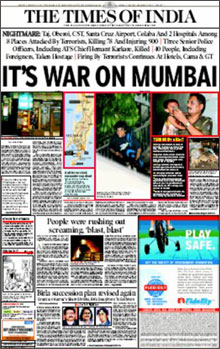
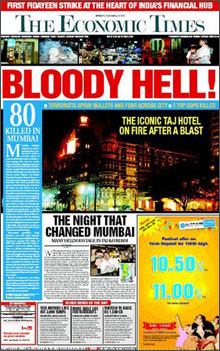
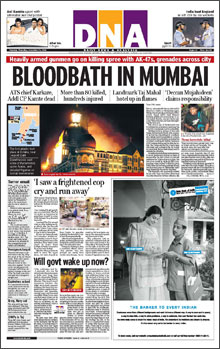
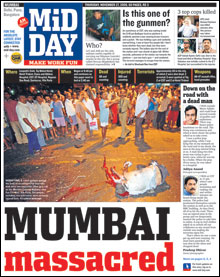
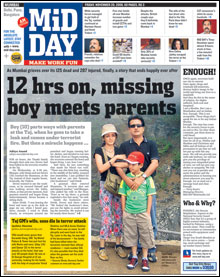
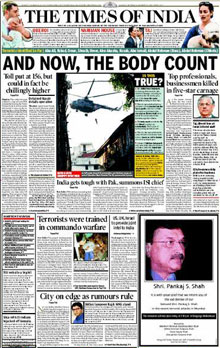
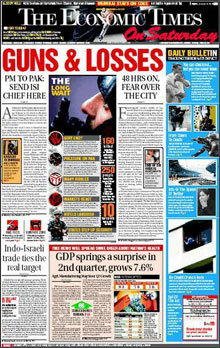
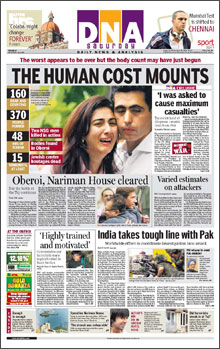
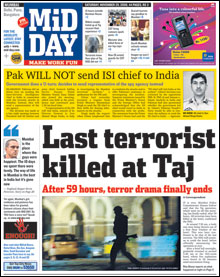
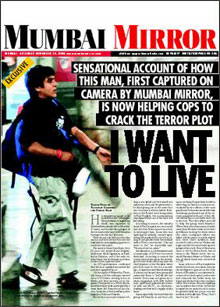
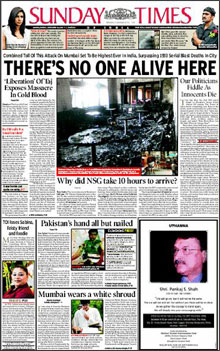
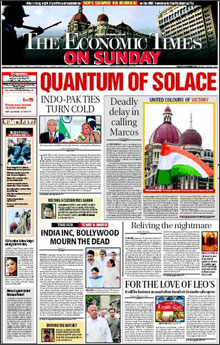
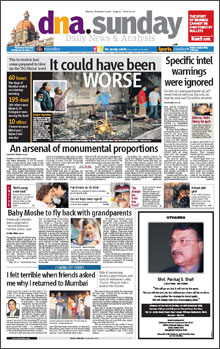
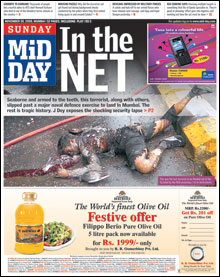
And this is how the front pages of some of the Mumbai dailies were from November 27 to 30, 2008:

 Â Â
    Â
 Â Â
  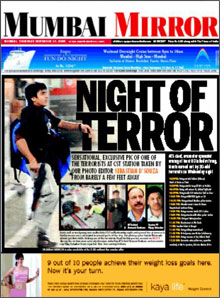


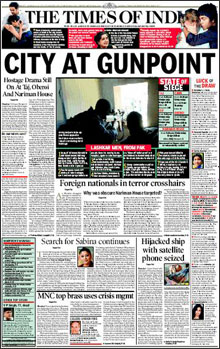 Â Â
  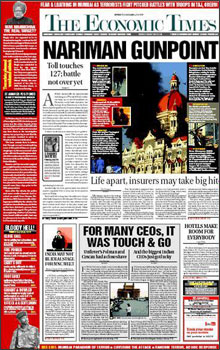  Â
  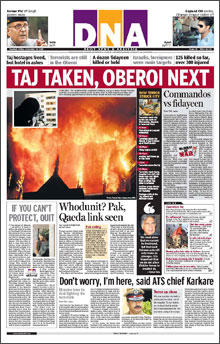
 Â Â
  

 Â Â
    Â
 Â Â

 Â Â
    Â
 Â Â
  
And this is how the front pages of some of the Mumbai dailies were from November 27 to 30, 2008:
   Â
 Â
   Â
 Â
   Â
 Â
   Â
 Â

By Sachin Kalbag
On the morning of November 28, 2008, around 100 reporters rushed to Chabad House in Colaba where four Pakistan-trained terrorists had taken hostage all the eight Jewish people living in the building. Chabad House, or Nariman House as it was previously known, is the outreach centre for the Jewish community in Mumbai, and is the first stop for any religious activity for the community, especially for those visiting from outside the country. It was a natural target for Islamist militants who had laid siege to key locations in Mumbai from the night of November 26.
There were a few reporters present at the spot, but most of the attention from media houses for the most horrific terror attack in India’s history was given to the Taj and the Oberoi, both plush five-star hotels where hundreds were held hostage, and many later killed. Nariman House, on the other hand, is in a middle-class area of Colaba at Hormusji Street, and access to the building is through a narrow lane on the west, and a slightly wider but still crowded lane to the north. Escape is practically impossible.
It was in this situation that Rabbi Gavriel Holtzberg and his pregnant wife Rivka found themselves on the night of November 26. Later, reporters at “ground zero” were told that the hostages were tortured badly before being killed.
For the reporters, which included this writer who was reporting for the Delhi-based newspaper Mail Today, there was seemingly not much to do but wait until the well-trained National Security Guards (NSG) commandos neutralised the four terrorists.
However, it was not all just wait and watch. Intermittent fire had already been targeted at journalists at the Taj on the night Nov 27, and the four terrorists at Nariman House could have, out of desperation, hurt any of the hundreds of onlookers and journalists, which included cameramen from news agencies all over the world. In fact, a few bullets were indeed fired at us, but they seemed more like warning shots than any attempt at killing us. The terrorists, reportedly, were told that their only aim at Nariman House was to kill the Jews. According to a Times (of London) news report, the Pakistani handlers told the terrorists that “the lives of Jews were worth 50 times those of non-Jews”.
A unit of 22 NSG commandos arrived in the morning rappelling down a military helicopter, and entered Nariman House. Soon, the exchange of fire began. A second unit of NSG commandos, most likely snipers, took positions in a building situated 100 metres north of Nariman House. Separating them was the narrow lane, whose most remarkable feature was a large banana godown which was shut indefinitely.
There was neither food nor any water for journalists, so we relied on the goodness of the locals to provide us with biscuits and cups of tea. The more fortunate ones were given vada pav. We could not even imagine the stamina of the NSG commandos who had nothing to eat or drink during the entire offensive that last close to 12 hours.
The terrorists, it was immediately obvious, were well-trained in military warfare and hand-to-hand combat. How else could they survive an onslaught by some of the best trained commandos in the world?
In the middle of all this, journalists were shooting pictures, giving live newscasts and filing stories to their respective newsrooms. The pressure on television reporters was immense. Viewers from all over the world wanted the latest, and the live pictures were not providing much context. Studios kept calling their correspondents, who had nothing much to say. This often resulted in misreporting.
One such reporter, whom I got acquainted with, was being repeatedly called upon to give updates. In frustration, he began describing events that never took place. For instance, he would sit and chat with me for 20 minutes, and then, when his editor called, he would simply rattle off trivial stuff that was the figment of his imagination at best. When I asked him why he did that, he replied, “This is television, yaar. You print guys will never understand.” Later, at around 6:20 pm, they even claimed that the operation was over.
I was more amused than angry. I cross-checked with a Hormusji Stree resident, Dhaval Koli, whom I had befriended during the day. He said the firing is still on, and the operation isn’t over. Koli worked at the local Baskin Robbins shop, and he offered to take me around as he had lived his entire life there. His help turned out priceless because I could add details to my reports that others could not. For instance, he was the first to tell me that Sandra Samuel, the 44-year-old nanny of Holtzbergs’ son Moshe, had rescued the toddler. The operation finally got over at night, three hours after television reporters had declared it finished.
Around 9 pm, I ate my first morsel in 26 hours – a vegetable sandwich bought by a colleague working at India Today’s Nariman Point office. Later, after filing stories, I went to a pav bhaji stall to eat some Mumbai street food. There is a certain satisfaction you get by eating good food after more than a day of not eating. My respect for war reporters went up a hundred notches.
I had arrived in Mumbai on November 27, and stayed on for four more days. Most of these 102 hours were spent on the streets. I could not meet my parents or my friends, who kept calling up. No reporter I knew there could find time to drink water, leave alone meet friends and family. This was one of the most horrific events of independent India, and as reporters, we could not even blink. We were, we soon realised, eyewitness to history.
Sachin Kalbag is Executive Editor, MiD DAY
By A Correspondent
Leading mutual fund company Birla Sun Life Mutual Fund (BSLMF) retained Indigo Consulting for developing a platform for its recently launched investor education and awareness programme Jaanoge Tabhi Toh Maanoge. Indigo Consulting, a full-service interactive marketing and technology agency from the Publicis Groupe, developed the www.jaanotohmaano.com website that is an integral part of the BSLMF initiative.

Speaking about the website Ajay Kakar, Chief Marketing Officer, Financial Services – Aditya Birla Group said, “Jaanoge Tabhi Toh Maanoge is not just a mere campaign. It is a platform that we can own through time here after. The JTTM website which captures facets of mutual funds now becomes the hub that we will continue to enrich with a lot of informative nuggets, life facts and trivia to make it sticky with viewers.”
Vikas Tandon, Managing Director, Indigo Consulting added, “Most content around this topic is perceived to be fairly technical. The biggest task for us was to offset this notion and present mutual fund concepts in a manner that is high on simplicity and visual appeal.”
By Shambhavi Anand & Writankar Mukherjee
Why would an imaging brand like Canon advertise its products on cartoon show Doraemon? Canon’s executive vice-president Alok Bharadwaj said the current generation of children aren’t as aware of Japanese electronic brands as previous ones and, hence, the use of the popular cartoon characters for a rub-off effect.
Doraemon, Hello Kitty and Ninja Warriors are popular among Indian children (and their long-suffering parents) and better known than Japanese staples such as Sony and Panasonic or even Toyota and Honda. “In a certain sense, these equities have become large when compared to age-old brands,” said Satyajit Sen, CEO of media buying company ZenithOptimedia. “However, both (sets of brands) operate in different spaces and that should also be taken into account.”
The development reflects the importance of ‘soft’ power, as exemplified by the spread of pop culture icons, such as the Doraemon anime series. “Japanese cartoons have broken the monopoly of western world characters such as Mickey Mouse and Donald Duck,” said Mr Bharadwaj. “That same message that Japan stands for high quality will only grow in the kids and boost other businesses.”
Recognising this, the Japanese government has announced the launch of a new project to aid global promotion of the country’s culture, including its anime, video games and cuisine. The Cool Japan funds will start with Â¥50 billion (about $500 million) in backing from the Ministry of Economy Trade and Industry combined with 10 billion Yen from a range of companies. For PlayStation maker Sony Computer Entertainment, the popularity of cartoon characters such as Doraemon and Hello Kitty has led to a jump in sales of both gaming consoles and software, said Atindriya Bose, country manager. “The rate of adoption increases when a cartoon character becomes popular,” he said.
The popularity of Japanese anime in India has persuaded an increasing number of companies such as Maruti Suzuki, Honda, GlaxoSmithKline, Hindustan Unilever, and Samsung to use the blue robotic cat Doraemon to promote their products.
That’s where those long-suffering mums and dads come in. Parents tend to watch cartoons since the children are glued to them, said Chitranjan Dar, chief executive, foods, ITC. Which is why Hindustan Unilever promotes Surf Excel detergent and Tresemme hair care on cartoon programmes.
A 2012 study by Cartoon Network showed a majority of parents watch television with their kids. After serials, cartoons are the most preferred genre for parents, ranking higher than news channels. About 75% of parents spend time watching TV at least five-six times a week with their children. This number is even higher, close to 80%, for parents of younger children. Channels say that in spite of substantial growth, the genre is under-monetised, with 7% viewership and just 3% of revenue share.
According to the industry that buys advertising time and space on television and in print, more than 8% of national viewing time – more than that of news channels on most days – brings a horde of advertisers to children’s channels. According to TAM data, Ninja Warrior, Shin-chan and Doraemon have the highest ratings among shows meant for children across channels that cater to them.
Some children’s channels earn close to 50% of their revenue from advertisers targeting adults.
Source:The Economic Times
Copyright © 2013, Bennett, Coleman & Co. Ltd. All Rights Reserved
Licensed to republish
By Our Research Associate
It’s not a distinction that we are all too happy about, it’s data that cannot be ignored.
In the period 2001-12, the Mumbai terror attacks story gained maximum viewership as per TAM data made available to MxMIndia.
These are All-India figures and include regional news and it is for the target audience being CS 4+ years (Cable-Satellite, above 4 years).
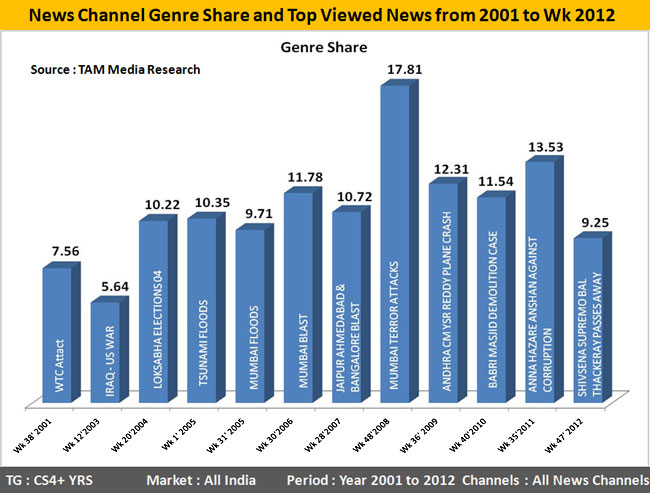
While Mumbai terror attack saw news channels score a genre share of 17.81 percent, the Anna Hazare fast agitation was second with 13.53 percent. The plane crash which led to the death of Andhra Pradesh Chief Minister YSR Reddy is third with 12.31.
What has emerged from these numbers is that all news events that spread over a period of time generated more eyeballs. For instance, in the case of the news around the passing of Shiv Sena head Bal Thackeray last year, the news channel coverage lasted a day and a half. The coverage on the Mumbai terror attacks was spread over four days and it went on for much after that. Ditto with the YSR Reddy plane crash.
Interestingly, the Gujarat riots of 2002 does not figure in this table, whereas the World Trade Centre attack in September 2001 does have fair viewership.
By A Correspondent
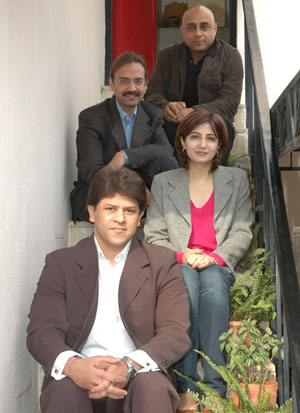
Network1 News and Information Syndicate (NNIS) has announced that its news and feature service subscribers will now have access to live coverage from its network across metros locations. Simultaneously, NNIS has enhanced its focus to news breaking from Congress and BJP headquarters in Delhi to capture real-time developments during the ongoing assembly elections as also the general elections next year.
Led by Arup Ghosh, N1Media has its co-founders Shireen Sethi, Kamal Dixit and Sundeep Misra. “While NNIS has succeeded in getting great recognition for the quality of its content plus the choice it makes in selection and production, our clients can now get top quality live coverage during the elections and beyond,” said Arup Ghosh, CEO, NNIS, whose experience spans Bennett Coleman group, NDTV and start-up operations he led at Sahara, Channel7 and NewsX.
In addition to television, NNIS has also built a strong presence among Online Portals and Mobile Value Added Service providers since it was set up in April 2010.
“In the past, our association with media houses helped them create great branding. Now, it is our turn to create our own brand in NNIS which shall make maximum impact in times to come,” said Shireen Sethi who brings extensive on-air experience coupled with programming skills. “Acquiring the best that there is in technology-from news capturing, processing to transmission-allowed us to leap frog a complete generation. The new generation equipment offers twin advantages to media houses as they get quality, speed and reliability,” says Kamal Dixit, who as Chief Technology Officer and co-founder leads NNIS’ technology operations and brings in wide-ranging broadcast systems expertise.
As NNIS does not work on legacy systems, it is in a position to offer news and feature content at prices that can help channels to reduce their operational expenses thus becoming profitable, a communiqué adds.
In September 2013, NNIS raised growth equity from Rajasthan Venture Capital Fund (RVCF). Earlier, prominent angels– Saurabh Srivastava (Rajasthan Projects Private Limited), Raj Bhatt (Shell Investments Limited) and Navjot Sobti (Almondz Global Securities Limited)– invested in the venture.
The first leg of the Business Standard Quiz will take place on December 7 in Mumbai.
The quiz was taken to B-Schools across the country with over 200 colleges participating at an intra-college level. At the regional level, the quiz has been opened to corporate professionals as well. The other regional finals will be held in Delhi, Kolkata and Chennai – dates for which will be announced shortly.
According to a communiqué, the quiz will see an elimination round which will be a pen-and-paper test followed by the semi finals and finals. The top three winners in each region shall receive attractive prizes. The quizmaster for the Business Standard Quiz will be Gaurav Sri Krishna, who contributes to the Strategist Quiz (in the newspaper) and has also authored a quiz book published by paper.
Registration in teams of two is mandatory to participate in the quiz. For more information, call Mansi Singh at 022-24978456 Extn. 368; Email: mansi.singh@bsmail.in or look for ‘BS Conferences’ on Facebook.
By A Correspondent
So what’s Sir Martin Sorrell doing these days? Betting big on China of course as he did in a signed article in London’s Daily Telegraph last Saturday. It’s interesting hence to note that the world’s most powerful name in advertising and marketing services is going to doing a show titled ’30 Minutes with Martin Sorrell’ for our own CNBC-TV18.
This new monthly half-hour programme (subject, of course to his hectic schedule, a communiqué from the channel adds) will kick off from tomorrow, that’s Friday, November 29 at 7pm.
The show will be hosted by Anant Rangaswami, Editor of Storyboard and Senior Editor of Firstpost. Each month, Mr Rangaswami will speak to the WPP CEO on recent and imminent developments from the world of media, advertising and marketing.
Although CNBC-TV18 via its PR agency Good Relations India did not part with the transcript of what Sir Sorrell said, a communiqué says that among the key issues the show will cover on Friday will be Twitter’s revenue model and valuation, the rumour that WPP will buy IPG, why big retail should be bothered about Chinese ambitions and finally the WPP captain’s prognosis for calendar year 2014.
Interestingly, this is what Sir Sorrell wrote about India in the Telegraph article: “India may remain in stasis after the election, as no party will have a clear majority and a coalition will continue to compromise.” And on China? “I’m very bullish on a China with strong new leadership following the Twelfth Five Year Plan and the Third Plenum of the Eighteenth Party Congress – when did a Western government set out such a detailed and comprehensive plan?”
The 68-year-old media baron believes “next really big thing, or things, will be coming from China”. Perhaps it/they will. Meanwhile, let’s wait for what he says on his own show this week and then, month after month.
By A Correspondent
Population First, a communication and advocacy initiative for a balanced, planned and stable population, will conduct a workshop titled ‘Men are from Venus, Women are from Mars’ on tomorrow (November 29) at Mayfair Banquets, Mumbai, addressing the media and advertising fraternity. The workshop aims at exploring gender similarities and appreciates the differences, specifically in the workplace and this workshop is designed and managed by Social Access. Population First has been doing these gender sensitization workshops for the A&M fraternity on a regular basis. Last year, a similar event was held in Mumbai along with the Interntional Association of Advertising (IAA, India Chapter).
The workshop will include two panel discussions – one that will highlight the changing fabric of the Indian workplace, and the other, which will explore the idea of self-regulation in the development of the messaging and the possibility of a mechanism to gauge the neutrality and sensitivity of the messages. (*See Disclosure).
(Disclosure: MxMIndia editor-in-chief Pradyuman Maheshwari is one of the panellists in the second discussion)
By A Correspondent [updated]
Bloomberg TV India and Autocar India will present the annual Bloomberg TV India Autocar India Awards on December 20. Speaking on the Awards, Amrit Rai, Business Head – Bloomberg TV India said, “The Bloomberg TV India Autocar India Awards have become the benchmark of performance for the industry and with each passing year, the bar has been raised by the players. We expect the 2013-14 Awards to be a keenly fought battle across all categories and wish all nominees the very best.”
Added Hormazd Sorabjee, Editor – Autocar India magazine, on the Awards: “These awards have unmatched credibility thanks to an exhaustive evaluation process and a jury that is the best in the business. Consumers can rely on these awards to make an informed car buying decision.”
The Bloomberg TV India Autocar India Awards 2013-14 will be given across 20 categories.
The awards night onDecember 20will take place at the Seaside Lawns of the Taj Lands End in Mumbai and will be presented by Reliance General Insurance and powered by Mobil 1.

By A Correspondent [updated]
The India Chapter of International Advertising Association (IAA) has announced its next webinar with Rob Norman, Chief Digital Officer, Group M (Global) today (Thursday, November 28) at 5 pm.
Mr Norman is also a Director of WPP Digital and Wild Tangent and a non-Executive Director of BBC Global News Ltd. He is on the board of the Center for the Digital Future at USC, a member of the Facebook Client Council and an advisor to venture capital funds – Greycroft and GGV.
Said Srinivasan Swamy, President IAA India Chapter & Vice President, Development Asia/Pacific region of IAA said ” I am really happy to see that this is our 7th webinar and our initiative to provide this seamless learning platform is paying off. We now have participants from across Asia. Our speakers are coming from various geographies too. It’s all working well!”
Abhishek Karnani, Director, Free Press Journal and Manish Advani, Head – Marketing and Public Relations, Mahindra Special Services Group, are co-chairing the IAA Webinar series.
“We are very excited to host Rob in our forthcoming IAA Webinar; it sets a very powerful example to what IAA seeks to do for the fraternity. He will give us a global perspective on future of Digital with specific to Indian environment”, said Mr Karnani.
“I am confident Mr Norman will inspire thousands of young digital aspirants in their digital journey by sharing some great examples of success based on his Digital Journey”, added Mr Advani.
Over the last seven months, International Advertising Association (IAA) India Chapter has hosted speakers like Sanjeev Kapur CMO & Head of Customer Franchise Management Citi (India), Ashish Hemrajani, Founder and CEO Bookmyshow.com, Rajan Anandan, MD Google India, Nishant Rao MD Linkedin, Ajit Balakrishnan Founder Rediff.com and Julie Roehm, Chief Story Teller, SAP, USA.
Questions for Rob Norman through the IAA India Chapter Facebook page at www.facebook.com /IAA.IndiaChapter. The hangout will be aired live on IAA (India)’s YouTube channel – www.youtube.com/iaaindiachapter on November 28 at 5pm.
The table below. tells you the story. As per TAM, Week 47 of the calendar year saw Star Plus as the #1, Colors #2 and Zee #3. Life OK is #4, Sab at #5 and Sony at #6.
Please note that these numbers haven’t come in from TAM, but from a source we trust and is reliable. Readers are requested to verify the data before making any decisions.
|
Channel |
Gross Viewership in Millions |
| Star Plus |
560 |
| Colors |
513 |
| Zee TV |
433 |
| Life OK |
335 |
| SAB |
308 |
| Sony |
269 |
| Star Utsav |
98 |
| Sahara One |
30 |