Category: MEDIA

  • Social Media finds its use in corporate HR


    By Priyanka Sangani


    When Marriott International announced it was opening a new Courtyard by Marriott property in Bilaspur, it got over 300 CVs through its Facebook page. The page was launched just a month ago and already has 1.1 million likes.


    A few months ago, Godrej Consumer Products started using Yammer, an enterprise social networking site, not unlike Facebook. What surprised Sumit Mitra, head – group HR and corporate services, the most is the rapidity with which employees caught on to it, irrespective of age, location and hierarchy. It is rapidly emerging as a platform to share best practices across the business, and has now been rolled out across the Godrej Group.


    Cisco Systems has brought down its usage of placement agents from 50% to less than 5% of the total people hired over the last four years bringing down recruitment expenses by over Rs 30 crore a year, while L’Oreal India saved on 93% of its recruitment costs last year by using social media.


    Look closer and you realise that these aren’t stray examples. From a time when Indian companies instructed their IT departments to put in firewalls to block access to all kinds of social media, they are now exploring how these sites can be leveraged. “We are past that stage where we debate the impact social media will have on productivity; you have to learn to channelise it creatively,” says Prasenjit Bhattacharya, CEO, Great Places To Work, India.


    Godrej first started experimenting with social media as an HR tool in July 2012 for Godrej Loud, its campus recruitment programme. “After the initial campus visit, all communication for this initiative was done through Facebook and Twitter. The benefits in terms of reach, cost effectiveness and productivity are significant,” says Mr Mitra. Apart from the tangible cost incurred in flying people across the country multiple times, there was a high hidden cost in terms of management time and productivity. The company has now moved its entire summer internship (and campus recruitment) process to Facebook.


    Platform Play

    At L’Oreal India, the use of social media stretches up to mid-management positions as well. Mohit James, director-HR, says that the company has its own company page on LinkedIn and has hired for over 20 senior level positions in functions like IT, marketing innovations and development through social media platforms: “The hiring process becomes a lot more open, cost effective and has a faster turnaround time. Using social media allows you to reach out to far more people than you could have earlier, and it also gives them a chance to see what the brand is all about before they even apply.”


    While a number of companies have signed up with Microsoft’s Yammer or are simply using Facebook for their online communities, for those with the tech expertise and inclination, building your own platform is always an option. At HCL Technologies, MEME was the result of a group of enthusiasts who went ahead and created an internal social networking platform despite feasibility concerns from the IT department. With over 80,000 active employees, this is now an integral part of the communication process at HCL. Prithvi Shergill, chief human resource officer, HCL Technologies, says, “The company is present in 31 locations and this is a convenient way to reach out to everyone.” There are special interest pages and the human resources department even uses it to get people’s opinions on policy changes before actually rolling them out.


    One big reason why social media is gaining acceptance as an effective communication tool for companies is the entry of the digital natives into the workforce. Over 60% of the employees at Cisco are under 30. The company uses Webex Social, its own social networking platform for all internal communication, including buying and selling things. Subash Rao, senior director – human resources, Cisco Systems says, “It is essential to reach out to employees in a manner that they are most comfortable with. So with most people spending more time on their phones, we’ve ensured that Webex Social and Cisco Jabber, an instant messaging service, are both accessible on the mobile.” The company is now in the process of shifting static intranet pages like blogs to this platform which will make the exchange far more interactive.


    “While traditional channels continue to exist we are increasingly finding that our audiences prefer to consume information at their own pace. Moreover, given the dynamic nature of our business employees feel the need to connect informally in addition to connecting formally with their peers,” says Microsoft India’s head of human resources, Rohit Thakur. In August, Microsoft created a special employee microsite using SharePoint for their annual kick-off meeting. “The microsite provided our employees with the facility to register for the event, learn about the agenda and logistics and comment on the topics covered in the meeting. We also used the microsite to poll our employees about their feedback. This will help us design next year’s event in line with the audience needs. All this was possible due to enterprise social technologies such as Yammer, SharePoint and Lync. I also strongly believe the engagement during this meeting helped us drive significantly better business momentum during the quarter,” says Mr Thakur.


    Mr Bhattacharya, who has observed various companies up-close says, “Social media is an enabler and allows a multi-dimensional view of the organisation as against the earlier unidimensional view where the conversation was restricted to job description and compensation. Whether you like it or not, social media has an impact on the perception of the organisation. If you are smart about it, you will allow access and use it to promote discussions and dialogues on the company and the brand.


    Godrej for instance tried using blogs earlier but with limited success given that the degree of interaction was far lower. “We were looking for a platform to connect employees across the world where we could have a free flow of ideas without hierarchies,” says Mr Mitra. So, if a distributor has run a successful promotion in a small town, he can post details and pictures within minutes and share his experiences. Earlier this kind of knowledge exchange would have taken a few months. It helps that the senior management is fairly active on this platform as well, with Godrej Consumer MD Vivek Gambhir ensuring that he spends at least 30 minutes a day on it. Mr Mitra himself is a part of various groups related to HR and people management.


    Last year, Polaris Financial Technology launched its own enterprise collaboration portal, Octopus, which primarily functions as a project management platform. Employees have access to all the details related to the project they are working on, but what sets it apart from other such portals is that it integrates various other social networking features into itself. “The site facilitates sharing of knowledge through the technology wikis and design wikis, and also provides a platform to ask questions. Chances are that someone else may have already encountered the problem you are facing and has a solution, so you don’t need to reinvent the wheel,” says Sashi Mohan, CIO and CTO, Polaris FT. The company also has a popular video sharing channel, KTube which it uses to share videos on a wide range of issues, not just related to technology.


    However, using social media to communicate with your employees, or as a recruitment tool, isn’t necessarily idiot proof. “While finding people may have become easier, a recruiter needs to know how to engage, network and harvest a talent group and not just use social media as a search engine. LinkedIn is more than a platform to acquire talent; it is a medium to build candidate consideration and employer branding as well,” says HCL’s Mr Shergill. Cisco has a separate page for campus recruitments where it gets the alumni from these institutes who are working at Cisco to talk about their experiences as it builds a far stronger connect with potential employees. The biggest challenge, says Mr Rao, is that most companies still don’t take social media very seriously. “You need to have a dedicated resource monitoring social media. If activity levels on your page lag, it has an immediate fall out or impact on people’s interest levels.” This is also perhaps one of the biggest challenges of using social media – constantly updating it with relevant information. While it definitely helps cut down on the deluge of emails and brings in a lot more democracy to the communication process, companies need to ensure that they are providing meaningful -and not distracting- content.


    Marriott International launched its dedicated jobs and careers page on Facebook as a result of the traction they were getting from (potential) employees on their hotels page. In addition to job postings, they also update the page with excerpts from Chairman Bill Marriott’s blog and employee success stories. Gurmeet Singh, area director of human resources-Indian subcontinent, Maldives, Marriott International says, “Attrition in this sector is high at about 35% so it’s useful to employ non-traditional methods of sourcing. Besides, the generation is also such that you can reach them more effectively through social media.” A clear indication of how seriously the company takes its social media initiatives is that it has fairly detailed corporate and regulatory guidelines on how to use social media. These have been in place for three years, but are constantly evolving. Prasad Iyer, cluster ecommerce- India, Malaysia & Maldives, Marriott International, says that this is a double-edged sword. “While you want to reach out to people externally, you have to manage expectations internally as well. At the end of the day, it’s a social platform and cannot replace the existing professional systems you have.”


    Mr Shergill echoes this sentiment adding that it’s primarily an enabling mechanism and you cannot devote all your energies to it. Then again, there will always be topics that won’t generate the kind of interest you want in these forums and at such times, it’s best to revert to email or face-to-face conversations. It’s also important to ensure that the posts don’t get offensive or aggressive.


    Going ahead, while a lot would depend on how these particular platforms themselves will evolve, most companies are working towards moving their e-learning initiatives to social media. Another trend that’s rapidly gaining traction is gamification. L’Oreal has been using an offline game Brandstorm globally for two decades now, and has recently introduced two online games, Reveal and RU HR? The company tries to recruit about a third of its managers through these channels. While RU HR? requires participants to deal with real human resource situations and develop an HR strategy, Reveal is aimed at non-marketing professionals who can get online and participate in say a discussion on supply chain issues and solve a problem to move to the next stage. James says that the benefits are twofold. “Not only does this expose people to L’Oreal, but it also allows the company to assess them in terms of brand fit based on their reactions to various stimuli.” This is followed up with an actual interview since there’s always the danger that it could be a group of people playing the game as one candidate. “The two most important benefits of gamification are crowdsourcing and collecting powerful customer data. Crowdsourcing helps in solving complex business problems where participants bring in a fresh perspective to solve tricky situations. As these games require comprehensive research and study, it also helps the organisation to collect important customer data and statistics,” he says.


    One thing that is clear is that as just as social media influences how we communicate in our personal lives, it will have a bearing on how we communicate at work and companies would do well to adopt it, albeit with caution.


    Source:The Economic Times

    Copyright © 2013, Bennett, Coleman & Co. Ltd. All Rights Reserved

    Licensed to republish

     

  • After Designyatra, Kyoorius launches FYIday series with Laura Jordan Bambach

    By A Correspondent


    After holding nine editions of the Designyatra very successfully, Kyoorius, a not-for-profit initiative by Mumbai-based Transasia Fine Papers, has announced Kyoorius FYIday. Under the aegis of the ‘For Your Information day’ or ‘FYIday’, a series of seminars, workshops and training sessions will be held periodically across different cities. The platform explores a more intimate, interactive and informal knowledge-sharing format as against the umpteen conferences, panel discussions or just plain speeches by unprepared biggies attended by disinterested industry folk.


    Rajesh Kejriwal

    FYIdays will be led by specialist speakers on a defined subject and with a limited attendance of around 100 people for a seminar to 25 people for workshops. To be flagged off in New Delhi on November 28 at Gurgaon and on November 29 in Mumbai, the first edition will feature Laura Jordan Bambach,  President of D&AD & Creative Partner at Mr President – on the UK’s most celebrated boutique digital agencies.  She will share her insights on ‘Digital Campaigns: Building Brands & Memories Through Digital Media’ Said Ms Bambach: “After the overwhelming response at the Designyatra, I am glad to return to India for the Kyoorius FYIday and share  greater detail, insights and interact more directly with Indian designers and  marketers alike. Commenting on the initiative, Rajesh Kejriwal, Founder CEO, Kyoorius said, “The Kyoorius FYI Days is focused on events that are much more specific, engaging and informative. Through this initiative we hope to help bring the local community together to share knowledge, exposure and learning. Over a period of time, FYIdays would have speakers from specific disciplines – Typography, Broadcast Design, Publication Design, Strategic Planning, Strategic Branding, Retail design, Architecture, Product


    Design etc – with seminars, workshops and training sessions held through the year and across India – leading up to the annual design conference – Kyoorius Designyatra. Registrations close on Monday, November 25 at www.kyoorius.com/fyiday/


  • Gaurav Banerjee takes charge of Star Plus as GM

    Gaurav Banerjee

    By A Correspondent


    It’s an office that’s has seen various occupants in the recent past, but Gaurav Banerjee, who has been part of the Star India system for a while, should well reverse that trend.


    Uday Shankar

    Star India CEO Uday Shankar spotted his talent at Star News (now called ABP News) where he was CEO and at the TV Today (Aaj Tak) group, where he was News Director. Mr Banerjee joined Aaj Tak in 2000 and was the 9pm primetime news anchor and exec editor at Star News. A St Stephen’s and MCRC Jamia student, the new Star Plus business head was responsible for the successful launch of ABP Ananda, MCCS’s Bengali news channel (then Star Ananda), and later setting up the network’s regional channels and taking Jalsha to No. 1


    Mr Banerjee joined Star Plus in October 2009 and played a key role in shaping content around the “Rishta Wahi Soch Nayi” theme, we are informed. He also helped shape content strategy for Life OK and has developed popular shows like Mahadev, Diya aur Baati Hum and Sasural Genda Phool.


    The last occupant of the Star Plus biz head office was Nachiket Pant Vaidya who moved to MSM Sony’s movies division in September this year. Mr Vaidya took charge of Star’s flagship channel in July 2012 from Nitin Vaidya who helmed the network’s Hindi channels for a little over a year.


    Mr Banerjee will report to Sanjay Gupta, COO, Star India.


  • Subhash Chandra receives doctorate at Univ of East London

    By A Correspondent


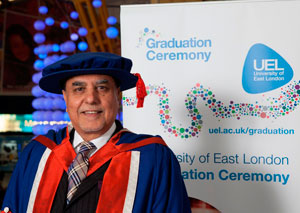
    Zee and Essel group Chairman Subhash Chandra was awarded an Honorary Doctorate of Business Administration from the University of East London (UEL).


    Mr Chandra received the Doctorate from Lord Gulam Noon, the Chancellor of the University of East London, at the ceremony for their Royal Dock Business School graduates. Accepting the award, Mr. Chandra thanked the entire senior management team at the Royal Dock Business School, saying, “It is indeed a privilege to be recognized outside one’s country, and in the presence of such highly acclaimed and respected individuals. I thank you all for bestowing this prestigious award that I feel honored to receive.”


    Mr. Chandra’s felicitation adds a feather to the crown of Zee Entertainment Enterprises Ltd and marks the establishment of the broadcaster in the UK andEurope, and follows a recent launch of DittoTV, an online, tablet and mobile platform providing live streams and TV on demand from 17 Zee channels. ZEE TV is now in the process of commissioning new programming produced specifically for the UK and European audience.


    Later today (Nov 21), Mr Chandra will deliver a keynote speech at AsPIRE, the annual event hosted by JP Morgan at Lord’s to promote Asian-Pacific global leadership. Mr Chandra will take the audience through his life journey from humble beginnings in India to becoming a global billionaire. He will reveal his role models and advise on implementing ideas into successful business operations.


  • NDTV Good Times refreshes, adopts #LiveYoung positioning

    By A Correspondent


    Lifestyle entertainment channel NDTV Good Times has refreshed itself and adopted the #LiveYoung positioning from earlier this week. In the new avatar, the channel will take a fresher, edgier and more relevant approach to its programming targeted towards the young and the young at heart, notes a communiqué.


    Smeeta Chakrabarti

    So what we see is a new logo, icons, idents and colour palette that reflects a “hip-cool on-air” look.   Elaborating on the channel refresh, Smeeta Chakrabarti, CEO, NDTV Lifestyle said, “After an in-depth research and a deep dive into our consumers’ mindset, the channel has recharged its offering. The new visual and content strategy is a direct result of these initiatives, and we are confident that they will resonate and connect with our viewers”.


    Said Channel Head Arati Singh:  “The programming of the channel has become more impulsive, interactive and action oriented with a younger and edgier attitude. Keeping in sync with the young and young-at-heart viewers, we have reworked on the visual appeal by introducing vibrant icons reflecting the different content and mood of the programming on-air.”


    As part of its refresh, NDTV Good Times aims to be in tune with viewers’ lives through the week and at different times during the day by introducing dedicated categories such as; ‘Good Night with Good Times’, ‘Good Food with Good Times’, ‘Good Travel with Good Times. Additionally, Kingfisher Supermodel 2013 and Bachelor’s Kitchen with Aditya Bal have been reintroduced with a brand new flavour, with more to come in the next few months.  Highway on My Plate, one of the more popular shows on the channel is scheduled to be seen in a younger avatar, we are told.


  • Is a 6-month recusal enough for Tarun Tejpal’s act of sexual assault?


    By A Correspondent


    At the recently held Think festival organized by Tehelka magazine, there was a session where rape survivors recounted their stories. The title of the session: The Beast in Our Midst.


    As it has now emerged, even when the various delegates and ‘thinkers’ were deliberating on the ways of the world at the Goa event, there was a beastly act on elsewhere. Tarun Tejpal, Tehelka founder, celebrity journalist, author, mentor to budding writers and a beacon for those against all things wrong in the country, had indulged in what has until the time of writing been described as an act of molestation.


    Mr Tejpal has confessed to his crime. Ah, well, remember he’s a writer. So the words he has used in a letter that appears at various places on the internet (including our favourite blog Sans Serif at http://wearethebest.wordpress.com/) to describe his acts is that it was a “bad lapse of judgment” and “an awful misreading of the situation”.
    We weren’t present in the 2011 edition of the Thinkfest, but Mr Tejpal is reported to have made this controversial statement: “You’re in Goa, so eat, drink, make merry and sleep with whoever you want.” The writer-journalist has ostensibly taken his own words seriously.


    The victim has said she’s a friend of his daughter. That her father and he were once colleagues. She tried to stop him from what he was doing. Not once, but twice over, over two days.


    Mr Tejpal’s books (coincidentally titled ‘The Alchemy of Desire’ and ‘The Story of My Assassins’) have received rave reviews. “I have always held that Tehelka the institution, and its work, have always been infinitely more important than any of us individuals. It is tragic, therefore, that in a lapse of judgment I have hurt our own high principles,” he wrote to managing editor Shoma Chaudhury who will now be incharge of the magazine. The letter described “pompous in tenor” by the Mumbai Mirror diarist does appear to be pretentious. “I feel atonement cannot be just words. I must do the penance that lacerates me. I am therefore offering to recuse myself from the editorship of Tehelka, and from the Tehelka office, for the next six months.”


    In a letter to the Tehelka staff, Ms Chaudhury has forwarded Mr Tejpal’s letter and said: “This is a hard time for all of us, and I hope all of you will stand by the institution” She is quoted to have to have told an Indian Express journalist that the journalist has not filed a criminal complaint and that she (the victim) and other staffers were satisfied with the action taken. “It is an internal problem and we are not setting up any enquiry into the matter,” Ms Chaudhary told Business Standard. “The matter was taken up internally, and has been addressed and redressed,” she told the Express. However, a confidante of the victim told NDTV that the victim was not satisfied with the action taken.


    Is a six-month ‘penance’ of being away from the top job at Tehelka enough? Is staying at home, in the hills for half a year enough?


    In many ways what Tarun Tejpal is being subjected to on Twitter and Facebook is worse than a dozen lashings in the Middle East? He’s being ridiculed, humiliated and mocked at so much that even some of the most universally lampooned Indians on Twitter – N D Tiwari would appear to have done nothing wrong.


    But the law is clear on the subject. Sexual harassment cases need to be handled in a certain way, and this one could be called an assault. According to a set of Twitter messages, the victim is said to have written the following to Ms Chaudhury: “As of Saturday evening, he sent me text messages insinuating that I misconstrued “a drunken banter”. That is not what happened. Banter does not involve forcing yourself on someone, trying to disrobe them, and penetrate them with your fingers despite them pleading for you to stop.” Note: this is an unverified version. MxMIndia has in its possession a copy of the letter the victim is said to have written.


    The victim we are told has retained copies of Mr Tejpal’s text messages and it is said that the video footage from the elevators is also available as proof of Mr Tejpal’s acts.


    Journalists and activists believe the apology offered by Tarun Tejpal is half-baked and the case should be handled in a legally tenable way.


    In many ways, Tarun Tejpal’s act is a blow to the world of news media. Especially when we have an assortment of law-makers and influencers wanting tighter controls on the craft. The question now is: will the law-enforcers from Delhi or Goa act against the editor?


  • Comment by Geeta Seshu on Tarun Tejpal case: Supreme Court guidelines must be followed

    By Geeta Seshu


    Inexcusable as it is, Tarun Tejpal was not the only person who made a shocking ‘error of judgement’. Clearly, the other really major error of judgement in responding to the sexual harassment charge by a young journalist during the magazine’s Thinkfest in Goa recently must lie with the Managing Editor of the magazine, Shoma Chaudhary.


    In his email, Tejpal referred to what he termed a bad lapse of judgement and an awful misreading of a situation. He offered an unconditional apology and recused himself from the editorship of the magazine for six months. In her email to the staff, Chaudhury appears to accept both the apology as well as Tejpal’s decision to step down for six months:


    “We have also believed that when there is a mistake or lapse of any kind, one can only respond with right thought and action. In keeping with this stated principle, and the collective values we live by, Tarun will be stepping down for the period mentioned”.


    Unfortunately, this is simply not enough. And the outrage that followed on social media sites by journalists and editors is only some indication that the Tehelka management has fouled up in tackling what is a pretty straightforward issue.


    When any complaint is lodged on a charge of sexual harassment, the law binds the management of a company to institute an inquiry with an independent member on a complaints committee. The Vishakha guidelines are clear on this.


    Moreover, the Sexual Harassment of Women at Workplace (Prevention, Prohibition and Redressal) Act, passed by both houses of Parliament in 2012, was gazette in April 2013. Rules under the Act are currently being enacted but the Vishakha guidelines are clear and, as a statement of the Network of Women in Media, India, said, “compliance with the Supreme Court’s guidelines is the very least that mediawomen expect of the media which are, after all, supposed to be the watchdogs of society.”


    It is highly unlikely that the editor of Tehekla was unaware of these guidelines. Reports in various websites even attribute quotes to the aggrevied journalist seeking an inquiry under these guidelines. Was this done? Who constituted the committee? Was there an independent member as required by law? When were the hearings held?


    In any complaint, an independent inquiry is important and crucial. Due process of law must be followed so that justice must not only be done, but seen to be done.


    In the present instance, a major aspect of the complaint: that of the guilt of the accused, is already established. Tejpal has not only not denied the charge, but tendered an unconditional apology. It’s possible that, given incontrovertible evidence and/or the admission of guilt, an independent inquiry would have arrived at the same conclusion – that the charge was proven.


    The next step is the delivery of justice. Tejpal’s offer to recuse himself from editorship is all very well, but is this what the aggrieved journalist wanted or sought? What exactly did the journalist seek in terms of justice for the wrong done to her?


    For Tejpal, the ‘punishment’ for his act, couched in vaguely religious terms of atonement, laceration or penance, is that of stepping down from a post he occupies. How does Tejpal’s self-imposed, self-denial of his position, that too for a limited period, make any difference to the charge? To whom will it make a difference, if at all?


    But, while it may be part of a larger response of a man in a position of power and influence, it may not provide any succour to the individual concerned.


    The determination of the relief that the journalist will seek – whatever it may be – can only be done in a transparent manner, with full accountability and clarity. Whatever decision is then taken in terms of dealing with a clearly criminal act – must be done with the consent of the journalist concerned. Only then can a complaint like this move towards closure.


    The NIMBY phenomenon

    Despite numerous articles, the media is simply unwilling to address sexual harassment when it happens in its own backyard. Media houses need to come clean and publicise whether they have instituted sexual harassment committees in the work place and whether any complaints have been lodged before these committees.


    To date, the record of existing instances of sexual harassment in media houses is pathetic. The well-known instance of sexual harassment in Statesman, filed by journalist Rina Mukherjee in Kolkata, resulted in her dismissal in 2002, an order against which came in February 2013, a good 11 years later!


    In March 2013, a journalist filed a sexual harassment case against a senior editor in Sun TV, and was again suspended from service. A complaints committee instituted by Sun TV did not follow the procedures as laid down by law and did not uphold her charge. In another instance in India Today, a complaints committee was set up but the independent committee member is yet to be appointed!


    Geeta Seshu is a senior journalist and writes on free speech, women and representation and media ethics. She is Consulting Editor of the media watch site, The Hoot. She can be reached at @geetaseshu


    Photograph: Department of Communication and Journalism, Mumbai University


  • Shailesh Kapoor: Roll our the red carpet for Hindi cricket broadcast

    By Shailesh Kapoor


    The recently concluded India-West Indies Test series, better known as Sachin Tendulkar’s farewell series, recorded some of the highest ratings for Test cricket in recent times. The second day (when Tendulkar came into bat in the morning in what many hoped will be a century effort in his final Test innings) and the third morning leading upto his farewell speech, rated at par with regular ODIs, a rare occurrence over the last two decades.


    What interested me more about the ratings was the Hindi to English viewership ratio, which ranged from 2 to 6, on various days. Some of this variation is explained by which channels Star Sports may be pushing on the last mile, and the fact that for the second Test, they had two channels showing the English feed vis-à-vis one showing the Hindi feed, which is when the ratio dropped.


    The fluctuation of ratio apart, all indicators tell us conclusively that Hindi sports broadcast is the future in the non-South markets in India. That’s what the viewers will increasingly shift to, and that’s what the broadcasters and MSOs will push with greater confidence in the months to come.


    Hindi commentary attempts are not new to Indian cricket, but the Star Cricket campaign last year (Jo baat Hindi mein who kisi aur mein nahin) was the first serious communication attempt in this direction.


    It can be argued that the language doesn’t matter in cricket. But that’s far from the truth. High language comprehension can enhance viewing experience and get irregular and light viewers to watch more. These are a large section of viewers who watch only India World Cup matches or select parts of exciting ODIs and T20s. Getting them to watch more matches for more time is the only real growth opportunity in cricket viewership today, and there can’t be a better growth injection for this than Hindi commentary.


    The criticism on the quality of commentary in Hindi has existed for decades now. But it has been primarily fuelled by Doordarshan and All India Radio commentary. Some unintentionally comic moments notwithstanding, Star Sports’ Hindi commentary this season has been well above the mark, both in terms of the choice of panel and the execution. The ‘elite’ audience who compare the two languages don’t really count. It’s more like The Big Bang Theory audience commenting on Balika Vadhu.


    If you are an ‘intersection viewer’ like me, who understands both languages equally comfortably, there is a good chance that you will still prefer English commentary. My two main reasons for this choice are the comfort level built with English commentary over three decades, and my preference for international commentators versus the Indian ones. The latter has nothing to do with language. Our lead commentators are generally not as articulate and opinionated as their counterparts in Australia and England.


    But most viewers are not intersection viewers. Comprehension of English ranges from nil to poor to barely-there in most households in India. Then there is the additional issue with foreign accents. We are perhaps the only country to subtitle all English entertainment content on TV in English itself!


    For this section of audiences, the Hindi broadcast is a lifeline. It has taken some time to come, but come it has. As time passes and generations change, the habit (my first reason above) will die too, and we will see the Hindi broadcast gain even more momentum.


    IPL too introduced Hindi commentary this year. They should be encouraged with the Star Sports performance and invest more in it in the coming year, with a stronger panel and better reach and marketing. IPL, in many ways, is the defining cricket tournament on television today, and it has the ability to set and fuel trends.


    So, well done, Star Sports. It would have been even better if you put your Hindi feed on Star Sports 1 and English feed on Star Sports 3, than the other way round. Would have been a nice, symbolic gesture!


    Shailesh Kapoor is founder and CEO of media insights firm Ormax Media. He spent nine years in the television industry before turning entrepreneur. The views expressed here are his own. He can be reached at his Twitter handle @shaileshkapoor


  • Star Plus stays #1, Colors and Zee at #2 and #3.

    By A Correspondent


    The GVTs of Week #46 of the calendar year 2013, according to TAM, show Star Plus leading in the Hindi General Entertainment category. Star Plus scores 529193 GVTs, a little below the previous week’s 536270. Colors and Zee were placed second and third as per the GVTs.


    The following are the ratings of the leading Hindi GECs. Figures in brackets are those for Week 45.


    Star Plus         529193            (536270)

    Colors              479010            (486423

    Zee TV             440447            (428610)

    Life OK            340200            (344624)

    SAB                 315637            (310534)

    Sony                297801            (341054)


    Please note that the information has not been supplied and verified by TAM Media. However our source is reasonably reliable.


  • Sachin’s farewell Test is highest rated in 8 years

    By A Correspondent


    Master Blaster Sachin Tendulkar’s farewell Test match has emerged as the highest rated Test on television in India in the past eight years. The match garnered 1739 average TVTs which remains unmatched since 2005.  According to a communiqué, the Star Sports network channels together had the maximum channel share across all genres during the six playing days of the series. (Overall TVTs generated during the day). Also, starsports.com attracted 3.5 million unique visitors during the two matches of the India-West Indies Test series.


    Star India put out all stops for the series. It had secured the title sponsorship rights for the Test series and launched its seven-vehicle network on Day 1 of the first Test. There was a 360-degree initiative involving programming, production, marketing to add buzz around Sachin Tendulkar’s farewell series. The broadcaster also launched three shows programs to engage with the sports fan. Then there was a  ‘Cheer for Sachin’ campaign along with a slew of on-ground activities. Star India CEO Uday Shankar presented Sachin Tendulkar with the first STAR Sports ‘Believe’ Trophy during the post-presentation ceremony in Mumbai.


    Speaking on the occasion, Nitin Kukreja, Head of Sports Business, Star India, said, “We are delighted with the ratings. Our strategic investment in the Hindi language feed over the past year or so is now paying us huge dividends. We will continue in our endeavor to promote sports culture in the country,” added Nitin.


    Important: The TAM numbers quoted above (Average TVTs; TG: C&S 15+, M, SEC ABC ) are sourced from a communiqué sent by Star Sports. These have not been verified with TAM.


  • CNN to profile Ted Turner on Sunday, Nov 24

    By A Correspondent


    Want to know about innovator, visionary, trailblazer and the founder of CNN Ted Turner? Well, just watch – what else – CNN itself. Mr Turner is the subject of a 60-minute profile encompassing his remarkable life and achievements. Reported by CNN anchor Wolf Blitzer, Ted Turner: The Maverick Man explores Mr Turner’s difficult early years, his extraordinary career, his legendary America’s Cup win, Turner’s historic humanitarian and cable television legacies – and everything in between. The documentary will air on Sunday, November 24 at 4.30pm IST.


    The film features first-hand accounts from Turner on founding his first “Super Station” and rapidly transforming that venture into a global media company. Of CNN’s ground-breaking, enterprising broadcast coverage of the 1991 Iraq War, Turner reflected it as still the “greatest scoop in the history of journalism.”


  • The MxMIndia Annual #2: Hum 2, Humaare 2


    It’s been a little over two years since MxMIndia took off. It is indeed too good to be two.


    We started MxMIndia with several objectives, but the means of achieving these were very important. The reader is on top of our value chain. Our primary allegiance is hence always to you, dear reader. Stakeholder profits, advertising revenues and relationships come later. This of course is with an understanding that by serving readers and engaging with them adequately, we would serve other interests as well. We believed that revenue considerations needn’t necessarily influence editorial integrity in a B2B publication.


    And how are we doing? We think we have served our readers and all our constituents fairly well. Yes, we aren’t making monies as of now, but that will happen. Hum Honge Kaamyaab. Not just ek din, but soon.


    Okay, this isn’t the reason why we are dedicating this prime space for this special announcement. It’s about our Second Annual. Work on it has been on since a few months and instead of the usual classification of our Annual under media genres, our theme is a little hat ke.


    Since we have completed two years, we played with the number two and the theme is titled ‘Hum 2, Humaare 2’. We wondering whether we should spell the two as ‘Do’ or ‘Doh’. So we just decided to make it simpler and used the numeral instead.


    It’s about the Man, the Woman, the teenage child and a younger one. It is about how these consumers are changing, and how media and marketers should interact with them. And have been interacting with them.


    We have already spoken to a fair number of industry captains and are doing so as you read this.


    The issue is scheduled to be out next month.


    If you wish to participate in the issue by way of contributing editorially or by way of advertising, contact: Ritu Midha or Rishi Vora for editorial (ritum@mxmindia.com and rishiv@mxmindia.in respectively) and Unni or Ramesh for Sales (Unni@mxmindia.in and Ramesh@mxmindia.in respectively). Please also cc editor@mxmindia.com for editorial and sales@mxmindia.com for sales.


    The telephone number for both editorial and sales is 9833872678. Ideally text us, and we’ll have someone get back to you asap.


    Meanwhile, please await the Annual. It’s going to be fun, insightful and unputdownable.