Category: MEDIA

  • Vizeum bags Repcom Home Finance mandate

    By A Correspondent


    Chennai headquartered RHFL, promoted by Repco Bank has appointed Vizeum Media as it media AOR (Agency on Record).  RHFL, a government undertaking, is embarking on a growth path and the appointment of Vizeum is seen in line with the same.


    Confirming the appointment of Vizeum, R Varadarajan, Managing Director, RHFL said: “We are focused on translating into reality the aspirations of people to own a home through credit support customized to suit individual needs in a transparent and ethical way. The vision for our growth required us to get on board domain experts to guide us.  Vizeum approached us proactively and the discussions have been on for many months.  We are quite satisfied with their knowledge, passion and more importantly the sincere commitment to build our business.  Their leadership staying involved in our business is an added benefit. We look forward to working with Vizeum”


    S Yesudas, Managing Director – Indian Subcontinent, Vizeum said, “It is a matter of pride for us that more and more clients are finding value in associating with Vizeum. It also makes us very humble. We have our task fully cut out for RHFL. We will stay focussed on their business with utmost sincerity, in as selfless manner as possible. This business will be handled out of our Chennai office”


  • Winners of Social Media Week last entry pass contest at 10pm

    We got so excited about the whole proposition that we put all the info in the headline. Well, almost.


    So here’s the Deal:

    Social Media Week Mumbai, the hottest tech thing happening to have happened in the city this year, is ending on Friday, September 27. But not without a bang. A day full of top draw content is being hosted by Group M at the Westin Hotel, Goregaon (Western Express Highway).


    Group M is giving away 10 passes to MxMIndia readers for free access to the day’s proceedings. Each of these cost Rs 6000, so it is indeed a BIG deal.


    Here’s how you can win the prize. Just send us a one-liner to editor@mxmindia.com with the subject line saying: SMWM13. Also, please put your full name, telephone number and email id. Don’t worry, we are not going to onpass these to a holiday resorts company. It’s just to ensure that your registration formalities get complete.


    Here’s what you need to write:

    In not more than 20 words, tell us why is Social Media so important for a business to be successful.

    You need to send in your entry by 4pm India time today (Wednesday, September 25, 2013). The best 10 of the first few entries get the passes. We will announce the winners by the last five digits of their mobile numbers at 6pm today (Sept 25). Winners will receive a letter from us and then a letter/regisistration intimation from the Group M office.


    So, let’s list what you need:

    1. Tell us in 20 words or lesser why Social Media is so important for a business to be successful.

    2. Also write your name, telephone number and email id

    3. Put SMWM13 in the subject line of the mail

    4. Send the mail to editor@mxmindia.com. It must reach us by 4pm India time today (Sept 25)

    5. Await the winners’ list at 6pm


    Update: Due to a technical hitch with our mail server, we have not been able to announce the results of the contest at 6pm. It will be posted on the website at 10pm. Our apologies.


  • BBH converts radio spots to digital content for Skoda

    By A Correspondent


    How do you ensure that a great idea travels far and gets noticed?


    BBH India created a series of radio spots to launch the limited edition Skoda Rapid Leisure which comes loaded with a host of features including a rear view parking camera.The spots were received well on radio, but the agency wanted to reach a wider audience. They realised that nobody (outside of advertising) ever shares a radio spot online. The challenge was to convert the audio spots into visually interesting digital content.


    Said Russell Barrett, CCO and Managing Partner of BBH India: “It’s clear that to reach a wider audience, your idea needs to be media agnostic. A genuine idea should cut across languages, cultures and media as well. Thankfully with Skoda, we have clients (Kamal Basu and his team) who believe in the same philosophy. They agreed that a video rendition of an audio idea was an exciting, new way to approach communication in today’s age. We also lucked out with the talent we could tap in to at BBH with the likes of Manish Darji, Yohan Daver, Sushma Joseph, Hitesh Kalia and the rest of the team on Skoda. I’m actually really excited about the implications of this kind of project. It’s clear that low budget need not mean low quality.”


    Credits:

    Chief Creative Officer: Russell Barrett

    Executive Creative Director: PuneetKapoor

    Director: Sushma Joseph

    Creative Director Art and Illustrator: Manish Darji

    Copywriter: YohanDaver

    Agency Executive Producer: Hitesh Kalia&Sushma Joseph

    Account Director: Anirban Mukherjee

    Account Manager: SuraviPradhan

    Account Planner: Kanishk Kabiraj

  • Worldwide ad growth buoyed by digital, mobile adoption

    By A Correspondent


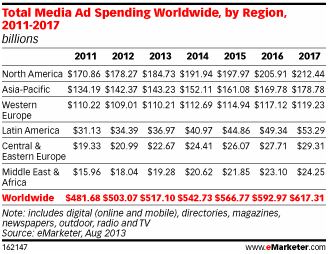
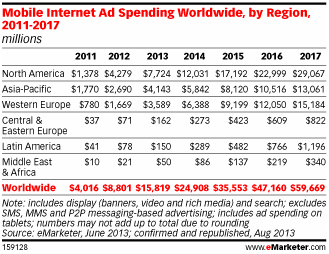
    Global ad spending will rise 2.8% to more than half a trillion dollars in 2013, driven by continued adoption of digital devices and internet connectivity, according to eMarketer’s latest Global Media Intelligence Report, produced in collaboration with Starcom MediaVest Group.


    Still, the global economy is in recovery mode, and while total media ad spending will be up this year, the rate of increase will not be particularly strong. eMarketer estimates ad expenditures will rise 2.8% worldwide to $517.10 billion, compared to last year’s 4.4% spending increase. There are no India-specific numbers with what has been shared with us.


    Digital, however, is a bright spot-particularly mobile. eMarketer estimates spending on digital advertising will reach $117.60 billion this year, up 13.0% compared to 2012 levels, while mobile spending will hit nearly $15.82 billion, representing a whopping 79.7% year-over-year increase.


    Much of the spending growth stems from broader digital adoption on the part of consumers. The full report, which covers six major regions-including Asia-Pacific, Western Europe, Central and Eastern Europe, the Middle East and Africa, North America, and Latin America-and 40 countries, paints a picture of continued device adoption globally.


    Key figures on media usage and spending from the report include:

    :: Internet users: More than 36% of the global population today, compared to 21.7% in 2008

    :: Mobile phone users: 60.7% of the population this year, compared to 40.0% in 2008

    :: Smartphone users: Just under one-third of mobile users and about 20% of the global population, compared to 3.7% of mobile users and 1.5% of the population in 2008

    :: Social network users: About a quarter of the global population, compared to 8.3% in 2008

    :: Facebook users: More than 15% of the global population, compared to 3.1% in 2008

    :: Total ad spending: $517.10 billion in 2013, up 2.8% from last year, compared to $484.30 billion in 2008

    :: Digital ad spending: 22% of total ad spending in 2013, compared to 12% in 2008

    :: Mobile ad spending: Just 2.6% of total ad spending and 11.9% of digital ad spending, compared to 2.1% in 2008


    The Global Media Intelligence report is eMarketer’s largest and most comprehensive snapshot of the state of media usage and spending globally. The report contains more than 700 charts collected from over150 global research sources, which SMG helped identify and gather for local and core global markets, in addition to benchmarks, analysis and context provided by eMarketer.


  • Content & more on Social Media Week Day 3


    By Fatema Rajkotwala


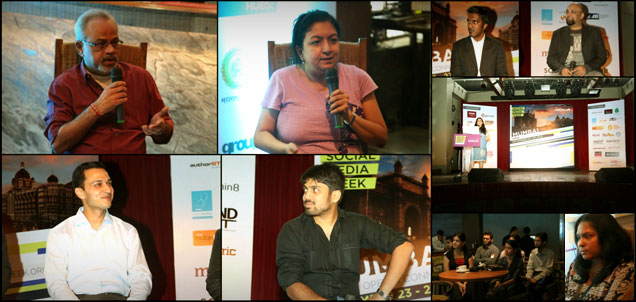
    As the Social Media Week Mumbai progressed into its third day, the panels delved deeper into ways in which conversations are dominated by entertainment and cricket, the negative practices prevalent in social media, and how crowdsourced journalism can be used effectively for content creation. There was even a discussion around youth and how social media has benefited women entrepreneurs in India. The proceedings happended across five hubs in the city and this report covers only the events at two of the venues – Blue Frog and Barking Deer.


    Within the Indian context, social media seems to be predominantly ruled by conversations by two major industry giants, entertainment, that is Bollywood, and cricket. In the second of the sessions curated by MxMIndia, Hemant Kenkre, former cricketer, commentator and PR consultant; Deepa Gahlot, senior journalist, awardwinning film critic and Head of Theatre and Films Division at NCPA; and Krishna Vilasini, Managing Partner, Entertainment and Brand Marketing, Genesis Burson-Marsteller to share their insights (Disclosure: MxMIndia is also a Media Partner of the Social Media Week Mumbai).


    Agreeing that social media conversations on cricket do seem to overshadow most other talks on social media, Mr Kenkre said, “Cricket, as we know, is a religion in India and even though it seems to be in our face and on our screens, there is very little known about what goes on behind the scenes. This is why social media is a relevant space for fans. Cricket in India is run by an ‘old boy’s club’ and as fans, we don’t get much interesting information on our cricket icons.”


    Similarly, Ms Gahlot said that in India Bollywood tends to dominate everything. “Today, you cannot do a book launch, an event or a press conference without involving Bollywood lending its name. In this space, social media caught on fast as a PR marketing tool because a lot of people tend to watch movies than vote. Now everyone is a critic. On the flipside, this has helped small films that would’ve otherwise sunk at the box office, gain mileage and manage do recover costs and do reasonably well. It also creates controversies such as the one surrounding The Lunch Box and The Good Road Oscar nomination. So, social media is a powerful public tool but it is a platform where you cannot control negative opinion.”


    Representing the PR industry side of things, Ms Vilasini spoke about how social media is a definite godsend for the communications industry. “Entertainment and television in India is very close to people’s hearts and egalitarian, in sense. We have realized that television viewing is now a multi-screen experience for viewers, counting mobile screens and PC viewing. Social interaction is welcomed and created by us. It makes everyone feel important, have a voice and we embrace, work to amplify and maximize it to fully channelize the power of social media. ”


    The panel went on to discuss what the impact of social media has on cricketers and if it affects their performance on the field. Mr Kenkre agreed that at times it does, “Cricketers do check what is being said about them but what is said on any public communication platform is very controlled. Even when they are not officially connected, cricketers or selectors or any official person within the system does not have a chance to come out and explain themselves because at some point they may be part of the industry again. So nobody speak honesty on social media and people who matter in cricket are largely not on social media.”


    In response to how do PR agencies handle negative criticism on social media, Ms Vilasini pointed out that maintaining a buzz is of prime importance and that the hotel industry closes the loop well when it comes to negative publicity. “We advise our clients to first listen to what is being said, by whom it is being said and then address it. Most times, if you acknowledge someone’s opinion, the ranting stops. We encourage conversations on Bigg Boss, even though a lot of what is being said is negative. We will be petrified the day no one is talking about a show on television.”


    As the head of theatre and art at NCPA, Ms Gahlot spoke on whether apart from affecting Bollywood, social media is making inroads into theatre. “We do monitor reviews and use social media for disseminating knowledge about upcoming events. It also has helped in improving or changing content according to feedback, which is possible with theatre, as opposed to after a film is made. It is considered safe to vent or rant on Bollywood as compared to politics, for example.”


    Mr Kenkre spoke for the panel with his closing remark, “The challenge in social media is to engage the audience and do so at the right time.”


    Crowdsourced journalism

    Day 3 at SMW also brought up the new byproduct of social media – crowdsourcing in journalism. Avid Learning called in Gauri Vij, Editor of Time-Out Mumbai magazine to share her insights on “Crowdsourced journalism and viral news in the city”. She cited innovative examples of how crowdsourced journalism is being used internationally by the Guardian through its app – Guardian Witness or by Indian helpline, CJNet Swara or Traffline. She also gave example of successful collective blogging ventures such as Moifightclub, a film blog where people can record, report, perceive and share through social media.


    Speaking about how her magazine successfully used crowdsourcing for the compilation of its urban dictionary issue, Ms Vij said, “We realized that we needed help and the wisdom of our crowds and we asked for it. Samosapedia has also done this effectively. Social media helps in interacting with your readers, from a marketing perspective it creates a buzz and it also gives immediate feedback on hard worked stories.” When asked if social media undermines the work of resident journalists or comprises on creditability, Ms Vij added, “You have to verify facts and be careful of what you carry.”


    Negative practices in the Indian social media

    Moving away from the good face of social media, social media consulting firm Social Samosa brought together a panel of social brand managers and agency experts to talk about the ignored elephant in the room with their discussion on “Negative practices plaguing the social media industry”.


    Commenting on the approach of brand managers and brands alike when it comes to social media, Ekalavya Bhattacharya, Head, Digital, MTV India said, “The problem is that brand managers are not working for the brand but more to impress their bosses or are more concerned about the fans or followers of the competition. The buzzword now is Engagement and Facebook is changing its offering accordingly. It is heartening to see some brands care about their content but many a times, contests are being confused with content.”


    Bringing in the advertising agency outlook, Ashwath Ganesan, National Strategy Director, Social @ Ogilvy said, “Social, more than digital, tends to be looked at as a cost cutting way of advertising but its is not free. There are time, opportunity and transparency costs. Digital is an expression; social is a behavior and ideas are ideas.”


    Iyer Premkumar, Head, Online Marketing, Gozoop spoke about how the problem of client’s insistence on numbers was created by brand managers themselves. “We made clients realize that look at how well your competition is doing.”


    Does undercutting by brands and agencies affect innovation due to a decrease in the amount of money pumped into the market? Does this in turn pose the problem of talent retention? Panelists agreed that undercutting of opening up business opportunities. Mr Ganesan said, “I think it is more of a valuation problem than a pricing problem. People don’t know what they want to do on social media. Until companies understand the real impact or value of social media until it becomes a core business position rather than an imposition.”


    Is there a lack of ideation in terms of social media campaigns and content which are often inspired from international content or complete rip-offs but are by being applauded through awards? When can we expect a Redbull or an Oreo kind of success in Indian content? Speaking on innovation and new ideas, the panel discussed how most times there is a global mandate being pushed towards a digital spend and the fact that these brands are semi-local leads to global campaigns being adapted and distributed. “Innovation is often confused as doing something first rather than doing something better. All stories have been told; can you do it more interstingly?” said Mr Ganesan. Mr Bagchi added: “While incremental success can be improved upon, explosive success can never be improved upon. Said Mr Bhattacharya: “There is a lot of cool content on the web in India but we are not sure the audience is ready for it.”


    The panel also discussed why social media is being used primarily for marketing rather than as a tool for market research or a strong customer service platform. The panelists agreed that an edgy brand can adopt a bolder stand rather than an FMCG brand that is looking at reaching out to a more conservative audience. Said Mr Bhattacharya: “Yes, you can do so much more with it. As an edgy brand, we can take on someone if someone takes a dig at us. This culture is still not high in India.”


    However, panelists agreed that it is still too soon to specifically create content for the web audiences in India. Saugata Bagchi, Vice President, Tribal Worldwide stated, “The evolution of the audience is what makes the campaign a success. In India, we’re far away from there. So, I agree with the market forces, which combine to create the concept of adapting, or getting inspired so that in the short term the campaign becomes successful and the medium gets more traction than what it currently has. Another market reality is that even though we’re talking about publishing content, it is seen as a media driven rather than a content driven vehicle.”


    Youth and Social Media

    Considering the youth make up for almost the entire userbase of the Indian social media, Naman Sharma, founder and CEO, U’th Time Magazine hosted a discussion on the challenges and proposed solutions for the youth while using social media and the need for better content creation in this context.


    Rishi Vohra, author, Once Upon the Tracks of Mumbai shared his experience with social media during the promotion of his book, “After understanding the power of this medium in our country, I completely relied on social media to market my book. I kept my story in mind while writing my first book but I have kept the youth in mind for my upcoming book. Social media is a great tool to advance your word of mouth publicity, to brand and position your product but it is not meant for advertising it.”


    Addressing the key question of how much social media interaction translates into sales, Sumit Verma, independent film-maker and founder, FitHead Factory shared his personal learning from how social media can be used by artists such as himself to monetize content, “For crowd-funding, Linkedin works better than Facebook or Twitter, which helps more in direct chatting. Social media helps in spreading the word, finding like-minded people, connecting content creators and their audience and turning content viral because of youth and we are a young country. If your content is good, social media will help.” Some other solutions for raising funds were Vimeo, which has begun paid distribution for content or by partnering with Youtube, Wishberry, Indiegogo or Kickstarter.


    The panel discussed pertinent issues such as the social media to be used as a tool to bring about social change, a need to train the youth on how to conduct themselves on social media, and how despite the negative content, it can be used to retain consumers and turn critics into loyalists.


    Women Entrepreneurs and social media

    Helping leverage women entrepreneurs gain valuable insights on how to use and mark their presence on social media to advance their businesses, Moxie Media and Communications drew a large charter of female audience for their panel discussion. Hosted by Moxie Media Marissa Bronfman, founder and President, the panel comprised Malini Agarwal, founder, MissMalini Publishing; Pooja Dhingra, founder, Le 15 Patisserie and Priyanka Khanna, fashion features Editor, Vogue India. The panel of enterprising women shared their personal social media story, personal insights and techniques on what worked well for them, and urged women to use the platform to the best of their advantages.
     

  • Winners of Social Media Week Entry Pass to Last Day Contest

    Social Media Week Mumbai, the hottest tech thing happening to have happened in the city this year, is ending on Friday, September 27. A day full of top draw content is being hosted by Group M at the Westin Hotel, Goregaon (Western Express Highway).


    Here are the winners of the Contest that we ran earlier in the day:


    Four of the last five digits are:


    01. 752×0
    02. 493×4
    03. 338×1
    04. 911×9
    05. 819×8
    06. 989×0
    07. 879×5
    08. 736×2
    09. 805×2
    10. 947×6


    Congratulations!


    Winners will receive a registration/invite mail by 1pm on Thursday, September 26.


  • Srinivasan Swamy re-elected President of IAA India Chapter

    By A Correspondent


    Srinivasan Swamy

    Srinivasan Swamy, Chairman & Managing Director of R K Swamy BBDO was re-elected President of India Chapter of International Advertising Association at the Annual General Meeting held in Mumbai on Wednesday, September 25.


    Neeraj Roy, MD and CEO of Hungama Digital Media Entertainment, was elected Vice President. Jaideep Gandhi, Chairman, Jaya Advertising and Monica Tata, MD, HBO India were re-elected as Treasurer and Secretary respectively for the year 2013-14.


    Neeraj Roy

    “IAA India was on an over-drive in 2012-13 under the leadership of Srinivasan Swamy” said Pradeep Guha, VP & Area Director, Asia Pacific of IAA.


    Noted a communiqué: in the eleven months since the previous AGM, there were six major events – IAA Leadership Awards, IAA Seminar on Gender Sensitization, IAA Olive Crown Awards, IAA Knowledge seminar on Real Estate in a Digitized World, IAA-Kyoorius DigiYatra and the one scheduled on 30th September, IAA Platinum Jubilee – Global Marketing Summit. In addition, there were five IAA Debates and five IAA Mentorship Webinars – 16 industry defining events in 11 months.


    “I am happy I was at the helm at IAA when many new initiatives were planned and unfolded. I had a great team who executed much of these programmes with élan. As we move forward, our aim at IAA India is to be seen by IAA Global as the most vibrant of all IAA chapters worldwide. I am sure that recognition is not far,” said Srinivasan Swamy. Mr Swamy was co-opted onto the global IAA Board in May this year as Vice President- Development, Asia Pacific, as an acknowledgement of the initiatives that were undertaken in the first six months at the helm in India.


    The other members of the new Managing Committee are: Pradeep Guha, Pheroza Bilimoria, Kaushik Roy, Sam Balsara, Raj Nayak, Ramesh Narayan, M G Parameswaran, M V Shreyams Kumar, Kunal Lalani, Avinash Pandey, Arunabh Dassharma, Neville Taraporewalla, Partho Das Gupta, Rajesh Kejriwal and Abhishek Karnani, Manish Advani, Janak Sarda, Vishakha Singh, C V L Srinivas and Atit Mehta.


  • dna to evangelise governance with 500+ multi-lingual social platforms

    By  A Correspondent


    Zee Media’s dna has launched ‘I Am IN – dna of India’, an ambitious technology-driven initiative, that promises to “enlighten, engage and empower citizens of India in getting involved in  the cause for better governance”. It gives power to the people to be vocal about local issues, to report news, connect with governance representatives and like-minded fellow citizens and more by way of a multilingual, hyperlocal, pan-India digital platform that will encompass over 500 local circles and neighbourhoods across the country over the next few months, notes a communique.

     

    Said ZEE Media Corp chairman Subhash Chandra: “We keep complaining about India, we keep saying we don’t know what to do and how to do it. We try to look at the big picture, not realising that it is made up of smaller problems. Solve the smaller problems and the big problem will be solved.  The change in India has to be ground up, and with the launch of “I am In – dna of India” we hope that can be achieved, enabled by technology and powered by the desire of 1.2 billion plus Indians who want a better tomorrow.


    Dr Bhaskar Das, Group CEO, Zee Media added: “The power of hundreds of hyperlocal networks, each made of thousands of people, all of who act in a focused manner to improve their locality can surely bring the much needed qualitative change in our country. ”


    The hunt to find volunteers for around 200 localities / neighbourhoods that the platform is launching with, has already begun.


  • Crowd-funding, crowdsourcing and cinema in the age of the social media

    By Fatema Rajkotwala


    The influence of the internet age and social media has left few areas of creativity untouched and has then seeped into how this creative output is produced, marketed, received and consumed by the audience. Indian cinema and filmmakers are no exception to the impact of social media. What is the future of the Indian film industry in this scenario? What is the untapped potential of social media in India compared to the West and what are some of the detrimental ways in which it affects us today?


    In a freewheeling and candid conversation, Rohan Sippy, Director and Producer and Guneet Monga CEO, Anurag Kashyap Films Pvt. Ltd joined Pragya Tiwari, Editor-in-Chief, The Big Indian Picture at the GroupM office in  Goregaon on Day 4 of Social Media Week Mumbai 2013. The panel discussed and debated the areas of Indian filmmaking that have been impacted by social media, alternate ways of marketing and crowdfunding, censorship, criticism and box-office collections for an enthusiastic audience that devoured in each tidbit of the views of the respected movie makers.


    While crowdfunding, as an instrumental tool for raising funds for a project through social media networks such as Kickstarter, Indiegogo and Wishberry is gaining popularity, crowdfinancing and equity financing has still not picked up in India. Voicing her strong belief that the Indian film industry needs to come together to form an ecosystem, new wave producer of films such as Gangs of Wasseypur – Part 1, Peddlers and The Lunchbox, Ms Moonga said, “We cannot function in isolation. The indie community really needs to come together and we need more people talking.” Ms Moonga has successfully used new age techniques like crowdfunding for her films and believes that raising money on networks such as Kickstarter has worked well for many. “Raising money through crowd funding is comparatively, much more structured and popular in the West.”


    Talking about the importance of word-of-mouth promotion and freedom from censorship in the advent of social media, the panelists shared their personal experiences on movies such as The Lunchbox, which gained immense buzz on social networks. Movies such as The Good Road, Ship of Theseus and Grand Masti also came up in conversation when the matter of box-office collections came up. Mr Sippy admitted that social media networks such as Twitter as a great leveler but confessed to missing the blissfulness of the simpler ways of filmmaking and marketing of the earlier days. “Taking a film out there still faces a lot of challenges beyond raising money. While it is great that there are now conversations on social media networks and people are getting in touch, these people are now bombarded by everyone. The joy of using these networks was of genuine discovery of something that people are talking about but with the corruption of trending and bought popularity on social media, is lost. There are no rules here and fans can turn a conversation in a national debate. For mainstream films, television is still big in terms of marketing.”


    On the issue of box-office reviews and collections, Ms Tiwari asked the panelists if marketing budgets are eating into film budgets and how much is one to believe in the social media popularity for a film’s success. Mr Sippy expressed his refreshing points of view, “Marketing efforts are driven towards the first week of screening, which results in collections and ticket sales tapering down to almost 30 per cent soon. Studios have sold their souls to exhibitors by accepting this arrangement. The pros of social media are that people are listening to their peer groups due to a possible lack of connect made by film critics but we can’t be sure now with marketing hawks having taken over Twitter too.” On the flipside, he agrees that a film can be affected by negative word-of-mouth. “We like shouting; that is the nature on Twitter. Sometimes a big budget film’s collections may also get affected by these immediate bad reviews.”


    Ms Guneet differed in her opinion here, “There is only this much you can do for small budget films in terms of promotional efforts. Money on television is so high so this is where word-of-mouth helps. We have seen a standard pattern in box-office collections across our films. In the grander scheme of things, the audience for mainstream movies is huge for even one time watchers and B and C sectors.”


    Social media is also showing us a new way of watching films -niche or genre films such as zombie films but the panelists agreed that this still doesn’t guarantee it commercial success. “This is good for personal interest. Kids these days like to collect movies because the internet is limitless.”


    Moving on to the topic of alternate movie release platforms that are popular internationally, such as Netflix, what hopes do we have for India in this regard and as a way to curb piracy? Playing the devil’s advocate, Mr Sippy light-heartedly admitted, “What else do we have other than hope? Satellite television is so big in India that the bureaucracy results in us having to show a movie on television within two months of release.” On a practical front, he believed that alternate platforms are good for audiences but making it sustainable is a different matter. “We are a different culture of audiences from the Netflix subscribers abroad. Youngsters have a fixed entertainment budget and if they can avail of a censored free version and watch it online, then something is better than nothing.”


    Ms Moonga cited Voodoo.com that has turned piracy into a money making model. She believes that Video on Demand is the future in India. “VOD is bigger than satellite television rights in the West and is waiting to happen.”


    Ship of Theseus was the first film in India to use crowdsourcing as a way to zero in on filming locations. Lamenting on the closing down of many iconic theatres in Mumbai such as Liberty Cinema, Mr Sippy said, “We have to engage exhibitors who want to maximum ticket sales with the highest prices and more popcorn sales. Conversation on social media is great but it finally results in buying a ticket and watching the movie, which will encourage exhibitors.”


  • Shailesh Kapoor: Mahabharat at home, Grand Masti outside home!

    By Shailesh Kapoor


    Two weeks ago, Grand Masti, an adult comedy packed with double entendre jokes (the kind where there you get only the “second meaning”), opened to phenomenal box-office, registering Rs 400 million on its first weekend. This huge opening made Grand Masti the fourth highest Bollywood opener of 2013, ahead of several A-list starrers.


    There was little doubt that Grand Masti will open well, but I was personally caught off-guard by the degree of its wellness. Evidently, a population of youth came out in big numbers to watch “sexy jokes”. It’s safe to say that many of them are not even regular moviegoers: The idea of watching verbal porn got them to the theatres as an exception.


    Three days after Grand Masti released, Star Plus launched Mahabharat at 8.30pm. The show has opened to very good ratings, with the first week’s average of 3.1 TVR making it in the first instance of any fiction launch crossing the 3-TVR mark in its first week since (at least) 2011.


    It’s well-known that TV viewing is largely a family affair in India, and the youth are involved, actively or passively, too. I’m, thus, intrigued by a 19-year something young boy from somewhere in Chandigarh or Indore, who watches Grand Masti on Friday with his bunch of college friends, laughing his heart out at every joke, and then joins his parents to watch Mahabharat on Monday. And probably enjoys that too!


    Several media observers and social commentators will label this behaviour as hypocritical. It’s been argued for ages that there is a cultural hypocrisy in India, where we, the second most populous country in the world, can’t just get ourselves to talk about sex comfortably. In turn, it leads to a sexually suppressed population, especially the teenagers and the youth, an audience Grand Masti instantly caters to.


    But there’s more to it than just the sexual suppression. The more we study the youth, the more we realize that there home v/s outside separation is a well thought-out one. It has been created by their generation as a legitimate method of functioning in a society where family values are still paramount. And it goes beyond just sexual expression.


    For example, more than 80% Indian youth who smoke would hide it from their parents. The number is equally high for those who consume alcohol. And I suspect the number doesn’t change much even when you enter your late 20s and the 30s. Parents, after all, shall always remain parents.


    From the appropriateness of language to dressing to habits, everything has a home-version and an outside-version (or friends-version). The former is designed to run the institution of family smoothly (and not grudgingly so, at all) and the latter to have some legitimate fun at the right age.


    Now one would expect that as these youngsters grow up and became parents, this dichotomy would perish, as they will be more “open-minded” and “approachable” as parents. No, it won’t. Because it’s not about approachability anyway. It’s about the voluntary adoption of family values, when in a family context. It’s an inbuilt mechanism that triggers off at the right situation, like it does when they are with their family even today. And it will trigger off in its full glory when they get married themselves.


    Most of the television success stories (fiction) over the last decade have been created around the importance of the institution of family in India. When Grand Masti is telecast on TV, it will be censored beyond recognition, and then rate poorly. But even if they allowed it to be telecast uncensored, it would have rated poorly anyway. Because the big television rule remains: When at home, do as the home-members do!


    Shailesh Kapoor is founder and CEO of media insights firm Ormax Media. He spent nine years in the television industry before turning entrepreneur. The views expressed here are his own. He can be reached at his Twitter handle @shaileshkapoor


  • BARC close to final decision on measurement vendor

    By A Correspondent


    The Indian media industry’s Broadcast Audience Research Council (BARC) is now close to the award of the contract of television viewership measurement in the country.


    The BARC board met on Friday and a spokesperson issued a press release saying it was recognized that “BARC has the opportunity to change the paradigm and the solution should last for the next 15 to 20 years.”


    Added the communiqué: “The Board agrees that there is a quantum jump in technology that is being envisaged. Considerable progress has been made in identifying suitable cutting edge technologies available for measurement of present and future Broadcast distribution platforms. The Board decided to authorize the BARC Technical Committee and the Management to initiate pilots with these solutions to assess the suitability in Indian conditions.”


    It is learnt that BARC has asked three vendors to initiate these technology feasibility pilots, and one among these three will finally be awarded the contract.


  • Talent hunt launched for ‘memsaabs’ across HSM

    By A Correspondent


    Close on the heels of a tie-up between Big FM and Big Magic Bihar & Jharkhand, the Reliance Broadcast Network GEC  have tied up to take the popular reality show to the various Hindi Speaking Markets in the country.


    Speaking on the occasion, Sunil Kumaran, Business Head, BIG MAGIC said, “We are excited to take this property national. There has never been a show of this kind, since it doesn’t have any caveats to the talent that the women can showcase. The collective power the television and radio, makes BIG Memsaab a property with unmatched reach, greater cost efficiency, offering a deeper connect with audiences and marketers across markets.”


    Ashwin Padmanabhan

    Ashwin Padmanabhan, Business Head, 92.7 BIG FM added, “The show on radio has received phenomenal response and we are happy to be extending this opportunity to women audiences further across India. We have seen entire families coming forward to encourage the woman of the house to participate in this talent hunt and are confident of a fantastic engagement with audiences and marketers alike.”


    The property will be supported by a multimedia campaign across television, radio, print, digital and on ground. BIG Memsaab will be a 13-week property divided into phases like pre-promotions, city auditions, semi finale’s and the city finales, culminating with a national winner.