Category: MEDIA

  • Internet influences hair, skincare and beauty buys: Study

    By A Correspondent


    Google India has released its report on a study titled ‘Women & Web’ to understand internet usage pattern and its influence on purchase decisions of women internet users in India. The study was compiled by looking at search query data for top women-oriented search categories in India and independent online research done by TNS Australia, which reached out to over 1,000 women with access to the internet in India.


    Out of the total 150 million internet users in the country, around 60 million women in India are now online and use the internet to manage their day to day life. With easy access to internet at homes, cyber cafes, offices and growing adoption of smart phones, internet is being used by women for a variety of things. The study revealed that women who are online are relatively more affluent and younger. 3 in 4 women in SEC AB are now online and 75 percent are in the 15-34 age group, with over 24 million women accessing the internet daily.


    In terms of top searched categories by women on Google in India, apparel & accessories was the biggest search category followed by food & drink, baby care, hair care & skincare. The study revealed that – Skincare, hair care, food & drink were the fastest growing search categories, with queries coming from mobile phones growing rapidly and accounting for almost 25 percent of total query volumes in these categories.


    The study also revealed data on the growing influence of digital medium on women’s purchase decisions for these categories. Data from the online research conducted by TNS Australia, highlighted that among women who had access to internet, over 50 percent said that internet research influenced their decision before finalizing a product. In terms of most researched category and influence on final purchase decisions – internet influence was the highest for skin care (72%), baby care (69%) and hair care (65%) products.


    Rajan Anandan, VP & Managing Director, Google India said, “With this report, it is clear that the internet is empowering Indian women with easy access to information and helping them to make more informed decisions in their day-to-day life. The top generic searches and most searched brands reflect that women are heavily engaged on the internet and are using it to do online research before deciding on their final purchase for categories like skin, hair and baby care products.”


    In terms of online activity, email, search and social networking were the biggest drivers for women. Downloading music, looking for educational content, job search, watching videos and consuming news were the other top activities. The report also indicated adoption of ecommerce by women in India, with 1 in 4 shoppers buying baby products online. Women also emerged as strong brand advocates – with 80 percent saying that they recommend their purchases to other women and 25 percent stating that they share it online.


    Video on the web also emerged as one the key drivers of internet usage among women in India, with women accounting for 40 percent of the total monthly YouTube user base in India. Apart from music videos, TV shows and film content, beauty & fashion videos were popular among women on YouTube. Education, health and fitness, home care & cooking were also rated among the top 10 video content categories of choice on YouTube.


    The study was compiled by Google India, by combining Google search query data in India for apparel & accessories, food & drinks, baby care, hair care & skincare product categories along with TNS Australia research conducted online of over 1000 women in the age group of 18 to 65 and industry reports. The search query data was compiled for the period of one year starting from April 2012 to March 2013. Other data sources include TGI & IRS.


    Apparels & Accessories – International

    Apparels & Accessories – Indian

    Foods & Beverages

    Baby Care

    Hair Care

    SkinCare & Cosmetics

    Zara Fastrack Coca Cola Firstcry Loreal Oriflame
    Ray Ban Tanishq Amul Babyoye Livon Lakme
    Victoria’s Secret Fab India Cadbury Babycenter Tresemme Maybelline
    Louis Vuitton Van Heusen Pepsi Hushbabies Sunsilk Loreal
    Swarovski Chennai Silks Maggi Johnsons Baby Pantene Avon


  • 1 Minute View: Can TV do it better in crises

    It’s around five years since the terrorists struck Mumbai, but we have still not heard the last on the coverage by news television channels of the siege.


     

    Crises in the form of man-made and natural disasters, and the kind at Uttarakhand which is a combination of both are extraordinary situations. Since each of them comes unannounced and possibly hasn’t happened before, it’s a first for the journalist too. Just as it’s for the disaster-relief personnel and the administrative authorities.


    But like we don’t expect the powers that be to throw up their hands up and say they were ignorant since it’s never happened before, we don’t want journalists to come up with a similar excuse.


    It’s important that media TV newsrooms go through the drill of how emergencies are going to be handled. And what is it that it takes to offer balance coverage.


    What happened at Uttarakhand was unfortunate. What’s happened on news television was sad. We have had an avalanche of screaming and shouting on the nightly news. Read our Editor-at-Large Anil Thakraney’s comment at:

    http://www.mxmindia.com/2013/06/anil-thakraney-uttarakhand-disaster-tv-anchors-screw-up-yet-again/


    The News TV folk know well enough that Big Brother in the form of I&B Minister Manish Tewari is watching.  Let’s not be surprised if he uses the R-word yet again (R for Regulation).


    Before that happens, it’s vital to take remedial action.


  • Shopify enters Indian market with SingTel

    By A Correspondent


    E-commerce platform Shopify (http://www.shopify.in) has announced its entry into the e-commerce market space in India in partnership with communications group SingTel. Available from Rs 750 per month, the solution is an easy way for individuals and small business to set up attractive online shops within minutes, and accept secure credit card payments for goods and services. Shopify is successfully operating in over 100 countries and powers over 50,000 online stores with annual sales exceeding $1.5B USD.


    With Shopify’s web-based solution, storefronts can be set up and ready for business with just a few clicks of the mouse. Merchants can customise their storefronts, keep track of orders and manage customer data via a web browser. The platform provides features such as hosting, beautifully designed templates, a web dashboard to manage products and orders, a secure shopping cart, SEO tools, 24 hours customer service support, mobile optimized stores, and an iOS app which offers merchants the convenience of managing their business while on-the-go.


    In India, Shopify aims to reach out to new entrepreneurs who want to build their business online, established businesses that want to improve their stores with a stronger focus on branding, and brick-and-mortar retailers who want to take their products online.


    Customers in India can enjoy the following features: 

    – Shopify apps that help merchants extend the functionality of their store, and market their business online (e.g. referral apps, e-mail marketing apps, SEM services).

    – Customer support to help with store set up.

    – The ability to collect online payments through their Shopify store. Shopify supports PayPal, DirecPay and PayU in India. PayU conveniently accepts Visa/ Mastercard Credit Card and debit cards from more than 50 banks.

    – Free Advertising credits on Facebook and Google.

    – Sign up to Shopify and enjoy attractive shipping rates in the coming months


    “We’re really excited to announce this partnership with SingTel,” said Harley Finkelstein, Shopify’s Chief Platform Officer. “We built Shopify to allow anyone with a product or a service to easily create beautiful and highly scalable online stores, at an affordable price. SingTel is the ideal partner for us, as we’re both focused on helping small businesses succeed in today’s global economy. Together, we can help millions of small businesses and individuals build profitable online shops.”


    Loo Cheng Chuan, SingTel Group Digital Life’s Head of LocalL!fe, said, “SingTel is excited by the tremendous growth opportunities in the e-commerce market. By 2015, 35 percent of internet users in the Asia Pacific region will make purchases online, and 30 percent of these transactions will be performed on a mobile device. Shopify is an affordable and fuss-free solution to help entrepreneurs in emerging markets expand their reach in Asia and beyond. With more than 468 million mobile customers in 25 countries, SingTel is uniquely positioned to enable entrepreneurs to seize opportunities in the region.”


  • SAB TV targets Top 3 slot with new look

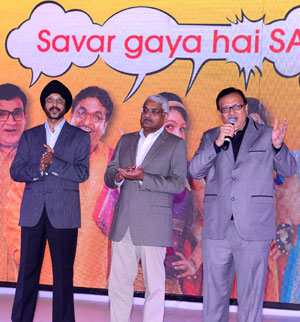
    Anooj Kapoor, EVP & Business Head SAB TV along with NP Singh, COO, MSM Network & Man Jit Singh, CEO, MSM Network, unveiled the new look of the channel

    By A Correspondent


    Multi Screen Media’s second GEC SAB TV unveiled a new look of the channel on Friday amidst much fanfare. While retaining the brand colours of red and yellow, the look has been enhanced by Argentinian design studios Steinbranding. The brand promise of ‘Asli Mazaa SAB Ke Saath Aata Hai’ and content strategy however stays the same. SAB TV  has further strengthened its bouquet of offerings with the launch of – SAB Ki Sawari, SAB Ki Paathshaala, SAB Ke Comics to further its connect with viewers.


    Said Mr Anooj Kapoor, EVP and Business Head, “Our new look signifies renewed freshness and a positive move into the future The bond the channel has built over the years will be  strengthened through unparalleled content and consumer engagement initiatives.


    A multiple media marketing campaign has been initiated to complement the relaunch.


  • Madison Media is Raymond’s Media AOR

    By A Correspondent


    Madison Media has been appointed as the media Agency on Record for leading textile, apparel and fashion retailer, Raymond Limited. Madison would be responsible for the entire media mandate for all Raymond group brands, including Digital and OOH.


    Gautam Kiyawat
    Mrinmoy Mukherjee

    Says Mr. Gautam Kiyawat, Group CEO, Madison Media Group, “We are delighted with this new win and are confident that we can add substantially to building the Raymond group brands.”


    Commenting on this development, Mr. Mrinmoy Mukherjee, Director, Marketing, Raymond Limited said, “Madison Media’s leadership status as one of the best integrated media solutions agencies in India and well-integrated service and processes will help our brands scale newer heights of success.”


  • Are Marketers ready for the Digital E-way?


    By Ritu Midha


    The internet has long stopped being Wonderland. Indians are adapting to the ways of the web, and flocking to it for multiple reasons. The third largest internet consumer on the web, India is also one of the largest smartphone markets. Indian marketers are experimenting with the capabilities of the internet and while early adapters are already reaping benefits, others too are looking at getting into a far more serious relationship with it. Flirting alone is not enough!


    First a quick look at some recent internet studies. The numbers might vary from study to study, but the trend they plot is the same:


    – As per the Boston Study ‘From Buzz to Bucks: Capitalizing on India’s ‘Digitally Influenced’, Internet users in India will grow from 125 million in 2011 to 330 million by 2016, nearly a 300 percent jump. This will lead to more purchase decisions being impacted by digital influence.


    As per this report, 40 per cent of India’s 90 million urban internet users already say that what they buy is influenced by online activities such as product research and price comparison. The digital influence right now affects $30 billion of urban consumer spending, and is likely to accelerate further.

    It states that men are far more likely than women to be on the internet (32 percent versus 12 percent) and more than 300 percent likely to be digitally influenced (14 percent versus 4 percent).

    – Kleiner Perkins Caufield & Byers partner Mary Meeker’s report, meanwhile, states that India will have 67 million smartphone subscribers by the end of 2013, a 52 percent growth YoY.


    Interestingly, more than 50 percent of Indian respondents surveyed stated that they share nearly everything online, while the same number for the US is just 15 percent.


    – As per 2013 global ‘Internet World Stats’ report, India is ranked third (following the US and China) in number of active internet users. In sheer numbers it translates to 120 million users (up from 81 million users in 2010). In percentage terms, however, it is only 11 percent.


    As for the smart phones the study estimates that from 18 to 20 million smart phones in 2012, the number will grow to 30 million by 2016.


    – The Google study perhaps is the most interesting of all. It states that of the 150 million internet users in India about 40 per cent are women. It indicates that of these about 60 percent (24 million) are online every day. Among their key activities online are checking email, interaction on social networking sites and online shopping.


    Though the numbers might not sound huge when compared to television viewership or readership numbers, the medium’s continuous growth, India getting younger by the year, and purchasing power of this populace make it a force to reckon with. And then there are the medium’s inherent traits like high involvement, engagement, focused targeting, and measurability.


    Another key reason for the marketers to join the digital bandwagon is reducing cost efficiency of traditional media. States Vivek Nayer, CMO, Marketing Division, Mahindra & Mahindra, “In traditional media there is huge competition for commercial time and column centimetres. With the new guidelines, channels will be able to show ads only for 12 minutes per hour. It might lead to further increase in ad rates. In traditional media due to the high rates, ad sizes and durations are being reduced. Brand stories cannot be shared in 20-30 seconds. The digital platform allows you to tell the brand story. Secondly, there is high spillover. In digital, media interaction is far more targeted.”


    Marketers are not looking at digital just as a medium of brand communication but as a platform to engage with the consumer. Vivek Balasubramaniam Srivatsa, Head Marketing, Renault comments, “Online is not just a media choice, it creates brand experience and drives transactions. The key is to bridge the virtual world with the physical world seamlessly.”


    India getting younger and the young Indian being bolder and far more web savvy than his/her parents too is a key reason for the advertisers to look at internet far more seriously. States Ranju Kumar Mohan, Director & Business Head, JK Ansell – Kamasutra, “Audiences are evolving. Digital is the right medium for targeting bold experimental Indian youth. An effective way to use online is to link offline events with online activity. It immensely helps in growth in conversations.”


    Rajiv Dingra

    One of the key reasons digital engages with the consumer much better than the traditional medium is because here consumer is not listening to the story, but is a part of it. According to Rajiv Dhingra, Founder & CEO, WatConsult, “Digital marketing reduces marketers power to control the message – that power here resides with consumer. For the brands to be able to connect with the consumers online, it is important to make them a part of the story.”


    For a brand like Bisleri, which has long seen success via tradition route, too digital is emerging as an important medium to cut the clutter. States Anjana Ghosh, Director Business Development & HR, Bisleri, “For the last 50 years we have built brands like Gold Spot, Thums Up, Limca, Maaza and Citra via traditional media. However, now with more 3000 brands trying to battle for consumer attention on television and print, it is inevitable that one uses digital in the best possible way. It is important to engage with the consumer, and know what the consumer says.”


    Brands are increasingly using web to promote its on-ground activities. It helps in reaching a much larger number of users, and thus increases the RoI manifold. States Mr Nayer, “Amplification of offline events online enhances RoI. Mahindra has formed the Purple Club for Mahindra XUV 500 owners, and we do special events for them. One such event is XUV 500 torque day where we invite XUV 500 owners to drive on F1 track. We do considerable online activity around the event – we put up videos, send mailers and create buzz on FB. During the event, it is not only us putting live updates on Facebook, but also the participants themselves! It increases the buzz manifold. Another event we created was at Auto Expo Delhi – where we used augmented reality. Here a virtual cheetah sitting on the car and moving around became extremely popular not only with those at the venue but also online. The video had wow factor, and so went viral. Besides amplifying the ground event massively, it also won us a gold Abby and a silver Abby.”


    Marketers are emphatic that brands’ online persona needs to be same as the offline one. The interactions and activities conducted online too should be in sync with its offline activities. Any dissonance, they believe, would end up impacting the brand personality adversely. Mr Srivatsa comments, “The online experience needs to be in line with the brand promise. The key is to interact with online users right and to make them our brand ambassadors. There has to be seamless integration with reality.”


    A few brands have taken a leap forward. They are not only using online for brand communication and interacting with the consumer alone, but also to get insights into the consumer behaviour. Vinay Bhatia, VP, Marketing & Loyalty, Shoppers Stop reflects, “Marketers can get interesting and useful insights into their consumers by analysing data. We have a introduced a tab ‘Perfect for Me’ on our Facebook page. Here we display products to the users based on their preferences. Almost 50 percent of the people who use Perfect for me tab are First Citizen Club members. We now have both, their buying data and thinking data. Marrying the two provides useful and interesting insights.”


    Adds Mr Mohan, “One gets sharper data and insights from digital platform. Our product extension in 2010 was based on feedback we gathered from trendsetters. It was done on a closed door FB page.Based on that feedback KS deodorants were created. These deodorants are now doing very well in the market.”


    Marketers are also realizing that while they can talk to the consumer on various platforms, internet is the only place where they can listen to the consumer. Subramanya Sharma, CMO Cleartrip states, “Forums, Twitter, Facebook and feedback are the platforms to continuously listen to your consumers, understand their needs and pain points. What people like and converse about, are clear guidelines to improve one’s products and services.”


    Sanjay Tripathy

    For services the web is a completely different ball game – as the focus here is not on marketing alone but also on providing an excellent online service experience. Sanjay Tripathy, EVP, Head-Marketing, HDFC Life says, “BFSI (Banking, Financial Services & Insurance) is not a product business. Our online presence, to some extent, is about query and interest, which leads to new business acquisition. The web, however, works immensely well as a medium to service the customers.” He adds, “Having said that, for online to work, the right ecosystem is important. The company should have right mindset and right partner.”


    So the inclination is there to use internet as a medium not of advertising communication, but of brand – consumer interaction. Though, there are still only a few examples of path-breaking digital marketing, the learnings are immense. What a brand expects and attains out of online brand-consumer interaction depends on the brand’s PLC, its involvement level, and also on its internet age. As more and more brands put weight behind digital in this tug of war with traditional media, it will get more interesting. However, inclination alone is not enough, brands need to condition themselves to listen to the consumers and evolve. If they just want to convey an advertising message, digital is no match for television.

    Quotes in this article are excerpts from 9th Marketing Conclave organized by the Internet Mobile Association of India (IAMAI)


  • Zee 24 Taas Goa Marathi Film Fest begins on June 28

    By A Correspondent


    The sixth edition of the Goa Marathi Film Festival will be held from June 28 to June 30, at Panaji, Goa. Marathi news channel Zee 24 Taas, which has been associated with the event for last three years as a media partner, is one of the presenters this year. The festival is thus called the ‘Zee 24 Taas Goa Marathi Film Festival’.


    The festival will screen around 15 Marathi movies, and as part of the festival Vinsan Graphics has organized a short-film competition to encourage new Goan talent in filmmaking.


    It is also hosting workshops on topics like ‘Catapulting Marathi Cinema’ which will touch upon the dynamics between international film festivals and Indian cinema and will include festival strategies, precautions a filmmaker should take vis-a-vis international film festivals, the kind of films that work and effective marketing strategies. Another panel will be ‘Co-production and International Funding’ and a special workshop for NRI filmmakers.


    Veteran actor Vikram Gokhale will be honoured with the ‘GMFF Kritadnyata Puraskar’ award for his outstanding contribution to the Marathi film industry.


    The event is being presented by Waman Hari Pethe Jewellers, along with Zee 24 Taas.


  • ABP Majha Sanman Awards on June 28

    By A Correspondent


    The ABP Majha Sanman Awards 2013 will be held on June 28, 6.30pm onwards at The Ballroom, Shangri-La Hotel, Lower Parel, Mumbai.


    Marathi news channel ABP Majha will hold the fourth edition of the Majha Sanman Puraskar awards to recognize outstanding Maharashtrians. This year, the Majha Sanman Puraskar is scheduled on June 28, where achievers and icons of the state will be honoured.


  • Cycle Pure Agarbathies to co-sponsor ODI tri-series in Windies

    By A Correspondent


    Cycle Pure Agarbathies is co-sponsoring the one-day international tri-series between India, Sri Lanka and West Indies, from June 28 to July 11. The tri-series will be held at two venues this year: The first half at Sabina Park in Kingston, Jamaica, and from July 3 in Trinidad.


    The ODI Tri-series will feature a total of seven one-day matches including the final. As a part of the co sponsorship initiative Cycle will feature on pitch mats, perimeter boards, and third umpire decisions. Special awards will be given to the players who showcase best all-round performance and also exhibit true sportsmanship. The awards that will be presented to the best all rounder are ‘Cycle Pure Agarbathies Trusted player of the match and Trusted player of the series award.’


    Cycle Pure Agarbathies is also the associate sponsor for the sports programme ‘Straight Drive’ that will be aired on Ten Sports during the ODI Tri-series.


  • Times group launches education centres for professionals

    By A Correspondent


    As a part of its foray into the education business, The Times of India group has launched the TimesPro brand under the Times Centre for Learning. TimesPro aims to provide skills to the industry and transform graduates to professionals by offering specific courses in BFSI (Banking and Financial Industry), Media, Organized Retail, Hospitality and Healthcare.


    As a part of the launch, the company has set up state of the art learning centres in Mumbai, Noida, Jaipur, Lucknow, Ahmedabad, Hyderabad and Bhubaneswar. The company will leverage the group’s extensive resources, knowledge base and technology expertise to provide a first of its kind learning experience.


    In creating this new education initiative, the Times group has taken the lead from the fact that there exists a large gap between industry requirement and skillsets of fresh graduates. The extent of this skill gap has been highlighted in the 2013 employability survey by Associated Chambers of Commerce and Industry of India (Assocham) which states that only 10 percent of graduates are employable.


    On the launch of TimesPro, Managing Director Vineet Jain said, “The Times of India Group has innovation and excellence in its DNA. TimesPro through its unique and modern training programmes will provide the industry with graduates having relevant professional skillsets. These programmes will also make graduates more employable and job-ready.”


    In its endeavour to upgrade the skills and knowledge of graduates according to the needs of the corporate sector, TimesPro courses will be designed and delivered by industry experts having extensive experience across industry and academia. Its flagship programme – Post Graduate Diploma in Banking Management will be launched in June 2013 and will cater to the rise in demand for skilled graduates in the banking industry that is expected to be created by the influx of private banks in the next few years due to the amendments made by the RBI.


  • LinkedIn’s Nishant Rao in IAA webinar on June 27

    By A Correspondent


    The International Advertising Association (IAA) – India Chapter has announced its next webinar with Nishant Rao, Country Manager, LinkedIn, as speaker. The webinar will be held on the Google Hangout platform on Thursday, June 27 at 3pm. MxMIndia is partnering this initiative.


    Srinivasan Swamy, President, IAA, India Chapter, said, “We began with Rajan Anandan in April and followed it with Ajit Balakrishnan in May. We are seeing increased participation, and are glad that this knowledge sharing platform by IAA about the Digital medium is gaining traction.”


    Abhishek Karnani, Director, Free Press Journal and Manish Advani, Head – Marketing & Public Relations, Mahindra Special Services Group, are co-chairing this IAA webinar series.


    “It’s an honour to be presenting Nishant Rao in our next Webinar. This ‘World Goes Digital’ webinar series is aimed at helping professionals across age groups understand digital trends and nuances,” said Mr Karnani.


    “When I landed in India after a long stint in Canada, I didn’t know anyone in India, but through LinkedIn I was able to expand my network at a rapid pace. Network led to Net worth for my organization. I am glad through IAA many youngsters in India will learn more about LinkedIn that too from a leader of LinkedIn,” said Mr Advani.


    The inaugural webinar with Rajan Anandan, MD, Google India, was held in April and with Ajit Balakrishnan, Founder and CEO, Rediff.com in May. Over the last few months, the IAA (India Chapter) has conducted a series of activities – the IAA Leadership Awards, a Gender Sensitization Seminar, and the IAA Olive Crown Awards. Every month, the IAA also conducts IAA Debates in different cities, on topical issues concerning the industry.


  • Forbes will stick to its DNA: R Jagannathan


    R Jagannathan or Jaggi, as he’s popularly known, is a veteran business editor, having worn the biz ed hat several times over. As Executive Editor of BusinessWorld (way back in 1987 till 1990), Business Editor, India Today (1990-91), Founding Exec Editor, Business Today (1992-93), Resident Editor, Business Standard (1993-96), Editor, Financial Express (1996-2000), Editor, myiris.com (2000-02), Exec Editor, Business Standard (2002-05) and Editor – DNA Money (2005-07). In June 2007, he was made Managing Editor and later Executive Editor of the six-edition DNA news daily, a position he held till 2010. He joined the Network18 group in 2011 to launch Firstpost and in March this year, he was elevated to Editor-in-chief, web and publishing for all of the Network18 group’s print and online publications.


    Late last month (May 2013), Mr Jagannathan took charge of Forbes India after four senior editorial heads including Founding Editor Indrajit Gupta exited the organization in controversial circumstances. The Editors’ Guild of India and Press Club Mumbai deplored the development and issued statements even as, according to rumours, Mr Gupta and his colleagues have taken the Forbes India management to court on the issue.


    MxMIndia spoke with Mr Jagannathan last week to find out how the transition has been and specifically what are the changes he’s planning to bring about in the fortnightly magazine.


    One can’t start this chat without asking how the transition has been. There was evidently much sound and fury when it happened.

    Yes, as far as I am concerned it was totally unexpected because as late as last year and even early this year there were several meetings with Indrajit and all to discuss common newsroom ideas and various things so I thought everybody would’ve been little bit prepared for it. So when the announcement was made in March, we were ready for it and we were not pushing it too fast also because we wanted people to buy into the idea of the common newsroom. I think for about a month I was attending their meetings just to understand their processes and various things. I always believe integration processes are slow, it takes time and we need to get people’s buy-in so that’s what I was working towards. But somewhere along the line, probably they were not happy with the idea.


    As a journalist who’s been through the ranks and who has seen things from both sides, did you find the entire episode unnerving?

    No, it was not unnnerving for me because I believe that certain things have to happen because today the cost of content is very high regardless of whether you are running a print publication or a dotcom. You have to see how you can synergize and get additional kinds of content from multiple sources so the move towards common newsrooms sort of has to happen. In India, it is happening at a slower pace than elsewhere.


    Integration is always a tough process…

    Of course it is. You are dealing people who have a way of doing things. Let’s say if you are in a magazine you are used to writing, say, one story in a fortnight whereas in Firstpost we are in a newsroom where we are churning out lot of copy on a dynamic level so obviously it will take some time…


    As somebody who has set up and worked with business magazines for long, what was your view of Forbes India when you took charge? And how has it been so far?

    Forbes is a fantastic product and is well accepted by the market. Anybody starting Forbes four years ago was doing the right thing by going in the direction that they were going. Later, ForbesIndia.com was set up so everything was going according to the plan. The only thing is that as you move along, you’ve got to see the challenges ahead and be pro-active. As a category, magazines have been stagnant for a long time and struggling in all domains. So just because you are not struggling does not mean that you should not prepare for the future. It’s this thinking that led the management and us to look at how Forbes needs to be in the future.


    You’ve helmed Forbes India editorially for a month-odd now. Any changes planned?

    No, nothing very significant because it’s not that everything in the past was wrong. We have made incremental changes in some parts which were not working… which you have to do regardless of who is the editor. You have to constantly keep reviewing the product and make it elegant.


    The one important thing that I am probably changing has to do with the fact that you are a franchised edition of a globally accepted product. So, there is no need for you to reinvent the wheel in India, you don’t have to stuff in India content because you are a foreign product with an Indian DNA. In fact if you make it more and more Indian, you are competing with Business Today and Business World. Now you want to be in a category where you are a global publication which has an Indian element in it. So what I am doing is not chucking great content and replacing it with 70 percent of your content. You do the other way around… you make sure that the 30 percent of the Indian content measures with the global brand and do that.


    What is the content ratio now and what it’s going to be?

    We haven’t significantly changed it but we have started the process. I think earlier Forbes US content was more like 40-50 percent or maybe lesser. Sometimes it was even 30 percent to 20 percent. But we are making it more like 50-60 percent range…


    Forbes India often was often fairly aggressive in its journalism. There was this story on DNA I guess when you were editor which was pretty damning… Are you going to follow the same aggressive approach?

    See, I do not know entirely what was done in the past, but you certainly have to tell the truth. There’s no doubt about that. But, as far as the core philosophy of Forbes is concerned, it’s largely pro-business, it is not meant to be an NGO. It is not meant to be anti-capitalism. We are for capitalism but not for crony-capitalism, so there is a difference. We don’t want to say that capitalists are good even if they are doing rotten things. We are not in the business of saying that the government is a lovely thing, food security is great. All those things we are not going to do, so I think shift in focus is happening little by little. We have not entirely changed it. We have an approach where we say entrepreneurship is key. We believe that if entrepreneurs are given the right inputs, India will benefit because entrepreneurs can create jobs that governments cannot.


    So good business is good and bad government is bad. We want less government and more business very clearly. I mean those are the broad philosophies of Forbes and that philosophy we have to adopt here.


    Will you continue with the current periodicity?

     Yes, we will be fortnightly as we have always been. In fact what we do is like even in the past when we have special issues, we will have additional issues.


    And will Forbes life continue as is?

    We do plan to do some tweaking in the product because I think it is little more artistically-oriented right now. It should be a little more lifestyle-oriented so we will be looking at content probably in the next few weeks. The current issue is going to bed, it’s doing well and has a fair amount of ads. We want to see if we can make it much better commercially and it’s far more oriented towards Forbes Life as it is in the US.


    Internationally, Forbes has a few extensions like Forbes Woman. Are you looking at those in the near future?

    No, what we may have is special issues which might come free with the magazine but that is like once in a year. We want to make sure that the core brands – Forbes India and Forbes Life, and Forbes India more than Forbes Life – will really succeed. It is a crime for Forbes India to not make money. Forbes is about the rich, about being profitable. So Forbes has to be profitable and we will be profitable if we stick to our core DNA, which we will.


    But the dynamics of the business are such that they weigh against all magazines.

    Yeah, so we are also tweaking the business model which is basically to be a little more asset light. That is we have a core team of editors who will continue to remain there but we are also taking more content which we will get others to do on a project basis so it’s not like we want to do everything in-house. Hence many things will get changed so that the cost factors probably work out a little better.


    Does this mean you will shed some weight?

    No, we are not shedding any more weight except if anything happens through the process of natural attrition.


    But there will be some re-allocation?

    Yes, because we are expecting people to contribute more so you bring down costs either by getting people to be more productive or you don’t replace when people leave.


    And on the website, will we see changes there too?

    We think ForbesIndia.com is eminently monetizeable because it has a very strong business environment in which advertisers want to put in money so we think we will build the brand by increasing the content in that and certainly it will be grown


    Will it be a business-y Firstpost?

    No, Firstpost and Forbes are two different brands and there is no question of mixing the two brands. Firstpost is an edgy, opinionated site. What we may do is occasionally re-publish some stuff from here for Forbes. And where it is relevant, the reverse also. People working for the two places might contribute separately for the two brands. A brand is a brand, you don’t want to screw up by mixing up the two brands.


    It’s about people synergy that is the person in Forbes might write something for Firstpost and the person in Firstpost might contribute and do something in Forbes Life. So in a sense it’s like free-of-cost content in some ways because you are doing it in the spare time. You are doing additional work, so it’s not about mixing up the brands.


    So, how do you divide your time? You have held multiple hats in the past but here Forbes must be taking a fair bit of your day?

    I think it’s largely a time management issue. In the first half of the day, I work for Firstpost and in the second half, I look at Forbes. This is a fortnightly so you need not have to look at it daily. At a later stage, there may be a line editor working under me who will be doing the actual running of the Forbes part but we have not come to a decision on whether to do that or not. In the foreseeable future at least I will be running the magazine and after that we have to internally discuss how it will go forward.


    What about the other publications which are part of your portfolio?

    There also there are some degrees of synergies that we have built in…


    Journalists typically crib about more work for the same amount of money!

    I have always believed that it’s not about more work or less work. It’s that journalists are very bad time managers. When I was in Business Standard, we had a Financial Times editor working with us and we used to ask him how he manages to file five stories a day. He said, “We have our beats and everything and there may be a story outside the beat that the editor might assign you. It’s a standard formula in terms of what kind of stories you do. You talk to a guy, a rival or whatever it is. Writing a 500-word story doesn’t take more than an hour or an hour-and-a-half so I can easily file five stories a day.” And this is for a newspaper. The point is in India the average newspaper reporter does one story and thinks it’s a great thing. Of course we do have great faith in the so-called exclusives. Often the exclusives are defined by the reporter and not actually what the reader wants. At Firstpost, I could do much more in the 8-10 hours because if you constantly look at how your time is going, you realize that you can actually do more.


    Would it help having a different breed of journalist for an integrated newsroom?

    Yes, unfortunately we tend to recruit the same people we know but when DNA started, one of the suggestions I made to the promoters was that beyond a few top level editors, you should spend six months taking on an entirely new breed of journalists who can be trained in your drill. On what makes for a story, how you should write a story and this is how many stories I expect you to file. Be internet-driven first and then write for the newspaper. This was the plan that I had made, but they were so excited about the product at that stage that we never went into it. But now there’s an opportunity to achieve that…


    Finally, would you say it’s going to be business as usual for Forbes?

    Yes, the responsibilities of content for the people will change a bit. But that’s at the margin because we want them to settle in first and then start contributing in other parts.