Category: MEDIA

  • 1 Minute View: Brand BJP needs resurrection

    Some three decades back, soon after the Babri Masjid episode, the BJP stood for Hindu nationalism. And not just that, it was perceived as a party with a difference, an alternative to the so-called pseudo-secularism of the Centrist parties.


    Once the BJP-led NDA government got to power, it was forced to shed militant Hinduism because it couldn’t afford to make that as its credo. And its efficiency levels in power were not dramatically different from the Congress.


    Realising that a down-in-the-dumps Congress may be a more worthwhile alternative, a Congress-led UPA government got to power a decade back.


    It’s not that the BJP has been totally wiped out, but save Gujarat CM Narendra Modi, it has no national level mass leader. Modi’s charisma is suspect thanks to the strong opposition post the Godhra carnage and riots.


    Does Brand BJP have any value? It does, but it’s down very much. Will Brand NaMo have a positive rub-off on the party. Given that he’s perceived to be a man of action, it may work with some, but there’s enough negativity that he brings to the table that will need to be addressed.


    For Brand BJP to score high in the coming elections, it will more than just election rhetoric. Some scientific image management, may be?


  • Tyroo strengthens its India leadership team

    By A Correspondent


    Multi-screen performance network Tyroo has announced the appointment of Ratnakar Bharti as the General Manager & India Sales Head and Sandeep Sabharwal as Global Head, Delivery & Publisher Relationships. The strategic restructuring of the corporate leadership team signals Tyroo’s renewed focus on the region geared towards product innovation and greater adoption of performance marketing.


    On the restructuring of the leadership team, Siddharth Puri, CEO, Tyroo Media, said, “Tyroo is on a strong growth path. We have ventured into international markets and expanded our product portfolio. In addition to our core leadership in Cost-Per-Sale and Cost-Per-Lead, we are the only network in India with exclusive focus on pay-for-performance model on mobile and video. We are aiming at a 100% growth in FY 2013-14; with such promising growth plans, we felt the need to strengthen our leadership team that could partner with us towards the desired future success. I am delighted to have both Ratnakar and Sandeep in my team and confident that their association will help us in making deeper inroads into the market.”


    Ratnakar Bharti, a veteran in the digital media domain, has over 15 yrs of experience having led and managed media planning, buying, campaign management, business development and ad sales for brands across business verticals. Most recently, he headed National Sales for Ideacts Innovations Pvt. Ltd for close to four years. Ratnakar has also been associated with organizations such as Rediff.com, Intercept technologies, Business Standard and Indiabulls.com.


    Sandeep Sabharwal, another industry veteran, has over 18 years of diversified experience in business functionalities that include sales, business development & marketing. He has had close to a decade long stint in the digital media domain with expertise in digital media planning and buying, display, SEM, SEO, Mobile/WAP marketing, ad servers & analytic tools. Prior to joining Tyroo, Sandeep held the role of Head, Digital Team – North at Maxus, GroupM. In the past, Sandeep has worked with Quasar Media, Cybermedia, NU-TECH and Flex Refrigeration in various roles.


  • MagnaGlobal predicts India adspends to grow 7.8% in 2013, 11.9% in 2014


    By A Correspondent


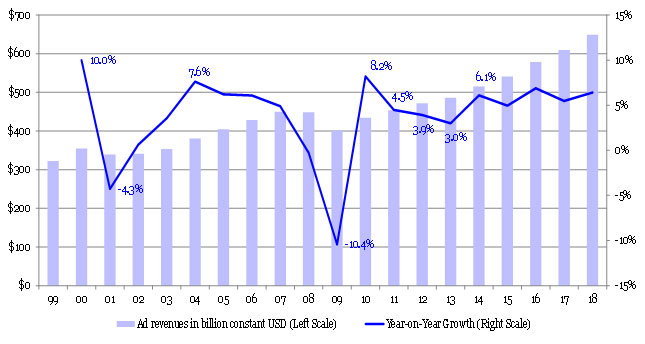
    Magna Global predicts the global advertising market to grow by +3.0% this year, to $486 billion, thus slowing down from 2012 (+3.9%), and then accelerate by +6.1% in 2014, to $515 billion. Compared to the firm’s previous forecasts, published in December 2012, this represents a small downgrade for 2013 (-0.1%) and a small increase for 2014 (+0.1%). Magna’s analysis covers ad market conditions in 73 individual markets, adding three new markets this time: Sri Lanka, Pakistan and Kenya.


    The Indian Economy experienced its worst near decade slowdown in 2012, with real GDP growing by +4.0% compared to +7.7% in the previous year (source IMF). The downgrading of economic outlook by rating agency hampered the investment climate. The government took some measures to reduce subsidies, opened up FDI in retail and plan to introduce targeted subsidy through direct cash transfer to cut expenditure. However the impact of these reforms remains uncertain in the short to medium term. In its April report, IMF forecast +5.7% of real GDP growth this year and +6.2% in 2014.


    The Global Headlines:

    # Media Owners Advertising Revenues will grow by +3.0% in 2013 to $515 billion dollars and accelerate to +6.1% in 2014.


    # In 2013 APAC and Latin America growth will offset the stagnation in EMEA and North America


    # In 2014, US and European ad markets will benefit from economic recovery, US mid-term elections and global sports events.China remains a reliable growth engine and Japan confirms a surprise return to growth.


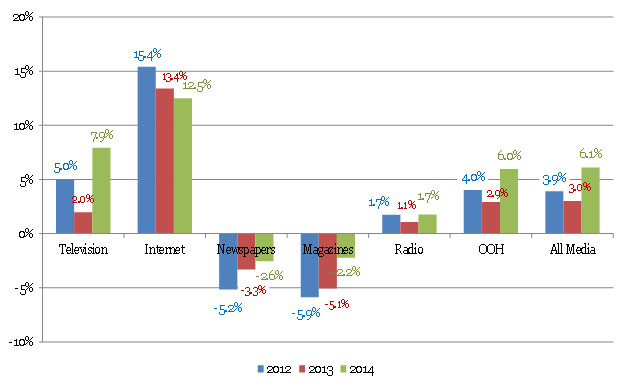
    # Digital Media will grow by +13.4% in 2013, reaching a 23.3% market share.


    # Social media generated $5.9 billion in advertising revenues in 2012 and we anticipate an impressive 39.6% growth in 2013.


    # Automated “programmatic” buying already represents 17% of online display transaction in the US and up to 30% in some other advanced markets.

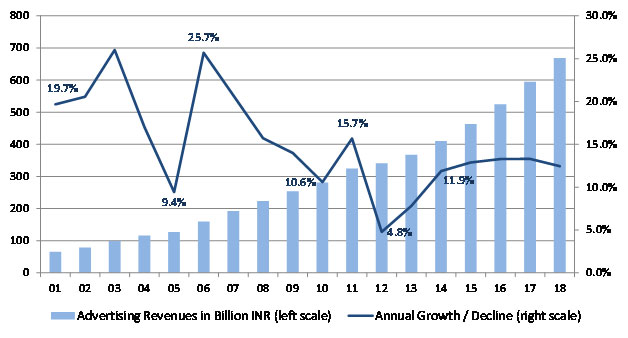
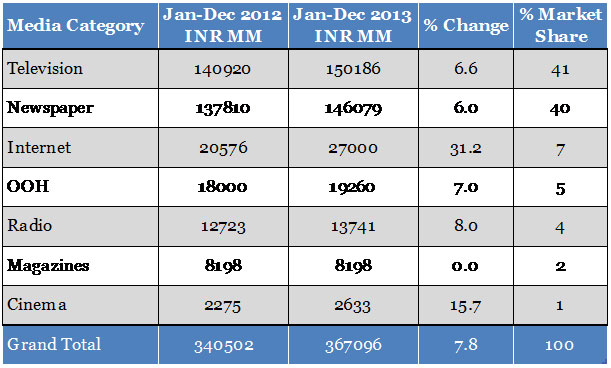
    Magna expect’s the advertising market to grow +7.8% in 2013 with television and print contributing over two-thirds of all revenue. Television advertising will grow +6.6%. Digital media growth +31% is faster than any other category with Mobile & Video outgrowing traditional display. The Print story is still relevant in India and will continue, Newspapers category expanding in language and regional pockets is estimated to grow +6.0%, magazines will however remain flat. Radio and out-of-home advertising will grow +8.0%. With the investment climate expecting to warm up and demand from external economies backed by solid domestic consumption we forecast the advertising revenue to grow +11.9% in 2014.


    The rest of the forecast is as follows, as received from MagnaGlobal:

    Globally, the predicted acceleration in ad revenues is in line with expectations of accelerated economic growth in the second half of 2013 and throughout 2014. In its April 2013 report, the IMF predicted 2013 real GDP growth to reach +3.3% globally and 2014 to accelerate to +4.0% in 2014. Although the economic forecast is still modest for developed markets (+1.2% and then +2.2%) and for Europe in particular (+0% and then +1.3%), it will in many cases bring the economic environment to the point where business growth triggers not only ad spend growth but, in some markets, faster-than-GDP growth. In markets where marketers have been cautious, they may at last switch from optimization mode to expansion mode.


    Digital media will continue their double-digit growth in 2013, as ad revenues will increase +13.4% to $113.6 billion. Growth will be driven by search (+14.6% to $52 billion), video (+21% to $6.6 billion), mobile formats (+54% to $12 billion) and social formats (+39.6% to $8.2 billion). Other formats will barely grow, and actually decline in many markets due to the commoditization and deflation of display inventory.


    Television advertising growth will slow down in 2013 due to the absence of global televised events. Following a +5.0% growth in 2012, ad sales will grow by only +2.0% to $196.5 billion, but TV remains the leading media category(40% market share) ahead of digital. Print formats continue their decline: in 2013 newspaper ad revenues will decline by -3.3% and magazine revenues by -5.1% to a combined $110 billion (a 23% market share). Radio advertising will grow by +1.1% to $32.5 billion and out-of-home media revenues will increase by +2.9% to $32.6 billion


    Slowdown downgrades India from Top 10 in 2017: Venkatesh S, MagnaGlobal
     

    We had published IPG Mediabrands’s MagnaGlobal forecast for adspends in 2013 in the month of December along with an interview with the Bengaluru-based Venkatesh S, EVP and Director Intelligence Practice at MagnaGlobal on the study. On receiving the mid-year projections, we interviewed Mr Venkatesh yet again. Here’s the Q&A:

    The annual forecast made in December 2012 had your annual forecast for India at 8.7% y-o-y growth. Now it says 7.8%. That’s not too big a drop given that the year has been no great shakes so far. What’s your comment on this change?

    The change is because of drop in newspaper projections.  While overall the volumes have gone up in similar period of comparison, the growth is coming from smaller towns and editions.


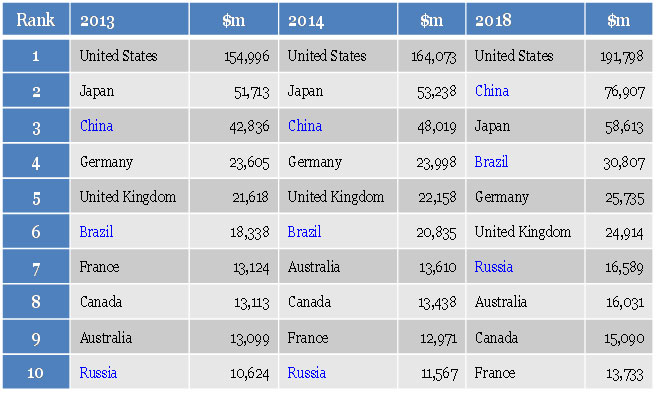
    In December, India was among the Top 10 markets in the year 2017. Now it doesn’t figure even in 2018. Reason for us to sob?

    Our predictions are basis macro-economic modeling factoring in structural changes in local markets.  The slowdown experienced last year will drag the economy for some time to come.  The business and consumer confidence is slightly optimistic currently.  These factors have led the downgrade of India from the Top 10.


    These days, the spends on BTL and various experiential activities have increased. How do you see the growth of that? And would you see it being captured under a separate head in the years to come?

    There is a realization in the industry that activations or experiential marketing drive brand preferences compared to visibility campaigns.  These will continue to gain traction.  While there are estimates of the activation industry size to be anywhere in the range of INR 8000-12000 crores, the challenge to quantify is to define the constituents of BTL and quality of data capture.  For example, should sampling be part of BTL?


    Also, do you think social media and PR will also find place in this study?

    We have been covering most of the constituents in the digital space including social and reported under Internet category.


    Magazine numbers have gone down from December to now. In Dec, you had predicted 4.2% growth. Do you see a beginning of a decline in spends on magazines?

    Magazine especially general category has been on the decline.  One of the reasons is our readership methodology being skewed towards newspapers. Keeping fingers crossed on the new methodology addressing this category.


    There’s no change in the internet from Dec to June. One would’ve expected a growth in the estimation?

    While overall digital spends have not changed, though some of the sub-categories within have gone through few movements


    What percentage of this is in the traditional internet and what is it on mobile phones?

    Social and mobile contribution to total internet is about 19%


    Lastly, would you see 7.8% increasing when we get next year’s report in December?

    Not ruling out slight adjustments inter-category, I don’t have any visibility of this going up.


    2013-2014 across geographies

    There continue to be wide regional and national contrasts in the global advertising landscape in 2013. There will be almost no growth this year in EMEA (+0.4%) and North America (+0.7%). On the other hand, we are increasing the 2013 forecast for Latin America (+12.5%) and for APAC (+5.9%).


    EMEA: ad markets hit by European recession

    EMEA will barely growin 2013, with the sub-region going through varied states.

    Plagued by economic recession and record unemployment levels (12.2% in the Eurozone, 8.4% in the UK), Western Europe ad revenues will decline by -1.6%. Resilience of the two biggest markets – the UK (+2.2%) and Germany (+0.6%) – will partially offset the decreases in Southern Europe (France -3.3%, Spain -10.4%, Italy -9.4%). However, after three, four andsometimes five years of negative growth in some markets, we believe most of Western Europe will bottom out in 2013. For instance, there are signs already that television pricing may stabilize in the second half of the year and increase, however slightly, in 2014.


    Central and Eastern Europe will grow by an average +7.6%, in line with previous expectation, but again reflecting national contrasts, with double-digit growth in Russia (+11.7%) and Turkey (+10.2%) partially offset by stagnation in several smaller markets (Poland, Czech Republic, Hungary).


    The Middle East and Africa sub-region will be growing by +4.8%, with advertising expenditure increasing in the Gulf Cooperation Council countries (+3.8%) and in South Africa (+5.5%) but decreasing in Morocco (-2.1%) and Kenya (-20%).


    US: light at the end of the tunnel

    The US economy is on a slow but steady trajectory towards recovery. Despite the government sequester and higher payroll taxes that have contributed to the uncertainty that plagued the beginning of the year, 2013 will show moderate economic growth. The second half of 2013 and 2014 are expected to improve, due notably to a stronger housing and job markets and higher business and consumer confidence. The US unemployment rate remains high (7.6%) but is declining month after month (+175,000 non-farm jobs in May).The latest consumer sentiment index showed a surge at 84.5 compared to 76.4 in April, bolstered by optimism stemming from rising stock market, home prices, and employment.


    For 2013, we expect +0.4% growth in media owners ad revenues, to $155 billion. These growth rates are not normalized and do not take into account the absence of the incremental Olympics and political spend that occurs in even years. If neutraled for political and Olympic spending in 2012 and 2013, the underlying growth would be stronger by approximately 1.5%.


    We anticipate total US television advertising to decline -2.8% in 2013 with -6.8% in broadcast TV due to the absence of Olympics and political spend, and +2.4% for cable TV. Digital media is the only category to show significant growth in 2013 (+11.5%), although the pace of growth should plateau slightly as a result of deflationary pricing trends affecting display formats. The category will be driven by mobile advertising continuing its aggressive growth at +61.7% to $5.4bn. Print advertising will continue to decline as ad sales will drop by -6.7% for magazines and -6.8% for newspapers. Radio is expected to remain flat this year and out-of-home advertising will grow +3.5%.


    China: a successful soft landing

    The Chinese economy successfully engineered a “soft landing” in 2012, with real GDP growing by +7.8% compared to +9.3% in the previous year (source IMF) and inflation coming under control (it was +1.8% in 2012 following +7.8% in 2011). The Chinese government can thus afford to continue stimulus programs and maintain high-single-digit real GDP growth rates in the mid-term. In its April report, the IMF forecast +8% of real GDP growth this year and +8.2% next year. When factoring inflation, that translates into low-double-digit nominal GDP growth for the next five years.


    Advertising spend had its own soft landing last year; it increased by 9.3%, which was the first time it grew at a slower pace than nominal GDP. In the mid-term however, MagnaGlobal believes the ad market still has the potential to grow faster than the economy because domestic and international brands are competing for the attention of Chinese consumers while media inventory is limited, therefore driving media cost inflation. In 2013 we expect the advertising market to grow by +11.6% to RMB 302 billion. Television continues to command the highest media market share, growing 7.6% to RMB 109 billion and while digital is rapidly gaining (+27% to RMB 88 billion). Internet penetration will have to expand to older rural demographics for continued gains as the urban youth market has been completely saturated. Supported by robust domestic demand, ad expenditure will grow again by 12.1% in 2014 and by 12.6% in 2015 and China will pass Japan to become the 2nd largest media market globally by 2016.


    Another “sleeping giant” is waking up in Asia: Japan. Following the general elections of December 2012, Shinzo Abe from the Liberal Democratic Party became the new Prime Minister. Prime Minister Abe introduced an aggressive unorthodox, expansionist economic policy – that has become known as “Abenomics” – to break the pattern of deflation/stagnation that has plagued Japan in the last fifteen years. In April the IMF raised its real GDP growth forecast to +1.6% for 2013 (+0.4) and to +1.4% for 2014 (+0.7). The IMF is acknowledging a shift in the Japanese economy: after 10 years of deflation, CPI inflation is expected to be flat in 2013 (+0.1%) and up by +3.0% in 2014, which, by Japanese standards, sounds like hyperinflation. The perspective of more dynamic economy and positive inflation in the mid-term has led us to change our advertising spend scenario too. We revise ad revenue growth forecast from +0.2% to +1.5% in 2013 and from +2.3% to +2.9% for 2014.


    In Russia, already the world’s 10th largest advertising market, advertising sales grew by +11.4% in 2012 and are expected to grow at a similar rate (+11.7%) in 2013. Unlike many other large European markets, digital claims less than 20% of the total spend in Russia, while television controls half of total ad spends. TV advertising cost inflation continues to drive double digit television growth rates (+10.3% in 2013), and despite recent regulation requiring no TV sales house to control more than 35% market share, there are still only a handful of dominant points of sale and therefore limited competition. The Winter Olympics in Sochi in 2014 will also benefit television ad spend. Russia’s GDP growth should remain robust in the high single digits, which will continue to drive Russia’s advertising market higher in the top 10 global rankings.


    Latin America bracing for the World Cup

    As Latin America is gearing up for the 2014 FIFA Soccer World Cup (the first to be organized in the region since Mexico 1986), we anticipate stronger advertising demand in the next 12 months, most notably in the host country Brazil, and mostly on television. The region’s ad revenues will grow by +12.5% in 2013: growth will be moderate in markets with low inflation (Brazil +10.7%, Mexico +5.5%) but explosive yet again in countries with hyper-inflation (Argentina +28.7%, Venezuela +15.7%).


    In 2014, ad growth will accelerate further to +12.9%. The entire region will benefit from domestic and international brands investing to be associated with the event. The Brazil market will grow by +13.6%, Argentina by +21.9% and Chile by +4.7%. Television will be the biggest winner, growing +13.6% to $25.5 billion and strengthening its leadership in the region (59% market share) but digital media and social are also expected to thrive, with ad revenues growing by +19.7% and +43% respectively. Brazil is already the second biggest market for Facebook with more than 70 million users and the big sports events of 2014-2016 are bound to accelerate social usage even further.


    2014: strongest growth since 2010

    For 2014 MagnaGlobal predicts global advertising revenues to grow by +6.1% to $515 billion, which is a slight acceleration compared to our December forecast (+6.0%). This will be the highest annual growth since 2010, when the global advertising market grew by +8.2%, having rebounded from the worst recession year on record, 2009 (-11%).


    The global ad market will be driven by a stronger economy (+4.0% of real GDP growth according to the IMF), aggressive economic policy in China and Japan and stabilization in Western Europe. In addition, adspend will be driven by the even-year events: Soccer World Cup in Brazil (with soccer becoming increasingly popular in markets like Japan, China and the US), Winter Olympics in Sochi, Russia, and the mid-term election cycle in the US. Since the “Citizen United” decision of the Supreme Court that removed any limitation to fund-raising and campaign spending, ad spend around mid-term congressional elections and “propositions” has become almost as big as a presidential race year.


    We have increased our 2014 forecast for North America from +5.1% to +5.6% (US: from +5.4% to +5.9%) and our forecast for EMEA from +3.2% to +3.3%. APAC will grow by +7.4% and Latin America by +12.9%.


    Focus on Digital Media

    In its new report, MagnaGlobal is also focusing on two major trends affecting digital media advertising: the rise of programmatic buying and social media.


    Programmatic buying is a method of buying and selling digital display inventory through automated, data-driven platforms and, sometimes, through real-time bidding (RTB). It fundamentally allows the demand side to buy audience for online display and video formats as they buy key-word search. Programmatic transactions continue to grow in the US, commanding an increasingly large share of display advertising revenues. In 2012, programmatic transactions represented $2.4 billion i.e. 17.4% of total display advertising, and we expect this to increase to 48% of revenues by 2017. Internationally, most markets still lag the US at this point, but some less advanced digital markets may face smaller legacy issues and resistance to change in the value and therefore evolve more rapidly towards automation.Some Western Europe are showing robust RTB growth such as the Netherlands where 29% of digital ad sales are already transacted via programmatic methods. Expansion in APAC and South America is still in more nascent stages.


    For the first time, MagnaGlobal is publishing estimates and forecasts on the size of social media within internet advertising revenues. Says Vincent Letang, Director of Global forecasting and author of the report: “In recent years, social media has become a central part of the online experience, partly at the expense of portals and emailing. Everywhere, internet users already spend 25% to 30% of their online time on social networks. Facebook is the leader with 1.1 billion users to-date, but other forms of social internet are flourishing, notably in Asia or Russia, and monetization is accelerating in 2013”. Global social advertising revenues are estimated $5.9bn in 2012, growing 36.8% compared to 2011. Social media advertising is expected to increase further from $8.2bn in 2013 to $24.3 in 2018, representing a 24% CAGR in the next five years.


    The next MagnaGlobal forecasts will be published in December 2013.


    Figure 1: Global Advertising Market (Media Owner Revenues)


    Figure 2: Advertising Revenues by Media Category (Growth Forecasts)


    Figure 3: Top 10 Markets


    Figure 4:India Advertising Market (Media Owner Revenues)


    Figure 6: India advertising revenue by media category 2012-2013


  • Now TV18 & Viacom 18 too withdraw subscription from TAM

    By A Correspondent

    TV18 and Viacom 18 too have withdrawn their subscription to TAM ratings, it is learnt. Reliable sources from the Network18 group informed MxMIndia about this decision.

    MSM (Sony), Times Television, NDTV and SAB had already withdrawn their subscriptions. TAM, a spokesperson said, was unaware of the development.

    Over the last week, there has been much discussion in the Indian broadcast industry on the issue of the television measurement service administered by TAM Media Research, a joint venture of Nielsen and Kantar Media, a WPP firm. Broadcaster body IBF issued an advisory last week urging its members to make their decisions.

    While the apex associations of advertisers and ad agencies – the ISA and AAAI scoffed at the suggestion that measurement should be done away even in the interim, earlier this week SAB and today (Friday, June 14) TV 18 and Viacom18 have gone ahead with the withdrawal of the subscription.

    Withdrawal of the subscription would of course not mean that TAM would stop even as around 80 percent of TAM’s revenues comes from the broadcast fraternity.

    According to a report on afaqs.com, Star India too has pulled out, though MxMIndia has not received any intimation of the same. The PR agency of Star India said it had not issued any communication on this.

    At the time of the writing, other leading networks – Zee Entertainment, Sun, Discovery, Reliance Broadcast etc were still subscribed to TAM’s weekly ratings.

  • Multi Screen Media forays into film production with MSM Motion Pictures

    By A Correspondent


    Leading broadcaster Multi Screen Media Private Limited has ventured into film production under the banner of MSM Motion Pictures.


    The new venture has collaborated with Eros International for its first film titled ‘Bajate Raho’ that is set for release on July 26. Three other films are on the floors and set for release later this year.


    NP Singh

    Said NP Singh, COO, MSM Network, “We are delighted to venture into the movie business as it offers enumerable opportunities for us to co-create, produce, innovate and offer engaging and high quality content to entertain the Indian audiences.” On Monday (June 17), Mr Singh was present at an event to unveil the new venture as well as the film, in the presence of its stars.


    According to sources, MSM Motion Pictures will be associated with medium budget ventures to start with but will eventually go in for big, solo productions. Initially Mr Man Jit Singh, CEO of MSM Network and Mr NP Singh will personally oversee the division.


  • Bloomberg, India TV join Star, Zee, 5 others in TAM boycott. DD to stay

    By A Correspondent


    Monday would’ve been a day of mixed emotions for the TAM Media Research head quarters in the Eastern Suburbs of Mumbai.


    Two more channels – the first amongst the standalones, wrote to TAM with an unsubscription notice. With yesterday’s development, the list of broadcast entities who have pulled the plug on TAM is:

    1. Star Network

    2. Zee Network

    3. Television18 and Viacom18 networks

    4. Multi Screen Media (MSM/Sony) network

    5. NDTV network

    6. Times Television network

    7. SAB network

    8. Bloomberg TV

    9. India TV


    A TAM spokespersons confirmed receipt of letters from the above. The reason for the mixed emotions was the fact that Prasar Bharati CEO has announced that he will not pull out his subscription from TAM services.


    Meanwhile, as per a communiqué issued by Bloomberg TV India, the channel has also asked TAM to stop reporting its viewership numbers.


    Sriram Kilambi

    Speaking about the termination, Sriram Kilambi, President of the channel said, “There are quite a few reasons that have led to this decision. One of the key issues is that all people meters that map the viewership trends are placed in the residences of viewers whereas the primary viewership of a business news channel like Bloomberg TV India is during working hours i.e. from the office. Furthermore, our analysis of TAM numbers indicate that sample size of people viewing business news is too small to be insightful. Therefore, the data that is generated by TAM does not represent the facts. It is better that they do not report data at all rather than report data that is insufficient and incomplete.” Over the last year, the channel has raised concerns over the methodology adopted by the TV measurement system.


  • Disney takes 30 kids, families to HKG Disneyland

    By A Correspondent


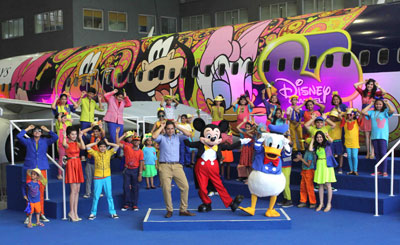
    Disney’s beloved Mickey Mouse and Donald Duck along with the popular cast from Disney Channel india, winners of Jet Set 2 and designer Shantanu on the occasion of unveil of the Disney branded plane

    Disney Channel culminated its Jet Set 2! Campaign with 30 kids and their families flying to Hong Kong Disneyland.


    Generating a staggering 8.3 million entries, Disney Channel’s Jet Set 2! surpassed last year’s 6 million entries and has seen winners from across the country.


    “The phenomenal response to the campaign, now in its second year, demonstrates the brand’s unique ability to connect so well with audiences. Our association with renowned designers Shantanu and Nikhil for the Disney inspired line, unveiled through the winner kids, only added to the excitement and celebrations,” said Bikram Duggal, Director-Marketing, Media Network, Disney-UTV.


    The channel, in association with Jet Airways, also unveiled an aircraft adorned with Disney characters at an event held on Monday (June 17). The new Disney plane from the fleet of Jet Airways will take to the domestic skies beginning June 20.


  • Hathway to carry NatGeo other Fox Int Channels in HD

    By A Correspondent


    Leading MSO and cable broadband provider Hathway will not offer its customers high definition viewing of all Fox International Channels (FIC). Hathway’s consumers can now take a pick of their favorite channel in HD Quality from National Geographic Channel, Fox Traveller, Nat Geo Wild, Nat Geo Adventure, Nat Geo Music and Baby TV.


    Speaking about the partnership, Jagdish Kumar, CEO, Hathway said, “Hathway is known for being a trendsetter and we are extremely pleased to partner FIC.”


    Commenting on the partnership,  Keertan Adyanthaya, Managing Director, NGC Network India and Fox International Channels says, “We are delighted our channels will be available in enhanced picture quality across Hathway’s extensive network.”


  • Sandeep Dahiya quits Viacom18

    By A Correspondent


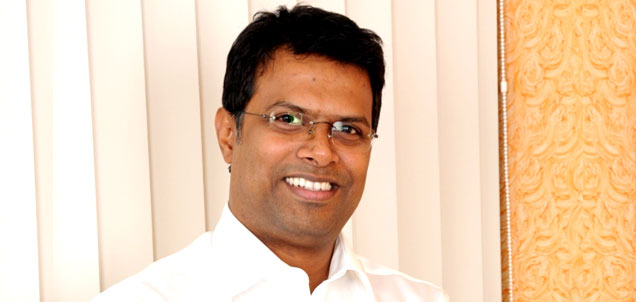
    Sandeep Dahiya

    Viacom18 Media has announced the resignation of Sandeep Dahiya, Senior Vice President – Consumer Products and Communications. Mr Dahiya has been with the group for eight years and has worked in multiple-functions across the group – consumer products, communications and corporate affairs. He will continue in his current capacity till July 15. It is not known where he is moving to next.


    Making the announcement, Sudhanshu Vats, Group CEO – Viacom18 Media Networks said, “Over the last many years Sandeep has passionately led Viacom18’s consumer products’ business and taken it to a respectable position. He’s laid a strong foundation in creating eco-systems for our brands outside their core business and we’re committed to building on this foundation even further.”


    Commenting on the development, Mr Dahiya added, “The 8-year phase at Viacom18 has been the most fulfilling and exciting phase of my professional career and I’ve tremendously enjoyed working on some of the most well-known brands/properties – be it Colors, MTV, Nickelodeon, Vh1 and Comedy Central.”


  • Poised for a content-led assault: M K Anand


    Though it has been the works for much longer, the Disney and UTV merger has happened in right earnest for just around a year. Since then, the Ronnie Screwvala-led conglomerate called Disney-UTV has been stitched together without causing any publicly visible signs of anguish that are part-and-parcel of any merger or division. M K Anand, managing director, Media Networks, Disney UTV, tells MxMIndia about life after integration, his focus on content, and whether the network is looking at going in for a GEC, as was rumoured last year.


    It’s been over a year now with Disney UTV. How the story been so far? Is it well integrated?

    Well, for the first 15 months now we have focused on getting the whole team together as one piece, that was first and foremost. Ultimately, the wellspring of all output is coming out of these people here. We started as two different companies from two different suburbs and brought them all together and make a one-team situation. We are in the last phase, we have not completely done that. I think basically I brought two boats together very close and then tied them and slowly was confident to take some planks together so that the water is not seeping, and it’s become one boat.


    The processes of Disney and UTV were dramatically different…

    Well, intense processes is what defines Disney… so very very deep, very very thought out and very very correctly done is Disney. And UTV’s most important benefit has been very high speed. In the market, whether it was films or whatever we have done in the TV space, there was a lot of premium on agility, the challenge that I faced was to ensure that I do not lose both, so we needed speed to diligence and we needed to bring diligence to speed. I don’t think it is an either or situation, you don’t need to sacrifice one for the other, you can achieve both, that’s something we are quite happy to note.


    So in specific terms, which part of the transition happened most easily, and what took some time?

    First of all, we are still in the middle of it all, the integration is not fully complete. Next year at this time you would say the thing is done because we have taken a building of three-and-a-half floors and that’s going to be the first integrated company office where everybody is going to sit at the same place and the whole environment is the same. Till that happens, I think you will still have, a bit of this and a bit of that. Second, the technology backbone is getting integrated as we speak. There are a lot of processes which are determined by technology. For the unified new system to be developed and proper testing done, the deadline is September 30 this year. That’s when we want to completely migrate into one backend one media centre, one uplink centre, satellites, everything.


    How have your three buckets of the broadcast business panned out – the kids, movies and youth channels?

    The buckets is more on internal division. At an external level, we would like to, as we move forward, become one Disney UTV network as against this system or that system. Yes, we are sort of focused on the niches so there are specialists who look after the kids’ business, kids’ GRP , viewership, there are specialists who look after movies GRP, specialists look after Bindass and UTV Stars, so those are product levels and I would really not want to call them buckets. The bucketization of the business i had done to ensure that these two boats that actually got together, so to allow the each boat to have an identity while the merging was happening. Two months back, we have totally removed it, I mean totally horizontalised. The entire sales is one team, there is a sales head, the entire programming is one team, the entire content is one team, the entire marketing is one team, so earlier we were these 3 buckets but now we are 5 departments and we are integrated at the top which is run by 3 – 4 of us who have visibility over everything. Vijay heads the programming, Nikhil heads the sales, Indro heads the content, Bikram heads marketing, Charles heads the tech backend. All these people have total oversight on all the channels. The entire company, 20, 30, 40 people from each of these departments are reporting into these guys, they are department heads. So now we are not divided business-wise.


    This is the second or third time in one-and-a-half years that you have had a change.

    Actually the first time. Yes, the first one was the integration itself but that was a financial or ownership change or an acquisition-based reality, but after that we basically brought both ships together. There was no change in the organization structure at all — Vijay was already business head of kids channels, Nikhil was already the business head of youth channel, Sameer was head of movie channels. That structure has been there right upto March 2013. What we have done is practical re -organization, people have been re-allocated. For the first time we are now putting teams which have different corporate origins. I thought it was better to do it now than earlier because we wanted to people to really understand, recognize each other. If i would do that restructuring at that time, there would have been lot more reservations. The buy-in is easier except that the fact I see that the new office has taken a little more than what we would have loved it to be.


    With the new org structure in place, how and what is the road ahead for each of the channels?

    The first thing we did was to ensure that now that we have 9 products including international etc what are those products we can launch quickly, what are the products we expand quickly and in what area. One of the first  was Disney Junior which got launched quickly. We were interested in expansion in the south with Disney channel but unfortunately because of distribution blockages we were not able to do that. The second thing we wanted to see is what is deficient in content and distribution; ultimately these two make a broadcast product. When we did that we realised that distribution was the thing we could have done faster. Distribution was about setting an agenda, budgeting it and giving ourselves a deadline. Then we realised that only UTV Action to a large extent and Disney channel were the two channels that were optimally distributed. All the other channels needed a little more and it was not done due to whatever reason – objective not set, finance not adequate.


    By May last year, we were done with the basic policy of equating the team all together, it gave us a target of December 31, by which time we wanted to completely revamp and overhaul the placement of the channels. Research and ground work started around June, we took a lot of consultancy help from people in the business like TAM and Chrome and What’s On India. In August, we started changing the placement, the neighbourhood on all the channels, so we started getting results from end of September and early October. Then the 10-week blockage or the blackout happened, so when the December 24 data came in, our change in GRPs and reach was not purely because of DAS, although people think it is DAS which helped us. We had already started correcting our distribution so UTV Movies for instance was a sub-30 channel, it is now poised to be an above-50 channel in terms of reach. Similarly with Bindass, Hungama, with Disney channel, so there was very clear correction of reach that we required and that required us to penetrate with the benchmark of the market leader and not the benchmark of what is possible for us to do. Pre-data, most of our channels were 70 to 75 percent penetrated and we said lets go to 90 percent so we have tried to benchmark 90 – 95 percent penetration for all our channels and I am quite happy. What that did for us is from about combined 4.5 percent Hindi speaking markets we moved to about 6 percent. To understand the impact from 170 GRPs in some weeks we have gone to 215, 218, on an average we have gone to 200 GRPs so about 12 to 15 percent improvement on overall gross impact of the network.


    Are you happy with the progress on distribution…

    I had looked at 2012 as the year of distribution so the last part got done by 2012. I wouldn’t say that everything got done but we more or less finished everything in the first quarter of this calendar year. The other thing we realised that when you get into DAS, you need more muscle to get the deals in the manner you want – whether it was placements or subscriber revenues. Anuj (Gandhi) had joined IndiaCast and we had a prior relationship with him, so it was a short time before we were able to seal that JV. We were quite happy to be part of IndiaCast.


    How is that doing for you?

    Very well.


    In terms of revenues coming from distribution, given LC1 and Phase 2 and soon the entire country get digitized. How ready are you for Phase 3 Absolutely. LC1 knowledge was there last year so we had benchmarked that by September 30 we would have started getting results. We would have loved to see how we were climbing, but that 10-week data was not there. But by September 30 we had ensured we were in all places in the country without having prejudice to whether it is metered or not metered, so all the channels are now fully LC1 distributed, and DAS has improved things for us.


    Did the team rationalization etc cause any upheaval?

    We nipped that upheaval in the bud by doing some very detailed talent mapping across. Any rationalization means when you will bring people of two organizations together and some of them may have worked with each other in the past and the situation in the new entity is different.


    Before we brought the whole thing together, what we did was what cartographers do to unknown territories. You don’t go all over the place to make the map; you take the terrain and do the altitude of say 20 different places and then you know here is the hill and here is the pond. So what we did was, Disney is the host so from that point of view we thought of bringing everybody to the Disney scale of structure of salaries, designation or managements cadres etc. Fundamentally what we did was we picked up 10 percent of UTV people as representative of the total, we mapped those people and we took their current designation and salary out from the knowledge point of view. We just took their functions and experience, and started mapping them with other people in the Disney system, so that was an on-paper exercise that HR did with me. Then we matched those 30 people with 30 mirror people on the other side, and we put the actual operating managers together and we discussed how two people on either side are similar for so-and-so reasons.


    This exercise was the most important. The moment we did that, there was a clear buy-in that this person may be called an assistant vice president but that person’s current role and job in that company is equal to director or senior manager. So once the designations of the 10 percent were established, then we did the full mapping of all the people, went back to salaries and said this level should get this salary; then we realised that because of designation this person is becoming senior manager but the senior manager is currently getting 8 lakh and the requirement of senior manager is 12 lakh – so should we make that person a manager or a senior manager? There was a lot of activity which we repeated, which I myself did with HR, and it went very well, very smoothly, because we had done such diligence and there was such great democratic consensus from the groups. No one complained.


    Are you happy with the way it has happened?

    Completely. Usually an integration of this level would have taken 20 percent people out. Look at it; have you heard of any resignations? People going out from here? We were able to tighten the whole thing without sacking a single person. My diktat, you could say, was that integration would not be used or quoted, now or even five years later, that I lost my job because Disney and UTV integrated. Last year and this year I would say people have gone out by natural attrition, there are people taken on for performance, but that’s a natural thing.


    Moving to the present, are you happy with way your channels are doing post the transition?

    I am happy with the development of reach, but once you get a team in place and get your technology, your distribution in place, now what do you do? Use the same channel to produce higher value products, better products and more products, so there is a natural extension into increasing Bindass, increasing Disney channel, increasing Hindi movies channel in terms of content capability. In our business it is easily measured by something called TSP. Now we will start improving TSP through higher investment into content. Last year was the year of distribution, I think the next two years will probably be the era of content and then we will have the year of new launches.


    From December onwards we have started earmarking the Top 10 people in all departments, and I have mandated that everybody should spend time with consumers, whatever focus groups that research does, once in a quarter people should go along with the research team and sit alongside to listen to what consumers are saying. It is our move to becoming larger. My point is when we were separate we were 110 GRP-80 GRP company. Then we came together and now we are 200 GRPs.The biggest guy is getting 600 GRPs and we are now one-third of that. The payback over 5 years to 10 years is, if you get higher GRPs, more viewers are using you, spending time with you, so fundamentally, the next step, can we go to 300 GRPs? From there can we go to 450 GRPs, 750 GRPs, can we become No. 1? These are all theoretical, conceptual questions; as of now, this 200 GRP system, can we push it to 250 GRPs by putting better, more, higher quality content on the existing platforms? We have already started that on the movie channels, you can see that on UTV Action and UTV Movies it has gone from 40-50 GRPs to 80 GRPs.


    So we are very naturally poised to go into a content-led assault on the market and really gain traction in terms of time spend and a little more reach. We are doing quite well because this whole traction that we caught in the last quarter of the calendar poised us to ask for those rates and we are happy that advertisers have rewarded us with the right ad rates.


    But you now have the 12-minutes ad restriction…

    The 12-minute restriction coming up in October is good for us as fortunately about two years ago we had already started getting strict about it. When I was running Bloomberg, I was running 22 -23 minutes. On movie channels we have run 20 minutes. In around October 2011, we put a curtain that even if we have problems in the numbers, we will not go beyond a certain number and that number is in the range of 14 to 17 minutes, 16 minutes is the highest on certain channels. Because of this our cutback is going to be only two minutes on the kids’ channels, for example.


    It goes up at peak hour?

    Yes, that is the difference. What’s happening in music-based channels is, they run break-free in the morning and try to push it into various places at other times. That is one good thing now, that all of us are on par. If you want to run break-free you are going to lose money. So I think we are not going to be that affected. I’m not saying it is not going to impact but it would affect us to the tune of around 3 percent at the end of the first year but by the end of the second year it would have given us so much more hygiene-led improvement in break TVRs that we believe it will be better for all of us.


    Will in-house promotions suffer?

    No, we will have to morph it into show programme products like promotions or contextual placements. I think it will go from 2 minutes to 1 minute across the universe.


    Do you think TRAI will also govern in-house, in-show placements?

    No, they saying that when you are putting something on your EPG, we want you to not put more than 12 minutes every hour of content other than what you have promised, so you have to show 48 minutes of content. If you are promising Telebrands there then you put Telebrands, but when you are saying I am putting a show there then you have to give 48 minutes content. In those 12 minutes if you do 6 minutes ads and 6 minutes promo we won’t get up to protest. Our first step is to ensure quality of service and that quality of service is 12 minutes maximum of non-content time.


    What about acquisition of movies; competition has been fairly aggressive on acquisition, and a player like Zee which was not really aggressive has now become very aggressive…

    An HMC has to have a GEC if it has to be able to look for new movies. A movie channel is a library, a good content library, of content like Tarzan the Wonder Car, Lakshya, Amar Akbar Anthony; that is the fundamental promise, that whenever you switch on the channel it’s going to have some entertaining content. I don’t promise you to give a new movie. So unless you have your own GEC it’s difficult to bid for new movies. Our business model will always be library-based but the library has to be replenished because something has to keep coming in, and to some extent new movies need to come.


    There were rumours last year that you were looking at going in for a GEC. True?

    No, we are not contemplating a GEC. Last year, we were not contemplating a GEC, we were out in the market looking for how to broadbase our existing offering. GEC as a model is hyper-competitive as well as giving way to other models, and when DAS fully gets rolled out, we don’t know… It’s like saying, do you want to invest in a PC company at time when we are seeing that the tablets are on the rise. It’s better we get into the tablet business or the handheld business at the time that the PC is going out of the fashion. I am not saying that the GEC is going out of fashion yet, but I would be quite hesitant about fully moving into that and saying that is the bet.


    But it’s a good driver.

    Yes, but as a model I’m already able to drive 200 GRPs with 4-plus. If you look at other players, No 4 is driving about 280 to 300 GRPs including a GEC. No 3 and 2 are driving 400 to 450 GRPs and N1 1 is driving 600 GRPs. In that situation, 200 GRPs is not bad, without a GEC. That too our distribution is optimized only over the last four quarters and we are seeing results, which means there was ceiling for growth and we don’t believe that currently we are fully optimized as far as these channels are concerned with reference to content. Over the next year, you will see what we are going to do with Bindass. The whole orientation shift of Bindass has gone from 25 GRPs to about 50 on average, I guess it’s 47 today. Purely by tweaking the format, and probably investing a little more into original production on these channels, we believe we can drive this network itself to 250 GRPs. Then what are we talking about? Ultimately what is the television business? How many people you are impacting, how many people you are influencing, how many people you are entertaining. That is measured by the numbers we are getting. And if those numbers are good with or without a GEC, then it raises the question, are there other ways?


    So you surely won’t be looking at a GEC?

    It depends on the horizon; I am talking about the strategic horizon. One and a half years or two years is the correct horizon to look at for any media company and management. But if you are talking about a Colors, Star Plus kind-of GEC, then no.


    Is there any new channel that you are looking at launching?

    No, to be specific, if you will ask me, GEC or non-GEC, I am not launching any new channel as I see it for another one-and-a-half years. Other than some language versions if that’s possible.


    On the regional front?

    No


    In terms of the future, the strategies you mentioned, what are the kinds of GRPs you are looking at, say a year from now, combined?

    Combined I would look at an average of about 230 GRPs from our current level of 200 GRPs, another 10 percent without launching any new product.


    10 percent in a year, is that fair?

    It’s a large network, everybody is stable. Unless one launches a new channel, to capture without launching channels by sheer competitive improvement of our content, if we are able to push that number, we are doing a good job, basically my movie network should be a 100 plus network by next year this time.


    UTV has always been game-changing in terms of new programming, breakthrough ideas etc. Post the merger has there been any flagging in this respect?

    Post merger, in fact, from both sides whether it was confidence and local management ability and backing, or it was financing or lack of it, the post-integration era for me, as an individual, I feel more empowered and more enabled to do what I want to with reference to a growth agenda than I would have been earlier. I am not saying we were not growing, we were absolutely aggressive, but for instance right now, nothing stops us from having a 10-year horizon to become No 1, ahead of the existing player. I am not saying it’s an objective, but you could if you want to, because you have the ability and pedigree to do that. UTV was a guerrilla; it was about how to make the maximum out of the best combination of, say, mass speciality channels. So that was a niche strategy. Right now we can be niche, we can be mass, if you want we can do a GEC. Nothing stops Disney, for instance, it has all the capability to roll out a GEC, if strategically it is required. So capability-wise I think we are a little better off combining the two, whether it was management ability from the local management side or the sheer scale of Disney being Disney. With reference to proof of that, we just silently launched a channel called Disney Junior just like we launched UTV Stars the year before that. We were able to do a JV with IndiaCast without much noise.


    The integration, plus the IndiaCast-UTV JV, plus growth of about 25 to 30 GRPs to come to 6 percent of the market, plus DAS 1, 2 and LC1 and the whole tax changes etc – it’s been a solid year. In this kind of situation we have only improved. All channel ERs are up, revenues are up, quite on target.


    Ok are there any breakthrough programmes you are looking at, such as we heard of Amitabh doing a fiction show for Sony, are there any such big things that are going to come up?

    I think yes, we have given ourselves some targets from the point of view of the top 10 indian franchises. I’m not talking just about GRPs but in terms of recall, in terms of sharing pack, in terms of buzz value, right now for instance we can probably look at Emotional Atyachar as one of the top shows in the last three years in the Indian industry. So we are giving ourselves the target that in the next 18 months we can come up with one more top show. It could be a Disney, Hungama, Bindass or a UTV stars show, that’s the task we have given ourselves. What have we contributed to the Indian consumer, not as channels but as programmes? Doraemon as a franchise, we have gifted to Indian children. We found it, we bought it, we packaged it and we put it out there. As a broadcaster we have done that kind of a service to the viewer. I think it is a breakthrough concept, and we want one more such by 2014 end.


    We are living in a DVR era, and you have people accessing television on the internet etc; does it impact your revenues, how are you getting set for that era?

    As of right now, it has not. Will it? Yes, it will, but when distribution becomes ubiquitous and that can happen any time because if 4G comes and devices are really good and cheap, it could be situation where YouTube can become suddenly larger than Tata Sky in India in terms of reach. How will we insulate ourselves? Only one blanket for that – better and better content. Fortunately we are a content company, and we are sure we will do better than average, 100 percent and nearing excellent most of the time.


    In terms of the bottomline how are you, pre-merger and now?

    I can’t really give numbers but we are, I would say, we are on a consistent cost base. I’m talking about the integrated operation of the two companies, without much of increase over last two years. We are able to find efficiency due to better integration, we have been able to squeeze manpower in this one whole year by reducing recruiting etc. Overall on a stable cost base, our revenue has been increasing at the rate of 25 – 30 percent over the last two years and we look forward to a similar number, about 30 – 32 percent increase is what we are expecting.

     

  • Narendra Modi is most mentioned political leader on social media: Blogworks study

    By A Correspondent


    As the countdown to the general elections 2014 begins, social media conversations around possible candidates for the top positions have gathered momentum.


    Marketing, communication and research services firm Blogworks has launched the first edition of its monthly India’s Most Mentioned Political Leaders index analyzing the Top 20 Most Mentioned Political Leaders online for the period January 2013 – April 2013.


    Some of the key highlights of the report:

    – The top five ‘Most Mentioned Political Leaders’ online are Narendra Modi, Rahul Gandhi, Manmohan Singh, Sonia Gandhi and Arvind Kejriwal (in that order)

    – Narendra Modi leads with more than thrice as many mentions as the nearest contender, Rahul Gandhi

    – Narendra Modi (63%) is marginally behind Rahul Gandhi (67%) in terms of percentage of mentions by the youth between the age-group of 18-34. It is noteworthy that ArvindKejriwal and Sushma Swaraj’s mentions are from a relatively older age-group of users between 45-54 years of age

    – Narendra Modi has the highest mentions by women (30%) followed by SushmaSwaraj (24%)

    – Though Narendra Modi has the highest total reach on Twitter, M Karunanidhi leads in terms of being connected with the most influential users onTwitter followed by Arun Jaitley, J Jayalalithaa, AnnaHazare and Omar Abdullah.


    A copy of the report can be downloaded from http://www.blogworks.in/post/most-mentioned-1/.


  • Radio City bags gold at NY festival

    By A Correspondent


    FM network Radio City 91.1 FM has won a Gold in the ‘Best Sound’ category for ‘Radio City Acapella Jingle’, at the recently held New York Festival.


    Commenting on the award, Kartik Kalla, National Programming Head, Radio City 91.1 FM said, “We have an exceptionally dedicated and passionate team which believes in innovating. At Radio City it is our constant effort to encourage our team to experiment & go beyond the conventional route, and awards only boost them further.”


    New York Festival’s International Radio Programs & Promos Competition for The World’s Best Radio Programs & Promos honours radio programming and promotions in all lengths and formats from radio stations, networks and independent producers from around the globe.


    The winning jingle can be heard at http://www.newyorkfestivals.com/worldsbestradio/2013/pieces.php?iid=458311&pid=1.