Category: MEDIA

  • Publicitas Publishing launches luxury quarterly Eat Stay Love

    By A Correspondent


    Publicitas Publishing’s latest magazine, Eat Stay Love, a contemporary luxury quarterly, launches this month.


    Eat Stay Love has been written and designed for today’s sophisticated and well-to-do global consumer with a penchant for luxury. Every magazine edition will feature columns by renowned names from the world of luxury, food and travel writing – both Indian and International. The first issue has columns by Naomi Price, Fiona Caulfield, Shobha Narayan, Anil Dharker, Magandeep Singh, Michael Swamy and Bibhu Mohapatra.


    The magazine’s name symbolizes the numerous aspects of a luxurious travel experience which is reflected within the three sections of the magazine:

    Eat – Foodscapes, Restaurant recommendations, Celebrity Chef Interviews, food travelogues, Wine and spirits.

    Stay – Luxe hotel launches, recommendations, spas, exotic destinations, Indian and International city guides.

    Love – Personalities, art, design, music, culture, local and international shopping.

    “Eat Stay Love is the result of detailed research, our rich experience and solid investment. The sumptuousness of it makes you stay on every page longer and keep going back again and again,” said Marzban Patel, CEO Publicitas India & Asia.


    Indu Joshi, COO Publicitas Publishing India, said, “With years of valued experience in publishing top hotel magazines, it was only natural for us to launch our own product. We have got a fabulous response to Eat Stay Love and will soon launch a few more magazines of our own.”


    Eat Stay Love is at present available across select luxury five star hotels in Mumbai and Delhi. A digital version of the magazine is also available for subscription on Magzter.com.


    The current custom publishing portfolio of Publicitas Publishing includes Taj Hotels & Resorts, Singapore Airlines, SilkAir, SIA Engineering Company, Thai Airways, The Oberoi Group, DFASS Group, Frasers Hospitality, The Leela Palaces Hotels and Resorts, DLF Emporio, American Express Publishing and HomeTeamNS.


  • Exhibit launches new site thetechy.com

    By A Correspondent


    Tech and lifestyle magazine Exhibit has announced the launch of its newly designed tech website, thetechy.com. The site features the latest news, views, reviews, innovations and features in technology, social media, automobiles, e-commerce and lifestyle.


    “Nothing seems to evolve as fast as technology in today’s era, hence we at Exhibit Group decided to come up with a hardcore tech website, which will keep the readers informed and updated about everything related to tech as it happens”, said Ramesh Somani, Editor, Exhibit Magazine. “We have included features to make the site quicker, easier and more interactive for our users. Be it the best scoop on gadgets, gear, apps or even tech affecting your lifestyle – we’ve got the corners covered so that you don’t feel the need to jump to different websites just to be in the know. The website is our next step towards our vision of engagement and involvement of our readers,” he added.


    Thetechy.com content focuses on technology, gadgets, automobiles, ecommerce and lifestyle, and includes feature articles on buying guides, comparisons, futuristic tech, photography and analysis, as well as videos and social media integration. The website’s tagline is, “Where tech meets lifestyle”.


  • i next now available on vending machines

    By A Correspondent


    i next has adopted a parallel distribution channel by installing newspaper vending machines, to widen its circulation net and engage the readers at crucial tap points. The three-fold initiative includes utilizing sales promoters in customized jackets and customized bicycles for paper distribution, besides the vending machines. The specially designed jackets donned by the promoters can hold up to 50 copies.


    Newspaper vending machines are used worldwide, and they are often one of the main distribution methods for newspaper publishers abroad, In India, however, the trend is somewhat less positioned and this thus is likely to give the ‘first mover’s advantage’ to the publication to mark a reputed image among the readers since as of now very few publishers in the country use vending machines.


    The prime objectives of this initiative, besides readers’ engagement, are to give them alternate options of choice where multiple products of the company could be displayed, and also to provide convenient locations for the readers to pick newspaper from. The five-rack machine, installed in 10 i next cities across UP, Jharkhand, Bihar and Uttarakhand, also carries other newspapers and magazines from the Jagran group. It accepts 1, 2 and 5 rupee coins, and notes of 5, 10, 20 and 50 denominations. More details are available at www.inextlive.com.


  • Dumping TAM is not the solution!


    Dumping a system does not solve the problem: CVL Srinivas
     

    While both AAAI and ISA have expressed their views on the controversy, we asked GroupM CEO South Asia CVL Srinivas, CEO South Asia, GroupM as head of the country’s largest media agency conglomerate for his views on the issue.


    As the country’s largest media agency conglomerate, what is Group M’s view on the current imbroglio – given that three broadcasters have stopped their subscriptions making charges?

    In our view it is an extremely ill-advised, ill-timed and regressive move. TAM is the rating system followed by the industry. Rating systems world over have evolved and keep evolving. To simply junk them altogether is not a solution. Issues if any need to be addressed jointly by all stakeholders as were done in the past. Both AAAI and ISA have already made their stand clear on this. As a responsible member of the industry we will work with our colleagues across industry bodies to help address the issue.


    You represent some of the biggest adspenders in India: are you happy with the data dished out by TAM week after week?

    In a dynamic market like ours which is seeing a lot of structural change (like digitization, increasing penetration of TV in smaller towns, more access to satellite channels etc) there is bound to be fluctuation every time the sample is refreshed or any other change is made. In addition, there are behavioural changes from a viewer perspective that keep happening. Nobody can deny the fact that consumption of content on digital platforms is growing at a rapid pace. TV ratings keep shifting and mirroring real life in a manner they best possibly can given the limitations of a sample survey.

    And your clients? Have they (especially big ones like Hindustan Unilever) raised issues about TAM’s and the data’s bonafides?

    Our clients continue to back TAM. They do not think that dumping a system solves the problem. Whatever questions keep coming up are always discussed openly with TAM and addressed.


    TV as a medium has shown robust growth despite a general slowdown. To a large extent this is because of the existing rating system. Given the magnitude of spends on TV, a rating system is a must. With no ratings a spot on one channel is the same as a spot on another channel. The lead channels in every genre will stand to lose the premium they command on rates.


    Does the fact that TAM is part-owned by your parent WPP put you under greater pressure from advertisers – since you obviously can’t be vociferously condemning TAM, if there was need for it?

    TAM is recognised as an industry system and has been in existence for many years. All clients, agencies and media owners have been using this data.


    Would you think that broadcasters have too much of ownership of the measurement exercise when actually it should be advertisers and media agencies since you’ll are the primary users of the data?

    While advertisers and agencies use the rating data to help plan and buy media, for broadcasters it is the currency that helps them sell their inventory. They are able to command a premium wherever ratings are high. They use ratings to market their programmes and channels.


    AGENCY+CLIENT VIEW
     

    Srinivasan K Swamy, CMD, RK Swamy BBDO and President, International Association of Advertisers (India Chapter)


    TV ratings have shown a downward trend after digitization of distribution. The decline is quite steep – as much of 20-25% in several instances. Such decline affects the revenue stream of broadcasters and hence it is natural for them to reject it. But it is like giving a dog (TAM) a bad name to hang it.


    Advertisers and agencies need ratings for advertising planning. It would be a retrograde step if the ratings had to be given a go-by, even for a short run. I am confident a solution will be found to continue the ratings even with Channels withdrawing their subscriptions.


    Lloyd Mathias, Lloyd Mathias, Director, Green Bean Ventures formerly with Tata Teleservices, Motorola and Pepsi and former Chairman, MRUC

    Basically media doesn’t like being measured by a third party. It happened in print with people raising objections to the NRS and later the IRS. In fact the Media Research Users Council (MRUC) which was set up by stakeholders faced a constant threat of boycott.


    The same lack of discomfort of being measured by a third party afflicts television too.


    However, in all fairness even advertisers have said that the number of Peoplemeters isn’t enough. I think the methodology has to be transparent, the Peoplemeter base has to increase and the system must factor in cross-consumption of media.

    ISA view: Advertiser cannot advertise without television ratings
     

    Statements issued by the Indian Society of Advertisers (ISA) and the Advertising Agencies Association of India (AAAI)


    The Indian Society of Advertisers (ISA) has read with concern recent reports that some broadcasters have decided to stop subscription to television measurement service. This is a matter of immense importance as the measurement system is integral to the health of the industry. The rating system needs to continue for the smooth functioning of the industry as it’s the very foundation of the commercial process, media planning and pricing. The ISA believes that any measurement system should appropriately reflect the viewership pattern and should not be judged on a short term basis.


    The best course of action is to engage in a constructive dialogue and pursue continuous improvement. While some broadcasters have stopped using the current rating system for measurement, as advertisers we support it and will continue using it till another credible measurement system is made available. Any action taken which is detrimental to the measurement system would be detrimental to the industry at large. “An industry-accepted rating system is the need of the hour and ISA is working with rest of the industry to ensure this is in place and any action to the contrary will have an adverse impact” – Hemant Bakshi, Chairman, Managing Committee, The ISA and Executive Director, Home and Personal Care – Hindustan Unilever Limited.


    AAAI view: TV could lose popularity with advertisers

    Advertising Agencies Association of India (AAAI) has expressed shock at the decision of some channels, supported by the Broadcasters’ Association, IBF to decide not to subscribe to the only TV Ratings service in the country – TAM. TV ratings provide the currency based on which thousands of crores worth of advertising time is bought by advertisers with confidence. Ratings also provide the basis on which media agencies do sophisticated analysis and arrive at sharply targeted plans for a brand’s target audience to minimize wasteful advertising and improve advertising effectiveness.


    An established rating system augurs well for the Advertising and Marketing Industry, because it enables advertisers to invest large sums of money in advertising with the confidence that they are reaching the right number of desirable audiences. It has been seen from experience in India and other markets that an established media research study on an ongoing basis leads to rapid increase in advertising spends in that medium. Those media which do not have such a system have not grown in India. Also, the current TV ratings system has thrown up real leaders in each of the genres based on the audiences they deliver and enables such leaders to command a premium price based on such ratings, rather than advertisers and agencies having to rely on perception. And very often perception is different from reality.


    AAAI will hold broadcasters responsible for deliveries as per signed agreements based on the TV Ratings System. Says Arvind Sharma, President AAAI, “The move by broadcasters to discontinue with ratings is ill-advised and not in the interest of advertisers, advertising agencies or broadcasters. It will lead to overpaying and underpaying of advertising time, both of which will lead to a collapse of TV as an advertising medium. The ratings from Broadcast Audience Research Council (BARC) are yet some time away and until they are released it is critical to continue with the current system. Most broadcasters all over the world have some issue with media measurement systems but that does not mean that the system must be abandoned. Instead it must be improved and identified gaps must be plugged”.


    Wtf! Why can’t all stakeholders sit together and clear the mess?
     

    By Pradyuman Maheshwari


    The media industry is captained by grown-ups, wise and mature men and women. We propound theories on ways the world should be run on our news channels and send social messages via our soaps and shows. But, wtf, why can’t broadcasters, advertisers, advertising agencies and measurement/ research firms sit together and clear the mess?


    With BARC having invited proposals by issuing a global RFP, a new system can be expected to be in place this time next year. However, since there is a year to go and much business to be sought, can we do the following:

    1. Get a third-party to study the problems and come up with a white paper superquick? A consulting firm like Ernst & Young could be asked to do it. Or KPMG. Or PwC. Or whoever can do it without getting influenced by any of the stakeholders. We could ask the folks at BARC to do it. Let the three stakeholders plus the government-owned Doordarshan commission this soon.


    2. Let each stakeholder appoint a representative to have a Measurement Steering Committee which will work in the interim. These could be from amongst people running BARC currently.


    3. Alter the method of funding research. Although no one was willing to come on record on this, there is a sentiment that the broadcasters have a dominating influence on BARC (and now TAM). This has got to change (the perception and if it is indeed a fact). Currently, since it’s advertising which drives the broadcast business, the ad agency and the advertisers are the primary users of the data.


    Hence, the stoppage of subscription revenues going to TAM (and later BARC) can derail the entire system. And have a significant impact on the TV trade. Perhaps the South African model of a small percentage of all advertising revenue going to fund research may work.


    These are three immediate measures that may work. There are various other minds at work… one hopes we will eventually see reason.


    Whatever be the way out of the mess, it’s clear that the industry can ill-afford a system without a measurement system. TAM, in this case. And it’s also important TAM understands the problems of broadcasters and corrects all the problem areas.


    That’s the only way to go.


  • 1 Minute View: Time for stakeholders to sit together and clear the mess

    The following comment was carried as MxMIndia Comment today.


    We echo similar sentiments and would hence replay what our editor-in-chief wrote this morning:

    The media industry is captained by grown-ups, wise and mature men and women. We propound theories on ways the world should be run on our news channels and send social messages via our soaps and shows. But, wtf, why can’t broadcasters, advertisers, advertising agencies and measurement/ research firms sit together and clear the mess?


    With BARC having invited proposals by issuing a global RFP, a new system can be expected to be in place this time next year. However, since there is a year to go and much business to be sought, can we do the following:


    1. Get a third-party to study the problems and come up with a white paper superquick? A consulting firm like Ernst & Young could be asked to do it. Or KPMG. Or PwC. Or whoever can do it without getting influenced by any of the stakeholders. We could ask the folks at BARC to do it. Let the three stakeholders plus the government-owned Doordarshan commission this soon.

    2. Let each stakeholder appoint a representative to have a Measurement Steering Committee which will work in the interim. These could be from amongst people running BARC currently.

    3. Alter the method of funding research. Although no one was willing to come on record on this, there is a sentiment that the broadcasters have a dominating influence on BARC (and now TAM). This has got to change (the perception and if it is indeed a fact). Currently, since it’s advertising which drives the broadcast business, the ad agency and the advertisers are the primary users of the data.

    Hence, the stoppage of subscription revenues going to TAM (and later BARC) can derail the entire system. And have a significant impact on the TV trade. Perhaps the South African model of a small percentage of all advertising revenue going to fund research may work.


    These are three immediate measures that may work. There are various other minds at work… one hopes we will eventually see reason.


    Whatever be the way out of the mess, it’s clear that the industry can ill-afford a system without a measurement system. TAM, in this case. And it’s also important TAM understands the problems of broadcasters and corrects all the problem areas.


    That’s the only way to go.


  • Tangerine streamlines process to manage digital identity for brands

    By A Correspondent


    Content creation and management solution provider Tangerine Digital Entertainment has announced the launch of its advanced User Generated Content Management service that will facilitate in protecting and building brand identity across digital platforms and simultaneously provide insights to user engagement with the brand.


    Tangerine uses proprietary technologies to aggregate user-generated content, which is then automatically parsed and categorized. This is supported by manual moderation for accurate comprehension and chart out the next course of action. The involvement of human touch becomes imperative while dealing with rich media (videos, images) as the content is subject to language, dialect and various cultural contexts. Tangerine uses a combination of technology that adds to efficiency as well as human touch to ensure accuracy.


    Kesavan Kanchi Kandadai, CEO, Tangerine Digital, said, “Unlike automated content management software and systems, our team will evaluate every user response for brands working with us, arrive at a quick response to help users and finally analyze on customers’ perception on the brand.”


    The service will be beneficial to gaming companies, e-commerce portals, ratings & review sites, mobile apps, image sharing sites or even a reality show like, Kids Indian idol as content needs to be moderated as per brand positioning. In all it will be an extension to brand management on digital platforms.


    Tangerine Digital has worked previously in this space with international clients and now is launching this in India where it has worked with various sports and entertainment brands like ESPN Star Sports and Sony Entertainment Television. Recently American Swan, a premium online Fashion & Lifestyle Brand has signed up with Tangerine Digital to avail this comprehensive module.


    “As the digital presence of brands is growing, the need for managing User Generated Content is becoming more imminent. Brands today are increasingly using Social Media platforms to reach out to existing and potential customers. While doing so, they also need appropriate monitoring to safeguard their brand’s image, respond and engage customers to address their needs, and gain invaluable insights on current products & offerings to better position themselves. A good example of using UGCM is gaining customer insights & response to our recently launched Spring Summer ’13 collection. That’s where we have awarded our UGCM duties to Tangerine Digital to monitor and manage customer response and reviews which seed insights for future product development,” stated Anurag Rajpal, CEO, American Swan.


    “Today, strong brands need to engage with their customers at every step, recognize their needs and then alter their products and services to suit their customers. To help them do this effectively, we will manage the user content across all digital platforms on all social networks and platforms on the internet,” added Mr Kesavan.


  • Brandlogist spots ‘ambassador next door’ for Peperone

    By A Correspondent


    Brandlogist Communications recently helped Delhi-based ladies handbag brand – Peperone – cut through the clutter and talk to today’s girl. Building on Peperone’s positioning of ‘A brand for real girls’, Brandlogist used social media with a clever integration of offline and online media to get people involved. A campaign that ran for 45 days, focused on promoting the brand on social platforms.


    The idea was to create Peperone as a brand for real girls. “It’s not a bag advertised by a celebrity who is being paid to endorse it but girls should be buying it because people in their friend circle talk about it. To do this we used social media with a clever integration of offline to get people involved. A campaign to select six girls for Peperone’s yearly look-book was launched. But unlike most ‘model hunt’ kind of campaigns, the focus was not on a contest but we actually went offline & identified real influencers in the college community who would connect with the brand,” Saurabh Parmar, CEO, Brandlogist Communications explained.


    “The clear insight was that today’s girl doesn’t only connect with a Kareena or a Deepika; they could also connect to an Arundhati Roy, a Kiran Bedi or even a Tina Fey. The idea was to identify and engage the different character sketches which a girl could connect with & these girls with their own unique sense of style are being chosen as our brand ambassadors,” said Roma Joshi, Brand Manager, Peperone.


    In the case of Peperone, while the brand has been in the market for years, this was the first actual conversation it was having with its TG, ever. So the onus was on the power of the first impression there with focus completely and purely on brand awareness. “We gained momentum with 1373 people talking about us at the peak of the campaign. The likes continue to increase with last count at above 23,500. All this in just a span of a month and a half,” said Mr Parmar.


    Brandlogist’s approach included an integration of both offline and online activities:


    Spotting the ‘ambassador next door’ – Launched a campaign to select 6 girls for Peperone’s yearly look-book but unlike most ‘model hunt’ kind of campaigns, the focus was not on a contest but they actually went offline & identified real influencers in the college community who would connect with the brand. Elaborating on this Roma Joshi the Brand Manager said “The clear insight was that today’s girl doesn’t only connect with a Kareena or a Deepika; they could also connect to an Arundhati Roy or a Kiran Bedi. The idea was to identify and engage the different character sketches which a girl could connect with & these girls with their own unique sense of style are being chosen as our brand ambassadors.


    Conversation around Pepperone on Social Media - “We actually got bloggers to review the product without a blogger outreach campaign. How many times have you heard that happening for a previously unknown brand,” asks Mr Parmar of Brandlogist.


    Marrying Campus outreach with Facebook - Along with the action on social, Brandlogist has integrated the campaign to the real world by going in campuses interacting with the target group, getting reviews and putting up posters in premier institutions prompting participation thereby driving traffic to the FB page.


  • Law firm files suit against NDTV, demands $1.7mn as “unpaid” fees. NDTV terms plaint “frivolous”

    By A Correspondent


    It may not have any impact on the law suit that NDTV has filed on television measurement practices, but it merits mention given that it concerns a leading Indian broadcast network.


    According to unverified information made available to MxMIndia, law firm Sabharwal & Finkel, LLC has sought ‘quantum meruit’ damages from New Delhi Television Limited (NDTV) for “unpaid legal services” provided by S&F to NDTV. The amount the law firm has demanded is USD One million seven hundred thousand dollars ($1,700,000).


    As per the law suit document filed at the US District Court Southern District of New York, S&F and NDTV had entered into a retainer agreement duty from May 25, 2012. The services were rendered till April 22, 2013 on the which date NDTV is said to have officially terminated its engagement with S&F. The termination notice is reported to have noted that S&F will not be entitled to fees regardless of the judgment in the case.


    The legal document filed (on June 4) further states that another law firm named Pepper Hamilton LLP has now been given charge of the earlier case on television measurement practices. A copy of the law suit is available with MxMIndia. However, as mentioned earlier, it has not been verified by either S&F, NDTV or information available online on the Court’s website.


    Meanwhile, when MxMIndia asked the NDTV spokesperson on whether the company, we received a statement saying: “NDTV has not yet been served with the complaint and will review it in due course with its lawyers after being served. NDTV strongly believes that this complaint is frivolous and without merits.  NDTV intends to fight it vigorously and will pursue all causes of action and remedies it may have against these plaintiffs.” Mr Ravi Sabharwal of the law firm S&F could not be reached at the time of writing.


  • 1 Minute View: Telegram, RIP

    So it’s curtains for the 160-year telegram service. Effective July 15, the state-owned BSNL has decided to discontinue the service.


    For generations, the telegram was the fastest mode of transmitting information. Save the telephone call – local calls, or long distance domestic by STD and internationally by ISD. Then there was the trunk call and also the instant opertator-managed service called ‘lightning’ calls.


    The fastest and official mode of sending a message was the telegram. News of births and deaths, extension of leave from office, greetings and even call for interviews were done via the telegram. As they would say in Hindi: sasta aur tikau!


    There was also the telex and the teleprinter.


    Advancements in technology saw the demise of the various Ts. Trunk call first. The telex and teleprinter and now the telegraph.


    There are faster ways of sending messages now, there are surer ways of sending messages now, though sometimes we do miss the humble telegram. People can avoid taking your call, but one would seldom not take receipt of a telegram.


    However, the service had to die, which it will wef July 15.


    RIP, telegram.


  • Zapak engages with Twitter Influencers to premier Summerland

    By A Correspondent


    Zapak Solutions, the social media arm of Zapak Digital Entertainment, recently invited about 50 twitter influencers in Mumbai (who had a cumulative reach of over 3.5 lakh followers) and engaged with them through a phygital activity (physical activation with a digital mechanism to it) that was called Summerland Tweetup. The activity was thoughtfully designed and executed to create a buzz for the India premier of Big CBS Love channel’s new show, Summerland. The objective of the tweet-up was to engage viewers and amplify the social media presence of the show, which resulted in #Summerland trending at No. 4 nationally within 3 hours of commencement of the activity.


    Summerland Tweet-up: the event:

    Zapak Solutions invited close to 65 top influencers on Twitter to be a part of the Summerland Tweet-up through a unique Twitter invite designed for the event. This was followed by three personalized Twitter reminders sent to each invite with RSVPs. Upon reaching the venue, while the invites were being greeted physically by the teams at Zapak Solutions and at Big CBS Love, there were “welcome” messages sent to each invite on their twitter accounts as well. The event kickstarted with the exclusive screening of the first episode of the new show ‘SummerLand.’ This was followed by a small contest; the questions of the contest were based on the episode, the characters and the storyline. Post this, the guests were requested to write a brief review on their twitter pages – called the ‘Tweeview’.


    The Reach:

    The tweet-up was instrumental in propagating the show and creating a buzz on social media. The @BIGCBSLOVE Twitter handle added more than 200 new followers within 3 hours during the campaign. The campaign reached out to over 3.5 lakh Twitter followers with 1736 tweets, 497 re-tweets and total mentions of 226. The #Summerland trended at number 4 in India and in Mumbai at different intervals. All this on the day of the IPL final!


    Commenting on the success of the tweet-up, Rahul Avasthy, Head – Digital Strategy and SMM Business, Zapak Digital Entertainment said, “Social Media is rapidly becoming an integral medium to reach the target group. For Big CBS Love’s new show Summerland, we decided to leverage Twitter extensively and create an Influencer Outreach program via tweet-up inviting 65 Twitter influencers. With the influencers tweeting consistently, we reached out to 3.5 lakh Twitter followers which resulted in #Summerland trending at No. 4 in India as well as Mumbai. To entertain the Twitter influencers and add an element of fun to the event, we also organised a karaoke session along with some funky props which influencers took pictures with and shared on Twitter.”


    Anand Chakravarthy

    Anand Chakravarthy, Business Head for Big CBS Network, said, “Big CBS Love brought Summerland to the Indian audiences for the first time. In order to create a strong presence for the show, we partnered with Zapak Solutions to engage viewers with a unique tweetup event. The activity was instrumental in building hype around the premier of the show, along with engaging viewers and Twitter influencers in contests to enhance social media presence. We are extremely happy with the outcome of the event and the response the show has received across India.”


  • Digital is new normal for newsrooms: Oriella study

    By A Correspondent


    The full digital tool-set is now in use in newsrooms and editorial offices around the world – with far-reaching implications for the public relations industry, the latest Oriella Digital Journalism Study has found. The journalism study was done by Oriella and its partners across the world including Candour Communications, which did the survey for India. A ‘digital first’ policy, breaking news online as it happens, is in place at over a third of the media titles surveyed with use of mobile apps, in-house produced video, and social media as a news source all on the rise.


    The Oriella Digital Journalism Study, based on a survey of almost 550 journalists from 15 countries including India and spanning Europe, Asia-Pacific and the Americas, tracks how digital technology is impacting how news is gathered and published around the world.


    This year’s study – the sixth – provides evidence of wholesale changes in how publications gather and communicate stories. This year’s study further found a quarter of the journalists surveyed often prepare multiple versions of the same story as it develops, while a fifth said that ‘citizen journalism’ now carries as much credibility in their organization, as mainstream reporting.


    Digital media is also shaping publications’ revenue models. The proportion of respondents saying their outlet has a mobile app has nearly doubled over the past two years to 40 percent. In addition, use of premium apps to monetise content has increased by a third since 2012.


    Robin Grainger, Director of the Oriella PR Network, said, “Our study suggests 2013 is a watershed year for the world’s media. The growing interest in ‘digital first’ reporting, video, real-time news, mobile content and citizen journalism all exemplify what we’re calling the ‘New Normal for News.’


    “If these trends accelerate, there are some potentially game-changing ramifications for media and communicators alike. First, touch-screen interfaces will open up new possibilities for story-telling. One example could be interactive graphics (or digi-graphics) which blend high design and big data to enable readers to navigate their own path through stories.”


    He added, “Second, we may see a polarisation of journalistic output. At one end, short, tweet-like news updates will provide near real-time coverage of events in print and on video, optimised for small screens. At the other end, we may see much longer-form feature and investigative pieces. ‘Shorter but quicker’ journalism could also afford media brands greater prominence – and consequently greater traffic – in search rankings, news readers and ‘social news aggregator’ apps such as Flipboard and Pulse News.”


    Sanjay Bose, Executive Director, Candour Communications, said, “The survey in India threw up interesting trends that have emerged in the Indian media. Digitization of news and the availability of social media platforms have drastically reduced dependence on conventional news gathering sources. With the increasing use of smart phones in India, access to real time news is only a click away.”


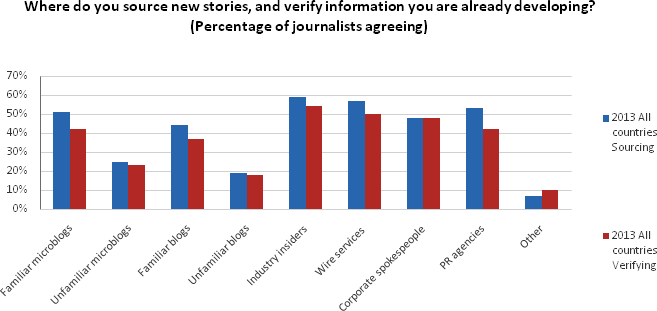
    The study finds that journalists are using social media for news gathering, but continue to place an emphasis on trusted sources and pre-existing relationships. For example, 51 percent of journalists said they source news stories from microblogs such as Twitter and Weibo, but only when the source behind them is already known to them. When the source is unknown, their use by journalists halved to 25 percent. By contrast, 59 percent of respondents said they sourced their news from ‘conversations with industry insiders.’


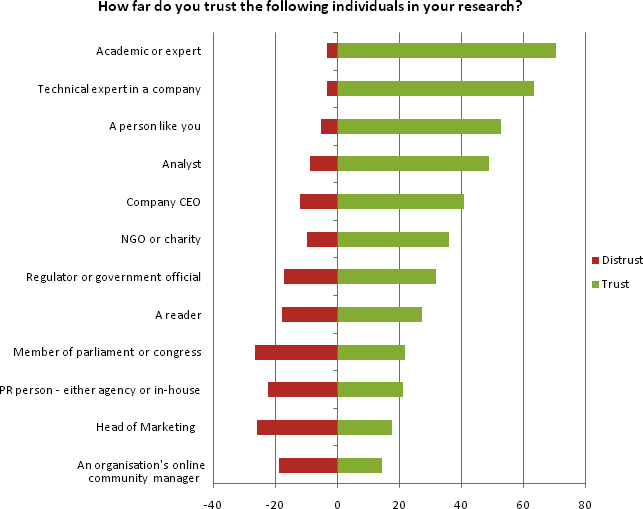
    The sources most trusted by journalists were academics and other experts, who were trusted by 70 percent of journalists; technical experts in companies (trusted by 63 percent) and analysts (trusted by 49 percent). Company CEOs were trusted by only 41 percent and actually distrusted by one journalist in eight. The least trusted individuals were politicians, PR officers, heads of marketing and community managers – all of whom were distrusted than trusted by journalists. (See chart)


    Despite all the changes occuring within newsrooms, the study found journalists remain upbeat about their jobs. Thirty four percent said they believed digital media had improved the quality of journalism over the past two years. However, the digital model is creating headaches for many of them – almost a third (32 percent) agreed that they are finding it harder to keep abreast of events on social media.


     

  • No impact of AAAI, ISA statement. SAB pulls out of TAM subscription

    By A Correspondent


    To those who thought that broadcasters would back down after the apex bodies of advertisers (ISA) and ad agencies (AAAI) issued their statement endorsing the need to continue with the existing currency of television measurement administered by TAM, the move from Sri Adhikari Brothers (SAB) to pull out its subscription from TAM is a setback.


    SAB, which runs music channel Mastiii and regional entertainment channels Dabangg and Dhamaal, has joined MSM, Times TV and NDTV in the show of no-confidence in the prevailing television viewership measurement system in the country.


    Confirming the news, Mr Markand Adhikari, Vice-chairman and Managing Director of the SAB said he was pulling out given the reasons that are well-known.


    When asked on what his gameplan would be given that measurement numbers from a BARC-appointed system would be at least a year away, the issue will be discussed jointly with other channels.


    Meanwhile, a broadcaster who wished to stay anonymous is hopeful that there will be a settlement to the problem. “Losing out on subscriptions will impact TAM’s operations and hence it will surely provide a solution. And broadcasters too can’t live without measurement for too long.” The senior channel executive also indicated that while the IBF has issued an advisory last week, it may adopt a less offensive stance now.