Category: MEDIA

  • 1 Minute View: Is the Indian press really free and fair?

    If you read the excerpts of the very absorbing panel discussion held last weekend at the Press Club Mumbai’s RedInk awards, there is a fair deal of conflict that disallows a free and fair news media.


    And the least worrisome of these is the threat that comes from politicians and the government. For, one can take representations to the powers that be, and thrash out issues. But you can’t do that with the judiciary. You can do little if there’s a Privilege Motion against you from the legislature or the Parliament. You are screwed if you take on any business group and god help you if the goons want to get even with you.


    The problem gets grave when owners and newsroom managers impose censorship or push news that doesn’t deserve to be carried.


    So is the press free and fair? Yes. And no.


    It’s mostly fair and free, but it wouldn’t be incorrect to say that there are several rotten apples out there.


    There is a fair amount of opposition to a self-regulatory body that deals with all media, but we think that it’s a solution that must not be dismissed on a whim.


    Clearly, the issue of self-regulation cannot be resolved in an hour-long panel discussion, but what happened at the Press Club Mumbai’s event was a good start. We need it to happen amongst not just journalists in Delhi, but across the country. Only a detailed dialogue and buy-in from all stakeholders can resolve the problem. And help the make the news media free and fair.


  • Links of the day (29 May)

    Rupert Murdoch aims to defy naysayers with new News Corp

    http://www.livemint.com/Consumer/TBCYRnenu0g7u5wIiYBl9M/Rupert-Murdoch-aims-to-defy-naysayers-with-new-News-Corp.html

    Livemint.com/Reuters

    Murdoch says while some brands face individual challenges, as a whole the publishing portfolio is ‘undervalued’, notes this report


    Apple CEO Tim Cook says additional ‘game changers’ in progress

    http://www.livemint.com/Companies/ROrRFnXo9FS8qrY4uhqmkO/Apple-CEO-Tim-Cook-says-additional-game-changers-in-progre.html

    Livemint.com/Bloomberg

    The Apple CEO says television and wearable computing are areas of interest, says the report


    Missed calls preferred voting system for TV reality shows: Survey

    http://www.afaqs.com/news/story/37621_Missed-calls-are-most-preferred-voting-system-for-TV-reality-shows:-Survey

    Afaqs.com/Satrajit Sen

    According to a research conducted by Mobilox Innovations, a majority of respondents prefer using missed call voting system to vote for the contestants in reality shows, notes the report


  • RCB emerges as Twitter war winner: Asterii

    By A Correspondent


    If Twitter was the pitch the game was played on, Vijay Mallya’s Royal Challengers Bangalore (RCB) would’ve been the clear winner. Asterii Analytics, a marketing analytics company that’s part of the Draftfcb Ulka Advertising, conducted an in-depth study on the Twitter wars among the IPL teams. To leverage their popularity and build consumer connect all teams have created several social media platforms, the primary being Twitter.


    And the key findings were:

    • Royal Challengers Bangalore (RCB) proved to be a clear winner with over 1,23,000  tweets, and Kolkata Knight Riders (KKR) team coming to a close second with over 116,000 tweets. Excited fans of RCB have been most excited and tweeted
    • The Asterii Analytics team analysed the tweet patterns based on win and loss scenarios. KKR and RCB celeberate when they win and are subdued when they lose. However CSK bucks the trend and fans tweet more on the team hashtag when they lose.
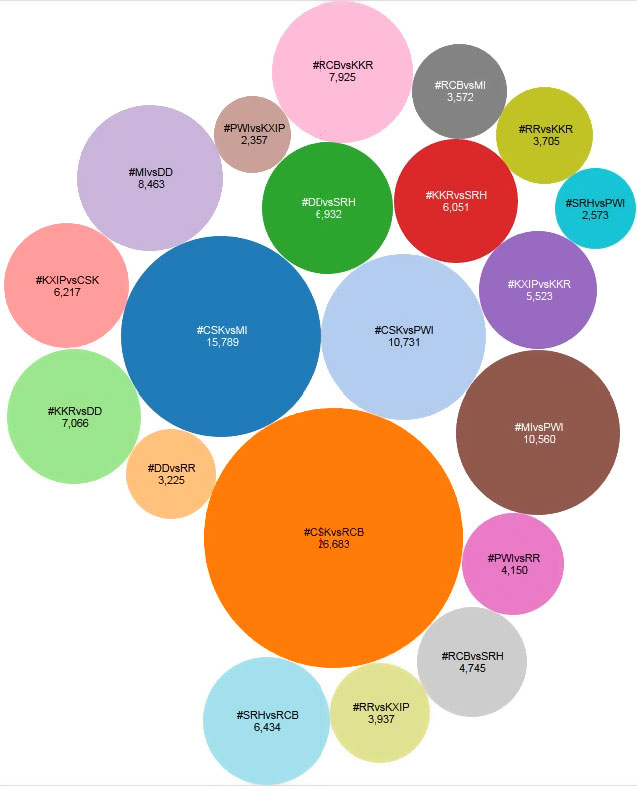
    • The most exciting match turned out to be the one between CSK and RCB as this match attracted over 26,000 tweets
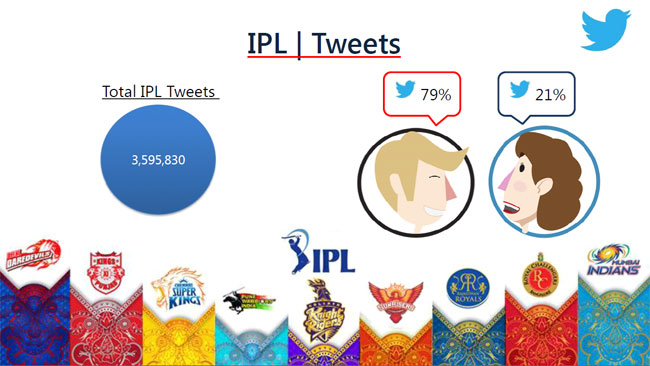
    • A good number of women participate in Cricket-Twitter wars. The study shows that 21% of tweeple were women


    Twitter trends show the popularity of a brand or franchise, considering this Asterii Analytics observed keenly that ever since IPL started at least two hashtags of IPL have been trending daily. Asterii Analytics reviewed all matches held in the first 13 days. For this study, over 3.5 million tweets were analysed across 21 matches in 13 days.


    The Asterii Analytics team analysed the tweet patterns based on win and loss scenarios. KKR and RCB celeberate when they win and are subdued when they lose. However, CSK bucks the trend and fans tweet more on the team hashtag when they lose.


    (Source: Match hashtags and hashtags of both teams competing)


    Which match got the most tweets?


    The most exciting match turned out to be the one between CSK and RCB as this match attracted over 26,000 tweets.


    (Source: Match Hashtags)


    Cricket may be perceived as the game that is pre-dominant among males, however a good 21% women have been found tweeting for their favorite teams.


    21% of tweeple were women


    (Source: All IPL tweets)


    Before Match/During Match/After Match: Expectedly the most tweets were during the match, which accounted for approx 80% of the tweets for the match. KKR, RCB and CSK seem to continue getting tweets even after the match is over.


    (Source: Match hashtags and hashtags of the individual team)


    Commenting on this initiative Niteen Bhagwat, CEO, Asterii Analytics, said, “The era of the multi-screen consumer has truly arrived. Millions of viewers are engaged not just with their TV screens but also with their phones and laptops to give real time interactivity. It is a phenomenon that will grow exponentially in the years to come.”


  • Piyush Pandey, others celebrate Cannes Lions’ 60 yrs of game-changing ads

    By A Correspondent


    The Cannes Lions International Festival of Creativity is set to commemorate its 60th anniversary with the launch of Game Changers, an exhibition and accompanying book that celebrate six decades of campaigns that have changed the landscape of the advertising industry forever.


    On display in a designated area of the Palais des Festivals, the exhibition will run alongside the Cannes Lions Festival welcoming both delegates and the general public from June 15-22. From Volkswagen’s ‘Think Small’ to the Nike Fuelband via Levi’s ‘Launderette’, it looks at the ‘firsts’ from the creative companies that have been transforming brands for 60 years. After the Festival this exhibition is set to travel to different venues around the world.


    The book, Game Changers: The Evolution of Advertising, published by Taschen for Cannes Lions, features more than 150 of the most outstanding campaigns to have been produced since the 1950s, and discusses the context in which they were launched. It also features eyewitness accounts from key industry players David Bailey, Lord Tim Bell, Lee Clow, Brian DiLorenzo, David Droga, Jeff Goodby, Paula Green, Bob Greenberg, Sir John Hegarty, Valdean Klump, Aaron Koblin, Piyush Pandey, Fernanda Romano, with an introduction by Arianna Huffington (of ‘Huffington Post’ fame).


    “There is no better way to celebrate Cannes Lions’ birthday,” says Philip Thomas, CEO of Lions Festivals, “Pulling together decades’ worth of ground-breaking campaigns reminds us why this industry is so special. Its relentless creativity, passion and its ability to innovate and reinvent shines through in Game Changers. It is both a fascinating and educational walk-through of defining industry moments and the world’s greatest creative work.”


    The Game Changers: The Evolution of Advertising book will be exclusively available for sale at the exhibition in Cannes before going on general release later this summer through major bookstores and online. More information is available at www.gamechangersatcannes.com.


    Other 60th anniversary celebrations taking place at the Festival include an exhibition of Cannes Lions memorabilia and a drinks reception hosted by the City of Cannes at the Cannes Connect Bar on Friday June 21. The 2013 edition of the International Festival of Creativity takes place in Cannes, France, from June 16-22.


  • Isobar India appoints Nilesh Pathak as CTO

    By A Correspondent


    Isobar India has appointed Nilesh Pathak as its Chief Technology Officer, in keeping with its technology thrust. With this appointment, Isobar (part of the Aegis Media group) will also endeavour to grow as a tech agency, servicing both global and national clients from India.


    Mr Pathak has over 16 years of experience building high quality enterprise software for various domains using wide range of methodologies and technologies. He was until recently with JP Morgan (India) where his responsibilities included providing technology leadership to its Treasury Services platforms.


    Says Shamsuddin Jasani, Managing Director of Isobar India, “Technology will play a key role in our goal to become the most sought after digital agency and Nilesh will play a key role as a member of our senior management team to make this happen.”


  • Star Sports 2, Star Cricket gear up for ICC Champions Trophy 2013

    By A Correspondent


    Sports channels Star Sports 2 and Star Cricket have announced a slew of production and programming initiatives for the upcoming live coverage of all the matches of the ICC Champions Trophy 2013. Star Sports 2 will broadcast the event in Hindi while Star Cricket and Star Cricket HD will showcase the tournament with English commentary. Live coverage will start today (May 30), and will continue the action till the grand finale on June 23.


    Said Vijay Rajput, Chief Operating Officer, ESPN Software India Pvt Ltd, “The ICC Champions Trophy is a true test of cricketing excellence with the top eight ODI teams going head to head to be crowned – Champions. There is no room for error as a defeat can cost a team dearly. We will leave no stone unturned to make this tournament an unprecedented viewing experience and are working with the ICC to deliver a world-class telecast for viewers worldwide. With a range of special programming, on-air enhancements, brand new camera angles, state-of-the-art graphics along with a high quality team of analysts comprising some of the great names of international cricket we intend to take the fan engagement to a newer level by redefining the way international cricket has been showcased till date.”


    The list of commentators include cricketing superstars like Sourav Ganguly, Sunil Gavaskar, Kapil Dev, Navjot Singh Sidhu, Sanjay Manjrekar, Arun Lal and Akash Chopra (India); Nasser Hussain and Michael Atherton (England); Shane Warne and Tom Moody (Australia); Michael Holding (West Indies); Ramiz Raja and Wasim Akram (Pakistan); Russell Arnold (Sri Lanka); Pommie Mbangwa (Zimbabwe) and Simon Doull (New Zealand). Seasoned analysts like Harsha Bhogle and Jatin Sapru will undertake the hosting duties for the English and Hindi telecast of the event. MxMIndia learns that senior cricket journalist-editor and commentator Ayaz Memon is also on the telecast panel.


  • Video’s the way to go: Ajit Balakrishan @ IAA Webinar


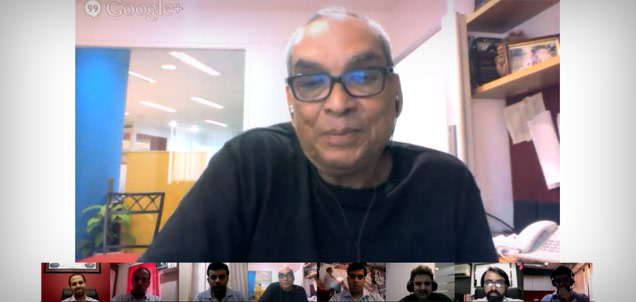
    The International Association of Advertisers (India Chapter) conducted its second webinar on Thursday, May 23 with Ajit Balakrishnan, Founder and CEO, Rediff.com. The IAA Webinar series with the theme ‘World Goes Digital’ is spearheaded by Abhishek Karnani, co-chair and director, Free Press Journal group and Manish Advani, head – marketing and public relations, Mahindra Special Services Group. *


    The panellists included: Abhishek Karnani, Co-chair, Director, Free Press Journal; Ajay Pandey, founder and CEO, Badhai; Gaurav Mendiratta, CEO, Sociosquare; Aditya Kuber, CEO, Media Sphere Communications and K Narssimhan, CEO, Commit. Pradyuman Maheshwari, Editor-in-chief and CEO, MxmIndia moderated the event. Other than the panellists, some questions that came in from the public in response to our announcements on social networks were also posed to Mr Balakrishnan.


    Excerpts from the Q&A:

    Opening Remarks by Ajit Balakrishnan, CEO, Rediff.com

    There is little doubt that the internet has come a long way since all of us started messing around with it around 18 years ago. The way I look at it is that it has often been a surprise to me that the web technology and internet happened first in the media world and my suspicion is that very soon we are going to see internet and web-based thinking in trade areas like education, healthcare etc what I call as the less-frivolous parts of human endeavours. I for one, am looking forward to that.


    Q. With a large number of players venturing into the digital space, how according to you can brands fight with the larger players and continue to make a mark in the digital media space?

    Ajit Balakrishnan: Let me say that every giant killer started off by being small. I remember Google when it started in 2000 was a tiny company with revenues to the tune of US $35-40 million. I think the successful ones that we have seen throughout the world tend to offer some consumer promise in a new technological way, which they manage to deliver. If you manage to do that at all times then you have a chance to upstage the big players. I have no doubt about that whatsoever; the field is wide open at all times.


    Q. You have been a pioneer in the industry and have seen the industry grow from nothing to what it is today. Have you seen any change in the customer behaviour and expectations on the medium as yet, and, what is the change you foresee in the next 3-5 years?

    Ajit Balakrishnan: My guess is that India is at a very early stage of revolution of the internet and the number of users in India who have unconstrained access to high-speed internet on mobile as well as PC is very small. So what has happened so far is that about 12-15 million users in India have so far access to high-speed internet which in relation to about 300 million middle class Indians is a very small number. So it’s a relatively English-speaking, mostly westernised group of people who tend to follow latest trends and what is going on latest in the US and whose brand values are built around the internet. I think that when this number rises from 12-15 million users to around 200 million users in the next 3-5 years by that time you will see more typical Indians landing up on the internet. The first likelihood is that people at that juncture may not necessarily be coming from an English background and secondly, what they do on the internet will also be different – doing more of social. Some of you will remember that in the mid-80s on television there were only a handful English channels that was ruled largely by Star. Then, a pioneer in Subhash Chandra stepped in and broke the rules of the game. Today, English-language television is a very small proportion of the total. So one will see such kind of initiatives taking place in the near future. But, it is still early days and things like email or social messaging will take precedence. In the early stage of all that is happening, technology is very important. I think technology-oriented pace will continue for another 3-5 years. Post that there will be a blending of mediums like content, applications that will be blended with technology…it will become more media applications oriented.


    When you started Rediff, what did you expect in terms of users or economic outcome…?

    Ajit Balakrishnan: I did not start hoping for any financial outcome from entrepreneurship. I saw an interesting idea at that time and was fascinated by the possibilities that the internet had to offer. I was fascinated by the possibilities of the internet by watching Compuserve and AOL experiment with the medium. So I told Arun that I am going to take a room somewhere in Fort, South Mumbai and figure out where this has to go. So I didn’t have the faintest idea where this would go to but yes, even today it is very unclear to me where the internet is headed next. I personally think that the technological tricks dominated the trade are going to pass in a year or two. In fact among the top 100 companies, everybody uses the same technology; there is nothing unique one can do. The problem in India is that early adopters of sophisticated technology are very small but all that will change soon.


    The same could be said of Rediff as well which has undergone a change in the way it now presents itself on the online space. Is that an indication of the changing times…

    Ajit Balakrishnan: We essentially took a ‘tight look’ as one would like to call it. Web is increasingly becoming a visual medium today. That is different from 10-15 years ago where it used to imitate the newspaper paradigm. But it is now moving to be a visual metaphor. There is a big swing being observed towards video as well but as yet nobody in the world knows how video on internet will play out. But one part of it is where pirated video is played out more and the second part of it is bloopers. Nobody knows what will be the grammar of the 2-3 minute video but I am sure it will arrive soon. In the early days of television there were not much popular sitcoms, people played movies. But then the sitcoms arrived with 2-3 slots for ads, so something like that will happen for 2-3 minute videos as well.


    What according to you will be the low hanging fruit that will make the fence-sitters start using this second screen to complement television, newspapers etc?

    Ajit Balakrishnan: I feel the reason why digital ad agencies are not as big as the others is because they tend to be conservative. I have been on that side so I know how it happens. Their best clients are typically the ones that are very large and that make products for mass media conservative audiences. Be it a Colgate or the others, the main market for such clients is outside the sophisticated audience. The internet doesn’t make as much sense to them because their growth comes from smaller towns and rural India. So, big ad agencies tend to be full of such clients. But there are clients in the financial services sector for example, who love to have a sophisticated audience. I’d say do not give up, wait for 2-3 more years and you will see big bucks coming to the sector.


    What problems do you face in online shopping for Rediff where you have many big players in the space?

    Ajit Balakrishnan: As a group, there are lot of things that are going good for Indian online e-commerce sites like us. First is that private equity has more or less withdrawn from organised retail. So if you are based in some Tier 2 town and you cannot find a good phone in a retail shop you can rush online and shop for your product from there. There has been a sudden explosion in 2011-12 in the range of $ 600mn that has been pumped in the Indian e-commerce sector across say 50 companies. That has woken up the e-commerce industry in India. This injection of capital and excitement has made a player like us grow by 100 per cent year-on-year. While that is good news, the bad news is that infrastructure around e-commerce has not yet developed. For example, if you have a credit card you can shop easily but the failure rates with debit cards on the internet tends to be in the range of 40-50 per cent. The reason for that is that for debit cards to work well through banks it has to be communicated well through an internet high speed line and that kind of telecom service will be tougher to achieve in smaller towns and cities. So while there are 100 million debit card users there are only about 8 million credit card users. But this problem is being looked into. Once this problem is sorted the debit card e-commerce will jump up.


    The other thing is that the cost for courier companies is high in relation to margins. So the courier companies need to be much more efficient and make money in no more than Rs 10 per delivery. This is the reason why some players have their own delivery people to capture the imagination of the public. But there are some who are doing a good job compared to Blue Dart and the others that follow a hub-and-spoke model. But like all things in India, these things take some time but when it happens it happens very well. E-commerce is about 2-3 years away from a gigantic boom in India.


    How big a role do you see for video playing on the internet in India?

    Ajit Balakrishnan: The thing about video is that it jumps over the language barrier. The fact is that Indian language-based internet has not taken off at all but with video, you leapfrog that barrier. So video is indeed terrific. In fact the sales people keep telling me that the ad agencies have woken up from their slumber on the internet and they love video because that is something they understand well. So video is destined to be successful.


    The problem that small companies face is talent who get lured away by MNCs after working for a year or two with us. How did you confront a challenge such as this?

    Ajit Balakrishnan: This is not a new problem that any new enterprise faces in Mumbai or elsewhere. There are plenty of jobs and lots of talented people mingling together. This problem will continue to happen at any stage in your professional career. When you grow a little older, things like stock options are technical ways of holding things back but I think that there is a pattern among people you recruit. Some who love the idea of doing innovative work, some who love security, some who like the thrill of changing jobs every year. There are guys my age who have changed some 20-odd jobs. So there are things that you cannot control but try and build an anchor group of 5-6 people whom you feel will be critical to the success of a business. The risk with that again is that those who are among your core group today may not be with you tomorrow. While we had the stock option scheme for us it does not work in every industry. But I can promise you that hiring and retaining talent will remain a 24-hour job and will be so at all stages of your life and not just the start-up.


    How do you mass-produce content that is creative and engaging enough?

    Ajit Balakrishnan: We don’t need to mass-produce content, we should see how we can cost-produce content especially for a 2-3 minute video. I think at most it costs just 5 lakhs but the idea is much more important there than the grand production. I think with television it has come to a point where the ads costs at least 1-2 crore behind an idea which is laughable. I think they have bought this upon themselves. But nobody knows what kind of an idea would work. We are in a situation which Charles Dickens was or the book publishing industry was in the 1830s. Charles came in and showed with ‘Great Expectations’ how we can write a book and we all know that there were more than hundreds of imitators after that. We need such kind of creative geniuses.


    In India, most ad revenues go to global top 5 websites that works up roughly to about 75 per cent. What is left for everyone else is a small pie. What do you foresee of this trend?

    Ajit Balakrishnan: Advertising has such a trend where the winner takes it all; it is not just a web phenomenon. Take the newspaper industry for example, whoever is No 1 takes about 60 per cent of the revenues while the No 2 takes in another 20 per cent. So from No 3 to 10 barely mange to hang in while all the others hang in for prestige reasons. A similar thing is observed with channels as well where the top 2-3 players take in 70 per cent of the ad pie. So media is akin to ‘winner takes it all’ situation partly because audiences tend to gravitate towards what is most popular. The internet space also such a practice but that will change as the industry evolves. People who mix technology and creativity platform will emerge winners. When things begin to change there is an opportunity to move in. I have seen many creative companies that have created successes especially from Korea. I think it is possible in India too. First we have to get the audience then the revenues will follow.


    As an industry, we still hover around the 4-5 per cent ad pie. At Rediff, have you taken any initiatives to increase the pie at a faster pace?

    Ajit Balakrishnan: Where ad spends is concerned, my sense is that big agencies should control about 90 per cent of spends in India. I think they are looking for ideas. If each one is able to produce one success story for brands, overnight the pie could increase significantly.


    With the youth taking to the web in a big way for content consumption, do you foresee the beginning of the end of live television in 5 years time from now? Do you think there will be convergence of internet with television for content consumption?

    Ajit Balakrishnan: I think it is a trend of time-shifting today. It started with the VCD/VCR device that enabled us to record and watch content at leisure. The youth of today are similarly doing time-shifting and watching it whenever they please. The television audience is so large that there are lots of audiences who have nothing to do most of the time. These families will prefer the social family programmes and watch it with friends and family. I think these trends will co-exist.


    Do you see independent publishers including bloggers becoming financially independent in India?

    Ajit Balakrishnan: I am a great proponent about blogging and I think the innocence about the internet was blogging. Individuals who had ideas could go and publish it without the consent of publishers and editors…that is the touching thing about the internet. Unfortunately, the business model has not yet developed but I am sure that it will develop soon. For example, if you see the NY Times paper, you will want to read the columnists first. I keep wondering what if somebody decides to have his own blog; what are they going to do? Many of us will go directly to the blogs. So in a way the magazines and newspapers ought to be threatened. So why is blogging not economically sustainable in India is because of the scale. If there are 300 million users and if even 4-5 million users come to your blog the ratio would be about $2 per user per year. You will end up being a blogger with about $ 3-400,000 a year. That is much more than what you would get if you work for somebody. So we are waiting for scale to come about but blogging will be about text and video in the future.


    If you were to invest $ 1 million in digital in the next two years what would be the three ideas that you would chase?

    Ajit Balakrishnan: It’s a tough one but let me give it a try. I think one will be where there is a language application which does not depend on English or anything; probably more voice-based in approach. The other would be something that will be big for professionals like lawyers and doctors because their business models are local in nature. The web will allow them to practice across more places. So an idea that will enable them to expand their business models further. The third would be doing something in education but I am not sure what. These three are likely to be models that will be successful. And all these will also be highly successful on the mobile platform.


    • MxMIndia was a partner to the IAA Webinar

     

  • One Minute view: Grow by breaking the language barrier

    Should we return to the silent era of audio-visuals or at least the type of content served by Charlie Chaplin films?


    One of the takeouts from the webinar with Rediff CEO Ajit Balakrishnan organised by the International Association of Association (India chapter) is that what will work on the internet/digital media is something that can break the huge language barrier that exists in India. Mr B suggested 2-3 minute quickie videos as a possibility. Videos that are low-priced and don’t cost a few crores as ad films do.


    What we need is the top creative talent to channelise their energies on this. Thanks to social networks,  online media have got huge viral power. The bucks can be big from just Google ads!


    As the adline says: What an Idea Sirji!


  • Zindagi Live announces Season 6

    By A Correspondent


    Hindi news channel IBN7 is back with the sixth season of its award-winning reality show, Zindagi Live. The show, hosted by Richa Anirudh, will present the most heart-rending, courageous and inspirational stories.


    The season-opening episode will take a walk down memory lane and meet the yesteryear news anchors of Doordarshan. Twenty years ago, presenters like Shammi Narang, Salma Sultan, Sarla Mahesvari and Minu Talwar were household names. They were admired for their style, diction and appearance. But in today’s cutthroat world of 24-hour television news and numerous news anchors, they have been completely forgotten. Zindagi Live takes this opportunity to talk to these icons and reveal some untold stories about them.


    The previous seasons, over the last five years, have won numerous accolades for highlighting issues that relate to every household. In its sixth season, starting Sunday, June 2, 2013 at 11 AM and 8 PM, Zindagi Live will draw attention to new topics and untouched issues.


    Said Ashutosh, Managing Editor, IBN7, “Zindagi Live, the flagship show of IBN7 has over the years drawn attention to various issues. The show is a platform for those brave spirits who have stood strong and conquered hardships. Season six will showcase many more stories of such courageous people who believe in themselves and refuse to let anything deter them from their destiny.”


  • Kids bring more emotions & cuteness to Indian Idol format: Gaurav Seth

    By Meghna Sharma


    Gaurav Seth

    The IPL season is over and the GECs are going all out to bring back the eyeballs to their channels. Sony which is the part of the Multi Screen Media network of which Max is also part of, has over the years launched Indian Idol after the cricketing event finishes. However, this year the channel will be launching the first season of Indian idol Junior.


    “Our aim always has been to gather eyeballs on a certain platform and them move the same to another. Hence, from the last five years after IPL gets over we try to shift the same set of viewers to Indian Idol. And this year, with the launch of Indian Idol Junior we aim to generate even more viewers as kids will bring more emotions and cuteness to the format,” says Gaurav Seth, Senior Vice President, Head-Marketing at Sony Entertainment Television.


    When asked about the expectations from the new version of the format he added, “We thought why can’t we showcase the same talent which adults have in the children? Apart from bringing freshness it will also get more attractions as children bring with them the whole family.”


    A look at the promos explains this year’s theme “Gaano Ka Wahi Jaadu, Ab Bachon Ki Aawaaz Mein”, wherein participants between the ages of 5 – 15 will lend their voice to just not one but, many tunes. The channel along with the agency (Leo Burnett) went through a lot of ideas before locking in on it.


    “The idea was brilliant but without proper execution it would have failed. After choosing the four landmark song, we had to decide how to put children into the theme. But the responses we have got so far has told us that the execution has been good,” says Mr Seth.


    However, when asked about the pressure and expectations such shows put on children and how does the channel plan to tackle it, Mr Seth clarifies, “We have set timings for children – when to do rehearse, study or relax. Parents too will be staying with them throughout the process. We don’t want to compromise the health of the kids as well as their day-to-day life. We will do our best to make sure there is no exploitation.”


    Apart from television, the channel will be using a 360-degree marketing mix for the show. A lot of radio activations wherein a junior idol will be chosen from various housing societies, mainstream print launch will be done on the launch of the show and hoardings across Mumbai and other 29 cities have been launched.


    The show has already got six main sponsors on board – Nissan Micra, Horlicks, Kelloggs Oats, Alpenliebe, 99 acres and Real. The channel aims to garner a premium spot rate from the show.


  • NDTV announces first edition of Property Awards

    By A Correspondent


    The stage is set to honour and acknowledge excellence in Indian real estate as NDTV gets ready to confer NDTV Property Awards on June 3, 2013, presented by CERA. After the success of its flagship programme, The Property Show, NDTV has now announced its first “Property Awards”, a platform to recognize and applaud individuals and establishments who have achieved notable success in the real estate segment in the country. The Awards ceremony, to be held at the Taj Palace Hotel, New Delhi, will be attended by the Union Minister for Housing & Poverty Alleviation, Ajay Maken as Chief Guest.


    Vikram Chandra

    Announcing the first edition of the awards, Vikram Chandra, Group CEO, NDTV said, “The real estate sector in India has come a long way by becoming one of the fastest growing markets in the world. It is the efforts of many establishments and individuals in the sector that have marked this growth and with these awards we aim to recognise their contribution to the country. We at NDTV are proud to announce the first edition of the NDTV Property Awards, a credible and distinguished platform to recognise and honour the most resilient and the strongest real estate leaders of this year.”


  • Mint Asia holds India Dialogues in Singapore

    By A Correspondent


    HT Media business daily Mint’s Singapore-based edition Mint Asia presented the first India Dialogues at the Marina Mandarin in Singapore recently, bringing together on one platform U K Sinha, Chairman of capital market regulator Securities Exchange Board of India, K V Kamath, Non-Executive Chairman of ICICI Bank and Diwakar Gupta, Managing Director of the State Bank of India. They discussed the future of the Indian economy with Tamal Bandyopadhyay, Mint’s Deputy Managing editor. In attendance were luminaries of the global investment community based in the island-nation.


    This session was preceded by a panel discussion on ‘Where is Media in Asia headed?’ Panelists Norman Pearlstine, Chief Content Officer, Bloomberg LP, and Marcus W. Brauchli, Vice President, The Washington Post Co, engaged in a free-wheeling exchange of ideas with moderator, Mint Asia Editor R Sukumar


    Said Mr Brauchli: “From the point of view of media companies, those who are agile and adapt (will succeed). HT (Media Ltd) has done a terrific job. What has happened with HT is Mint has produced a very specialised string of contents that happens to coincide with the mood and interest of the country at the time. The competition is going global.” Normal Pearlstine said, “It is dangerous to generalize about countries in Asia, but particularly given the differences in internet penetration, you will see areas where there will be continued growth in short and medium term in terms of print in India, in Indonesia and perhaps a couple of other places but for the most part in Japan and (South) Korea you will see real fall rather quickly in terms of print.”


    Rajiv Verma

    Earlier, Rajiv Verma, CEO of HT Media (and publisher of Mint Asia), said in his keynote address that “Mint Asia will cater to the information needs of Singapore’s significant market of Indian influentials. It will provide insights and perspectives on the Indian economic and business environment.”