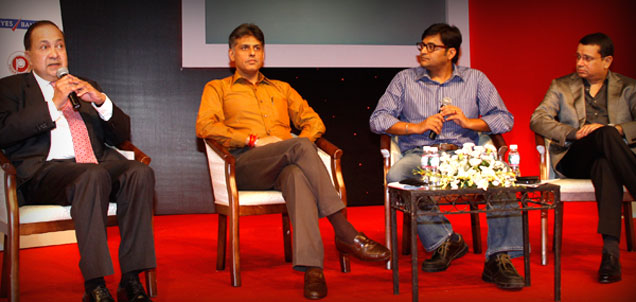
Panel discussions can be quite boring but at the Press Club Mumbai’s RedInk awards last Saturday (May 25), the audience gathered was actually asking for more. This despite an awards presentation and of course drinks and dinner that were awaiting members of the fraternity. The theme of the discussion was ‘Keeping the media free and fair’ and moderating it was Arnab Goswami, editor-in-chief, Times Now. Former editor-in-chief of the Hindu group, I&B Minister Manish Tewari and Star India CEO Uday Shankar were the panellists discussing the issue.
Arnab Goswami: Keeping the media free and fair… I was just thinking if you ask Mr N Srinivasan today who has refused to speak to Times Now about 10 times in the last 10 hours, he will certainly say that media is too free and is completely unfair. That’s what it is all about. It is totally subjective assessment. I would restrain my own views, the problem is because on television, I tend to forget that I am an anchor. I have assumed the role of an analyst much too often. But I will try and hold myself back because I have three absolutely tremendous speakers here today, three people who represent different points of view voice of youth, men with great experience.
I’d like to start this chat by first asking the most experienced gentleman as far as this profession is concerned, certainly on the panel, Mr Ram this question makes a few presumptions. Keeping the media free and fair, you assume that there is a threat that the media presently faces and it also makes the assumption that media might not be fair in the future. May I ask you to give your points of view on this?
N Ram: Yes, I think that is a good entry point into this discussion. It is quite provocative assumption that you are not my friend, are we really free? I used to think that India, among the developing countries, was in an enviable position. And I have revised my view after that. Why do we say this so far as press is concerned, Article 19 (1) A, plus Article 19 (1) G equals freedom of press. That is not possible because qualified by the reasonable restrictions enabled by the constitution are the eight heads and no more. That be reasonable. And thanks to judicial interpretation, freedom of the press has come to stay. This is the great advantage in India, institutionally speaking.
Unfortunately, the broadcast media and now news television in particular, haven’t been given the same status so far as freedom of speech or expression is concerned. Although in practice, they seem to be rather free as Arnab’s channels and many others bring out every day. So I am not quite sure of that but the problem today is that the so-called reasonable restrictions have turned down, some of them, to be mightily unreasonable. The law of criminal defamation is a daily threat to the press, to television. The contempt of court where judges decide their own cause – that is a problem although it’s not that frequently invoked. Legislative privileges poses problem here and there. Above all, the jurisdiction of criminal contempt, I think, is a major threat. Add to it the intolerance that we see around us. And not just from the govt, I must emphasise that, from many sources in our society including governments and state governments also.
I think this has now changed the game so that the feeling of insecurity, what a famous American jurist called the chilling effect phenomenon. People censor themselves when they write or speak on television or so forth. Despite that we only admire our colleagues, including young men and women, who brave these hazards every day and take huge risk and end up in jail or have to appear in court on matters that wouldn’t get them in any trouble in a truly democratic system. So I have revised my view on this.
The second part of question: are we fair? There also I have doubts because very often, the press as well as television – we fall short of the standards of fairness and justice that would be demanded of our institutions. Apart from the phenomenon of paid newsand  apart from problems like private treaties and so on which clearly militate against fair coverage, we have various other problems: hyper-commercialization in the news media, the control that proprietors exert over the content, poor material conditions of many of our colleagues. I recently read the longish report of the standing committee on Information Technology that your ministry has put out. It has got some interesting things to say on the condition of journalists in India including their remuneration. I think all this detracts from a healthy state in the media. I do not want to go on and deal with the central paradox of the digital age. I think on the whole, we fall short institutionally speaking, on the standards of fairness of justice which the public including politicians are entitled to expect from us.
One of the issues which bothers me is editorializing in the guise of news. I speak of newspapers here, but it might apply to television. These days, the standard argument is that everyone knows what’s happening – breaking news on TV, you do not say it for the first time. The front page function of the newspaper has changed profoundly. So what do you do to engage the readers or audience? You editorialize, you give it colour. And in the process, I think the standards of journalism get affected. It’s not easy problem to resolve because merely dull recording, factual reporting, may not engage the audience and you may lose the plot but editorializing blatantly in the guise of news, I think, has become a vice in the Indian press but I also see it elsewhere. I see it in the UK, I see it in the US on sensitive international issues. We must do something about it. I am not talking about an anchor expressing strong views. I am talking about the reporter in the field compelled to editorialize in news reports.
Arnab Goswami: On one side there are at this point of time, and I see them, moderate to strong disagreements of your views with those of Manish Tewari. You feel the medium is threat to profession and you also feel medium needs to live up to certain standards. You put these two very well. Manish, may I ask you to respond to that. I have three points which I would make. Mr Ra Mr Ram’s observations lead me to my first, which is to put it bluntly, this great concern of the falling standards of journalism that I hear from the political class of this country seem to coincide with the scams of the last three years. Ten years back, or pardon my saying so Manish, six years back there were challenges unique to news and Mr Uday Shankar – a purveyor of news television would know that there was lot of criticism of Hindi channels. Nobody complained about that as much as they started complaining about the falling standards of the profession, the lack of responsibility of journalist to coincide with the CWG scam and continues up to today. Why this concern, especially at the time of scams?
Manish Tewari: When I think of what you have succeeded in doing, is narrowing the focus of something which should have been a far more esoteric and academic discussion. And I do not want to, because we have done it, night after night, for the simple reason that some of those gentlemen who were possibly responsible for putting out some of that stuff in the public space have now honourably retired. So I will allow them to rest. But to come back to a far more substantive point that Mr Ram made about the sum total of the freedom of the press that 19 (1) A and 19 (1) G adds up to the freedom of press. With all due respect to Mr Ram and I have great respect for him as a professional, I beg to disagree. And the reason I disagree is because 19 (1) A and the reasonable restriction of 19 (2) which apply to it, and 19 (1) G and 19 (1) 6 operate on two different fields altogether. While the former operates with the extrapolation of the freedom of the press from the freedom of speech and expression, the latter really applies to the entire business of the media per se. And there I think you need to make a distinction — a distinction between the freedom of the press and the freedom of the owner of the press. While I do not think anybody has an issue with the former, with regard to the latter, and at times we joke amongst ourselves that we give two sorts of licenses in the broadcasting space – a news licence and a non-news license, so I was thinking to myself that it is high time we start giving views license also because most of the times what you hear is views, and do not hear the news.
So therefore, I think and that’s why when I outline those paradoxes, they are real situations which all of us collectively address as we go along. Because my apprehension is that increasingly you are seeing judicial intervention taking place in areas which should be preserved for self-regulation. And if we do not self-correct, and if we do not come to certain solutions, I am afraid that these interventions will just keep growing. You are concerned about falling standards of journalism. I have a very healthy respect for journalists. You would have never heard me talk about falling standards of journalism. In fact, I think in totality, journalists do a great job. And I am not talking about the national press. I represent a constituency which is one-third rural. We have journalists in the tehsils, and they run a far greater risk at reportage because of the tyranny of the state governments which Mr Ram referred to. Yes, there are people like the esteemed chairperson of Press Council of India, the former Judge of the Supreme Court who has concerns, I am not saying right or wrong, about “falling standards of journalismâ€. He is unfortunately not here, he is in the US . But next time he is here, I think we should have a discussion.
Arnab Goswami: I have had the pleasure of having him in some discussions in the past. His interest lies more in Sanjay Dutt these days. I am glad to have problems in the profession and standards of journalism because many would say, Mr Tewari with great respect and this is what young journalists feel that the nature of journalism is changing. Yes, it is becoming more strident. Views are a right of expression of every journalist. And as far as self-regulation is concerned, I think Mr Tewari Mr Uday Shankar will elaborate further on this, in this Azad Maidan – here there was an almost riot-like situation, I have never seen journalist expressing his self-regulation so voluntarily as he did at that time. Now whether you talk about that or renewal of communal situation arising in Uttar Pradesh or during the coverage of Ayodhya verdict, one have never seen so much voluntary self-regulation so maturely from so many young journalists.
Manish Tewari: Before you go to Uday, let me say: The difficulty with the whole self-regulation, for any regulatory mechanism to work, it has to be universal. It cannot apply to certain segment of media only. Therefore, you will have to find a way of making it universal and if the self-regulatory bodies do decide to take punitive action in a particular case, there should not be an option of opting out. ‘I am leaving the association, it’s my way or the highway’. So that is why I am saying that we are committed to the institution of self-regulation take route but I think we need to find a modus vivendi to make it universal so that it can be applicable across the board.
Arnab Goswami: Mr Tewari, taking from what you said on ‘views’, I’d like to go across to Uday Shankar and get his side of the story as well. Uday, my question to you would be what really comes out of kind of observation that Mr Tewari makes out of views, I can interpret that differently. May be some people in the audience will feel that today because of the strength of views and directors of views, politicians are feeling more moral/public/ethical pressure to respond. So even though they would not like to respond to certain situations, they have to because of the pressure that the media puts on them. How would you like to respond to that in the light of the subject today of media being free?
Uday Shankar: Whenever there is a debate on whether media is free and fair, I get a little suspicious depending on the nature of people who are talking on it. I am eminently comfortable when the gathering is of this kind because you have a point of view, you have practitioners who can throw light on this. As Ram said very clearly that fairness of the media is under question and should be questioned continuously. Not just in this country, but should be done everywhere. And it is not just about media, it is about any profession. What you are doing always has a scope for improvement and that should be done but usually people make the argument in this country, and recently more and more so, people make the argument primarily to suggest that since media is not fair, hence it must be curtailed because that is invariably the subject. As you said, there are eminent people who are concerned about falling standards in media and the practice of fairness in media. They have not once expressed concern about falling standards in their own profession. And I need to understand that everything is hunky-dory in legal profession? Everything is hunky-dory in judiciary? We have equal, if not bigger challenges, in this profession. But that does not mean that a journalist should be made incharge of regulating them. And similarly, if there are issues with journalism, we need to address them.
I agree with the Minister that it cannot be an option, but it is optional primarily because it has got no institutional support from the State or the Government usually. Today, for first time in the last couple of years, regulation has been given a chance in television to an extent and I think it has made things a lot better than any official enforcement would have brought.
Arnab Goswami: I think you have hit the nail on the head and I would like to go back to Mr Ram.
N Ram: If I may pick three points. The first one is complaints come up when news media gets very active in investigating and exposing the wrong-doing corruption. I remember the struggle against the so-called anti-defamation bill of 1988 which came very close to the heels of our Bofors investigation. We had a spirited movement here in Mumbai. So it is true and an important point. Secondly, I am glad that the Minister brought out the distinction because put in another way, I’d say you must make a distinction between state of the news industry towards printed press and broadcast media and the state of journalism.
The first may be reasonably buoyant although right now the economy seems to be hardened. The state of journalism is quite something else and very often in public discussions, these get conflated and I think, according to him as a lawyer comes straight from the constitutional self. Thirdly on regulation, the best discussion and debate I have come across on self-regulation was around the Leveson’s enquiry. Leveson eventually came to a very clever scheme in my opinion although for complex reasons, the British press has not yet signed onto it. What is the mode? independent self-regulation underpinned by legislation. That was the original idea. There was virtual revolt against legislation so, it is underpinned by Royal Charter, which itself is underpinned by legislation, by law. And yet, they have not signed onto it. I thought long and hard, why are they so scared of it and almost paranoid? Why are people refusing to come onto this? Because they are running scared of independent self-regulation.
Self-regulation that is compelled in the sense, it’s a contradiction in terms but you are required to be self-regulated by system, readers, and viewers. Then I think it is a genuine check on the vices and malpractices of media. And that is the lesson I draw from Leveson. Fortunately, in India, you have a Press Council, which is largely toothless and I have read Mr Katju on it who has some valid points and suggestion he makes for licensing is totally unacceptable. But what is the problem here. The Press Council is not independent. It is packed, I would say it is infested, with our own kin and a few politicians. And Leveson wanted to avoid both. I think we have got the model completely wrong. And if you are really going to self-regulate, I do not think that self-regulation without statutory underpinning is going to get very far. It is a good worthy experiment but it does not go far enough. So how do you bring these two things on the same page? Press Council – not independent, toothless, but having a certain history, and a certain visibility. The other thing – self-regulation – which is not really independent enough although it is better than the Press Council. So how do you get them on the same page and how do you get the model right? That could be of great interest to us.
Arnab Goswami: You know, 2- 3 years back, before Mr Tewari took over as the Minister, I had the opportunity of sitting in on a meeting where all channel heads were called. And the government, literally on a plate, offered statutory self-regulation. In other words, the govt told us that you self-regulate and we give you the power to do so. And the resistance from the channels at that point of time, which I think was worthy resistance, was that we will regulate ourselves not as a gift from you but as a right that we arrogate to ourselves. And I would just like to make that point following from what you said. But Mr Tewari, first of all I would like you to respond to the fairly straightforward observations of my friend Uday. Secondly, you talked about the foreboding possibility that in the near future you would not like to regulate the media but the judiciary might like to. Mr Tewari, of late, there has been more tension between politicians especially between your government and the judiciary than between the media and the judiciary. Tomorrow, if the judiciary were to regulate politicians, you would fight back. And in every point of time, there have been several discussions including editorial articles by your sitting ministers ( I do not know if you have written it yourself) where you basically told the judiciary not to encroach in the area of the executive. And today I want a concrete statement from you on whether you feel the media in this country represented by the several in this audience has the same right to defend its territory that you give yourself.
Manish Tewari: I think, Arnab, the very straight answer to that is that I think that the media is very capable of fighting its own battle. I don’t think you need to fire the gun from our shoulders. If you feel that the judiciary is encroaching on to your turf, stand up and fight. Not withstanding the tension between political executive and the judiciary, which are inherent in the constitutional scheme of things and that’s the manner in which it has been designed. Judgment after judgement which is coming out of the courts is not coming out to regulate the politicians. The whole structure of democratic governance is designed in a manner whereby Parliament regulates itself. Judgment after judgment is telling us that please regulate the media. And that’s why I say, and to come back to your point of you’re sitting in a discussion’ and ‘you wanting it as a right and not as a gift from the government’, I think you have probably not studied the ASCI model. The ASCI model of self-regulation in the advertising space which is underpinned by a statutory rule in the advertising code, 7 (9) if I remember correctly, is a perfect model of self-regulation, which has a statutory basis. I think that’s something you should look at. BCCC should look at it. The NBA should look at it. And if you guys feel that advertising model has worked which according to ASCI and incidentally when it comes to surrogate branding and stuff like that we have, not withstanding the rules, deferred to what ASCI says.
So it would be worth your while to really look at that model.
Arnab Goswami: Mr Tewari, with respect, advertising is not journalism. Journalism is not advertising. Never the twain will meet.
Manish Tewari: I think those lines are getting blurred. And they are getting blurred very quickly, my friend
Arnab Goswami: Mr Tewari, I wouldn’t try to shoot from your shoulders. You said about what the judiciary thinks. Where do you stand?
Manish Tewari: I do not have a mandate in this point in time to speak on behalf of judiciary but I do have mandate to speak on behalf of government. and repeatedly, we have demonstrated it through our track record that our relationship with media, not with standing the inherent tension, has been an essay in persuasion, has not been regulation. I think our track record for the past 9 years, speaks for itself.
N Ram: I would agree with you on this. We have not faced any real problems from the central government in the recent period but why doesn’t the government take the initiative to get rid of the whole jurisdiction of the criminal contempt. And you can strengthen the civil law. But why do we still need this law of criminal contempt? Here I can say that it is an act of omission, it is becoming very costly for the freedom of the press and freedom of news television in India.
Manish Tewari: Mr Ram, I think you made a fair point there. Because it is not only journalists, there are other lot of us who operate in the public space who are unwitting victims of the law of criminal defamation. But I think we need to tread very carefully because some of the judgements which have come out recently even with regard to civil defamation with due respect have been very excessive, therefore I think, the whole issue needs to be looked at holistically. And you make a fair point in regard to both the laws of sedition and the criminal defamation and possibly at some point in time when you do decide to revise a penal code which goes back to 1860, you need to look at lot of these issues afresh in contemporary sense of the word.
Uday Shankar: I think we must understand that when we say we fear attempts to subjugate from political executive and bureaucracy, we are not saying that it is the only source of apprehension. I do not think judiciary left to itself, would accredit itself any better as far as regulating or gagging the media is concerned. When we say there are attacks on free and fair media, those attacks are not just from the political class. Left to itself, any group which is drunk on its power would attempt exactly the same thing because what the media seeks to do is question/ challenge the authority, which they do not like. If we dislike or push back against he attempts to control from the political class, we should be even more vigilant of such attempts coming from institutions and community like judiciary because at least here you can have a blunt debate and you can stand up. This whole shield of contempt is far more dangerous when it comes to pushing back attempts of gagging from institutions like the judiciary.
The second point we should be conscious about is that media is just throwing a spotlight, it doesn’t decide anything. To that extent, it is a good idea to encourage a system where we are minimizing the scope for debate. It’s a good idea to encourage the space for good debate. And that good debate is not being restricted by these people. There is an internal attempt from the owners. Sometimes it is a very unconscious process of time and sometimes it is a conscious process of that space for debate being eroded by the ownership and the people who run media houses.
Arnab Goswami: Do you believe, Uday – you have been into television journalism for long time now – this debate that you are talking about is making some people uncomfortable? If I were to report the BCCI story in a PTI wire copy-DD news (with all respect) form, then it would have no impact? Mr Srinivasan would be laughing. The fact is that people debate, people get involved in subjects and people want their own point of view. This same plurality of views that democracy gives us become a threat?
Uday Shankar: I think it is indeed a threat whether it is the BCCI or the International Olympic Association or whether it is another field. Any authority or body is always unsettled by it. so that is definitely the case. The real issue is to come back the point that Ram made that there is a lot of opinion masquerading in news, I think that’s true and even bigger problem is that a lot of very poor opinion is masquerading in news. It is bad enought that it is opinion in garb of news and worse that it is really half-baked, ill-informed opinion. And in newspapers, I see, I see in name of analysis it is all opinion. While there must be analysis, I see no analysis but only opinion.
And that brings me to another issue that we must address as journalists ourselves and that’s exposing ourselves to a lot of criticism is the issue of competence. I think the quality of journalists, and while in general we see a lot of good quality people and very good quality of journalism, but we need to conscious about quality of people who are coming into the business. I continue to get very concerned about quality of intake and the way this society has changed; the way employment universe has changed. Earlier, if you were a Liberal Arts graduate in the country, no matter how good you are, in the country you have two-three options only: you became a teacher or journalist. If you were slightly liberal radical in your approach, chances were you would end up either as a professor or become a journalist. Today, those people have many more options. As a result, the kind of people who are coming in media are clearly not equipped half the time to tackle the issues and do the stories they are supposed to be doing. And the effort that is going internally and somewhere it is also about the collapse of the entire institution of mentoring by the editor — that has collapsed. And that is particularly a big challenge in electronic media. And if we do not address that it becomes a very unvirtuous cycle where poor quality, poorly mentored people are doing poor quality stories: opinionating a great deal and hence exposing the whole institution to question and attacks.
Compiled by Ananya Saha
 The Ministry of Information and Broadcasting’s decision to ban Comedy Central for 10 days would have come as a shocker. A shocker to not just the popular comedy channel, but also to the various English entertainment channels on air in India.
 Harish Bijoor, Marketing & Brand strategy specialist and CEO, Harish Bijoor Consults Inc
 Vandana Das, President, DDB Mudra Group, Delhi
 Sachin Kapur, Chief Marketing Officer, Groupon India
 There’s more to the new season of Jhalak Dikhhla Jaa, the Indian version of the BBC show Strictly Come Dancing, than just the airing on Colors from June 1. The channel has planned an online offensive that will not just extend the on-air excitement, but also engage internet users with the show and its stars. MxMIndia posed a few questions at Vivek Srivastava, Digital Head of Colors, to get a sneak peek.