Category: MEDIA

  • IMC 2013: Need to keep pace with digital: Nitin Paranjpe


    By A Correspondent


    The 7th edition of the Indian Magazine Congress lived up to its reputation of being a landmark event. The wait was worth it as stakeholders, marketers, industry captains and foreign dignitaries made their way to the venue at ITC Hotels for the start of procedural sessions, and the IMC 2013 kicked off with an inaugural address by the CEO of one of India’s hottest brands.
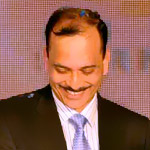
     

    Nitin Paranjpe

    Nitin Paranjpe, CEO & MD, HUL told a packed gathering about the need to do away with the old and be custodians of change for the betterment of the business. This, he reasoned, was possible only if one were to inculcate a reality that’s now become an indispensible part of the way we do business – namely digital.


    Cautioning the audience, especially advertisers, on the trends prevailing in the Indian marketplace, Mr Paranjpe said that the industry was seeing a tectonic shift in the television viewing habits of consumers today. “With an array of alternative streams available to communicate with the consumer, advertisers will find it challenging in the way they want to communicate with consumers,” he said.


    In a hard-hitting statement, Mr Paranjpe said that the 30-second commercial will no longer be as effective a form of advertising given that the consumer has an array of options before him to access content. Even media agencies and also media owners in some sense will have no say in telling consumers what to watch or not, he cautioned. “The issue today is that is that we are in a pretentious mode or are rather not willing to confront this reality. The sooner we wake up to this reality and stop pretending to not know the better prepared we will be for tomorrow. The core is: if digital is going to play a huge role going forward then we need to do things to help us stay relevant.”


    Advocating a way forward for the business community, Mr Paranjpe added that the topmost priority for most business houses will be digital capability and finding new business opportunities. “AT HUL, we have taken a huge first step towards familiarising our employees with the opportunities that arise from digital and are spending significant amount of time and money in training them to be future-ready.”


    In order to facilitate a smooth transition into the future that will largely digital, Mr Paranjpe disclosed that it will be essential for owners to ink tie-ups with specialists who can offer skill-sets in a manner befitting to the business. “We have to be realize that transformation and change need different forms of commitment and we have to be ready to facilitate that. I am not so much worried that we are still not doing enough for the business but what gives me sleepless nights is to see rapid changes transpire around us every single day, especially from digital.”


    Imploring business heads to rethink strategy, Mr Paranjpe said that that to be future-ready businesses will have to bring about a change in the business model. “A recent finding that I came across revealed that where the trust quotient was concerned, business houses and politicians were competing in the last rung. It is surprising but true that we are still not trust-worthy to be seen as beacons of change for our consumers. The thing is that we are judged by the outside world as having a self-serving attitude; this needs to change,” affirmed Mr Paranjpe.


    Sharing with the gathering another reality, Mr Paranjpe said that the truth is that we were forced by the government to include CSR as a mandatory practice but had we self-regulated ourselves earlier to this reality we wouldn’t have required an external source to impose guidelines for us. “What can be inferred is that the model of doing business tomorrow cannot be what we are doing today. This will be the mother of all changes.”


    On the implications that digital has brought about in the marketplace, Mr Paranjpe shared his own organisation’s example as he said: “Two years ago the decision that we took to make our employees digital-savvy was met with some scepticism but we’ve learnt a lot along the way and are better prepared to be agents of change of tomorrow. What is required is to have in place a mechanism to be future-ready. We are used to the mentality of ‘easier wrongs and harder rights’ but we will have to keep working on building our talent and skill sets.”


    Signing off, Mr Paranjpe said that it was important to see what would be the implications of these decisions on the revenue models of business firms. “At the end, that is what matters to every organisation. But then the good thing is that change offers opportunity. If we are change-ready we could achieve a lot more in 3-5 years than double that time it may have taken us to reach our goal.”


    Prior to Nitin Paranjpe’s keynote address, Association of Indian Magazines President Tarun Rai welcomed the delegates as he shared a few inspirational experiences confronting the magazine industry in India. Admitting that digital will drive the future for the industry, Mr Rai asserted, “The pace of change in technology has been humongous. This change has been a good thing to have happened for magazines especially with the launch of tablets about two years ago. It has been a huge area of opportunity for magazines as now magazine content can flow nicely onto the digital screens. The way the digital magazine market has been growing has been huge in India. Digital has been provided us a new revenue opportunity and a new reader reach to magazines and its content.”


    Elaborating, he said, “As India’s digital market is growing the way the market is growing and people’s aspirations are growing faster than the economy, and their disposable incomes there is going to be need for more magazines catering to the niche and lifestyle segment. Even in the traditional format, magazines are going to grow rapidly. Coupled with that is the added opportunity that comes from digital. This is the most exciting time to be in the magazine publishing business.”

     

    Tarun Rai

    The challenge for the business, Mr Rai said, is that there is a need to develop skill sets pretty quickly. “The learning curve has to be very steep and short because the editorial team led by the editor has to repurpose content. One just cannot go from a magazine to another platform in a simplistic way. Also, the ad sales has have to be able to monetize these platforms with advertisers. Right now, I do not think that in any parts of the developed world the right models of advertising monetization have happened on the digital devices.” Addressing another challenge, he said, “The third challenge is for the marketing team to be able to utilize the opportunity of the multi-platform brand that we have created. Earlier this opportunity was available only to an event. But all that has changed with digital gaining prominence over the past few years. Finally publishers have to make sure that there is a business model; you do not want a situation where resources are being diverted into multi-platform at the cost of printed magazines. We have to make sure that it makes business sense as well.


    “The good news is that it is finally a good time to be in the magazine business,” averred Mr Rai.

     

  • IMC 2013 Day 01: Print is in a vortex: Peter Kreisky

    By A Correspondent


    Peter A Kreisky

    Before sharing his experiences and know-how on the global state of the magazine industry, Peter A Kreisky, Chairman, Kreisky Media Consultancy preferred to begin by sounding an alert by announcing that the largest read publishing group Time Inc had been brought over by a relatively smaller player Meredith Corporation in the US. “This tells us what the future will unfold for the print marketplace especially with digital playing a key role in the transformation.”


    Stating that the print industry in the USA was around 3-5 years ahead of India, Mr Kreisky through his presentation on ‘Towards the new business model’ highlighted some hard facts surrounding the magazine industry. Backing up his claims through numbers, he pointed out that in 2007-09 the US magazine market witnessed a 35 per cent drop in number of ad pages, which was felt the most by news magazines that saw a decline of almost 65 per cent while newspapers were next reporting a decline of about 60 per cent. “This was the time when the industry as a whole was in a state of crisis but there was a remarkable turnaround that happened from June to September 2010 where top publishers went about hiring new leaders to run the reigns for companies. The thing about these leaders was that they were a younger lot than their predecessors and who were ready to take the plunge where future-readiness was concerned.”


    Admitting that the use of print/paper was on the decline, he said that the industry was in a state of vortex that was compounded with issues like extended recession, structural change in ad spends, rise of sophisticated mobile devices, decline in newsstand sales, evolution of powerful digital gatekeepers, etc. But based on the change that was being witnessed, according to Mr Kreisky the three facets that were core to the business were a trusted magazine brand, curated & valued content, and engaged communities.


    Mr Kreisky went on to present five new rules for Magazine Media that comprised the following: a) B2C model – from print publishers to being magazines everywhere, b) Portfolio model – From bigger is better to owning customer communities, c) Strategic control – multi-title aggregation to harnessing digital gatekeeper, d) Customer revenue – circulation dollars to branded commerce and e) B2B revenue – from ad sales to marketing sales.


    As for the first rule of B2C, Mr Kreisky highlighted that publishers need to move from being print-centric to brand-centric. He cited the example of the Meredith Publishing group that was the first player to adopt the ‘magazines everywhere’ approach. “Today the multi-platform strategies have evolved from porting the same print content to a clearly-defined role where content strategy and business models have gained much prominence.” Today, consumers are at a stage where they need to subscribe only once and they get access to all digital content unlimited, added Mr Kreisky.


    Next, Mr Kreisky went on to question the gathering on whether their brand was indispensable for an identifiable community. He cited the examples of brands such as ESPN, The Economist, Dwell, Bloomberg etc and suggested that the publishers had to make a choice whether their digital magazines would be a container or a connector where the role of containers would be to delegate editorial-aggregated content while connectors would be about bringing clusters of people together around well-defined interests.


    On the topic of harnessing digital gatekeepers, Mr Kreisky stated the examples of tech brands like Apple, Facebook, Twitter, Microsoft etc who were playing a huge role in being gatekeepers while also providing a scope to act as collaborators. He shared an important quote with the gathering as he said: “It’s become very clear that digital trumps print and that pure digital without any legacy costs massively trumps print.”


    On the next rule of circulation dollars to branded commerce, Mr Kreisky said that where paid content was concerned, avenues such as events, e-commerce, membership schemes etc would do well going forward. “Paid content models can peacefully co-exist with free models if they are clearly differentiated,” reasoned Mr Kreisky. As for the emergence of e-commerce as a model, Kresiky went on to present the example of Shop Bazaar that was leveraging its digital presence well by advertising and selling products only advertised in magazines. That provided the publishers a good revenue model and also enabled them t provide only exclusive stuff to their customers.


  • IMC 2013: Mags must cash in on change: panel on RoI

    By A Correspondent


    Sam Balsara

    In an atmosphere where the explosion of digital media is leading to questions about the relevance of magazines, Madison World Chairman and Managing Director Sam Balsara put forth what was probably the defining argument, when he summarized the question of magazines and their ROI.


    Leading the panel discussion on the second day of the Indian Magazine Congress, on ROI from Magazine Media, Mr Balsara said there was good news as well as bad. Underlining the continuing importance of magazines, he cited a Henley Centre study which found that nine basic needs are fulfilled by media, and magazines as a class, irrespective of genre, fulfilled most of these needs.


    The nine needs are split into two main classes: informational needs and cultural needs.


    Information needs:

    • Instrumental: information for daily life such as weather, transport, traffic, sales, opening and closing times, etc.
    • Analysis: to understand the world, form views, have opinions.
    • Enlightenment: keeping up with the world, national and local events; being and becoming informed.
    • Self-enhancement: bettering ourselves, knowledge for its own sake or for later application; acquisition of skills.


    Cultural needs:

    • Ritual: media use which frames daily routines, such as getting up, going to work, relaxing after work, accompanying domestic chores.
    • Default: absorbing media because it is there or because others within the social context are using it.
    • Relaxation: passive absorption of media, unwinding.
    • Entertainment: keeping ourselves amused, keeping others amused, having fun.
    • Escapism: frees the user mentally from the immediate constraints and/or dullness of daily life, enabling him/her to enter into new experiences vicariously.


    This wide range of needs creates a demand which magazines can meet because there is such a variety of them.


    Mr Balsara said that the other piece of good news is segmentation, which is sharper in magazines. This means good news for planners, as it means less waste, and they can target specific groups due to the proliferation of niche and special-interest magazines.


    The third piece of good news, Mr Balsara said, is that magazines have a longer half life than most other media. This means a longer lingering effect for advertisers, in sharp contrast to television which, although it did a good job of demolishing magazines in the 1980s, has a low half life.


    Moreover, from an engagement point of view reading magazines is an active activity, compared to something like watching TV which is passive. Therefore, intuitively, a combination of TV and magazines should be a potent medium for many brand plans, Mr Balsara said.


    TV advertising also becomes more effective when advertisers also spend on magazines, Mr Balsara said, highlighting that overlap scheduling doubles the impact. Though TV overwhelmed magazines in the 80s, the fact is that the effectiveness of TV comes down as the level of clutter increases.


    Multi-media is indeed ROI-accretive, Mr Balsara said, and those brand plans which use more than two or three channels of communication have an overall higher level of effectiveness. Multi-channel campaigns are more effective across the board than single-channel activity, he added.


    On the downside, however, is the fact that magazines contribute to just 4 percent of the total advertising pie, he said, and this is lower than the global average.  Plus, he observed that though literacy in India is going up, and this helps newspaper readership, it does not seem to be benefiting magazines. On the other hand, he said, though small, there is an increasing use of magazines online which, though not robust, is growing.


    Making some suggestions, Mr Balsara said that the Association of Indian Magazines should conduct studies on the impact of multi-media on different categories, to check accretive ROI. The next few years, there is going to be a strong movement for multi-media, specially from big brands. To meet the need for another medium in addition to television, magazines should be ready, he said. AIM, he said, should also develop case studies on the impact of use of magazine advertising on sales/purchase intent. His third suggestion was that magazines should exploit their content creation capabilities to open up new areas of growth.


    CVL Srinivas

    CVL Srinivas, CEO South Asia, GroupM, said that publishers and sellers needed to look at leveraging all the good news to convert it into revenues. Magazines are the best medium for building engagement, and score high on the trust factor, but this has not been translating into revenues, he said.


    A change of mindset is required from publishers and sellers, he said; the latter need to stop selling ads and start selling engagement. Magazines can form an engagement layer over media like television which are heavy on exposure. Moreover, a lot more relevant research is required; for example, what is the interplay between magazine consumption in different formats? More category-specific research is required, he said.


    Most important, magazines have to gear up to ride the digital wave, said Mr Srinivas, and had to move from being passive to becoming active communities, using digital interaction to its full advantage.


    Ambika Srivastava

    Ambika Srivastava, Chairperson, Zenith OptiMedia and Vivaki Exchange, said that the role of advocacy and recommendation is very big. It is clear that consumers value the content of magazines, and the role of magazines in guiding the consumer to a purchase needs to be measured. Advertisers need to look at content very carefully, she said, to go beyond the traditional formats and think about dynamic engagement.


    Ashish Bhasin

    Ashish Bhasin, Chairman India and CEO South East Asia, Aegis Group, said research had shown the highest level of engagement in any advertising is in magazines. But the conundrum is that revenue is not coming in at a commensurate level, and this needs to be addressed. Magazine spending had grown at a rate equal to or less than the overall ad pie when it should have grown more, he said.


    Magazines need to change the selling game, he said, and instead of focusing on figures and statistics, marketers need to sell engagement. Engagement is not being measured and is not being given the credit it deserves.


    He also said that magazines are the masters of innovation, and need to capitalize on this advantage. Technology is the friend of the marketer in this respect, and innovation and engagement naturally lie in magazines. Innovation is what will change the dynamics of the game, he said.


    Finally, considering that magazines have only 4 percent of the ad pie, individual titles need to practice coopetition, and need to get together to fight for the medium as a whole, instead of cutting each other down. Instead of fighting for the same dollar, coopetition can increase the number of dollars we are fighting for, Mr Bhasin said.


    The discussion was moderated by Worldwide Media CEO Tarun Rai.


  • IMC 2013: Being creative and loving it

    By A Correspondent


    While brands do acknowledge the big role that the medium of print essays in getting them to speak to their audience, the task has become more daunting in recent times what with the advent of multiple mediums. At such times, being innovative and creatively unique is what may make them stand out from the clutter.


    In the session on ‘Advertising Creativity and Magazine Media’ at the Indian Magazine Congress 2013, the panellists took turns presenting their viewpoints on how print could still remain a preferred medium for brands going forward.


    Lutz Kothe, Chief General Manager, Marketing & PR, Volkswagen, India began by saying that advertising in India has come a long way. “While for the magazine industry 2013 is about niche and genre-based publishing, the times are also changing and turning out to be challenging. The onset of several new mediums especially digital has provided an array of choices for the advertiser to choose from. In a couple of years from now, integration with digital technology will be the way forward. But while 360 degree would be the way forward, an important thrust would continue to be given to magazines.”


    Josy Paul

    Josy Paul, CCO & Chairman, BBDO India compared a magazine to that of an infant as he said it is all about touch, feel and involving sensorial feelings. He went on to demonstrate some examples of some fine print ads that captivated the attention of the audiences. But he also agreed that the ad agencies of today did not resort to using the medium as effectively as it could and rather depended heavily on other mediums like television and digital.


    Satyaki Ghosh, Director, Consumer Products, L’Oreal India said that his organisation was highly appreciative of the medium of print. While we are the seventh largest advertiser on the medium of television, our percentage of spends on the medium of print is still high. Print is the only medium that enables us to educate our audiences and also gives us the premium that we desire. “But what I expect from the medium especially magazines is partnerships that would allow us to make our core idea bigger.” Ghosh also cautioned the publishers that they should not engage in innovation for the sake of it; the readers should not be confused with what we are trying to tell them.”


    When asked on how open his organisation is to incorporating new ideas, Ghosh said “We are open to ideas from wherever it comes but usually it is the domain of the creative agency, and even the media agency to transform thought into reality.”


    Kothe had a slightly different approach as he said that it doesn’t matter from where the ideas come as long as it is effective. “Where magazines are concerned, we do get ideas from the editorial teams as well and if we like it we go ahead and incorporate them.”


    As for Josy Paul, it is all about looking at how they can maximise media and the answer lies with innovation. The other aspect that readers look forward to from magazines is for it to deliver news-worthy content.


    Sonal Dabral
    Sonal Dabral

    Sonal Dabral, Chairman & CCO, DDBMudra, put forth his observation as he said that each time he is confronted with a problem there are chances of finding part-solutions to it. Where the medium of magazines is concerned he said, “The medium of magazines allows us to write or explain stories, something that that the television or other mediums do not offer. With the onset of multiple mediums the going will be a bit challenging going forward.”


    The panellists agreed that the way forward would be for creative firms to work alongside brands and produce work that would be educative, appealing and informative.


  • Jaldi 5 with Amit Nair: Khana Khazana should do well with digitization

    Indians love food. Yes, it is a fact and Khana Khazana is a proof of that. In the early 1990s what started as a show with Chef Sanjeev Kapoor as host and in 2010 turned into a full-fledged channel just certifies it. India’s first-ever food channel is all set for re-branding and give its viewers better and new shows to look forward to. MxMIndia’s MEGHNA SHARMA quizzed the channel’s business head, Amit Nair, to get a taste of channel’s strategy. 


    1.After the new and refreshed content, what can the audiences expect from the channel?


    The content strategy is very info-entertainment oriented. All our shows are very chatty, conversational and interactive unlike regular cookery shows. We are delighted to announce the start of four new shows on air all back by research and by understanding the pulse of women by interacting with them extensively. These our shows are Food Ka Mood, Bacha party, Breakfast express and Ab Har Koi Chef. Each of them have been designed with specific needs in mind. In the coming months we plan to launch a lot of new shows that will also target a broader TG. There will be more travel + food related to reality shows and will dish out more theme based or concept driven shows every quarter keeping our TG in mind.


    2. So how has been the ride so far?

    Khana Khazana has always been synonymous with great food experiences and has a unique place in the heart of homemakers and cooking enthusiasts. Hence, since our evolvement to a 24-hour food channel the response has been very heartening.


    3.Is there enough audience for a food channel in India? Where do you see the genre in the next few years?

    Food as an offering on television has been growing since the days of Khana Khazana. GECs had cookery shows, then we started having food shows within the regional space. Subsequently even news channels got into it and on the GEC front it evolved from instructional cooking to food reality. With dedicated food bands on lifestyle channels the time was ripe for a dedicated food channel and Zee was the first to do so. In mature television markets, there are 3 -4 dedicated food channels so we are very bullish about this genre. With digitization and greater monetization, specialized offerings like food are expected to do very well.


    4.But given the limited viewership, do niche channels like yours see enough advertisers?

    While our core target audience is female, we have seen enough and more men venturing into the kitchen to try out recipes that are different from the norm. So while we may have FMCG and durables as main advertisers there is a lot of interest from home and lifestyle related brands to advertise.


    5. With competition growing, what is the marketing strategy of the channel?

    We will be closely working with our DTH/cable partners to increase interactions with consumers. Focus predominantly will be on digital and activations and build close viewer connect.


  • Radio City 91.1 wins the ‘most popular youth brand’ award

    By A Correspondent


    Radio City 91.1 was named the ‘Most Popular Youth Brand’ of the year at the 5th Youth Marketing Awards held recently. The awards, hosted by the Global Youth Marketing Forum (GYMF), felicitate outstanding achievement and brand recall among youth, across various sectors.


    Apurva Purohit

    Radio City CEO Apurva Purohit said, “We are elated at winning the ‘Most Popular Youth Brand’ of the year. The award testifies to our efforts in establishing a youth connect. It reflects the top of the mind recall that Radio City has been able to establish amongst its target audience.”


    Radio City has engaged the youth through their pan-India properties like Gully Premier League and Radio City Super Singer. Streams like ‘Radio City Freedom’ or ‘Radio City Indipop’ on its web radio, PlanetRadiocity.com, are also popular with the youth.


    The Youth Marketing Awards are celebrated annually to recognize and appreciate outstanding contributions by young individuals, groups or brand in the areas of business, leadership and development. The selection of winners is done by the research cell which constitutes researchers and senior professionals from the industry.


  • Tryst with destiny @ FICCI Frames in March

    By A Correspondent


    Uday Shankar

    Announcing the launch of the 14th edition of India’s foremost business conclave on media and entertainment, FICCI Frames 2013, Uday Shankar and Karan Johar, the Chairman and the Co-Chairman respectively of the Media & Entertainment Committee, unveiled the theme of the conclave, ‘A Tryst With Destiny: Engaging a Billion Consumers’.


    Speaking on the occasion, Mr Shankar said, “While the industry has made spectacular progress in the last 20 years in increasing the intensity of engagement with the Indian consumer through superior content, there is still a gap in our ability to monetize the engagement and use the resources generated to advance both access and content. The year 2013 is one of many milestones in the media and entertainment industry and Frames will offer an opportunity for us to put these developments into perspective, look at the larger picture and engage on such a bold and important theme.”


    Mr Johar said, “The M & E industry has the potential to become the catalyst for social change and a force of good for every niche of society. FICCI Frames has been the most eminent platform for the M&E sector and its initiatives over the past decade have improved the quality of content generation, skill development and stature of the industry. We believe that our new agenda will be the change agent for social and commercial development, connecting a billion people, while shaping and informing their opinions and getting influenced by their collective needs in turn.”


    At Frames 2013, the aim is to deliberate on the growth of the industry and find ways to maximize both its creative and economic potential by engaging with the billion strong consumer base in our country. We have key international thought leaders, studio heads and academics lined up to speak on a range of topics covering the main objectives of the sector – digitization, making big budget films and being successful in Bollywood, censorship, marketing, exhibition, distribution, viability of the sports broadcasting business, the future of content consumption in an era progressively getting defined by the digital media, innovation and planning required in various policy issues within TV, cinema, animation and gaming.


    The line-up of stalwarts includes Andy Bird, Chairman, Walt Disney International, Anne Sweeney, Co-Chair, Walt Disney International & President Disney ABC Television Group; Bob Bakish, CEO, Viacom Media International, Teri Schwartz, Dean, University of California, Los Angeles (UCLA),  Colin Maclay, MD, Berkman Center for Internet and Society, Harvard University, Andy Kaplan, President, International Networks, Sony Pictures Television, Mira Nair, film-maker, Dominic Proctor, President, Group M Worldwide, Seymour Stein, Vice President, Warner Bros Music, David Womart, the Producer of the Oscar-nominated Life of Pi, film maker Gurinder Chaddha, Jonathan Taplin, Director, Annenberg School of Innovation, The University of California school of communications and journalism, Andy Weltman, the international head of Pinewood studios, and Graham Broadbent, the British producer of the Best Exotic Marigold hotel.


    Key stakeholders and regulators will also be present, from government to industry leaders. Attending for the first time will be the information ministers of SAARC countries, forming an exclusive panel on forging bilateral ties to augment growth amongst geographically and culturally connected countries.


    FICCI Frames 2013 will be held from March 12 to 14 at Hotel Renaissance, Mumbai.


  • Is Digital eroding relevance of TV and Print?


    By A Correspondent


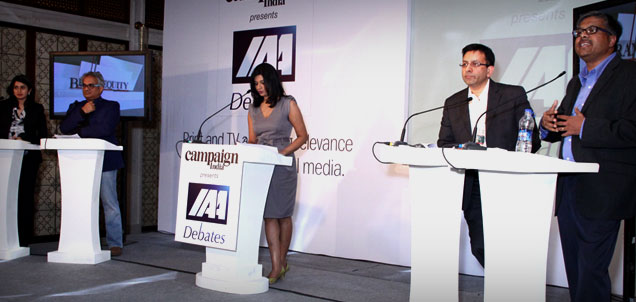
    The traditional media of print and television are under siege, as it were. Though they are still dominant media, they are seeing a sea change in the way they are being consumed. The explosion of new media also threatens their relevance and hold. Or so it is believed. But is it an overreaction and does digital not pose that much of a threat to TV and print?


    To find out, the India chapter of IAA organised a debate in Mumbai on Monday (Feb 18) on whether television and print are losing relevance with the growth of digital in India. The debate series is being sponsored by Campaign India and the co-chairs of the IAA debates initiative are Partho Dasgupta and Neville Taraporewalla.


    Seasoned professionals Virginia Sharma of IBM and Mahesh Murthy of Pinstorm (and Seedfund) argued for the motion while Sanjay Gupta of Star TV and Arunabh Das Sharma of The Times of India group argued against the motion. The debate was moderated by Sonali Krishna, Anchor of Brand Equity show of ET Now. A cross-section of industry professionals were in attendance. As were some representatives from MxMIndia.

    We bring you some of the highlights of proceedings. Note, this is only a part of what was discussed.


    Mahesh Murthy: If you look at the Census report, if you see rural India there are just 33 percent homes that have television vis-a-vis 54 percent that have mobile phones. Overall if one compares, urban plus rural, TV used to take 32 percent penetration in 2001 which has grown and is at 47 percent at the moment. But mobile has grown from 9 percent in 2001 to 56 percent today. Mobile today is 24 percent larger in Indian households especially rural where the number is about 50 percent more.

    If you look at the numbers further, television has about 111 million viewers whereas mobile has about 133 million users – which further consist of 400 million users of SMS, 900 million SIM cards, etc. When one compares the publication number of The Times of India that is at 3-4 million which is dwarfed by 18 million users of Facebook every day in India.

    If you look from the consumer’s POV the three most desired audiences from an advertiser’s perspective is the 15-24 yr-old youth that barely reads a paper or watches TV and is highly digital-savvy; 25-34 yr-old females – Facebook alone has 11 million of those and I do not think any other medium in India can give you that kind of access to this age group; and finally 35+ age group – it will be hard-pressed to reach a CEO today as long as he is on his tablet or i-Pad or email, etc.

    When we move on to the advertisers, all of two years ago digital was all of two percent of the ad pie which has now become about 8.5 percent, meaning that digital has grown by 400 percent while the share of television or print has gone down.

    If you look at how digital has been explored by other people like politicians who have more than 200 people to handle just the digital medium, which I do not think is the case with other media. Even when one looks at the credibility factor, Nielsen states that the most credible medium is word-of-mouth, followed by what strangers write online followed by what is written on websites and then comes print.

    So what we are seeing is that print and television are not going zero; while they still have relevance they are losing their relevance because of the advent of digital. I’d like to end by requesting each one to ask themselves as to where do you see yourself in the future – whether five years from now you’ll be seeking a job in a company that does not do digital. The honest answer will decide where your preferences will skew towards the end of this discussion.


    Arunabh Das Sharma: I’d like to begin by saying that what we are discussing here is relevance. Is it about ad dollars; is it about ‘x’ percent more mobile penetration or is it about what these media have stood for the longest time – which is curated content. What digital has done is created a proliferation of choice and when that happens big becomes bigger. In such a situation everything grows. I’d like to share here an example of how the growth of social media has fuelled the growth of television and print and how they the two mediums are getting healthier now that the investment in content is becoming stronger and stronger.

    In the 1950s, it was said that radio was going to kill the medium of print and was followed in the 1970s where it was said that television would kill the medium of radio… none of that happened. There is a reason why different media play different roles in our lives. A recent study by research firm Ipsos talks about what are the global rules that different screens play in your life. So while the mobile screen is a lover, the computer screen is a sage while the tablet is a wizard but the fact of the matter is that you need a lover, wizard and a sage; the fact of the matter is that every medium has a special role to play and we ourselves will be very myopic if we assume that television is linked to a cathode ray tube or that a newspaper is linked to a piece of paper.


    Virginia Sharma: Is your motion that TV and print continue to be relevant or that they are growing in relevance?


    Arunabh Das Sharma: I think the topic needs to be redefined whether print and TV are losing relevance but whether digital will ever gain relevance? In fact I’d like to say here that 2012 saw some of the biggest gains in stock prices of print companies because of one aspect – they had figured out their business model. The issue was that in 1992 when the readership started dropping they had to figure out a business model which wasn’t to be.


    Virginia: Do you have any comparable stats to validate your observation?


    Arunabh: It doesn’t even show on the scale for India. I’d like to add here that a lot of people wouldn’t know about this but a gentleman in the US just brought a bunch of regional newspapers with the assumption that the growth of print will happen through hyper-local and regional papers, which is exactly what will happen here too.


    Virginia Sharma: I’d like to start off by answering the question, ‘What does relevance mean?’ In today’s world relevance means business impact. The fact that it was said that digital does provide a platform of choice is correct; also the fact that social as a medium has grown is also correct.


    Arunabh: If relevance is defined as business impact, are we talking the same scale in that sense in India?


    Virginia: What I am saying is business relevance to advertising agencies…


    Arunabh: But I thought it was also about ad dollars…


    Virginia: No ad dollars is about expense. Business relevance is about business outcomes and about what the CEO measures, particularly the RoI. To quote numbers from a CEO study that was conducted, the use of social and web from 11 percent to 48 percent for social and from 37 to 49 percent for the web in the primary way to interact with the customers.  That for me is business impact and what the boss sees this as a way to engage the audience. What do most brands like Coca Cola, Pepsi, ICICI, HDFC etc have in common – it’s their innate belief that this medium is relevant and their investment in this medium is not just what the ad agency says it is.

    So, two big cases. First, the primary metric of the CEO study for marketers for success is RoI. You can measure RoI based on the ability to understand customers and target them with what they need. You can only measure digital better than you can measure print and television. Therefore the future for marketing where RoI is concerned as a primary measure for success has got to be digital if you want to make the case.


    Arunabh: I think the challenge is not about measurement but about conversion and that’s how a medium works. Measurement that you are saying is how many people have seen the ad not how many people because they have seen the ad went and watched something.


    Virginia: Measurement for me is actually measuring consumer behaviour and doing it successfully. To sum up, the business case is very simple, if you want a good RoI you have to use digital as a key medium to be able to feature consumers and that ultimately is going to be key.


    Sanjay Gupta: When I started working 20 years ago I thought print is going to die and today print is about Rs 14,000 crore from Rs 6,500 crore it was a decade ago. For television the growth has been from 5,000 crore to 16,000 crore. The key points that I’d like to present here are that firstly, consumers love television and it is thriving. The thing is that if you find something relevant you spend time with it. Around 700 million people in this country spend three hours every day watching TV. When they start it is for two hours, which then picks up to three hours. Also in the last one year, 70 million new people have started watching television. That’s more than the number of people who watch digital in any given point in a month. The same is the case in developed countries like the UK and the US where the time spent is around 4-5 hours every day.


    The other thing is that big is becoming bigger on television. The belief is that proliferation of choice will make users fragment. A recent example I’d like to share is of the movie ‘Dabangg’ which was watched by 150 million people. Even shows like Balika Vadhu etc aggregate about 40-50 million viewers in that half an hour. The point I’d like to make is that social media is actually helping the business become bigger and better. The people fall in love with our characters and they do that only on television and not anywhere else.


    Mahesh: So essentially your point is that even TV uses digital…


    Sanjay: TV does use digital. To quote an example our show Satyamev Jayate was the biggest show that we did and we used the channel of social media to make people come and watch it. It was in fact the highest trending topic on Twitter. So what I am saying is that digital is driving our business to do better.


    Virginia: Is it content that drives behaviour and interest or is it the medium?


    Sanjay: It is content. To cite figures, in the UK people watch about 80 minutes of video and out of that 80 percent is either pornography or YouTube – that’s the power of that medium there. Whereas if you provide good content it makes the viewer keep coming back to watch more and more.


    As to what is changing, digitization is changing the way television companies do business. Till now only 20 percent of the revenues from digital medium came to the broadcaster but the transparency with DTH that number is moving from 20 to 100 percent. So subscription revenues of TV companies have grown five times and what does it give us – the power to invest in content. That is what will make it even more relevant in the future.


    Murthy: So your point is that television is using DTH or rather digital to deliver itself to homes?


    Sanjay Gupta: The point I am making is that the medium is powerful, profitable and is growing. The fact is that people will not consume any one or two mediums, they will consume all the mediums. The question is: how do we use the power of each of these mediums as they have to be relevant.  So print and TV will not lose their relevance they will continue to grow. The real question is that we need content aggregators and devices. Digital as a medium is just an aggregator of content and fundamentally the question we need to answer is how meaningful can this content get on the medium if it has to grow even further.


    Arunabh: Statistics do give us a picture. The fact of the matter is that both these media are huge and growing. If they were not then we could have turned around and said that it is not but like all new media they are finding newer ways – whether through a screen, a mobile, an app – of growing the medium. We are not here to debate whether one medium is better than the other, the fact is that we as consumers love to consume media and do it the way we want to. It is not about whether x, y or z is losing relevance, the fact is it is bigger and it is growing. In fact the next round of growth is already visible to us – it is coming from regional markets. Because of our infrastructural issues it will take digital some time to pick up speed but until such time our friends in the digital world would do really well to figure out what kind of content creates stickiness and what kind of content keeps readers going for 175 years. The day one of these digital mediums complete a 175 years in the form and fashion from what they started then we can talk about it further.


    Virginia: I think the four of us together have made a very compelling case for the growing relevance of digital and that it is powerful, profitable and here to stay. Such a combination would make this medium indeed relevant. Print and TV is going digital, decision-makers are going digital, politicians are going digital… the big question is, which side do you want to sit on? And no, digital does not want to be the medium it was 175 years ago, it wants to keep up with the times as well as the generation it is catering to and it will constantly evolve and is eager to change. It will make money regardless of the shape it will take. The question is, are you ready for the future – digital?


    The debate was won by the team against the motion. Before the debate started, 44 people from the audience were against the motion and 31 were for it. After the debate ended, the numbers were 42 against and 34 for.

  • Digital is changing the publishing game: IMC panel

    By A Correspondent


    There is a revolution happening in India, and publications have to ride the wave. This has been the dominant theme ever since the digital eruption began, and the urgency has only grown. The message was echoed at the panel discussion on ‘The State of Digital Publishing – Challenges and Opportunities’ on the second day of the Indian Magazine Congress.


    Kirthiga Reddy, Director, Online Operations, and India Head, Facebook, said that according to the Indian Readership Survey, digital media has been growing faster and bigger than print media, and its drivers are technology and changing consumer behaviour.


    On the technology side, India has the highest growth rate in internet adoption. “We are in the midst of a smartphone, tablet, featurephone revolution,” she said. “On the consumer side, consumers want to find exactly what they want, when they want it, as the pressure of time is intensifying, and this is changing how people are doing things.”


    There are three big opportunities in social media, Ms Reddy said. One is reach, the second is two-way interaction, and third is using that interaction for unprecedented personalization. “On the Facebook platform for example, you can reach one billion people globally. Marketers need to think about platforms including the lowest end feature phones, as well as using the range of regional languages.”


    People do not just want to consume information, they want to interact and share it, she said. This desire to share is higher in India than the global average. Some best practices are to have a content strategy that leverages the power of each platform, it’s not about one content strategy for all. The most effective use of social media is when the company thinks of social media as part of everything that they do; it is not something separate.


    Moving on to personalization, Ms Reddy said that in five years from now, it will be unthinkable that an individual goes to a website and sees the same thing as other individuals. Consumers are going to demand personalization. No one is going to have the time to flip through pages and pages of matter which is irrelevant to them. One challenge to highlight at this time, she said, is education to help people navigate the new world of new and social media.


    Umang Bedi, Managing Director, South Asia, Adobe, said the global trend is to put digital first, and India has to keep in step. The way the world looks at content strategy is about taking content into a digital format first, giving the flexibility of creating content any time anywhere, and rendering that content and distributing it. Then it is about optimizing, personalizing and monetizing the content, breaking down the traditional silos. Adobe, he said, is very close to a solution for meeting the consumer need of personalized customization.


    “Mobile traffic has exploded in India, and everyone wants to put content in digital format. And every time someone goes online and interacts, they leave a digital set of signals. Brands need to listen to these signals, assimilate data and make decisions based on these observations which are tailored to each individual. Conversions grow by 4x or 5x when brands are able to differentiate themselves in this way,” Mr Bedi said.


    Punitha Arumugam, Director, Agency Business, Google India said that thinking about digital has to go beyond desktop and mobile, but the context is likely to become one comprehensive device – the Google Glasses – as early as by the end of the year. Adapting publishing to existing digital devices has to include developments of the future such as this, she said, which will change the way consumers interact.


    The advent of technology has ended up making consumers increasingly lazy, she said, and this also influences the way brands reach them. She cited the example of pizza company Red Tomato, which has a fridge-magnet application that can be used to order pizza instantly based on previously ordered choices. However, when reading a magazine online, consumers behave the same way as they do with magazines in hard copy, she said. Which is, they stop at pages, stop at ads, etc, in contrast with other online behaviour which is search-oriented.


    In the publishing space, magazines need to be frenemies rather than enemies, Ms Arumugam said, highlighting that collaboration can help the industry as a whole, and thereby benefit individual brands as well. She also added that measurement needs to include online readership as well as the traditional offline numbers, and the next IRS, in collaboration with Google, would be tuned to reflect this.


    The discussion was moderated by Pradeep Gupta, Chairman and Managing Director of Cybermedia.


  • India TV Yuva Awards honour the rising stars

    By A Correspondent


    In a glittering ceremony held recently in the capital, Uttar Pradesh chief minister Akhilesh Yadav was given the most popular youth icon India TV Yuva Award in the politics (male) category. The event was laced with the presence of politicians, industrialists, actors and eminent sportsmen.


    Chhavi Rajawat, a young MBA-educated girl working as a sarpanch in Rajasthan village bagged the India TV Yuva Award for best youth icon in the politics (female) category. Team India cricketer Yuvraj Singh was given the best youth icon (male) award in the sports category by BJP president Rajnath Singh. Olympic bronze-winner Manipur boxer Mary Kom got the best youth icon (female) award in the sports category.


    Pratyusha Banerjee of the ‘Balika Vadhu’ fame bagged the best TV actor (female) award. Siddharth Shukla, best known as Collector Saheb in Balika Vadhu, received the best TV actor (male) award.


    In the Business category, Balaji Telefilms owner Ekta Kapoor bagged the best youth icon (female) award, and Indiabulls group co-owners Sameer Gehlaut and Rajiv Rattan won the best youth icon (male) award.


    In the Music category, Mamta Sharma won the best youth icon (female) award, while Sonu Nigam won the best youth icon (male) award. Three youth icon awards were also given in the Special category to Bollywood actor John Abraham, Manish Paul and Rani Mukherjee.


    India TV Chairman and Editor-in-Chief Rajat Sharma said, “The Yuva Awards given to youth icons in the fields of politics, sports, music, television and business were an aspirational salute to young men and women, who through their grit and determination have inspired people and have shown exemplary leadership and extraordinary excellence with achievements much bigger than their age.”


    The winners were decided on the basis of a stringent process of nominations through a nationwide research by a well known research agency followed by audience votes. The Jury was chaired by Sarod Maestro Ustad Amjad Ali Khan and included the Chairman & editor in chief, India TV Rajat Sharma, cricketing legend Kapil Dev, VLCC founder Padmshri Vandana Luthra and Prof. Pushpesh Pant.


  • Big Magic International strengthens reach in Canada

    By A Correspondent


    Big Magic International (BMI), part of Reliance Broadcast Network Ltd. (RBNL), has announced a strategic distribution tie-up with Telus and Cogeco, providing the largest coverage in Canadian markets. This additional distribution sees BMI gain a stronghold in Canada. Having launched in 2012, with Ethnic Channels Group (ECG) as its exclusive distribution partner, the channel is now present in 5 of the 6 platforms, across GTA, East and the West Coast.


    With this move, BMI reaches out to the South Asian diaspora living across the length and breadth of Canada, with the extremely popular shows like Rasoi ki Rani and Big Memsaab Season 6, already huge hits locally in India. Also planned in the pipeline are local shows targeting youth and a business show on the success stories of Indians in Canada.


    BMI is the first variety entertainment channel to connect with the Indian community in Canada.


  • Vh1 India and Hungama launch app for Facebook

    By A Correspondent


    Vh1 has announced its entry into the digital space with the launch of a new generation app, Vh1 Pulse. The app will enable fans to be in sync with their favourite tracks, any time of the day.


    Powered by Hungama.com, Vh1 Pulse is a music streaming application on Facebook which will enable over 1.7 million fans of the channel to listen to Vh1’s picks of the best international music.


    On the application, all songs will be picked by Vh1 and fans can listen to the playlist specially created which includes the best of all English music.


    Speaking about the new app, Ferzad Palia, Senior Vice President & GM – English Entertainment, Viacom18 Media Pvt. Ltd. said, “With a fan base of nearly 2 million ardent music lovers, this addition to the Vh1 India Facebook page is part of our philosophy of ‘Vh1 Everywhere’.”


    Siddhartha Roy

    Siddhartha Roy, COO – Consumer Business & Allied Services, Hungama Digital Media Entertainment, said, “Social communities are the new media real estate for brands where they can increase interaction and engagement with their consumers. There is an increasing demand for international music and Hungama is committed at satisfying this need by powering this service via its platform and content.”