Category: MEDIA

  • 94.3 My FM wins three awards

    By A Correspondent


    Harrish M Bhatia

    In an award-winning spree, radio station 94.3 My FM has bagged three major awards recently. It won the Asian Leadership Awards in Dubai, in the category ‘Radio Station of the Year’. It also won the award for ‘Brand excellence in Media & Entertainment’ category in the Global Awards for Brand Excellence organized by the World Brand Congress Awards in Mumbai. 94.3 My FM shared the award with SAB and Movies Now in the category.


    The station was also recognized for its new and innovative initiatives in the mobile application space. 94.3 My FM bagged the Best Mobile application in the media category award at the Mobbys Awards held recently in Mumbai. The mobile application from My FM which won the awards has unique integrated features for listeners to connect and engage with the station.  Features like My Connect allow users to go to their city-specific social media platforms. Other features include My Message where one can send a song request or contest participation SMS to My FM with a one-touch key and My Download where end users can download My FM tones as their mobile ringtones.


    “I am elated at the recent award wins and the industry recognition for the brand. It not only showcases the growing preference of the brand among its listeners but also strengthens our belief in the localized approach we take in the markets we operate in to reach out to our listeners. I would also like to thank my staff which has worked seamlessly for us to reach this level of excellence. With the recent award wins,  94.3 My FM has not only spelt out its brand pull but also the prominent position that it has taken in India’s radio market,” said Harrish M Bhatia, CEO, 94.3 My FM.


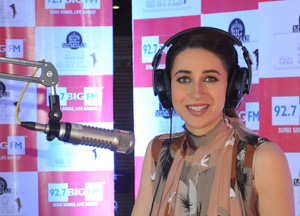
  • Karisma Kapoor debuts as RJ on 92.7 Big FM’s show

    By A Correspondent


    Actress Karisma Kapoor has taken on the mantle of an RJ with FM radio network 92.7 Big FM.


    On December 24, 2012 Ms Kapoor will debut as an RJ for a women-centric radio show called Big Memsaab. Through a specially conceptualized segment, ‘Big on Style’, she will play the role of a beauty and style guru who will share her expertise on fashion and trends. The segment will air on Big Memsaab every day between 11am and 12noon across 31 stations of the radio network.


    Apart from a multi-media marketing campaign across radio, television, outdoor, on ground and social media, contests will also be hosted on air, wherein lucky listeners from across the 31 cities stand to win a personalized grooming consultation with Ms Kapoor.


    Speaking about her association, Karisma Kapoor said, “Having worked in movies and television, I was extremely keen to try a new medium – so I decided to do radio. The Indian media scenario is constantly evolving and radio is the perfect medium for me to be closer to my fans than ever before. I am very excited about my radio debut on 92.7 Big FM’s afternoon show, Big Memsaab. I am confident that my fans will enjoy the show thoroughly and will continue to support me as I undertake this new journey.”


    Commenting on the occasion, Manav Dhanda, Network Programming Head, 92.7 Big FM, said, “Ms Kapoor makes a daily appointment with radio listeners, which is a pioneering move. The features of the show will be the first across media, which is very exciting. The format of the show, the pegs that we will touch upon and the innovations planned are what makes the show unique and appealed to her. Radio is a live medium and highly engaging allowing for direct interaction with crores of Indians and fans across the country for a celebrity.”


  • Designers showcased on TLC’s Project Runway

    By A Correspondent


    Lifestyle channel TLC is showing new episodes of Project Runway All Stars at 8pm on Sundays, with designers Isaac Mizrahi and Georgina Chapman as judges and model Angela Lindvall as series host.


    The series showcases 13 of Project Runway’s expert designers competing with one another, for prizes that include an exclusive designer’s boutique in select Neiman Marcus stores, $100,000 cash from L’Oreal Paris and a feature spread in Marie Claire, besides others.


    Participants have to create the best clothes given restrictions on time, materials and theme. Their designs are judged, and one or more designers are eliminated each week.


  • Kolkata digitization: Tug-of-war between State and Centre

    By Ananya Saha


    The digitization conundrum in Kolkata is not likely to see a solution soon, it appears. While the Centre recently ordered the MSOs in the city to switch off analogue signals by December 27, the State wishes to take into account the ground realities and extend the deadline. The State government is also upset because of the pressure from the Centre.


    Swapan Chowdhury

    Swapan Chowdhury, General Secretary, Cable & Broadband Operators’ Welfare Association, Kolkata said, “Yesterday a meeting was called by the State Urban Development Minister Firhad Hakim with all the existing MSOs of Kolkata. He has categorically stated that no switchover will be done from December 27 onwards. When MSOs informed him that they have already written to MIB, he said that it was also a State issue.” The MSOs have been told to not follow the terms of the Central government.


    Mr Hakim also said that he was looking at a tripartite meeting between the Centre, State and local MSOs to sort the problem in a systematic manner.


    On the condition of anonymity, a local MSO said that situation is grim and 100 percent digitization might take more than a month in Kolkata. Sumit Bose, President, GTPL, said, “The State has their set of concerns and we respect those concerns. On the other hand, the law has to be respected.” He added, “As MSOs, we are keenly watching the situation. We would like to move on with the model.”


    “It is the matter of State issue also to look if the systems are followed or not. And MIB cannot pressure us if the realities do not match the goals. But because of the political tussle, the Centre is not ready to talk to the State govt. They are trying to do it forcibly, bypassing the State govt and the minister concerned,” said another cable operator, who did not wish to be named.


    “There is still a shortage of STBs in the city, and it will take some time to sort out. But non-availability of STBs is not the only problem; the State govt will not let MIB to build so much pressure. MSOs have obligation to local govt as well. The MSOs are currently ‘sandwiched’ between local and central govt,” Mr Chowdhury said. Mr Bose said, “There are various figures floating in the market about the digitization levels in Kolkata. It is not easy to estimate the exact numbers because of the Cable and Satellite homes. Even a 10% here and there can mean three lakh homes. But I would like to say that GTPL has fared well.”


    Kolkata was supposed to completely digital from December 28, according to the recent directive from MIB. According to Mr Chowdhury, the switch off of analogue signals was initiated from December 16, and was to switch to digital genre-wise.


    Needless to say, the stakeholders in this process are waiting for the stalemate to be sorted out. But when would the State and MIB, and the MSOs reach a common consensus is hard to say.


  • The Anchor: 5 ways a mobile app can change the Chennai Open

    By Ashu Jindal


    #1 Riding the digital wave: Digital media has become one of the largest platforms to reach out to audiences. This app will be available for both Android and iOS, giving Aircel Chennai Open an unprecedented reach to an audience that was earlier untapped.


    #2 Enhanced fan engagement: It is the first time that an app has been launched in the history of the tournament. This app takes the extent of interactivity to a completely new level, giving the spectators an enhanced experience, on par with any other international sporting event.


    #3 Going beyond borders: Aircel Chennai Open has become the definitive ATP World Tour title in South Asia with many more top-ranked international players participating in the event, which has resulted in a worldwide fan following. The app can be downloaded by anyone in any part of the world and the latest news and happenings from the tournament are just a click or swipe away.


    #4 Easy accessibility: The app allows tennis enthusiasts easy access to all information about Aircel Chennai Open on their phones, right from schedules and draws to live scores, current updates to event news, player profiles to tournament history. The users will also be able to watch match highlights on their phones.


    #5 New avenue for marketers: The app opens up new avenues for advertisers and sponsors, it allows them a direct, 24×7 reach to the consumers in a targeted manner. The app also allows them to interact with the audiences in the form of customized content and contests.


    Ashu Jindal is COO, IMG Reliance


  • Bigg Boss, Wanted top Whats-On-India rankings in Week 50

    By A Correspondent


    With the delay in the release of the TAM Media Research ratings, we look at how Whats-On-India rankings look like for Week 50 (December 9-15)


    TV Trends has been built using specialist and proprietary algorithms that collate, analyse and compute millions of observations across multiple platform. It provides cues and powerful insights on the potential consumption and intention-to-view of content by Indian TV viewers. The sources from where observations are aggregated include What’s On India platforms like: Web, Mobile portal, Apps (Android, iPhone, iPad, Blackberry, Windows Mobile, Nokia Ovi), EPG-on-the-Cloud (MobileTV and IPTV).


    The report gives the Top 5 Programmess of the Week for the following genres: English Movies, Hindi Movies, English TV Shows, Hindi TV Shows, Regional TV Shows, Regional Movies, Sports and Kids, Documentaries, Lifestyle & Food.


  • Is our TV measurement future-ready?


    By Bipin Mundhwa and Amit Nevrekar


    TV audience measurement through the ‘peoplemeter’ is accepted as the most appropriate technique among others for measuring TV audiences. However, the capability of the peoplemeter (an electronic device) is completely dependent upon external factors such as continuous human intervention (Manual Inputs). Viewers need to press their respective button on the peoplemeter remote (as assigned to them) to let the system capture the data on who is viewing what. Which means it is safe to say that it does not automatically capture the viewers and their viewing patterns. It requires the viewer to keep in mind that they have to press the respective button every time they leave the room and enter the room.


    In an age, where people forget to turn off the switches while not occupying the room or even turn off the water taps after use, do you think people will remember religiously to switch on and off their respective people-meter remote button every time they enter and leave the room?


    There are high chances that the viewer may get interrupted by something and leave the TV room or for a while take an exit to do some other household activities without pressing the exit button. In such situations, the people-meter does not stop capturing the viewership of the audience, even though he/she is no longer viewing. What could be more erroneous than this?


    Jaldi 5 with Bipin Mundhwa & Amit Nevrekar: No one influenced us to write book
    Bipin Mundhwa

    01. It’s interesting that your book is published around the time when TAM is being needled by many stakeholders. In fact it’s also being sued. Is it just a coincidence or planned… given that you’ve highlighted the T, A and M in your book title ‘The Advertising Mess’?

    Frankly speaking, we had planned the date for our book launch much before the announcement of non-reporting of viewership data by TAM. The main objective of our book was to provide the necessary practical literature on The Audience Measurement systems in India. Over the years, we have seen different methodologies for the same medium in the same period resulting in different findings and thereby creating a Mess in media buying and planning.

     

    Amit Nevrekar

    02. Having worked with TAM as also with other media organizations, why is it that you didn’t raise some of the issues earlier?

    Working with TAM was always a pleasure. And we constantly discussed many improvements as part of our professional duty.


    There may be people who may say that you have written this at the behest of someone wanting to take on TAM?

    Firstly, we have not condemned a particular organization or criticized upfront. The book is about ‘bridging the gap for accountable MarCom’, where we have presented the ‘Bridge’ model which provides a unified B-Score across mediums in a single metric based on engagement levels, rather than inflated exposures. No one can influence us for taking such a mammoth effort whilst working, especially in a media agency, media house with hectic working hours. It’s only our self-inspiration and passion for our industry.


    03. Given that there will always be television channels who feel aggrieved by any ratings, there will be people who will raise objections against any measurement system?

    Every media professional subscribing to the respective measurement system’s data has the right to raise questions to understand and utilize the data in most logical and appropriate manner.


    04. You’ve touched upon corruption. And you say that with digitization, it could only increase?

    Yes, we have identified some loopholes in the system which can simplify corruption post digitization and needs to be addressed for robust data representation.


    05. One of the primary motives of the book is to talk about the ‘Bridge’ model that both you have developed. Have you had any discussions with BARC about it?

    The bridge model is purely developed by us. We haven’t had any discussions with BARC as an organization but we certainly had series of discussions with members of BARC, MRUC and other media veterans of the industry.


    In the current peoplemeter, if the TV is ON but none of the panel members have logged in the system (that is, pressed the peoplemeter button), then the peoplemeter would prompt for an input to register the viewing occasion for the respective panel member.


    But what if the panel member has logged in the system and is not present in the room. Is there any kind of validation thought about?


    However, today’s technological advancement allows us to make every impossible thing ‘possible’. There are Pyroelectric (“Passive”) InfraRed sensors that can detect whether a human has moved in or out of the sensors range. And undoubtedly, these are very inexpensive chips.


    Another such technology is used by Microsoft in their Xbox 360 game console, ‘Kinect”, which is a motion sensing input device capable of facial recognition along with full-body 3D motion capture. Which means if incorporated in the peoplemeter, will not only sense the individuals present in the room, but also identify if they are viewing the TV along with their engagement through facial expressions.


    Also, a very interesting point crops up, which ideally should have been raised by MarCom professionals. Bear with us as we elaborate.


    With the new Digital Video Recorder now commonly available along with most of the DTH providers, individuals have now got into the habit of not watching programmes live, but recording their programmes of choice and watching at their convenience.


    For example, if a working individual chooses to record a programme which was telecast from 4 – 5 pm, reaches home at 8 pm, and watches this recorded programme from 9 – 10 pm.


    ANOTHER PROGRAMME BEING TELECAST FROM 9 – 10 PM ON SOME OTHER CHANNEL IS ALSO RECORDED BY HIM AT THE SAME TIME TO VIEW AT A FUTURE TIME OF HIS CONVENIENCE.


    The critical point we are making is, most people with DVR facility have now got into the habit of recording almost all programmes they wish to view, and while viewing the recorded programmes, most of them would forward and skip all the ads.


    The question is, at 9 pm in the case of the above example, what will the peoplemeter capture as viewership?


    Will it capture the 4 – 5 pm show which is being watched between 9 – 10 pm or will it capture the 9 – 10 pm show which is being recorded for future viewing at the same time?


    And will the peoplemeter be able to gauge whether the ads have been skipped by the viewer while watching the recorded programme, which is bound to happen in most cases?


    BECAUSE THE 10-MIN AD BREAK CAN BE FORWARDED AND SKIPPED IN A MATTER OF FEW SECONDS..


    Thus this DVR facility has the potential of making the peoplemeter defunct and useless.


    Definitely, the currencies such as TAM should be keeping up with these advances in technology. We are very sure they have an answer for the questions we have raised above.


    BUT, we are also sure the industry and MarCom professionals would love to see a practical demonstration, if they claim that the people-meter can take care of these issues. Speaking is so much easier than doing.


    According to research paper published by Andrew Green (2010), the people-meter is only capable of capturing what is being displayed on the TV screen and not the actual behaviour of viewers.


    Very interestingly, TV broadcasting would be going digital in coming days. It has already gone digital in the four metro cities of India as on November 2012.


    In future, there could be options of pay v/s free channels, where the pay channel will have only programme content and no advertisements, similar to the current HD channels.


    DVR (Digital Video Recording) technology is also expected to dominate in the near future, which means there would be more flexible and enhanced TV viewership. This would also include storing of favourite TV programmes by viewers who would watch them at their convenience while skipping the commercial breaks.


    There is also an increasing trend of VOD (Video on Demand) in direct-to-home households. Would this mean lower viewership for repeat telecast of TV content? Because as the name suggests, VOD is TV content that can be viewed at anytime as per the convenience of the individual viewer. More sob stories for MarCom due to digitization.


    The new-age television viewership will include CAS (set top box), as well as others like DTH, DVR, IPTV/VOD, internet TV, TV programmes via YouTube and mobile TV. Conventional wisdom says that subscribers of these technologies will have vastly differing lifestyle habits. As we say, “necessity is the mother of all invention”. For the first time, the audience will be in the driver’s seat for choosing their option of technology of reception. So is the case with TV channels that they wish to subscribe to.


    Now, looking at the traditional TV measurement system, the viewership base will be determined by subscription packages, as now the option of choosing a specific channel is available to the viewer. In the recently phased-out analogue system in 4 metros, for a fixed monthly subscription fee, subscribers got access to ALL TV channels.


    This means the sampling frame for estimating TV viewership is based on the audience pool that recently had access to all the channels for a fixed subscription fee.


    Whereas, the new technology of digitalized reception will make the subscriber’s pool asymmetric for sampling. There are bright chances that the universe (the channels which an individual subscribes to), will fluctuate depending on basis of favourite channel/popular programmes/sports seasons or a new series, as people may change their channel subscription from time to time.


    For example, let’s consider a household which has recently switched to the DTH system from the old analogue system. Now this particular household has not subscribed to a particular GEC channel because they felt it was not worth paying an extra fee as they were casual viewers of only one programme on this channel, as against other GEC channels where they watched multiple programmes.


    Now after a couple of months, this household again decides to subscribe to that GEC channel they had abandoned because of a new programme of interest to them, along with a sports-pack for the upcoming IPL cricket season. Post the IPL season, they again unsubscribe the sports-pack.


    This means the channel’s universe has now changed beyond recognition. This will keep happening as now it will be directly related to pay for what you watch.


    In such situation of switching subscription plan from analogue to digital, peoplemeter may capture the audience movement from analogue to digital. However, within digital, the viewership for channels may fluctuate significantly (as these are sample surveys, where 1 panel member’s viewership is extrapolated to around 20,000 audience or more). This could result into vague and half-hearted understanding of channel viewership as practitioners would not know the reason for volatility in channel viewership i.e. Subscribed but NOT viewing OR Channel NOT subscribed.


    Until now in analogue mode, the same set of channels that a household with a people-meter had was also the same set of channels that all other households had, so the household with the people-meter was representative of all other households in the universe, at least as far as availability and access to channels went.


    But now, with households free to choose and reject individual channels, it is not necessary that a household which has a peoplemeter will have similar channels as other households in the universe.


    In fact there could be thousands of permutations and combinations of households with different sets of channels. So how would one judge whether the peoplemeters households are truly representative of the universe.


    Now with due respect to the existing people-meter technology for capturing TV viewership data, can we ask ourselves how geared up are we to take on the future challenges of capturing TV viewership data in light of the above mentioned technological advancement.


    The story does not end here. The real challenge is still to be explained by us. TV as a medium was largely an ‘at-home’ medium. However, TV as a medium is now becoming highly portable. How are we going to measure the audience on portable TV?


    For example, most of the working population may watch IPL out-of-home such as at office, at a common friend’s place, on their laptop, etc. On weekends they would also go to restaurants and pubs to watch the game in a social gathering and cheer for their favourite team. Their receptivity to the programme may be higher but it does not get covered as the people-meter is not capturing out-of-home viewership.


    This may influence viewership of popular sports seasons and they may get under-reported as compared to actual viewing figures.


    According to Horrell (2008), IPTV (Internet Protocol Television) could offer some encouraging answers to audience measurement such as real-time audience measurement through return-path-data technology from TV owning households itself. Moreover, it allows broadcasters to divide audiences based on socio-economic class, geographies and basic demographics. This would enable advertisers and media planners to showcase lifestyle, socio-economic class and geographic location based Ad streaming. One can avail the technology now as this is reality.


    One of the sophisticated devices according to Pellegrini, Pasquale and Purdye, Ken (2004), for measuring out-of-home TV viewership is Arbitron’s Portable People-Meter for capturing passive viewership data based on encoded audio signals, embedded in the TV programmes being watched. This pager-like device would have to be carried by selected individuals to enable this device to capture the encoded audio signals. However, it could prove to be misleading if the audio signals are being captured in the vicinity but the individual is actually not watching it. For example, in a coffee shop, the PPM may record TV viewership for an individual but the selected individual is engrossed elsewhere.


    What does all this mean for advertisers? How will they optimize their media investment?


    In totality, TV as a medium which even today is highly fragmented with 700+ channels will have very tough and challenging days ahead as far as measurement goes.


    ‘The Future is now, but Measurement is Yesterday’


    Extracted with permission from

    The Advertising Mess

    By Bipin Mundhwa and Amit Nevrekar

    Published by Sci-MO

    Price Rs 249, 139 pages

    www.theadvertisingmess.com


  • MIB bows to news TV pressure, pushes TAM to delay ratings data release

    By A Correspondent


    In what is clearly a case of government interference in the broadcast business, measurement agency TAM Media has been compelled by the Minister Manish Tewari-led Information and Broadcasting Ministry to not release the data for ratings for the last week as well as for around the last two months which it had agreed to not release. The other stakeholders – the IBF, ISA and AAAI – have been mute witness to the decision and chose not to take the government head-on.


    While TAM spokespersons were unavailable for comment, sources tell us that news broadcasters had petitioned TAM to not release data for a while. When TAM sought the advise of other industry stakeholders, they (the other bodies) trashed the plea and chose to go ahead with the release.


    However, it appears the news broadcasters were able to convince the government which used its power to push ahead with the late evening knock.


    Late last night, TAM issued the following statement: “At the request of the I&B Ministry, the Government of India, and in concurrence with IBF, AAAI & ISA, we are delaying the data release to Thursday/Friday.The reason for doing so is that  the Government of India has requested us to withhold release of news channels data by two or three days.  The industry is meeting with the ministry to take a decision. Thank you for your cooperation.”


    While TAM and the other industry bodies are not required to toe the government line, they chose to do so, fearing retribution in the future, an industry observer told MxMIndia.


    News channels are reportedly desirous of a longer ratings-free window. They believe the current processes followed by TAM do not effectively track their viewership. However, advertisers and media agencies want the presence of a measurement currency so that they can effectively spend monies.


  • Bloomberg TV announces Season 3 of Assignment

    By A Correspondent


    Bloomberg TV India, the English business channel, is back with Season 3 of the reality show The Assignment that revolves around Dream Jobs. The launch episode will see Rajeev Samant, CEO and Founder of Sula Vineyards mentor Savita Nair, Creative Director Leo Burnett India as she lives her dream job of being a vintner.

     

    This season will see one corporate executive given a chance to live their Dream Job every week, mentored by an expert from the field. The reality show aims to capture the corporate hot-shots grapple with the responsibilities of their dream jobs and reflect on the experience of living it.


    Apart from Rajeev Samant, CEO & Founder of Sula Wines, the third season of the show will also feature mentors like Alyque Padamsee, Indian Theatre personality and ad film maker; Vikram Bawa, Fashion and Advertising Photographer; Nikhil Chib, Owner and Executive Chef – Busaba; Hormazd Sorabjee, Editor – Autocar India; Junaid Merchant, India’s first Canine Behaviourist and Horse breeder among many others.


    Sriram Kilambi, President, Bloomberg TV India, said, “We believe that a channel has to be innovative in its programming strategy all the time to hold the viewer’s attention. This season, instead of assigning a challenge to the participants as in the first two seasons, we asked them to set their own challenge i.e. live their dream job for one day, analyse their own performance and figure out if it is was as ‘dreamy’ as they imagined it to be.”


    The show will be telecast every Saturday at 7pm and Monday at 10.30pm from December 22. The first episode features Rajeev Samant, CEO and Founder of Sula Vineyards as the Mentor and the Assignee is Savita Nair, Creative Director, Leo Burnett India.


  • Aaj Tak launches on Cogeco Cable, Canada

    By A Correspondent


    Hindi news channel Aaj Tak, part of the TV Today network, has launched on Cogeco Cable Inc, a major Canadian cable telecommunications company that is supposed to be the second largest cable system operator in Ontario and Quebec in terms of Basic Cable service customers served.

     

    With this launch, Aaj Tak will now be accessible to viewers in Ontario, expanding Aaj Tak’s presence in the Ontario market. The channels will be sold in the following package- ATN + Zee Cinema + Big Magic + Aaj Tak + Headlines Today for $25 per month.


    Commenting on the launch, Ashish Bagga, CEO, India Today Group said, “It is a step in our endeavour to expand our presence in key markets across the globe. We want to be easily accessible to all our viewers worldwide at economical prices. Moreover, Cogeco is a perfect choice for broadcasting Aaj Tak in Ontario. Cogeco is a very capable group and they are doing an excellent work in Cable communications industry. We are hopeful this launch will strengthen and benefit both Aaj Tak and Cogeco.”


    Slava Levin CEO of Ethnic Channels Group, TV Today’s exclusive partner in Canada said, “Aaj Tak is one of India’s leading TV brands. This launch will help more viewers connect with the brand.”


  • Paritosh Joshi: Eternal Vigilance – The Price of Freedom

    By Paritosh Joshi


    Twice last week we have been shaken to the very core of our being as unspeakable horrors unfolded, in a distant commuter town in Connecticut and then right here at home on a bus in Delhi. Anger, indignation, frustration, desire for vigilante leveling of scores outside the criminal justice system, fear, sorrow, resignation… they have all run their predictable, grim course as people vent a deluge of emotions that inevitably arise in response.


    There’s a subtext to the discourse that we cannot, even dare not afford to miss. In both instances, the media and their portrayals: of gun culture in one instance, attitudes toward women in the other; are being identified as a factor in amplifying and even glamourising criminal dysfunction. Anguished voices in digital forums are pointing at how a deranged mind of a bright if introverted high school student may have sought out his gruesome final fifteen minutes of media glory in a schoolyard massacre. Or how Indian films and television shows don’t merely condone ‘eve teasing’ but encourage it, thus building a slippery slope from where descent into the most perverted sexual crime is an inevitable consequence.


    What compounds the felony, in popular perception, is that the media are seen to be doing this driven solely by the greed for more eyeballs, even if it is at the cost of taste or common decency.


    Which brings me to a theme that I have dwelt on before and will continue to belabor, ad nauseam if need be, until things begin to improve. The theme of responsible self-regulation.


    Thomas Hobbes, John Locke and Jean-Jacques Rousseau were among the earliest philosophers to develop the theory of Social Contract. The theory attempts to explain why an individual in human society is prepared to surrender some of her individual liberties to become a part of a governed collective that in return protects her other rights and freedoms. The idea develops quite intuitively, predicated around the permanent vulnerability of an individual outside of the collective to all sorts of perils, natural and man-made, and how joining the covenant instantly trumps a large majority of them. Extending this Social Contract idea, the Media belong to, and are intended to serve, the community in which they operate and to which they must perforce surrender a few of their untrammeled rights in order that they retain most of them. If the Media are seen as engaging in dysfunctional behaviour, they open themselves up to the charge of defying the Social Contract and can be penalized by being docked all their rights and privileges within the democratic polity of the day.


    A particular example of Media delinquency is on display when horrors, such as those of recent memory, are squeezed for all they offer by way of ghoulish ‘entertainment’. We all remember the classic but usually entirely rhetorical “Is bhayanak apatti ke baad aap kya mehsoos kar rahe hain?” type question asked to unwary and naive survivors of disasters. Even in the current events cited above, the victim’s and the perp’s relatives have already been sought out and interviewed at a stage when their lives have abruptly upended most cruelly.


    I see tokenism too. A few media houses have organized public vigils and little quasi-political rallies where they will have plenty of ‘grief’ on display, complete with slogans, banners and similar appurtenances that need to be worn only so as to demonstrate bnafide intent. This is not going to cut it.


    In fact, nothing less than a public mea culpa by the Industry as a whole particular issued by the leading News and Entertainment broadcasters, followed by an unequivocal commitment to introspect on and develop prescriptions for what ails their ethical systems, will suffice in the court of public opinion.


    What if no such acknowledgement is forthcoming?


    Well then, start preparing yourselves for that most unfortunate and liberty-destroying outcome: a government-appointed and -empowered media watchdog.


    Paritosh Joshi has been a marketer, a mediaperson and a key officebearer on industry bodies. He is developing an independent media advisory practice. His column, Media Matrix, appears on MxMIndia on Thursdays


  • Jaldi 5 with Ajay Trigunayat: ‘The aim is to set new benchmarks in 2013’

    Where brands or media properties are struggling to stay afloat through this tough economic crisis, two-year-old movie channel Movies Now has no such bitter experiences to share. After a roaring 2011, the channel – that completed its second anniversary this week, has an interesting tale to tell about its performance in 2012 as well.

    Ajay Trigunayat, CEO, English Entertainment Channels, Times Television Network tells MxMIndia what the year held for the network and plans for 2013.


    01. How would you analyse the year 2012, which also marks completion of two years for Movies Now in India?

    A lot has happened in the last two years:

    • The category has expanded exponentially with Movies Now witnessing a 50% jump in viewership reaching out to 56 million viewers per week.
    • In the past twelve months, we have effectively consolidated our leadership position, dominating the category with a phenomenal 30% in comparison to Star Movies (28%), Sony PIX (17%) and HBO (14%). (Source: TAM, CS 15+, 8 metros, wk 52 ’10 – wk 39 ’12)


    02. Could you share some of the highpoints for the network in India this year?

    • We have led the category since our launch & 2011-2012 has seen immense growth in terms of Reach, TSV, Audience Engagement & consequently Revenue.
    • In 2012, we built on the library-led movie concept by offering the viewers a plethora of blockbusters packaged as captivating properties celebrating the Best of Hollywood Icons – Best of Cameron, Best of Leo, Best of Spielberg and lots more.
    • Movies Now constantly keeps innovatively engaging with its fans and followers in the social media sphere. In the two years, the channel has jumped to the top spot with 2.3 mn fans on Facebook. In comparison, decade old players, Star Movies & HBO, stand at 1.4 mn & 1.5 mn respectively. Movies Now is in the top 5 leading brands on Facebook in India (in the media category) & in the top 3 fastest growing pages on Facebook in India (in the media category). The channel maintains a strong fan-following on Twitter with a lead of 13000+ followers.
    • Movies Now has significantly overshot international benchmarks in terms of the Brand Awareness & Brand Preference in just 2 years of its launch (Source: Millward Brown Study)


    03. Have you witnessed a spike in viewership and revenues over 2011? Could you elaborate the growth story through statistics…

    • Out of the top rated 100 English Movies in the last 2 years, 52% aired on Movies Now as compared to 32% on Star Movies, 14% on Sony PIX and 2% on HBO. (Source: TAM, CS 15+, 8 metros, wk 52 ’10 – wk 39 ’12)
    • Movies Now has also attained an astonishing 31 minutes of time spent per viewer which is a testimony of the audience stickiness on the channel. Star Movies stands at 27 mins, PIX at 21 mins & HBO at 20 mins (Source: TAM CS 15+, 8 metros, wk 52 ’10 – wk 39 ’12)
    • Consequently, Movies Now doubled the effective rate to ‘3600 per 10 seconds and seen an increase 60% in terms of revenue as compared to last year.
    • Movies Now achieved a phenomenal 30% channel share in comparison to Star Movies (28%), Sony PIX (17%) and HBO (14%). (Source: TAM, CS 15+, 8 metros, wk 52 ’10 – wk 39 ’12)


    04. What was the year like for the Movies genre in India – growth and challenges?

    • Our biggest challenge is the perception of our channel being niche. With Reach of 56 million viewers and TSV of 55 minutes per week which is almost the size of any possible European country, I don’t really think Movies Now can be called niche.
    • The English Movie Channel Category has been under-monetized. It would also be a challenge to leverage the urban affluent English movie viewing into the advertising revenue it deserves.


     05. What would be your focus for 2013 in the sphere of movie/content acquisition?

    • The idea is to consolidate our library further and bring in the Best Blockbusters for our viewers.
    • Starting January we present :

    > Sons of Guns: Brings the Bad Boys of Hollywood that will showcase movies like Ocean’s eleven, Bad Boys, etc.

    > Grand Masters: Legends of Shaolin featuring Jet Li, Jackie Chan and Bruce Lee along with the master of Bruce Lee himself in IP Man 2.

    > Badge of Courage: Line-up of some special movies this Republic Day like Iron Man, True Lies, Knight and Day, Quantum of Solace, Demolition Man and Robocop

    > Crack it Up: Rib-tickling comedies like Dude where’s my car, Austin Powers, Hangover, Aliens in the attic, Harold and Kumar, Not Another Date Movie and a lot more.

    • February:

    > Gods of Hollywood with the Best of Hollywood Icons like Bond, Spiderman, Rocky Balboa and many more.

    > For the first time on Indian Television, Movies Now will premiere the much talked about movie, ‘The Grey’ starring Liam Neeson.

    > Best of family adventure movies like Harry Potter, Narnia, Percy Jackson in Adventure Diaries

    > Valentine’s Day also has a special line-up including Monster-in-law, Date Night, I Love You, Beth Cooper..

    • In March, we will bring the complete Star Wars movie franchise which will be customized for the Indian audience in a big way. One of the property’s that has been appreciated well comes back with a bang with Shaolin Masters 4.