
Category: MEDIA

  • Rajesh Jejurikar quits Zee, to return to M&M

    By A Correspondent


    Rajesh Jejurikar

    Zee Entertainment Enterprises Limited (ZEE) has announced that Rajesh Jejurikar, the company’s President has stepped down after a brief stint of 10 months, to explore new vistas. His role at ZEE, involved managing all the key verticals at Zee, except programming. Mr Jejurikar is reported to be returning to his former employer, Mahindra & Mahindra.


    Punit Goenka

    Punit Goenka, MD & CEO, Zee Entertainment Enterprises Limited said, “In a short stint at Zee, Rajesh has brought in newer business perspectives and has contributed to the process immensely, bringing in positive business impact to the organization. The entire Zee family wishes him all the success in his new endeavors.”


    Speaking on his tenure at Zee, Mr Jejurikar said, “The time spent at ZEE was extremely fruitful. I am thankful to ZEE and Punit for giving me an opportunity to explore and broaden my experience in the media & entertainment space. ZEE has all the fundamentals required to become a global media enterprise. As I part ways, and move back to the manufacturing sector, I wish ZEE all the success.”


    Mr Jejurikar’s last day with the company will be December 31. All verticals and department heads at Zee, will now report into the MD & CEO, Punit Goenka.


  • Vikatan Group focuses on events as growth strategy

    By Tuhina Anand


    Tamil publications group Vikatan has charted out its plan for next year which will help it in accelerating its growth. The group is stepping up its interest in doing on-ground activities as it sees immense opportunity that these events provide while helping in growth as well as building the brand further. The strategy being to give advertisers additional platform, increase circulation and bring into fold new readers with new and some revamped offerings.


    Talking about their plans, Pravin Menon, National Head, Ad Sales, Vikatan Media Services, said, “Vikatan is a strong brand with a heritage of 85 years and we feel that with our print, digital and on-ground offerings we have a very strong portfolio to deliver to the clients as well as readers and meet their needs.”


    Vikatan is now working on finalizing its events calendar for 2013. The focus being that the events will not just help in reaching their advertisers and giving them an additional platform but also their readers. Especially with the reach that Vikatan has it will help them in making inroads with customized events in various parts of Tamilnadu. As Menon puts, “We have a deep understanding of the Tamilnadu market and we want to leverage that. This we want to combine with our diverse offerings by building on ground activities and launch verticals of the mother brand.”


    In this regard, the group which has under its umbrella Aval Vikatan, a fortnightly has targeting women, and launching Aval Vikatan Mangalam. This will be a wedding special and is positioned as one stop point for brides-to-be. The edition is planned for January 2012. The magazine highlights different community weddings of Tamil Nadu, different types of foods served at wedding, tips for a fun wedding, wedding collections, beauty tips, unique wedding themes, jewelry, honeymoon destinations and best photographers, among others.


    The idea is to catch the readers and advertisers in the wedding season. This will also be present in a digital avatar.


    Currently, Vikatan has 10 magazines including their flagship brands Ananda Vikatan, Aval Vikatan and Junior Vikatan. The group has been very active this year in making itself visible to people and pushing itself further to reach the potential readers. Recently it launched a weekly magazine Timepass , an entertainment magazine targeting those young at heart. To launch the magazine the group had also come out with a TVC. Hence, as one can understand that there has been a shift in the way the group is marketing itself. There is an increased emphasis on the digital media and reaching people through the social media. The Vikatan Group is more aggressive and looking at a comprehensive strategy to reach their customers.


  • AppFest 2012: Exploring the ‘Apps’ economy

    By A Correspondent


    AppFest 2012, organised from December 13-15 in Hyderabad, provided an environment for developers and entrepreneurs to come together on a platform and leverage the enormous opportunity to move towards an ‘Apps Economy’. Given the strong base of mobile users, rapidly growing number of Internet users, availability of innovative minds and depth of resource pool, the opportunity is enormous.


    The three-day event that included Talkathon, Hackathon and Challengathon, attracted more than 400 developers.


    “The young generation should look at product development and creating world-class apps, while creating a culture that would build companies and create valuations.” This was the message given by Sanjay Jaju, Secretary, Department of Information and Communications, Government of Andhra Pradesh to the developers, while officially declaring open the Hackathon and Challengathon at the AppFest 2012, organised by Internet and Mobile Association of India (IAMAI). “Product development is what eludes us despite all the advancements in ITeS,” he added, while exhorting the developers to try and build a mini Silicon Valley – by virtue of which Indians can create value, Intellectual Property, patents, and companies. He urged the developer community to break free from the existing value chain, and aspire to build world class products and companies.


    AppFest 2012 is the first step towards realization of this opportunity, and hopes to foster an environment where businesses, developers, platforms and networks are incentivized for their efforts. It is important that the first person and the last person in the value chain, – the innovators/developers/entrepreneurs, are amply rewarded.


  • The MxMIndia Annual 2012: The One Big Idea


    By A Correspondent


    The word idea may throw up various images. In recent times of a cellular phone company with its ads going ‘honey bunny’. Or its star endorser asking “What’s your idea, Sirji?”.


    But, mercifully, the core definition of the word idea stays. For MxMIndia’s first annual, we asked a cross-section of the industry on what’s their big idea for their business… what, according to them, is the concept of mental impression that could change the game for them and others?


    The objective was to have an unputdownable issue, but one which the business could benefit from. A volume that senior and entry-level professionals will read and develop their own ‘Big Ideas’. A special issue that students consider necessary add-ons to their textbooks.


    While we have over a hundred professionals comprising the Who’s Who of the industry responding to our simple question, there are some who didn’t respond, or were travelling or on vacation, or just too busy to write in by our deadline.


    For an industry that has built its fortunes on the premise of ideas, it surely needs some soul-searching to figure what could be the way forward if it has to take a big leap into the future.


    It was heartening to see the experts treat our request as a no-holds-barred attempt as they reverted with a bevy of options that had us gasping for more. Some gave their views on a macro level, others out of the experience at their own place of work. While it may be a task to list out the options here, the two favourites that had the seal of approval by most were technology and content. Technology, that would play an integral role in making things work seamlessly in the future, and, the right and proper usage of content with which any domain could create a distinction for itself.

     

    Punit Goenka

    Being the biggest by marketshare and popularity, the domain of broadcast had a fair share of ideas that experts thought would make it suitable for the industry’s smooth transition to the future. Sharing one such vision for the future was Punit Goenka, MD & CEO of ZEEL, who had the following to say: “The screens are getting smaller and entertainment too is getting more and more customized. Content, too, on the other hand, needs a fresh perspective, when it comes to this new ecosystem which is in its nascent stage. Avenues for premium and niche content have widened up, and the audience is now in a more acceptable phase than ever before.” Proposing his big idea for the industry, Goenka said that “Narrowcasting is something which I believe has the potential of turning into a big idea which has the scope of altering the broadcasting industry. Surely at this stage, there are immense constraints to it, in terms of internet connectivity, bandwidth charges, cost of devices, etc, but the key is that the future certainly is digital and there are two ways to the same. Narrowcasting would bring in more choices for the viewers, with the influx of new channels and new content patterns.”
     

    Raj Nayak

    Raj Nayak, CEO of Colors had an equally enriching idea as he envisioned: “A lot of avenues that were not available earlier like content on mobile etc will start opening up in a big way with 4G. Broadcasters will increasingly be looking up to digital to bring in more viewers and also revenue for the network.”


    Providing a vision statement on behalf of the advertisers, media veteran Sam Balsara Chairman & Managing Director, Madison World had the following to share: “From an advertiser’s perspective, the one idea that I would like to propose to advertisers who use TV heavily is to supplement their ad spends in TV, with some spends in at least one other medium – either Print, Radio, Outdoor or Digital, if not a couple. There is considerable merit in balancing quantitative data on Reach, Frequency, GRPs and

    Sam Balsara

    CPRP with qualitative aspects on how the human mind responds to a stimulus and our experience shows that in majority of the cases where advertising copy quality is average, multimedia campaigns deliver far better on sales and brand KPIs than single media campaigns.”


    As for the second-most sought after medium of print, Rahul Kansal, Executive President, Bennett, Coleman and Co. Ltd believed that technology again would be the catalyst that would drive this medium ahead. He said: “Newspapers should be able to engage the readers in a variety of ways and should be able to stimulate all senses of its consumers. What I mean is that print has been largely restricted to having a

    Rahul Kansal

    one-dimensional appeal where one plays only with visual elements. But what really is stopping us from taking advantage of the technological advances and say, add an audio element to the medium? Or we can even look at stimulating a sense of smell in the print medium. I am not saying that such experiments are not happening but they are few and far between and the need is to increase the frequency of such innovations that will help develop better engagement with our readers.”


    While most experts had something good to share about the impact that digital has on their business, a more fine vision was provided by Sanjay Trehan, Head, MSN India who said that to be really meaningful, “the one big idea that could potentially change the face of the digital industry in India must reach people with the kind of content that makes a difference to their lives (Hyperlocal), in a language that they understand (Vernacular) and on a device that is personal as well as ubiquitous (Mobile).” According to Trehan, to be really powerful in today’s digital ecosystem, “an idea must also co-opt the community into the creative process (Social).”

     

    Prashant Panday

    Being the most undervalued medium of them all, Prashant Panday, CEO and Executive Director, ENIL (Radio Mirchi) had a sharp message to share as he said, “There is just one simple thing the government must do to do to release the animal spirits of the radio medium – get out of the deep freeze! The deep freeze is apparent. The Phase-3 policy of radio reforms was announced in July 2011. It’s already been 14 months and there is not even a mention of when the auctions will take place. In contrast, the Phase-2 auctions were conducted within six months of the policy announcement in 2006.” Adding another dimension to his appeal, Panday added that there is one other crucial thing the government must do before Phase-3 auctions to change the face of radio. “It must accept the recommendations of TRAI and reduce the ‘separation’ between two adjoining FM channels from the present 800 Khz to 400 Khz. This one single initiative will help double the number of channels in every city.”
     

    Arvind Sharma

    Highly accountable for giving clients their due through way of recognition, Arvind Sharma Chairman & CEO, India Subcontinent, Leo Burnett India had the following message on behalf of the creative frat. He said: “I believe that just like the TV dominant era required a new way of thinking about brand communications – brand stories, a new way of thinking about brands is needed today. A way of thinking that will drive synergies through TV & print, social media, smartphones, mall activations, PR and branded content. In my view this new way of thinking will be ‘Participation platforms’.”


    Agreeing that the medium of outdoor wasn’t seeing the same rush as the others, Sunder Hemrajani, Managing Director, Times OOH was more straightforward as he pointed out: “Out-of-home in India is in a stage of flux. Though there is a positive momentum in terms of a rapidly growing transit segment, the industry continues to wade through the muddy waters of regulation, measurability, pricing issues & the challenges of creating differentiation.” Advocating a way ahead, Mr Hemrajani said: “In times of flux, what anchors an industry is the ‘big Idea’ – a daring leap of faith that does more than change the rules of the game. It changes the playing field itself.”

     

    Prema Sagar

    Though public relations is ignored by many as part of the media and entertainment ecosystem, MxMIndia believes it plays a vital role. Senior practitioner Prema Sagar who is Principal & Founder, Genesis Burson-Marsteller, had the following to share: “The future of Public Relations in India will hinge on how we build trust and manage perceptions in a period when media and communications channels are evolving rapidly. The proliferation of social media as a credible news source comes down to one thing — trust. With so many resources available to get news and information, audiences only seek sources they deem truly credible.” Suggesting a way forward, Prema Sagar said: “In order for our industry to continue forward and keep pace with advancements, we must be transparent and open — what I refer to as ethical influencing.”


    Note the comments above are just nine of the over hundred captains of the Indian media and entertainment sector. Also writing in the MxM Annual 2012 is our battery of columnists (in order of their last names): Ranjona Banerji, Jaisurya Das, Paritosh Joshi, Shailesh Kapoor, Peter Mukerjea, Sundeep Nagpal and Anil Thakraney. Plus all members of Team MxMIndia, save those on leave or sabbatical.


    With abundant insights and secrets to what could drive several media domains into a successful future, MxMIndia’s Annual 2012 Issue titled ‘The One Big Idea’ is truly a collector’s edition. It is for private circulation only. To lay your hands on this must-read issue and for bulk copies, you could write to sales@mxmindia.com.
     

  • Times of India launches ‘Alive’

    By A Correspondent


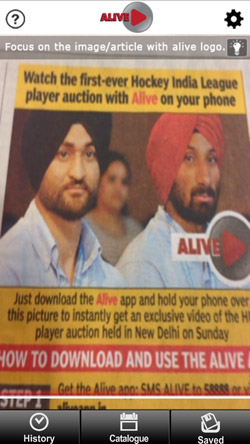
    The Times of India Group has soft-launched its Augmented Reality experience application, Alive. To its surprise, on the launch day of December 16th, the app was downloaded 250,000 times, leading to 300,000 augmentation views on a single day. This significantly surpassed internal estimates of about 15,000 downloads on day one. Augmented Reality is a technology that bridges the online and offline worlds using the mobile phone. It allows readers of the newspaper to interact with a print medium, and get access to rich media content, such as videos, photos, and polls. The Times of India’s Alive App boasts of being the first augmented reality service launched in India by a media company.



     

    On December 16, the most popular augmentation was a video interview between Arnab Goswami and Salman Khan, where Salman Khan sheds light on his darkest days when diagnosed with a disease. This story was augmented by 65,000 users over a four-hour period.


    Times Internet CEO Satyan Gajwani said, “We love bringing new technology solutions that add value to our users. Alive is exciting because it is a new dimension to a medium people are used to and comfortable with. We’ve thought hard about where AR actually adds value and where it’s just a gimmick, and we’re working to ensure that each augmentation brings something new to our readers.”


    BCCL Managing Director Vineet Jain, said, “Times of India believes in innovating constantly and out of the box thinking. This technology has existed for years as QR code readers, but no newspaper in the world has used it editorially to delight its readers. We are excited to bring a new level of interactivity to the newspaper every day, and there is more to come in the coming weeks. Times of India and Alive is just a small peak into how the future newspaper will look in the era of convergence.”


  • Star Gold launches on Virgin Media in UK

    By A Correspondent


    Yeshpal Sharma

    Adding another feather to the cap of the Star Network UK operations, Yeshpal Sharma, Sr Vice President Star UK & Europe, has announced the launch of Star Gold on Virgin Media as part of their ‘Asian Mela’ offering.


    Mr Sharma stated, “With the launch of Star Gold on Virgin Media, the UK’s largest cable platform, the Star Network has further strengthened its offering to its loyal and growing UK viewers.”


    Star Network channels available on Virgin Media’s ‘Asian Mela’ bundle now include Star Plus, Star Life Ok and Star Gold.


    Star Gold is the Star Network’s dedicated 24-hour premium Bollywood movie channel, 100% subtitled in English. It boasts one of the largest Bollywood movie libraries in the world. Star Plus and Star Life Ok are 24-hour premium Hindi General Entertainment channels, with English subtitles.


    Emma Jones, Director of Content Acquisition at Virgin Media said, “Star Gold is a fantastic addition to our Asian Mela bundle. This is great news for customers with access to even more Bollywood entertainment; Virgin Media is the TV destination to enjoy the best movies around.”


    Virgin Media’s Asian Mela bundle now provides access to 13 South Asian channels for just £12 a month. Star Gold is available on Virgin Media on EPG channel number 801.


  • Sabyasachi Ghosh joins Delhi Press as Ad Sales Director

    By A Correspondent


    Sabyasachi Ghosh

    Sabyasachi Ghosh has joined Delhi Press as the Advertising Sales Director. He will be leading the advertising sales function across the group publications.


    Mr Ghosh was previously at Ananda Bazaar Patrika for four years, where he was leading the advertising sales for ABP and Telegraph, and then later their magazines division. Prior to that, he spent close to 17 years in GroupM in various roles, spanning both domestic and international markets. He started his marketing career in Response division of Times of India in Kolkata in 1988. Ghosh has a BA in Economics from Jadavpur University and an MBA from IISWBM, Calcutta University.


    At Delhi Press, Mr Ghosh will be in charge of managing the entire revenue stream for the group from advertising and sponsorship activities for its magazine brands, online sites, events and reader activations. His mandate is to work out the strategic and tactical programs for unlocking the latent values in many of the group’s publications that are already leaders in their respective genres, developing marketing extensions around the existing portfolio, as well as nurturing some of the recent launches and acquisitions. He will be reporting to Anant Nath, Director of Delhi Press.


    Mr Ghosh’s appointment comes on the heels of induction of V. Natarajan as Vice President- Brand Marketing and Strategy. In this role, Mr Natarajan is spearheading the overall responsibility of brand management of Delhi Press magazines and the corporate brand and strategy at the group. He is leading the brand management team, which is responsible for ideating, developing and executing brand management programs for various group publications.The brand team, through its initiatives, is to support both advertising sales and circulation sales for developing marketing programs to facilitate increased consumer awareness and equity for Delhi Press magazines. Natarajan comes with a rich experience of over 20 years in brand & marketing having worked with The New Indian Express, Business Standard, and the ABP group. Natarajan has an MBA from Faculty of Management Sciences, Delhi and an engineering graduate from Jadavpur University. He will also report into the Director, Anant Nath.


  • Aaj Tak awarded CII Design Excellence Award

    By A Correspondent


    The ‘Aaj Tak font” from Aaj Tak, the Hindi news channel, has been announced the winner of the “Visual Communication award” at the CII Design Excellence Award in New Delhi. The award was presented by Confederation of Indian Industry (CII), which has been associated with Design Summit for the past 11 years.



     

    The font for Aaj Tak is designed to look strong, upright and with a little quirk of stubbornness for a channel that is stubborn to keep reporting the way things are and not package them in a ‘easy to digest’ form. The letterforms were designed as ‘open’ forms keeping in mind the small screen size which many Indian households still have. The design for ticker version was complex as it had to be used in small moving size.


    The CII Design Excellence award is the celebration of very best of Indian design over the past 24 months. It seeks to demonstrate the value of design to the Indian industry and will be a true acknowledgement of the prowess of Indian design, innovation and originality.


    Commenting on the achievement, Ashish Bagga, Group CEO, India Today Group said, “Congratulation to our design team for such a commendable job. Design plays an important role in differentiating our brand with the competition & making it stand out. Innovation has been core to our all our design and this award will motivate us to further enhance our capabilities.”


    The design award was presented to Aaj Tak on the first day of the summit in the overall category of visual communication.


  • The Anchor: 5 errors brands made on social media in 2012

    By Rajiv Dingra


    #1 The brands assumed that everything that works offline also works online. Just because you might have a sexy campaign offline, does not imply that it will remain sexy on social media.


    #2 Purely looking at marketing, and not looking at social media as a customer-relationship medium.


    #3 Focusing more on content more than communication. There is too much focus on gifts, contests and participation, with very little focus on what message is being passed through.


    #4 Inability to differentiate between customers and users. There are people who come to your fan page and ask serious queries about products. But we are chasing numbers of fans instead of individually replying to those customers.


    #5 Larger number of fans or spread of platforms does not mean presence on social media. Social media is as good as your last update, or campaign, or how it engages the fans. Social media is an ongoing daily effort to be responsive, interactive. Presence on platforms does not imply that you are doing social media.


    Constant innovation, and constant upgradation, is the need of the hour.


    Rajiv Dingra is CEO of WATConsult.com


  • Dentsu wins creative & media mandate respectively for Orangina

    By A Correspondent


    Dentsu Communications, Dentsu India’s full service advertising agency has been awarded the creative duties for Orangina. And Dentsu Media has bagged the media mandate for the beverage which willbe manufactured and marketed in India by Suntory Narang Private Limited, a joint venture between Suntory Group and the Narang Group.


    Commenting on awarding the creative and media mandate to Dentsu Communications & Dentsu Media respectively, Avik Sanyal, COO of Suntory Narang said “We are very excited and confident for a successful launch of Orangina. Partnering with Dentsu will propel our communication and media strategy to build a strong brand equity”


    Commenting on the win, Dentsu Media CEO Divya Gupta said “Dentsu Media is excited, looking forward to working on Brand Orangina in India. Together with the Suntory Narang team, we will craft passionate and incisive media strategy to shake the market.”


    Said Arijit Ray, CEO Dentsu Communications, “Orangina is a great brand to have on the roster and we’re looking forward to working closely with the Suntory Narang brand team to build and evolve a distinctive communication charter for Brand Orangina in India.”


  • Let the (ratings) games re-begin!


    By A Correspondent


    After a brief two-month hiatus, the broadcast industry will be waiting with bated breath to lay their hands on the viewership data that will be released by TAM tomorrow – that is, December 19 2012. The day will be of utmost importance in the broadcasting fraternity as it marks the release of data post the digitization drive that transpired across four major metros and also for the fact that the industry expects new trends to emerge, something that was amiss when the analog world was largely in operation until October 31, 2012.


    Just to recap, TAM had stopped issuing ratings to the industry citing deferment. In wake of the phase-wise DAS implementation that was scheduled to take place across the four metros, the custodians of TAM Media Research – Advertisers (ISA), Media Agencies (AAAI) and TV Broadcasters (IBF) – had arrived at a joint consensus on the need to temporarily defer TAM TV Viewing data release for the All India market for a period of 9 Weeks starting Week 41 (October 7, 2012, Sunday) and ending Week 49 (December 8, 2012). This deferred data will now be released on December 19, 2012 along with data for Week 50 (December 9-15, 2012).


    LV Krishnan

    At a press conference last week, LV Krishnan, CEO, TAM Media, highlighted the progress that had been made so far post the switch to digitization by the four metros and what were the immediate trends that were showing up in the new universe. What was heartening to note was that most analog homes in Mumbai and Delhi had made the imperative switch to digital with Mumbai recording a 93 per cent conversion rate compared to Delhi that recorded an impressive 97 per cent. On the other hand, Kolkata witnessed only 70 per cent conversion from C&S homes to digital while Chennai recorded more abysmal figure of just 26 per cent homes that had moved on to digital.


    Emphasising on the new rating mechanism, Krishnan said that as per the advice of the CIC committee, TAM will not report homes in the DAS area that are not digital. This will lead to the universe also shrinking correspondingly. Thus while analogue data from Mumbai, Delhi and Kolkata will not be released, an exception will be made for Chennai where it will continue to report analogue data given the low conversion rate observed there. Krishnan added here that the Urban Agglomeration or non-municipal corporation areas in Mumbai that consist of Navi Mumbai, Thane, Dombivli, Kalyan etc will continue to release analog data as they would be liable for conversion when the second phase kicks in. Thus, going forward, the data that would be released will be reported at breaks of C&S 4+, NCS (Terrestrial), C&S Digital 4+ and C&S Analogue 4+ (for non-DAS areas).


    Among the few trends that were observed as a result of the digitization drive, Krishnan pointed out the move had been a boon for niche genres like English and kids entertainment that witnessed a spike in viewership (time spent) during this phase. He noted that about 60 percent of channels with a pre-DAS share between 0 and 0.5% gain in share had witnessed a 4 percent net share gain post digitization. This was not the case for larger market share channels that witnessed a slight reduction in the net share gain.


    In order to facilitate the ever-expanding universe size, TAM has said that it would be increasing its sample size by about 400 peoplemeter boxes in the Mumbai and Delhi markets starting from the first quarter of 2013. It has also decided to add another 250 peoplemeter boxes to centres such as Chennai, Hyderabad, Bangalore and Kolkata.


    While all systems are set for the December 19, 2012 release Krishnan stated that with digitization having set in it was important to be cautious when analysing data in this phase like for example taking averages, looking at trends, not cutting data too fine such as a particular half hour on a particular day, ensuring that sample sizes are sufficient etc. Asserting his gameplan for the future, Krishnan said that for Phase 2, TAM seeks to carry-forward the learnings and continue working with the committee to make it conducive and resourceful for the broadcast environment.


    MxMIndia spoke to a few members from the broadcast fraternity to see if not having data for two months made any difference to their survival and what would be their expectations from the new ratings that get released from December 19, 2012.


    Ajay Bhalwankar, Head- Content – Hindi GECs, ZEE

    “There is a myth about every Wednesday morning being a scary one….You won’t find us running helter-skelter every Wednesday. Ratings tell you what has been liked and what has not been liked but not what has to be done! So they are just a reference point. We have an internal meter which we follow to check whether our shows are creating magic or not. Initiatives on digital and social media brought us closer to our audiences. This internal judgement is important. I started my career in the ’90s and we had no ratings then for nearly eight years. So, ratings do not bother me.”


    Anand Chakravarthy, Business Head, BIG CBS Networks

    “Our issue with TAM has always been that the English entertainment genre has never been well represented. The fact is that the English entertainment speaking audiences are never fairly represented in the sample, due to which the data released is not quite comprehensive. As a network, we have never depended on numbers to sell; we’ve always talked about the quality of content and the quality of our offering which has been our strength. In fact we have always maintained that TAM data is not a yardstick for niche channels like the English entertainment channels because the sample size of TAM does not represent this audience well.


    Even with digitization happening, the question, is how well will the new sample represent households that watch English entertainment channels? There could be some amount of movement of market shares between genres as we know that some parts of metros are still not disconnected completely. Therefore the universe size may reduce in some markets that will lead to change in ratings from the larger genres to possibly the smaller genres. But the fundamental issue, does the TAM ratings represent the English entertainment genre well enough and does it have the right sample size and profile of people, the answer to that is no. It will continue to be a problem unless it is addressed very clearly and head-on. That’s an issue that needs to be addressed very quickly. We are working with TAM to see how we can better evolve the system so that the English entertainment space is represented well enough.”


    Nina Elavia Jaipuria, EVP & Biz Head – Sonic & Nickelodeon India

    “What happened was for the good of the industry because it was required that everybody come to a consensus and see that the data is sanitised thanks to the changing environment and that it would give us a better understanding of phase 2. So while life was disrupted for about 8 weeks, it was all for a good cause. But having said that, I also believe that TAM is the only currency that exists in this industry and therefore we did miss its release to some extent. But it was a minor hurdle and nothing major so as to change our lives drastically.


    As for the release of data once again from tomorrow, we have to see what the new TAM has in store for the industry. They must be having their hands full as of now but then there is a committee which is looking to sanitize data that gets released. With the digitization numbers already pouring in, we are eager to see the kind of trends that the kids entertainment genre has managed to throw up. I see content and marketing playing important roles as they will drive viewership to the genre. So I would wait to see what TAM has to offer and take that lesson to phase 2 of digitization. I am sure that TAM will keep themselves abreast of the sample size and formation based on the manner in which digitization gains acceptance. So the universe will also move accordingly and I am sure that TAM would have taken into account that factor. Whether it is SEC fragmentation or it is the universe movement, TAM surely would have taken all these things into account. Also, digitization will only help the industry in terms of it becoming more transparent and more measurable and the fact that the niche genres will have a better chance to survive.


    Also, it will become an environment where the reliance on ad-sales will witness a drop. It will not vanish completely but we will see more reliance on subscription, which will be a good thing. All this won’t happen overnight as only 4 metros have been included in phase 1, which will move to 38 other cities in phase 2 that will take another 4-6 months. But in the end the country will be digitized for good.


    From a qualitative perspective, we would like to see different slicing of data especially from a demographic and psychographic perspective in the kids’ genre. Traditionally we have been doing 4-14 yrs which is sliced 4-9 and 10-14 yrs and the more we look at kids today and the fact that they are becoming more dynamic today, there is a need to relook at the slicing by TAM.


    Ajay Trigunayat, CEO, English Entertainment Channels, Times Television Network

    We are of the view that it’s difficult to capture rapid macro-transitional changes:


    1. Analog >> Digital migration

    2. Panel Updation

    3. Change in SEC definition


    We certainly understand it’s a challenge to condense this transitional period but we are hopeful TAM will accurately reflect these changes soon.


  • No TAM data release today as MIB ask withholding news channel numbers for 2-3 days

    By A Correspondent


    There will be no release of data from TAM Media research today, as the Minister Manish Tewari-led information and broadcasting ministry has urged TAM to withhold release of data of news channels by two or three days.

    Late last night, TAM issued the following statement: “At the request of the I&B Ministry, the Government of India, and in concurrence with IBF, AAAI & ISA, we are delaying the data release to Thursday/Friday.The reason for doing so is that  the Government of India has requested us to withhold release of News channels data by two or three days.  The industry is meeting with the ministry to take a decision. Thank you for your cooperation.”