Category: MEDIA

  • Fourtifying media & brands with research


    By Meghna Sharma


    In today’s world where there are plenty of brands for consumers to choose from, an in-depth knowledge about the target audience is as much as a necessity as breathing for any brand to become successful. Research now plays an increasingly important role in a brand’s lifeline.


    Entertainment industry today is growing at a fast pace and with number of options available to the TG, the brands need to know what will make the TG choose them over others.


    Ormax Media, a media & entertainment research and consulting firm, entered the industry four years ago (July 28, 2008) with a motto of helping brands understand and retain not only their target groups, but also help them grow in their respective fields.


    Clients Speak
    Raj Nayak, CEO, Colors

    Raj Nayak

    Ormax Media has opted for a very focused media research approach, which was a definite need gap for the industry, especially TV. Ormax has managed to capitalise on this opportunity with their innovative and robust tools specifically designed to cater to these needs. At Colors we have always had a research-oriented approach towards content development. In that context, we have been working with Ormax Media since the very beginning (interestingly both Colors and Ormax Media came into existence around the same time!).


    It has been a fruitful association so far, and I would believe this to be true for both the parties. While working on some really interesting projects together, there has been a lot of learning that has enabled us to know our viewers even better. An effective promo creative measurement tool, which builds in the crazy timelines of the creative getting ready and it hitting on-air, is something which I feel is still a need gap at this point of time. Keeping in line with their record for building research tools which have catered to the needs of the industry, this is one area where we see tremendous potential for Ormax.

    ____________________________________


    Chandramohan Puppala, business head, Saam TV

    Earlier, most of the companies used to rely on gut feelings or follow TAM to get an idea about what their audience wants. However, one couldn’t predict the change in trends or know their TG’s mindsets. It was a big challenge for channels, especially regional channels, to know their viewers. It was an even bigger challenge for regional channels, where Hindi was also the majority language. For instance, in Maharashtra, Hindi is also spoken by people. Also, in smaller markets, no matter how the sampling is done, choices differ from region to region. Hence, when research entered the entertainment industry, it helped channels to have a direct connect with the audience and guided them on how they can change their course to gain the most.


    Ormax Media adapts very quickly to what the clients’ want and provide a customized research which enhances their role among their TG.

    ____________________________________


    Ashit Kukian, COO and president, Radio City

    Ashit Kukian

    For any industry today, research is an important element. However, it is important for an organization to be very clear about what they want as an end result. The brief we gave to Ormax and their own learnings have made it a win-win situation for both. The inputs we get from research are visible in the results. So, as the industry gets more mature, there is going to be a robust growth in the field of research as well.

    ____________________________________


    Jai Lala, principal partner, Mindshare

    Jai Lala

    Since there is no syndicated data available, there can be a lot of fangs to it, especially in the television industry. Take sports broadcasting for instance, there are a lot of ground partners, so it is a complicated process. Hence, research helps us to understand the market and how to maximize from an event. Last year, for IPL we had done a joint research with Ormax Media and it was quite fruitful for us.

    ____________________________________


    Atul Phadnis, founder and CEO, What’s On India

    Atul Phadnis

    Ormax Media is spearheaded by people like Shailesh Kapoor who have practical knowledge about channels. So, it gives the organization an uncanny ability to know what the key questions are which need to be answered. This helps them to not only know what a channel wants, but also how the research must be conducted. Also, the organization offers customized and structural services which have helped the industry grow.


    As the firm celebrates its four years of existence, MxMIndia spoke to the founders to get an insight on how research has evolved over the years and how the journey has been for Ormax Media so far…
     

    Vispy Doctor

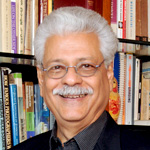
    “Till a few years ago, the phrase ‘consumer knowledge’, which is our prime derivable, wasn’t a common phenomenon. When we went to media clients in the entertainment space, for many of them research was a new thought.  So, we had to explain how it could help them create better products which will help them grow,” recalled Vispy Doctor, founder and managing director, Ormax Media.


    Over four years, Ormax Media has worked with 76 leading media and entertainment brands as business partners. In the first year, it focused on television, and GECs in particular. In the second year, the focus was expanded to other television genres as well as radio. In the third year, Bollywood became the priority. And now, at the end of the fourth year, the organization is set to offer unique and relevant offerings.
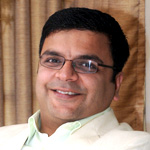
     

    Shailesh Kapoor

    Elaborating on Ormax’s four years, Shailesh Kapoor, CEO said: “The first four years of Ormax Media have been very eventful and successful. We have received great support from the media & entertainment industry, especially in our endeavour to create unique research products and approach entertainment research in ways that are unconventional and challenging, but also result oriented.”


    Growth matters

    The entertainment industry has its pros and cons and one of the biggest ‘cons’ of the industry is that it comes with a fairly low success rate – as low as 15 per cent. Therefore, the organization hopes to help the industry increase its success rate, even if by a small percentage.


    “Since we have been able to explain it to our clients, they have appreciated and accepted the concept of research. Hence, our growth has been fairly steep, and I can say that we are growing at a fairly high rate of 75-80 per cent, as we add more and more partners in our kitty,” said Mr Doctor.


    According to Mr Kapoor, the television industry has its cyclical changes, but is in a fairly stable state, vis-a-vis what it would have been 5-6 years ago. However, he does add that the definition of “stable” in television is very different from that in packaged goods and other sectors.


    As for the film industry, it is in an evolution stage, much like what the TV industry was in the late 90s and early 2000s. And one can see exciting times ahead for Bollywood, especially in research, where it has seen growing acceptance year-on-year.


    As far as Radio is concerned, it hinges a lot on the Phase 3 licenses. “Media & entertainment is a growing business, and research will continue to become more and more important as the market matures. We are all set for the challenges ahead,” Mr Kapoor added.


    Procedure: Easy or difficult?

    The organization offers a number of research products for various sectors of the entertainment industry. The list includes broadcast television networks, radio networks, film studios, newspapers, media agencies, DTH service providers, digital entertainment companies and production houses.


    So, when asked how difficult or easy the research procedure is for each variant, Mr Kapoor explained: “The larger GECs are the easier ones, as they are far more professional and they understand the value of research. Whereas in the more touchy-feely areas like films and creative companies, it becomes a little difficult as it is more about sentiments. However, it is difficult to rate them as it might be easier to work for a GEC, it might be more interesting for a film.”


    He added: “As a good service company, it becomes our job to orient ourselves to the client’s needs, but without compromising on the research rigor and correctness. That’s the balance that may be easy or tough. But it’s a part of our job.”


    A correct sample size plays is essential for any research to become successful and come out with results which will benefit the researcher. So how does the organization choose its sample?


    “For every client, the TG might different so we have to be careful about what attributes are they looking for in a sample size. For example, for a serial, it might be cultural overtones. So, how that serial is perceived in a city like Mumbai will be very different from how it is perceived in a small town like Indore. And if we are able to find this difference and collate preferences, it will help the channels,” explained Mr Doctor.


    Expansion plans

    The organization’s focus is to consolidate through new clients and repeat business. It now has 21 products for various sectors and plans to entirely focus on these products and getting them to become bigger and better in their own right. Also, it plans to target media agencies and advertisers through products like Celebritix, which was launched on July 25.


    “I’m often told that whichever channel you go to, Ormax gets mentioned in conversations consistently. We have a young team which made this happen. Four years ago, I would have bargained for much lesser. But again, this is only the start, and we know that we can achieve a lot more than what we have so far…” said Mr Kapoor.
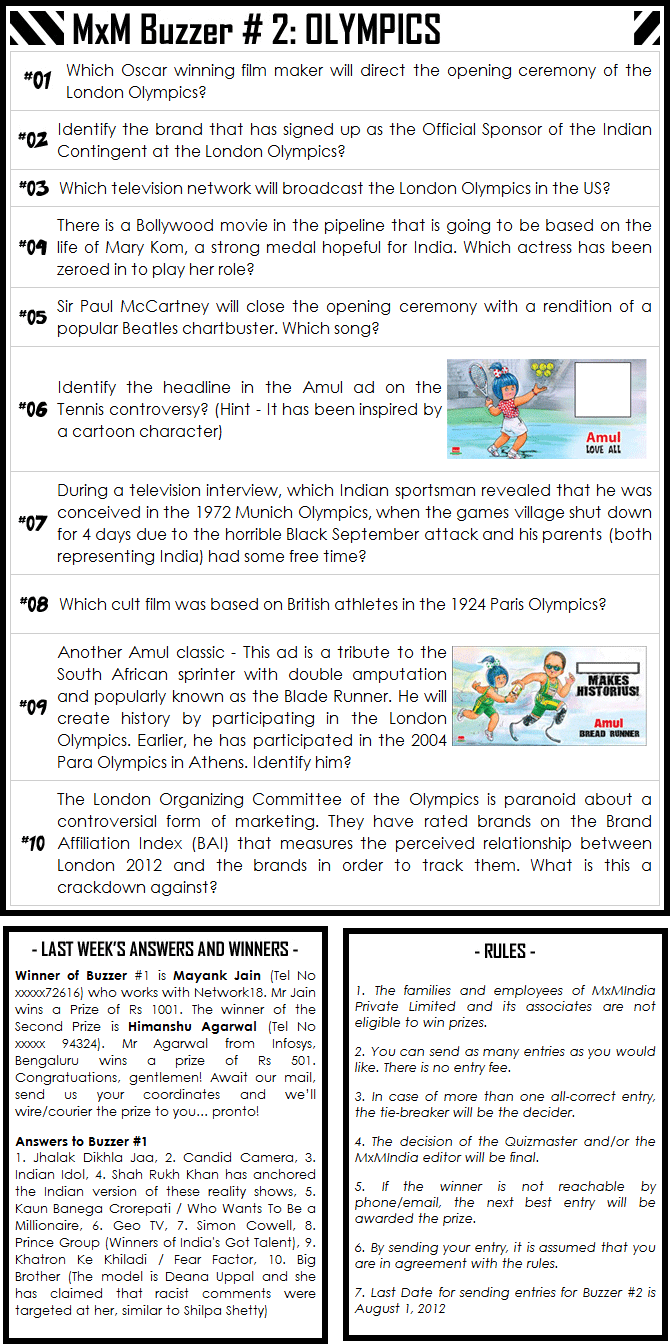
     

  • MxM Buzzer # 2 | The Olympics Special

    Here’s the second instalment of our near-new media quiz that will happen every Friday on MxMIndia.

    Our quizmaster is Sorbojeet Chatterjee, Vice President – Marketing at Neo Sports.

    To enter this quiz, simply email the answers with your personal details (Name, email id and telephone number) and a one-word descriptor for Goafest at editor@mxmindia.comwith Buzzer#2 in the subject. Standard contest rules apply (see box below).

    There will be 2 prizes every week: First Prize: Rs 1001, Second Prize: Rs 501.

    If there’s a tie, the best descriptor for Goafest will get the prize (note: tie-breaker question will change every week).
    Last date for sending entries: Wednesday, August 1.


  • BM study finds almost two-thirds of world leaders are on Twitter

    By A Correspondent


    Burson-Marsteller, the global public relations and communications firm, released “Twiplomacy” – the first-ever global study of world leaders on Twitter. The study shows that almost two-thirds of world leaders have a Twitter account. However, whilst the social network offers direct interaction between users, almost half of world leaders don’t follow any of their peers.


    “Twiplomacy” is the first research of its kind, aimed at identifying to what extent world leaders use Twitter. Burson-Marsteller analyzed 264 government accounts in 125 countries.


    Data used was taken in July 2012 from the accounts of 264 heads of state and government and their institutions in 125 countries world-wide looking at over 30 variables using Twitonomy. Burson-Marsteller used Doesfollow to analyze Twitter relations between world leaders and MyFirstTweet to identify the first tweet of each world leader.


    The findings indicate that over a quarter (76) of all world leaders and governments are following Barack Obama. However @BarackObama mutually follows only Norway’s Jens Stoltenberg and Russia’s Dmitry Medvedev but hasn’t established mutual Twitter relations with other world leaders. European Union president Herman van Rompuy (@euHvR) is the best connected world leader, mutually following 11 other peers. Australian prime minister @JuliaGillard is the second best connected leader.


    Russian President Putin, Rwandan President Kagame, Singapore Prime Minister Lee, Dutch Prime Minister Rutte and 35 other accounts do not follow any other Twitter user; effectively cutting themselves out of the conversation.


    On the other hand Ugandan Prime Minister Mbabazi and Rwandan President Kagame are the most conversational world leaders on Twitter with 96 per cent and 93 per cent of their tweets being @replies.


    “This study illustrates how Twitter is closing the communication gap between us and our world leaders. On the one hand, it allows heads of state and government to broadcast their daily activities and government news to an ever growing audience. On the other hand it allows citizens direct access to their leaders. Consequently, it is now, more than ever, critical for these leaders to get it right on the social network”, said Jeremy Galbraith, CEO of Burson-Marsteller Europe, Middle East and Africa.


    The study found that politicians often discover Twitter during election campaigns but once elected, these accounts tend to go silent, such as the accounts of Brazilian president Dilma Rousseff @DilmaBR and French president Francois Hollande @FHollande who have abandoned their followers since taking office. There are 120 personal accounts, however only 30 world leaders tweet personally and then only occasionally.


    “16 of the G20 leaders have are actively using Twitter for public diplomacy, but it is sad to see that the heads of state and government in China, Saudi Arabia, Indonesia and Italy still do not have joined the Twitterverse”, said Matthias Lufkens, Burson-Marsteller’s Digital Practice Leader in Europe, Middle East and Africa.


    Twitter is also used by small nations to put them on the world map and tweet eye-to-eye with their peers. The president of the Dominican Republic unilaterally follows 71 other world leaders. The president of Portugaland the prime minister of Trinidad and Tobagoboth unilaterally follow over 50 other peers in the hope that they will return the favour and the young Republic of South Sudan hopes to gain international Twitter recognition by following 16 peers.


    Twitter is most popular in North and South America with 80 per cent of governments active. Barack Obama is the most followed world leader with 17,115,077 followers, globally in 5th place just behind Britney Spears. Venezuelan president Hugo Chavez is in second place with 3,152,608 followers, followed by the White House, Queen Rania of Jordan and10 Downing Street, all having over two million followers.


    Other key findings include

    • Out of the 264 accounts of heads of state and government, 90 have never ever sent a retweet and 99 have never sent @reply
    • US President Barack Obama was the first world leader to sign up to Twitter on March 5, 2007 followed the same month by @EPN, the account now used by Mexico’s president-elect Enrique Pena Nieto.
    • Most popular tweet: “Same-sex couples should be able to get married.” – President Obama”, retweeted 62,047 times on May 9, 2012
    • World leaders tweet in 43 different languages. English is used by 34 per cent followed by Spanish (15 per cent). However Spanish and Latin American leaders tweet three times as much as their English counterparts
  • Industry welcomes DAVP plans to embrace digital with cautious optimism

    By A Correspondent


    Directorate of Advertising and Visual Publicity (DAVP), the multi-media advertising agency of the Government of India, in its Annual Report 2011-2012 stated that out of the total value of advertisements released by DAVP, 15 per cent goes to small newspapers, 35 per cent to medium newspapers and 50 per cent goes to big category of newspapers. DAVP also has an audio visual wing which undertakes various advertising or publicity campaigns through various other multimedia vehicles like the television, radio, out of home and now even the internet and mobile.


    In what could be a shot in the arm for the digital industry, DAVP has been conducting pilot projects on websites and through SMSes. According to DAVP’s Annual Report 2011- 2012, 33 of India’s top websites were empanelled for releasing advertisements. In addition to this, more than 110 advertisements via SMSes were also sent.


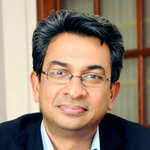
    Rajan Anandan

    According to Mr Rajan Anandan, VP and Managing Director, Google India: “This is a welcome development for the entire digital advertising industry. With over 120 million Internet users in the country, digital is already the third largest advertising medium in terms of revenue in the country. It’s too early to talk about the impact, but it’s definitely a step in the right direction as the overall marketing/advertising approach is making a shift to being more accountable and measurable.”


    In fact on July 26, The Sectoral Innovation Council by the Ministry of Information and Broadcasting submitted a list of recommendations to the Minister of Information and Broadcasting, Ms Ambika Soni. One of these recommendations stated: ‘New Media should be utilised for media campaigns by the government’. In addition to this, it also recommended that ‘E-mode transactions should be a priority for the functions of DAVP, RNI, CBFC and licensing activities of the Government for ensuring transparency’.


    Arpan Chatterjee

    Mr Arpan Chatterjee, online media professional and consultant with webdunia.com noted: “This is a logical extension by DAVP to focus on digital media, which is generating a critical mass in the country. It is to be noted that DAVP started digitization of its own system of issuing release order and payments to media companies over a year back and the fact that it is now looking at digital media more seriously was only a matter of time. DAVP’s move to enter the digital media will only add to the importance of the digital medium, but how it uses the medium is something one has to wait and watch. DAVP ads can also help create certain guidelines for internet advertising in India, which currently is self-regulated.”


    Even before these recommendations were made by the Sectoral Council, the IAMAI (Internet & Mobile Association of India) is said to have lobbied hard to bring a shift in the government’s approach towards digital media. The IAMAI is also said to have played a key role in getting the mobile SMS aggregators empanelled.


    Dr Subho Ray

    Dr Subho Ray, President – Internet & Mobile Association of India (IAMAI) explained: “Today with 100 million internet users and growing every day, digital is the most cost effective way to reach out to youth and, through them, their parents. The engagement with internet and mobile of the youth is very deep and the relevance of the message too gets transmitted on this medium. Young urban voters aged between 18 and 35 are a major constituency today for all political parties. And the internet, whether through mobile or PC, has surfaced as the best medium to reach this group.”


    DAVP recently revamped its website with an aim to make it user-friendly, it has also adopted digitization by issuing release orders and payments to media companies online. In fact the Ministry of Tourism is said to have been one of the early adapters and a large advertiser online. While these developments also show the government’s willingness to use digital, nevertheless what remains to be seen is how effectively the medium is used by the government in the long run.


    Mr Gyan Gupta, CEO, Dainik Bhaskar Digital Division pointed out that although these are good recommendations and a welcome step, it all depends on how much DAVP is willing to spend on digital. Just like any other medium, digital too needs a sizable ad spend: “DAVP has started this process last year and the trial is still on. Although this is a fantastic move, the question really boils down to how much is the government willing to spend on digital? What will be the ad spend from DAVP on digital? Digital today has become the third largest medium with increasing reach – it has become a medium which cannot be ignored. But, if the government is not willing to spend a sizeable amount or if each publisher does not get a decent money or ad revenue then it is not worth it, it will be irrelevant.”


    Mr Gupta too had a set of recommendations for the DAVP, which is said to have had a consensus among the other local language publishers: “First, they have to look at the categorization of the website very clearly and second, DAVP must also ensure that enough volume of advertisement is pumped into digital.”


    Now that more and more people are gaining access to the internet and spending more time online, not just in urban but also in rural India, perhaps the government has realized that it is a medium it can no longer ignore. With the 2014 general elections fast approaching, the government is expected to increase its advertising spends in order to showcase its achievements and with the Council’s recommendations to use digital, the government could well use digital extensively to reach out to the youth.


    Mr Upen Rai, Director, Times Internet Ltd, observed: “By bringing digital publishers into the DAVP fold, the signals are very clear from I&B ministry that it is digital all the way. With e-filing of taxes and other e-govt frays including Passport Kendras, it was a matter of time! Next stop would ideally be its relevance to general elections, yes this time around social, and digital will play a large part… Watch out for this space…”


    The 2009 Lok Sabha elections or general elections saw political parties advertising online and the next general elections could well see political parties further increasing their spends online.


    BG Mahesh

    Mr BG Mahesh, Founder and MD, Oneindia.in said: “Considering the contribution of Government ads in Print and TV channels, if the similar importance is given to the digital medium, it will be a very good sign for the Digital industry. It will not only fuel the higher growth rate for the digital industry, but will also provide the government a better connect with youth of country who spend a lot of time on Internet. Furthermore, if DAVP also extend the digital spends to mobile internet, the reach would be much broader as today phones with internet connections, or smart phone, start from as low as Rs5,000 and their dependence on electricity is very less as compare to desktop/laptops.”


    So, how would the youth of today react to government advertisements? Will it have any positive impact on them? Ms Chhaya Balachandran Aiyer, CEO and MD, BCWebWise said: “Awareness will increase, and we can pave the way for a betterIndia. We will see more open forums, debates and discussions. There are perils of uncensored content, at the same time, and this is something India needs today.”


    Chhaya Balachandran Aiyer

    So, while the industry has welcomed the Sectoral Innovation Council’s recommendation that the Government must utilise the new age media for its media campaigns, there is a cautious optimism among industry players as far as ad spends in the medium is concerned.


    Mr Anurag Gupta, MD, DGM India stated: “Government spending should be seen in the same light as spending by any brand. A marketer spends his monies where the users are, and if users are online then the best way to reach them is by advertising online! Any online media consumer whether it is youth or the older people will react to online advertising by the Government in pretty much the same manner as they would seeing the same ad in print or on TV.”


    Anurag Gupta

    Nonetheless if the government approves of these recommendations and does increase its digital ad spends, it would be a major boost for the entire digital industry particularly for increasing the digital advertising revenue. Currently, DAVP ad spends seem majorly skewed towards print and, to an extent, even television. However as the government increasingly uses the new age medium, what kind of implications digital advertising may have on DAVP ad spends only remains to be seen.


  • Is news media ownership a cause for worry?


    By Shruti Pushkarna


    Hardly had the news of the acquisition of English news channel NewsX by ITV Media Group and Hindi news channel Live India by Prosperity Agro filterd in, there were murmurs on whether it was vital for the government to impose entry barriers for the news media. ITV of course has been in the news for around five years and Live India already had a sizeable stake by a property developer HDIL.


    As part of MxM Mondays, we spoke to a cross-section of news media practitioners to offer their views on the issue.


    This issue of media ownership has been debated on in the past, and more so recently, because of the entry of corporate groups into the news media. Earlier this year we saw two big corporates enter the media domain, when Reliance Industries bought a stake in Raghav Behl-led Network18 and Aditya Birla Group invested in the Aroon Purie-led Living Media India.


    While big business owning media is not a new phenomenon, there are numerous instance of politicians owning and controlling sections of the media, especially in Southern India.


    Hence the question arises: Is it a cause for worry when people with non-media interests start owning the mass news media?


    Here are a cross-section of views from captains of the industry (in alphabetical order of their last names):


    Tariq Ansari, Chairman and Managing Director, Next Mediaworks Ltd

    Tariq Ansari

    The worry is not around who owns the media but whether they act in a way that is consistent with journalistic standards of integrity and fair play. We seem to have forgotten simple journalistic conventions like a declaration of interest from the owner of the publication/channel on stories in which there is a substantial commercial interest.


    Media, much like steel or fertilisers or communications, will eventually belong to those who have the means and desire to invest in it. The point about it being the preserve of a few is inexplicable. Nobody is stopping anyone from raising the capital to start a newspaper/magazine/TV station/radio station/website. We live in a free country. Anyone who has the ability to own media should be able to do so, without limitation. Clearly my preference would be that criminals or those with clear vested interest should not own media, but I am not sure if the law of the land can prevent this from happening.


    Vinod Mehta

    Vinod Mehta, Former Editor-in-Chief, Outlook magazine

    I am worried. Media diversity is very important for freedom of the press. I don’t want Media in the hands of a few owners. It should be open to all.


    And here’s what MxMIndia’s regular columnists say:
     

    Ranjona Banerji, senior journalist, columnist and Contributing Editor, MxMIndia

    Media ownership is a worry to the extent that journalists are not able to withstand corporate pressure. For instance, the Birlas started Hindustan Times and the Tatas has a stake in The Statesman (to name just two) and the battle between marketing and editorial is as old as the profession. The problem comes when senior editors capitulate and reader interest is surrendered or sacrificed. I would turn the spotlight back on journalists: are we fighting the good fight?

    _______________________________


    Mediaah/Pradyuman Maheshwari, editor-in-chief, MxMIndia:

    Many years back when I asked a leading industrialist why he was keen on starting a news channel he replied with the famed Deewar dialogue (some alcohol in the system did the trick): Aaj mere paas buildingey hai, gaadi hai, bank balance hai, but even then these guys owning newspapers and channels are ruling the world. We were in the late 1990s, and journalists and news media owners were indeed much sought after. That may have waned over the years, but the desire to own news media stays. What hasn’t changed is that the intent of owning the news media goes far beyond returns on investments.


     

    When the British ruled India, it was the desire to mobilize public opinion that led to several national leaders and even businessmen to embrace news. Post-Independence, with the birth of a new economy, it was a mix of nationalistic sentiment and also to use it as an ally in a tightly controlled business environment. The ’60s and ’70s saw the media taking off with magazines like the Illustrated Weekly of India, later India Today and several others in regional languages. The imposition of the Emergency got people to realize the importance of the news media as the liberalization of the economy and and the airwaves ensured that there is no looking back.


    Being a democracy, there are no entry barriers to the media. And rightly so. However, when a few years back a few real estate and assorted players jumped into news television there were representations to the information and broadcasting ministry that there ought to be tighter controls.


    The current murmurs are being heard because NewsX has been acquired by businessman Kartikeya Sharma. ITV, his media company, also runs the newspaper Aaj Samaj and regional and Hindi news network India News. And the reason for the concern: it was feared that being the brother of Manu Sharma who has been convicted in the Jessica Lallmurder case, he could misuse his position to influence the executive and the judiciary. Well, the Supreme Court upheld its sentence of life imprisonment in 2010, so evidently he didn’t achieve much. To be fair to Sharma, a senior editorial and business executive who has worked with him, told me that he saw no interference on content, especially on the Manu Sharma front.


    Clearly, the money power of rich businessmen and politicians cannot bring in readers or viewers, as the case may be or make a success of the media enterprise. In the late’80s, the Ambanis acquired Commerce Weekly and converted it into a business daily. They also acquired The Sunday Observer that was once edited by Vinod Mehta and was exceedingly popular.  The Ambani indulgence in the media failed despite hiring top journalists and publishing executives. They could only use the papers to fight a few minor battles, and even those without much success.


    Mehta worked and fell out with industrialists Vijaypat Singhani and L M Thapar as both found news too hot to handle and counter-productive to their primary businesses (and revenues). One had assumed he would meet the same fate when Rajan Raheja, a then-emerging industrialist with some interests in real estate, set up the Outlook magazine group. Mehta has led many battles with the mighty and powerful in his magazine and both Raheja and Mehta have survived each other.


    Save the Outlook example which is a good indicator of business interests and independent journalism co-existing, clearly big money is not enough to drive consumption of news media. My worry though lies elsewhere:

    1. Lack of transparency in the ownership of media.

    2. Creation of a monopolistic scenario with business groups investing in multiple and similar vehicles

    3. Level playing field for competition in case of vertical and/or horizontal cross-ownership, and

    4. Diversification of media companies  into entities beyond news


    1 & 2. Transparency requirements in media ownership are critical. When the government announced recently that a certain conglomerate doesn’t not have interests in the media, is it really the case, or is that what is on paper and hence deemed correct? While doubts have been raised about how the acquisition of a sizeable chunk of Network 18 via an independent trust would impact the editorial independence of the group, the real worry is the rumoured interests of the group in other media ventures too.


    Could we have a situation that a genre of channels or newspapers or the media entities in particular region of the country be owned – directly or indirectly – by one group? How do we tackle a monopolistic scenario such as this?


    3. The PR head of a radio station in Delhi once complained that she could never hope to get her press release into the two main English dailies in the city because both had their own FM stations. So, while the most inane event from the group’s radio station gets covered, the lady’s FM frequency never got a mention even for a big activity. So rampant is this blacking out of a rival group’s activities that it’s now considered standard practice. In many countries there are strict rules for horizontal and vertical cross-ownership. While the TRAI has suggested restrictions in vertical ownership (a TV channel can’t fully own a DTH or cable platform etc), horizontal ownership is fine (so a TV channel can also run a newspaper, radio station etc).


    4. The last of my worry areas can be a bigger concern, and, if misused, even graver than big business or a political party getting into the media. Many news media groups have invested in sectors outside of news and doubts have been expressed if there is any connect between the relationships with governments via the news media and the winning of such contracts.


    Even though the government at the Centre is weak, and we can be sure it will flex its muscles often enough in the run-up to various elections until 2014, I don’t see any immediate solution to the problem. But what can play a deterrent for those who abuse the media will be public opinion via social media.


    Sevanti Ninan, Editor, thehoot.org and Columnist, Mint

    Sevanti Ninan

    Yes, it is a cause for worry when people with vested interests start owning the mass media because political ownership of the media is increasing, and there are no transparency requirements on media ownership.


    Readers and viewers are unable to discern ownership-related biases. There is also a renewed trend of corporate investment in media increasing. Media companies are supposed to file ownership details with the registrar of companies, but one, it is not properly done, and two it is very difficult for lay people to access the correct and latest data.


    On the issue of media being a preserve of only a certain groups, even now it is fairly widely owned.


    Maheshwar Peri, Chairman, Pathfinder Publishing India Pvt ltd

    Maheshwar Peri

    In my opinion there is no cause for worry. I think, increasingly, the cause for worry comes from a few industrialists who’ve gotten into media. But if you go back to the flag bearers of Indian journalism in the 1980s, Indian Express was owned by RNG, an industrial group. So, to say that ownership by industrialists would hurt media is a slightly wrong way of looking at it.


    There is definitely a cause for worry when people get into media for reasons other than running it as a professional empire. If you look at some of the politicians who’ve come into media or political parties that are launching their own channels, that’s a cause for worry because they have a reason to dish out news which suit their needs and opinions.


    So there is a problem when people in public office get into media, but it’s not so much of a problem if industrialists or venture capitalists or any others moneybag get into it because they want to make it a commercially viable operation. And they know they can make it commercially viable only when the reader/viewer respects them. In case of politicians, they are not interested in making it commercially viable; they just want to ensure that their point of view finds a space in the public domain.


    I think unless a reader or consumer respects you, you won’t be able to sell beyond a point. So all of us, whether or not owned by corporates, are always trying to ensure that we give unbiased and credible information so that the reader continues to respect us as well as the advertiser continues to invest in us.


    And what makes one think that they have a better opinion about media than a fruit vendor? I don’t think there can be a classification of who has a better opinion about certain things in this country – we are a democracy. So the worse thing is to say that ‘these’ kind of people can get into media and ‘those’ kind cannot.


    Tarun Tejpal, Editor-in-Chief, Tehelka magazine

    Tarun Tejpal

    To some extent, there is cause to worry about media ownership. We have to air, discuss and examine issues of monopolies, cross media ownerships, and of cross business ownerships. And to try and build in some structural safeguards that both help ensure the financial viability of honest, robust media, and deter media owners from using their media instruments for unfair advantage in their other businesses.


    Theoretically, it (media) should be open to all. But we must build in safeguards that minimize the misuse of public discourse and public instruments of media. This is not easy, but a discussion must start on this issue at all levels.


    Paranjoy Guha Thakurta, Senior Journalist

    Paranjoy Guha Thakurta

    The growing corporatization of the Indian media is manifest in the manner in which large industrial conglomerates are acquiring direct and indirect interest in media groups. There is also a growing convergence between creators/producers of media content and those who distribute/disseminate the content.


    In India’s unique ‘mediascape’, it is often contended that the proliferation of publications, radio stations, television channels, and internet websites is a sure-fire guarantor for plurality, diversity, and consumer choice. There were over 82,000 publications registered with the Registrar of Newspapers. There are over 250 FM radio stations in the country. Despite these impressive numbers of publications, radio stations and television channels, the mass media in India is possibly dominated by less than a hundred large groups or conglomerates, which exercise considerable influence on what is read, heard, and watched.


    One example will illustrate this contention. Delhi is the only urban area in the world with 16 English daily newspapers; the top three publications, the Times of India, the Hindustan Times, and the Economic Times, would account for over three-fourths of the total market for all English dailies.


    However, what is unacceptable is media barons using news outlets as tools to further their business interests. In this country, as in the world over, large media corporations are clearly playing a bigger role in the political economy that they report on. Though a free media is fundamental to the existence of a liberal democracy, concerns about the accountability and transparency of media companies remain. For instance, the RIL deal has enabled Network 18, Eenadu, and the merged group to expand its offerings to benefit its stakeholders and its advertising target audiences. What remains to be seen is whether clear boundaries can be etched between the boardroom and the newsroom.


    There’s absolutely no doubt about the fact that if it’s truly going to be a responsive media, then the media should reflect the views, the interests, the aspirations of a larger section of population as possible. The problem with much of our media is that they are too busy trying to ‘reach’ consumers to potential advertisers than providing information to citizens.


    Next Week:

    Why do we all like to damn TAM?

    The Sectoral Innovation Council recommendations last week said that there was need for an alternative to TAM, short for the media research company formed by a jv of two international research biggies: Nielsen and Kantar. This is a view that has been expressed several times over the years.


    One of the main peeves against TAM is the number of Peoplemeter boxes present to collect data. Can 8000+ boxes effectively poll a populace of 1.2 billion, is what many broadcasters keep asking in public. In private though, not many are ready to pay up by increasing their subscription fee to enable the installation of more boxes across the country.


    Also, what’s happening to BARC, the joint industry body that was to provide an alternative?


    MxMIndia will speak to a cross-section of the industry to get answers. Meanwhile, if you have a view, email it to us at editor@mxmindia.com with the subject ‘MxM Mondays #2’


  • Divya Bhaskar launches Rajkaaj in Ahmedabad

    By A Correspondent


    Ahmedabad is the commercial and the political capital of Gujarat. As per internal research and readers feedback, it was evident to the Dainik Bhaskar Group that the readers in Ahmedabad are deeply interested in the political and bureaucratic activities of state. Power corridors of Ahmedabad and Gandhinagar were of prime interest to the readers.


    Keeping this interest in mind, Divya Bhaskar launched a special page – Rajkaaj -in its main issue in Ahmedabad to address this heightened reader need for political news.
    Mr Saras Sethi, State CEO Gujarat said: ‘Divya Bhaskar has always been a newspaper that has remained above the curve; and we use reader’s feedback and formal research for keeping a tab on the changing environment. RAJKAAJ aimed at providing focused political news is a perfect example of this philosophy. We understand that this will further strengthen the strong reader connect that Divya Bhaskar enjoys with its readers and will help then remaining updated on the political and bureaucratic scenario and the power struggle or equations.”


    Divya Bhaskar, the Gujarati newspaper from Dainik Bhaskar group with 11.44 lakh readers (IRS Q1 2012) is the only Gujarati newspaper with more than a million readers in a city.


  • Hockey India signs multi-year deal with ESPN Star

    By A Correspondent


    Hockey India entered into a multi-year broadcast agreement with leading sports broadcaster ESPN STAR Sports to exclusively broadcast the soon to be launched Hockey India League (HIL). ESPN STAR Sports will also cover all international hockey test matches under Hockey India to be played in India for the next 5 years.


    In a multi-year deal, ESPN STAR Sports has been granted global telecast rights for the professional hockey league. The FIH-approved league will see the best of national as well as international hockey stars showcase their prowess. The first edition of the league is expected to be played in January 2013. The league will comprise of at least six franchise hockey teams and will feature 33 hockey matches to be played in prime time in stadia across the country. All teams will play each other on a home and away basis (30 league matches) followed by 2 semifinals and the final.


    Hockey India further announced that ESPN STAR Sports has the global broadcast rights to telecast at least 5 international hockey test matches every year under Hockey India to be played in India for the next 5 years. The number of matches that India will play against top quality international opposition could go up depending on the finalization of the series schedule.


    Hockey India Secretary General and Chairman, Hockey India League, Dr. Narinder Batra said: “We are delighted to have ESPN STAR Sports as our broadcast partners. Hockey India has a clear vision – we want to revive the glory days of hockey inIndiaand drive popularity of the game across the country. This partnership with ESPN STAR Sports will play a key role in our overall plans.”


    Speaking on the professional hockey league, Mr Batra added: “The proposed league (HIL) will be the biggest initiative that hockey has ever seen in India. We have been working out the details for months now and I am glad to announce that things are quickly falling into place. I am confident that our partners ESPN STAR Sports will help us deliver a flawless world class product.”


    Peter Hutton, Managing Director, ESPN STAR Sports said: “Hockey is close to our heart and we will drive all our efforts to make this league a success. We are also delighted to have all international hockey test matches under Hockey India to be played in India on our networks for a 5 year period. I look forward to some memorable occasions and a new era for Indian hockey.”


  • U-turn to comfort zone!


    By Tuhina Anand


    Anita Nayyar

    After a fabulous five-year stint at Havas Media, Anita Nayyar is returning to the agency post a four-month stint at Bennett Coleman & Co Ltd (BCCL). The news of her joining BCCL as Director, Customer Strategy was seen as a big leap and an opportunity for her to be on the other side of the table. Her decision to come back and reclaim her old role as the CEO for Havas Media for India and South Asia hence came as a surprise. The fact that post has been vacant ever since she left in April this year evidently made it easier.


    On her part, Ms Nayyar maintains that she was missing the pace of her agency life; after all she has been with media agencies for more than two-and-a-half decades. “There was nothing wrong at BCCL. In fact, it was an interesting assignment and BCCL is a fantastic organization and they took good care of me. However, I have realized that my heart lies in being on the other side of the table and that is on the agency side,” she told MxMIndia.


    “In fact, the stint made me understand the issues from a publication point of view which often we fail to see as we have not been a part of it. It gave me an opportunity to see a new side of business and will surely help me in the way ahead,” she added.


    CVL Srinivas

    CVL Srinivas, Chairman, SMG India and MD, LiquidThread, APAC, moved to Private Treaties at BCCL after Maxus and now with SMG. Talking about his moves, Mr Srinivas said: “I moved at a time when I was to head to Singapore to run Maxus Asia-Pacific. I had chosen a successor to head Maxus India and completed the handover, so it was a good time to sit and evaluate career options. Having worked in media agencies for 13 years on the trot, I felt it was time to get out of my comfort zone and explore the world outside. I had always done roles that involved scaling up businesses, building teams, so I thought working with or for start-ups would be a good way to build on my strengths and yet do something different.


    On the stint at Private Treaties (now called Brand Capital) ending soon, Mr Srinivas commented, “I consulted for a few start-ups before joining Times Treaties where I had a two year stint. In all, I was outside of media agencies for a good four years. I chose to come back because of the role that was offered to me by SMG. It seemed to have all the right ingredients at that stage of my career.”


    It is not uncommon of an advertising person to move to the client side of the business but only few switch to the media side of the business (print and broadcast primarily) and more importantly even rarer come back to the agency once again. However, as we understand that it’s not the case of sour grapes for comebacks.


    Karthik Lakshminarayan

    Karthik Lakshminarayan, COO at Crest (Madison Media) re-joinedMadisonwhere he had worked for close to eight years post his foray into broadcast and production when he was with Colors, FoodFood and Fremantle Media. For him the decision to join broadcast was, as he puts it: “A challenge thrown to be a part of a launch and do something completely different and radical from Media Planning and Buying which I was doing for over 14 years and was adept at.”


    However, the decision to come back was, “purely because it was Madison as it was a home-coming. Any other agency would not have been the same or felt the same.”


    A senior industry person who had been in a similar situation pointed that while hiring an agency person is desirable for media houses as they come with multiple experience of working on various brands, but the difficulty begins once you are inside the publication or broadcast company. There is a huge cultural difference, because the kind of monies the media houses deal with is humongous as compared to what the agencies deal with. In his words: “The agency people are bound by certain set of responsibilities, it’s like a relay race where you do your work and then hand the baton to the next yet at the same time be part of a team, however the media house is huge and set of responsibilities diverse hence making the transition becomes difficult. Also, one could be a CEO of the agency and be well recognized but the same person will get lost in the media house where there are many biggies ruling the roost.”


    Suresh Balakrishnan

    Talking of the scale of business being different, Suresh Balakrishna who joined back LMG as CEO of Brand Programming Network after a decade of being with print explained, “The media houses definitely means operating on much bigger canvas and the scale of monies involved being huge. You learn to be a business man as there are hard trade-offs and you need to take hard calls on driving the bottom line as well as the top line. So the pressure involved in definitely higher. ”


    While that’s the view of people who have made a comeback, the recruiters have a different take. An advertising industry recruiter on anonymity said: “I can’t really think of many who have made a transition and then come back to the media agency. Yes for us, those willing to come back especially at senior level are good prospects for recruitment considering the dearth of talent besides they are value for money. There is comfort in coming back to your old set up.”


    However she added: “I do think that people who are willing to come back are usually those who are having a tough time in their current set up.”


    On the other hand, those who made the switch and then came back to agency feel that the experience only helped them in their career. As Mr Srinivas puts it: “I learnt a lot at BCCL. Firstly, to get a first-hand experience of being on the media owner side was very helpful. Secondly, I worked with some very fine minds at Private Treaties and got a much better understanding of how businesses are built and brands created from scratch. And being part of India’s largest media company (when one is not used to such scale on the agency side) was a huge learning in itself.”


    Mr Balakrishna too added, “The learnings at media houses have been immense as I had  joined HT around 2001 which was a time when media houses were just getting professional in their approach and this was an aggressive phase of growth. Mint and DNA were challenger brands as they were not the leaders so one had to be literally on our toes thinking all the time to take away whatever possible from competition to establish ourselves.”


    However he added that his decision to join back was primarily because he felt that while he had acquired depth of learning he was missing the width of learning that an agency offers. One gets to work on different categories and with market becoming increasingly competitive and clients keeping a vigil on ROI the media agency business has become only more organized and scientific in their approach.


    Imaging: Rafiq, Images: Clipart


  • End of Season 1 of Satyamev Jayate: The good, the bad and the ugly truths of life

    By Meghna Sharma


    In the past 13 weeks, one show has done what no other show has been able to in a long time – get people face-to-face with the ugly truths of our society. Aamir Khan’s television debut, Satyamev Jayate, was the most-talked about show even months before it was aired. It was touted to revolutionize the Sunday morning slot on the Indian television.


    From the very first episode till its last episode on July 29, the show was able to create a lot of buzz. People shared their views on the social ills the show highlighted on social networking sites. The news channels and newspapers carried expert views and opinions on the show. It didn’t back down from highlighting the fact that a country of one billion lives like ostriches when it comes to taking action against such evils.


    However, inspite of all the hue and cry, one question still remains on everyone’s mind: was it really effective?


    MxMIndia spoke to industry experts, journalists and even activists after the show was aired on May 6 and almost all of them gave it thumbs up. Now that the show has ended, we got in touch with the same people to know their opinions…


    TRP: the only yardstick?

    Chandradeep Mitra

    For any channel and show, the TRPs it gets are the yardstick at which its popularity is measured on. Star India’s Satyamev Jayate which premiered across nine channels – Star Plus, Star Pravah, DD National, ETV, Star Utsav, Vijay, Star Jalsha, Star World & Asianet – got a rating of an average 4 TVR for the CS4+ in the Hindi speaking markets and an average of 4.9 TVR for the All 4+, according to the TAM viewership data. But, as the weeks rolled on, the ratings dipped.


    Many, however, feel that such shows cannot be measured by TRPs as they are much bigger than that. “For a show like this, ratings alone cannot be the yardstick. One must not forget that the it was a non-entertainment show and was aired on Sunday mornings.  For a slot and content like that, the show did very good,” said Chandradeep Mitra, managing partner, Anvention.


    Anil Sathiraju

    He added: “We must look at the social impact it created and I’m sure it will remain in people’s memories for a long time. Apart from the buzz created on social networking sites and getting eyeballs, I’m sure now companies will also increase their CSR activities as it highlighted the work done by a few.”


    Similarly, Anil Sathiraju, Head – south, Mudra Max Media, too feels that content and impact are more important than the ratings: “What the show has done to the morning slot is evident enough, that it made people sit up and take notice. And I’m sure now most channels, including Star, will want to revive the slot and come up with shows which will not make the slot redundant.”


    Sundeep Nagpal

    The show wasn’t developed and promoted for TRPs, said Sundeep Nagpal, founder director, Stratagem Media. “It was applicable for the masses and not many shows of such genre have been created. Hence, it would be wrong to judge it on the ratings…it’s much more than that. It bought out the issues which are prevalent but under the surface. For example how many of us in Mumbai knew about Khap panchayats? The show is a turning point in the Indian television history.”


    The much-hyped show even went on to charge an exorbitant amount for the 10-second advertisement slot which was sold at thrice the usual rates. “For an advertiser, the show was the best medium to reach its audiences. For the first time, a show was created, which in turn created two new stakes – timeslot and a new category of a show. So, many didn’t hesitate in paying that extra for the quality they were getting in return,” explained Llyod Mathias, director GreenBean Ventures and former CMO of Tata Teleservices and Motorola.


    Aamir Khan vs Content

    Anita Nayyar

    According to the media planner, Anita Nayyar, who is moving back to her former agency Havas from Bennett, Coleman & Company (BCCL) by August, initially the show got the hype only because it was anchored by the actor and the fact that the concept of the show was well hidden. However, for a show like Satyamev Jayate, it’s the content which plays a bigger role.


    “Satyamev Jayate is a socially relevant show and in the beginning, I think, it did mobilize people. However, in between it lost its public appeal. And I’m not surprised as such shows only appeal to a certain section of the society. Hence, it wasn’t even able to garner the TRPs it deserved,” said Ms Nayyar.


    She explained that though the show was anchored by a popular actor like Aamir Khan there was a gap between enlightenment and mobilization. “The show was supposed to mobilize people, but it was only able to highlight the evils which we all know exist. Nonetheless, it was a good show.”


    Voicing the same opinion, Sarla Bijapurkar, sociologist, believes that if one has to score Aamir Khan vis-a-vis the content of the show, Aamir would win. “Public memory is very short and everything will be lost if there is no follow-up. For instance, take the episode where diktats of Khap panchayats were highlighted. Has anything changed? No, we still have such bodies making people’s lives miserable. Sometimes, when one hears or reads about such instances, it makes you wonder if we, as a society, take two steps backward for every one step taken forward.”


    “For me, the show will only mean something if it is able to do a follow-up on the issues highlighted. Also, instead of raising a new issue every time, I think, they should have focused on fewer and discussed about different dimensions related to a particular issue. Maybe, then it would have been able to brought about a change,” said Ms Bijapurkar.


    Waiting for a change…

    Ranjona Banerji

    However, there are many who think that the show was a success and was able to do more than just generate public interest and will eventually lead to some change as evolutions don’t happen overnight.


    Ranjona Banerji, a senior journalist and contributing editor, MxMIndia, feels that the show did justice to the concept though there were a few dodges like the show being too emotional, sometimes. The first two episodes – female foeticide and child sexual abuse – were able to create a lot of public interest. “Apart from these two episodes, the episodes which moved me were the ones on disability and senior citizens. The show did the work of a journalist and was even able to answer a few questions. Hopefully, they’ll tweak the show a little bit and come up with a second season – better and stronger.”


  • Hungama Digital bags Best Campaign award at PMAA

    By A Correspondent


    Hungama Digital Media Entertainment Pvt Ltd has won four awards at The Promotion Marketing Awards of Asia (PMAA) – The Dragons of Asia 2012.


    Hungama Digital Media bagged the PMAA Dragons of Asia for ‘The Best Campaign from India’ for its Maruti Suzuki Cricket Stock Exchange campaign. It also bagged a Gold in ‘The Best Innovative concept’ category, two Silvers for ‘The Best Use of the Internet in a Promotion Marketing Campaign’ and ‘Best Use of Social Marketing in a Promotion Marketing Campaign’.


    Said Sunila Dhar, Deputy General Manager Media, Maruti Suzuki, “We are very happy to have got this award. Our association with CSX has been for two years and it is overwhelming to see the response to the game. It was based on the correct consumer insight of the passion for cricket, and the fact that we all have an opinion on the players and like to give a calculated opinion. Besides, the game has been made highly engaging by Hungama with many new segments in its second avatar.”


    Speaking to MxMIndia on the news, Siddhartha Roy, COO, Consumer Business & Allied Services, Hungama Digital Media Entertainment  said, “To be acknowledged by the PMAA for our campaigns is a great boost to the team’s morale, but it does raise the bar for them to keep creating successful, clutter breaking campaigns . Our Biggest winner – Maruti Suzuki Cricket Stock Exchange was a well thought out and superbly executed project by the team.” Speaking about the product, he added, “Cricket by far dominates and drives consumption on digital gaming, and with CSX we created a differentiated offering for consumers. With a trading game that is impacted by the real world cricketing news and stats, consumers have the opportunity to be more involved within the game. Ayaz Memon’s expertise ensures that users have the most accurate knowledge and info to make the trade on the stock exchange so as to maximise their earning.”


    Added Ms Niloufer Dundh, Head – Integrated Media, Hungama Digital Media Entertainment  said: “I am delighted, and thrilled with the awards we won, hats off to the team for creating Maruti Suzuki Cricket Stock Exchange campaign and for constantly improving and innovating. This is the second year we aired a campaign for this product, it was first launched during IPL 2011. I am also very happy because we had a brand like Maruti who supported us and had faith in us for these two years.”


    This year, the awards witnessed the introduction of the Dragons of Malaysia, in partnership with Marketing Magazine, as a plan to recognize more local agencies. All winning campaigns were then judged locally and then again in the Dragons of Asia, with 50 Gold, Silver and Bronze winners now taking part in the 2012 MAA Worldwide Globes.


    Awards won by Hungama at PMAA 2012 – The Dragons of Asia (Orders of Merit)


    The Dragons for the Best Campaigns in their Country

    Dragon Campaign Client
    Best InIndia Cricket Stock Exchange Maruti Suzuki


    Best Innovative Idea or Concept

    Dragon Campaign Client
    Gold Cricket Stock Exchange Maruti Suzuki


    Best Use of the Internet in a Promotion Marketing Campaign

    Dragon Campaign Client
    Silver Cricket Stock Exchange Maruti Suzuki


    Best Use of Social Marketing in a Promotion Marketing Campaign

    Dragon Campaign Client
    Silver 7 U Lemon Pattalum 7 UP


  • Mediaah! Dear Editor, Mint: It’s incorrect to damn TV news

    By Pradyuman Maheshwari


    Click here for Larger view

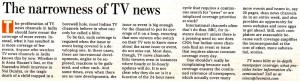
    I find the media coverage in the Mint by far the most balanced from the time it started and was quite surprised to see a bizarre second edit in today’s edition titled ‘The Narrowness of TV news’.


    Now we all know the problems with the news on television: it’s often sensationalized, it can go and on over an inconsequential issue and do whatever it takes to garner ratings.


    While making a case for its argument on the narrowness, the editorial concludes:

    One shouldn’t really be complaining because such coverage ensures the continued relevance of newspapers, which actually cover many more events and issues in, say 20 pages, than news channels do in an entire week, and also provides an opportunity for news websites and news apps to get ahead. Still, such complaints are reasonable because such coverage amplifies the inconsequential at the cost of other, more substantial, stories.


    I don’t think there’s anything wrong in what the Mint has said, except that it has made some gross omissions. One, it bases its arguments only on the primetime slots on news channels. For instance, let’s take Times Now among the English. Yes, the 9-10/10.30 blocks are taken up by extended studio discussions on one or two or at most three topics and an end-piece, but at around 8.30 it does carry news snippets from across the country. I must confess I don’t watch enough of news television to be able to give you specific timeslots across networks, but I’m certain every channel has a slot for round-up albeit not at the 9-10pm slot.


    Mint’s editorial evidently doesn’t take factor in the news on the Doordarshan channel (DD News) which is possibly more all-encompassing, though the emphasis is more on the ministers and government events.


    My peeve against the comment is that it assumes that news in our newspapers is perfect. It may be noted that HT Media, the company that owns and publishes Mint, doesn’t own a news channel, though it actively allies with CNN-IBN for special surveys and events.


    The fact is that just as the malaise afflicts news on TV, it also exists in newspapers. In fact there are enough biases in the papers. And these move from news to editorial pages too. A leading national daily who the Mint editors may be familiar with dropped the column of a well-known commentator because he/she had written a slightly negative article on an emerging politician of a disposition that the newspaper group is close to. Then there are cases of paid news and a variety of vested interests at play.


    The primetime slot on television news is like the front page of the newspaper. Just as you’ll not get a hundred news stories on Page 1, the same holds good for television news.


    So to damn the content mix of one medium on its editorial page is not on, dear editors of Mint. The decay is huger in print – in the big and small cities. The narrowness exists in newspapers too — on the news pages and beyond.


    Buzz me if you have a story to tell. Confidentiality assured. There are various ways you can reach Mediaah!: pradyumanm[at]mxmindia.com, Gtalk pradyumanm@gmail.com, BBM 29FEA79C. Twitter @pmahesh and of course the mobile: 98338 76278.  The views expressed here are my own.


  • Arvind Sharma elected AAAI President for 2012-13

    By A Correspondent


    Advertising Agencies Association India (AAAI) has elected Arvind Sharma, Chairman, Indian Subcontinent, Leo Burnett as the President for the year 2012-13. MG Parameswaran, Executive Director and CEO, Mumbai at Draftfcb Ulka has been elected as the Vice President. Nagesh Alai, the outgoing President will be the ex-officio member of the new AAAI Executive Committee.


    When MxMIndia congratulated Mr Sharma and asked about his agenda for the year ahead, he said: “AAAI is an industry body and it is a team work. We will be meeting on August 17, where we shall be listening to each other’s views before setting up the agenda.”


    He added: “The industry is growing and transforming at a rapid speed, thereby also providing newer opportunities to an advertising agency for growth. The amount of monies being invested in advertising has increased, and newer avenues have opened up for investments, thus the challenge is to understand and adapt to the changes. As an industry, we need to understand what lies ahead and prepare the agencies for the future.”


    Other elected members of the Executive Committee include Ganesh Baliga (Fifth Estate Communications), Ashish Bhasin (Aegis Group), Nakul Chopra (Publicis Communications), Tanya Goyal (Mogae Group), Kunal Lalani (Crayons Advertising), Vinod Nair (Network Advertising), Pranav Premnarayen (Prem Associates Advertising & Marketing), Sridhar Ramasubramanian (Matrix Publicities and Media India), Vikram Sakhuja (Group M), Umesh Shrikhande (Contract Advertising) and Srinivasan Swamy (RK Swamy BBDO).