Category: Digital

  • Amazon Prime Video redefines content watching in India

    By A Correspondent


    With the launch of its Prime Video service, Amazon is ready to redefine content consumption in India. With the best content selection at your fingertips, and consumer-first product features, Amazon Prime Video unshackles consumers from the bonds of traditional entertainment consumption. To take this thought forward, the brand brought in Leo Burnett India to conceptualize its new integrated campaign – “India Ka Naya Primetime”.


    Speaking about the new campaign, Ravi Desai, Director Mass and Brand Marketing, Amazon India, said, “Amazon Prime Video offers consumers the ability to enjoy the very latest and exclusive content, with easy-to-use features, enabling them to take control of what they want to watch, when they want to watch and where they want to watch. We believe this campaign will work towards building awareness of this new Prime benefit, as well as bringing new consumers to Prime Video, as every content lover would be attracted to this new world of entertainment.”


    When it comes to content watching, India has evolved with content becoming its new social currency. Expectations are that content should not be limited by where consumers are, the device they are using, availability, or when they are watching. Having said that, while expectations from content have changed, we still end up consuming it the way we used to – by appointment viewing. Amazon Prime Video consumers are no longer restricted by a time slot, programming choice, or by who has control over the TV remote. They can watch latest and exclusive content, anytime they want, anywhere they want, making anytime – Primetime!


    To carry this thought forward, the films feature a young couple, Rohan and Roshni, who are defined by their love for content. The characters individually have a distinct personality, and together, as a couple, give us a glimpse into their very interesting everyday lives, with entertainment enabled by Amazon Prime Video. The insight for the campaign stems from everyday fun, tongue-in-cheek moments. These moments allow for narratives created around the couple’s content watching behavior, making it relatable for anyone who loves to watch movies and shows.


  • Chrome DM launches Subscriber Establishment Survey for broadcasters

    By A Correspondent


    Chrome Data Analytics & Media has released the latest round of‘Chrome Subscriber Establishment Survey’or ChromeSES, a Primary Research Survey used by broadcasters to prioritize channel placements across cable networks in India.


    With Chrome SES, broadcasters can obtain subscriber count by state/strata; mode of transmission- digital/DTH/analog; MSO; city/headend; SD/HD.


    With a field staff strength above 650+ on the ground and data collection units across urban and rural India, Chrome DM has also released the latest numbers on the current phase of digitization.


    The Chrome SES update released in February 2017 is a result of ground changes observed in the last quarter of 2016. The report contains a range of findings that would help broadcasters to obtain the latest transmission split insights within a market.


    Here is a snapshot of some of the findings:

    1. All India:Only 19 per cent analog connections left in Urban + Rural India as of Dec 2016, compared to 24 per cent in Sep 2016
    2. In Urban India, only 8 per cent of analog remains, largely in TN and AP.
    3. In Rural India, Analog connections make up 31 per cent. In Aug 2016, 37,000+ villages were analog, whereas in Dec, 32,000+ still remained analog.


    Speaking at the launch, Pankaj Krishna, Founder and CEO, Chrome DM said, “For Phase 4, the overall size of the market itself is a huge challenge. As the sun sets upon Analog in India, we are monitoring the Transition from Analog to Digital across the Country. In the period between September to December, Madhya Pradesh & the North Eastern states have been the frontrunners, whereas Tamil Nadu & Karnataka have been found to be lagging.”


  • Yahoo announces global content partnerships with leading publishers

    By A Correspondent


    Yahoo has announced that it has inked content distribution deals with a host of leading UK publishing partners, including The Telegraph, the Guardian, The Independent, the Evening Standard and Hearst UK. The move enables publishers to distribute content via a curated feed, created in partnership with Yahoo in five countries, the United Kingdom, United States, Canada, India and Singapore. Yahoo claims over one billion monthly users worldwide and the agreements open up a new channel for British publishers to reach this vast global audience.


    In addition, the partnerships create a new revenue stream for publishers, with content set to be monetised via a revenue share model using Yahoo’s powerful cross-platform native advertising marketplace, Yahoo Gemini. Advertising will appear within each article to reach and engage relevant audiences with highly-targeted content.


    Said Greg Miall, Director of Global Partnerships, Yahoo: “Yahoo is committed to building the richest set of premium and personalised content experiences for our users and we are thrilled to use the power of our global platform to work with such high calibre publishers. The fact that Yahoo can do one global deal, opening up UK publishers’ content to such a vast global audience is hugely exciting.”


  • Prime Focus partners with Dabang Mumbai Hockey Club

    By A Correspondent


    The fifth edition of the Coal India Hockey India League (CIHIL) saw the coming together of two entities to support the sport in India. Media services major Prime Focus Limited (PFL) announced their association with the Dabang Mumbai Hockey Club (DMHC)as an Associate Sponsor.


    Commenting on the association with DMHC, Vikas Rathee, CFO, Prime Focus, said, “This is our first association with a hockey team, and we are extremely proud and excited to be supporting Dabang Mumbai HC. This is a team of world-class Indian and International players, including 5 players from the Junior World Cup that lifted the trophy in 2016 after 15 years. At Prime Focus, one of our key objectives is to empower the young artists of our country, by ensuring that they learn the skills required to play on a level playing field with the very best creative talent from across the globe. We found a reflection of our values in DMHC’s endeavor to promote and encourage the young hockey talent of India to not only compete locally, but ultimately to reclaim India’s world supremacy in the sport. Associating with DMHC fits perfectly with our brand proposition.”


    Commenting further on this partnership, Saumya Khaitan, Chief Executive Officer, Dabang Mumbai Hockey Club said, “To partner with a company like Prime Focus, which has attained worldwide recognition for excelling at its services in India and overseas, gives us immense pleasure and pride. It can add a lot of value not just financially, but also by helping us learn to further package the final product better for a visual treat. We look forward to a long-term partnership with Prime Focus, which would further help the national sport get the acknowledgment it deserves”.


  • Mirum India wins digital mandate for Banjara’s

    By A Correspondent


    Banjara’s, the herbal beauty care brand, has awarded the digital duties to Mirum India. Banjara’s has been a fast growing FMCG player in the beauty care segment with 60+ products in its portfolio under skin &hair-care. So far the brand has been operating predominantly in the South India, but from this fiscal year wants to aggressively target the Rest of India markets. This expansion plan will be majorly driven by digital marketing.


    As part of the digital mandate, Mirum India will manage all the social media platforms and create new digital touch points for Banjara’s, with focus on brand building. Mirum India will also be offering media buying services as part of the mandate. This account was won following a multi-agency pitch.


    Ramesh Vishwananthan

    Ramesh Vishwananthan, Managing Director, Vishal Personal Care Pvt., Ltd., said, “We are aggressively looking at expanding our footprint outside South India with digital leading the way. We were looking for partner rather than an agency, who would understand our ambitions. Mirum India with their diverse understanding of the digital landscape, fitted the bill. We are excited about this new partnership.”


    Hareesh Tibrewala

    Hareesh Tibrewala, Mirum India, Joint CEO, Mirum India, said “Banjara’s is one of the fast growing FMCG players in South India with a very ambitious brand DNA. Mirum recognises this and brings to the table its vast Indian & Global expertise in digital shopper marketing. I’m glad we’re the ones Banjara’s has put their trust in. Together we look forward to take the brand to the next level.”


  • Budget News ensures big high for mobile platforms


    By A Correspondent


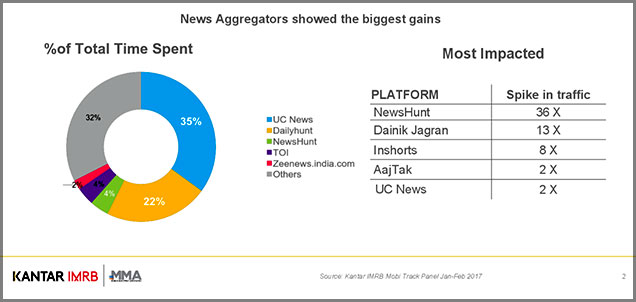
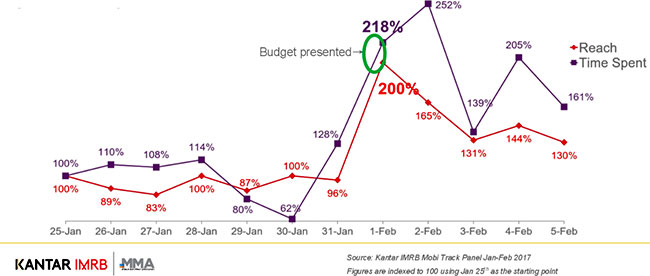
    Coming in the wake of demonetisation, news platforms saw a surge in traction driven in large part by the Budget 2017-related narratives, as per a study conducted jointly by market insights major Kantar IMRB and the Mobile Marketing Association (MMA India). the A steady diet of budget forecasts contributed to an increase in overall time-spent in the days leading up to the Budget presentation. This was followed by a massive spike in engagement on February 1, the day of the Budget speech.


    A second spike in traction was witnessed over the weekend following the Budget as readers caught up on in-depth analyses and the long-term implications of the Budget announcements.  News aggregators drew the lion’s share of engagement among smartphone users—the top two aggregators accounted for almost 60% of total time-spent on news related content. The Times of India was the most popular of the standalone platforms with twice the traction of its nearest competitor Zee News. Platforms like Dainik Jagran, Inshorts, and AajTak saw the highest gains in traffic during this time, notes the study.


    Kantar IMRB’s Mobi Track smartphone usage panel was used to analyse consumption of budget related content in the weeks leading upto and during the Budget 2017 presentation.


    “Looking at the data from Kantar IMRB’s MobiTrak smartphone usage panel—the surge in budget-related news consumption confirms people’s attention and interest in the event. Engagement levels were expectedly highest among the digital generation i.e. 20-24 year olds —they accounted for the highest Reach and Time Spent  across all demographics. The desire for multiple points-of view was evident in the strong preference for news aggregators, a stark contrast to the behaviour of offline-readers who tend to limit their reading to a handful of print publications”, said Hemant Mehta, Managing Director, Media – Digital and Chief Strategy Officer, Kantar IMRB.


    Added Preeti Desai, Country Manager India, MMA: “News consumption is undergoing two fundamental shifts across the globe including India. One is the rise in news audiences accessing news via their mobile devices, the other is the increase in people who read or watch news through social platforms. Mobile will continue to grow leaps and bounds as one of the primary mediums that Indians will access ‘News’ and the multiple spikes during 2017 budget showcases how fast Indians have adopted reading news not just in English but also in multiple languages (15+). It is important to note the second spike – post-Budget Day – the time spend is actually higher during the weekend and indicates that apart from short news Indians also reached out to various mobile news sources for longer in-depth analysis post the budget day. With rapid changes in the mobile landscape, it is important to keep a continuous pulse on the way consumers interact and these passive probes and insights on mobile usage in India by MMA and Kantar IMRB are of critical importance to the modern day marketers as they acknowledge mobile as the third largest advertising medium in India, after TV and Print. Mobile Ad spends are expected to grow to Rs10,000 crore in 2018 [Source: Mobile Ecosystem and Ad-Sizing Report India 2016].”


  • VideoTap to unveil interactive smart video platform at MWC, Barcelona

    By A Correspondent


    VideoTap Digital, the media technology company promoted by DilipVenkatraman, formerly CEO of CNN-IBN and IBN7 and Savvy Dilip, formerly Group CMO of ITV Network, is all set to showcase VideoTap, the next generation video platform at 4YFN – Mobile World Congress at Barcelona which starts today (Feb 27). VideoTap is a cloud-based interactive smart video platform, powered by proprietary patent-pending technology that could well transform the way video content is delivered, viewed and monetised.


    So what’s VideoTap all about? Well, consumers want video on demand, but many times they want to watch only a specific segment within a video, and not the full video. They also want to watch many such specific segments one after the other, continuously, for a personalised experience. They do not want to waste time to search from many videos. Addressing this gap, VideoTap offers consumers personalised real-time video compilations, interactivity on videos, and direct-to-scene watching.


    Commenting on this, Venkatraman, Founder and CEO of VideoTap said before he left for the Mobile World Congress on Sunday: “VideoTap is an original concept and is fundamentally differentiated from existing offerings in the world. Our highly motivated and innovative in-house technology team has built this platform from scratch. We are very excited about showcasing VideoTap at a global platform.”


    Added Co-Founder and COO of VideoTap Savvy Dilip: “Consumers want more control over their viewing experience, and we have built an entire ecosystem to deliver an unparalleled user experience. We are excited about working with video publishers, especially broadcasters and production houses, to unlock the value of their content libraries.”


  • Is your company ready for Social CRM?


    By PrabhakarMundkur


    Take what happened to one of my friends last week. A very reputed retail chain owned by one of the most trusted companies in the country let him down very badly. A washing machine he had bought last year and was still under warranty let him down. Unfortunately my friend had opted to buy the own store brand of the retail chain rather than a LG or a Samsung or some other more reputed make. The washing machine stopped working suddenly. There has been no response from this well known retailer for over a week and finally my friends name was struck off the complaints list without his even knowing it. He then had to go through the trouble of re-registering his complaint in which he lost another seven days.


    He decided to complain about his experience on social media since he thought it might be at least mildly embarrassing. To their credit their Twitter handle started conversing with him almost within five minutes. The very next day the Hyderabad call centre of the retain chain called my friend and began to make at least some amends for the neglect shown to him by Customer Service. His case however still remained unresolved. The mechanic attending the complaint said that if my friend went back to the store where the washing machine was purchased from, he would have a replacement with a new machine. But when my friend reached the store all he heard was an ugly altercation between the Customer Service Representative and the Mechanic where the Customer Service executive fired the Mechanic for making false promises of product replacement to the customer. He went on twitter again to update the latest status on his case and the company’s Twitter handle once again promised to get the case resolved at the earliest. In the meantime my friend is biting his nails on what is going to happen to his washing machine.

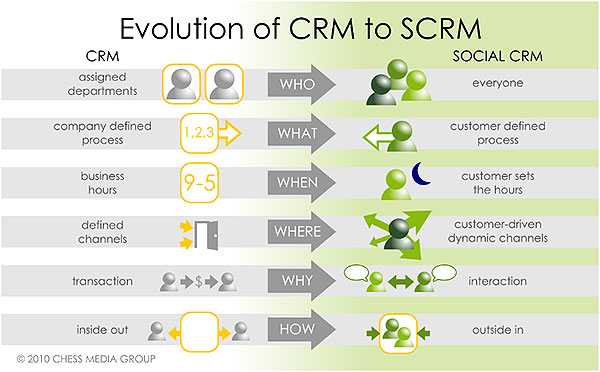
    While in many ways social media has become the new face of Customer Service(because traditional Customer Service is completely out of touch with customers ) the above case is a sure sign that the biggest brands in the country need to do a better job of their Social CRM. In a way Social CRM takes over where traditional CRM left off. Unfortunately traditional CRM still operates on a 9am to 5pm basis and they wouldn’t care a hoot what happens to customers once they leave their office. Social CRM on the other hand is 24×7. Because customers may need help at any time of day or night.


    What is Social CRM?
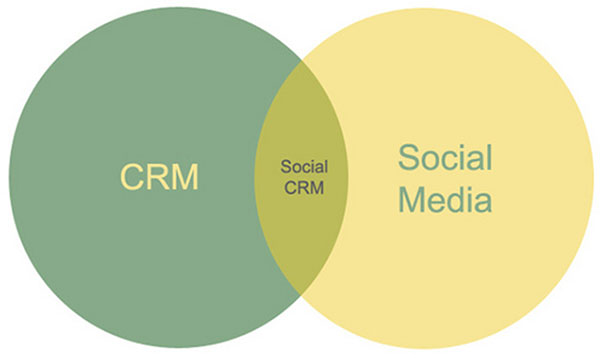
    But first of all let’s start by defining Social CRM. Social CRM (customer relationship management) is a phrase used to describe the addition of a social element in traditional CRM processes. Social CRM builds upon CRM by leveraging a social element that enables a business to connect customer conversations and relationships from social networking sites in to the CRM process. Social CRM may also be called CRM 2.0 or abbreviated as SCRM (social customer relationship management).


    Social CRM takes over where CRM left off
    People under 35 spend almost four hours on social media, and more of that time is being spent engaging with brands. One piece of research has shown that the volume of tweets targeted at brands and their Twitter service handles, for example, has grown 2.5x in the past two years. Similarly, the percentage of people who have used Twitter for customer service leapt nearly 70%, over a two year period. McKinsey’s analysis shows that 30% of social media users prefer social care to phoning customer service.
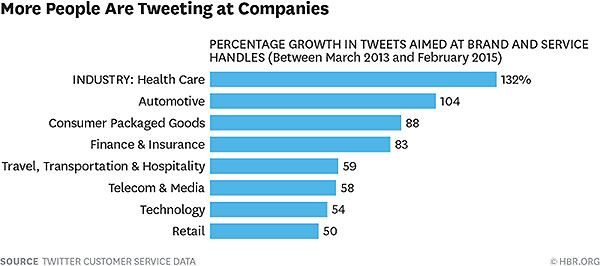


    The most successful social media interactions are personal, genuine, and relevant. To scale that connectivity requires integrating social media data into your CRM system.


    You could be forgiven for treating the idea of “social CRM” with a certain amount of scepticism. It just sounds like a buzz word. Also it is sometimes hard to distinguish the hype around social media from the genuine value it can bring. But social CRM isn’t a gimmick, and it doesn’t ask you to “forget everything you know” or “reinvent your business”.


    Social CRM simply adds a social dimension to the way you think about customers and your relationships with them.


    Given the current state of customer service, Social CRM would be an important weapon in the armoury of brands that have large number of customers. Its not enough to just have a twitter handle or a Facebook page. That doesn’t complete your Customer Service or your Social CRM.


    Why is Social CRM important?

    It’s a familiar story. Marketing departments are diligently creating and publishing tweets, Facebook posts, and YouTube videos, carefully crafted to make the most of each channel and designed to encourage sharing, retweeting and customer engagement. But the audience doesn’t come.


    Meanwhile, your customers are elsewhere on Facebook and Twitter, having conversations about your organisation – discussing you, recommending you, complaining about you and even trying desperately to talk to you. But they’re not getting the answers they want.


    Social CRM bridges the gap. No more forcing customers to use the channel you prefer. No more losing track of issues when they change channels. You can engage and respond to customers individually and in the way they choose.


    With Social CRM you can place your customer right at the heart of your organisation.


    Veteran adman Prabhakar Mundkur is currently Chief Mentor at HGS Interactive

     

  • Internet users to cross 450mn by mid-2017: IAMAI-IMRB


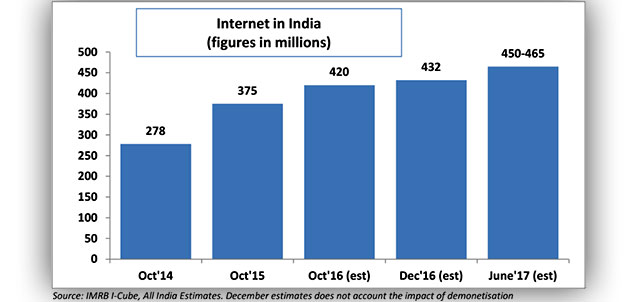
    It’s raining surveys and studies in the A&M industry. But this one is sure to be quoted in various forums through the year. The number of Internet users in India isestimated to be 432 million in December 2016according to a report ‘Internet in India 2016’, jointly published by the Internet and Mobile Association of India and Kantar IMRB on Wednesday. The number of Internet users is expected to reach between 450-465 million by June 2017.


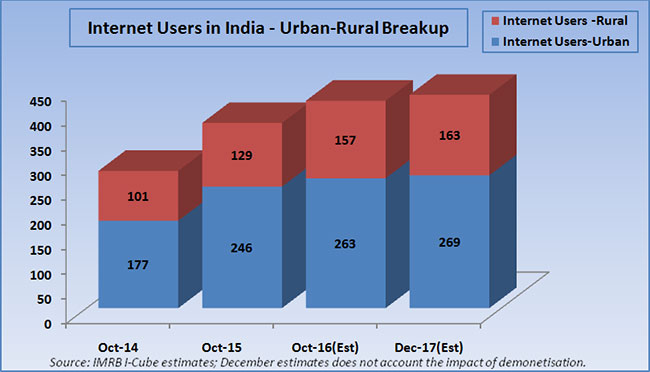
    While the growth of internet usage in India is mainly being fuelled by the rural sector,the urban user base starting to show signs of levelling out.


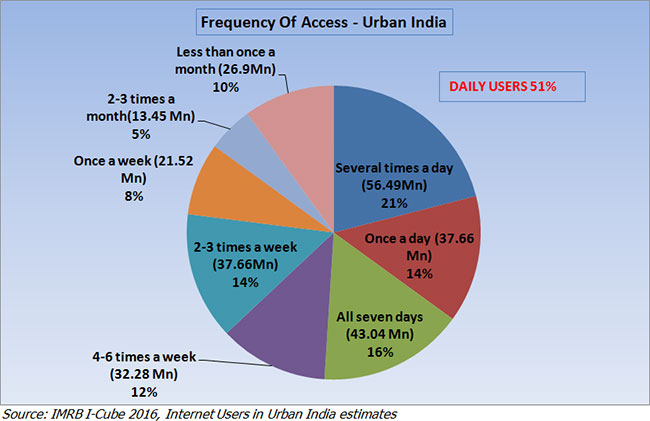
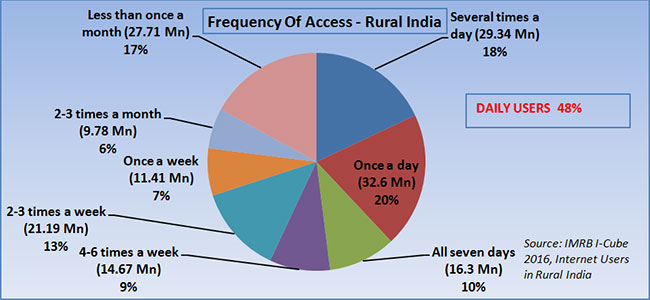
    In Urban India, there were estimated 269 million internet users in December 2016, while in Rural India, there were 163 million Internet users. The report finds that urban India has close to 60% internet penetration,reflecting a level of saturation. However, with Rural India having only 17% penetration, there is still large scope of development.


    The future growth policies therefore must focus on bridging the digital divide that exists between urban and rural India today. In terms of numbers, Urban India with an estimated population of 444 million already has 269 million using the internet. Rural India, with an estimated population of 906 million as per 2011 census, has only 163 million internet users. Thus, there are potential 750 million users still in rural India; if only they can be reached out properly.


    Frequency:

    The report also finds that 51% of urban Internet users or 137.19 million use internet daily. On the other hand, 242 million or 90% of the urban internet user’s user’s use internet once a month.


    In Rural India, 48%or around 78 million are daily internet users. On the other hand, around 140 million or 83% of the rural internet user’s user’s use internet once a month.


    Gender:

    Among the Rural Internet users, the ratio between male to female Internet users is 75:25. The proportion of Internet users by gender in Rural India has seen much change over last year with Internet users among rural females growing at 30%. The increasing gender parity in internet usage is a welcome development.


    Demographics:

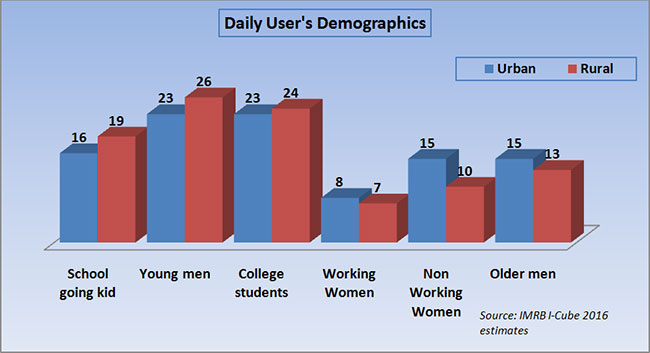
    An analysis of ‘Daily Users’ reveal that both in Urban and Rural India, the younger generations are the most prolific users of internet. The gender ratio is slightly better in Urban India, while both urban and rural India show almost similar ratios of working and non-working women registering as daily internet users.


  • Amazon Prime Video announces deal with Lionsgate

    By A Correspondent


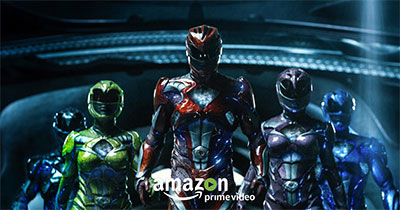
    Amazon and Lionsgate announced a long-term exclusive deal that will make Prime Video India the subscription streaming home for hundreds of Lionsgate’s top acclaimed films, television episodes and upcoming new releases. Blockbuster movies like La La Land, which has grossed over $370 million at the worldwide box office and won six Academy Awards, event films including Deepwater Horizon and The Divergent Series: Allegiant and upcoming 2017 releases Power Rangers, The Shack and others will also be exclusively available only to Prime members, and will not be available on satellite or pay Television.  Rohit Tiwari at Morris Street Advisors, which represents Lionsgate in India, negotiated and closed the ground-breaking deal.


    “It is awesome that Lionsgate has partnered with Amazon Prime Video to bring its original, daring and highly acclaimed content to Indian customers.” said Nitesh Kripalani, Director and Country Head, Amazon Prime Video India. “We know our Prime members are going to absolutely love the selection of award winning films, indelible characters and unforgettable stories from edge-of-the-seat thrillers to spectacular action to heartfelt drama – in true Lionsgate style.”


    “Our collaboration with Amazon Prime Video India is the latest example of our commitment to bring world-class, award-winning movies and television series to the Indian market and its viewers,” said Lionsgate President of Worldwide Television and Digital Distribution Jim Packer. “We’re very pleased to partner with Amazon as they continue to transform the face of entertainment in India and bring our premium film and television content to their viewers.”


  • WATConsult to manage Brussels Airline’s digital media strategy


    WATConsult has won the social media mandate of Belgium’s largest airline, Brussels Airlines. WATConsult will be involved in the digital media strategy planning for the brand’s Indian presence along with the content creation and design across its social media platforms.


    Speaking on the same, Rajiv Dingra, Founder and CEO of WATConsult, said: “As an avid traveller, I have always seen Brussels Airlines as one of the best airlines in the world. It is exciting to have partnered with them and bringing this world class brand to India.”


    “Social Media and digital in general, has become a very important marketing channel for Brussels Airlines over the last few years. As we enter the Indian market for the first time, it is important to have a strong partner in order to raise awareness about the Brussels Airlines brand. We firmly believe that WATConsult is the right partner for us to do just that,” said Patrick Roofthooft, Brussels Airlines Director Commercial Development India.


  • AirAsia India dedicates latest digital campaign to women

    By A Correspondent


    Acknowledging International Women’s Day, AirAsia India has released its latest campaign #FlyWithAirAsia that celebrates Indian women who revel in their individuality, with aspirations that transcend rules.


    Speaking about the concept of the film, Amit Agarwal, Head of Content, Circus Elephants said, “When the client shared the concept they had for Women’s day, we knew that we had to design it not only to get the brand guidelines right, but also make an impact on the audience who will be hailed with lots of women centric messages during that time. The challenge was to make it different yet very relevant to what the brand stands for – the aspiration to fly.”


    Said Kiran Jain, Commercial Director, AirAsia India: “We take great pride in our women every single day.  Today being International Women’s Day, we pay tribute to all the women around the world who continue to break barriers to achieve their dreams.”