Category: Digital

  • Digital Summit: Business in the time of the cloud

    By Akash Raha


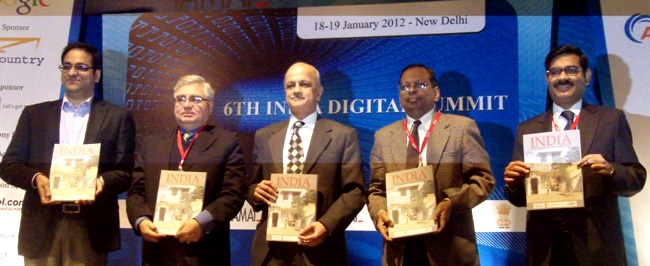
    The second day of the Sixth India Digital Summit hosted by IAMAI and Ministry of Information & Technology got underway in Delhi on January 19, 2012. The last day of the summit featured a wide array of discussions and debates between prominent members of the industry.


    Leadership Session 3: The connected home: devices and service revolution

    In the current scheme of things there is a proliferation of newer devices. Each and every day there are a plethora of newer devices coming in the market. To support all these devices a new service industry came up to support them. The session spoke about the nexus of devices, connectivity and the service sector in the back drop of the nuances of the industry, such as security.


    The session was chaired by Mr Sanjay Trehan, Head MSN India, Microsoft and the stage along with him was shared by Mr R Sivakumar, Managing Director, Intel South Asia.


    The discussion started off with Mr Sivakumar talking about the connected home. He said that the times have changed from connected homes to connected life. Earlier, Home was where the first use of technology begins. We have been using technology over the past decade without knowing about it. But some of those ideas are fast dissipating as our devices are no longer wired and we can move outside the periphery of our house and hence the idea of connective life.


    As technology has developed, the proliferation of devices too has increased. He said that the technology in the future will be dominated by three screens out of all the new devices based on convenience and ultra mobility – smart phones, netbooks and large television screens.


    He spoke about the growth of ecommerce and gave the example of the Indian Railway site irctc.co.in which does business of Rs 500 cr each month. The service provided is getting more sophisticated and more available as time goes by. With proliferation of device and connectivity, services provided online are increasing.


    When posed a question on security threats by Mr Trehan, Mr Shivakumar said that the security capabilities are still at its early stages and have to be built on. In terms of new technology, the bogey that we often ride is the talks of national security. National security and integration of security protocol is very important and yet there has to be ways to streamline the whole process and allow newer technologies to come in.


    Power Panel 7: Cloud Cluedo – Solving the mysteries surrounding the cloud

    The following session tried to unveil the mystery of cloud computing technology. Even though everyone in the technological domain are talking about this technology and its use, few people know about the intricacies of it, which the panel tried to unveil. Cloud computing gives one the ability to put business applications on the ‘cloud’ which would then make it possible for the users to access it from wherever he or she wants to.


    The following session was moderated by Manoj Chugh, President India & SAARC, EMC Corporation while the panelists were Mr Fredric Moraillon, VP – Marketing, Asia Pacific & Japan, Akamai Technologies and Rajnish Menon, director – ISV & Cloud Strategy, Microsoft.


    In his opening remark Mr Chugh explained that there are various kinds of clouds, such as Private Clouds and Public Clouds… Moreover, there is a whole mix of these clouds which gives rise to Hybrid Clouds of all shapes, sizes and colors. Cloud computing saves cost of infrastructure and will help businesses grow in the future, thereby creating new job opportunities. Moreover, while the old skill sets are going to remain important, new skill systems are needed for Cloud.


    According to sources, 50% of the cost of infrastructure can be saved when a business employs and moves their infrastructure to the Clouds. The initial cost of the infrastructure will depend on what kind of a Cloud it is. No two clouds are alike and clouds constantly grow and make newer clouds.


    Mr Menon explained to the audience that Cloud is very useful as it standardizes IT capabilities. To show the efficacy of cloud, he pointed out how all the fortune 500 companies have some sort of Cloud or the other. The point is, that Cloud is already here and is all pervasive.


    The next question that Mr Menon talked about is, is Cloud secure? The answer that he proposed was, yes, it is one of the most secure one as authority is given to only one or two who can see all the data. For those who wondered how costly cloud is, Mr Menon told that “Cloud is really cheap, but it depends on what applications you are using etc.”  In terms of regulation, currently, there is no cloud law in place in India and it is all about interpretations of the other existing laws.  Cloud computing has therefore become a new way in which one can deliver and consume IT.


    Talking about the cloud, Mr Moraillon said “From the Cloud perspective the consumer and the business are constantly merging.” He said that one can put anything on Cloud…But the question is what do you want to put on the cloud but the question is what the security level you have to secure that data is? Information is of value and it is important to keep it in the vault. But yet Cloud is useful as it is helpful and makes work and processes much easier. “You can do a campaign, a budget, file travelling expenses etc… Cloud can do all of that very easily and efficiently.” Today, one feels disconnected when ones hard disk crashes – a lot of hard work goes away, but such a thing does not happen with Cloud as the data will be present and secure on the cloud.


    The three important aspects which Cloud is efficient on is Time, Money and Labour; Wherein, it saves time and money, and allows employees to work just the way they want to work, from wherever they want. In the modern times markets are extremely fragmented and clouds helps adapt, open newer avenues to connectivity and the way work is done. The only possible concern that some businesses still have today is that of accessibility and security, however, cloud is developing and is developing fast. It is imperative that businesses move to cloud to be successful in the future.


    The panelists explained that one should move easier process on the cloud first and then go on to bigger process which have legacy and are relatively harder to move. But to start moving to the Cloud, maintained all the panelists, is essential.


    Power Panel 8: “To be or not to be an Entrepreneur”

    Being an Entrepreneur and building a business out of the scratch is never easy. In the current session the panelist discussed and talked about their difficulties in becoming successful Entrepreneurs. The talked about their experiences and shared their visions with the crowds.


    For many, starting a venture was a triggered by their situation, for some it was a choice and for the rest it was a mix of the two. The session was moderated by Manish Vij, Founder and CEO, Vun Network. The panel members for this session were Dhruv Shringi, Co-Founder & CEO, Yatra.com; Dinesh Aggarwal, Founder & CEO, IndiaMart; Rishi Khiani, CEO, Times Internet and Anisha Singh, Founder & CEO, Mydala.com.


    Mr Shringi said that currently the entry barrier is low to get into the business and it is a very good time for people to get into the business as the growth rate is good. Yet, Mr Aggarwal warns that people should not get into the business just because there is opportunity and growth. What is really required is a will to do ecommerce.


    To start off a business, funding is an important issue… Ms Singh pointed out that to garner funding and make profit eventually one has to have conviction in once business. Funding is tough and one has to have the ability to convince the investor, moreover, immense trust in once own vision is required.


    A few of the members in the panel also had a co-founder and investor… Talking about the aspect, Mr Khiani said that it not important that your partners are like you and think like you, but it is important that they have the same vision as you and believe in the product as much as you do.

     

  • The Impact of Internet in India


    By A Correspondent


    Access to Internet and broadband are widely regarded as catalysts for economic and social development of a country. A number of research studies have demonstrated the positive impact that Internet and broadband penetration have on national income (GDP) as well as its transformative impact on businesses and livelihoods. Internet (among other means of access such a fixed line or mobile) is increasingly viewed as an efficient mechanism for accessing information.


    Several case studies have highlighted the role that information can play in inspiring economic activity and good governance. In this sense, information can be viewed as a public good, access to which yields positive externalities. Internet allows better access to information and hence the existence of ubiquitous information infrastructure becomes a key input to the efficient functioning of markets and government.


    One of the chief tasks of this report is to provide a compelling basis for government intervention in the internet market in general and broadband in particular.


    Scope of study:

    To the best of our knowledge this is the first study that systematically investigates the growth impact of Internet and broadband at a sub-national level. India is ideally placed for such an analysis because it has more diversity within its borders than any other country. Over 1.2 billion people live and work in India in very different circumstances and geographies. Yet critical telecommunications policy is formulated at the national level and applicable across the country. The study would be incomplete if it failed to demonstrate the manner in which Internet and broadband create growth impacts.


    Assessment of internet and broadband impacts – international experiences

    Two broad approaches have been used to measure the economic impacts of broadband and Internet; these are the input-output method and the multivariate regression analysis.


    The former technique relies on input-output matrices to estimate the impact of broadband infrastructure deployment on output and employment generation in a country.


    The latter are largely international cross sectional studies that attempt to gauge the impact of broadband infrastructure on economic activity by establishing a causal link between broadband deployment and economic growth.


    An influential and widely cited study in this genre is the World Bank inquiry into the economic impacts of Information and communication technologies (ICTs) including broadband (Qiang et al 2009). It draws its intellectual inspiration from Roller and Waverman [rW] (1996, 2001), who were the first to quantify the positive impact of investment in telecoms on the economic growth of a country. The research suggests that the contribution of broadband to economic growth is indeed substantial, and may be more profound than comparable narrowband or voice-based ICTs. The study finds that 10 per cent increase in broadband penetration boosts GDP growth by 1.38 per cent in developing countries.


    Many other studies support the growth-dividend hypothesis for broadband. McKinsey & Company found that 10 per cent increase in broadband household penetration delivers a boost to a country’s GDP that ranges from 0.1 – 1.4 per cent. Booz & Company found that 10 per cent higher broadband penetration in a specific year is correlated to 1.5 per cent greater labour productivity growth in the next five years.


    The point of departure for this report is to measure the Internet-growth linkage within the national boundaries using the multivariate regression model.


    Analyzing the growth impact of Internet in India

    India’s teledensity has shown extraordinary growth since private participation was allowed in the sector, rising from less than 1 per cent in 1998 to 61 per cent on September 3, 2010. Several studies have found that the telecommunications infrastructure is one of the significant factors in economic growth, alongside others such as overall investment, education, energy and transportation networks. Despite the rapid growth in mobile penetration rate – an acknowledged driver of growth – India lags behind other countries in Internet and broadband penetration. Based on TRAI data, while there were 687.71 million mobile subscribers as of June 2010, the corresponding numbers for Internet and broadband were 17.9 million and 10.31 million respectively. Net additions in broadband subscribers are merely 0.2 to 0.3 million per month compared to around 15-18 million mobile connections.


    The benefits and externalities associated with greater Internet and broadband penetration are far too significant to wait for the market to deliver these outcomes. India’s federal structure, with some states such as Uttar Pradesh, Maharashtra, and Madhya Pradesh having significantly higher population and geographical area than most European countries, readily lends itself to such analysis.


    Moreover, balanced regional development has always been an objective and therefore studying the impact of telecom’s liberalization across states will provide valuable insights for this policy aim.


    While the rapid spread of mobile telephony has been the most visible demonstration of the benefits of telecom sector liberalization, attention needs to shift to data and Internet. Accordingly, we attempt to answer three questions:


    • What is the impact of Internet penetration on state growth rates?
    • Do less-developed states show a greater impact of Internet penetration?
    • What is the mechanism by which Internet affects growth; and what are the constraints, if any, which limit its impact.


    Our first major finding is the existence of a positive and significant coefficient on Internet. The result shows every 10 per cent increase in Internet subscribers delivers, on average, 1.08 per cent increase in output. Accordingly, Indian states with higher Internet penetration can be expected to grow faster. What it means is, if Bihar had half as many Internet subscribers as Punjab, it would have resulted in an increased growth of 7.02 per cent in state per capita income.


    We also estimate the impact of mobile telecommunication on growth in order to compare it with the growth impact of Internet; the model is the same as used in the 2009 study (ICRIER 2009).


    The coefficient for mobile penetration that 10 per cent increase in mobile penetration delivers, on average 1.5 per cent increase in GDP, is a marginal increase from the earlier estimate of 1.2 per cent in 2009. Given the low Internet penetration levels in India, it is not surprising to find a lower growth dividend for Internet than for mobile (1.08 versus 1.5).


    (Extracts from the report by the Indian Council for Research on International Economic Relations along with the IAMAI and the Government of India’s Department of IT)


    Shruti Pushkarna’s interview with ICRIER’s Rajat Kathuria, who has co-authored the report with Mansi Kedia-Jaju.


    [youtube width=”400″ height=”200″]http://www.youtube.com/watch?v=fzagYBZ19AQ&hd=1[/youtube]

    On the findings of ICRIER study on impact of internet

    The finding of the study is that an increase in internet penetration by about 10 per cent leads to GDP effect of 1.08 per cent, which means that for every increase in internet, we are going to get GDP impact. And this is fairly a large impact but we hope that once internet reaches a critical mass we’ll have even larger impacts.


    Right now internet penetration in India is fairly low, so we haven’t reached what’s called critical mass. But once critical mass is reached, this impact could go up to even 1.5- 1.8 per cent.


    But even at 1.08 per cent, it’s a fairly large impact. So the manner in which internet is beginning to impact India is through small things such as overcoming the constraints of alternate infrastructure, lack of roads, lack of information, and internet is able to breach that gap fairly efficiently and quickly.


    So what internet is doing in India today is allowing small businesses to access information, allowing students to get access to information they never had, allowing doctors to expand the scope of their geographical activities, and if you aggregate all these little impacts that internet is having at the level of entrepreneurs, at the level of individual experts and then at a much higher level, at what it’s doing to a huge retail outlet, to say a WalMart; it improves the supply chain of an entity like WalMart as it improves the efficiency of a farmer or a doctor.


    So internet can have impact across the spectrum of activities, social and economic impacts. And those impacts are beginning to show up in India.


    [youtube width=”400″ height=”200″]http://www.youtube.com/watch?v=eOBMiKpLBM4[/youtube]

    On the recommendation of ICRIER study on impact of internet

    The recommendations of the report are as follows: If you wait for the market to deliver these outcomes, internet will happen, it will eventually happen but it might take a bit too long because private sector is not interested in making such huge investments in the core infrastructure.


    The secretary has recently announced a Rs20,000 crore fund just to lay optical fibre across the country to connect the 250,000 gram panchayats. The private sector is not going to do this because the gestation period is very high and the revenue stream is uncertain.


    But once the government does it, and that’s what we are recommending, the government should shortcircuit this process, otherwise internet and broadband will grow in islands clusters in India. In Gurgaon, Delhi, Ahmedabad and other cities, they will get good internet connectivity and the rest of the country will be deprived.


    In fact, it should be the other way round, we need internet connectivity more in areas where the other infrastructure is weak. So what we are recommending is, short circuit this process, overcome the market failure.


    The government should become a protagonist in investing huge amounts of money upfront and then the private sector will deliver what it does best, create business models around infrastructure.


    [youtube width=”400″ height=”200″]http://www.youtube.com/watch?v=QtjCaItw0lY[/youtube]

    On constraints faced in documenting ICRIER report on impact of internet

    If we had access to more data…one of the constraints we faced in documenting the report is access to information, and if we had better quality information, we could have come up with probably more robust estimates. The estimates would not change maybe but we would have more confidence in the robustness of our estimates if we had improved quality of data access. But that’s something we have to live with in India.


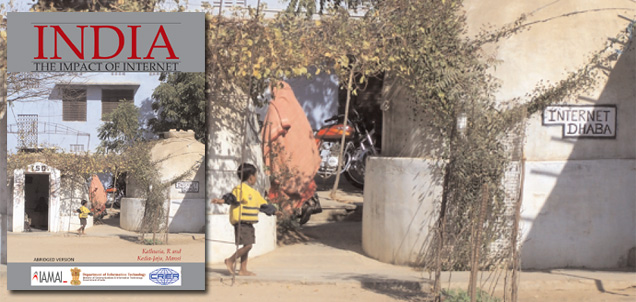
    Image courtesy: cover of ‘The Impact of Internet’.

    Copyright 2011 ICRIER
    All Rights Reserved
    Cover Photograph by Digital Empowerment Foundation


  • Full-service mobile offering for Mindshare India

    By A Correspondent


    Being an early practitioner in offering mobile media solutions to clients in India may have paid off for Mindshare India. Having rolled out a dedicated mobile practice division in India in 2006 may have been one of the big factors in Mindshare India being appointed as the network’s Mobile Marketing Centre of Excellence recently. As per the new development that came into effect last week, Mindshare India will now be responsible for driving mobile thought-leadership and establishing best practice with the rest of the network as well as developing and nurturing new talent. In addition, India will also act as a production hub for mobile content production needs, including mobile web sites, augmented reality and online advertising units such as Apple’s iAds. The Indian full-service offering will extend to everything from mobile strategy to ideas to actual development.


    The Centre of Excellence team will be led by Ashok Lalla, Leader, Digital Mindshare South Asia. He will be working with Vinod Thadani, Regional Director – Group M South Asia.


    Sharing his thoughts on the progress the division has made over the years and the possible reason for India being chosen as the country of choice, Mr Lalla said, “We have invested in the Mobile Marketing space over five years and have developed a very talented team along the way. We have also done a lot of excellent work in the Mobile space which has received plenty of global and national accolades. This track record and the availability of top notch trained talent made India the natural choice for Mindshare’s global Mobile Marketing Centre of Excellence.”


    On the immediate changes that could be expected on the talent front, Mr Lalla said, “We are putting together a scalable team including operations that will be responsive to the fast changing mobile marketing space and also serve as the production centre for all Mobile marketing requirements for Mindshare worldwide.”


    Applauding the Indian unit for the honours bestowed upon it, Norm Johnston, Global Digital Leader said, “The Mumbai office has consistently been at the forefront of driving innovations in mobile marketing. We want to tap into this expertise and share it throughout our network. Our clients are increasingly looking for smart, cost-effective mobile marketing solutions given the exponential growth in smartphone and tablet penetration and the corresponding uptake in mobile Internet usage.”


    When asked whether there would be a change in the way it deals with its siblings from other parts of the globe, Mr Lalla stated, “We are sure that as other networks recognize the quality of the Mobile marketing talent and work coming out of India, they too will look to India to lead Mobile initiatives for them.” In fact, Mindshare India proposes to establish and socialize Mobile marketing best practices and learning opportunities to the rest of the Mindshare network, he said.


    Though a market leader by a huge margin, Mr Lalla is positive of the growth that will come out from its mobile unit in India. “We see Mobile marketing services as a key driver of the overall growth of our Digital business in India. Both in terms of absolute numbers from Mobile marketing services provided, as well as through other Digital marketing services that would be required to complement Mobile.”


    While it may be too early to cite the impact of this development on the growth of the division, Mr Lalla is very clear on the focus for the division. “Our focus will be to build a scalable team structure that delivers to the needs of our global network effectively and efficiently. And also use best practices to build valuable brand assets which include Mobile internet sites, applications for different platforms and campaign production capabilities that can be deployed quickly. Also, as said earlier, our key aim would be to keep growing our Excellence in Mobile Marketing services not just within the Mindshare network but across the global Mobile marketing landscape.”


  • Yatra.com on lookout for a creative partner

    By Shubhangi Mehta


    After providing TBWA with its creative mandates in August last year, yatra.com, the travel porch has once again called for a creative pitch. The account size then was pegged to be around Rs15-20 crore.


    Before TBWA, Yatra.com had appointed Rediffusion Y&R as its creative agency in 2009; while Leo Burnett was the official agency in 2007.


    The online travel company entered the market in August 2006. It had initially appointed Everest Brand Solutions as its creative agency, and Mudra’s media agency, Optimum Media Solutions (which was re-christened Mudra Connext), handled its media duties.


    Yatra Online Pvt Ltd. is a travel company providing information, pricing, availability and booking facility for air travel, hotels, buses and car rentals across 5,000 large cities and small rural areas around the globe. It acts as a complete tour planner for travellers and is a one-stop shop for every travel need.


  • Tribal Fusion is now world’s 2nd largest digital display ads provider

    By A Correspondent


    Tribal Fusion, the global online advertising provider owned by Exponential, is the world’s second largest source of display advertising, according to comSCORE’s December 2011 rankings of the leading global display networks.


    Site reach measurement service comSCORE reported that Tribal Fusion’s premium publisher network reached more than 490 million unique users globally, behind only Google (1.2bn) and just head of AOL Advertising (477m), which includes its advertising.com ad network subsidiary.


    The company said the new ranking reflected its growing global presence and increased demand from brand advertisers for campaigns that take advantage of its rich-media capabilities to offer more engaging creative executions.


    Dilip DaSilva, founder and CEO of Tribal Fusion and parent company Exponential, said: “Brand advertisers across the globe are increasingly looking for new ways to leverage digital media to connect with their prospective customers and are looking for the same kind of high-impact and emotionally engaging creative messaging that they get from traditional TV advertising. And beyond just reaching their prospective customers, our tight integration with our publishing partners, allows brands to connect at scale with prospective customers using high-impact, engaging messaging.”


    Founded in 2001, Tribal Fusion has expanded across the globe and now operates offices in 37 locations worldwide including theUnited States, Canada, Mexico, Brazil, United Kingdom, Spain, Germany, France, Saudi Arabia, United Arab Emirates, South Africa, India, Thailand, Malaysia, Singapore, Indonesia, Philippines, Hong Kong, Australia and New Zealand.


    “Digital media can be accessed by visitors in any country; as a result most premium publishers attract a global audience. Through our ability to monetize publisher inventory in so many countries, we have now become the partner of choice for premium publishers in every country,” said DaSilva.


  • Publicis Healthware launches India presence at Health 2.0

    By A Correspondent


    Publicis Healthware International (PHI), part of Publicis Healthcare Communications Group (PHCG) – the largest healthcare communications network in the world, has launched Health 2.0 inIndia.


    PHI is an integrated agency focused on improving communications across the health & wellness community, with a strong eHealth and information technology focus. As one of the largest global digital agencies, PHI has developed a strategy which focuses on three key service offerings: consulting (innovation planning, change management and e-business strategy), communications (digital marketing, web development, e-detailing, e-CRM, e-learning, e-science, health 2.0 and KOL management) and eBusiness solutions (software platforms, business solutions and proprietary tools to increase the deployment of the digital tactics).


    Publicis Healthware International (PHI) will be based in Mumbai and would be spearheaded by Abhijit Shitut, Jt. Managing Director and Kiran Pai, Jt. Managing Director at Publicis Life Brands Watermelon.


    Roberto Ascione, President of PHI is currently in India to launch the new PHI presence, as well as, to promote its most recent product, Videum.com, a global health video portal able to globalize video assets leveraging an exclusive subtitling technology and featuring unparalleled search engine optimization.


    Ascione spoke on his plans for the Indian market at the Health 2.0 conference inDelhi: “Indiais an emerging information superpower. The digital medium is catching on fast with more and more people becoming web-savvy.Indiahas the largest population of new users after theUSandChina. Healthcare needs are growing and so are awareness levels. People are demanding better and more effective healthcare solutions. In fact, ‘healthcare’ is one of the most searched and Googled words inIndia. Launching PHI will help us widen our reach and aid us in getting a strong foothold inIndia.”


    Ashley Kuchel, President of PHCG, APAC, further elaborated: “With a growing focus on providing clients an enhanced digital experience, the launch of PHI inIndiastrengthens our position in this sector. With this initiative, we hope to increase our APAC footprint and become a formidable digital entity inIndia.”


    Abhijit Shitut echoed the sentiments: “Today, every healthcare client inIndiahas digital ambitions. Our clients for a long time have been demanding a keener expertise in digital solutions.”


    Kiran Pai added: “With PHI’s products and capabilities now added to the Publicis Life Brands portfolio, we can now call ourselves a full-service healthcare agency that would enable us to provide more focused and integrated campaigns; empowering client businesses to grow manifold.”


  • How (and why) marketers love social media


    By Rishi Vora


    There is sooooo much happening in Social Media. Every brand – no matter how big or small, every media and entertainment company, especially film and television content (where YouTube has become such a rage!), even a local mall or a retail outlet owner in a small district is looking to be on Social Media, where he feels he should be before his neighbourhood rival is, and win more customers.


    Although this might sound as if Social Media is a disparate measure for brands, the fact is that the market is responding to the rise of a new medium which is a just about a three-year-old phenomenon; one which promises to change the game as far as marketing is concerned.


    There are many cases of brands benefiting from the social space, be the whacky Old Spice videos that did the trick in 2010 – yes, they were a set of videos, but became most popular on Social Media or Kolaveri Di, which became an online sensation. Or whether it is the case of Megan Fox meeting Rose Boy back in 2009, thanks to Kodak that took the initiative of taking it to the masses, through Social Media of course, offering the winner a handsome $5,000. There are many more stories where brands have recognised the opportunity and made the most of it. Celebrities have now become a key asset to the marketing strategies for many online brands.


    Traditional Media:

    Even the radio channels and newspapers danced to the tune of Social Media, a rare case of digital beating traditional media hands down. But the TV Channels and content companies are the ones taking the most advantage of the new medium.


    Akash Chawla, Marketing Head – National Channels, Zee is of the opinion that the percentage spends on digital has seen an increase and social media is one direction where most channels are putting their focus on. “We’re not the only ones to have entered the social space. It’s important to be there. But, the fact is that being on social media is also a fad. It is stylish and fashionable. The medium is highly measurable, and you get real time responses from consumers.”


    Even participants of Zee TV’s flagship reality show Dance India Dance Season 3 claim that watching videos on YouTube has encouraged participation in the show.


    Star Network too has been fairly active in the space, promoting all of its entertainment channels on platforms like Facebook and Twitter. And so as Viacom 18, MSM Group.


    Social Commerce:

    Yet another aspect of the social media – social commerce- as a trend started last year, and as experts believe that 2012 is going to be a year when Social Commerce will take off in a big way. Three of the most upcoming and prominent social commerce platforms are: Facebook (f-commerce), Twitter (t-commerce) and GuruLike.


    F-commerce or f-comm refers to the buying and selling of goods or services through Facebook, either directly or through the Facebook Open Graph. Experts forecast that F-commerce transactions on Facebook will overcome Amazon’s annual sales ($34 Billion) over the next five years.


    The emergence of social media has resulted into a sea change as far as the marketer’s psyche is concerned; who a couple of years back was unsure how the medium fare for the brands. He has now realised the true potential and as a result has started to appoint specialists for the job. This has resulted in the rise of specialist social media agencies- people who evangelised the medium three to four years back and who’re now well-equipped to handle marketing problems, using the power of social media.


    Social Wavelength and Windchimes are the two most popular pure play social media agencies, while there are other digital agencies that offer 360 degree digital solutions (where social becomes one part of the offering). And then there are PR agencies that have now expanded into offering social media services to existing clients. Hanmer & MSL Group, Ketchum Sampark, AdFactors and many others. Though these agencies pitch for social media businesses separately, they have the added advantage of an existing PR clientele.


    Sanjay Mehta
    Sandhya Sadananda

    Social media and creativity:

    Though different agencies follow different processes, there is a misconception which plays in the minds of many that Social Media does not need creativity; there is not much of strategy involved, as against other forms of advertising.


    Sanjay Mehta, Jt. CEO, Social Wavelength clarified: “Executing a good social media strategy is a mix of two disparate skill sets: One is creativity, like that of an ad agency, to differentiate the social media activity of the brand, and second: processes, of the kind that one usually associates with KPOs, as social media is not a campaign, but virtually a day-to-day, minute-to-minute business process.”


    Sandhya Sadananda, who prior to launching Windchimes, was a PR professional, explains how Social Media is not an extension of PR. “Unlike the US and the UK, PR in India is still a media-led activity. When you are in Social Media, you need to rethink the way you look at communication. Social Media cannot be seen as an extension of PR. Unlike PR, here you have the direct control in terms of the content you want to put up. At the end of the day, it is about adding value to the brand. And that could be in terms of content, the creativity, the number of fans and so on.”


    The nuts and bolts:

    So how do Social Media campaigns run? How different the approach needs to be? What are the systems and procedures that need to be followed? How does a social media agency scale the operations?


    Mr Mehta explains: “The starting point is to create a ‘character’ for the brand on social media. All communication, tonality and so on has to be in sync with the brand positioning and the brand’s character. For a TV channel, a social media campaign will typically have one set of conversations centred around the brand, and the other additional set of conversations to go closer to the interests of the target group.”


    From the standpoint of the marketer, however, the question which most often arises is: ‘Does social media help clients improve bottom lines’. This is also one reason why spends on social media are way too less in comparison to other media. Yes, these are early days, but pure play social media agencies have to grow and that is seen as a big challenge.


    Ms Sadananda affirms: “One needs to look at social media, not from a bottom line perspective, but from the point of view of qualitative engagement. The ROI in this business is so much number driven (number of fans, interactions) that people started to equate that with the bottom line. If you’re expecting increase in sales after a social media campaign – that’s not going to happen. One needs to have a different sort of mindset when it comes to social media.”


    She adds: “It’s very easy for marketers to make this just another medium. Agencies need to step in and help them understand the true nature of the medium.”


    Challenges:

    On the challenge for agencies to scale up their businesses, Mehta reckons that one needs to visualise the scale, in terms of the opportunity. And then investigate into various ways of creating an organisation, bringing in leadership levels and correcting/ tweaking the model as business grows to ensure smooth sailing.


    But, broadly, it is content that will decide the fate of specialist agencies. And, that in experts’ mind, is a bigger challenge. Adaptation will be the key as platforms evolve, users evolve. It is an age of e-commerce, and Social Commerce is not far behind.


  • Amazon enters India via Junglee.com

    By Correspondent


    The world’s largest online retailer is tiptoeing into India, using cover from a comparison shopping site Junglee.com it acquired 13 years ago.


    Amazon, whose moves have been closely watched for any sign of an imminent entry into the Indian retail market, will not sell or buy anything in the country for now. Instead, it will direct customers to both online and offline vendors listed on Junglee.


    Amit Agarwal, vice-president of Amazon, would only say Junglee would “help customers discover products from online and offline retailers in India and from Amazon.com”. He declined to say more about the company’s plans.


    Conspicuously missing from the list of vendors on the Junglee site is Flipkart.com, India’s biggest online retailer founded by two former Amazon executives. Flipkart expects to post sales of Rs 500 crore by March 2012. Amazon ended 2011 with revenues of $48 billion (about Rs 2.5 lakh crore).


    “Its recent moves to set up a fulfillment centre (in Mumbai) and now the Junglee launch certainly look like precursors to a retail launch whenever the government allows FDI in multi-brand retail,” said Devangshu Dutta, CEO of retail consultancy Third Eyesight. A legal expert at one of the country’s largest law firms said Amazon was making a ‘clever entry’.


    Agarwal said Junglee will display over 1.2 crore products and 14,000 brands for Indian consumers. The company has also launched Amazon seller services in India where vendors can hook up to Amazon’s portal to acquire customers.


    Source:The Economic Times

    Copyright © 2012, Bennett, Coleman & Co. Ltd. All Rights Reserved


  • Gadgetsguru gets hyperactive, launches brand campaign

    By Archita Wagle


    An eye-catching full page ad in the Times of India on Monday morning spoke of “Demo kahin bhi lijiye, shopping gadgetsguru.com par hi kijiye”.


    Asked why the big bang route, Arun Kapoor, CEO-gadgetsguru.com said: “This is purely a branding ad. We are trying to increase our brand awareness.”


    Mr Kapoor goes in depth about the strategy adopted, explaining the reason for coming up with an ad just now: “There is a lot of competition from other online portals. Every other portal will offer you Cash-on-Delivery, 30 days warranty and other sops. So we created a whole new funda. Instead of competing with the online industry, we decided to take the offline industry (the retailers and the wholesalers).”


    While offering branded products to the customers, the online portals lose out due to the fact that the customer doesn’t get a demo of the products he may want to buy. Even when a person goes to buy an expensive item from a shop, s/he will  go to 10 different shops to find out about the best deal they can get. “A person buying products online can’t get a feel for the product he wants to buy. So we are telling him/her that they can go to a shop to get a demo of the product they have their eye on; but they should buy it from us as we give them the best deal they can get,” Mr Kapoor explained.


    Gadgetsguru.com was founded by Mr Kapoor in 2004. The website and the backend support was developed in-house. When asked about what was the reason for coming up with such ads now, Mr Kapoor said: “When we started in 2004, the first few years were not so great. The first year saw sales of just Rs1.25 lakhs. It didn’t make sense at that time to give out such full page ads. Now that we have established ourselves, we decided to increase our brand awareness. Also we have recently been affiliated with Brand Capital, Bennett Coleman & Co. Ltd’s offering (earlier called ‘private treaties’. We have got a budget of Rs30 crore for the next three years thanks to the tie-up. So we decided to for it now.”


    [youtube width=”400″ height=”200″]http://www.youtube.com/watch?v=-b5JSmWtvnc[/youtube]

    Gadgetsguru.com is not just coming out with print ads, but have also launched TVCs which take a tongue-in-cheek look at “bahanas” that consumers give to avoid buying a product after they take a demo at the shop. The TVCs show a boy running out to avoid buying a tablet by telling the salesman that he is allergic to tablets; a man refusing to buy a refrigerator because the door faces south instead of east; and a woman running out of the shop on the pretext of testing the zoom on a digital camera. The voice-over at the end tells us “Demo kahin bhi lijiye, shopping gadgetsguru.com par hi kijiye. Faayda aap hi ka hai.”


    The TVCs were launched recently when the promos for the Zee Cine Awards  started to be aired. Gadgetsguru.com is the associate sponsor for Zee Cine Awards.


    In fact, Mr Kapoor promises that radio and online ads will be launched in the next 15 days. When asked about what they would be talking about, Mr Kapoor refused to say anything.


    Not only that, gadgetsguru.com has launched a campaign on Facebook which promises the person coming up with the best bahana a chance to win a BlackBerry.


    The creative mandate for gadgetsguru.com’s ad campaign has been handled by   Manoj Motiani, Founder & Chief Creative Officer of Thought Bubbles. Mr Motiani was formerly a creative director with O&M. “We decided to give the creative mandate to Thought Bubbles as Manoj Motiani is a good friend,” explained Mr Kapoor.


    Gadgetsguru.com is on a roll. After launching a branding campaign, they are now looking at providing services in countries such as Singapore, Malayasia, UAE andcUK. “We will be starting our services in Hong Kong,DubaiandSingaporein the next three months. We are looking at tie-ups with the major market players who have a reputation of expertise in electronics market. We will create a sub domain for that particular country so that people in that country and surrounding areas can buy from there. We have been getting a lot of orders from South-east Asian countries,” said Mr Kapoor.


  • Cricket gets even more interesting with Zapak’s Cricville

    By A Correspondent


    Zapak.com, India’s leading gaming portal, announced on Tuesday the official launch of Cricville, a social cricket game on Facebook. This is Zapak’s second initiative in the social gaming, first one being Zapak Tambola. Before the official launch, the game was launched in the open Beta testing phase and got rave reviews.


    http://www.insidesocialgames.com/2012/02/06/social-cricket-game-cricville-aims-to-hit-a-six-on-facebook/


    Cricville broadly follows the IPL-pattern gameplay where the user can own a cricket club and work towards making it bigger and better. The user can work as a club manager, and build the club’s city and stadium. S/he can also hire a coach to train and upgrade the players’ overall performance.


    Users can choose from an array of exciting modes to play. These include Challenges, where the users can throw challenges to their friends on Facebook; Tournaments which will help increase the user’s rankings and in turn help the user’s chances of winning Gold, Silver & Bronze trophies. The users can also play practice matches to improve their overall skills. The game also allows them to upgrade their players by improving their batting, bowling and fitness to score over their friends.


    Speaking on the launch of Cricville, Manish Agarwal, Chief Operating Officer – Reliance Entertainment – Digital Business, said: “Cricket is not just a game but a complete religion by itself in India. With IPL just round the corner, this is the perfect time to launch Cricville, which follows an easy and competitive gameplay that will appeal not only to cricket fans but also to other gaming enthusiasts on Facebook. Zapak wants to tap the Indian-themed games segment which offer universal appeal on Facebook and what better way to spearhead that other than Cricket.”


    Zapak Digital Entertainment Ltd. is India’s largest gaming company that addresses the complete value chain of digital gaming. With currently 8 million registered gamers, Zapak.com is not only the largest casual gaming sites in the country but amongst the top casual gaming sites in the world. As per a recent survey on an average a user spends about 21 minutes on Zapak.com, which is way higher than the average time one spends on any gaming website.


  • CarTrade to take a creative ride with Salt Brand Solutions

    By Shubhangi Mehta


    Salt Brand Solutions have registered their first win of the year by walking away with the creative business of CarTrade.com. Agency sources close to the development have confirmed the news to MxMIndia.


    The win is a result of a multi-agency pitch. There wasn’t any incumbent on the account. The account size of the same is estimated to be Rs6-8 crore.


    CarTrade.com was launched in October 2006 by Akshay Shankar and Nick Silderhuis. The website was founded to provide more transparency to the Indian car and bike market, so that vehicle buyers and sellers are able to close better and more informed deals, in a more efficient way.


    CarTrade.com isIndia’s largest online vehicle market, where buyers and sellers of used and new vehicles can meet and deal. It caters to buyers and sellers of new cars, used cars, new bikes and used bikes. It is a comprehensive vehicle platform, offering finance, insurance and other such services, too. In 2009, CarTrade.com was acquired by MotorExchange.in, a solution for business buyers and sellers of vehicles.


    Salt Brand Solutions is an agency, founded by Mahesh Chauhan and Minakshi Achan, advertising stalwarts, that offers holistic brand solutions.


  • Madhu Trehan & Co to show journos the mirror with Newslaundry.com

    By Shruti Pushkarna


    With the ‘want to turn the mirror’ on themselves, the latest offering from the world of news is the launch of a website called Newslaundry.com. With their unique and explicit tagline, ‘Newslaundry – sab ki dhulai’, the agenda is set from the very beginning. A website which will work as the media’s watchdog.


    The site was launched on February 6 and is the brainchild of one of the pioneers of modern-day news journalism in the country: Madhu Trehan. Ms Trehan founded Newstrack, a video news offering, and newsmagazine India Today.


    The website has been launched with a four-member team and a few others on board. Abhinandan Sekhri, one of the founding partners told MxMIndia: “Newslaundry founders are Madhu Trehan, Prashant Sareen, Roopak Kapoor and Abhinandan Sekhri. We have three in-house writers, other than the founders. We have video editors, production people and directors.”


    So why did Ms Trehan start this? What did she have in mind before she launched Newslaundry? We have the answer from the lady herself. Madhu Trehan told MxMIndia: “It evolved between my partners – Abhinandan Sehkri, Prashant Sareen and Roopak Kapoor. I have always enjoyed creating a product that doesn’t exist. That happened when I started India Today. The leading magazine at that time was The Illustrated Weekly, which belonged to a dated post colonial time. Newstrack was developed because there was no television news other than Doordarshan. Newslaundry is a product which is not a clone of any other website in the world. The nature of it creates a new space.”

    So, could she not have done a similar media analysis show on mainstream television instead of doing it online? Ms Trehan was candid in her reply when she said: “It is because we did a media analysis that showed a channel is a losing proposition, so we chose to go online.”


    However, Mr Abhinandan Sekhri indicated that they did try and go the television way at first: “We did try. We mentioned such a show to various TV channels but they were not ready to put it on their own channel. Also we have so many ideas and so many shows we want to make, and no channel will give us that kind of time. Besides, this is the future. The new irreverent generation consumes media online through mobile devices. Sooner than you think, more people will be consuming media in the online space than conventional TV/magazine. Time will tell which ones work better than others but one thing is for sure – there has to be a change in how we tell our contemporary political and social narratives. News has to be more than it is right now.”


    On whether there is space for such a media website, Sevanti Ninan, Editor, The Hoot, commented: “Yes, there is. There is so much media and so little media watch. There is room for more entrants in this space.”


    Ms Ninan echoed Mr Sekhri’s views on how no television channel is open to self-criticism. “Where is the mainstream TV channel which is willing to carry criticism of itself and its peers?”

    Even though slowinternet speeds could be hurdle in an uninterrupted visual experience online, Ms Ninan is sure that the site will ‘click’ with viewers. She said: “Journalists love gossip. I think Newslaundry.com will click with them, particularly on account of the interviews with media biggies. What Barkha Dutt or Karan Thapar or Vinod Mehta say will give them something to gossip about. The interviews are a strong point.”


    Ms Trehan believes the website will work because “it answers a need that is not fulfilled yet.” In fact Ms Trehan seemed confident of the differentiating factors that NewsLaundry brings to the table. She said: “The difference is that we are combining all of today’s technologies. We have text articles called Criticles. We have what we call Washboards; these are a combination of text, videos and links. We have TV shows webcast. We have cartoons. You cannot do all that on a TV channel. We have the freedom to be far more irreverent. Mainstream TV does not make journalists or journalism accountable. That’s what we aim to do. We ourselves are open to being accountable.”


    On being asked on the revenue channels for the website, Ms Trehan replied that they expect revenues from the usual places. As for now, there are partnerships on with Google (and YouTube). Mr Sekhri added: “Advertising is the obvious immediate way, but in future, this space is going to change dramatically with podcasts and apps. And if anyone wants to put it on air on their channel, we’re more than happy to. We think stuff like this should be on TV too. Being able to take a dig at yourself is a sign of self-confidence which news channels need to have. And if anyone wants to pay us coz they think we deserve it, write in your cheques. Online is the future.”