
Category: MARKETING

  • Indeed unveils new brand campaign

    By Our Staff


    Indeed, the job search app, has unveiled a new campaign that connects job seekers with relevant work opportunities.  Built on the theme of ‘Let Jobs Find You’, Indeed’s goal is to continue to create awareness among all job seekers. The ad campaign is conceptualiced and created by DDB Mudra.


    Said Nishita Lalvani, Director,  Indeed India and SEA: “Having observed the Indian labour market scenario for close to more than a decade, we strongly understand the unique perspective and requirements of Indian job-seekers, and offer customised solutions to help India get to work.”


  • Yardley London launches new campaign with Kriti Sanon

    By Our Staff


    Yardley London has launched a new TV commercial on its range of perfumes. In the TVC, actor Kriti Sanon is the voice of the brand. The commercial has been conceptualised by Contract Advertising.


    Said Manish Vyas, CEO, Wipro Yardley: “While Yardley has always been known for its fine floral fragrances, through this new range, we intend to bring affordability to the consumers who always inspire to use world class Yardley perfumes. We intend to democratize the usage of safe, branded and international quality perfumes and make it accessible to Indian masses.”


    Added Sagar Mahabaleshwarkar, CCO, Contract: “Our core insight was to drive home the fact that Yardley perfumes are more than just their exotic natural fragrances. The idea was to empower people in making a lasting impression while stepping up in the professional world and their daily lives, with renewed freshness.”

  • Happy 30th, little monk!


    By Avik Chattopadhyay


    Avik ChattopadhyayApart from being the International Labour Day, May 1 also happens to be the birthday of personalities like Balraj Sahni, Gordon Greenidge and Joseph Heller. And the Maruti Suzuki Zen.


    It was launched on that date 30 years ago, at the Maurya Sheraton hotel in New Delhi. Unveiled by then Finance Minister Pranab Mukherjee, the Zen went on to become one of India’s most loved brands. Codenamed ‘YE-2’, the little car was a big gamble that both Maruti and Suzuki played in the early 1990s as a new vehicle made for a new ‘liberalised’ India. For those of us who remember, 1991 is when we entered the third phase of our nationhood, the first being Independence in 1947 and the second being the emergency of 1975. This was a new India, wanting to open up to the world and dismantling the red-tapes and licence-controls that defined us in the first four decades of our development.


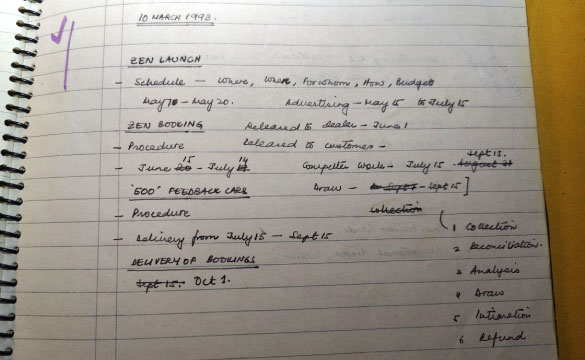
    Page from my notebook with notes on the Zen launch plan, dated 10 March 1993.


    The Zen defied convention. It was almost the same size as the popular Maruti 800 yet was a very different personality, beyond mere mechanical specifications. While it did have an aluminium engine as a novelty and major talking point, it did not rationally justify the price difference it commended over its older sibling. Till then, a product had to be physically larger than the other to command a higher price. The more the metal, the more the price. That was the only way to demonstrate greater value. Not with the Zen. It demonstrated that aspects like design, touch-and-feel, refinement, dynamic performance and comfort were, in combination, a higher value proposition than competition, even from your own family.


    Till 2006, the brand was built as a combination of some clever communication and lots of positive word-of-mouth. In fact, when launched in 1991, it took time to gain public liking. The Indian customer was used to the metal-price equation and the Zen was challenging that. The early adopters did the task of building the initial buzz around its performance and refinement that crucially helped in its gradual adoption and popularity. The initial seven / eight months were an actual struggle. While the network was given lots of “selling tools”, the value proposition was built only when the initial customers swore by it and the automobile journalists praised it sky high. I call this the “Sholay Effect” of hugely successful brands taking time to gain momentum from being almost written off, just like Sholay did.


    Magazine covers on the Zen in May-June 1993 – courtesy Team BHP


    There were four elements in the way the vehicle was launched which together helped build its formidable equity. First was the Suzuki badge on the vehicle. It was the first Maruti product to carry it, subtly stating that this was an ‘international’ product in the Maruti portfolio. There was a move to have the Maruti badge on the vehicle, but that was dropped in favour of the international narrative.


    Second was a term coined to describe its styling – ‘jellybean’. That was the best way to explain its harmonious lines, soft curves and aerodynamic shape, from the front bumper to the rear lights. That term caught the fancy of the media and it was all about jellybean styling after that.


    Third was the ultra-smooth all-aluminium engine which was so refined for its time that many, including Wikipedia, think the name Zen stands for ‘Zero Engine Noise’.


    Which brings us to the fourth element…the name Zen. It was given by me, in a competition within the company. The then director of marketing and sales Kozo Senga liked the name Zen. I explained that the vehicle was exactly as a Zen monk – you have the power within your outer calm that should be used responsibly and only when required. The vehicle looked sedate when parked but was a rocket when revved. Zen it was!


    Rare pic of a YE-2 with the Maruti badge in the plant – taken in Jan 1993


    The initial advertising for the Zen did not work. Though all the still photography was done by the amazing Hardev Singh, the advertising agency and the marketing team went overboard with the positioning statement of “Engineered for Exhilaration”. Nobody could either pronounce it properly or remember the statement. Thankfully, the word-of-mouth had started working its magic so the advertising really did not matter. The brochure however was a very popular item and almost all walk-ins into Maruti showrooms wanted one. It was a distinct square shape and the product in all its glory was the hero. Hardev Singh’s photography did the trick. People basically wanted a test drive and a brochure. Heady times indeed!


    Zen launch brochure of 1993 and one of 1996


    In 1994, the Zen started being exported to various countries, especially those in Europe. Badged as the Suzuki Alto, it was on the streets of London, Paris, Berlin and Rome. This made it the ‘world car’ for Maruti and India and that is what the next communication campaign was all about. This really worked in further building the brand’s appeal as the Indian was now driving exactly what a Londoner or Parisian was.


    By now, the sales numbers and growing popularity allowed the engineers in Gurugram to plan modifications and variants. A diesel Zen was launched in 1998 housing a Peugeot engine. Though it did not do very well, it demonstrated the company’s and brand’s engineering prowess as a trend setter. In 1999 a variant called the Zen Classic was launched but did not go well with the Indian design sensibilities. The reversals did not hold the company back from trying yet new things to cater to the Zen-clan.


    In 2000, Maruti launched the Alto and the WagonR, both hatchbacks catering to the same demographic target segment. In light of newer siblings, the Zen started losing some if its sheen and some crucial intervention was needed from both the product planning and engineering teams. To commemorate the tenth anniversary of the little monk, Maruti Suzuki did possibly its most audacious move of launching a limited edition 2-door Zen, exactly as it was sold in Europe. Out came 300 Zen Carbons in gleaming black and 300 Zen Steels in svelte silver, each vehicle individually numbered and badged. Even though just 600 units, they took the market by storm, being lapped up by both youth into their first jobs as well as retired couples. The brand was back in the reckoning with a very disruptive step. It was a statement that while the Alto and WagonR were selling in Japan, the Zen was being sold in Europe.


    The Zen Carbon and Zen Steel welcome letter – 2003


    Closely following the Zen ‘singles’ as they were called was a major restyling of the vehicle to give it a steroid boost. It did create some flutter primarily due to a high-decibel marketing campaign but the vehicle was on its old tired wheels. It had its best chance when Suzuki was planning its next big global launch in India codenamed the YN-4 in 2005. This vehicle would again disrupt the market in the way it looked and performed, just like the YE-2 had done 12 years ago. This should be the new Zen. That is the only way the legend could be revived in its new avatar. An attempt was made in the top circles to carry the Zen badge forward through this new vehicle. Consensus was otherwise. The new vehicle became the Swift, yet another uber successful brand till today.


    And the Zen? Well, a half-hearted attempt was made by slapping the name on a car that was a completely different personality from the Zen. It was called the Zen Estilo and launched in 2006. Thankfully the customers saw through the feeble game quicker than Maruti Suzuki had anticipated and the product sank without a trace in 2009. Thereby laying to rest one of India’s most loved and aspired for automotive brands, ever.


    Best wishes of the day, little monk.

    Rest easy!


  • Kinder Joy brings Tom & Jerry and Hello Kitty collectibles

    By Our Staff


    Kinder Joy, the confectionery brand of Ferrero, manufacturers of sweet-packaged products, has launched its new TVC campaign continuing with the tagline ‘Iss Mein Kuch Khaas Hai’ in India. With this new TVC launch, the brand is now announcing their limited-edition Kinder Joy range of Tom & Jerry and Hello Kitty toys.


    With these limited-edition collectibles, Kinder Joy continues to strengthen its position in the Indian confectionery market and increase brand loyalty among its customers. The limited-edition collectibles are also likely to attract collectors of all ages who appreciate the uniqueness and novelty of the limited series.


    Speaking on the campaign film, Amedeo Aragona, Regional Marketing Manager Indian Subcontinent – Kinder Brands at Ferrero said: “We are excited to bring Tom & Jerry and Hello Kitty to India, as they have a great appeal with kids and adults. The new collection will have new figurines which are very different from the previous launches. And we can’t wait for the kids to experience Kinder Joy’s latest range. Also, the use of Applaydu app makes it extra special for the children to learn along with the parents.”


  • Fitterfly launches campaign to fight diabetes

    By Our Staff


    Fitterfly, a  health-tech company, has launched the #WorryNot campaign, a multi-platform initiative to support people living with type 2 diabetes. The campaign aims to help people live worry-free, happy, and healthy lives with the help of technology and personal coaching.


    The three films launched as part of the #WorryNot campaign showcase the daily struggles of a person with diabetes – especially food restrictions, lack of motivation to exercise, and the effect of blood sugar fluctuations on sleep. These relatable situations are portrayed in a light-hearted manner followed by the coaches’ interventions which make life easier for the character.


    Said Dr Arbinder Singal, Co-Founder and CEO, Fitterfly: “Science and technology have advanced and it is now possible for people to know what exactly works for their blood sugar and defeat diabetes in a simple and worry-free manner. We need to get this message across to each and every person living with diabetes. We want to create awareness and hope, inspire them to take action and live better. Our #WorryNot campaign is aimed at collating a huge bank of user-generated content about the daily struggles people living with diabetes face, and to provide them with a support system comprising of nutritionists, clinicians, fitness experts, and physios, as well as psychologists. We believe that with the right guidance, people with diabetes can enjoy their daily life without any worries.”


  • Saif Ali Khan roped in as brand ambassador for Dollar hosiery

    By Our Staff


    Dollar Industries, hosiery brand has collaborated with Saif Ali Khan as the face of Dollar Lehar,the affordable product segment of the brand. The new ad film conceptualised by Lowe Lintas, Kolkata and directed by Uzer Khan is set in the backdrop of Rajasthan.


    Said Vinod Kumar Gupta, Managing Director, Dollar Industries Limited: “The lines of distinction between top metros and the rest of India is fast blurring when it comes to making a fashion statement. Increasing disposable incomes coupled with the aspiration to look as stylish as their metronome brethren cuts across Tier 2 & Tier 3 cities. As India’s homegrown innerwear brand, we decided to create a level playing ground for both our premium and economy segment and therefore we needed a communication which would appeal to these new evolving consumer segment who aspire for value-for-money fashion. The first step in that direction was to rope in Mr Saif Ali Khan to add to the style quotient of Dollar Lehar and then have a communication that would reflect his uber-cool persona through a witty plot and a memorable execution in the campaign Mastiki Lehar.”


  • TBWA creates campaign for TVS Ronin motorcycle

    By Our Staff


    TBWA creates campaign for TVS Ronin motorcycle to showcase the confluence of modern and retro worlds of motorcycling. The motorcycle has been engineered ground up with unique tech features like Dual channel ABS, Rain and Urban modes and Bluetooth connectivity with voice and Ride Assistance, in a retro design package. Its brand philosophy- Live the Unscripted life – stems from the motorcycle’s unique capabilities, in the city and on the open road.


    Vimal Sumbly, Head Business – Premium, TVS Motor Company said: “The TVS RONIN motorcycle has been designed from a blank canvas to reflect the spontaneous, fluidic, versatile and multi-faceted young rider of today. We want our viewers to know there is no right or wrong while living life on your terms. The brand inspires them to explore new things and varied experiences in life without fearing the result. We want them to live the #Unscripted life. And with the TVS RONIN, we are opening many possibilities for them to do it.”


    Govind Pandey CEO TBWA India, the agency that conceptualized the idea for the brand, said: “TVS RONIN, the motorcycle defies categorisation. It appeals to modern day ‘Ronins’ who refuse to be boxed, people who are open-minded about possibilities. People who have a knack for making connections between seemingly unconnected people and situations . And creating unexpected surprises. This film represents a serendipitous merger of two genres that ends up creating something unexpectedly delightful.”


  • Jindal Stainless and Social Panga Release Mother’s Day Film

    By Our Staff


    Jindal Stainless along with integrated creative and digital agency Social Panga has launched a digital campaign this International Mother’s Day (May 14). The film highlights how our lives tend to make more sense when our moms are around.


    Head of Corporate Communications, Jindal Stainless, Sonal Singh, said: “This campaign is dedicated to the backbone of our homes, the true heroes whose selfless love and sacrifices for their children knows no bounds – our mothers. Though the campaign storyline connects a mother’s unconditional love to home-cooked food, the connection between a mother and child is far more universal and deeper. We hope the campaign rekindles our gratitude towards our mothers.”


    Gaurav Arora, Co-Founder of Social Panga, added: “The idea that ‘when a child moves away from their home for the first time, they often face the initial struggle of making it on their own’ is everyone’s story. Our aim was to encapsulate that feeling with the selfless love of our mothers, so the audience can find their own story within this movie. As a corporate brand, Jindal Stainless itself has thousands of employees living outside their homes, and thus, the movie brings the point home in the sense of the employees finding the advertising efforts of their employer, relatable.”


  • Saif Ali Khan roped in as brand ambassador for Dollar hosiery

    By Our Staff


    Dollar Industries, hosiery brand has collaborated with Saif Ali Khan as the face of Dollar Lehar,the affordable product segment of the brand. The new ad film conceptualised by Lowe Lintas, Kolkata and directed by Uzer Khan is set in the backdrop of Rajasthan.


    Said Vinod Kumar Gupta, Managing Director, Dollar Industries Limited: “The lines of distinction between top metros and the rest of India is fast blurring when it comes to making a fashion statement. Increasing disposable incomes coupled with the aspiration to look as stylish as their metronome brethren cuts across Tier 2 & Tier 3 cities. As India’s homegrown innerwear brand, we decided to create a level playing ground for both our premium and economy segment and therefore we needed a communication which would appeal to these new evolving consumer segment who aspire for value-for-money fashion. The first step in that direction was to rope in Mr Saif Ali Khan to add to the style quotient of Dollar Lehar and then have a communication that would reflect his uber-cool persona through a witty plot and a memorable execution in the campaign Mastiki Lehar.”


  • IPL16 ads: They don’t make ’em like it anymore


    By Sanjeev Kotnala


    Sanjeev KotnalaI am a loyal IPL follower, and I watch the match telecast every evening. The quality of telecast and the options for the viewer have increased exponentially. However, that cannot be said for the ads telecast on IPL. Watching them makes me overtly nostalgic. In earlier IPL seasons, the brand and agency people invested much more effort into crafting and developing the advertisements. It is much more about media muscle and frequency than the craft today. Somewhere high frequency seems to be a substitute for creative content.

    IPL 2008, the first edition, had everyone excited. It was expected to become the Super Bowl equivalent for advertising in India. Today, IPL is one of the richest sports leagues, with two months-plus of excitement and engagement, delivering eyeballs and loyal enthusiasts on digital and TV. IPL advertising almost defines the advertising spending trend for the nation. It should be common sense that the brands wanting to exploit the IPL matches across the season need multiple creatives to avoid overexposure and audience apathy. Unfortunately, the advertisements hardly reflect the thinking. The advertisement content and creative lack high engagement. It makes me think- They don’t make them like it anymore.


    IPL- everything is not lost.

    A few brands stand out in the scores of brands trying to effectively use the IPL platform across TV, OTT and Digital.


    RuPAY

    RuPay, with its UPI plus credit card communication, is an excellent example of focused communication. All three advertisements are interesting and engaging. The ‘Silver Helping Hand’, ‘Catch Expert- Chaos in Museum’, and the ‘Slippery Spy- mole’ are fun to watch and communicate the message.

    Unlike the Tata Tiago example of reasons to go for an E-SUV, which may not be the best and most effective way for the brand. Do people still need reasons to buy an electric vehicle!


    DREAM11

    DREAM11 has been consistent through the IPL seasons and has always worked on ‘All will play’. This season is no different. The brand continues the good work. The Bollywood and cricketers’ interactions as opponents in the game are engaging and funny. ‘Lal Singh’, ‘You don’t go for awards’, ‘Dialogue Delivery’, ‘Viral’, ‘All is well’, ‘Duplicate‘, ‘Lagaan’, ‘Riaaz’ and ‘Retake‘ are a few of the ads. Hope to see more situations in the rest of the matches.


    MYCIRCLE11

    MyCircle11 has also done well with its ‘Second prize 1 crore- toh pehla prize kya hoga‘ communication, continuing the Giant theme and format. However, the situations and the excitement are missing as the idea becomes a prisoner of the format. And for some reason, the 2023 videos are unavailable, and even the site showed Jeeto 1 crore everyday campaign in 2021.


    AMAZON

    The ‘Aaj Amazon se kya Khareeda’ series is another set of communication that makes the point while engaging the audience. It slowly builds on categories- the order size and common everyday items.


    IPL ADS- ALL-TIME FAVOURITES

    All of us will have different advertisements telecast with IPL seasons as favourites. Here are the ads that stand out. If I have missed some really good ones- do let me know.


    VODAFONE ZOOZOO

    The Vodafone ZOOZOO would rank as an all-time favourite of all IPL ads. The way the ads were conceived, executed, released, and the build-up was well planned and executed. In fact, they were produced and timed with the IPL season.


    AMAZON CHONKPUR KE CHEETAHS

    My other favourite of mine has been Chonkpur ke Cheetah by Amazon. Even today, in the Amazon ads, telecast on IPL16, the brand is extending the same- similar concepts like A-to-Z, Aapni Dukan, and a platform for everything, including your everyday items. Chonkpur was another instance and example of IPL-specific communication. The slow unveiling of the journey of Chonkpur ke Cheetah was well planned and executed, keeping the excitement high.


    CRED – NOT EVERYONE GETS IT.

    When the ‘Cred – Not everyone gets it’ series started, it had a mixed reaction. But, the way the series progressed and the brand kept unleashing fresh creative starring another popular celebrity, it grew on you as an audience. A well-thought-through and executed campaign.


    SWIGGY, NO ORDER IS SMALL.

    Swiggy and Zomato both exploited the audience’s interest in watching the telecast. They have offered various schemes to make people order during the matches. However, what stands out are Swiggy ads of ‘No order is small’ and ‘What is the score’. It also introduced the actor who became known as Swiggy Uncle and was featured in many more TV films.


    ADD-ON

    Not IPL Ad- but the Kid-adult format by FLIPKART was an engaging experiment killed by overexposure and format constraints.  Another series that was engaging and interesting was Voltas Murthy.

    Similarly, Make My Trip’s consistent use of celebrity Alia, and Ranveer Singh continues to be superbly executed with its own fun quotient while delivering the message. However, that cannot be said for Ranbir Kapoor – Asian Paint ads which lack engagement- proving that consistent use of celebrity is not the solution and the content remains the king.


    NET-NET

    Want to associate with IPL and exploit the platform? Then the brand must understand that the ads are the real breaks and the interruption in the audience’s interest. And the season is long, and the media cost is too high to associate. The brand message should be simplified and relayed to the audience through multiple creatives to keep the engagement levels up and excitement with the brand. Do invest in creative development and execution even at the cost of losing out on frequency of exposure. An excellent /Good creative exposed less number of times is a far better proposition than a mediocre/average creative exposed many, many times.

    Just for the suggestion watch this ever favourite ad of mine. Ericsson One Black coffee ad.
     

  • Zoomcar announces brand campaign

    By Our Staff


    Zoomcar, the marketplace for car sharing in emerging markets, has announced its first large scale brand campaign #ApniHiSamjho that depicts ahost-guest connect. With this campaign Zoomcar expects to see users have a better understanding of the marketplace model.


    Said Greg Moran, CEO and Co-Founder Zoomcar:“We are excited to go live with our new brand campaign #ApniHiSamjho that was created to showcase and build our Guest-Host community. #ApniHiSamjho is the overall tagline of the campaign that articulates the true spirit of our platform.  We believe a brand campaign should ultimately tell a powerful story. At its core, it’s about translating this story for people in such a way that we clearly demonstrate the value that we create for them. Whether you’re a guest or a host, you come to the Zoomcar platform with the expectation that we can help serve your requirement.  We believe this campaign helps satisfy this need, whether a guest embarking on a trip or a host pursuing an entrepreneurial opportunity.”


  • Center fruit onboards Harmanpreet Kaur

    By Our Staff


    Center fruit chewing gum from the house of Perfetti Van Melle has unveiled its latest campaign ‘Mood Ting Tong League’. The brand has roped captain of the Indian Women’s cricket team – Harmanpreet Kaur and digital influencer RJ Sukriti.


    The brand through this digital series aims to mirror India’s passion for sports, especially Women’s cricket through the idea of gully cricket, and bring alive the fervor.


    Commenting on the campaign, Gunjan Khetan, Marketing Director at Perfetti Van Melle India, said: “Cricket holds a special place in the heart of every Indian, and we believe it is crucial to also celebrate the immense talent and potential within women’s cricket. With the Mood Ting Tong League campaign, we are not only embracing India’s passion for cricket but also striving to shine a spotlight on women’s cricket. By featuring Harmanpreet, who embodies the dynamism of women’s cricket, we hope to inspire a new wave of enthusiasm among fans. Through our ting tong way, we aspire to create an inclusive and empowering cricketing experience that resonates with both existing fans and new audiences alike.”