
By Rasul Bailay
India’s successful malls say multi-products and multi-brand chains (Westside, Pantaloons, Shoppers Stop and Lifestyle) have outlived their utility as anchor tenants at least in malls in metro cities and may find relevance in smaller cities.
Such malls are either evicting these brands altogether or relocating from their showcase ground floors to less attractive upper or basement levels and offering space to the new global brands which will generate higher revenue per square feet, add to the mall’s appeal, bring in the young crowd who is also likely to spend at the food court.
Barely months after Select Citywalk Mall in Delhi relocated once-anchor Pantaloons department store to a smaller space on the upper floor, Westside store has exited from the Ambience Mall in Vasant Kunj. In Mumbai, In Orbit Mall in Malad is relocating Lifestyle department store to the lower ground floor from the ground level to make space for Swedish brand H&M while Oberoi Mall is shifting Future Group’s multi-product store Central from ground floor for Zara and H&M.
“We would rather have a Zara or a Mothercare as our anchor tenant that brings their full range in a 4,000-5000 sq ft than these multi-brand chains,†says Arjun Sharma, chairman of Select Group that operates Select Citywalk that relocated Pantaloons from its 20,000 sq ft space to 8,000 sq ft on the first floor. “Brands like Westside are slowly going away (from large malls) and they will get replaced by a Forever 21, H&M probably or a Zara. It is part of normal churn,†Sharma said.
In order to accommodate coveted global brands, a lot of other brands have to contend with lesser attractive space. Ambience mall is relocating Jumbo Electronics and another brand to lay the red carpet to H&M and Gap and signed a closure deal with Westside. A person at Ambience asking not to be named said Westside exited before the lease ran out because it was “working out either for the mall or for Westside.â€
“We need to understand that the visitors’ profile have been changing and aspirations are going up and the mall is basically a partnership between the customers coming to the mall and the retailer and if we do not change, they will start going to some other mall,†says Mukesh Kumar, vice-president at Infiniti Mall in Mumbai that is moving Reliance Trends to the lower ground floor from its 15,000 sq ft on ground and first floor to bring Gap.
“The people coming to the mall want new brands so we have to keep evolving.†Prominent mall owners say India’s shopping centre landscapes have been drastically changing over the years with brands like Zara becoming anchor tenant and not traditional supermarket Big Bazaar or a Shoppers Stop department store. Market watchers say footfalls at malls have been drastically impacted due to the emergence of a host of e-commerce companies in India that is luring consumers with deep discounts and hassle-free shopping.
Mall owners say brands like Zara, H&M, Gap, Sephora and Starbucks bring in the footfalls and keep the malls buzzing. They also bring the moolah for the malls as most of them currently operate on a revenue-sharing basis with brands. That’s is why all the successful malls in India are keen to have the above global brands in their shopping centres.
Kumar of Infiniti Mall in Mumbai says generally malls share revenues with fashion brands in the range of 10% to 12% but one mall was so bent on getting H&M into its fold that the mall agreed for a revenue- sharing of just 6.5%. Most of the malls say that there is still some steam left in the homegrown department store chains.
“Globally, this kind of department store concept has diminished in importance. I think in India you will see them around for at least half a decade or even more,†says Suresh Singaravelu, executive director at Bengaluru-based Prestige Group that operate malls is the city and building malls in other southern cities.
He says change is already happening. For example, Tata-owned Westside has started selling gourmet food and increased footwear and sports items.
Source:The Economic Times
Copyright © 2015, Bennett, Coleman & Co. Ltd. All Rights Reserved
Licensed to republish

 Close on the heels of its new brand overhaul and fresh content line-up, Zoom recently adopted a high visibility 360 marketing campaign that uses rich mix of media targeting key demographics in focus markets. As part of its marketing initiative, it has wrapped up an entire air-conditioned train – both, exterior and interior – on the Mumbai Metro line with the channel’s logo, ad creatives and colours. In addition, Zoom also put up over 200 hoardings across Mumbai, Delhi and Bangalore at prominent, high traffic zones and has activated a print campaign across 37 cities.
 Over the years, Godrej HIT has been at the forefront in building awareness against pest borne diseases through its ‘Kill Pests Kill Diseases’ campaign. Driving the initiative in a big way for Godrej HIT is its variant – Kala HIT that has executed many successful education campaigns through media and on-ground activations to fight diseases like dengue and malaria.


 Truecaller has launched its first-major brand campaign – “Take the right call†- marking the company’s foray into the world of advertising & marketing. Truecaller’s “Take the right call†campaign has been designed in line with the company’s efforts of providing users their right to know who is calling them. It also allows them to make the most of the opportunities that may otherwise pass by unknown. The digital film features popular actor Nawazuddin Siddiqui communicating the brand’s philosophy through his own life experience and goes live today followed by the television commercial.
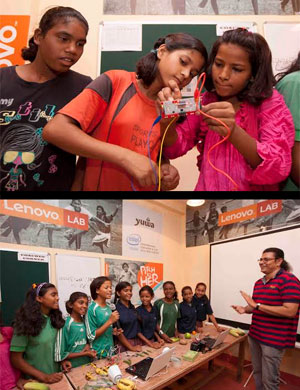 Lenovo has launched the ‘Pitch to Her’ campaign in association with Yuwa. Yuwa is a social development platform for girls based in Jharkhand that imparts training in football, provides free education and creates awareness about social evils like child marriage and domestic violence. As part of this initiative, Lenovo is calling the brightest minds in India to hack real world issues with technology and propose interesting ideas of change. Last year, Lenovo cheered for Yuwa and brought their story to millions of Indians as the Yuwa girls they took on the world’s best in the USA Cup – one of the most reputed international football tournaments for young girls in the world.

 Today, Bollywood has significantly emerged as an extensive marketing tool that can be used by brands, strategically, to talk to their respective consumers. Therefore, in a bid to exploit this growing trend, psLIVE assisted Sapat International to associate its fastest growing tea brand, ‘Parivar’ with the movie as the positioning of both the brand and the film exhibit an extremely seamless fit.