Category: COLUMNS

  • Shailesh Kapoor: T20 World Cup: Learning For Reality Television

    By Shailesh Kapoor


    It’s been a thrilling fortnight for Indian cricket fans. Starting with the India-Pakistan game two Saturdays ago at Kolkata, they have been treated to three steroid-like doses of entertainment. Beating Pakistan is always a high for any Indian cricket viewer, but the electrifying end to the Bangladesh game matched some of the most exciting moments Indian cricket has witnessed over the years.


    As if that was not exhilarating enough, the team backed it up with another adrenaline-packed performance this Sunday, beating Australia. Taking the chase deep into the last three overs, the team relied on the genius of a young star, who announced himself yet again at the world stage that night, this time in a way that was tough for even the most cynical to ignore.


    By the time you read this, the ratings for the first two of these three games will be out. It is certain that the India-Pakistan game will set a new BARC record, beating the India-Pakistan Asia Cup game earlier this year. And if India reach the final, the India-England final this Sunday is highly likely to beat that record, even if the India-Australia game doesn’t manage to.


    T20 Cricket, thus, has turned out to be reality television of the purest form. It’s unscripted (though some may debate this fact) and it’s edge-of-the-seat. This World Cup, in particular, may have brought many new and lapsed viewers to cricket, what with all the entertainment surrounding these three (and potentially two more) India games.


    This fortnight of cricket’s mega success has a lesson or two for reality television. The games that won our hearts have been characterised by elements most reality shows should aspire to have, if they have to acquire cult status and blockbuster viewership.


    There are four such things, in particular: Unscripted entertainment, fast-paced action that keeps you glued to the TV, a robust format and fan following.


    Most Indian reality shows today are either overtly scripted, or are unscripted but engineered or programmed to unfold in a certain way. For example, by giving a particular task or creating a particular situation, you force the participants or jury or host to react in a certain way. About a decade ago, this worked, because reality television was new to India and most viewers didn’t really have much of an understanding of formats. As time has passed, they have become educated reality television viewers, perfectly capable of sniffing out the fixes. There may be not such thing as “it’s scripted but will appear unscripted to the viewers” anymore.


    The pace of action in the recent India games, especially the last six overs in the Australia game, will put even the best of reality television to shame. The idea of time is redefined every decade, I guess. What was one hour a decade ago may seem like 75 minutes now. Hence, you need to give more in less time, to avoid falling into the boredom trap. Yet, reality formats have, if anything, slowed down in their execution pace over these years, often with the temptation of getting more episodes on-air.


    The importance of a robust format cannot be overstated. A format was created for a reason, and it has elements that make it work. “Adapting to India” may be prudent, but chipping and chopping it endlessly can take away from the essence of it.


    And finally, reality shows that have survived, or will survive in the future, are the ones that can manage to create fan bases for its cast, be it jury, host or participants. Early seasons of Dance India Dance are perhaps the best example of this. As is MTV Roadies. But these are rare exceptions in a long list of fan-less reality shows.


    The T20 World Cup will be over this Sunday. The next one is a long four years away. It is highly unlikely that the success of this World Cup will boost viewership of other cricket formats in India. But there is enough to learn from it nevertheless, especially for reality television producers.

     

  • Ranjona Banerji: Broadcasters’ Association bans ‘Breaking News’ usage + other

    By Ranjona Banerji


    BREAKING NEWS: The All India Broadcasters’ Association has jointly issued a declaration that the term ‘Breaking News’ will no longer be used by any television news channels in India. Ever. We may lose such gems as “Breaking News: Pigeons live in cities” or “Breaking News: Salman Khan gets bail” but hopefully we shall be able to live with this.


    CABINET MEETING: The Union Cabinet decided that from the birthday of KB Hegdewar onwards, they will uphold Indian culture and never call journalists “newstraders” and “presstitutes” any more. Sources say that former chief of army staff VK Singh was carried out weeping from the meeting.


    SOURCES TELL US: All TV journalists have sworn never to use terms like “my sources said”. This unfortunately includes scintillating TV conversations like:

    TV anchor: “Babli, your sources have told you that today is Friday, is that correct?”


    Reporter: “Yes Bunty, according to my sources, today is definitely Friday. However, we are still waiting for an official confirmation on this.”


    TV anchor: “As you heard from our reporter Babli, her sources have told her that today is Friday. We shall go back to Babli for an update as soon as she gets confirmation.”


    CLOUDS WITH CHANCES OF STUPIDITY: The BBC World Service’s weather people have sworn on copies of the film Twister that they will never say “fine and dry weather across India” when people in India are dying because of heat waves and delayed monsoons.


    SOUND CHECK: Mikes for TV debate panellists will now be fitted with decibel monitors that will automatically switch off when they go above 65 dB.


    SPEECH MODIFICATION: In bad news for fans of Indian prime minister Narendra Modi, all his speeches will no longer be broadcast live all the time. Many tantrums were observed at the India Today TV newsrooms say many unnamed sources.


    PATRIOT ACT: Super-patriotic journalists of print and TV are now required by law to have their faces painted with the Indian flag at all times. Failure to do so may lose them all privileges in Nagpur.


    GAY ABANDON: All print journalists who use the words “gay” when they mean happy, “apparel” when they mean clothes, “air-dash” when they mean “fly” will forced to spend three months in solitary confinement reading Chetan Bhagat books so that they can find new ungrammatical clichés.


    CONTINUAL PAIN: The Newspaper Association of India has decided that newspapers will no longer have seven front pages, six of which are ads for flats that no one can afford to buy.


    NEVER EVER EVER EVER NEVER EVER: will Arnab Goswami of Times Now try and save the nation again, even from himself.


    Okay, I gave myself away. Have fun and see you next week.


  • Ranjona Banerji: Panama Papers makes one feel proud to be part of the media!

    ​By Ranjona Banerji​


    Mighty congratulations to the International Consortium of Investigative Journalists and Suddeutsche Zeitung of Munich for the Panama Papers story. Congratulations to the Indian Express for being part of the consortium. It is not often enough that you feel proud to be part of the media and it is not often enough that the media works on such marvellous leaks and resulting stories! Whatever the outcome, we have seen the greed and iniquity of the powerful, the rich and the influential across the world.


    The Guardian, which is part of the ICIJ, calls the Panama Papers “history’s biggest data leak”. That is, an “unprecedented” 11.5 million files from the world’s fourth largest offshore Panama-based law firm Mossack Fonseca have been made public. The German newspaper Suddeutsche Zeitung accessed them and then shared them with the ICIJ.


    What these leaks have revealed is that the higher up the ladder you are, the greater the depths you will sink to avoid paying taxes. Politicians from across the world are indicted by these leaks. If Vladmir Putin of Russia is one of the biggest fish wiggling in mild discomfort – he wrestles bare-chested with bears after all – other smaller fish are facing political crises like in Poland. From Africa to Asia to the Middle East to Europe, tax evasion through offshore money-parking is rampant and makes real life far more exciting than a spy novel.
    The next step for the media is to ensure that this information does not get buried and forgotten. Some of India’s biggest names are superstar Amitabh Bachchan and the current prime minister’s good friends, the Adanis. Given the influence that both hold, they will pull out all stops to wriggle out unscathed. It is also true that we have enough star-struck and government-struck journalists amongst us who will help.


    The work done by Julian Assange and Wikileaks, by Edward Snowden and Chelsea Manning (earlier Brandon) demonstrate why journalists cannot take government at face value. The Panama Papers add to that another dimension – the super-rich. As if we did not know that but we often pretend as if politicians should be our only targets. They are all mixed up, as we very well know.


    ​​​​It would be a shame if the work that went into revealing the Panama Papers is wasted. The onus is on all journalists to carry on.


    **


    Back home, a three-member team of the Editors’ Guild travelled to Chhattisgarh to investigate reports of journalists being threatened by the police and the state government. The results are frightening to say the least. The two-member team found that all journalists who work in Chhattisgarh feel that they are under the government scanner. They fear doing their jobs because they are caught in the crossfire between the government and Naxal forces.
    This paragraph from the report should be an eye-opener, even to our media friends who are government toadies:


    “The fact finding team came to the conclusion that the media reports of threats to journalists are true. The media in Chhattisgarh is working under tremendous pressure. In Jagdalpur and the remote tribal areas the journalists find it even more difficult to gather and disseminate news. There is pressure from the state administration, especially the police, on journalists to write what they want or not to publish reports that the administration sees as hostile. There is pressure from Maoists as well on the journalists working in the area. There is a general perception that every single journalist is under the government scanner and all their activities are under surveillance. They hesitate to discuss anything over the phone because, as they say, “the police is listening to every word we speak”.”


    What is happening in Chhattisgarh needs to be exposed and discussed because it shows that both the state and the Naxals are pressurising and threatening the media to ensure only one point of view gets through.


    ​​The result is that we do not know what is happening in Chhattisgarh and surely that can no longer continue?


    “The President of Divisional Journalists Association of Bastar, S. Karimuddin said, “I have not visited any place outside Jagdalpur for the last six years, simply because I am not supposed to write the truth and if one cannot write what one sees then there is no point going out to gather information.” He represents UNI in Bastar for more than three decades.
    A similar claim was made by the Editor of a local newspaper Dilshad Niyazi who said that he had not visited the neighboring district Bijapur for the last eight years out of fear. Another senior local journalist, Hemant Kashyap, well travelled in the area said he knew Bastar like the back of his hand but that now journalists had stopped travelling. “All the journalists have now stopped going inside the forests because of the fear of police as well as Maoists,” he said. “Now we ask Maoist organizations to send photographs and press releases. We publish them as we receive them because we don’t want to explain every single line we are writing to them. Similarly the police expect us to publish its version so most of the journalists print their press releases as well without asking any questions,” Kashyap said.”


    The Editors’ Guild has done the homework. The rest of the media needs to wake up to the real pressures felt by our colleagues and respond accordingly. It would also help if big city newsrooms realised that there is an India beyond their coffee machines.


  • Sanjeev Kotnala: Goafest – Down Memory Lane

    By Sanjeev Kotnala


    Since the time it started, I have a strong love-hate relationship with Goafest. I was quick to find faults, compare with others, share suggestions, demanding some changes and yes to appreciate good things or have enjoyed my affair with it as a sponsor, delegate, disrupter, publisher, winner, jury member and in my own small way tried to push participation in the Publisher Abbys. And here I come again for the nth time not missing a single year. This time I visit it as an independent representing ‘Intradia World of Brand and Marketing advisory and Training’ and ‘MxMIndia’ where I write a Wednesday Column.
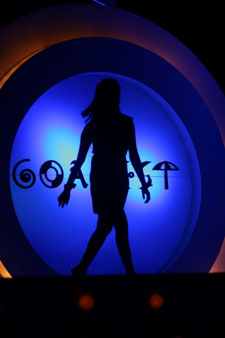


    My involvement with Goafest primarily has been as a delegate representing highly dynamic Dainik Bhaskar Group (DBG).  The 2016 edition gives me an opportunity to walk down memory lane. It was always an event of importance and focus in the Indian A&M industry. It happened in April but is yet to fix a week. Unlike some big festival across the globe, you can still not be sure about Goafest as to which Thursday of April will it start in 2017.


    At DBG templates have a short life, SOPs mutate fast and ‘let repeat the activity’ is never an answer. So every year, Goafest was a new start. The first task for marketing was to justify the fest participation internally. The brand was on the lookout for a differential interaction with delegates. Nothing was fixed, including the list of delegate to attend.


    At the start, DBG sent few delegate to the fest. Complaints of DBG people spending more time at the shack with beer and fish than in knowledge seminar echoed back.  Questions about fest functional utility, possible association and sponsorship were discussed.


    Finally it was agreed that Goafest was best to meet informally people you anyway meet in business. May be you could set up meetings in coming days and if possible make a few new contacts. It remained predominately media and creative. Lack of client participation was observed and seen as a weakness. It will be a new chapter to just discuss the internal discussions on the subject, suffice to say short of a ‘Visiting Cards collection contest’, everything else was done.


    Then the brand graduated to being a seminar sponsor. One area where it always seemed unjustified investment. Goafest in the initial years has never been able to answer a sponsor’s basic question ‘What’s in it for me’. Personally, other than Discovery, Times Now, IBM, HT, GOOGLE and may be Malayala Manorama, no other brand registered. The sponsorship agenda was buried for sometime.


    Now it is a bit different, the sponsors at fest are better supported. The brand associations are not clutter-breaking but brands like Times Now, Colors and Discovery get strongly associated. In my view sponsorship works as aggregator and continuous presence, the Colors model is the best example of it. Sporadic sponsorship is never the answer. Or one can see sponsorship as the brands contribution to the industry. The amplification for sponsor brand can still be bettered.


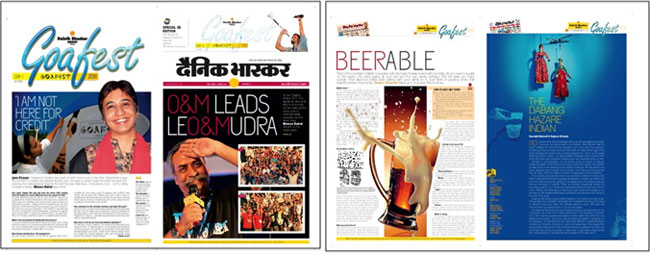
    DBG then sponsored Goafest newsletter brought by ‘E4M’. If my memory serves me right, it then sponsored the newsletter by ‘Afaqs’ before it decided to bring out its own special newsletter ‘Dainik Bhaskar Goafest’ (DBGFNL) in a true magazine style.


    The taskforce for DBGFNL changed every year. It was drawn from different editions of the newspaper. Most of these passionate team members had no past experience of covering media and advertising events but they were fast learners and great experimenters. DBGFNL was class content delivered early morning much before the trade publications. It was there in the hotel rooms, restaurants and lobby of hotels where delegates stayed. It was also distributed at the venue. I remember it surprising many with the only 3-D issue in one of those years.


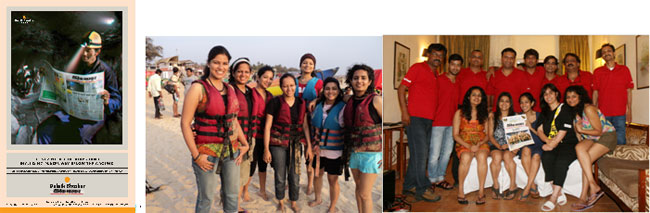
    My team members like Neha Mavani, Shailey Tatia, Nidhi Dagga, Dipty, Mamta Ranasaria, Preema, Sheela, Rajesh Pajni along with Mansi Dabral (freelance) Raghuram (edit) and Rakesh ( Circulation)  did wonderfully well. They worked hard and partied harder. The edit- visualizer and production teams from different centres across India supported us well.


    DBGFNL was off agenda when the fest management team hiked their fee for distribution. Anyway to organise and bring out an edition with the single printing press in Goa was time and cost-inefficient. Additionally the cost of the team stationed in Goa was high and the readers did not get too engaged with the product.


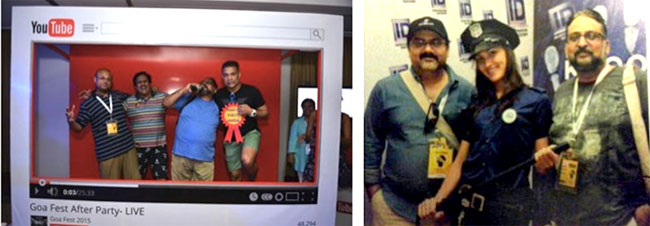
    Then the ‘No SOP no Template’ attitude of DBG sprung another surprise on Goafest, the often commented upon ‘Passport’ Party. For readers it will help to understand that at that time Goafest was really a two-day Friday-Saturday event. Thursday used to be an invitee-only Industry Conclave. The truth is that lot of young delegates came on Thursday afternoon and had nothing planned for the evening. This gap was identified and for them DBG created a party some 20 mm away from fest venue for Thursday evening.  It became known as Passport Party as the invitee (in form of a passport) was handed to delegates when they were exiting the airport, railway station or checking in at the hotels. Akshay Jain did a fabulous job. There were vehicles at pre-defined hotels and checkpoints at designated time to whisk them away to the party that went till late in the night.


    The fun was when Jagdip Bakshi while closing the Industry Conclave and breaking for the dinner announced ‘Dainik Bhaskar is doing a Guerrilla event,  they are trying to hijack the evening,  there is some Passport Party organised by them, I will request people not to encourage it and not participate. I was at the Conclave and this gave us some great unasked for publicity. Many delegates of industry conclave showed interest and we immediately arranged for dedicated vehicles to transport them to Passport Party.


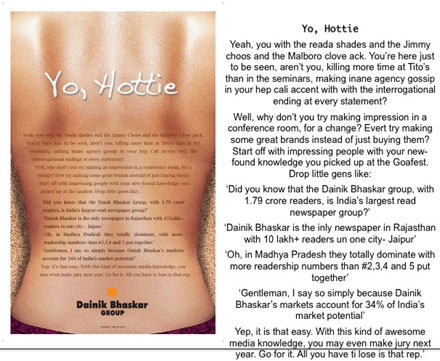
    Goafest was fun for another reason. It allowed the team to create some humorous ads that the brand would not have otherwise allowed. All this was possible under the justified cover of the Goafest ambience and feel. It was understood that the ‘advertising’ fest crowd was far open and you need to be a lot cheekier in your communication at the fest to stand out.


    So, from the single colour t-shirts so as not to get lost in the Kumbha of Indian advertising, to using them as message board – many things were experimented. Yes, there were many such things that on a normal day would not been accepted within the brand culture? Here, I am sharing a few visual from that time. It was not a case of split personality but more like DBG operating with ‘Horses for the courses’ vision.


    Oh, no way one can forget Beaches, Beer and ‘Bang for the buck’ at the Casino during the fest. Long live, Goafest


  • Ranjona Banerji: IPL, drought and extreme hypocrisy

    By Ranjona Banerji


    If we were not facing impending doom, the outrage of English news channels over the IPL tournament and drought in India would be nothing short of amusing. It is true that drought conditions in Maharashtra are much worse than in earlier years. It is also true that at least nine other states are suffering from drought conditions. But it is also true that this drought has nothing to do with the IPL tournament.


    The connection itself has only occurred to the television media because a public interest litigation asking for the tournament to be shifted out of Maharashtra came up for hearing in the Mumbai High Court. Long before that though water supply has been restricted, Section 144 has been imposed to prevent water riots and farmers have been complaining. How many years ago was it that Ajit Pawar of the NCP made that disgusting remark about urinating into dams of there was no water? Has the situation improved since then? Could TV journalists have ventured into the hinterland to find out what’s been happening since? The IPL after all is held every year at exactly the same time.


    At the same time as TV anchors are spitting fire at this evil IPL that is stealing water from desperate people, their channels are running long happy, inspirational ads about the IPL and how it is India’s tournament. What is this but hypocrisy and a cynical manipulation of a very real and very frightening problem? Barring NDTV, I cannot recall any other English news channel doing any stories at all on the problems of farmers, rural India, water, wild life and anything that is not some political hoopla over which you can have a panel slugfest.


    I can guarantee you that once the IPL tournament begins these same anchors will turn into simpering, fawning, skin-crawling fans if they ever come across a real-life cricketer in the IPL. They will also very easily forget about water, drought and everything else when they want to watch a match live or even when they have a shower or brush their teeth with running water. The problem though will not go away.


    I suppose though one must be grateful at least that thanks to the PIL and the courts, drought and water-scarcity has got some attention before matters became even more horrific. I have some free editorial suggestions for TV journalists, even as they continue fulminating against the IPL for perhaps one more day.


    They can speak to agricultural experts about the exchanging sugarcane for sugarbeet, which apparently will reduce water use drastically as well as allow multi-crop land use. They can question the sugar lobby on what they have done about better irrigation methods in their cooperatives. They can question the government of Maharashtra at least on what action they have taken about expected drought, given the experience of the last few years. They can ask about Maharashtra’s irrigation scam and what is going on there. They can ask people who have studied India and the world’s water problems to shed some light on what has happened so far and what can be done.


    It is not enough to have some city-bred BJP spokesperson to tell us that the government is “grippling” with the crisis and that the BCCI should be “magnamous” or that the Maharashtra government so sensibly and conscientiously advised that people not waste water while celebrating Holi. We need someone less absurd to be questioned by our fearless fire-breathing TV anchors. We need to hear from people who know a little more about the problem than former cricketers.


    The issue is not cricket and it is not the IPL. It is negligence and apathy and lack of understanding. And it is journalists showing complete lack of responsibility.


    I have no cause to be sanctimonious here. We have all been guilty of such behaviour at one time or another. It’s just that this time, it sticks in the throat.


  • Sanjeev Kotnala: An enhanced experience this year

    By Sanjeev Kotnala


    Goafest 2016 can be summarised as high on energy with good knowledge sessions and charged after-parties. In short, a celebration of excellence. Thank you AAAI, AdClub and the whole advertising, media and marketing fraternity for making it a huge success.


    There are many version of ‘My Goafest’ as it satisfies different needs, but skews are inevitable. Some call it a ‘beer and beach’ event, while networking types see it as anything between a ‘How’re you doing’ walk-through to a ‘let’s catch up’ promise to a serious business and influencing opportunity. For many (hopefully most) it is a conduit to the best the industry has to offer, that must be viewed as a holistic experience.


    Whatever the need, this year’s Goafest has delivered a quantum, positive leap in experience. And to the inevitable naysayers and hyper-critics guiding, I merely say this: Crib if you want.


    We should acknowledge the positive experience enhancer at Goafest. Realise that events on the scale of Goafest will never be able to tick all the boxes at the same time, and that results will take time. However, Goafest 2016 saw some high-powered speakers share a spectrum of divergent but relevant viewpoints, trends, expectation and processes.


    Knowledge speakers satiated the delegate’s desire for a 360-degree understanding. And there was no mega digital push!


    Many statements on client expectations and agency relations, creativity and insight were repeated for the nth time. It only told us how slow we have been to change and adapt. The real test is in practice.


    ‘Braincoupling’ was quite evident in the Q&A sessions. It does not matter what worked — the Rs 25,000 prize for the best question or the moderator filter. The net result was that they were relevant and effective Q&A sessions.


    The jury seemed to be stingy with Golds. Read it as a wake-up call for agencies and clients. They need to put a lot more effort into finding jury approval.


    The Goafest App was a positive intervention. In 2017, the app will be one of the pivotal axes of enhanced experience. The introduction of the ‘Music Sundowner’ and death of the ‘rain dance’ was a welcome relief.


    The media hub near the knowledge hall was helpful. The grouping of accredited press on Whatsapp and the constant tracking and linking with speakers, was well-handled. Kudos to the Goafest team, and long live Goafest.


  • Ranjona Banerji: I have written this content without either an adviser or a mentor. Weep!

    By Ranjona Banerji


    There have been changes at DNA, the last newspaper that I worked at. Since I quit in 2010, there have been several changes of editors and owners and managements. But the newest changes are intriguing. A news item put out by afaqs says that “Shreyasi Goenka who has been “mentoring the content at DNA will now take over as content advisor and will guide all functions at DNA”.


    There will also be a new “editor-in-chief”, Rohit Gandhi.

    An editor in chief, I understand. It is a job function and a lovely high-flown title.


    But what is a content advisor? Several decades at a newsroom have left me stumped. I asked a few whiskered journalist friends who are even older than me and they were equally clueless. Those younger seemed baffled as well.


    So what is a “content advisor” to do? Does it mean making a decision like which story is more important than another on a page? Like a news editor in the olden days? Or is it about how a story is written like a sub-editor or a rewrite desk? Or is about which stories make it to the front page like the editor, even, perchance, an editor-in-chief?


    Or is a content advisor just the new thing in town in newsrooms now dominated by management jargon? A meaningless designation meant to either disrupt or remain cosmetic as a newsroom goes about its business as usual?


    Are news reports, investigations, features, edits, diary items in a newspaper now to be known as “content”? I think websites use that term but for news websites, it seems likely that they also rely on the old terms.


    Having been out of a newsroom for almost six years now – yes the same DNA — I find this mildly amusing. However, when you consider the turbulent times that I saw at DNA, perhaps I am less amused. Perhaps content needs to be mentored as it tries to figure what on earth was happening around it. Can you hear the content crying, “No no, I am not a front page story. I am a simple feature. You are confusing me. I am in desperate need of mentoring.”


    The old style evil sub would have just dumped the story or cut it down ruthlessly. The new caring content mentor might take it out for coffee?


    **


    Meanwhile, the news cycle has turned and not surprisingly, the terrible fire at a temple in Kerala is dominating headlines. The water crisis and IPL have not died down completely but nightly outrage has, on television at least. Temples have taken centre stage. The saviour of India Arnab Goswami told us last night that “believe you me”, thanks to Times Now’s campaign and the support of its viewers, women of all ages will now be allowed into the Sabarimala temple, the Haji Ali dargah and so on. I would not bet against him since I don’t have the courage.


    Newspapers have shifted from anti-IPL outrage to suggesting solutions like other crops instead of sugarcane and pointing to decades of bad irrigation policies. (My father by the way wants to know why no one is considering his ideas of sugarbeet and sometimes throws newspapers around in disgust.) It is not likely that TV will take this up so we have to be satisfied with what we have.


    I must also apologise for mentioning in my last column that only NDTV bothers to cover droughts and rural issues. TS Sudhir’s Up South show on India Today TV packs a real punch into its half hour with solid journalism and yes, has been covering the problems of farmers and people who do not live in big cities.


    **


    The British Royals as in Duke and Duchess of Cambridge, as in Wills and Kate as in son and daughter-in-law of Prince Charles and the late Diana, Princess of Wales are in India. Twitter on Tuesday morning is all abuzz with skirts and suits flying in the breeze and different sorts of “Marilyn Monroe” moments (not singing Happy Birthday Mr President or wanting a diamond ring from Cartier but skirts flying in Seven Year Itch).

     

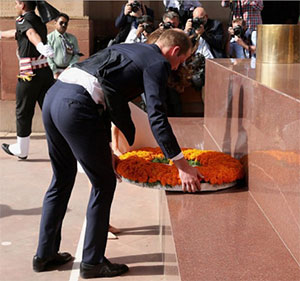
    So there’s this photograph of William, taken from the Twitter page of Buzzfeed’s inimitable Rega Jha, which no one talked about:


    And this, which many more talked about:

    http://www.mirror.co.uk/news/uk-news/kate-middleton-marilyn-monroe-moment-7732766


    Because maybe sometimes we all need our content to be mentored?


    Ranjona Banerji is a senior journalist and commentator. She is also Consulting Editor, MxMIndia. The views expressed here are her own.


  • Sanjeev Kotnala: Goafest 2016 thumka needs to sync with the beat. Think about it

    By Sanjeev Kotnala


    My view on Goafest captured on April 11 looked at the positive side of the event. The enhanced experience was primarily based on 16 of the 17 speakers engaging the audience with relevant and interesting points. And that is quite an achievement. For a change, it was not digitally skewed. It was more holistic. It had more things getting a wow, than a slow nod saying ‘tell me something more’. Additionally, the media hanger next to knowledge hall, PR teams constant interaction and engagements, death of rain dance, a Goafest app, ‘Over The Top’ picture and some seriously high energy engaging performances before the awards made it that much better.


    I truly mean it when I say ‘Thank you AAAI, AdClub and the whole Advertising, Media and Marketing fraternity for making it a huge success’.


    Nevertheless, within the fraternity we need to be a lot more honest. Goafest 2016 would have returned with a report card with a ‘CAN DO BETTER’ remark.


    It is something that most of the delegates expressed. I do think the committee, and the senior fraternity must have felt the same.


    We had a brilliant knowledge session. NEVERTHELESS, WHY CAN’T WE START ON TIME? Why do speakers always run out of time? Why should people who come on time be penalised by the late start? Why can’t we cut the speaker when they cross time limits? The best of the events practise these simple rules.


    Speakers (I am told – at least on Day 1) for the umpteenth time repeated what we have been listening for the last eleven years. The suggestions on client expectation and agency relations, creativity and insight sounded stale. I agree it is not their fault when the industry has been slow in adapting and practising what they univocally agree. The real test is in practice but then… think about it.


    The ‘Q&A’ sessions after the knowledge seminars were good, perhaps it was the Rs 25000 for the best question that made the grey cells active. On the other hand, possibly it was the moderator picking the right questions. In the Karan- Balki session we saw Kubra Seth doing a damn good job moderating. I won’t believe if someone told that was planned.


    This is an area where we need to help develop and mentor next generation. May be we should stop having moderators above 45 years of age. Get the new blood. Think about it.


    This delay affects the schedule throughout the day and the engagement and networking opportunities. We need to do something about it. Starting on time not only makes life easy but is also a demonstration of respect to delegate and their enthusiasm.


    Cascading result of the delayed sessions is a delayed award show. No one really knowing when the awards will start. Is it okay to ask people to take their seat by 7pm when the show starts only by 7.30pm?


    Maybe like in an airport, we need screens outside the main hall. Where session, topic, original time and the revised time can be flashed. Delegates pick and chose their sessions, and this will help them. Think about it.


    Evening sundowner music session creates a relaxing bridge between knowledge sessions and awards. It gives delegates not staying at the venue, time to go and put on their award/ party gear. Good thing.


    Between lunch and dinner, there is a huge time gap. If some snacks can be arranged around 5.30pm, it will help many delegates. And as Indian stomach does not appreciate drinks after meals, snacks at an ‘after party’ will be welcomed. Think about it.


    Maybe the Goafest app In 2017 will be one of the pillars of enhanced experience. I can expect a lot many picture contest, quotes, games, tallies, etc. on the app in real-time. So much so that next morning you will be able to get the coverage of speakers and award winning entries on your app. Think about it.


    If the front two rows at awards are to be reserved, why can’t we use the rope-separators? Why someone has to stand guard and politely keep pushing genuine delegates? A simple ‘RESERVED’ board could do the job.


    There is a huge scramble for first few rows during awards and celebrity sessions. One could consider selling the third and fourth row at a premium and donating money to some charity. May be the top five agencies of last year can be given advantage seats. Think about it.


    There were glitches galore during the awards ceremony, which in some organisations would have made heads roll. This is not something new. It has been happening for years. Why have we not found a solution for it? Glitches in industry events make the entire fraternity look clumsy and indifferent. Thank god we still have low marketer participation.


    It is time that only the jury chairman gives awards. Including sponsors and others to give awards, is a practice Goafest can do away with. Frankly, speaking, there was a lot of angst expressed by many… simply said, they believed it decreased the award status.


    There are many versions of ‘My Goafest’ as it satisfies different needs. Polarised views and reaction true to an individual point of view are born. Biases are inevitable. It is a ‘Beer and Beach’ event, networking type’s grade it between ‘How you doing walk through’, ‘let’s catch up’ to serious business and influencing. For many (hopefully most) it is a conduit of best; the industry has to offer. It needs to be seen as a complete holistic experience.


    Introduction of ‘Music Sundowner’ and death of ‘Raindance’ was a welcome relief. Someone needs to do the sunset time check, and it can be more pleasurable.


    Whatever may be the need, Goafest delivered a quantum positive leap in experience. Please, do not forget the contribution of ‘Naysayers’ and ‘hyper critics’ guiding Goafest introspection leading it to deliver of a hugely defined experience. So people go ahead and crib.


    We should acknowledge the positive experience enhancer at Goafest. We must realise that events of Goafest scale will never be able to tick all the boxes at the same time and results will take time.


    Getting McCann back was good. The presence of R Balki and Piyush Pandey was a bonus. The amount of energy Piyush pulls in is phenomenal. It is high time that Ogilvy and Lowe start participating. Do it for the next generation! (This is no way a comment on winning entries)


    In awards; we need to be metal-sensitive. If bronze awardees were not invited onto the stage, then the treatment should have been consistent throughout the three award nights. May be we could actually publish the Bronze award list earlier and only announce Silver and Gold on stage.


    That brings me to something more sensitive. The jury was definitely stingy with Gold and for good reasons. I am happy. It is better not to award then promote mediocrity. The results must be internalised. It is purely a reflection of what is being entered. It is a wake-up call that the agencies and clients need to put a lot more efforts to find jury approval.


    On the other side, I am not sure if Goafest as an entry would have walked the stage, knowing that bronze awardees are not invited on stage.


    On a lighter side, ‘Unlike our bar – the registration will close tomorrow’ read the mailer from Goafest. Hidden within it was the promise that bar will not close. Unfortunately, beer management during the event was pathetic. The beer was not chilled at most times. The bar seemed to open and close with mystical timing. Discovery of beer counter working hour algorithm by trial and error was a tough one to crack. Placing a board or clearly communicating the timing would have helped. Expecting this next year I am not going to ASCI over it.


    On a serious note, I meant it when I tweeted ‘This is my last Goafest’ but in the same breath I added ‘Maybe I would change my mind’. Possibly I will be there next year too to see how far have we moved.


    Long live, Goafest.


  • BCCI – Bhogle’s Cricket Career Interrupted


    By Shailesh Kapoor


    Controversies have been defining elements in the Indian Premier League (IPL) over its previous eight seasons. In a way, they have also given the league its personality, that of a flamboyant rich bloke who’s constantly up to some or the other mischief. And a sharply defined grey personality is better than no personality at all.


    But the controversies related to the IPL this year (and we are only a week into the long league) have been unlike those in the previous seasons. The Maharashtra drought controversy reflects tokenism of the silliest level. IPL has become a soft target in a case of misplaced priorities and incompetent governance.


    In general, constant judicial intervention in the IPL over the last few years is not a healthy sign. BCCI has struggled with its public image ever since the sport got commercialised back in the ’90s. Far from being perceived as a professional organisation (which, in many ways, it actually is), BCCI is seen as a rogue body by the common cricket fan.


    While most controversies have had little to do with actual cricket itself, the one that broke last weekend upset diehard fans and followers of the sport the most – Harsha Bhogle’s last-minute exclusion from the IPL 9 commentary team.


    Compared to Australia, England and South Africa (and even New Zealand and West Indies, some will hasten to add), India has probably the weakest set of commentators in the English language. Sunil Gavaskar has mastered the art of sitting on the fence and Ravi Shastri is the king of the clichés. Sanjay Manjrekar has improved considerably over the years, but remains uninteresting, to use a mild expression. Sourav Ganguly showed great promise, but cricket administration has kept him busy of late. In the world of mediocrity that Indian commentators have created over the years, Harsha Bhogle has stood out as the best.


    Speculation is rife about what led to Bhogle’s ouster. He claims he just doesn’t know, and the BCCI response has been, like most other times, reluctant and reticent. But whatever the trigger incident may have been, it is certain that Bhogle did not enjoy an easy equation with the BCCI (unlike his other employer Star Sports) over the years. Which doesn’t come as a surprise, given his simplicity and humility, traits that BCCI would never put on its wall as its values.


    There has also been this rather bizarre controversy about an Amitabh Bachchan tweet, where he suggested Indian commentators would do better by focusing on Indian players. While that suggestion may reflect a misplaced understanding of the commentator’s role, it was just a suggestion after all. By endorsing it, MS Dhoni expressed his displeasure too. I re-watched the recording of the India-Bangladesh game and its post-match show to see what could have led to such a strong reaction by the captain. Barring the strange commentary by Gavaskar in the last over (his “glamour shot” theory has stayed since the 2011 World Cup), nothing else stood out as discomforting. But then, what’s a controversy if it’s a puzzle can be solved in a jiffy!


    Harsha Bhogle remains a popular face in Indian cricket, one that signifies the inclusive nature of the sport in this vast country. Thankfully, there’s at least some cricket beyond what BCCI controls, and we will hear Bhogle on-air again.


    As for BCCI, brace yourself for the next controversy. It must be round the corner.


  • Ranjona Banerji: Does media fuel horror stories?

    By Ranjona Banerji


    When I was a child, I hated carrots. I would do anything to avoid eating them. My parents and grandparents were great believers in the “no fuss” principles of life. If you went on and on about something trivial that was bothering you, they would either say “mind over matter” or “ignore it and it will go away”. So I apparently stared at the carrots on my plate, aged about 5, and plaintively asked my parents, “If I ignore them, will they go away?”


    What do you think happened?

    The reason for this little personal sidestep is that people often rant and rave that if the media ignored some unpleasant person or some unpleasant happenings, those people or things would go away. Is this true? Does the media feed into the horrors of society by publicising them and giving them more attention than they deserve?


    Sadly, I cannot offer you an answer. My instinct as a journalist is that part of our job is to unveil those very horrors of society so that society can confront them, deal with them and acknowledge that they exist. As a collective, society usually tries to bury – or like my carrots, ignore – its unappealing side, hoping that if they ignore these issues, they will go away. Most discriminations and prejudices have got strength from this sort of thinking. The problems of women, of the underprivileged, of race, of sexual abuse, of assault, of hatred, of the differently-abled, of mental health are some of the many unpleasant aspects of society that people preferred not to mention. As a result, abuse, discrimination and cruelty went on unhindered and victims suffered without recourse.


    A peruse of newspapers from the last century will make that clear: men’s issues, crime, war and politics dominated. What were the odds that you would read about the rights of transgenders in a newspaper even 50 years ago?


    I am not crediting the media with exposing these problems. But the media has played its role in increasing awareness. And on that basis alone, the “ignore it and it will go away” principle can be deemed faulty.


    This question of media exposure seems heightened by the times in which we live. Some people feel that this whole story about women marching on temples and mosques for free access is a non-story. Others feel that constantly airing the archaic and unpalatable for the 21st century views of some old Hindu priest, no matter how senior, serves no purpose. Others however acknowledge that just by pegging the cricket tournament IPL to drought as the media has done, the issue of water shortages and its attendant problems have been taken seriously.


    This also brings up the issue of “good news”. Many argue that the media never focuses on the better part of humanity and only focuses on the dregs. For one, this is not wholly correct. The media does cover humanity’s progress and its achievers. And sadly, this can become dangerous. There are enough instances of the media making heroes and heroines out of people without adequate research. And often, these personalities grow like balloons as generation after generation of journalists picks them up and pumps them up further. They are lucky as long as their feet of clays and feats of horror remain hidden. Because when the balloon bursts and the media discovers those flaws, even god cannot help them!


    On the whole though, every “good news” experiment by the media has failed mainly because we, as humans, prefer to know what’s wrong rather than what’s right despite any sanctimonious proclamations to the contrary. Take a look at fiction – whether movies or TV serials or books and see for yourself how many commercial and critical successes portray the “goodie-goodie” from start to finish without any conflict whatsoever.
    I have personal knowledge of one instance where the newspaper I worked for decided not to give any more publicity to a particularly vicious person. And when we and others stopped doing that, his star diminished. It became clear that the more publicity he got, the more dangerous he became. He is still around, but circumstances have defanged him for the most part.


    This one instance aside I would go for the bad news angle any day. You can put it down to my childhood. Those damn carrots did not go away!


  • Sanjeev Kotnala: Have you written a new chapter for your brand?

    By Sanjeev Kotnala


    Brands work with familiarity and consistency, with benefits and relevance and with emotional connect. They are just like human being. A set pattern of behaviour and an accepted level of unchanged unmagnified performance bring stagnancy into relationship. It is like marriage.


    A brand just like in a successful loyal marriage must strive to enhance the offered romance in relationship. It must rejuvenate the excitement before the inherent inbuilt natural urge of discovering alternatives take over. The brand-consumer relationship is like life, full of little incidents and episodes building the memorised and perceived aura.


    Remember the bike you rode, kiss you stole, car you owned, hotel experience, delayed flights, emergency delivery, assistance from unknown people, cosmetic or grooming products and even the mobile you own. Everywhere there is an unsaid level of expectancy and in-built redundancy.


    Brands use stories to justify their relevance and status. Consumer uses such stories to justify their choices.

    Dove, which was the just a beauty soap with moisturiser, wrote a new chapter with the campaign for real beauty. Toothpaste industry writes a chapter every season. Pepsi and Coke – where products do not allow much flexibility use communication to write a fresh novel every year. Mahindra has been doing a great job of engaging audience with newer twist and turn in its ever growing brand story.

    Brand like star performers cannot live on their earlier successes. They drop out of the audience’s present. The efforts required to get back in the system amplify exponential with the gap from the last successful adventure.

    When brands fail to write new codes of memories for the consumer in B2C, B2B or B2I, the books and the stories start losing their sheen. They become old; they have been heard a many times. They are past no one wants to see because the present is changing rapidly.

    Dell failed to write an interesting new chapter, so did Motorola. Kodak and Polaroid failed in their attempt, by the time they thought about it, the readers (consumers) preference for the genre had shifted.

    Apple and Samsung are a classic case of brands busy writing new chapters even before the ink dries on the last expression. It is more than just planned obsolescence. Do not forget, to succeed chapters must find an echo with the consumer choices.


    The game may be refined by the brand but is defined by the consumer’s willingness to accept.

    Look at the media side of business. Star is regularly writing a new story; reorganisation to sports to Hotstar. You hear stories with relevance. SRK, Amitabh Bachchan, Aamir Khan and R Balki are few celebrities who are more than keen on writing a new chapter in their relationship with audience. Dainik Bhaskar has been attempting to write chapters after the hugely successful thriller of Rajasthan and Divya Bhaskar (Gujarat Launch) and now the revived Zidd campaign. Indian Express has been consistent with its investigative journalism and continues to excite its audience, though its story needs a lot more tweaking to interest many. Ariel is not just tweaking the story line and characters in its brand story but is busy making attempts to define the story sharing pattern.

    Sometimes it is not just the chapter but also the construct skew and the genre of the brand stories that the brand needs a change. SAB has been one of the sharpest defined and positioned GEC channels with hardly any competition. Unfortunately, they were so wedded to the positioning that they failed to redefine their path when comedy and smiles started getting traded at news channels and other GECs with larger pull and money. The SAB team failed to tweak their ware. Possibly it is still serving the channel objectives, but they do need a new chapter.

    Possibly it is time to start looking at brands not as a treatise, series or even a novel. May be it is time to look at brand history and life through a series of short stories. It is something that will reflect brand’s adaptation to changing pace of expectations and desires.

    Keeping the brand story franchise alive and adding new chapters is a role that the agencies must play while partnering clients and brands. They need to be the resounding echo of the consumer’s shift in interests. They need to be doing more than just amplifying the stories traded by clients.


    You cannot keep enjoying the last successful chapter for long.

    It is a fallacy that the consumer with ever-increasing spectrum of fragmented taste and options is the one in the driver’s seat. If the brand with its new exciting relevant chapters can keep itself in-sync with the evolving consumer, the situation will change. It is time for brand-customer relationship to be mentored and not just sustained.

    The brand and consumer are no longer a planetary system with one of then the center of orbit. They necessarily be like quasars or the pulsating twin stars, always in an undefined tango of excitement. Always in the act of writing a new chapter.


    Sanjeev Kotnala with 28 years of corporate experience is the founder of Intradia World. A Brand, Marketing & Management Advisory. His focus area is Ideation and Innovation, a subject in which he conducts specialized workshops like IDEAHarvest, Liberate and InNoWait. For soft skill training, he follows SHIFT (Specific High-Intensity Frequent training), which is all about contineous frequent training with shorter sessions. Email sanjeev@intradia.in tweet @s_kotnala web: www.intradia.in www.sanjeevkotnala.com. 

  • Two views on CNN-News18


    Underwhelming relaunch of a channel in turmoil


    By Ranjona Banerji


    One unspoken rule in print journalism is that when you want to do a relaunch or launch a new paper, never ever bite off more than you can chew. That is, keep the readers’ expectations low and do not make your launch or re-launch so fabulous that you can never keep up to the standards you have set. It sounds cynical but it works. The most famous example of how not to do it was in the 1980s, when advertisements for the Metropolitan outdid the newspaper to such an extent that the paper sank without a trace. What copywriters wish a newspaper would be and what journalists can deliver are obviously parallel lines never to meet!


    It is possible that someone at Network 18 was aware of this rule and that is why the re-launch of CNN-IBN as CNN-News18 is somewhat underwhelming. I suppose in keeping with today’s rubbish management jargon I should call it a “re-branding” though heck knows I could be outdated on that too!


    The channel has gone through plenty of turmoil in the last few years. Even before Raghav Bahl sold out to the Ambanis, we had all sorts of stories of political pressure, of Congress versus BJP, of its two main faces Rajdeep Sardesai and Sagorika Ghose being eased out. In fact since Sardesai’s departure, the channel has been struggling to claim attention in an arena where it was once top choice.


    A re-configuration was therefore essential. And there is some thought at work here – getting a panel of in-house talking heads for instance. So we have Ayaz Memon, Ajoy Bose, Vir Sanghvi and Swapan Dasgupta as resident commentators, who will appear as experts on politics, sports, social trends and perhaps some will have their own shows. Until then, they have appeared on all or various news channels, now the viewer knows to expect them on CNN-News18.


    Features like Bhupendra Chaubey’s “Five headlines in five minutes” sounds a lot like something Headlines Today used to do years ago when its tagline was “smart news for smart people”, before it became India Today TV. All Hindi news channels offer a variation of this which is far superior: 700 headlines in 20 seconds.


    A quick survey of English news channels on Tuesday night showed a variety of stories on offer: the Kohinoor diamond and the government’s flip-flops on it, a Union minister’s comment that celebrities should be jailed for endorsing bad products, changing stances on the Samjhauta blasts case and the drought situation in the government. CNN-News18 decided that the late TV star Pratyusha Banerjee’s pregnancy and abortion was newsworthy during the same time slots. Also, comedian Kapil Sharma’s new show.


    (In other news, how on earth is one supposed to tell Times Now and NewsX apart if Arnab Goswami is not on air?)


    This is a quote of a firstpost.com report on the changes (firstpost.com is part of the Network 18 group):

    “Enlarged reporting teams equipped with cutting edge technology tools to deliver news from the ground fastest, new studios designed by the best in the world and a deeper leveraging of the CNN global news resources, form the core of this brand refresh. While continuing with its emphasis on engaging viewers in ways that are intelligent as well as innovative, the channel will focus more on immersive journalism. It means more in-depth reporting of news stories and covering angles in news developments generally left unexplored.”


    One hopes that the unbearable jargon aside (“immersive journalism”?), some of these features will soon be visible. An in-depth feature on grains rotting on the roadsides in Rohtak was however on the menu, which is an excellent story to cover. One assumes that immersive journalism could also look at submersible pumps and the damage they cause to the water table during drought conditions?


    So is CNN-News18 a Times Now-killer?


    By Pradyuman Maheshwari


    I know the headline is unfair. But that’s what every English news channel should aspire to do, right? Displace the leader.


    So the answer to the question is: No.

    Not yet?

    No.

    Why?


    Because the channel bosses haven’t done enough to effect a turnaround.


    It’s old wine in a new bottle.  So let me whine about it a little bit.


    Whine because Network 18 – given that it’s owned by Mukesh Ambani – has enough resources at its disposal. And in terms of top deck, it’s got some of the brightest brains. Rahul Joshi, President – News, is one of the best newsrooms managers in the country.  It’s also got some sharpshooters within its ranks.


    So what do we have? A credo that says it’s got no agenda. Heck, if there’s one business group that’s said to set all the agendas in the world it’s the Ambanis, but guess the owners don’t have much of a role… and one is being uncharitable towards the professional managers running it.


    One can interpret it as a comment on Times Now.  But let’s get to my instant view on CNN-News18.


    [] The look is neat and clean. Brighter… looks much better on a screen of at least 32 inches or more. Has some shades of India Today (after it switched from Headlines Today), but betters it.

    []Zakka Jacob is still the best amongst Tier 2b anchors in the country (Tier 1 being Arnab, Rajdeep, Barkha and you can add Prannoy Roy of course, Tier 2a being Vikram Chandra, Rahul Shivshankar, Rahul Kanwal and etc and Tier 2b has Ndhi Razdan and the likes and now Zakka Jacob.)

    [] The CNN-IBN reporting team is still top class, though post-retrenchment of the last few years, many bright hands have exited

    [] Bhupendra Chaubey is still around, albeit at 10pm. He is just about tolerable

    [] Getting Cyrus Broacha to do more than his weekly bit was a good idea

    [] Good to see Ayaz Memon on the primetime panel. Cricket rules, and we don’t too many observers of the game who can match him


    While getting Ayaz was a good idea, but why Swapan Dasgupta and Ajoy Bose? Both can speak on everything under the sun, but we could’ve got some better folk. Say Siddharth Varadarajan. A Hartosh Singh Bal would’ve been better than Bose.


    And Vir Sanghvi? One of the most stylish journalists in the country, he is past his prime (or as they say: sell-by-date).  The Niira Radia controversy didn’t too much for his rep, but he doesn’t make for good television any longer. Even a Suhel Seth would’ve been better.


    One would’ve expected an entertainment specialist to be also on the show, and getting inhouse resource Rajeev Masand on board would’ve been good. Or the many specialists on the subject in Mumbai and Delhi.


    Will the new look earn better ratings for the channel?

    I haven’t seen Mumbai roads plastered with hoardings on the channel, but am sure some work has been done on distribution. I don’t think we will see CNN-News18 upstaging Times Now the way India Today did on launch week, but perhaps the idea is do it slow and steady.