
Category: COLUMNS

  • Are ‘Trust in News’ & ‘Happiness’ interconnected?

    Are ‘Trust in News’ & ‘Happiness’ interconnected?

    Avik ChattopadhyayTwo very interesting global reports have been published over the last one week. The first is the Reuters Institute Digital News Report 2023 and the second is the 2023 edition of the World Happiness Report. As a marketer and ‘brand-o-phile’, I see a subliminal connect between the two.


    The Reuters Institute Digital News Report is an outcome of more than 90,000 responses across 46 countries on how much one trusts news, through conventional as well as digital media. While the overall global trust score has dropped a few percentage points, the report states that “it is not surprising that news consumers are increasingly feeling overwhelmed and confused, and many are turning away temporarily or permanently. Selective news avoidance and news fatigue have been exacerbated by the challenging times we live in.”
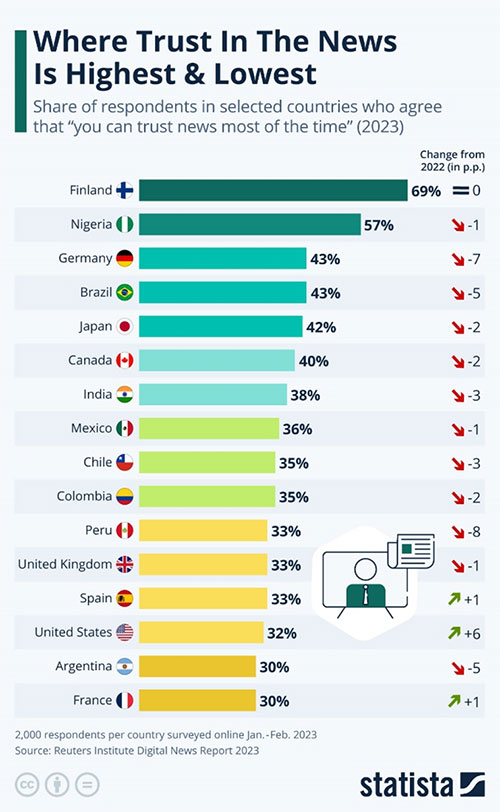


    India is somewhere middling with 38% of news consumers trusting what they read and see. It has dropped 3 % points since the 2022 report. Now with the election season looming upon us, one can expect a sudden drop in the score with every political party resorting to downright unethical and fake communication without batting an eyelid on the impact on an already tense social fabric.

    The special note on India in the report is quite telling.
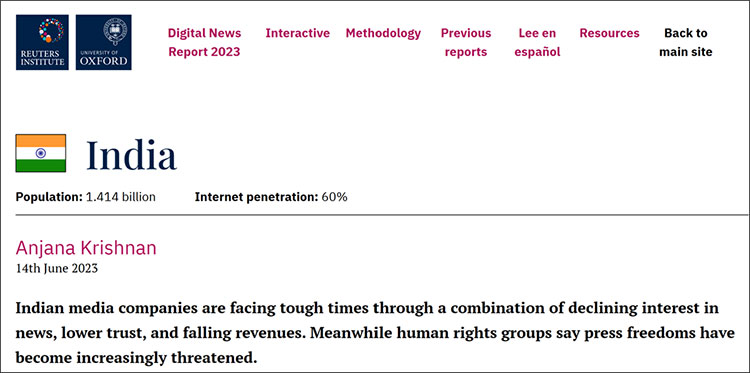


    Credibility is a huge factor. With the latest Press Freedom Index ranking of 161 out of 180, however much one may want to downplay the Reporters Without Borders study as being driven by agenda and deliberately disparaging towards the world’s biggest democracy, one cannot cross one’s heart and denounce it.


    The note states that “our Digital News Report survey finds steep falls in both the consumption and sharing of news. There was a sharp decrease in access to online news (12 percentage points lower than last year), particularly through social media (-11pp), the main sources of news for a predominantly younger audience. Television, popular among a large section of the population, also saw a 10pp decline as a news source with our younger and more urban-based sample.”


    While the government has brought checks and measures for media platforms, especially digital, on the authenticity of the news and its possible impact on factors like social harmony and national security, there are none for the social media teams of all political parties who deliberately churn out one-sided or fake posts, with the clear objective of misleading the populace and even instigating it into unrest. When the digital platforms dig up and expose these untruths, there is no legal recourse to punishing these people. All the Johnnies are consuming too much sugar without remorse.


    As the judiciary at the highest level seems to be the only panacea for most ills in the country, some sane citizens should file a PIL against such lie-spinners and let the court pull them to task.


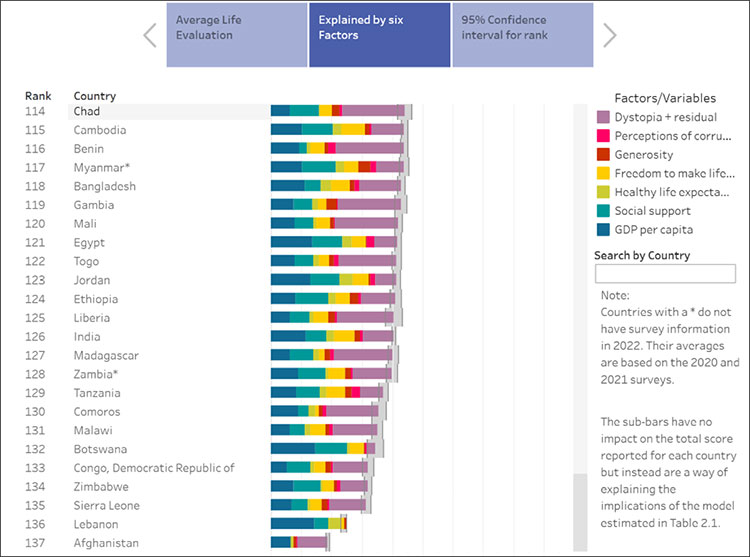
    The second report is the much debated and hated World Happiness Index by Gallup wherein certain sections of our thought leaders and citizenry cannot understand how can people in Pakistan, Bangladesh and Sri Lanka be happier than us, especially when we are going through our “Amritkaal” towards becoming the undisputed “Vishwaguru”. They need to understand that once again, this global report is not being undertaken with the sole purpose of showing India in bad light, but to help us introspect.


    If we study our score across the seven parameters in the second chart below, we will observe that we score badly on factors like life expectancy, corruption and generosity. These factors may not be as easily measurable like per capita income and are largely perceptual, but strong enough to take our score down. Also, the dystopia score is significant enough implying an undercurrent of social stress, possibly amongst certain communities.


    How are these two reports interdependent? Happiness is an active ingredient for trust. The lack of the first leads to increased scepticism and therefore the tendency to discount what you consume as news. You may put up a brave face in one report but the mask comes off in the other one.


    You posture to amplify the news that you opt to believe in as it shows you in better light. That is a fundamental defence mechanism, borne out of deep down insecurity and an inferiority complex. It is not that you openly consume and debate all sorts of news and digital content to logically establish that you are in the right. Similarly, you pose as happy, taking selfies next to objects, visiting places or doing things that take you away from your uncomfortable harsh reality. When it comes to responding to a survey, your disappointments with aspects of life around you get exposed. It is not the proverbial bed of roses.


    No external intervention can work in this case. Only a slow and gradual improvement in collective consciousness can shake the citizenry out of this sucrose-induced slumber.


    As a common citizen, you too are consuming enough sugar without even admitting to yourself. That is far worse than the media magnate spinning fake stories to drive you into a frenzy.


    The festival of democracy is less than a month away. Look before you leap.

    Jai Hind!


    Avik Chattopadhyay is a Gurugram-based brand and business strategist and commentator. He is currently also working along with XLRI to set up the Indian School for Design of Automobiles. He writes on MxMIndia every other Thursday. His views here are personal.

  • The Rise & Rise of the IPL

    The Rise & Rise of the IPL

    Source: www.iplt20.com


    Shailesh KapoorThe 17th edition of the Indian Premier League kicks off tonight. To say that it’s the biggest media event in India by some margin will be stating the obvious. The gap between IPL and other big-ticket properties has only grown wider over the last decade.

    The stature of IPL is reflected in our new report, titled The Ormax Sports Audience Report: 2024. The sampling of IPL in the 612 million audience base of cricket in India is higher than that of the ICC World Cup, by a good six percentage points. The list of most-recalled sporting franchises in India (across sports) sees a clean sweep, with the 10 IPL teams taking the top 10 positions, ahead of Manchester United and Patna Pirates, which are the most-recalled leagues in football and kabaddi respectively.

    In its first few years, IPL faced its share of controversies. But in its second phase, the league has been able to put cricket first, and that has helped it move away from the erstwhile imagery of a flippant brand, towards building credibility as a talent platform. This shift is fundamental in nature, and has held IPL in good stead.

    IPL is now a way of life for those in the media industry. Till not too many years ago, there was a lot of chatter about how GECs should dodge the IPL googly. Now, everyone has a playbook of sorts, and it’s not a topic to lose sleep over, anymore.

    This year’s IPL will be held amid the political fervor around the General Elections. News-wise, IPL will play second fiddle. But in terms of monetisation and viewership, it will continue to stay at the top. The stronger franchises are profitable now, and BCCI continues to get richer with each edition. Yet, there’s ample room for growth, as fan bases are continuing to build, especially for franchises that have made late entries, or taken their time to get going.

    This year’s IPL will also see younger captains across most teams. The average age of the 10 captains this year is 30 years, which is three years younger than the 33 years average age in IPL 2023. The old guard is passing the baton to the new, and that’s always a good thing, especially in a talent platform like IPL.

    Amid all the excitement, the biggest highlight of this IPL is going to be the return of Rishabh Pant. The actor survived a near-fatal road accident in December 2022, and his incredible recovery over the last 14 months has been a miraculous one. How National Cricket Academy has helped Pant get back to match readiness against all odds is perhaps the best example of BCCI money being put to great use.

    Pant is leading the Delhi Capitals side, and their first match is scheduled for tomorrow afternoon, at Mohali. We can expect a roaring reception to a special talent, who first got noticed via the IPL itself, before making it big at the international stage. I won’t be surprised if he makes this IPL his very own, to announce a comeback we have all been waiting for. Game on!

  • Shruti Pushkarna: Changing mindsets, rebuilding lives: Celebrating 25 years of First World Cup Cricket for the Blind

    Shruti PushkarnaLast weekend, I had the golden opportunity to witness the silver jubilee celebration of India’s first World Cup Cricket for the Blind. A room full of cricket lovers (players, organisers and supporters) took a trip down memory lane, recounting their love for the sport, the struggle for opportunities to play, some naughty moments, some tough ones. But all in all, a journey that shaped and altered their lives in distinct ways.
    George Abraham
    George Abraham

    I was fascinated by each account. Just as awestruck as I was 20 years ago when I first learned about cricket for the blind. As a student training to be a journalist and a producer, I met with George Abraham, the Founding Chairman of the World Blind Cricket Council. India had already established its position on the international stage by then.

    George shared how he came about organising the first ever Kanishka World Cup in 1998, bringing together representatives from seven countries to set the rules of the game. I also met with the then Captain Manvendra Singh Patwal, coach Uday Gupte and other Indian players, and shot a practice match with the team. That’s when I understood how this version of cricket was played with a ball molded with ball bearings that made sound. And the bowling was thrown underarm. There are 11 players like in mainstream cricket, out of these four are B1 (totally blind), three are B2 (partially blind) and four are B3 (partially sighted).

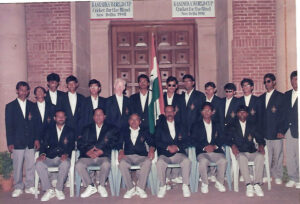
    The Indian team for the Kanishka World Cup 1998
    The Indian team for the Kanishka World Cup 1998

    Some years later, employed in a television news channel, I attempted to recreate the story, this time for a bigger (broadcast) audience. I filmed interviews and practice matches, hoping my editors would be just as excited about this unique tale laced with hardship, joy, grit, and faith. But that was not to be. Such news items rarely make it beyond the ‘Good News’ segment. Any follow up coverage or intersectional issues at play, are less likely to interest a business that thrives on politics, violence, and sensationalism.

    Rollercoastering through various jobs in the media, many moons later, I met with George again. This time to team up and raise awareness around life with blindness. That’s also when I really understood the objective behind this entire Blind Cricket movement. It was to erase the stereotype associated with vision impairment and give people an opportunity to witness (blind) men in action. The disability ceases to matter when you see enthusiastic players batting, fielding, bowling, and chasing runs.

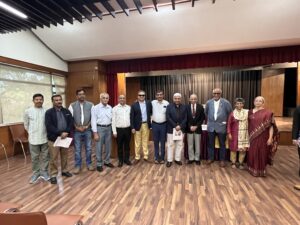
    Members of the World Cup for the Blind Organising Committee
    Members of the organising committee

    At the 25 years nostalgia party at the New Delhi YMCA last Saturday, 1998 Team India players shared what the game and the World Cup had done for them. George Abraham and his fellow organising committee members had managed to instill confidence, leadership skills, decision-making tactics and more, in each one of them. Moreover, they had exposed them to a whole new world which was unthinkable and unimaginable for most of the cricketers who came from special schools and small towns.


    Siddharth Sharma
    Siddharth Sharma

    But the story that stood out for me was of a young man who chanced upon a television advertisement announcing the World Cup Cricket for the Blind. He had lost his eyesight in a motorbike accident a few years ago, and the ad intrigued him. Siddharth Sharma asked his mother to jot down the number flashing on the screen and he made an appointment to see George in his office. Little did he know that his life was set to change from that moment on.

    Because of his ability to communicate effectively, Siddharth was offered a seat on the Organising Committee and made incharge of public relations. Suddenly after some years of unemployment and hopelessness, there was purpose to his life. He worked closely with a Public Relations agency, doing media rounds and sensitising journalists and raising awareness around the sport. Incidentally, the first Blind World Cup was vastly covered by the press in India and overseas.

    The PR agency not only hired Siddharth full-time after the World Cup but also promoted him to take up operations and business development for the firm. As he went out into the world, securing new business for his agency, Siddharth found a new sense of self-belief.


    The World Cup experience readied him for a brand new career. Today, Siddharth Sharma runs his own company, Foundations PR, that deals with lifestyle and luxury brands. He is also Asia’s first visually impaired self-employed public relations professional.

    Release of a special volume celebrating 25 years of the First World Cup Cricket for the Blind
    Release of a special volume celebrating 25 years of the First World Cup Cricket for the Blind

    None of this would have happened if George Abraham didn’t decide to shift the focus from the blindness to the person and his (her) potential.

    Cricket for the blind has progressed since then. There are many new opportunities, T20 championships and several other tournaments. We also have the Women’s Blind Cricket now. No doubt there is some media coverage around live matches and the struggle for mainstream recognition for this sport, but has the societal perception towards blindness evolved?

    Does the average Indian know that persons with blindness have similar aspirations and interests? That they work harder to prove themselves and yet struggle for acceptance from the majority-sighted population.

    If only the media representation of blindness focused on ‘what is’ as opposed to ‘what isn’t’.


    Wondering why MxMIndia publishes a disability advocacy column? Well, we strongly feel that the media can dramatically transform the world for persons with disabilities. This series attempts to help bring forth issues that the media must champion to create a truly inclusive and accessible India. Writing  this column is Shruti Pushkarna, a former journalist and now a disability inclusion advocate based in New Delhi. Her views here are personal. To access the archives of her 90-odd columns, please visit: https://www.mxmindia.com/category/ columns/shruti-pushkarna/


    If you have a view on the issues raise or would like to align with MxMIndia on this cause, write to us at editor [at] mxmindia.com.

  • Ranjona Banerji: Obsequious behaviour of Indian mainstream media

    Ranjona BanerjiWhen you imagine things are really bad, they only get worse. For Indian democracy, and in the behaviour of India’s democracy watchdog, the media.
     

    The issue of the electoral bonds and the Supreme Court strictures against the obfuscations of the State Bank of India in following its orders to reveal details of donations is still ongoing. The Union Government led by Narendra Modi had remained brazen and sanguine in its confidence that it is untouchable by any corrective forces.


    https://www.reporters-collective.in/trc/modi-govt-allowed-bjp-to-illegally-encash-expired-bonds


    Much of this confidence comes from the obsequious behaviour of the Indian mainstream media, not just from the BJP’s dependence on its core support base – Hindu religious majoritarianism. And the mainstream media, 10 years down the road, has remained steadfast in its worshipful genuflections.


    It does not matter how badly the Modi government performs, how viciously it misuses democratic institutions, the Indian media is always at hand to support it and blame someone else.


    Thus on a day that the Income Tax department froze the accounts of the Congress Party and arrested Delhi Chief Minister Arvind Kejriwal, the Indian media was out looking for someone else to blame. The fact that we are on the verge of a general election, that the Model Code of Conduct is in force mean nothing to the media because they mean nothing to the Modi government and the BJP. Indeed, in spite of all the government’s tantrums about citizenship, the fact that a Bangladeshi citizen is a Union minister matters not to the government and therefore matters not to the media. There have been massive campaigns against other ruling parties and governments in power for much less.


    Just consider this: one of the co-accused in the liquor licence case for which Kejriwal has been arrested – after Manish Sisodia of AAP and Kalvakuntla Kavita of the BRS – turned approver and then donated to the BJP in electoral bonds soon after his arrest. This spells CORRUPTION in capital letters but the lens of corruption somehow never points in the direction of the BJP.


    https://www.thenewsminute.com/telangana/delhi-liquor-policy-case-aurobindo-pharma-bought-bjp-electoral-bonds-days-after-arrest


    The number of politicians accused of corruption by the BJP who have been absolved of all charges after joining the BJP may be a social media joke but it is a serious example of how the BJP manages to use its clout – from media control to misuse of its powers – to remain stain free.


    How news is manipulated is clear from this example from The Economic Times. The spin, the dependence on some vague “sources” is blatant, and only works to absolve the Modi government of any manipulation. The victim is somehow to blame:


    https://economictimes.indiatimes.com/news/elections/lok-sabha/india/congs-accounts-not-frozen-recovery-of-rs-135-cr-made-more-transactions-under-scrutiny-officials/articleshow/108685200.cms?from=mdr


    Most others in the “more credible than TV media” have gone with the usual cheat method of headlining what the Congress says, rather than reporting the issue itself. This absolved them of any retaliatory action by the Modi government. Or so they think.


    This fear of a ruling government is not the sign of a thriving democracy and we all know that. We verge between a dictatorship and a fascist state. We have some tatters of democratic processes fluttering here and there. The Supreme Court in some cases. A few independent media organisations. A few citizens. A smattering of retired bureaucrats and government servants.


    Opposition parties themselves seem battered by both government actions and lack of media support.

     

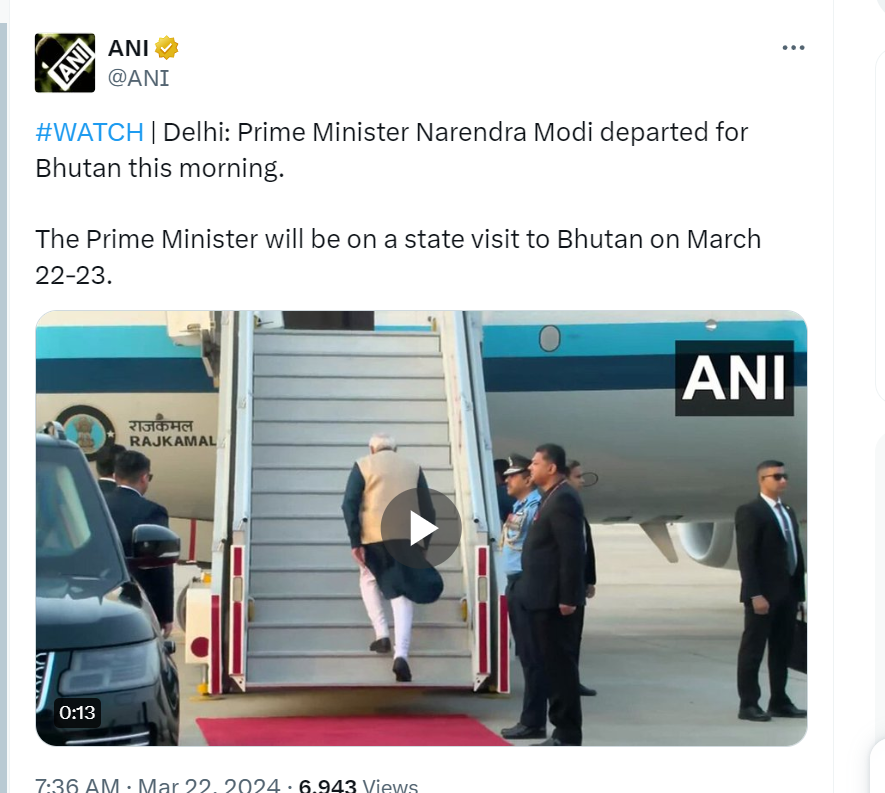
    While this farce of an election begins, with the Modi government sidestepping the Model Code of Conduct and the Election Commission watching, this photograph somehow encapsulates what the Prime Minister thinks of India and our democracy.


    Ranjona Banerji is a senior journalist and commentator. She writes on MxMIndia on Tuesdays and Fridays. Her views here are personal.


  • Being water-wise needs a behavioural change

    Being water-wise needs a behavioural change

    Sanjeev KotnalaIt was like any other Saturday morning. I was working on my laptop when the Nutgraf newsletter landed in the email. For people unaware of it, it is a paid weekly emailer that explains fundamental shifts in business, technology and finance that happened over the last seven days in India. And this week, it spoke of the Bengaluru Water Crisis where it drew upon the way Cape Town, the first Zero City (in 2018), was trying to fight the crisis.

    I know someone will say that if Cape Town has  adapted to the situation in last six years, let’s learn and implement the solutions. These people don’t realise that even if the problem sounds similar,  the solutions are not the same, though one can expect a lot more of overlap.


    It Is Bengaluru Today, It Could Be Indore Tomorrow

    There is a need to overreact. A few of us may not be alarmed or react to then situation as we may not have ever experienced a dry tap. We may be the ones who despite the umpteen messages to conserve water – may still be waiting for the bell to ring.

    We may joke that we Indians are good at crisis management and hence would wait for the day. We may laugh at the climate alarmists and brand it yet another ‘Behdia Aaya‘ (wolf) moment.  A few of us, strengthened by the Covid mindset, would say we will adapt to the situation and find a way out as we did in the past. Many would play that helpless card like they do during the voting, questioning what difference could a single vote make?  Not knowing that every step, vote, and drop counts. And not understanding that the government can do this much and no more.


    Sabka Number Aayega

    The water crisis is very secular and democratic. Sooner or later, it will hit all of us. For some time, a few wealthy ones may be able to scrape through and manage, but the government will have to step in and treat everyone as equals.

    Rationing of water, police deployment, restricted service would be par for the course. One may even be imprisoned and penalised for using more water than authorised. It can be worse than the Covid oxygen crisis.

    No, I am not trying to scare you but only familiarising you with the future.  You better be scared, or there is nothing to say.


    The Clock been running out of Time.

    The Bengaluru crisis was not created in one day. We have been walking towards it for many years. It was one of the Top 10 cities globally in the list of cities where the crisis was expected to hit first. At every city level, we and the government know the looming water crisis has picked up pace. How one or two bad years of monsoon may just tilt the balance.


    The Problem is That We Know It all.

    Come summer, there will be some cuts of 10-15% and we will manage. There will be Save Water campaigns. Some brand may even take it as a part of corporate social service and do lip-service to the situation. Hotel bathrooms would have those smart looking water-saving stickers on mirrors and will ask you to change the towel and bed sheet only when needed. A few leading  newspapers and TV channels will start initiatives to get their audience to contribute to save water and talk about five- things to do to prevent water wastage. And soon as the first announcement of monsoon dates (forget first shower) will revert to our normal default setting of water wastage.

    We will forget, like we have done for so many years, that a drop saved is a drop made.

    Many will tell you not to preach because each one of us actually knows everything.

    We all know the importance of saving and not abusing water availability.

    We have been learning and training others to act.

    We have stopped looking for hotels with bathtubs.

    We use only one bucket to bath and have stopped using the shower.

    We close the tap while shaving and brushing.

    We don’t use the heavy water guzzlers of fully automatic washing machine.

    We don’t waste water washing our vehicles every day.

    We recycle wastewater. We harvest rainwater.

    And more… The possibilities in the ways we can contribute are many.

    And on the other side

    In the name of development and infrastructure, we continue to bury the remaining  lakes and water bodies.

    We continue to cut trees and reclaim marsh lands.

    We create concrete fortresses clogging every possible inch recharging underwater bodies.

    We dig borewells not worried about underwater bodies.

    Oh,

    We have developed Apps and use AI to solve the problem.

    Oh,

    We know it will not solve the problem without a behavioural change.

    Oh,

    The list is long; we know what we should/could do.

    However, even then, we are guilty of not acting despite knowing what to do.

    There cannot be a worse idiot than literates who know.

    How many of us make it to the list of people who know, can act- but don’t to save water.

    Indeed, a lot of us.


    We are like that only

    Many of us know the need to wear seat belts and don’t. We wear it only when we know we can be penalised. Same with the helmet, speeding, insurance, jaywalking, or cleaning the house or not littering to road.

    We are habitual offenders, and we are the smartest of all.

    So we don’t need to be told or demonstrated what we need to do.

    We speak through our ego powered by the chalta hai attitude. We also believe we are beyond the tipping point and the helpless, we can make no difference.

    I Am Guilty Too.

    Yes, I am guilty too. I recall the water crisis film that my friend made a long time ago, the films that agencies did, and the campaign that newspapers ran and some of them I contributed to. Unfortunately, the clouds of water crisis were not as prominent as they are now and the efforts were seasonal- not really geared toward measuring the results.


    Net-net

    There is no time to play the blame game. No point in pointing fingers and listing who is more responsible for the crisis.

    Before accusing anyone else, I must look inward and make a promise. I will leave the list of the idiots who know but don’t act. I will do whatever is right and what I must do to conserve and avoid wasting water. And I will share and tell others to do everything possible to conserve water.

    Like me, we can be the small example for our circle of influence and control. And there, we can make a difference. We must know that the act is far more critical this time than the destination.

    Meanwhile, I look forward to the government, institutions, resident societies, cooperatives and colonies using every possible means. Use Sham-Daam-Dand-Bhedh (Logic and rationality, Price and penalty and differentiation and doubt) to nudge the population.

    It may be the water pressure, water-map, or levies – fines or control. Maybe it is time that we not only look at Bengaluru and the crisis but look at the whole nation. However, working from home or migrating without habit and attitude change only relocates the problem geographically. We need a behavioural change.

  • Ranjona Banerji: An Inconveniences called Wangchuk

    Ranjona BanerjiJust for fun, now and then I check the opening pages of the websites of our esteemed “news” TV channels.


    At 10.39 am, Times Now is apparently very worried about the terror attack on Moscow. Russia being contiguous to India’s borders, it is vital that our top TV channels keep track of our neighbours and what’s happening in their lands. Global and so on. O sorry, my mistake. We do not share a border with Russia. We do with China, and there’s something happening in Ladakh but, umm, well maybe another time or maybe…


    Times Now also gives us a peek into channel owner Vineet Jain’s Holi Party. Is furiously angry with Congress spokesperson Supriya Shrinate for her unsavoury X post on BJP Lok Sabha candidate Kangana Ranaut. And something about a passenger on Indigo Airlines. And some sundry stuff.


    Electoral Bonds? Missing.

    Latest economy figures? Missing.

    Stock Market? Missing.

    The arrest of Delhi chief minister Arvind Kejriwal? Missing.

    Looking back at the pandemic? Missing.

    Israel, Palestine, Gaza, UN Security Council resolution on a ceasefire? Missing.

    And Ladakh? Where did you say that was? Near Russia by any chance. Okay, no so no.


    News 18 at 10.33 am has a slightly better handle on the news than Times Now. AAP and Kejriwal feature as lead. The UN resolution on Gaza gets a peep in. But obviously Shrinate versus Kangana also gets top billing. The controversial Janardhan Reddy’s return to the BJP is presented minus context: he’s so happy to be home, yaay!


    Electoral bonds, the economy, the pandemic and of course Ladakh, missing.


    Why am I going on and on about Ladakh I wonder. The fingers type before my mind kicks in, I think. Must be age.


    India Today TV is very excited about Kejriwal and the elections and a bit about Israel. All their top star news readers are presented with their various expressions of their own self-importance.


    My patience has now run out with these Tv websites. It is 10.39 am.


    What is happening in Ladakh, though?


    Magsaysay award winner and climate activist Sonam Wangchuk has been on a fast for the past 21 days. His demands include statehood for Ladakh, Parliamentary seats for Ladakh and Kargil and a movement to save Ladakh’s fragile ecology from rapacious “development” from private sector entities.


    Wangchuk is something of a hero because he was inspiration for one of the main characters for the popular film 3 Idiots, loosely based on a Chetan Bhagat novel. When Article 370 was repealed by the Narendra Modi government in 2019, Wangchuk was widely covered by all these same “news” channels for his approval of the repeal and his hope that some benefit would now come to Ladakh.


    Wangchuk may have since realized that his state was cheated and his own expectations were unrealistic; the Indian mainstream media of course can never acknowledge that. And so, they must now ignore Wangchuk and his fast. The best updates are from Wangchuk’s own social media posts as he and his followers brave the cold to continue with their demands.


    https://scroll.in/video/1065713/watch-sonam-wangchuks-fast-to-demand-statehood-for-ladakh-enters-day-19-others-join-him


    https://www.telegraphindia.com/india/kargil-residents-stage-fast-to-press-for-ladakhs-special-status-in-sonam-wangchuks-support/cid/2009031


    We have already entered election season. This is a very important election for Narendra Modi. He has stated that the BJP will win more than 400 seats. It is evident that the mainstream media has been instructed to work as hard as it can to make Modi’s dream a reality. Thus, inconveniences like Wangchuk have to be ignored.


    How this affects the people of India is clearly of no concern to media owners, top star news readers and whoever else in the mainstream media imagines that they are still journalists.


    Ranjona Banerji is a senior journalist and commentator. She writes on MxMIndia on Tuesdays and Fridays. Her views here are personal.

  • Market Research in the Age of AI

    Market Research in the Age of AI

    Ashoke AgarrwalWhen one plots the future of Artificial Intelligence (AI) in marketing, one arrives at a singularity where all of marketing is the AI avatar of a brand in direct conversation and interaction with the AI avatar of the consumer. I have called the AI avatar of consumer – Concierge Intelligence in many of my columns here, including my first MxMIndia column back in Jan 2022 -“The Coming Post-Digital Age”.

    However, plotting and thinking about the intermediate points would be helpful.

    I have been part of a team working since 2020 on using Natural Language Processing (NLP) to generate secondary research semi-autonomously. The launch of GPT-3 and subsequent versions reframed the project for us. Like scores, perhaps hundreds worldwide, we are now trying to find a market niche, proprietary prompt engineering, and the correct interface to support a viable business. Say, a freemium WhatsApp interface for Indian SMEs offering online business consultancy services based on open-source predictive and generative AI models working on public and paid data sets.

    What about the emerging role of AI in primary consumer research? The big two—Alphabet and Meta—have been using predictive AI for decades to segment consumers, keep them engaged with their social media feeds and search results, and harvest clicks so their advertisers can pay them big bucks.

    Over the past decade, big corporates from both the B2C and B2B worlds have been using Big Data and Predictive Analytics to fine-tune their business and marketing plans. However, it is unclear whether they are at the cutting edge of predictive AI, just as Alphabet and Meta are. While a lot is currently being made of Generative AI and the likes of GPT, Llama, Gemini, etc., I bet that we shall discover that the disruptive power of AI will come not from generating sentences, pictures, videos or music but from underpinning key business, economic, social and personal decisions based on a dynamic array of multi-dimensional data sets. While predictive AI underpins generative AI, a different kind of predictive AI will also underpin the AI age. It will be predictive AI that works on an integrated, dynamic view of the natural world to deliver strategic action plans and monitor and fine-tune them. To use this level of AI, corporations and governments will need to go beyond internal data sets and subscribe to a whole range of third-party data sets.

    One category of these third-party data sets will be garnered through an IoT network of sensors synthesised with publicly available identification data sets—for example, vehicle movement with ownership details or scans of browsing shoppers, personal IDs and billing details. The ownership and personal ID can be scrubbed of all details except for basic demographics to meet privacy rules. Alternatively, the individual could opt to belong to an ID Bank that holds his details in escrow and can release them, using blockchain technology on payment of a fee – thus making the individual the valid owner of his ID and personal data.

    The ID Bank idea will fuel the second category of third-party data sets. These data sets will contain in-depth profiles of individuals, including contact information, demographics, psychographics, societal and cultural attitudes, media usage, product and brand usage, and purchase behaviour and intentions. The ID Bank will have a watertight agreement with the individual on securely holding the data and releasing any of it to a third party only upon approval and release of a specified fee.

    Corporations can then request the release of specified data from a selected consumer profile. For example, a car company may ask for a data set consisting of individuals who own one of a set of car models and have indicated a purchase intention for a new car in the next six months with permission to contact with offers. The ID Bank, in discussion with the consumer, will quote a certain fee on payment, for which the data will be released in a blockchain format that allows for usage tracking. The fee will be released to the consumer’s account, and the ID Bank will get a management fee.

    Creating, managing and marketing the two categories of data sets envisaged above will define the future of the market research industry over the next few decades.

    The corporation’s predictive AI systems will define the need for data from third-party data sets, consider the cost-benefit of buying them, and incorporate them into predictive analysis to build business and market plans.

    Over the decades, as AI and consumers become more sophisticated, intermediaries like ID Banks will be cut out, and a brand’s AI will be in direct touch with a consumer’s Concierge Intelligence (CI) with market research evolving into a version of anthropology focused on studying the behaviour of AI systems. “AInthropology” anyone!?

  • Technology and the immortality of an advertising theory @IPL

    Technology and the immortality of an advertising theory @IPL

    With apologies to none at all

    By Vikas Mehta


    Vikas MehtaYet another season of IPL is underway. And like many millions, I have been following the matches keenly on JioCinema. Since I am travelling, I do not have access to DTH or cable to watch it on TV. So, my writing is based on my JioCinema experience only.


    Usually, I comment on the ads during the IPL. I will continue to do so. But this particular column is going to first recount my experience with JioCinema from a technology- and consumer-friendly viewpoint and then I shall take just two examples to highlight some issues in the IPL ads.


    I find the app very consumer-friendly during IPL. The home page highlights the match of the day and with one click, I am into the match. But when there are two matches then the homepage keeps on highlighting the first match, well beyond 7:30 pm and the second match requires real searching. The issue does not get resolved even by refreshing the page.


    In terms of the content, I find the ‘Jeeto Dhan Dhana Dhan’ contest very interesting. It’s a simple multiple-choice question based on what will happen in the next over. With one click, the answer is submitted. And before the next question comes up, one is informed if one got it right. But the beauty is that for all those who got right answers there is some prize. Usually, a discounted product from an online e-commerce portal. I, played it almost at the end of each over for two days and I had around 20 prizes. And the redemption was also well-planned. Click on the same page to redeem the prize. The right page, which offers only the products on offers open up. Your discount has been copied to the clipboard. Choose, fill your details, pay if required and the offer has been redeemed. No choosing of products and at check-out realising that your preferred products have no discount. No ambiguity. Very well-organised and planned. And at the last count, I came across nine brands offering the prizes. Two of the three I redeemed were delivered in Dehradun within 48-72 hours. And of course, there are bigger prizes for those who answer the most correct answers daily. Unfortunately, I did not have the patience to sit through all 40 overs and answer all questions. But kudos to a well thought through and planned contest.


    In terms of communication, I remember that ‘Jeeto Dhan Dhana Dhan’ was an offer that Jio had offered in the IPL four to five years ago. So, to find that this year MyCircle11 was sponsoring the contest was bit of a let-down. It also clashes with the MyCircle11 advertising as it caused a confusion in my mind if the contest had something to do with the gaming app offering discounts to play games on the app. I then realised that Tata had sponsored ‘Jeeto Dhan Dhana Dhan’ contest in 2021 and last year it was MRF. Personally, it’s a simple and rewarding contest and any sponsor will reap the rewards with a longer association. Like, I think Jio did for two-three years. I still remember it.


    Now, let’s focus on the ads. There were many new ads this year. Predictably, Dream 11 came up with, till now, the best campaign. Simple thought. Good use of the cricketers. I particularly liked the Mr Sharma ka beta mera beta featuring Rohit Sharma, KL Rahul and Sunil Shetty. It crossed the thin line between a cricketer and his personal life in a beautiful, interesting and heartwarming way, with a hint of comedy. Communication theories always say use celebrities who add to the brand personality and to the memorability of the ad. This is a great example of the same.  Watch the ad here.


    The other ads in the series have focused on personal rivalries. Bumrah vs Shreyas and then Shreyas vs Bumrah. Preity Zinta, co-owner of Punjab vs Pant got me cracking up at the end. Not in the same league as Mr. Sharma ka beta but at least Dream11 is not just splurging money on celebrities.


    I am now hoping to see a Hardik vs Rohit. Oh sorry. It’s about team loyalty. So maybe Hardik and Rohit.


    But the ad campaign which got me thinking was actually Parle. It has released a series of ads, thankfully without any cricketers or film stars. These address issues which are mostly intangibles. Difficult to pinpoint, prove or substantiate. So, difficult to communicate too. Quality, trust, variety, new products. The campaign has tried to use some odd metaphors or join some improbable dots to convey these messages. I just felt that someone is ramming down these virtues down my throat.


    And that’s when I remembered a gem of theory that was part of the JWT thinking process. The difference between stimulus and response. The theory mandated that do not put your benefit or message as a stimulus, rather let it be the response from the consumer. Do not spoon-feed. Let the consumer discover it. That way it will be more memorable and the communication will have a lasting impression. Remember the Ericsson black coffee ad? Nowhere it said the world’s smallest phone or even a small phone. It demonstrated its size as a stimulus and the response was “a phone so small it can hide in my palm.” No wonder the ad is recalled even after three decades. Watch the ad here.

    I feel that Parle has missed a trick. The amount of money that is spending trying to hit us with trust, quality and other parameters would have been much better spent if the desired response theory had been used.

    And this thought got amplified when I saw the Apple iPhone 15 app on storage for photos. It beautifully showed someone marking photos to be deleted and then they used a perfect song “Don’t let me go”. Each photo that was being marked for deletion suddenly came alive with the character in the photo singing the song. And at the end there was just a simple message which said lots of storage for lots of photos. They could have gone to town on memory capacity or on transferring photos to cloud through their cloud service. But by using the stimulus of each photo imploring not be deleted, through a song, the benefit was like a stimulus which I will not forget. Great ad.


    And we wonder why Apple iPhone commands such a premium and is yet a world leading brand! Watch the ad here.


    In fact the Preity Zinta vs Pant ad also is a stimulus vs response theory ad. Watch the ad here.


    I sincerely hope that some of the JWT theories like the stimulus vs response one are not buried along with the venerable brand.


    Before I end, I saw as a part of media co-sponsor super “Pepsi yeh dil mange more”. I was intrigued and excited to see what was the contemporary version of this classic Pepsi campaign. So, I found it on you tube. See it here. And let’s match our reactions in my next column.


  • The Grey Area of Social Betting among Friends

    The Grey Area of Social Betting among Friends

    Sanjeev KotnalaNavigating the legality surrounding gambling and betting in India is full of confusion and uncertainty for the average citizen. What is legal or illegal gambling is subject to the interpretation of authorities and law enforcement officials. While one might engage in online gaming platforms under the guise of skill-based games without repercussions, the same cannot be said for a friendly game of cards during a festive occasion like Diwali or a generic pooled bet among friends on the election results. Even betting among close friends can teeter on the edge of legality unless certain precautions are taken, further complicated by different interpretations and rules at central and state levels.


    The Idea of Betting on Lotus

    Recently, during a reunion in Jaipur, discussions naturally covered the upcoming 2024 elections and possible outcomes. Like any other group of elders, everyone had their own interpretation of the current geopolitical situation and, hence, polarised outcomes. These predictions were based on informed analysis, akin to a game of skill.


    The idea of a closed-group betting pool emerged to add excitement to the discussion. Participants would predict the number of seats the BJP would secure under the Lotus symbol and contribute a nominal amount, with one person designated as the BetMaster. The individual closest to the actual result would claim the pooled amount.


    Confidentiality and transparency were built into the process. The last date for predicting and betting was the eve of the first polling date. The predictions were only known to BetMaster and made public a day after the first polling date. The participant could change the prediction once before closing the entries.


    Despite the transparent and confidential nature of the arrangement, a crucial question loomed: Was it legal? Despite being a mere 10,000 collective possible wagers in a 60 billion industry ( estimate of 2010), we were too educated not to intellectualise the possible scenario.


    Risky Social Betting

    This inquiry into the subject over digital checks and a few discussions led to a sobering realisation. While the friendly betting endeavour seemed innocuous, it could potentially run afoul of gambling laws in India. One could be fined INR 200 or imprisoned for three months. The mere possibility of legal repercussions, including fines and imprisonment, cast a shadow over what was intended as harmless fun among friends.


    Betting is the act of putting at stake a wagering amount (a valuable or liquid cash) on the prediction of the occurrence or non-occurrence of an event.


    Gambling in India

    Gambling is strictly prohibited in India under the antiquated Public Gambling Act of 1867, a relic from the pre-Independence era.


    Despite its age, its enforcement varies significantly across states, leading to a patchwork of interpretations. While the Act overlooks online betting, several states have enacted specific laws against it.


    Interestingly, gaming platforms have successfully argued in courts that their activities constitute skill-based games.


    Now, consider predicting election outcomes. It does require intricate knowledge and analysis akin to strategic skill. Yet, despite the parallels with skill-based activities like exit polls, this entertaining pooled betting among friends could be illegal.


    Under the Public Gaming Act of 1867, anyone caught gambling with cards, dice, or counters faces potential imprisonment and fines as per Section 45 of the Indian Penal Code of 1860.


    Game of Skill v/s Chance

    The legislative definition of a game of skill is one in which the element of skill predominates over the element of chance, including when the skill relates to strategising the manner of placing wagers or bets, when the skill lies in team selection or selection of virtual stocks based on analyses, or when the skill relates to the manner in which the moves are made, whether through deployment of physical or mental skill and acumen. 


    Based on this, many states consider rummy, bridge, golf, chess, poker, darts, and carom games to be games of skill. The gaming platforms have somehow convinced the judiciary that they are more a game of skill than of chance.


    If we were to fight, we could always prove that predicting election results requires a deep understanding of the geopolitical situation, processes, and ground reality—definitely, it is a game of skill. But then we wouldn’t have the energy and width to do so. We want easy clarity.


    Ambiguity in Gambling

    The ambiguity surrounding the legality of such simple, friendly social betting reflects broader inconsistencies within India’s gambling laws. Moreover, this is the case of educated professionals who have held positions of responsibility and repute.


    While online platforms exploit legal loopholes to operate as skill-based games, traditional forms of betting face stricter scrutiny, even within private circles.


    Not a Competition

    This pooling syndicate on election results could be considered a competition where the prize is offered for solving a puzzle, number, alphabet, crossword, missing word, or picture prize.

    Elections are one of the biggest puzzles of complex caste divides, manifesto statements, political inclinations, etc. However, with a prize of more than INR 1000, it ran foul of the Prize Competition Act of 1955, which bans a prize of more than INR 1000.

    Our prize money would have been 10,000 INR, a small sum in a 60 billion betting industry (2010 estimate), but beyond the Competition Act.


    Not even a Lottery

    Yes, in our scheme, typically, every participant predicted a number; in a way, he or she was buying a number that he or she believes has the most chance of coming when the results were declared. Now, does that make it within the Lottery Act?

    The lottery is defined in the Lotteries (Regulation) Act 1998 under Section 2(b): ‘lottery’ means a scheme, in whatever form and by whatever name called, for the distribution of prizes by lot or chance to those persons participating in the chance of a prize by purchasing tickets.

    So, our simple, transparent, innocuous betting could be against the Gambling, Competition, and Lottery Act! The group had to stop looking at further running the closed group syndicate for the IPL winner, the Purple and orange cap winner, and the US Presidential race.


    Social Betting Stifled

    Social betting among friends typically centred around sports or elections, is common in India. These informal wagers, characterised by low stakes and camaraderie, rarely attract legal intervention. However, the possibility of legal consequences looms over such activities, deterring individuals from fully embracing harmless social traditions. This prevents more of the educated class than the masses.


    Government concern with Betting

    The reluctance to legalise betting stems from moral and societal concerns, with gambling viewed as a vice associated with addiction and financial ruin. Yet, the distinction between games of skill and chance remains murky, leaving room for interpretation and enforcement discrepancies. One feels frustrated when online betting and gambling continue under the name of skill. On the other side, social gambling is under the scanner.


    The lack of clarity surrounding social betting perpetuates uncertainty and stifles harmless recreational activities. As the government grapples with defining and regulating gambling, it’s imperative to provide clear guidelines distinguishing between harmless social engagements and illicit gambling practices.


    Net-net

    The ambiguity surrounding gambling laws in India continues to confuse citizens and authorities alike. The absence of clear regulations leaves individuals hesitant to engage in harmless social activities like friendly betting pools. As we await clarity from policymakers, the question remains: can friends gather for a friendly wager without running afoul of the law? And are kitty parties, which are also a pooled lottery, legal? Until then, the legality of social betting in India remains a puzzle waiting to be solved.


    UNRESOLVED QUESTION.

    After all this reading and referencing, it is still to be determined if a closed group of people on WhatsApp can bet for entertainment with the least wager that would not financially ruin them.

    If someone has an answer, I would like to know about this election result predicting small wager betting among friends and about the Diwali teen patti among friends and relatives.

    And if it is OKAY- I still have time to set the betting among friends.

  • Ranjona Banerji: The mainstream media in a stupor

    Ranjona BanerjiThere was something crazily intriguing in that little clip doing the rounds, of a conversation between Union Finance Minister Nirmala Sitharaman and Times Now’s TV Person in Chief, Navika Kumar. Kumar has long been an outright and loyal supporter of the Narendra Modi regime at the Centre and of the BJP in general.

    But even she seemed a tiny bit surprised that the BJP welcomed a whole lot of “tainted” politicians from other parties into their fold. Why, she asks Sitharaman, why these people with corruption charges. Sitharaman replies that “everyone is welcome in the BJP”. Kumar persists. The answer is the same: “The party welcomes everyone”.

    In that other world in which we used to live when we were a democracy, TV people would have had conniptions over this subject. Corruption, BJP’s Washing Machine – all the phrases coined by opposition parties would have been used by the media itself. But since we live in this semi-fascist world, we have to be content with smirking a bit at the seeming surprise of the anchor when faced with the blank prissy acknowledgement of the minister.

    All is well when the King Emperor and his Chief Lackey make the decisions.

    Or there’s that other image. Of Narendra Modi, prime minister of India, sitting comfortably with his former mentor LK Advani, while the President of India, Draupadi Murmu, stands to one side like she’s an attendant. The President presented Advani with his Bharat Ratna, a reward perhaps for his role in the demolition of the Babri Masjid and the subsequent turmoil in India. Or as a sop for the mentor from his disciple for sidelining him once he rose to the top.

    That’s the politics of it.

    But the “optics” – a horrible word which today people love – told another story. Of an Emperor without grace or manners. And a system which has dumped protocol. The ascent of Murmu to India’s President was to underline the fact that she is a woman and a tribal. But this photograph emphasized how little Modi and the administration respect both those aspects and the office of the President itself.

    Again, for the Indian mainstream media, this was a non-issue. What does it matter if the office of the President of India is insulted in this manner. The main player is Modi: nothing else matters.

    And so it remains: Modi’s lies about how he had made electoral bonds transparent. His false claims about Katchatheevu. The Supreme Court directive to the Election Commission on a paper trail for EVMs. The enormous rally in Delhi by Opposition parties in support of jailed Delhi chief minister Arvind Kejriwal. The newest reports of hunger and unemployment in India. The falling rupee. Nothing but nothing moves the media.

    As one TV person screamed to a panellist on her show: I will always defend the prime minister of my India, so India’s mainstream media remains in a stupor. Or rather, supine in front of Modi and his cult.

    That a youtuber like Dhruv Rathee can so easily get 67 lakh views, in less than 24 hours, for his latest video on India’s fall to dictatorship, tells you how irrelevant the Indian mainstream media has become.


    Ranjona Banerji is a senior journalist and commentator. She writes on MxMIndia on Tuesdays and Fridays. Her views here are personal.

  • Election time, Mr Kahneman!

    Election time, Mr Kahneman!

    Avik ChattopadhyayOn March 27, the world lost one of its sharpest minds ever, in the fields of human psychology and behavioural economics. Daniel Kahneman was the undisputed master of the study of decision-making, judgment, heuristics, biases and human rationality. Getting the Nobel Prize for Economics in 2002 for his work, Kahneman finally put down all his thoughts and theories into one awesome compilation that he called ‘Thinking, Fast and Slow’ in 2011.


    As brand managers and marketers, all of us, inadvertently, have used one or more of his ‘behavioural patterns’ in our work. I unabashedly dipped my hands into DK’s work and do admit to not crediting him for the same in innumerable PPTs. I hope there are a few more like me as, going by one of his patterns, I too am a victim of the ‘confirmation bias’.


    Given that the world’s largest reality show is going to commence from April 19, the ‘dance of democracy’, through the seven chapters of its recital, would be a delectable ground for testing his key human behaviour patterns. On his behalf, here is my attempt at the same.

    Let us take each of the 10 key patterns DK espouses and contextualise it to the Indian parliamentary elections.


    Our brain uses two systems: System 1 and System 2

    System 1 is fast, intuitive and automatic. It is prone to biases and errors such as overconfidence.

    System 2 is slow, analytical, and deliberate. It is necessary for complex tasks requiring focused attention.


    System 1 is what most political parties resort to in their communication for the electorate. They are ably joined in by many media vehicles who leave no stone unturned to amplify these pieces of communication, building a smokescreen of rationality and people-speak.


    System 2 is what the ‘woke’ community indulges in, focusing on the actual issues at hand that need to be addressed in the communication campaigns rather than hubris.


    System 1 brain says that the lord shall redeem the faithful soon. System 2 brain reminds you that you are still unemployed.


    Irrationality

    Humans are not rational. We all make a lot of irrational mistakes.


    We will vote for personalities and not issues. We will vote for promises, most of which never get fulfilled, and not for present performance. We laud those who posture and not those who have the capability to actually perform. Right from middle school we are taught to ‘look before we leap’. From childhood, we are taught that ‘man is a rational animal’. Yet, as a voter, I think I understand what the nation needs better than the others and I am smarter than those around me.


    Prospect theory

    A personal favourite, the prospect theory suggests that people feel losses twice as hard as gains.


    DK cites an example that many people don’t want to play a ‘Heads or Tails’ game where they can win $100 but risk losing $50. He goes on to suggest that one should take this bet every single day!


    So, it is shrewd and politically diabolical to spin the web of being ‘wronged’ for centuries together, magnifying the narrative of the deprivation and current ills as a result of the same. Such a story told in a compelling manner can sway the emotions and minds of the most rational of people. History holds up many such instances. As DK himself says, ‘A reliable way to make people believe in falsehoods is frequent repetition, because familiarity is not easily distinguished from truth. Authoritarian institutions and marketers have always known this fact.’


    Halo Effect

    The halo effect is a cognitive bias where your overall impression of a person influences your perception of their individual traits or qualities. If you like someone, you’ll overestimate their capabilities and vice versa.


    Don’t we all know this. Culturally, we love creating demigods of mere mortals. We address them as ‘fathers’, ‘mothers’, ‘saviours’ and even ‘sewaks’. The opposite is also true. We incessantly denigrate and abuse someone we do not support. We address them as ‘libtards’, ‘presstitutes’ and ‘pappus’. Little do we realise that verbal abuse is also a cognizable offence, yet we laud our political heroes when they frequently resort to the same, from interviews to rallies.


    Availability heuristic

    The availability heuristic is a cognitive bias where you judge the likelihood of an event based on how easily it comes to mind. Our behaviour during the pandemic is an example fresh in our memory.


    DK says, ‘The illusion that we understand the past fosters overconfidence in our ability to predict the future.’


    Sunk cost fallacy

    The sunk cost fallacy appears when you keep investing in something even if it’s not worth it, simply because you’ve already invested resources in it.


    To put things in context, imagine the pain we had to endure finish a ‘Pathaan’ or ‘KGF’ just because you bought the ticket.


    Similarly, in the election context, it’s about putting your weight behind a person or a premise not because you do not realise the fallacy of either but because you have been branded within your community as belonging to a certain ‘camp’. The emotional cost of moving out of line is just too high.


    Confirmation bias

    This is the classic one in most consumer research reports. People tend to seek out information that confirms their existing beliefs and ignore information that contradicts it.


    DK says, “This is the essence of intuitive heuristics: when faced with a difficult question, we often answer an easier one instead, usually without noticing the substitution”.


    As a voter, always talk with people who have opposing views. It will be very insightful. We are currently in a state-of-collective-confirmation-bias where we go to any length to justify convenient lies, looking away from the inconvenient truths. And this applies to every political affiliation, right from an authoritarian streak to dynastic trends, anachronistic discourses to opportunistic divisiveness.


    Hindsight bias

    The tendency, after an event has occurred, to believe that one would have predicted or expected the outcome.


    This is reserved for the June 4.


    Framing effect

    When the way information is presented influences your decisions and perceptions, we call it a framing effect.


    We have always been fascinated with hyperbolic claims like ‘biggest’, ‘tallest’, ‘fastest’, ‘largest’ and ‘longest’. In fact, we have an entire book of records that chronicles such trivia. We prefer to see videos shouting ‘Politician A destroys Politician B’ than saying ‘Politicians A and B debate subject XYZ’. Even the nay-sayers resort to such methods of presenting claiming ‘the death of democracy’. This is like dhaba cooking… all masalas are added to anything that is cooked, just to make it spicier. Election campaigning does not move away from this recipe.


    Anchoring effect

    This is the last of the human behaviour patterns DK talks about. The anchoring effect is a bias where you rely too heavily on the first piece of information you receive when making a decision.


    This is where media and the IT cells play such a crucial role in determining how much of fake news is both created and perpetuated before it gets called out by one of the anti-fake-news activists. The damage is already done as the first piece of communication has already been amplified through social media. That damage can never be undone. And that is what every political party, sadly, banks upon…the deliberately created and circulated fake news, as our regulatory checks and balances are too slow and ineffective.


    I wish DK had visited India once in election time. He would have loved the empirical affirmations of the patterns he had painstakingly worked out. Having close to a billion people play out your biases and effects would be an experience of a lifetime.


    As he says in his book, ‘The premise of this book is that it is easier to recognise other people’s mistakes than our own.’


    Do not forget to revisit the ‘Hindsight Bias’ on June 4.

    Jai Hind!


    Avik Chattopadhyay is a Gurugram-based brand and business strategist and commentator. He is currently also working along with XLRI to set up the Indian School for Design of Automobiles. He writes on MxMIndia every other Thursday. His views here are personal.

  • Bias by Exclusion: News in the Times of Elections

    Bias by Exclusion: News in the Times of Elections

    Shailesh KapoorWe are exactly three weeks away from the first phase of polls in the General Elections. Expectedly, elections are dominating news coverage, and the action is only going to heat up over the next two months, leading up to the results on June 4.

    Historically, pre-elections and elections coverage on television news has been about programming ideas and access to the top politicians. The psephology part stopped being a differentiator a while ago, with opinion polls and exit polls being commoditised over time. Channels that could create engaging formats, have more feet on ground, and connect their viewers to the biggest names on the ballot, performed better than their competitors.

    Early indicators suggest that programming formats may not be the differentiating factor this year. Channels have maintained their typical debating formats, focusing on election-related topics, but barely breaking the template in the process. Yes, there is ground coverage, and it will pick up as we get closer to actual polling, but a lot of that is restricted to specific timeslots, often outside the primetime.

    What is striking is that channels have well-defined narratives, and are engineering their programming around it. In an election where most experts believe the outcome is a foregone conclusion, the narrative is easier to script. Yet, it is difficult to miss the political agenda behind these set narratives.

    For example, the electoral bonds data released by SBI a few weeks ago was arguably the biggest political story of March, till the arrest of the Delhi CM. But it was hard to find a debate on the electoral bonds on mainline news channels. Even as YouTube news channels covered the story in considerable detail, TV channels chose to turn a blind eye, barring a token story or two.

    Story selection is the most potent instrument of bias with a news channel today. Because if you choose to not show something, that’s the end of that anyway. One could argue that certain stories, like Manipur riots in 2023, do not generate ratings, and hence, are not commercially viable on mass television. That is a contentious argument anyway, given that principles of sound journalism would demand a separation between editorial and business. But with electoral bonds coverage, or the lack of it, even that argument doesn’t hold.

    It will be a pleasant surprise to see one of the mainline TV news channels stand out in the election clutter with an original and thought-provoking programming approach. Thankfully, there’s online news to fall back on!