

Category: COLUMNS

  • Brands and mental health


    By Kunal Sinha


    Kunal SinhaA few months ago, one of my son’s close friends jumped off the balcony of his high-rise home.


    For several weeks, I experienced first-hand, the trauma of a 15-year-old and his friends as they struggled to make sense of the loss. From talking to his school counsellor the very next day, to his friends speaking to each other regularly, promising to discuss their feelings – they showed remarkable maturity.


    Not everyone does. The numbers of those in mental distress are alarming. And they need help.


    According to a WHO report, more than 14% of people in India have mental health problems.


    Unicef’s State of the World’s Children states that one in seven young people between the ages of 15 and 24 in India experiences poor mental health, including symptoms of depression and disinterest. Shockingly, only 41% of those surveyed felt the need to seek support when dealing with mental health challenges.


    The sources of stress are numerous. There is a strong positive correlation between the population’s growing number of mental health issues, the decline in job opportunities for young graduates, unequal economic growth, as well as unrealistic expectations caused by exposure to social media.


    49% of Indonesian internet users had experienced bullying on social media; the figure in India is a shocking 85% – the highest in the world.


    A quarter of Americans said they were spending less time reading the news to manage their mental wellbeing.


    What’s more, the stigma attached to the disorder goes hand in hand with the rising number of problems with mental wellbeing.


    In India, there are 0.329 mental health outpatient services per 100,000 people. The ratio in Indonesia is highly disproportionate as well, with one psychiatrist serving approximately 227,000 individuals. Post the pandemic, the demand for online consultation had surged enormously, up to 800%.


    People are looking for solutions.


    In Indonesia, 83.6% of GenZ state that mental health is very important to them. The numbers for Gen Y and Gen Z aren’t too far behind, 80.5% of GenY and 80.3 percent of GenX also feel that mental health is very important to them. Over the past year, there was a 230% increase in search interest around the word ‘healing’, according to Google Trends.


    That’s where brands and organisations have the opportunity to step up.


    Help people dealing with stress

    From the 12 markets included in Global Web Index’s Zeitgeist data, 37% of people are under financial strain, while 30% are struggling to find a work-life balance.


    While 80% people globally believe businesses should assist customers during the cost-of-living crisis, only a small fraction of consumers received advice from their banks in the past year.


    The UK’s Lloyds Banking Group’s charity partnership with Mental Health UK stepped up to the challenge. The partnership promotes awareness of the link between mental health and money problems, encouraging discussion between customers and colleagues while raising at least £2 million per year.


    With this raised cash, Lloyds Banking Group went on to develop the UK’s first Mental Health and Money Advice service showing financial marketers around the world that clear, practical advice can support people experiencing issues with mental health and money.


    Normalise conversations around mental health

    Conversations about our feelings and mental health can be difficult, but they need to happen. Just 32% of internet users say they’re comfortable talking about their mental health, showing there’s still some way to go.


    In 2022, ITV released the latest instalment of its Britain, get talking mental health ad campaign.


    The ad depicts a conversation between a father and daughter after she’s had a bad day at school. Subtitles are used to illustrate the gap between what they’re saying and thinking, showing how difficult it can be for young people to open up. After a slow start, there’s a breakthrough, and the daughter finally tells her dad what’s on her mind.


    Was the campaign effective? Exploring the gap between what we say and how we feel felt an important conversation to bring to bear, especially when it comes to the young people in our lives. Since launching Britain Get Talking with ITV, it became the UK’s most recognised mental health campaign and started over 100 million conversations.


    Build a community of support

    Maybelline Brave Together is a global initiative, active in 25 countries, to support everyone experiencing anxiety and depression. The cosmetics brand is not selling beauty products; rather creating awareness to de-stigmatise mental health issues facing the population.

    https://www.maybelline.com/bravetogether

    More than half of first-year college students (54%) frequently felt anxious since starting college – and 60% don’t turn to professionals for help. They turn to their friends.

    Maybelline partnered with a community of mental health experts, and created support tools to help navigate everything from spotting the signs, to how to practice self-care, to exploring resources.

    The brand developed Brave Talk in partnership with The Jed Foundation – a free, expert-developed training designed to be delivered by college staff to empower students with the skills to support peers who may be struggling and help connect them to care.

    The campaign generated extremely high user engagement, achieving the goal of destigmatising mental health issues by promoting honest conversation among the audience:

    25% of users went on to look up mental health resources, and over 50% users said that their opinion about Maybelline had improved as a result of the campaign. In India, Maybelline roped in badminton star PV Sindhu in its campaign that asks people to “Raise your hand if you are pretending to be okay in front of friends and family”.

    So what do these mental health ads all share that make them so successful? Here’s a few things they have in common:

    1. They’re authentic

    Featuring real people, real stories, or real events that we can all relate to, all of these campaigns feel genuine, and are sensitively executed. The Jed Foundation works directly with volunteers with mental health issues, and Lloyds Bank encouraged discussion between its employees and customers in financial distress, and this creates empathy.

    2. They’re guided by data

    The best mental health campaigns draw attention to what’s happening right now, and they’re backed up by stats. When the story is led by true insights, it’s much harder to go wrong.

    Global Web Index data shows that younger people are most likely to experience mental health issues (16% more likely than the average person to say they’re prone to anxiety), and are overwhelmingly in support of mental health messaging in ads (73% say this), highlighting they’re an important, and likely receptive audience to target.

    3. They all include a clear message and call to action

    There’s a common thread that runs through each mental health campaign I’ve drawn attention to: brands need to normalise talking about mental health, and assure people that help is available. It can be a simple, but impactful message.


    Sources: 

    https://timesofindia.indiatimes.com/blogs/voices/cyberbullying-in-india-a-growing-concern-for-parents-and-educators/


    https://www.idntimes.com/hype/entertainment/lala-dita-pangestu/6-film-indonesia-bertema-mental-health-salah-satunya-kukira-kau-rumah-c1c2?page=all
     

  • Lessons learnt from 4th graders


    By Kunal Sinha


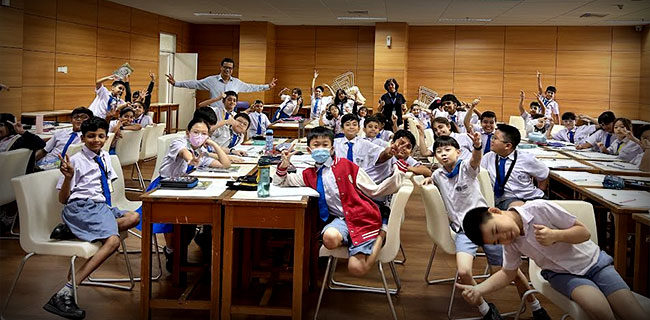
    Kunal SinhaOver the long years of my advertising career, I never passed up the opportunity to teach. To pass on my own rich and varied learnings to future generations of planners, researchers, creatives, account and brand managers is an elixir that I simply enjoying partaking ever so often.


    Usually, I receive invitations to deliver a guest lecture, sometimes teach a full course, at the post-graduate level. So last week, when a request to teach popped up on a WhatsApp Indian execs group in Jakarta, I was quick to raise my hand. Like the front-benchers in the Grade Four class whom I was about to teach the basics of advertising.


    Having run a creative writing programme for primary school students during the pandemic, I had a sense of how I wanted to run the hour-long session. I needed to involve them from the very beginning. Having put two offspring through IB education, there was one principle that just had to be followed: stoke the spirit of inquiry and make the learners think on their feet. Hell ya! Don’t today’s 9-10-year-olds know how to do that?


    Within the first 10 minutes of the class, they had not only told me about their favourite brands but pretty much taken us all through their customer journeys. They pointed out that 90% of ads sucked, a lot of them were misleading, and yet they enjoyed watching and remembered ads that entertained them. They hated it when they could not skip ads on YouTube, or their Instagram scrolling was interrupted by real estate ads.


    I had deliberately chosen many ads that featured kids. The old Hutch Boy and Dog ad. A McDonalds Ramadan ad featuring a warm, fuzzy story about a father and son. A funny ad from a Nissan car dealership that showed a conversation between two kids and a car salesman. Truecaller ads which showed spammers/ scammers as wolves in sheep’s clothing. And the Volvo Trucks Epic Split featuring Van Damme, who no one recognized even as his split evoked gasps and they wanted to watch it again. You know the one I’m talking about right?


    I had the most enjoyable hour I could have with my pants on.


    Everyone in marketing and advertising and digital and branding and market research … must go out and pass on what you’ve learned to kids. There are plenty of reasons to teach, and I list five here.


    1. Primary school kids, high school kids, BFA and BA and BBA students, those doing their PG in business or data science – it is the only way to get future generations interested in a career in the creative arts, a career in smart selling. Go ahead and inspire them.

    2. Every class can be thought of as an ideation session, or a human lab. You will get instant, unfiltered responses to your concepts. The younger the students, the more they question you – if you design your class that way. Behave like a learner, not a guru (even if LinkedIn has anointed you as one).

    3. Each example you show should not be to prove your point. Rather it should get the classroom to relate it to their own life experience, their likes and hates and come up with their own examples. The shared experience becomes a valuable lesson, for the teacher as well as the student.

    4. Teaching is the best way to hone your presentation skills and your stage presence. It prepares you for the unexpected. It builds confidence – so the earlier in your career you get into it, the better it is. With agencies spending practically nothing anymore on building such skills, volunteer guest sessions at your alma mater.

    5. It opens windows to the future. You understand what the interests, priorities, dreams of the next generation are. Whether they want to change the world in middle-school, or join the rat race while doing their MBAs. Do they view tomorrow as full of opportunity or conflict?


    Wasn’t a song written by Graham Nash 53 years ago so prescient?


    Teach your children well
    Feed them on your dreams
    The one they pick’s the one you’ll know by

    Don’t you ever ask them why
    If they told you, you would cry
    So just look at them and sigh
    And know they love you.


    Kunal Sinha is Group Chief Strategy Officer at M&C Saatchi Indonesia, and the author of seven books on creativity, travel, rural marketing and China.


  • Lame & Lazy: News Media’s Poonam Pandey Coverage

    Lame & Lazy: News Media’s Poonam Pandey Coverage

    Shailesh KapoorLast Friday saw the bizarre publicity stunt, whereby Poonam Pandey, along with a media portal (Hauterrfly) and a digital agency (Schbang) staged the news of her death, with cervical cancer being the stated cause. The stunt ended the next day, when Pandey posted a video message on social media.
    Rather than creating any significant awareness for cervical cancer, the incident has served as a comment on the state of our news media today. Every single news platform carried the news of her ‘death’, made tribute videos (often like showreels of her  pictures from her social media handle), spoke to ‘fans’, and generally behaved very concerned about the whole thing. These videos and articles, still available on social media, are a testimony to the sorry state of affairs in our news business.

    Even if one grants the benefit of the doubt to news platforms, that the incident was so bizarre that one wouldn’t expect any ‘foul play’ in it, that benefit of doubt would last an hour or two at best. Principles of sound journalism would suggest follow-up coverage that’s more investigative in nature. Here, a celebrity death was being reported for an entire day, but with no trace of the body or the place of death.

    Social media users came up with conspiracy theories that should have been no rocket science for a seasoned investigative journalist, such as Pandey posting very normal pictures on her Instagram just a couple of days earlier. Digital news platforms could have (somewhat) valid budget constraints. But for our leading news channels to report on the story from the desk, taking a text-based Instagram post, from a celebrity known for courting controversy, on face value, is a sign of how low the standards have fallen.

    If one were to think of staging a stunt like this, they will simply be deterred by the audacity of the idea. After all, you would expect it to be called out within a few hours, if not minutes. That a celebrity and two companies had the confidence of being able to pull this off is itself a telling statement. It’s like a live social experiment, in which our journalists were the social groups being tested.

    Disappointing it may be, but not surprising. If editors who get paid handsome salaries sit in the studios night after night and do armchair politics, staging debates with foregone conclusion, laziness is bound to seep into the culture of popular journalism, especially on the television side. Chasing a story seems to be now the job of the minions, and a desk job can be seen as a promotion!

    In any case, the art of interviewing has been long forgotten, and only a few veteran journalists from the 90s (or earlier) are keeping it alive. Political reporting has lacked nuance, and reporting on the economy has lacked domain literacy. And now, celebrity reporting, which one would imagine to be the easiest of them all, also seems sub-standard.

    The Poonam Pandey story would be forgotten soon. But the lazy media that reported it is here to stay. And we have little choice but to suffer.

  • Beyond romance: Valentine’s Day campaigns across the world

    Beyond romance: Valentine’s Day campaigns across the world

    Kunal SinhaThe path to love is paved with gold. And strewn with flowers.

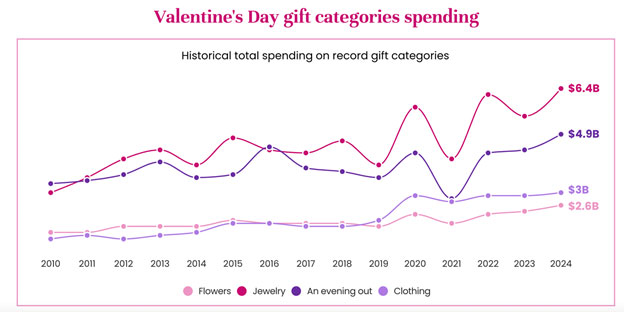
    In the United States, consumers plan to spend $25.8 billion on Valentine’s Day this year – an average of $185.81 per person. A 2023 Assocham report estimates the Indian Valentine’s Day market to be worth ₹25,000 crore, while the flower market around Valentine’s Day is estimated at about ₹500 crore.

    Source: National Retail Federation, 2024

    While couples spending on jewellery, flowers, clothes and romantic dinners drive the lion’s share of that consumption, non-romantic celebrations are a growing trend across the world.

    A remarkable evolution of the target audience is apparent in the diverse celebrations associated with Valentine’s Day. Celebrations are now about various kinds of relationships, including friendships, family bonds, self-love, and even expressions of love for pets.

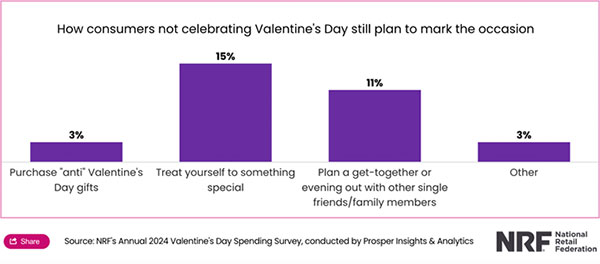
    Research amongst ‘non-couples’ reveals that people are spending on themselves – which is only to be expected in this age of self-love, getting together with other unattached friends or family members, or even buying ‘anti-Valentine’ gifts.

    These trends are particularly popular among younger consumers.

    Over half (53%) of 18- to 34-year-olds and 42% of 25- to 34-year-olds not celebrating Valentine’s Day still find a way to mark the occasion.

    Crafting campaigns that embrace this diversity resonates with a broader audience, capturing the essence of love in its myriad forms.

    For young women who mark the occasion by treating themselves or throwing a party with single friends, there’s “Galentine’s Day” gift guides from brands like Macy’s, Kay Jewellers and Walmart

    1-800-Flowers emphasises the importance of celebrating friendship, recognising that Valentine’s Day is not limited to romantic relationships.

    Their ad features a heart-warming scene between two friends, as they reflect on the bond they share and how their friendship has evolved over time. The friends engage in a touching conversation, asking each other meaningful questions about their friendship and the impact it has had on their lives.


    DoorDash Self-Love

    Knowing that most other delivery services would cater to traditional couples, delivery app DoorDash put forth a narrative that gave single women permission to enjoy Valentine’s Day to the same extent that couples would. This meant capitalising on the existing narratives around pleasure, passion, and romance that are always front and centre on Valentine’s Day – and tailoring them to single women.

    Since self-love isn’t new, it was important to have a fresh take. Taking self-love literally, the campaign tapped into the 72% of US adults that believe self-pleasuring is a form of “therapy”, and start a conversation that is weirdly taboo: female self-pleasure. Rooting the conversation in destigmatising female self-pleasure, it used the most iconic Valentine’s gift — a bouquet of red roses. The surprise element: The Self Love Bouquet, a bouquet exclusively on DoorDash made of 11 real roses and one Rose, the bestselling female sex-toy of the last five years. In creating the bouquet, DoorDash was able to deliver $6 million worth of flowers – twice as much as in the previous year to a new demographic – single people who don’t purchase flowers on this holiday, selling the stocks out in four days.

    Watch here: https://www.youtube.com/watch?v=f90ORAVPGSc


    My Muse

    In India, sexual wellness brand, MyMuse challenged love’s most well-known ambassador, Cupid, with its campaign, ‘Modern Love Needs Modern Solutions.’

    With Cupid representing age-old societal norms that represent only one right way to love, MyMuse shows how love and people’s expression of it have changed. So, whether it’s choosing your own path, picking your own traditions (old or new), or choosing to settle down or stay single, MyMuse understands that there is no one-size-fits-all in modern love.

    Proposing that “Modern Love Needs Modern Solutions – Cupid doesn’t get it, MyMuse does, the brand is running a campaign showcasing a well-meaning Cupid, who attempts to bring couples together in the name of love, using age-old tricks. As his attempts are rejected by people who prefer to find love and express it in their own way with the help of MyMuse products, Cupid has a complete meltdown and starts questioning his life’s purpose.

    Watch the series here:

    In addition to the films, MyMuse created a Cupid profile and launched a #cancelcupid campaign on LinkedIn, where it leveraged its employees as brand ambassadors.

    https://www.linkedin.com/posts/mymuse-india_cancelcupid-activity-7158445512885452801-J-cG/

    New forms of celebrating relationships notwithstanding, technology is allowing couples in love to experience Valentine’s Day in fresh ways.


    Gaming romance

    Zynga, the game publishing label owned by Take-Two Interactive, is commemorating the season of love with a variety of delightful Valentine’s Day 2024 festivities throughout its array of games.

    On Farmville, FarmVille 3 – Sweet Nothings, Ginny is brimming with enthusiasm for Valentine’s Day, eager to ensure that everyone on the farm feels cherished and included. She has organized a Valentine’s Phone Booth, where individuals can dial their loved ones and traditionally convey their affection. Participants can even win romantic rewards, contributing to making Valentine’s Day truly unforgettable under Ginny’s thoughtful planning.



    Monster Legends is commemorating Valentine’s Day with an uproarious new Era Saga featuring Lovestruck, a playful creature known for stirring up mischief during this festive period. However, Lovestruck isn’t the sole attraction in this season’s array; they’re also unveiling Shakespearante, a romantically reimagined rendition of one of their  beloved characters.



    Dragon City is staging a series of Valentine’s Day-themed events. Players are invited to gather around the campfire to listen to the twisted tale of the new Storyteller Dragon in Part I of the ‘Enemies to Lovers’ Valentine’s event. Participants can aid the new Hanshock and Gretackle dragons in piecing together this ancient narrative by unlocking storybooks filled with rewards and restoring honour to their families in Part II, ‘Sweet Revenge.’



    Cadbury Dairy Milk Silk – AI Stories

    Cadbury Dairy Milk Silk, the chocolate brand from Mondelez India, plays cupid once again to highlight love stories around us. This year, the brand brings an experience that allows couples to transform everyday moments of love into cinematic experiences, powered by generative AI and filmmaker Zoya Akhtar.

    Consumers can scan the QR code on Cadbury Dairy Milk Silk packs, leading them to a site where they will need to answer some questions that will help in curating their love stories with personalised avatars, which will be featured in the animated movie. The AI converts simple text input from the consumer into lovable character animations featuring the consumer.

    These AI-curated stories will be amplified through strategic media partnerships and personalised content collaborations with leading OTT and music platforms, as well as brand experience zones. Riding on the ultimate goal of making every couple’s Bollywood dream come true, selected videos from the campaign will be featured on the streaming platform Disney+Hotstar, allowing consumers to share their love stories with a wider audience.

    Watch the launch video here: https://www.youtube.com/watch?v=8FMhNiKYdOw


    Bumble

    Bumble, the dating app, is celebrating Lunar New Year and Valentine’s Day in Singapore by launching a new campaign called “Toss Love into the New Year”. The campaign is inspired by the traditional and iconic “Prosperity Toss” or Lo Hei and aims to help Singaporean singles cast out their dating fatigue and manifest a more prosperous love life.

    As part of the campaign, Bumble is giving away a curated exclusive ‘Lo Hei’ pack filled with eight goodies, such as fish ball crackers, Hershey’s kisses chocolates, and salted egg fish skin from Golden Duck. Each goodie represents Bumble’s eight mantras to manifest a prosperous love life, such as “Everything starts with a belief”, “I take control, love will unroll”, “Healing on the inside, beaming on the outside” and “I’m always real, authenticity is the deal”.

    The first 200 users of the app can get the pack on a first-come-first-serve basis. Bumble’s partners in the campaign are Singaporean influencer and content creator Saffron Sharpe and Feng Shui expert and TikTok creator Cliff Tan. Sharpe is featured in a video explaining the meaning of the eight mantras and setting up Bumble’s ‘Lo Hei’ pack. She also provides tips on rearranging one’s personal space to invite love back into their lives.

    Watch here: https://www.youtube.com/watch?v=OniSUjjTiV8

    Something to be inspired by when planning your next Valentine’s Day activation?

    Kunal Sinha is a senior strategy and foresights executive based in Jakarta, Indonesia. He is the author of several books including The Future of India’s Rural Markets and Raw – Pervasive Creativity in Asia. He writes for MxMIndia every other Monday. His views here are personal.

    [1] NRF and Prosper Insights & Analytics, 2024

    [1] https://startuptalky.com/valentines-day-india-economy/

  • Das ka Dum with Dr Bhaskar Das | One of the early indicators of a slowing adspend economy is the blank hoardings in Mumbai. So would you say that not-so-achche din aane waale hain?

    Bhaskar DasIf you wish to access the archives, please go to the Das Ka Dum tab on the website’s top navigation bar or click here: https://www.mxmindia.com/category/columns/das-ka-dum/

    Q: One of the early indicators of a slowing adspend economy is the blank hoardings in Mumbai. And we are seeing that now. So would you say that not-so-achche din aane waale hain?

    A: Your observation suffers from confirmation bias. There is a tendency amongst human beings to process information by looking for information that is consistent with their existing beliefs. This biased approach to decision making is largely unintentional, and it results in a person ignoring information that is inconsistent with their beliefs.

    Now I would ask you how many blank hoardings have you seen, in how many cities and which location etc. My interactions with hoarding-owners gives me a different picture. Of course dil would always maange more (as human beings prefer more the merrier) but business is good in general in outdoor.

    I don’t have statistics but good sites are generally occupied. But it’s not representative of the overall inventory occupation status in the country. Another sign of outdoor companies doing well is the investments that are made in developing new sites and improving the existing sites. No one invests in a medium that has declining achche din. So all is well, sir. I am sure the business would do better if the industry gets united to develop a third party database to enable buyers to evaluate the medium’s efficacy and justify investment.

  • Das ka Dum with Dr Bhaskar Das | It’s a leap year, and hence 29 days in February. How do you think should one maxmise on this extra day that we get?

    Bhaskar DasIf you wish to access the archives, please go to the Das Ka Dum tab on the website’s top navigation bar or click here: https://www.mxmindia.com/category/columns/das-ka-dum/

    Q: It’s a leap year, and hence 29 days in February. How do you think should one maxmise on this extra day that we get

    A: Yes, 2024 is a Leap Year. I can answer this question in a platitudinous way — this year is expected to be filled with possibilities, challenges and unique experiences. So, one can embrace the excitement, set meaningful targets and leverage the most of an extra day in 2024.

    But philosophically, I would like to add that just how can one day extra make so much qualitative difference which 365 days cannot? I might sound as a cynic, but it’s time we smell the coffee and be realistic and not build castles in the air for an additional day.

  • Das ka Dum with Dr Bhaskar Das | In a world saturated with digital ads, what can traditional mediums like print and TV do in India to stay relevant and effective in capturing audience attention?

    Bhaskar DasIf you wish to access the archives, please go to the Das Ka Dum tab on the website’s top navigation bar or click here: https://www.mxmindia.com/category/columns/das-ka-dum/

    Q: In a world saturated with digital ads – especially in the West, what can traditional mediums like print and TV do in India to stay relevant and effective in capturing audience attention?

    A: First things first, for any business, one principle to be always remembered is: Jhuk jao, ya Tut jaoge – that is, bend to market forces, listen to customers and to their unfolding/ unarticulated wants. Secondly, it’s not about the formats of delivery, it’s about catering to the demands and expectations of one’s served markets in sync with each format’s uniqueness. Any myopia about one’s format and not genre (eg news business as opposed to newspaper or News TV channel business) is a sure recipe for failure. In other words, it is an imperative to think through a prism of outside-in and horizontally but deliver content and context vertically and complementarily , suitable for an omni-channel content discovery. It might not be an easy task as legacy mindsets have learning disability and the proclivity to adhere to past success models is difficult to escape.

  • Das ka Dum with Dr Bhaskar Das | As technology advances, the line between personalised advertising and invasion of privacy gets thinner. How do you foresee the ethical considerations evolving in the future of marketing?

    Bhaskar DasIf you wish to access the archives, please go to the Das Ka Dum tab on the website’s top navigation bar or click here: https://www.mxmindia.com/category/columns/das-ka-dum/

    Q: As technology advances, the line between personalised advertising and invasion of privacy gets thinner. How do you foresee the ethical considerations evolving in the future of marketing

    A: I agree with your concern. In fact with the arrival of generative AI , the line is going to be blurred further. In reality, we shall be unable to differentiate between truth and fake, more and more. The more digital media make inroads into our life, as a user/ consumer, we shall be leaving our indelible footmark, to be leveraged or for deception. I hope someday regulations would ensure respect of individual privacy. But till then we have to live with the current practice where ethical considerations would be a casualty. At this point corporations do express their commitments to respecting privacy of individuals, but they get flouted in execution, willy nilly.

  • Das ka Dum with Dr Bhaskar Das | In less than a month from now, the new CEO of the India office of VML will take charge. Any thoughts on what she should be doing?

    Bhaskar DasIf you wish to access the archives, please go to the Das Ka Dum tab on the website’s top navigation bar or click here: https://www.mxmindia.com/category/columns/das-ka-dum/

    Q: In less than a month from now, the new CEO of the India office of VML (one-fourth of which is the old JWT) will take charge. Any thoughts on what she should be doing?

    A: I don’t want to be branded as an armchair advisor for any industry, let alone a big agency like VML. They know their business and its strategy.

    Having said that, I may mention that they must have definite plans to manage their business both with telescopic and microscopic perspective. In today’s business landscape, every business needs to future-proof their business models and remain in a perpetual beta state so that no macro and micro development could torpedo organisational existence.

  • Sanjeev Kotnala: Poonam Pandey for India Ratna… why not?

    Sanjeev KotnalaHere is the breaking news: Poonam Pandey- the epitome of subtlety and grace, is in the running for the coveted India Ratna award. This is not serious and is in sync with today’s time and needs.

    I have been fuming with disgust at the latest Poonam Pandey stunt. I want the law to take up and define what should – could- and would be acceptable.

    In an era where everything goes in love, war and advertising, Poonam Pandey is that shining example of intense path-breaking, raw, out-of-box thinking and strategic pushing of the boundaries. Who would die for a cause- what if it was just a 24-hour stunt, and not the full 72 hours- when we could have granted her resurrection status.

    Back in 2011, she vowed to streak through the streets of Mumbai. All in the name of patriotism, all to motivate the cricket team. The BCCI spoiled the party by denying her permission. And yet, in 2012, she kept her commitment by baring it all when KKR won the IPL trophy. Learning from the past, she did not seek BCCI permission. That’s commitment, passion, love and a sharp learning curve.

    She turned down Bigg Boss Season 7 because the promised paycheck did not meet her level of self-importance. A girl must have self-esteem and know what her value is. Then YouTube banned her channel ‘Bathroom Secrets’ because it did not want the young audience to learn many things they found interesting.

    A typical female can’t even fathom such rebellious acts and barriers to success. Oh, she knows how to amplify it. She was among the most searched on Google in 2012 and part of the Kingfisher calendar in 2011.

    But let’s give credit where it is due. Poonam Pandey has been tirelessly working relentlessly to spice up the mundane lives of many people. She was in Khatron Ke Khiladi-4 and did Total Nadaniyaan and Pyaar Mohabbat Sssshhh. She has been a beacon of hope and tidbit news for many journalists carrying scoops that made their editors and audience smile.

    Now, her recent death-defying act has been called a stunt. It may have raised many eyebrows, but she has been selflessly selfish throughout her life. She has stayed well within the boundaries of what can be expected from Poonam Pandey.

    And she, in fact, has schooled ASCI on exploiting loopholes in the influencer guidelines by not officially participating in the stunt; she smartly avoided the mandatory disclaimer she would have needed to carry- because all her work was done by the gullible journalist and fastest finger first media working for breaking news.

    When the news of her death spread, the nation collectively gasped- so young- merely 32- and then it turned out to be a bigger deal than we imagined. Maybe the media was in on the secret, or it started with a casual chat at a coffee shop.

    There has been a call ( on social media and a few WhatsApp groups) that it would be better for the National honours to be conferred while people are still breathing, Poonam Pandey, the ever-patriotic icon, has risen from the dead to claim her National Ratna and thus make a mark.

    Running naked, defying death, being a model, a Reality TV participant, an erotic actress (Google search), and gracing us with provocative Instagram pictures – Poonam Pandey truly deserves recognition.

    Let’s focus on the positive. Here is a lady who, by her recent stunt has worked on vaccine awareness, who believes in Mera Viskas- Sabke Sath, and ‘Made in India.’ She is an ideal candidate for National Awards in multiple categories.

  • Ranjona Banerji: Co-opted media as the first line of defence

    Ranjona BanerjiFamiliar tropes dog us incessantly. When a media is so dysfunctional, it is hard to even critique media functions.

    Thus, when the BJP’s best and finest attack journalist Nikhil Wagle on the streets of Pune, smash his car and try to pull him out of it, well, is the mainstream media going to cover the attack and berate the BJP?

    You can hear me laughing, right?


    You have a case filed against Nikhil Wagle for making “anti-Modi” remarks.


    Media houses like India Today concentrate on the video of the attack by “alleged BJP workers” – I quote the website. The attack itself is scary, as this video shows.


    https://www.indiatoday.in/india/video/watch-bjp-workers-vandalise-journalist-nikhil-wagles-car-in-pune-2499993-2024-02-


    Other mainstream media outlets concentrate on how the Opposition has called the condition of Pune a “goonda raj”, thus shooting from someone else’s shoulder as usual.


    And all the journalists’ bodies who are not supported by the legacy media condemn the attack.


    https://www.newsclick.in/journalist-bodies-condemn-attack-nikhil-wagle-urge-maharashtra-government-take-action


    This is business as usual. Wagle has been attacked, mainly by the Shiv Sena (the original, begun by Bal Thackeray) and the BJP several times. But this has not stopped him. He bucks the trend of capitulation and pays the price.


    In this interview, Wagle’s son Parth MN, a fine journalist himself, speaks to Meena Kotwal (another fine journalist) of The Mooknayak about the various attacks on his Father.


    These are some of the demands by journalists’ bodies of the BJP governments at the Centre and in the state of Maharashtra where the attack took place: “an environment where differing opinions, especially in politics, are respected”, “decisive action against the perpetrators”, “violence against journalists will not be tolerated”.


    They sound righteous and legitimate.


    However, I hear in them – I was going to write “childish innocence” but I now correct myself to “adult naivete”. Not to mention a certain tiredness. Those who believe in journalism as speaking truth to power have said this consistently for the past 10 years, but no one has listened. And frankly, no one within the BJP universe cares.


    These much-repeated words will make no difference as long as all those who claim to practice journalism but in fact work as BJP propagandists continue with their despicable travesty of journalism. And this means about 80 per cent of television, which remains far more powerful than print and digital. As long as TV people promote the cult of Narendra Modi, as long as they demonise religious minorities, as long as they ignore the suffering of millions and celebrate the illegal use of bulldozers against the innocent, the BJP and its governments will do nothing about respecting different opinions and punishing its own people. And let us not forget newspapers, especially those based in North India, who skirt along the edges of journalism without venturing too far within for fear of retribution.


    Even now, as India’s farmers begin another series of protests over their demands for minimum support prices, we have India’s big TV media faces attacking the farmers as they did last time two years ago. The usual language is used to debunk the protests: chaos, traffic jams, farmers are rich and so on. The default position is that anyone who counters or questions Modi and his policies or lack of policies must be a traitor.


    That some of us still have faith in the principles of democracy being followed by this government is testament to the human capacity for faith.


    As for me, I see the co-opted media as the first line of defence by the BJP/RSS against the crumbling edifice of journalism as it should be…


    Ranjona Banerji is a senior journalist and commentator. She writes on MxMIndia on Tuesdays and Fridays. Her views here are personal.

  • Sanjeev Kotnala: Untangling Unbiblical Cords in Life & Brand-Building

    Sanjeev KotnalaDuring birth, the physical umbilical cord is ceremoniously cut. Still, the bond between mother and child remains metaphorically tethered by what we might call an “unbiblical cord” throughout life. This intangible connection, though unseen, can be remarkably strong. It is often joked in India that, culturally, this unbiblical cord is seemingly unbreakable in nature.

    However, beyond this primal connection, we weave new unbiblical cords throughout our lives, some consciously and many unknowingly. These cords are not physical but are deeply felt, influencing our thoughts and actions.

    Our unbiblical cords form within families, among school and college friends, first love, and even with former bosses and organisations. They tether us to past experiences, shaping our perceptions and reactions to new challenges and opportunities. However, clinging too tightly to these cords can hinder personal and professional growth as we measure current situations against past experiences, often overlooking new possibilities.

    We must recognise that a few of these unbiblical cords, such as those connecting us to family and close friends, are essential. However, we must cut off many others for our own advancement. These include cords binding us to past organisations beyond mere networking relationships or in situations demanding crisis intervention. While breaking such cords can be emotionally challenging, it is essential for personal development.

    In Personal Professional World

    We must reflect on the web of unbiblical cords in our lives. We should strengthen the selected few, cut off the rest, or stop feeding them. However, these decisions must be more than just emotionally driven but also logical and rational. By doing so, we can free ourselves from the constraints of the past and embrace new opportunities with clarity and purpose. 

    In The World Of Brand-Building

    In the dynamic world of brand creation and marketing, we often find ourselves entangled in unbiblical cords with brand purpose, communication strategies, and messaging formats. But brands cannot afford to be bound by these outdated ties. They must break free and evaluate every opportunity and concept on merit.

    Today, brands cannot rely on past successes to guarantee future success. Today’s landscape is defined by shifting audience preferences, fickle loyalties, intense competition, and ever-dwindling attention spans. Holding onto outdated, unbiblical cords only keeps brands from reaching their full potential.

    It’s time brands take a bold stance and, at times, unpopular decisions to shed the burdens of the past. Keep the unbiblical cords that strengthen the brand’s identity and values, but ruthlessly cut loose those that hinder progress and innovation. 

    Recognising Brand’s Unbiblical  Cords

    There is a need to  understand the importance of staying agile and adaptable in a constantly evolving marketplace, and dedicate efforts to helping brands break free from the shackles of tradition to embrace a future filled with endless possibilities.

    However, the process of identifying the unbiblical cord that individuals, organisations, and teams carry is something that takes work and effort. There is a lot of understanding, research and cross-pollination of ideas, along with open debate that must operate in an environment of complete trust. The thought is not new, but the process is. These cords come from motherhood- the origin- the creators, and the leadership more than from the instinct and intellect the ground forces operate with.