Category: RANJONA BANERJI

Ranjona Banerji’s hard-and-soft look at nightly news and the fare in the morningers

  • Ranjona Banerji: When newsmedia went nuts about Tharoor

    By Ranjona Banerji


    And so we reach our most ridiculous news headlines via Twitter – so far. A bizarre and somewhat corny marital spat between Union minister Shashi Tharoor, his wife Sunanda Pushkar and a Pakistani journalist, Mehr Tarar. Tharoor is not new to Twitter controversies. He has got into trouble for a jokey tweet about travelling “cattle class” to please the “holy cows” of his parties. His involvement in the shortlived Kochi IPL team and that of Pushkar was revealed by Lalit Modi on Twitter and cost him a ministry position.


    But this was something else. Tharoor, who has over 2 million followers on Twitter, was suddenly found to be tweeting odd messages from Tarar, claiming undying love on whatnot. Then he issued a tweet saying his account had been hacked. Then his wife popped up saying the account was not hacked and that she had put up those tweets, based on messages sent on the Blackberry messaging service to her husband. Then Pushkar gave a series of interviews claiming that Tarar was an ISI agent who was stalking her husband, then she denied some of them, then she didn’t. Tarar jumped in, defending herself and threatened to sue Pushkar.


    All in all, another fine mess for Tharoor and a hilarious day for the world of Twitter and the media. Getting into the personal lives of celebrities is normally the domain of film publications and even they pussyfoot around our precious film stars (for fear of being denied the next interview) or upsetting some PR person. But for the Economic Times to put this Twitter fight on the front page is certainly unusual. Thursday’s ET had this headline, above the fold: “Tharoor gets into a Border Love Row”.


    By Friday, every newspaper had the story. The Times of India dedicated a whole page to the matter – and this when there was one more horrific rape in the national capital, the AAP was involved some questionable form of vigilante justice and Rahul Gandhi was or was not going to be the Congress nominee for prime minister. Now we all know all about Pushkar, Tarar and Tharoor – or at least I know far more about them than I ever wanted to.


    What to make into news… Journalists use the term “judgment call”. So how much news was in a spat between a husband, a wife and another woman? Yes, the husband is famous, the wife is high profile and the other woman was a great admirer of the husband. But was this front-page worthy for anyone, apart from the salacious nature of the story and the fact that the wife made it public? It is difficult to make a value judgment here but it is easy to see that this will not be an exception. It is likely to become the rule.


    Once again, social media is changing the equation as far as the traditional media is concerned. I am holding back from using a cliché like “interesting times” but I do concede that this particular story is quite funny, proving that other cliche that the truth is much funnier than fiction.


    **


    The media spotlight on the Aam Aadmi Party and Arvind Kejriwal is turning out to be a curse as much as it was a boon in the movement’s formative days. The vigilante actions by two AAP ministers in Delhi and their run-in with the police, Kejriwal’s need to hold a press conference every two minutes, the revolt by a vocal member – all these have only increased the scrutiny and the more the scrutiny, the more the trouble up ahead.


    **


    The only person weeping right now (apart perhaps from Tharoor) is Gujarat chief minister Narendra Modi who will have to pull off something staggering to become the media’s foremost darling once again.


    Ranjona Banerji is a senior journalist and commentator based in Mumbai. She is also Contributing Editor, MxMIndia. She can be reached via Twitter at @ranjona. The views here are her own
     

  • Ranjona Banerji: Did Sunanda Pushkar story merit top billing?

    By Ranjona Banerji


    The last few days saw the news cycle consumed by Sunanda Pushkar, Shashi Tharoor and Mehr Taraar with allegations of affairs and unhappiness. There was a tragic culmination to the story with the suspected suicide of Pushkar. But how important was this story, that newspapers and news channels gave it top billing?


    Sunanda Pushkar was the wife of junior minister Shashi Tharoor. The world (other than the cocktail circuit of Dubai and perhaps New Delhi) knew of her because of the controversy of the Kochi IPL team, where both she and Tharoor had some involvement. It was IPL commissioner Lalit Modi who revealed details of the Kochi team through his Twitter account. Tharoor had to resign as minister, Pushkar removed herself from the Kochi team and the rest of us became familiar with the term “sweat equity”. Tharoor married Pushkar and then both became the darlings of the Delhi cocktail party crowd.


    So far, there is no indication of how important either Tharoor or Pushkar are to the national narrative. When Pushkar started tweeting last week from her husband’s phenomenally popular Twitter account, it was all about how some Pakistani female journalist was stalking her husband. The journalist in question, Taraar, denied allegations, Tharoor said his account had been hacked, Pushkar said it wasn’t hacked and that she had been tweeting. She made elliptical allusions to an affair and then to how she had been made the scapegoat in the IPL controversy. All this was played out on social media and to a salacious mainstream media.


    Still, nothing of national interest is visible here except a gossipy prying into other people’s lives. It is true that Pushkar made it all public but that has no bearing on the importance of the material. Then Pushkar is found dead by her husband in a Delhi hotel room and that ends all other news. Apparently, top news anchors even stopped the nightly debates when they got the news on the cellphones.


    When Princess Diana died in a car crash in Paris in 1997, The New York Times famously decided not to make it the top story of the day. By any reckoning, Diana was more famous than Pushkar. As obituaries of the poor woman appeared in newspapers across India, most people had nothing more to say than Pushkar was warm, vivacious, a good cook and lit up parties when she entered them. Others mentioned that she was a bit of a social climber and old school friends popped up to tell us that she was a shy, withdrawn girl who wanted to shrug off her small town origins.


    The significance of the front-page leads and top billing on news channels is still unclear. The Delhi government with India’s new hope Arvind Kejriwal is involved in all kinds of bizarre tactics. Rahul Gandhi and the Congress are making valiant efforts to get back into the conversation. Narendra Modi is smarting from Kejriwal’s popularity while trying to save the country. And enough other sundry horrors happening all over the country and world to keep journalists occupied. So why did this story get so much importance?


    Here’s a theory: Delhi’s journalists knew Pushkar and Tharoor socially and therefore felt a personal loss with her death. They also felt some guilt at the way the affair allegations were played out in the media. The decision to make Pushkar top news was therefore a personal one, where the reader or viewer was forgotten. There is no justification at all for making this story more important than any other, even with the understanding that every such decision is a judgment call that can be contested.


    Even with Shashi Tharoor being a minister, this story was overplayed. The only takeaway is that everybody in India who takes part in the English media knows more about Sunanda Pushkar in her death than before. C’est la vie?


  • Ranjona Banerji: So why did Times make a front-page statement?

    By Ranjona Banerji


    Truth is, we have no political masters, nor do we have any hidden agenda. The only side we take is that of our readers.”

    So what compels a newspaper to make this statement, especially one that declares it is “the world’s largest circulated English newspaper”?

    The Times of India’s edition of January 23, 2014 carried this on the front page. The rather thin (leading to some very ugly hyphenation) single column headlined “To Our Readers” was a declaration that although the newspaper had been accused of first supporting and then turning against the newly formed Aam Aadmi Party, in fact it is for no one and against no one and will support whoever does the “right thing”.

    The newspaper also pointed out its philosophy, such as it is, which includes belief in “the primacy of the individual over the state, and that democracy in its truest sense is the power of one. We believe in personal liberty and in freedom of choice.” There is more in the same vein.

    As to why TOI decided to make this announcement is unclear, except for the allegations that it had switched horses mid-stream regarding the Aam Aadmi Party. But so what? As it itself declares, it has been accused supporting one or the political party in the past and has not bothered to make any front page announcements. Is it because the AAP is the new party of the middle classes, which is TOI’s core readership? Or has someone inside Bennett Coleman suddenly developed a very thin skin?

    The worst that The Times of India has been accused of is not patronage of a political party. The worst has to do with money: the introduction of Medianet where news items are sold for a hefty price and for private treaties, where certain business houses and entities can ensure good coverage for themselves.

    Obviously, there were no mentions of either in this intriguing, and if one may point out, clumsily written and punctuated, front-page editorial declaration.

    **

    However, it is also true that the media seems to be getting polarised politically in a manner last seen during the BJP’s Ram Janmabhoomi movement of the late 1980s. Journals and journalists both declared themselves to be pro-BJP and Hindutva, with an emphasis on a preference for economic reform as well as religious majoritarism. Much of this media anger was also against Congress hegemony and also showed itself in massive support for VP Singh’s breakaway movement.

    Since then, the media has been seen as supporting one or the other political direction although very often the accusations are quite wild. Right now the Indian media is clearly heading towards the Right – except for the gauntlet thrown down by the Aam Aadmi Party and its particular brand of agitation politics. And perhaps that is where TOI’s confusion begins.

    **

    The biggest current problem for the Indian media and television in particular is that it cannot see beyond Delhi. If the Gujarat chief minister was the front page hero for almost six months, he has been ousted by Arvind Kejriwal. Much as the AAP and Kejriwal have changed the game, they are certainly not the only stories in India. Yet day after day we are subjected to a series of Delhi-centric stories.

    Part of the problem is that Delhi has become the epicentre of journalism in India. As a result, once strong regional media entities have been forced to pay extra attention to the national capital. Most TV channels are headquartered in Delhi – Times Now being the notable exception amongst the top English channels. And our star TV anchors cannot see beyond their neighbourhood. Who knows what has been happening in India and the world over the past couple of weeks. All we know is that Sunanda Pushkar thought her husband was having an affair and then may or may not have killed herself and that Arvind Kejriwal slept on the streets next to his car for a few night until he was sent some hot paranthas.


    Ranjona Banerji is a senior journalist and Contributing Editor, MxMIndia. The views expressed here are her own. Ranjona Banerji can be reached at @ranjona

  • Ranjona Banerji: Disappointing and limited political coverage by Eng media

    By Ranjona Banerji


    Remember these words: “You shouldn’t think the media can do everything. It has a limited role.” This is Bihar chief minister Nitish Kumar talking to The Economic Times in a straight-talking, candid interview, about the BJP and Narendra Modi’s chances at the general elections. This interview comes just as I was getting bored with The Economic Times! Some food for thought for the media here: it does have a limited role. And the way the English media at least is going, ignoring large swathes of India to focus on the nitty-gritty of the local Delhi government, it is limiting its own role.


    Kumar mentions in this interview that a senior Delhi journalist had told him in 2012 – after his party the Janata Dal (United) split from the NDA – that four rounds of opinion polls had been planned to promote Modi and BJP as the winners in 2014. The collusion between political parties and Delhi’s journalists is nothing new and we see it in our newspapers and on our TV screens every day.


    For instance, Mamata Banerjee held a massive rally in Kolkata which saw lakhs of people turn up on January 30. It did not dominate media space the way any of Modi’s tiny little conversations or Arvind Kejriwal’s coughing fits do. I could not find a photograph in any of the national newspapers which I receive at home (four) although they did carry stories. Banerjee also has prime ministerial ambitions and as of now, she has control of Bengal, which sends 42 parliamentarians to the Lok Sabha.


    Talking about interviews, I only caught the Omar Abdullah interview on the BBC’s Hard Talk series in India. Stephen Sackur asked tough questions but interacted with Abdullah, who stuck to his own and answered those questions. If there is no back and forth in a conversation, the viewer gets distracted or annoyed. This interview managed to grab your attention. But enough flogging the same dead horse because from what I can see, people are still talking about the “interview of the century”!


    **


    In a small segue to sports coverage, I am disappointed to see so little about the Davis Cup ties which are about to start today. The Times of India has sidestepped tennis completely, except for a small mention that Roger Federer will play for Switzerland. Mid-Day, surprisingly, has nothing. The Indian Express comes good – with a focus on how both Leander Paes, who has India’s best Davis Cup record, and Mahesh Bhupathi are not playing.


    But the winner has to be Hindustan Times. On January 30, it carried an excellent interview (here we go again!) with Leander Paes and why he’s not playing this Davis Cup tie, underlying the politics that is strangling tennis in India. In today’s paper, (January 31), the back page is dedicated to tennis.


    The Times is perhaps like Star Sports India for whom sport is equal to cricket.


    **


    In all this media bashing, one has to acknowledge that when it comes to gender issues and violence against women, the media is not letting up. Every day, more and more horror stories are highlighted about just how women are treated in this country. Distressing as all this is to read, wider publicity is one way to tackle the issue if just to highlight what is going wrong. The media’s role may be limited but this is one instance where it can be effective!


    Ranjona Banerji is a senior journalist and commentator based in Mumbai. She is also Contributing Editor, MxMIndia. She can be reached via Twitter at @ranjona. The views here are her own


  • Ranjona Banerji: The Rahul Gandhi interview was more about Arnab Goswami

    By Ranjona Banerji


    Am I a serious journalist? After last night’s interview of Rahul Gandhi conducted by Arnab “I am a serious journalist” Goswami, I have come to the conclusion that I am emphatically not. My understanding of being a journalist is less me and more you. An interview has to draw out the interviewee. It has to place them on the spot, yes, but it cannot be about the interviewer. And an interview has to move along – if it’s getting stuck, you have to step back and come back to that unanswered point later. The reader or the viewer has to be your first priority.


    In this case, the unanswered point was the 1984 riots in Delhi where thousands of Sikhs were massacred by Congress members and others after Indira Gandhi’s assassination by her Sikh bodyguards. The horror of the killings was exacerbated by Rajiv Gandhi’s comment at the time that the ground shakes when a big tree falls. The point is important. The problem was that Rahul Gandhi was not the person to answer it. He was a child when it happened. The party has apologised since then as has the current prime minister. Why badger Rahul Gandhi endlessly on this issue when you can take him up on so many others.


    Then there’s the issue of corruption. Instead of talking about the sea of allegations against the Congress Party and issues like the coal allocation scam, Goswami got stuck on allegations against Virbhadra Singh, chief minister of Himachal Pradesh, based on some investigation that Times Now had done. Much as the nation apparently wants to know what Goswami thinks every weeknight at 9 pm, there is an India beyond Times Now. Really.


    Moreover, the number of times Rahul Gandhi mentioned “RTI”, “youngsters”, “women” and “empowerment”, anyone else would have taken him up on those issues and questioned him on what he had done about it. There are a number of problems with RTI in the states, including Congress-ruled states. Why not bring those up? What about the brother-in-law Robert Vadra? Not a single question on that.


    Bringing up Subramaniam Swamy’s allegations about Rahul Gandhi’s education was ludicrous. The kindest thing one can say about Swamy is that he is a “maverick” and he is infamous for throwing allegations all around, hoping something somewhere will stick. He is hardly the gold standard for information.


    The endless questions on Narendra Modi and the Gujarat riots became tedious after a point. And just to inform journalists in general, Modi did not get a “clean chit” from anyone. The SIT report said “no prosecutable evidence” which is quite a different matter.


    The whole interview sounded too structured. There was no flow and there was no charm. As of now, Rahul Gandhi does not stand accused of anything except being seemingly reluctant to take on too much and vanishing after making declamatory statements.


    I for one learnt little new about Rahul Gandhi except that he has some good artwork on his walls.


    However, the funniest thing about this interview was the “discussion” later with Vinod Mehta, editor emeritus of Outlook magazine and Siddharth Vardarajan, former editor of The Hindu. This was a first for me: an interviewer holding a discussion on how his interview went. If this is how serious journalists behave, well, thank the lord there are so many of us non-serious ones around!


    I hear that tonight there’s going to be even more discussion, from 8 to 11 pm. Luckily I have found itvchoice on my HD set top box so I shall watch some British reality TV shows about dancing on ice, dancing in your house and dancing in general. As it is I missed Elementary on AXN because of this interview.


    Or there’s always the BBC’s Hard Talk series on India…


    **


    Twitter not unnaturally was abuzz with the Rahul Gandhi speech and suddenly, Modi and Arvind Kejriwal (have I got the order wrong?) were off the grid, except when mentioned with regard to Gandhi.


    Now that was funny. May not last too long though.


    Ranjona Banerji is a senior journalist and commentator based in Mumbai. She is also Contributing Editor, MxMIndia. She can be reached via Twitter at @ranjona. The views here are her own


  • Ranjona Banerji: News media and its political leanings

    By Ranjona Banerji


    If you go by the internet alone, the Indian media is involved in some gigantic Spy vs Spy battle where Congress and BJP aligned journalists are playing a cloak and dagger game as sinister and silly as the one in Mad magazine. The words “paid media” are used so often that they have stopped being tiresome and are now just funny.


    And yet and yet, there is something that is going on under the surface, a division in the journalistic world perhaps not seen on this scale since the BJP’s rath yatra and the split in the country between those who wanted to break down a mosque to build a temple and those who did not. At that time, many journalists were quite surprised to discover that their colleagues were actually not as “secular” as they seemed and many were quite turned on by the religious sectarianism propounded by LK Advani and his BJP. The default image of the journalist as a jhola-bag-carrying Commie was forever banished.


    But there is a subtle difference between what happened then and what is happening now. At that time, individual journalists expressed their choices. For instance, The Times of India was a middle of the road newspaper, rather dull in fact while its editor Girilal Jain was a Hindutva supporter. The ownership played little role. The Indian Express and Ramnath Goenka were openly anti-Congress but in those days, pre the Ram Janmabhoomi movement, there was a sort of innocence as far as religious loyalties were concerned.


    Now, it is managements who are setting the agenda and journalists who are falling in line – some, it must be said, with more enthusiasm than others. TV18 has been the most obvious and the most prominent to recently align itself with the political right and most notably with the BJP’s prime ministerial candidate Narendra Modi. Before this switch though Rajdeep Sardesai, editor-in-chief of CNN-IBN had been accused of being in favour of the Congress. Even now, Karan Thapar is scrupulously fair and Sagorika Ghose is seen as the last Congress outpost in a BJP bastion! And what about the others? NDTV has long been accused of being pro-Congress. But during the Kargil “war-like” situation, others called it out for its “embedded” journalism which benefitted the BJP electorally.


    I worked with The Times of India in Ahmedabad during the Gujarat riots of 2002. Despite enormous pressure on the newspaper ownership and management from the governments in Delhi and Gandhinagar to stop our edition from reporting on the riots freely and fairly, the management not only stood by us but supported us wholeheartedly.


    The Living Media group has been accused of being pro-Sangh Parivar for some years now. And there was a time when its flagship magazine India Today was clearly tilted towards the right. (I worked with the group for many years in the 1980s when no such tilt was visible or conveyed to us.) But in that case, what does one make of the So Sorry cartoon series on Headlines Today which lampoons all Indian politicians quite superbly? This is unlike the once excellent The Week That Wasn’t on CNN-IBN which has suffered since TV18 turned right. It’s a tough call here – maybe they change their minds from week to week.


    One of the reasons why The Hindu apparently removed Siddharth Vardarajan as editor was because he did not give enough coverage to Narendra Modi on the front pages of that venerable newspaper. But The Hindu has always been seen as a pro-Left newspaper (and therefore not pro-right). So what is one to make of that?


    The Indian Express often receives the most flak from the rightwing on social media so evidently it has not stuck to the Ramnath Goenka brief.


    The fact is that because the Indian media does not openly align with political parties or movements, confusion is easy and suspicions even easier. In the UK, for instance everyone knows where a Guardian reader stands politically vis-a-vis a Daily Telegraph reader. The best compliment a newspaper or media group can be paid in India one supposes is when all groups accuse it of being biased. That means that something is being done right.


    The new player in the pack is the Aam Aadmi Party which has learnt the game very quickly and throws around allegations of media conspiracy theories with impunity. The irony in the fact that several senior journalists have jumped on to the AAP bandwagon does not occur to them. That is not surprising because irony-deficiency is a well-known symptom in the congenitally self-righteous.


    In all this, the maximum confusion is over the expression “paid news”. When the media uses the phrase, it is a direct reference to money taken by newspaper or media house managements from a political party to get favourable news printed. This is also how the Election Commission uses the phrase. When social media uses the phrase, it means any journalist who does not agree with the political position of the accuser! Ah well, sticks and stones.


    Ranjona Banerji is a senior journalist and commentator based in Mumbai. She is also Contributing Editor, MxMIndia. She can be reached via Twitter at @ranjona. The views here are her own


  • Ranjona Banerji: Falling caliber of editors & the crisis in news media

    By Ranjona Banerji


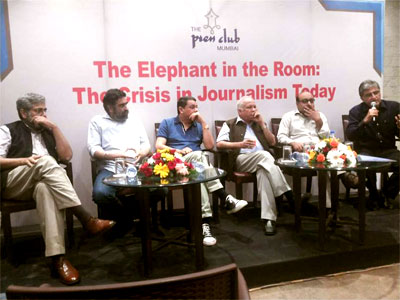
    The Press Club Mumbai held a discussion called, The Elephant in the Room: The Crisis in Journalism Today on Thursday evening. Participants were Kumar Ketkar, editor of Divya Marathi, Siddharth Varadarajan, former editor The Hindu, Hartosh Singh Bal, former political editor of Open magazine, Indrajit Gupta, former editor of Forbes magazine and Uday Shankar, CEO of the Star television network. The discussion was coordinated by Gurbir Singh, president of the Press Club.


    At the outset, the Mumbai Press Club has to be congratulated for confronting and seeking to address the problems faced by journalists and journalism today and flying down participants from Delhi for this discussion. If we do not discuss these things ourselves, it will become impossible to deal with the credibility and sustenance crisis we face. The bodies that have existed so far – like The Editors’ guild for instance – are quite frankly useless.


    The discussion started with Siddharth Varadarajan and Hartosh Singh Bal discussing the involvement of owners in the day to day running of publications and the pressures of advertising and management. Both Vardarajan and Bal lost their jobs because of owner interference. Kumar Ketkar questioned why owner, politicians and corporates imagine that journalists are really that powerful! Indrajit Gupta, who also left Forbes after a confrontation with management, pointed out how advertising pressure often does not allow journalists to function properly. Uday Shankar was scathing in the dereliction of duty by editors, pointing out that many had found it easier to go with the owner-flow rather than resist pressure, for their personal profit or advancement.


    Actually, almost everyone agrees with that. Editors, for the most part, are not what they were. But as veteran journalist Jyoti Punwani pointed out from the audience, the editorial versus management is age-old. The panellists could not agree on any solutions however. Bal for instance wanted a legal framework to protect journalists from owner pressure. Everyone wanted ownership patterns to be more transparent. And that was the crux of the discussion: dealing with management pressures whether it was to do with politics or business interests. How to make money and uphold the principles of journalism was a major issue discussed, including every journalist’s dream: to have a publication or broadcast house where the owners/managers did not interfere. The problems of credibility caused by the revelations of the Radia tapes and the questionable roles of Barkha Dutt and Vir Sanghvi also came up.


    All in all, it was a lively discussion. The event was web-streamed, which was an excellent way for the Mumbai Press Club to widen the debate’s audience and keep up with the 21st century. Net viewers sent in their questions via SMS.


    Although no conclusions were reached – the discussion went on for two hours – it is enough that the crisis was talked openly and candidly. Kudos to the Mumbai Press Club and all the participants.


    **


    Is it a sign of pride or insecurity that makes the Indian media go overboard whenever any person of Indian origin does anything at all? The ascension of Satya Nadella to the head of Microsoft was treated by some Indian newspapers in particular like Nadella had become President of the United States. Yes, Microsoft is a big and powerful company and yes, Nadella is of Indian origin. But above-the-fold on the front page is overdoing it, surely. In any case, the business pages had been predicting it for days.


    I suppose all it needs is for American newspapers to run front page stories headlined, “Microsoft founder Bill Gates is an American”. Yeah, I bet you would laugh then.


    **


    The battle over the Indian Readership Survey is getting more serious but remains funny. That Hindu Business Line should have more readers in Manipur than Chennai or that Nagpur’s Hitavada should have no readers at all speaks of completely mismanagement if not deliberate fudging of figures. Those with some memory may recall that the National Readership Survey was abandoned in favour of the IRS precisely because of such problems – but of course not quite so daft.


    **


    Somebody asked a question at the Mumbai Press Club last night to which I had no answer. Why, she said, is it okay for Swapan Dasgupta and MV Kamath to be openly pro-BJP and rightwing but it is not okay for anyone to be pro-Congress? Indeed. Why?


    Ranjona Banerji is a senior journalist and commentator based in Mumbai. She is also Contributing Editor, MxMIndia. She can be reached via Twitter at @ranjona. The views here are her own


  • Ranjona Banerji: Don’t support Modi and get damned!

    By Ranjona Banerji


    It’s familiar territory but it still requires revisiting. Both Rajdeep Sardesai and his wife Sagorika Ghose, both of the news channels CNN-IBN, were targets of online trolls this week – again. And again, the anger was aimed at their political affiliations. Or more specifically, because they were perceived as being opposed to the BJP’s prime ministerial candidate, Narendra Modi.


    Now online trolls are a well-documented group who use anonymity to attack people for all sorts of reasons. These attacks are often personal and vicious. Some have the ability to withstand them and some don’t. I myself have argued that journalists – because we operate in the public domain – must develop thick skins if we want to survive.


    So the discussion here is not about viciousness and threats of bodily harm. It is about the increasing inference that any journalist who does not support the BJP or Narendra Modi is corrupted. The obvious corollary is that journalists who do support the BJP and Narendra Modi are pure and untainted. Yet, both cannot be true.


    Either we want total objectivity at all times from all journalists which means that Swapan Dasgupta and Ashok Malik (I am just pulling names out of a hat) can no longer support or become mouthpieces for the BJP and Modi in print as much as all the others who are accused of being “Congress stooges” must stop interpreting Rahul Gandhi for the benefit of the rest of us. But if you allow one – and I see no one stopping either Dasgupta or Malik – then you have to allow the other – and that includes just about any political party or formation, not just the Congress.


    The irony for Sardesai and Ghose of course is that their employer and the channel they work for are widely seen as being pro-BJP and definitely pro-Modi. The same odd situation was faced by TV journalists of the Hindi news channel Aaj Tak during the Gujarat riots of 2002. While the India Today group was clearly pro-BJP (and this was evident in the writings of the India Today correspondent in Gujarat, among other indicators) members of its news channel were attacked for simply reporting what was happening.


    Indeed, this is why it is dangerous for media houses to have clear but unstated political positions. Everything is open to misunderstanding and attack. It is perhaps time, it needs to be reiterated, for media houses and journalists to be clear and open about their political affiliations. It happens in other countries; why not here?


    There is little doubt, for me at least, that this credibility crisis for the media has worsened after the revelations of the Niira Radia tapes and the conversations of Barkha Dutt and Vir Sanghvi with the lobbyist and PR person. After the initial disclosures by Open and Outlook magazines, there was some media coverage which soon petered out. This was a serious lapse on our part. We needed to have been more stringent because we in the media suffered the most. Instead, we hoped that if we ignored it, it would go away. Rot, however, has its own patterns of behaviour.


    The attacks on Caravan magazine for publishing interviews it did with terror accused Swami Aseemanand emphasise again the dangerous media environment we know live in. There’s no point denying it: the question is how we deal with it.


    **


    There is one brand of journalist who is forgotten in all this Congress versus BJP hoopla: those who do not support any one party but find various elements of many parties disturbing or difficult. I happily put myself in this category. As the old saying goes: I am not prejudiced, I just hate everybody!


  • Ranjona Banerji: Nothing’s changed in a no news week!

    By Ranjona Banerji


    The last week has been spent on holiday in Munnar, surrounded by tea estates and no internet connectivity. And given the enormous natural beauty around, there has been no time or inclination to watch television. News has been gleaned from a cursory glance at a newspaper at breakfast before rushing off somewhere or the other.


    And what have I found? That when you come back to it, nothing has changed. There’s Anna Hazare smiling his gummy smile in support of Mamata Banerjee. There’s Andhra Pradesh in an uproar over its imminent separation into two states. There’sNarendra Modi thundering along in some mock martial pose. And there’s the Aam Aadmi Party ready with its plan to take over the country. And there’s India, losing another cricket series away from home.


    Of course, the news cycle is what it is. When you work in a newsroom you do not always realise how little you have to work with. The latest scandal or some new revelation in an ongoing case consumes you. But as a “consumer”, you are faced with a wall of homogenous mediocrity from which you try and find something that might interest you. The short lesson is this: journalists need to spend a little time as consumers of their own products to understand how boring or predictable they can become.


    **


    The upside of being in a new place of course is the local news: the auto drivers’ striking in Coimbatore over set rates, the bird-sighting successes in the Ooty-Coonoor area, the latest freebie from the Jayalalitha government in Tamil Nadu or the side-stepping between the Communists and the Congress in Kerala are far more informative than the tedium of national news. The fact that the film stars are all different in South India also helps – the grasp of Bollywood reaches only so far.


    **


    The biggest loss of bad connectivity, at least on my part, came from the sudden divorce from social media. You do not realise, until you do not have it, how much those of us who use it depend on social media for the latest news and views. Twitter for the news and Facebook for the links which your friends find useful, instructive or annoying. You get glimpses into worlds you are not always familiar with and those can be used for topics of discussion in Twitter. Mainstream media needs to do a bit of thinking here, even while it still reaches where the dongle does not work!


    **


    Television news in India is still struggling with whether it is a news provider or an opinion aggregator, which is odd. It is clearly, the first place for “breaking news” as it never ceases to tell us (until the internet wins that war, which it will). But in India, it is still obsessed with picking up millions of opinions and presenting those, without establishing what is being discussed. Our host tried desperately on Wednesday morning to find out from television news just what had happened to the last Test match India played in New Zealand. But all he got from TV was a discussion on MS Dhoni’s captaincy from the anchors, from Rahul Dravid and from Sunil Gavaskar. From reading between the lines, we gathered that the Test was drawn. Who knows what the truth is. What is it, by the way?


    Ranjona Banerji is a senior journalist and commentator based in Mumbai. She is also Contributing Editor, MxMIndia. She can be reached via Twitter at @ranjona. The views here are her own


  • Ranjona Banerji: How the media is everyone’s whipping boy

    By Ranjona Banerji


    The media is now everyone’s whipping boy and there is no need for the media to get defensive about this. As long as everyone thinks you’re doing everything wrong, it is clear that you are doing everything right. The expression “paid media” is now indiscriminately used to describe journalists who do not subscribe to your political point of view, when the term within the media is used to describe managements who sell editorial space to political parties or politicians without informing readers or viewers.


    Arvind Kejriwal of the Aam Aadmi Party has accused the media of being pro-Bharatiya Janata Party and pro-Congress and also said that some of the media is dancing to the diktats of Mukesh Ambani and Reliance. More specifically, the media he says is either pro-Narendra Modi or pro-Rahul Gandhi; the unspoken implication being that the media is anti-him. However, through 2011 the media was extremely pro-Kejriwal and the India Against Corruption movement headed by Anna Hazare. One might wager that without media support, the IAC movement would have gone nowhere. Non-stop coverage of every IAC event, gross exaggeration of public participation figures all ensured that IAC, Hazare, Kejriwal, Manish Sisodia, Kumar Vishwas, Kiran  Bedi, Prashant Bhushan and others became household names.


    India’s controversial former chief of army staff VK Singh has also jumped into the fray, calling journalists “presstitutes”. This is how urbandictionary.com describes “presstitute”: “A term coined by Gerald Celente and often used by independent journalists and writers in the alternative media in reference to journalists and talking heads in the mainstream media who give biased and predetermined views in favour of the government and corporations, thus neglecting their fundamental duty of reporting news impartially. It is a portmanteau of press and prostitute.”


    In fact, I would question Celente’s (an American “trend forecaster) wisdom and political correctness in damning commercial sex workers (the now accepted term for prostitutes) by associating them with the media and with journalists.


    Jokes aside, Singh has been angry for a number of reasons – his various dates of birth did not sit well with either the Indian Army, the GOI or the Supreme Court, his various PR efforts sometimes backfired and Indian Express published a story last year about how some troop movements during his tenure were looked at suspiciously by the Government.


    The Editors Guild has taken exception to all this media-bashing and issued a strong statement: “Ironically, leaders who built up reputations and support by engaging the public through the media are now turning on the very media when they come under critical scrutiny…


    “The media that question and criticise political leaders and indeed every section of society should of course be open to criticism, even if it is harsh, of its functioning and to its flaws being exposed. The problem arises, however, when abuse and vague, unsubstantiated accusations of corrupt motives take the place of reasoned refutation and debate. An additional danger is that some of the followers could take their cue from the statements of leaders and may not stop with verbal attacks. Both print and television journalists have been subject to physical violence as well by political party workers.”


    Physical attacks on journalists are reprehensible and have to be tackled strongly by law and order. But general criticism of the media and of journalists has to be accepted as par for the course. As we have pointed out in these columns, there are clear instances of media bias on display at times and criticism of political parties, politicians and big business is sometimes a carefully calibrated exercise.


    The spread of the tentacles of lobbyists and PR people is well-known when it comes to film and business journalism for instance. And the Niira Radia tapes exposed the susceptibility of some of India’s biggest names. These are problems which the media must discuss more stringently, or criticism from those we criticise will only get stronger.


    If we don’t guard ourselves, someone else is going to try and do it for us. And that would be the real disaster.


  • Ranjona Banerji: Survey results are not gospel

    By Ranjona Banerji


    The TV channel News Express did a sting operation on market research companies to discuss poll surveys. They posed as members of political parties and asked if polls could be tweaked to favour them. The channel approached several agencies, of which some refused to take on any jobs on the grounds that they were too busy while others agreed to varying degrees.


    There is a serious need for market research companies and opinion poll companies to relook at their methodology and strategy. The fact that the last quarter results of the Indian Readership survey have been suspended points to some dire flaws in the system. It was apparent from the IRS results that either the surveys were faulty or that they were manipulated to favour some companies. Political surveys especially for election results have been so wrong for so long, that it is surprising that anyone pays attention to them at all.


    Many have pointed fingers at the media over poll surveys saying since it is the media which commissions these surveys, the onus is on them to ensure that the results are clean and correct. But that is an impossible burden on the person paying the bill. The media in that case would be better off sending its own journalists to track popular moods – which many newsrooms do anyway.


    The problem is – and this is especially true of television news – when the survey results are presented, they are done as gospel. Critical analysis is in short supply and empirical evidence, experience and sometimes common sense are abandoned in breathless declarations of these miraculous results. And when the surveys go wrong – as they most often do – no one takes responsibility.


    However, saying all that, banning such surveys infringes on the idea of freedom expression. People have the right to be foolish and believe foolish things. All one can hope for is for newsrooms to look at survey results with a more stringent eye before broadcasting them.


    Shivam Vij has done an analysis for scroll.in on this issue and it is well worth reading: http://scroll.in/article/the-case-for-banning-pre-election-opinion-polls?id=657211


    **


    While on the subject, many congratulations are due to Naresh Fernandes, Sumana Ramanan and the team at Scroll.in for their research-filled journalism which covers a number of issues that mainstream publications, television news and other websites ignore or forget about. Scroll.in needs to become a must-read for media professionals especially.


    **


    Pradyuman Maheshwari, editor-in-chief of mxmindia.com has started a column on primetime news for Mid-Day. I wish him all the best in this endeavour and welcome him to the horrendous task of watching the Yellers and Screamers on Indian news television, which some of us are forced to suffer. I keep an extra supply of blood pressure tablets, just in case, which I am willing to share.


    **


    I almost felt sorry for the Karnataka MLA who went on a junket to Australia, New Zealand and the Fiji Islands and came back to file a report on how cows and sheep grazed on grass there which should be followed in India and how more public toilets were necessary. He was grilled incessantly by Shiv Aroor of Headlines Today, who could barely contain his own laughter at the inanity of the report.


    The hapless MLA was seemingly unable to understand what he had done wrong. Sometimes Indian TV news can beat a comedy show.


  • Ranjona Banerji: Endless political coverage on TV can be tedious

    By Ranjona Banerji


    Rather than reporting on the news and commenting on outcomes, our TV news channels have opted for a paparazzi predatory mode. They’re all out to get someone – anyone – and then turn the screws on them. Headlines Today is watching every sneeze and wheeze made by Arvind Kejriwal in case they signify that he is making tall promises he cannot possibly keep. Times Now is looking under every pebble for a new UPA scam: don’t be surprised if you hear Arnab Goswami thundering about whether Sonia Gandhi knew that the gardener at 10 Janpath had requisitioned for 10 rose bushes and planted only eight.


    CNN-IBN continues to waffle between supporting Narendra Modi and the Bharatiya Janata Party, attacking the Congress and other parties as well as keeping up the pretence of objectivity. And NDTV, although it is often seen as a Congress voice, is attempting to sidestep this game completely.


    It was foolish of me to have expected more TV play on the sting operation on opinion poll companies by the Hindi channel News Express. But how could they, since most new channels pump up excitement by commissioning endless opinion polls on electoral results? You could find out, said one channel breathlessly, how Maharashtra would vote if the elections were held this minute. Needless to say, if Maharashtra voted in another minute, another result would be possible.


    **


    While political rallies are important, endless coverage can be tedious and lead to viewer fatigue. News television might think about having special two hour shows dedicated to political rallies and leave the rest of the time to real news like whether Koffee with Karan should have pushed itself back to 11 pm last Sunday because of its “steamy” content. Or whatever else they see fit.


    **


    Twitter just saw another ridiculous battle between Madhu Kishwar, still Narendra Modi’s most tireless cheerleader and Sagarika Ghose of CNN-IBN. Kishwar tweeted to Ghose: “CNN\IBN coverage of Gujarat & hype ard AAP likely 2b be used in journalism schools as example of devious,unethical journalism”


    I am not sure what “ard AAP” means but Ghose responded about “differing brands of journalism”. Upon which Kishwar said that she was fond of Ghose personally but they were far apart. Amusing as these little insights into people you don’t know are, there is also the fact that as Caravan reported and observers (including me) have pointed out TV18 which owns CNN-IBN has gone very clearly rightwing and pro-Modi. But obviously that is not enough for Kishwar. Perhaps total obeisance is the correct response.


    **


    Narendra Modi, who wants to be prime minister of India, was scheduled to appear on a live show organised by Facebook, Newslaundry and NDTV. Modi cancelled at the last minute – promos were running for days on FB and NDTV – and according to a Hindustan Times story, he did not want to share the platform with Arvind Kejriwal and others. Hindustan Times quotes NitiCentral, the pro-BJP website on this. I am unaware if Modi’s other unofficial mouthpiece, firstpost.com, had any explanation on this withdrawal. Madhu Trehan of Newslaundry’s tweets suggested that anyone has the right to change their mind. Indeed.


    However, as far as one can tell, Kejriwal, Mamata Banerjee and Lalu Yadav were not appearing at the same time as Modi but on other days. Whatever the reasons, speculation that Modi is unwilling to answer questions that may show him in a bad light continues. Propaganda is easier to manage when you are the one in control.