Category: BLOGS

  • Ranjona Banerji: The Nation wants to know: should we have TV anchors, why should we have TV anchors?

    By Ranjona Banerji


    The TV anchor in India is now looking to compete with astrologers. Would not call them soothsayers or forecasters – because those words imply wisdom – but certainly they are always trying to look into the future to predict various outcomes that may suit their channels. The news is not always about the news on TV. It is about looking into your little crystal ball and trying to understand what the news means. Sometimes it’s about asking other people what the news means.


    Should Pakistan apologise to India? Why won’t Pakistan apologise to India? Why doesn’t India do more against Pakistan? Should Sushil Kumar Shinde apologise to the RSS? And the biggest question of all, how will Rahul Gandhi run the Congress, will Rahul Gandhi run the Congress, should Rahul Gandhi run the Congress, why should Rahul Gandhi run the Congress, if he does, what will he do, if he doesn’t what will he do…


    There is little sense that the TV anchors have any clue what the answers to these questions are: perhaps I am being insulting to astrologers. TV anchors just look into the future and ask questions. Sometimes the guests they invite to their studios try to answer these questions but they cannot always manage because of the loud noises, constant chatter and the usual atmospheric disturbances.


    So Arnab Goswami has a regular fit over Rahul Gandhi’s ascendancy speech and all the questions he can generate over it, Karan Thapar answers his own questions as sociologist Dipankar Gupta informs him and Sidharth Vardarajan of the Hindu thinks we should wait and see what Rahul Gandhi does.


    Varadarajan is making an impossible suggestion as far as television in India is concerned. We just cannot wait. We must have the answers now. The nation wants to know.
    The nation in the meantime may be grappling with any number of problems other than the exact nature of Rahul Gandhi’s dreams and nightmares. For that, you have to read a newspaper, any newspaper. In case you are interested in Rahul Gandhi, here are three experts (two are ex-colleagues I confess) for you.

    Sidharth Bhatia in Hindustan Times: http://www.hindustantimes.com/News-Feed/ColumnsOthers/A-work-in-progress/Article1-997828.aspx

    Arati Jerath in The Times of India: http://blogs.timesofindia.indiatimes.com/paint-it-black/entry/long_road_ahead

    And Suhas Palshukar in The Indian Express: http://www.indianexpress.com/news/late-to-the-party/1062886/


    These are more analysis and informed opinion than reading auras and grabbing at straws in the wind so be warned in advance. That’s not a prediction, it’s just an advisory!


    **


    Mumbai’s newspapers continue to be a depressing litany of crimes against women and police insensitivity. One has to commend the media for continuing with this story that could so easily get lost in the quick turnover of news. Instead we see reporters and editors continuing with their focus on women and how they are treated in India. Kudos.


    **


    Last week, I attended a workshop, organised by Population First (which also runs the Laadli Media Awards for gender sensitivity and IPAS) on how pre-birth gender selection practices are affecting regular abortions in India and the consequent ill-effects on women’s reproductive rights and health. NGOs and activists across the board were extremely appreciative of the support they had got from the media when it came to the horrors of gender selection. The battle, they said, could not have been fought without the media. Bouquets therefore once again for the media and a well-deserved pat on the back.


    The writer is a senior journalist and commentator. She is also Contributing Editor, MxMIndia. The views expressed here are her own

     

  • Anchor | One Big Idea by Haresh Nayak: We have to associate our medium with the future

    By Haresh Nayak, Managing Director, Posterscope Group India
     

    In an industry which is suffering because of research / Insights has seen a change over the past few years that have put us in an intriguing position today. On the one hand, OOH has a rich heritage. As one of the “traditional media” – indeed, the oldest medium – we have a long and impressive track record that we can point to – hoardings work – they have done for centuries. On the other hand, the newer formats being developed in OOH and the way they connect smartphone-carrying consumers with other media, make it one of the most future-facing of all media. Those of us who work in this media are keenly aware of this. But those who don’t deal with the industry on a day-to-day basis may not be so aware of the technological changes that have changed the face of our medium.


    They may more readily think of the “traditional” side of the medium, rather than the cutting-edge side of it so I think the out of home industry faces a big question right now: do we want to be associated with the past, or do we want to be associated with the future? The reason this is such a big question is because industries – as we know – follow a ruthless, Darwinian trajectory. The dinosaurs die out very quickly. You adapt…or you’re gone. So, although there is a lot that’s very positive about OOH’s past, and while traditional posters remain a very powerful part of any marketing armoury, I think there’s only one answer to this question. We need to be associated – in the minds of clients and media planners – with the future. Media planners have a natural affinity with the future. They’re looking for something new and different to excite their clients. If you’re looking for new and different, you don’t go looking in a box marked “traditional”. If they perceive 00H as an old or traditional medium that could quickly become a problem for us. A big, Darwinian problem. We need them to perceive OOH as new and different or, at least, we want them to understand that if they’re looking for something new and different, OOH would be a worthwhile place to look. So we have to associate our medium with the future. Fortunately, I think we can do this. The groundwork has been laid by investment in new formats. The technology exists for both new and older formats to play an integral role in influencing today’s connected consumer.


    We are part of the future. But to make sure we’re perceived as such, we need to take every opportunity to behave like a new medium, not like an old one. One area where we can clearly do this is in rethinking our attitude to data and knowledge. How do new media behave in this regard? They share. They take an open-source attitude. Traditionally we don’t share. We regard data and knowledge as something that might offer a competitive advantage. So we keep it to ourselves and guard it jealously. This is an outdated attitude, it’s a traditional attitude, and it will perpetuate media planners seeing us as a traditional medium that behaves in traditional ways. If we can start to behave more like new media companies – and throw our data out there for everyone to use – the benefits to our medium overall will surely outweigh the marginal benefits for an individual company of keeping things to themselves. Because it will firmly establish us as a forward-thinking medium in the minds of the people who are in a position to spend more money with us. We need to share our insights and data about how consumers behave in this new, connected economy.


    We need to move towards genuine real-time planning and we won’t get there by acting selfishly as individuals; but we can get there working together. It will require a huge cultural shift to start sharing, of course. We’re used to treating all of this data as marketing collateral; but if we can make this change, and start to work together to develop the insight, the benefits will be there for all of us. We will be giving a new generation of media planners what they want – better insight, better measurement. If we have an opportunity to make media planners’ lives easier – and we don’t take it – we’re missing a trick.


  • Anchor | One Big Idea by Manajit Ghoshal: Publishers must raise the price

    By Manajit Ghoshal, Managing Director & CEO, Mid Day Infomedia Ltd, India

     

    The age-old model of selling newspapers to readers at a pittance and then to monetize through advertisement revenue is set to change in India. I am talking about newspapers in general and English newspapers in metro cities in particular. The revenue ratio for most English newspapers would be in the range of 85:15 for advertisement revenue and subscription revenue respectively. This should move to an ideal mix of 50:50 in the medium term and to a 25:75 mix in the long term. I am aware that I am sticking my neck out with these figures, but publishers have to respect content first and only then will they be able to make the readers pay the fair price with conviction.


    The present lopsided revenue model puts huge pressure on the business side of media businesses, and some of this pressure to get advertisement revenues seeps into the editorial function in terms of the business side trying to curtail negative edit on big clients. It’s a serious deterrent to independent newsrooms and while so far most publications have been able to keep a clean record as far as hard news is concerned, features and specials have not been able to resist some of this lure. Publishers of quality newspapers will need to up the subscription prices in line with international pricing models and thus reduce their reliance on advertisement revenues. This will also lead to increase in rates of advertisement as publishers will not be hard-pressed to cut yields to garner advertisement volumes.


    Most importantly, it will be favourable to the reader despite an increase in his media outlay because he will be assured of quality independent news without interference from big businesses. After all, if readers want the gold standard in news reporting they will be ready to pay the price.


    This flipping of the ad:subscription price ratio will herald a radical shift in media reporting and media selling.


  • Anil Thakraney: Media needs access to rape trial

    By Anil Thakraney


    With due respect to the honourable magistrate who ordered in-camera trial of the Delhi gang rape and murder case, and to the judiciary in general, I have to say one is quite disappointed with the decision to keep the media out of the courtroom. Am sure the concerned magistrate had valid reasons for taking this decision, but the junta does have the right to be informed on the legal proceedings in this horrific case. Here we are, demanding transparency in all walks of life, and in the case of a crime that jolted the entire nation, there is a media blackout! It does appear rather odd.


    I suppose the in-camera trial decision was taken because of the likely overcrowding inside the court premises, and a possible ‘law and order’ problem. Well, it’s the job of the cops on duty to handle these issues. Sure, the Delhi cops can’t seem to be able to do much to help women in distress, but surely they can ensure discipline inside a courtroom. And in this case, there’s no question of ‘protecting’ the rape victim from prying eyes, as, sadly, the unfortunate girl has passed away. So these explanations don’t convince me much.


    Truth is, the public has every right to know the details of the arguments being put out by the prosecution and the defence lawyers, as also testimonies being filed by the various witnesses. We also need to be made aware of the remarks and observations by the judge. Not only because this trial means a lot to a whole lot of people, this case involves more than the tragedy of one individual. The incident deals with the systematic failure of the state, the police and the aam aadmi at large… all the more reason the media needs to have access to the daily proceedings. Media scrutiny will also ensure the case doesn’t slow down, as it usually happens in India.


    If there is a concern that news channel anchors will conduct their own ‘trial’ each evening based on the media reports (and this is quite possible), the magistrate can easily declare a ban on such frivolous discussions. But factual reports from inside the courtroom are important.


    Anyway, as I said earlier, this is simply my own point of view, and there’s no disrespect meant to the judiciary. Whatever happens, let’s just hope justice is awarded to the victim’s family as soon as possible.


    ***


    PS: Haha. Fun, sarcastic posters on movies nominated for the Oscar awards this year. Really wish someone did a similar exercise on the ‘100 Crore Club’ drivel that’s been winning awards at multiple Bollywood fests.


    Link: http://www.theshiznit.co.uk/feature/if-2013s-oscar-nominated-movie-posters-told-the-truth.php


  • Debrief: L&T Health Insurance: There’s an elephant in the room!

    By Anil Thakraney


    Must say ‘Likh ke doge kya?’ is an interesting idea L&T Health Insurance has come up with. It’s based on a good consumer insight; we all like to talk big and loose, but when asked to put that on paper, we flee. Based on this theme, L&T Health Insurance promises to respond to your claims within six hours, or they are happy to be penalised.


    There are a few commercials on air, the one I saw features three situations. Mom tells kid that if he eats spinach, he’ll come first in class. The bratty kid wants that promise in writing. A couple of uncles snigger at a young punk, saying he’ll never become an engineer. The dude demands that comment be put on paper. A lady wants her husband to take her on an exotic holiday, promising she’d never ask for anything again. Of course, the man wants that commitment in writing. Arrives the L&T Health Insurance man with the ‘six-hour response’ promise.


    It’s a decent effort, and the ads are fun to watch. The promise addresses the consumers’ biggest worry, that of poor response on claims filed, so the strategy is sound. However, there’s a problem: The six-hour factor gets lost in all this writing business. In fact, I would have developed the entire campaign based on the six-hour deal, and that would have made the communication focused and stronger. While ‘Likh ke doge kya?’ brings in its own uniqueness, they have ignored the elephant sitting in the room: SIX HOURS. Tch, tch, tch.


    Also, must say the L&T Health Insurance chaps have very, very cunningly covered their backsides. The claim is they shall RESPOND within six hours, and not settle your claim. And that response could well be: ‘Aap kataar mein hain’! 🙂


    [youtube width=”400″ height=”220″]http://www.youtube.com/watch?v=5yPwFUxPzng[/youtube]

    Rating: (On a scale of 1-5): 2.5 Good consumer insight but key promise overlooked. 


  • Anchor | One Big Idea by Sandeep Sharma: Need to shift emphasis to ‘delivery of client’s marketing objective’

    By Sandeep Sharma, President, R K Swamy Media Group
     

    Currently, clients focus on maximising return on investments in media in terms of reach, frequency and GRPs. GRP becomes the currency for performance. And as long as the marketwise evaluation of a plan within the defined target group delivers those GRPs, the media agency is doing a good job.


    Going forward, all this will change. Given the slowdown in the last five years, the fundamental insight learnt is “Trend is no longer your friend.” This means today’s business environment is complex and clients are facing new and unforeseen challenges. The heterogeneity in India makes their task further difficult. In this scenario, standalone solutions will not work and the client will seek all constituents to work towards achieving one common goal which will be linked to his business result, either in terms of sales growth or gain in market share, clearly defined at the outset with all partners as a common goal.


    So what are the implications in the media context? The focus will shift from low rates to solutions. Solutions are agnostic to platforms or medium and in isolation or combined, whatever works best for the best solution will be the answer. Hence, creative idea synergy playing across all touchpoints and exposure for the viewer/reader will be superior; the further implication would be that creative and media agencies will have to work in unison.


    Agency planners will have to think solutions and not medium, will have to understand the client’s business and not just the brand. There will be a higher level of interaction between agencies and clients living the eureka moment of “True partnership”. Agencies will be truly seen as partners and extension of clients’ marketing and business teams, and not agencies or vendors.


    Last, but not the least, agency remuneration will be linked to the client’s market performance and achievement towards the goal, and here I pray the industry learns to play it right and not undermine itself like in the past and get their rightful share of the value they bring to the table. On this subject of remuneration, I pray that “Past trend no longer be your friend” for agencies.


  • Anchor | One Big Idea by Srikant Sastri: Broadband reach, multilingual content

    By Srikant Sastri, Country Chair, VivaKi India

     

    It’s actually two ideas that need to work in tandem, to transform the digital space in India. We’re late by a few years with both these ideas, but the time has come. As soon as service providers expand the reach of broadband, the numbers will explode. Simultaneously, low-cost smart phones, supported by an eco-system of multilingual content, will do for digital what regional TV has done in traditional space.


    Indian consumers, even at the bottom of the pyramid, have the innate ability to adapt to new technologies and devices as long as it’s affordable, accessible and delivers value.


    Desktop internet and browsers have not met these criteria, and this has limited digital growth.


    However, I would bet that the same consumer will lap up content delivered via easy-to-use multilingual apps on affordable smartphones. This will set off a flood of activity and revenues with respect to smartphones, content creation and ad formats, as well as a flurry of start-ups with smart business models.


    All of us have often wondered why India’s massive base of more than 800 million mobile phones does not translate into ARPUs for service providers, or viable advertising platforms for marketers. Broadband access, coupled with multilingual content, has the ability to make this a reality.


  • Anil Thakraney: Movies & ads don’t create rapists

    By Anil Thakraney


    I was watching Justice Verma’s press conference with both, enthusiasm and amusement. Enthusiasm, obviously because we were all keen to know what the committee had in store for desi women. And I was amused because the Justice and his team members reminded me of my strict school principal and teachers. A whole lot of nice theoretical lessons being belted out, with no road map on implementation. This is India for you. A nation of great thinkers and ideators, but a nation of very poor executors. Anyway, let’s see how the recommendations play out on the ground, though I suspect we shall see very little real change.


    However, I am glad that in the 360 degree approach taken by the committee to protect Indian women, the use of ‘item songs’ in Bollywood flicks and the ‘objectification’ of women in advertising was left out of the menu. These two issues have been discussed to death on TV chat shows, post the Delhi gang rape, so I was expecting the committee to issue an edict on these too. Happy they ignored the heated telly debates.


    This is because I strongly believe movies and ads have a very limited role to play in influencing social behavior. Think about this: If movies could affect people, we would have been a nation of a billion noble citizens, as films almost always tell us that good wins over evil. Clearly, no one believes that after the butter popcorn is done. By the same logic, item songs and semi-nude hotties can’t be contributing to rape. Cinema is an entertainment medium, and that’s how it’s viewed by the masses. Today’s blockbuster is tomorrow’s cheap, street DVD.


    Ditto for ads. TV commercials and press ads have been featuring beautiful women for years and years. And these gals attract attention to the product, and that’s all they do, nothing more, nothing less. Nobody wants to buy from ugly people. Again, if ads were contributing to rapes, the all pervasive nature of this medium would have turned millions of us men into rapists and molesters. And that’s not happened.


    The problem of crimes against women and children finds its roots in two factors: The way sons are brought up in India. And a weak law enforcement machinery. These are the things that need to be sorted out. And am happy the Verma committee mainly focused on them. Meanwhile, please let’s continue with the beauties in cinema and ads. Without them, the nation will become a very boring place.


    ***


    PS: The memorable Lance Armstrong/Nike ad. And to think it was an anti-doping commercial! Must say the words have turned out to be quite prophetic. There should be a case study done on how the champ’s confession damages Nike, the brand, because of their powerful association.


    [youtube width=”400″ height=”220″]http://www.youtube.com/watch?v=MIl5RxhLZ5U[/youtube]


  • One Big Idea by Harrish M Bhatia: Mutual cooperation by radio brands to show true potential for advertisers

    By Harrish M Bhatia, CEO, 94.3 MY FM


    The potential of radio as an advertising medium is by far the most underutilized in the country. Given a level playing field, radio has the potential to garner 8-10% of the advertising pie, which is a global norm in developed markets. However, with short-sighted policies, long delays in phase III and the lack of credible wholesome measurement tools, the medium has not been able to compete ably with other media vehicles. Many professionals still include radio in their plans at the last moment to highlight the probability of their idea being campaignable. Moreover, media spends are not proportionately allocated to radio even though it has outgrown other media in time spent, especially in non-metro markets.


    At this crucial juncture, radio players now need to combine forces, taking this challenge head-on to showcase the strengths that the medium has to offer and how radio can provide superior value to advertisers.


    Instead of competing on price, there is a need to focus on creative hard selling of the medium’s unique strengths like customized communication to address local market needs and ‘radio properties’ that contribute significantly in brand building. It is also imperative to highlight programming innovations which seamlessly integrate the advertiser’s brand without compromising on the entertainment quotient ensuring that the communication remains relevant and engaging. Lastly, radio players need to come to consensus on adopting a common measurement tool that can support and verify the credibility that radio offers.


    In a competitive category where higher salience in the consumer’s mind is of utmost importance, radio can play a critical role in occupying a dominant share of mind via higher frequency and faster turnaround time. Working together, the industry can present a stronger front and showcase the true potential of radio.


  • Ranjona Banerji: Country can’t be held ransom to career ambitions of anchors

    By Ranjona Banerji


    As journalists, we are expected to develop some sort of responsibility about our larger role in society. This can occasionally go beyond the spicy story and the exciting scoop. But now twice in a short span, we have seen TV going overboard over rather dangerous subjects. The first was the extreme jingoism displayed over skirmishes at the LOC between India and Pakistan. I quote from an edit page piece by Arun Prakash, former navy chief, in Friday’s Times of India: “If the incipient Indo-Pak crisis of the past fortnight had any lesson to convey, it was that the road to perdition is lined with shrill, hysterical TV anchors, bloodthirsty politicians and a seemingly somnolent national security establishment.”


    It is a damning indictment of the TV media and no less true for all that. And now, India and Pakistan having “stepped back from the brink” to quote Prakash, we have TV jumping into the treacherous waters of Hindu-Muslim relations. By overplaying and then seeking out endless reactions to Union home minister Sushil Kumar Shinde’s remarks about terror camps and the RSS and BJP, TV anchors are attacking a fault line that has in the past created massive disruptions in Indian society.


    It is all very well that some TV anchors became famous by covering wars and others became famous by covering riots but the country can hardly be held ransom to these career ambitions. A quick look at how newspapers have treated Shinde’s remarks – and the BJP’s reactions – and you get a clear indication of how a more mature, experienced mind functions. This is not a game.


    **


    Headlines Today has decided to look ahead to the next general elections and make its own forecasts through opinion polls. This faith in election forecasting is indeed endearing – most got it wrong at the recent Gujarat assembly elections for instance. The general elections are due somewhere in mid-2014. Anything is possible in the interim and it is amazing to see that a media house puts its faith in a survey done now.


    **


    I would have thought – foolishly as it turns out – that the Justice Verma committee report on rape laws would have got better play in the media. Reports on the report were scattered across pages making negotiation a little difficult without a GPS tracking device. Analysis has also been insufficient – so far – although The Indian Express has an edit page piece by Pratiksha Baxi which does shed some light:


    Perhaps, people are still reading through the report and trying to understand it?


    **


    I met some second-year students of a prestigious Mumbai college yesterday, studying the BMM course. I was asked why when I started my career I had opted to be a sub-editor when I could have been a journalist. This question I confess stumped me for a good five minutes. I tried to explain that everyone who works in the editorial section of a journal is a journalist (I’m guessing the same applies to news channels!) but all I got was a blank stare. A journalist, from what I now understand, is a reporter. That’s it. So let that be a lesson to all of you swanking around behaving like journalists when in fact, you are nothing.


    A few more questions and I discover where they come from: the bulk of their faculty are their own ex-students, with little or no experience. As long as HR departments believe that only people who do these bogus courses are worth hiring, senior journalists (reporters, sub-editors all) must take a greater interest in media courses across the country. No?


  • Reviewing the Reviews: Race2

    Race2

    Key Cast: Saif Ali Khan, Deepika Padukone, John Abraham, Jacqueline Fernandez, Anil Kapoor, Ameesha Patel

    Written By: Shiraz Ahmed

    Directed By: Abbas-Mustan

    Produced By: Ramesh Taurani, Ronnie Screwvala, Siddharth Roy Kapur


    It’s not often that a big budget, star cast film, made by the successful ‘director duo’ Abbas Mustan gets the critics to collectively sneer at it. Their films have always been high on style and low on substance, but with Race 2 this imbalance is even more pronounced, because the content is practically non-existent.


    So early in the year, a film already listed as one the worst of 2013… and there’s 11 months still to go.


    Race 2 got mostly 2 or 2.5 star ratings, except for TOI’s standard 3.


    Shubhra Gupta of The Indian Express commented, “There are often good reasons why retreads do not reach the same level as the original. In 2008, Race gave us bad guys and very bad girls who used bronzers and booze as lethal weapons, and Abbas Mustan managed to make of that mix a slick thriller. Five years later, we have a sequel, and it’s all so been there-seen that-so-what, that Race 2 just passes in front of our eyes without registering.


    Anupama Chopra of Hindustan Times quipped, “Race 2 is essentially a big-budget cartoon in which coolness is all. The director duo Abbas-Mustan (this is how they credit themselves) have no pretensions about what they are making – full-on masala with a dash of revenge, a slice of heist and characters who are either strutting their chiselled bodies in slow motion or betraying each other. The frame is crowded with good-looking people, mouth-watering cars, casinos, gargantuan hotels, planes and yachts. The money being tossed around is, and I hope you’re sitting down for this, 15 billion Euros. It’s the good life, and because this is a comic book, there are no consequences.”


    Vinayak Chakravorty of India Today wrote, “Look hot, act cool, fight tough. When it comes to action thrillers, Abbas-Mustan obviously stick to that brief while instructing their cast. The idea has clicked for the director duo for years though they fell flat with Players last year.


    Abbas-Mustan never believed in giving much of a brief to their writers, though. In most cases the script has indulgent winks at a foreign hit or two, suitably altered for desi tastes. Smart packaging and an engaging narrative style do the rest of the trick. Race 2 sticks to these basics, except the part about engaging storytelling.”


    Saibal Chatterjee of ndtv.com was scathing, “Race 2 proves how difficult it can be for a producer to let go of an idea that yielded a box-office bonanza the first time around. The makers of this film obviously haven’t heard of, or do not believe in, the law of diminishing returns. Race 2 isn’t so much a sequel as an ill-advised rehash. Revenge, one character says, is a dish best served cold. Ideas, for sure, aren’t best served stale. This is the second year in succession after 2012’s Players that Abbas-Mustan have the honour of unleashing the first Bollywood biggie of the year. Race 2, like Players, is big only on nausea-inducing clatter.”


    Madhureeta Mukherjee of the Times of India was relatively kind. “Get ready for jobs that ‘blow’, bare bods, chains, fists, fruits (of passion) et al. Kinky, huh? Not really. This is what goes into a high-flying, testosterone ride called Race 2, where everything blows up – from beastly cars to bronzed beautism. Macho men dive into mid-air and cars casually fly. The men are smart, but their gizmos are smarter. The women are ‘haute’, but mean machines give them a run for their curves. Such is this race of brawn and biceps (with limited brain power).”


    Janhavi Samant of Mid-day lists the defects thus, “Performances, phew, the film has more close-ups of cars than faces, so the less said the better. Fancy cars whiz past at high speed, alpha men charge and swagger ahead of exploding cars in slow-motion, men and women show off their sculpted bodies while coming out of the sea, or women in bold, bright red lipstick and nailpaint dressed for the ramp, even in a bedroom romp, and everyone talks about some billion-trillion-gazillion Euros worth of deals in vain – Race 2 is a bimbo film, all horsepower, no brainpower.”


    Karan Anshuman of Mumbai Mirror wrote tongue-in-cheek, “Here’s the plot: A is rich, B is rich, C is very rich. There are girls attached to all: secretary, sister, girlfriend: D, E, F (no, they’re not one person). These are all Indians in Turkey giving you the impression that they run the country. There’s also some action in Italy and since Abbas-Mustan shot that bit in front of Istanbul’s world-famous landmark Ayasofya, you get a good picture of how smart the filmmakers think you are.”


  • Anil Thakraney: They should go easy on Ashis Nandy

    By Anil Thakraney


    Sociologist and author Ashis Nandy made a controversial point about the Dalits at the Jaipur Litfest, and he now finds himself in a soup. Although the man later clarified and apologized for his comments, an FIR has already been lodged at the time of writing this piece. And because Nandy has been booked under the SC & ST Act, his arrest would seem like a very possible event.


    For those not in the loop, Nandy had said: “Most corrupt people come from Other Backward Classes, Scheduled Castes and Scheduled Tribes.” He later said that he was misquoted and misunderstood, and that he is sorry. This would ordinarily be the end of the controversy. But it isn’t, because he’s charged under the abovementioned Act.


    I have stated in a previous post that freedom of expression is not absolute; it does not give you the license to defame people, and deliberately provoke communal/religious tensions. The Indian Constitution states this as much. However, I don’t think Nandy did any of that, he merely expressed a point of view (and later clarified). The logical thing would be to ask him to explain his statement in detail, and if it’s found to be defamatory to a community, Nandy can be tried in a court of law. Indeed, that’s what might have happened if he had, let’s assume, said that most corruption comes from Hindus or Sindhis or Kashmiris or UPwallahs or Tamilians, etc. However, under the SC & ST Act, casteist statements invite criminal liability, and therefore an FIR and subsequently the arrest come into play. And as per law, this is a non-bailable offence.


    Now, I am not a lawyer, but I would imagine the said Act makes even minor criticism of our SC, ST and OBC brothers and sisters a matter of criminality. This doesn’t seem fair. Perhaps the time has come to re-define this Act a little more clearly and a little more fairly. So that while atrocities can invite criminal charges (as they must), general points of view (even if factually incorrect) don’t land people in jail. Especially so if the person has already apologised for the remarks. Really think time has come to move towards a more equal play for all citizens and groups in this nation. This is 2013 AD.


    ***


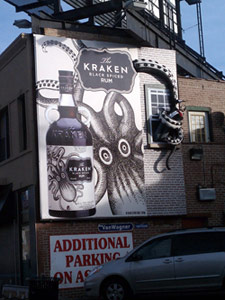
    PS: An amazing 3-D hoarding mounted in Chicago. This is for a brand of rum (in India it would be playing cards, haha). Wonderful use of 3-D to attract attention, and one wonders why we don’t get to see such creativity in our cities. It’s not really costly to execute, and we have the contractors to do it.