Category: BLOGS

  • The ICC World Cup of Brands 2019


    By Avik Chattopadhyay

     

    Cricket is possibly the only thing that binds India on this date. A few others like the National Anthem, the Constitution and the Flag are going through their phases of revisionism and identity-crisis. Bollywood has never been a unifier! If you feel offended, ask the movie-goer in Chennai and Cochin for the right perspective.

    So, when the ICC One-Day Cricket World Cup happens, every brand wants to ride the bandwagon. Either directly as ICC sponsors and partners or with the media vehicle Star Sports. In either case, paying top money for primetime. We were pitted against England as the favourites to win the cup, so eyeballs would be guaranteed till the 12th of July.

    The biggest sponsors of this world cup were Kohli and Dhoni.

    Kohli was on air for Uber, Shyam Steel, Google Duo and Nuvoco Vista.

    MSD for Dream 11, SRMB Steel, Orient LED, MasterCard and Bharat Matrimony.

    Pardon me if I have missed out any more.

    Through the tournament I just hoped some guy with a sense of humour would announce, “This match is brought to you by Nissan, Oppo, Coca-Cola, MRF, Virat Kohli and MS Dhoni.” But that moment never came.

    Instead, India stopped at the semis.

    And so did most of the eyeballs.

    Now that the nation is at relative peace and debating only about ICC rules and New Zealand being short-circuited [almost patronisingly], here is a good time to look at how the brands on the b[r]andwagon fared. My assessment basically from the multitude of products and services that spent oodles of money on television over the 48 matches…into 3 sets of the good, the bad and the ridiculous. They are in no ranking order, hence the alphabetical order.


    The Good 5


    Coca-Cola – adorable communication featuring Paresh Rawal and Ranbeer Kapoor. Simple story, brilliantly told. Though one might argue the open invitation to gulp down gallons of aerated sugar water, the sheer quality of the campaign pardons the sin. “Chaar saal dete hain world cup waale…” should go on to become an iconic quip over time.


    Dream 11 – in the 5 WhatsApp groups I am part of, there were at least a dozen individuals hooked on to this site. Old and middle aged people, mind you, leading otherwise responsible family and corporate lives, indulging in betting! Obviously, the communication, simple and compelling enough, made the most of the occasion. MSD kept well here…no byes and drops.


    Google Search – while the Google Duo communication was quite flaky, the one by Search was bang on! Again, like Dream 11, made the most of the occasion.


    Swiggy – they had started off during the IPL, but the excellent campaign continued through the world cup. The brilliant tie-ins with various cricketing situations through the commentary brought a smile on millions’ faces I am sure. They had quite a few stories on air but my favourite one is the “Batsmen are taking a risk here…” featuring the two old friends ordering quesadilla and lasagne!


    Uber – very tactical and topical but well communicated and that is why it is in my list of the Good 5. Virat played well, on all types of pitches, in all conditions. Disarming and to the point. Only I could not understand playing the ad on the final. But that is for another day and under another subject…


    The Bad 5 – these are brands that spent a lot of money on advertising that did not work, according to me, for various reasons, specific to each.


    Fogg – we know that “Fagg chal raha hai” but why? There was no new story…nothing on the occasion of the world cup. They are smart communicators, hence I was sure disappointed when they spent a lot of money rehashing their IPL messaging. And I just wish we stop playing up the anti-Pakistan bit any more. What is innocent fun at one time can become laboured if stretched beyond relevance.


    Kamla Pasand – this one really shook me up by the scruff of my neck. The dream of 130 crore people! Give me a break please. I expect such talk in Parliament, not for a sport catering to the middle class and above. And all that flag waving? Nope, does not work. Being a ‘pan masala’ does not help things. Do not try to be Amul or Tata Tea. To communicate like them you need to switch businesses.


    MasterCard – okay, so you got a couple new stories to tell, but do you need two celebrities to drive home your message? Also, too many messages I thought, with none clearly registering [in my mind at least, in spite of being a MasterCard user]. Visa did a much better job with a single story being driven home.


    Oppo – you are the sponsor of the Indian team and the ICC and this is all that you do…bring a pretty girl close to a prettier bird?! Did you think that just your name appearing on shirts, grounds and backdrops would do the job? Nope, according to me. That was just your name that millions saw across the cricket playing world, not your brand. Lost a big chance of doing something truly relevant and memorable.


    Pepsi – I know, I know…they were not on television but so what…they did spend a lot of money trying to out-do Coke. They thought they did this super clever “digital” campaign forcing the grand old lady Charulata Patel do weird poses with her fingers. You think that’s swag? Take a good swig!


    The Ridiculous 5 – these are the jewels that I have not figured out why they were there in the first place! I am sure they still do not have the answer themselves.


    Apollo Tyres – just because MRF is there? Huh? You think that is reason enough? “Ambush marketing” in the age of AI and ML!! Sad. Please think up a better reason. It’s a nice, feel-good ad, but totally wasted on this platform. Therefore, money well wasted.


    Bharat Matrimony – we know young immature couples do propose at the cricket ground or in flights taking them to one, but you really want to talk about all this just because MSD is your brand ambassador? This is no way to “maximise” presence and squeeze the last bit from your lemon. Lemon!


    Nissan – you are one of the world’s most respected brands and this is what you do? Make an SUV reverse into the crease, create an android hand and smash a metallic ball? Seriously? Katayama-san would commit hara-kiri on this!


    Orient LED – I was a kid once so let’s get this straight – kids do not study during summer vacations and when a world cup is on…any world cup. Period. So, stop the preaching on whether the LED light flickers or not. That’s when exams come up. Okay?


    Shyam Steel – every time I saw yet one more ad of the most loving couple in the cricketing world, I cried. For I wanted it to end as soon as it started and the only way out was to look away or quickly check WhatsApp messages. Need I say more?


    Avik Chattopadhyay is a senior brand and business strategist based in Gurugram. This is the first in a new series of columns he will write for MxMIndia.
  • Das ka Dum with Dr Bhaskar Das: Wouldn’t it have been better to get an honorary PhD? Less work on the thesis yet all the impact of being a ‘doctor’?

    We reserve any further comment on the question. But we do have one on the answer. In one word: super. Without further ado, Das ka Dum by Dr Bhaskar Das. Enjoy

    If you wish to access the archives, please go to the Das Ka Dum tab on the website’s top navigation bar.


    Q.  You’ve done a PhD not once, but twice over. There are some others in the media and advertising who have also done their PhDs. But we’ve also seen a few big bosses from A&M get honorary PhDs and they can now prefix their names with a ‘Dr’. Wouldn’t it have been better for you to have organised that? Less work on the thesis etc, yet all the impact of a ‘Doctor’. Aap ki kya Rai hai?


    A. Every PhD is a quest for learning. Path may be different but outcome is converged. My route has been academic. Others who get honorary PhD, their life journey, their enterprise are itself a subject of PhD that are rooted on the empiricism and exploration of knowledge. Hence the comparison, in case you were trying to do, is not appropriate as journeys are journeys. Labels are irrelevant. Prefix or suffix is incidental. Quest is transformational.

  • Das ka Dum with Dr Bhaskar Das: Do you also speak with your wife in a simple, simplified, uncomplicated way as you answer our questions?

    Bhaskar Das
    Bhaskar Das

    Ha Ha, He He, Ha Ha. We know you are doing that just reading the question, but before you depress the button to read it, do remember that this is your daily destination for the most explosive and most real questions that an Indian media veteran has ever responded to. Without any further ado: Das ka Dum by Dr Bhaskar Das. Read on…


    If you wish to access the archives, please go to the Das Ka Dum tab on the website’s top navigation bar.


    Q  Do you also speak with your wife in the same simple, simplified, uncomplicated way? For instance, if she were to ask you to just stop by and pick a loaf of bread before getting home one evening, do you give a philosophical ‘bread of life’ answer? Or if she says across the table: can you pass the sugar, do you reply: “why substances like sugar… aapna zuban mishti… or whatever one would say in Bangla…


    A. In any communication, understanding of the segment that one addresses is vital. The articulation has to tailored to the person and the occasion. Since wife is also a segment (as in the case of a marketer), one tailors it to that. In this specific segment, listening is a better art and convergence improves gross domestic peace. It’s universally true. Asymmetric articulation only exacerbate bilateral engagement.

  • Ranjona Banerji: For a profession in tatters, there’s some real work happening

    By Ranjona Banerji


    Journalists are at the forefront of the Covid-19 pandemic, as we have discussed. We do not really care except to pay lip service because it’s so much more fun debating over some toxic TV personality’s rants and rights.
    But enough of him. As more and more field journalists test positive in India, we need to urge their employers and news organisations to have better safety guidelines and measures for their staff. The general tendency in newsrooms has been “to get on with it”. Safety is of little concern. And post-incident help is not formalised. It’s all ad hoc depending on management/owner mood and senior editorial power. Imagine what that must be like in these sycophantic, spineless times.

    This is a witty, courageous and understanding personal account by Simrin Sirur, a young reporter, who has just tested positive for Covid-19. She is also a friend’s daughter, which is when you realise how close you are to this virus. (This is the second friend’s daughter who has tested positive. The other is a doctor in the UK, forced back to work after two weeks, but that’s another story.

    https://theprint.in/iwitness/disbelief-guilt-regret-amusement-when-a-covid-reporter-herself-tests-positive/411840/?fbclid=IwAR3QbsDbNML5d21EviOuBFvDPUsfCeBLkDPF8IM-F9fdy0RlNEkMKdX92J4

    **

    Luckily for a profession in tatters in several senses, there also is some real work happening out there. The Scroll has this report on the problems of tea garden workers forced back to the grind because of hunger. These are also India’s forgotten people whom no one wants to think about.

    https://scroll.in/article/960142/one-reason-why-tea-garden-employees-went-back-to-work-despite-covid-19-fears-hunger

    Livemint goes to Tirupur, India’s textile hub, which is now stretched thin:

    https://www.livemint.com/news/india/a-tense-textile-hub-spins-out-of-control-11588261831485.html

    I share these stories because I know that not many will read them and most people do not care. Yet, even as we mourn the terrible loss of two talented movie actors, the lives of the forgotten people also impact us. It is heartening therefore that some sections of the media provide space for such reports even in such times. Revenue loss has led to budget cuts which have led to salary cuts, size cuts, and all the rest of the horror.

    Freelancers have it especially tough because they are seen as the most expendable. They have lost assignments, columns, consultancies, and also any future prospects. Sadly, they are often the first casualties when money is tight, even though they do exemplary work. We understand. Rock and a hard place. But lack of spine and plans are also evident in newsrooms where managements are permitted to get away with murder. And that’s not really a metaphor either.

    **

    Amidst all this doom and gloom, luckily we have some media gems to lift our spirits.

    Both these are from my former employer, Bennett Coleman.

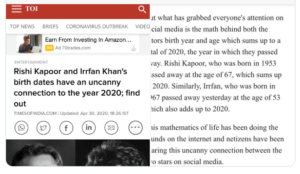
    In this first one (please see the screenshot), a little bit application of mind and a little less dependence on Whatsapp forwards may have saved the “brand” some embarrassment. Is there no desk which works here?

    It can work for anyone, not just late lamented talent. If you add your age today and your date of birth, guess which number you will reach? Take a minute to think it through. Even my third grade maths got this one!

    The second is not about a media mistake but in fact a perfect story to get you laughing. Rich person’s privilege is always a fantastic release mechanism!

    https://mumbaimirror.indiatimes.com/mumbai/cover-story/industrialist-sues-guest-for-spilling-wine-on-his-sofa/articleshow/75438612.cms?fbclid=IwAR0OBWqn61BBdgVM6Qz1eeUYUBR_q-haJ8BSmVKG6v0pgfl6LQk2C6Eailg

    **

    On which note, Happy May Day. Please take that any way you like!


    Ranjona Banerji is a senior journalist and commentator. She is also Consulting Editor, MxMIndia. Her views here are personal

  • Das ka Dum with Dr Bhaskar Das: Which work better in media – family-owned or professionally run set-ups?

    We end the week with an all-new question answered by Dr Bhaskar Das in the Das ka Dum series. Read on…

    If you wish to access the archives, please go to the Das Ka Dum tab on the website’s top navigation bar.


    Your view on family-owned organisations versus professionally run set-ups? Which can work better in the media sector?


    Your question smacks of availability heuristics syndrome where a chosen conclusion has been put into binary baskets on the basis of unrepresentative samples. Secondly, I strongly believe that there is no special qualitative difference between the two differentiated form of set-ups. Every business organisation has to be managed and there are examples galore where the share of failures are equally available in both the so-called clusters. And as if the media sector is something unique that requires extra-terrestrial skills. If business success is considered as one of the key litmus tests, it’s neutral to sectors and to  so-called family run or professional set-ups. The reason for failure happens for a variety of factors which can be clubbed under the broad categories of mismanagement and crisis of leadership. Period. Any other reason is merely a subset of that.

  • Ranjona Banerji: Salaam, Salute & a Big Shout Out to Quality Journalism

    By Ranjona Banerji

    I am not a proponent of the “good news” school of journalism by a long shot. And my experience in journalism has taught me that nor are readers, no matter what they may say in casual conversation. News is by its very nature bad news. “Nothing happened today except two children played in a park” is not a headline that works except in satire. But, watching all the really inexcusable, pathetic, miserable, vile, toxic, filthy examples of journalism around us, has got even me searching the “good news”.

    In between all the rubbish over the death of Sushant Singh Rajput on all TV channels or the constant vilification of Muslims whether on the unconscionable Sudarshan News or more reputed English channels or the acceptance that invented nonsense on OpIndia is actually some form of journalism, even if perverted, there is some real journalism going on.

    Health reporters across magazines, mainstream newspapers, news sites, specialist health sites and even in TV have kept us up to date not just on the latest Covid-19 figures but also on all the obfuscations, the confused data, the cover-ups when it comes to co-morbidities, the problems around treatment, the plight of healthcare workers, the public versus private hospital issues, money and payment issues, scams related to health certificates, the issues that non-Covid-19 patients face, the human side of the pandemic and much, much more. These journalists have risked their own lives to get us these stories. Some have contracted the virus in the line of duty and very sadly, a few have succumbed to it.

    These reporters will not get to be filth-spewing “anchors” anytime soon and that is why their work is not appreciated enough. But it is because of their work that we know what happens beyond government handouts. A salute to them!

    China’s excursions into India and terrible brutality meted out to Indian soldiers by the People’s Liberation Army would have been ignored and brushed under the proverbial carpet if it wasn’t for a small band of mainly ex-Armed Forces analysts. Non-Armed Forces defence journalists got into the act late and even then, they could not match the sort of detail, insight and analysis that we got from the initial coverage from our Armed Forces band. You can see how the subject remains obscured by the Central Government, including outright lies by the Prime Minister and contradictions from all the other government agencies involved. A huge salute here as well, although TV gets a pass on this one. Neither first nor insightful. Some TV channels, as is their wont, just put the usual defence of the Modi Government’s lies and incompetence.

    In spite everything that has happened since the virus lockdowns began, some brave journalists have carried on with their investigations into the aftermath of the Delhi riots of earlier this year. They have faced mob violence and police brutality as a result. But their commitment has not wavered. They work to remind us of the citizenship crisis that faced us earlier this year. A salute to them!

    Legal reporters and legal news sites have changed the way we understand the judiciary. Constant tweets about court proceedings, legal analyses of arguments and judgments have brought our own legal systems much closer to us. This has made the law more accessible and understandable, especially given the various democratically and Constitutionally significant court cases being taken up or postponed. Thank you!

    One subject is very close to my heart and that is environmental journalism. India’s environment and ecological balance has been under systematic erosion from the Modi Government’s various rulings and plans. Under the pain of the pandemic, significant and fragile protected areas have been opened up to developers. And even worse, the environmental impact assessments before such developments are given the go-ahead are going to be heavily diluted. A huge salaam to environmental journalists who have kept these issues in the public eye.

    I haven’t named names because there are too many and I am apprehensive about missing people out. But these are the shining examples than good work can be done, especially in terrible circumstances. Not everything has to be deflection, smoke and mirrors and government genuflection.

    A big shout out also to the behind the scenes journalists. All the deskies, designers, news editors, editors who oversee these stories and who do not succumb to pressure. The ad, circulation and distribution departments which also work through all climates. The managements which do not stop critical journalism. These are some of the worst times for newsrooms with huge job losses and cutbacks. That we see such good work in spite of everything, deserves a toast.

    I raise my glass to all of you. Thank you.

    PS: For the purveyors of rubbish: see you next week!


    Ranjona Banerji is a senior journalist and commentator. She is also Consulting Editor, MxMIndia. Her views here are personal

  • Comment | Sanjeev Kotnala: Is Tanishq on a Hat-trick of Taking Down Ads?

    Screengrab from the Tanishq Diwali 2020 ad


    By Sanjeev Kotnala

    When someone including me asks What is wrong with Tanishq? There is a counter-question, what is wrong with us? And What’s Your Problem? And the answer is: Everything.
    Tanishq, like every other brand and organisation, is a social entity and by definition, needs to be exceptionally sensitive to the ecosystem it operates in.

    Why?

    It takes too much of a strategy, guts or stupidity to do it again and so soon.

    To antagonise the community during the festival when you expect large sales to happen.

    So, here are a few possibilities:

    • Buoyant with the last BUYCOTT and buzz it created, the brand now uses it as a strategy. Release an advertisement. Withdraw it.

    • The brand does not bother with the boycott calls on social media. It knows that as a trusted brand, people will still buy from it. Which did happen last time.

    • The Tanishq team at the client and the agency’s end, including the consultants, have a long learning curve.


    NOTHING WRONG!

    On the other side, there is nothing wrong with the Tanishq Diwali Advertisement.

    Many brands could have taken this No Crackers as a CSR communication. Quite a few more may do so and not have a backlash.


    What did the ad say?

    The simple and good-in-its-intent Tanishq Diwali ad has four well-known women talking about how they will celebrate Diwali this year.

    Sayani Gupta tells how she is hoping to meet her mum after really long, and she is definitely not going to burn any firecrackers. She even adds – ‘I don’t think anyone should light any firecrackers. Lot of diyas. Lot of laughter hopefully and a lot of positivity’.

    Alya says she will eat a lot of sweets and food. She will spend time with her family and close friends. Neena Gupta says she will dress up and wear nice jewellery. Then finally Nimrat Kaur tells you that how this year it’s all the more important to be with family.


    The last outing with Love Jihad.

    The last time Ekatvam faced Love Jihad. Call for the brand to be sensitive was loud and clear. The brand withdrew the advertisement. And the brand was criticised by people, who believe that taking down the ad was a sign of weakness. And maybe the brand did not believe in what it was saying. 


    The Cracker-free Diwali

    Some states have banned firecrackers. A few have banned bursting firecrackers in public spaces. The new generation is quick in adopting green initiatives and is sensitive to the pollution issue. The cracker-free Diwali message should have been okay. 


    Brands must have its ears to the ground

    However, if the brands have been using their digital listening tools properly, they would have got a hint of resistance. These are definitively charged times. Hindus as a community are fed with multiple messages that question the treatment they get in a state that they believe should not have been secular but a Hindu Rashtra. They feel they are singled out in the politically and socially. They hate the temples controlled by the government when other religious places are mostly free from such governance. They see only their festivals, rituals and traditions questioned. They see the need to prove their faith.


    Any Spark would do

    The Hindu feel weak not in the number but in unity, in protest and acts. They believe that as a majority, they have the right not to be questioned for everything. They see how some other communities and religious groups can semi-dictate the agenda and their demands. How being a majority works against them? This is a charged environment. Anything and everything can be the spark that can socially have an equivalent of the Beirut Ammonia Nitrite blast.


    The brands have to realise it and be sensitive. No one would have said anything if it was burn crackers responsibly, burn less. 


    A Suggestion

    The concept of Ekvatm is excellent for the time. Somewhere it has been lost or robbed of its sheen because of few pieces of communication being interpreted differently.

    Maybe the brand could do well to bring alive what is hidden in its websites. The collectivism of multiple artesian, jewellery styles like Meenakari, Laser, Stamp etc. to create and celebrate Ekatvam.


    Sanjeev Kotnala is a senior marketer, business strategist and educator. He writes for MxMIndia weekly, on Wednesdays, and also on many other days. His views here are personal.


  • Ranjona Banerji: Bad Publicity for the Big 2

    By Ranjona Banerji


    Large and small corporations in other parts of the democratic world are often sensitive to public opinion, especially negative public opinion. They also occasionally stand up for democracy and for the social good. In India however such actions are largely manifest in their capitulation to “hurt sentiments” rather than any moral stand or belief in larger democratic and social interests.

    It will therefore be interesting to see how India’s two largest corporations, Reliance-owned by Mukesh Ambani and Adani, owned by Gautam Adani, respond to the constant bombardment of allegations of crony capitalism from India’s farmers. The Adanis have issued a clarification that they have not set up storage units to profit from the Modi Government’s new controversial farm acts and that instead these units are only for the Food Corporation of India.

    The Ambanis are currently, and congratulations to them, celebrating the arrival of a grandchild.

    The several million farmers on protest outside Delhi and in the rest of India have not yet roused them to reaction. But as of now, Ambani and Adani bear the brunt of the anger. Protesting farmers contend that the new farm laws have been put in place to benefit these two companies. And India’s farmers have decided to boycott both companies and their products.

    Will Ambani and Adani ride out this storm in brazen defiance or at some time will these two companies feel that they are being unfairly targeted with bad publicity? Bad publicity which is being deflected from the Modi Government’s actions on to them? The laws after all are Narendra Modi’s doing. Whether at the behest of Ambani and Adani are still a matter of conjecture. It is the BJP government at the Centre which holds the primary responsibility.

    As the mainstream media continues with the Modi government’s narrative of “All Sikh farmers are Khalistani terrorists” to “farmers are being misled” to “how dare the farmers wear jeans and speak English” to “how dare other political parties politicise the issue” and various other despicable insinuations, smaller independent media outlets and independent journalists provide on the ground coverage.

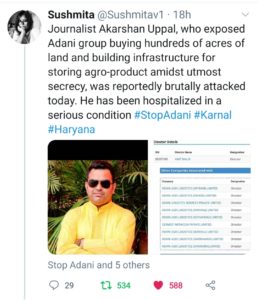
    And some of them pay a heavy price for not toeing the Modi government line. There are reports that a young photo-journalist, Akarshan Uppal, is in hospital in a serious condition after being brutally attacked. Just this week, Uppal had broken the story that the Adani Group had invested in land and registered agro-storage companies before the bills were passed. Hence the clarification mentioned earlier. Whether or not there is any connection between the attack and the company, this is very bad publicity for the Adani Group.
    How far will government protection save them from public anger? How far does democracy work in India? Yes, that sounds funny. I agree. If the protesting farmers were part of a Hindutva rightwing group demanding retraction of freedom of expression, most corporations would have caved in without a fight. I give you the Tatas and the Tanishq ad about inter-community marriages.

    **

    Meanwhile, all of Thursday, even as farmers had rejected all of Union Home Minister Amit Shah’s ideas and after that the government’s “proposals”, mainstream television concentrated on the “bhoomi pujan” for the new Parliament building. This had Modi and some priests conducting a Hindu ceremony for a building to house a legislature in a democracy. India can ill afford such shameful extravagance given the state of our economy. There is an ongoing case questioning this “Central Vista”. But our esteemed Supreme Court allowed this “ceremony” which was nothing but a publicity stunt for Modi, ably assisted by his captive, pliable TV channels.

    And then, if we are still a democracy, where was the President of India? Where were representatives of other political parties? The lapdog media, or “Godi Media” as the farmers have made famous, was happy that Modi alone represented India at a Hindu ceremony in a multi-faith nation.

    I know. Why do I bother?

    Even I wonder sometimes.


    Ranjona Banerji is a senior journalist and commentator. This column appears on Tuedays and Fridays. Her views here are personal.


  • The Insurrection & The Media


    By Brian Wieser


    Key takeaways from this week’s note:

    • Twitter’s permanent suspension of U.S. President Donald Trump’s account in the aftermath of this week’s insurrection in Washington, D.C. is an important and necessary action. Beyond helping to limit real damage to people and society, it will help to improve the platform as an environment for brands.


    Unfortunately, this was the most newsworthy issue of the past week. The Donald Trump-inspired insurrection and related fatalities in Washington D.C. on Wednesday was an unfortunately unsurprising consequence of many years of extremist rhetoric and misinformation.

    While the individuals who originally conveyed knowingly false information certainly bear the bulk of the blame, they would not have been as likely to succeed if they did not have some means of amplification.


    Over the past decade, in many countries around the world, misinformation has been widely shared and violence has been directly encouraged or organized by individuals using social media platforms. There are signs of changes to limit related content, but more still needs to be done. Historically, platforms often tolerated incendiary content and, in many cases, they amplified it. Efforts intended to address negative consequences have broadly been insufficient.

    News on Friday that Twitter would permanently suspend U.S. President Donald Trump’s personal account, along with separate reports that Apple and Google are threatening to ban Parler from their app stores, was a significant illustration of an enhanced focus on addressing the problems that have followed.

    On the other hand, for however many actions platforms take, problematic activities will likely continue to originate on social media because small percentages of lesser-known users can still equal millions of individuals or more than enough people to inflict significant harm to societies.

    What will catalyze the platforms to pursue more impactful changes?


    Sufficient force probably won’t come from consumers, who don’t generally pay for access to social media in the first place. Consumers have not significantly altered their reliance on these platforms and don’t seem likely to change their habits in meaningful ways any time soon. Social media’s underlying algorithms are undoubtedly effective at contributing to usage even among consumers bothered by what they know about the problematic content on the platforms.

    But why is this?

    Is it because consumers don’t consider the possibility that their activities and consumption patterns may partially enable the presence of conspiracies consumed by others?

    Or because they know platforms broaden the availability of hate-inspiring content but accept this reality as a trade-off to access the content they believe they need?

    Or perhaps because they typically only see their feeds and generally agree with what they see and determine that the problems are due to other users?

    Whatever the underlying reason, consumers are not likely to force platforms to take comprehensive actions.


    How about advertisers? Not likely here, either. Advertising collectively enables the good and the bad associated with social media, as there is virtually no other revenue stream for these media owners.

    Advertisers’ historical efforts to force platforms to eliminate the bad, however well-intentioned, have proven to be insufficient because even very large groups of budget-holders are far too fragmented to make much of an impact on companies with millions of individual customers.

    The vast majority of marketers have generally decided that, if audiences are using these platforms, it’s reasonable to try to reach consumers where they are regardless of any indirect or long-term consequences that may follow. If users don’t abandon the platforms and don’t attach negative considerations to sponsoring brands, it’s hard to imagine noticeable spending changes.

    Of course, brands still need to consider long-term implications.

    In the same way they can be connected to positive societal outcomes associated with the media owners they support; they can also be connected to negative social consequences enabled or encouraged by those same companies. At a minimum, marketers can ensure they limit the degree to which their brands are attached directly to problematic content on short notice with rapidly implemented “circuit-breaker” processes to pause spending or enhance content filters at sensitive times.


    Government may offer one partial solution to the problem. In a potentially ironic coda to the Trump era, the events in D.C. could contribute to increased interest among legislators in repealing Section 230 of the Communications Decency Act, as this would potentially expose platforms to financial consequences if they are deemed to have enabled or failed to prevent harm.

    Ensuring that platforms hosting or amplifying content that brings harm to individuals bear some financial or other legal consequences would likely deter much of the problematic activity on those platforms.


    These platforms need to take even more responsibility, too. They could choose to make changes themselves, if only out of the self-interest of preferring to operate in a society driven by fact and with less civil strife. Certainly, we can view Twitter’s actions on the Trump account through this light.

    More generally, if they want to continue to ensure they provide an environment for everyone to share content, they could choose to host problematic content without supporting the mass distribution or sharing of that content.

    Perhaps they could formally authorize only a select number of people—again, as determined manually by the platform itself—to benefit from automatically amplified content. Such solutions would undoubtedly be costly, although not necessarily prohibitively so, and probably would reduce usage.


    Perceived costs would not be as severe as the platforms (and investors) think they are. They likely deter change, but we would argue they shouldn’t. Platforms tend to believe that reduced usage levels would lead to reduced advertising revenue, based on the flawed premise that a change in supply directly causes a change in demand for a medium.

    Although this can be true in very broad strokes—a medium with 10x more or 10x less consumption will undoubtedly see an impact on total spending—within most realistic ranges, spending on a platform would be unchanged if usage falls.

    Of course, there could be an impact on the share of advertising inventory a given media owner has to sell within the medium; this would have a revenue impact for any given company. The impact, however, would likely be modest.

    More importantly, lost consumption from reduced amplification of incendiary content could be partially offset by increased consumption by consumers who have been bothered enough by what happens on the platforms to stay away from them. This is especially true for individuals who have been trolled or who hear hateful content directed to them.

    Brands that want to minimize their exposure to toxic content might also feel more favorably disposed toward media owners who don’t tolerate it and allocate relatively more money to those media owners as a result.

    In the case of Twitter specifically, we would expect that a reduction in incendiary content will make the platform more favorable to its advertiser base, given their larger-brand skew.

    Of course, social media platforms aren’t the only media companies transmitting the misinformation or incendiary content that is so damaging to societies. Content supported by advertising and consumers’ subscription fees on radio, television and streaming services plays a significant role.

    Over many years, every packager of incendiary content could more aggressively attempt to limit its production and distribution. At least they should because the aggressively oriented elements of modern society are unfortunately unlikely to back down on their own any time soon. Responsible citizens, social media companies and companies of all kinds should do everything they can to avoid enabling them.


    Brian Wieser is Global President, Business Intelligence, GroupM. Republished from https://www.groupm.com/global-marketing-monitor-weekly-market-trends-jan-9-2021/

  • Is Brand Bose Too Hot To Handle?!


    By Avik Chattopadhyay [updated]


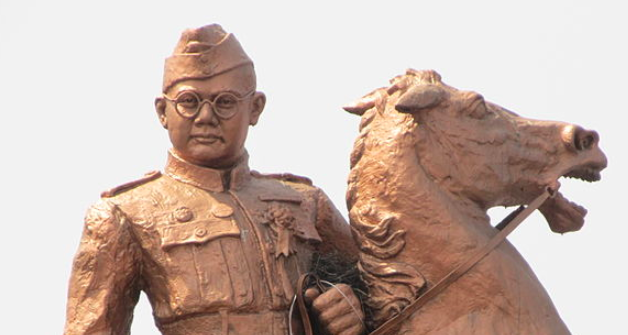
    His surname is a popular first name in all the states in South India.

    People say that there are more statues of him across India than those of Gandhi.

    Politicians of all hues and shapes have attempted to appropriate him for their own benefits.

    People are more bothered about how he died than how he lived.

    And today is his 125th birth anniversary.


    Today will set off a year of “celebrations” both by the central government and that of West Bengal. The Prime Minister has decided to rechristen the day as “Parakram Divas”, the day of courage or power. The state government, never to be outdone, has declared the day as “Desh-nayak Divas” or day of the national hero.

    It is actually his 124th birth anniversary, being born in 1897. But the country is celebrating it as the 125th! Why? Because the elections in West Bengal are due this year. So, it makes perfect sense for both the central and state governments to make the most of the situation and be seen as ‘closer’ to the man. So, what’s in a date!

    Bose is one of the most powerful yet enigmatic brands that India has seen. The enigma about his ‘death’ magnifies his appeal. Also, the fact that he became a ‘rebel’ in the freedom struggle and charted his own path increases the adulation and magnetism. He has left us a legacy filled with intense patriotism, adventure, intrigue, controversy, and action. He has given us coinages like “Jai Hind”, “Inquilab Zindabad” and “Chalo Dilli” that are in use every day.


    Yet he is a brand too hot to handle. No political party really wants to ‘own’ him. Sadly, Forward Bloc, the party he had founded is just too small to be of any consequence. The Congress has kept him at arm’s length for obvious reasons as he had a voice that did not match that of the supreme leader’s forcing him to leave the party even after winning the election as president. The Left Front, though absorbing Forward Bloc, did not openly espouse his persona as he had controversially aligned with the Axis powers. The BJP did play the ‘Netaji Files’ card merely for political gains but that did not seem to work, and they let him be. The Trinamool Congress really does not know how exactly to appropriate Bose.


    If one were to read the writings and speeches of Bose over the years, one would see his clear disrespect for certain political parties, the religious fundamentalists, and armchair thinkers. His open love for Urdu as well as the Bhagwad Gita is a delightful co-existence that many find difficult to fathom today. Giving the INA the motto of ‘Ittehad Itmad Qurbani’ while naming two of the battalions after Gandhi and Nehru is a paradox not witnessed in India’s history. Bose is an extremely ‘uncomfortable’ concept to grapple with. Thus, all have played him as a card and nothing more as they do not wish to align with his thoughts and beliefs. So, thankfully, he is still the “rebel” with no political masters.


    The world loves rebels, be they persons or products. As human beings we have this deep-down urge to challenge convention and have no ‘holy cows’. Rebellion is a subliminal trait, mostly suppressed due to overt constraints and pressures. Therefore, the average person has a certain level of respect for anyone who challenges authority, establishment, ritual or convention.


    Bose is the eternal rebel. The classic challenger brand.


    Clear in purpose. With a strong point of view. With the ability to question the higher powers. And have the capability to walk the talk. Challenger brands, with increasing popularity and following, are vulnerable to becoming mainstream and leader brands. The moment they become so, they lose the charm of the rebel. And are targets for the new challengers.


    Rebel politicians lose their appeal and charm when they join the mainstream. Challenger products and solutions lose their ‘clan’ or ‘tribe’ the moment they try increasing their base across customer segments.


    So, a challenger has to be conscious not to become mainstream in both appeal and acceptance. Its following should be intense but not necessarily large. Its purpose, promise, personality and philosophy should be adopted by a few committed followers who have the same action orientation.


    Does that mean that a rebel can never become an icon?


    Surely does as people love the act of challenging or rebellion more than the cause. And evolve into ‘pop’ icons. People across the world wear Che t-shirts and berets more because he looks ‘cool’ than ever supporting his cause of “perpetual revolution”. It is similar to wearing a Jim Morrison or an Undertaker t-shirt. The philosophy or profession does not really matter as long as the person is known to challenge the establishment.


    Bose has not become a pop icon as Che as yet, even in India. I do not know whether that is good or bad. Some ‘purists’ might object to putting Bose on a t-shirt and demeaning his image. The contrarian might argue that having more Bose t-shirts being worn might lead to more people wanting to know about this man and his life. I choose to be with the latter as I strongly believe that the cause of the rebel needs to be amplified as much as possible, across age groups, regions and countries. That will actually protect the rebel from misappropriation.


    Thankfully, the sudden collective euphoria around Bose that starts today will last till the West Bengal elections are done and dusted. Whoever wins will silently consign the man to pages of history and a statue at the Shyambazar crossing in Kolkata. Rebels are too hot to handle, be they persons or products. They take risks that the average will not even think of. They live lives of tumultuous adventure and uncertainty, not in line with the comfort and peace most of us crave for. They remain in the hearts and spirits of only a committed few. For the larger population they are but a holiday, milestone, or case study in a management institute.


    His unfinished journey on August 18, 1945 has ensured he remains the eternal rebel. One can never say what would have happened if he would have returned to India, disclosed his identity, and joined mainstream politics. Guess the man knew the pitfalls very well.


    As Bose himself once said, “Life loses half its interest if there is no struggle…if there are no risks to be taken.”


    Jai Hind!

  • Sanjeev Kotnala: Not the Bigg Boss I know or like

    By Sanjeev Kotnala


    Bigg Boss is one of my favourite reality shows. The Season 14 got over last Sunday. The channel claims Bigg Boss 14 was the best season with more eyeballs than ever before. It seems the magic continues. May be the magician has found a new audience to play with. However, loyalists like me are upset with the experience. It failed to meet our expectations. It is not the same show that we liked and grew with.

    On the other side, the channel and team must be complimented in producing and running the show without major issues. May be it is the best the channel could serve in the Covid-led pandemic.

    That I was able to predict the Top 5 finalists and the winner in advance is not a comment on the show content. To predict Bigg Boss 14 winner was so very simple.


    Is There A Problem?

    No, apparently there is no problem. The show did perform very well.  Even though I don’t have access to the viewership data, I do believe the channel claim. Anyway, nowadays, one is not sure, which data should be trusted?

    The show with its legacy, voyeuristic content and a large following is nowhere threatened.

    May be it’s that the show that has moved on. Maybe, the initial set of viewers no longer matter.  The show has attracted a new set of audience. Everything is okay. The show is performing. The host is superb. The channel is happy. The brands have no issue. Who am I to crib?


    The Difference

    Nothing. And that is the problem. Nothing has changed with the show. Yet, Bigg Boss is no longer the same show.

    Creativity is dead. The tasks are repetitive. The majority of the participants seem coached on how to ace the show. Some have not even bothered to see the last season or so they claimed.

    The captain of the house is no longer in command. Participants have a simple strategy of non-cooperation. Dissent is the default option. Rebellion is seen as content and entertainment. Participants start groups as a result of a desire to control and survive. They cannot be faulted for it. However, these groups are merely opportunistic. Participants drift in and out of groups without any agenda.

    There is class inequality. It is demonstrated across actions and judgment. There is no control of the language. Aukat, Ghatiya, Neech are some of the terms used to broadly paint someone. The language has so bad that it needs viewer discretion or some other warning.

    There is absolute anarchy. There is No Control. Wild cards and other members bring outside information and discuss them. The inside information is used as a leverage. The Bigg Boss remains inert to any such advances.

    The candidates in the show know who the other contestants are. No more are the names a surprise to them.


    Biggboss – Mandir Ka Ghanta

    This is what is really upsetting. The show has lost the plot. Candidates walk in and out of the show. They exit for silly reasons and re-enter with sillier explanations.

    There is no sanctity of being a contestant, ex-contestant- wild card or pure Bigg Boss inter-season traveller. There are ex-winners who are the regular faces on the show trying to act their part. The charm is lost.

    The wild card can enter anytime- fine but how many wild cards! A candidate who steps out to act and was given a proxy in the house! Bigg Boss – Mandir ka Ghantakoi bhi aaye aur bajayeh.


    The Winner Is No Longer A Mystery.

    Of the five finalists, Rubina was the deserving winner.  Every attempt was being made to ensure her win. Or that’s what social media chatter said.


    Salman Khan, The Saviour

    Whatever Salman Khan maybe charging the channel, I think it is perfectly justified. Fortunately, the ageing Khan still commands respect or fear. He is like a GodFather. And, it is he, who makes the weekend worth watching.  Unfortunately there is no alternative for Salman Khan. But, even Khan’s delivery and control is showing signs of tear. Is there an alternative? The question remains unanswered.


    Overall

    Bigg Boss14 was a drag. May be it was the lengthiest season of all. The viewership numbers may give the channel and the production house a feeling of complacency. But, it is time someone seriously takes a re-look on how the show is shaping up.


    What is so big about it and who is the Boss there?

    Bigg Boss14 was like some C-grade movie. It seems the script was written on the sets. The producers taking the viewers for granted. The creativity, the gamesmanship, the rewards all mixed up. The participants were controlling and dictating the terms.

    Bigg Boss decided to remain a mute spectator till pushed to act. Many times denying justice to the participants and trying to explain the situation.

    Frankly, the show lost ground and many loyal viewers. It became a drag at later stage.

    I sincerely believe in the show and the format. I believe it requires the infusion of fresh thoughts. And, I would hate the show to lose out. But if it decides to be the Mandir Ka Ghanta –  then joh chahe jab chahe, use bajayega.


     Sanjeev Kotnala is a senior marketing and strategy consultant. He writes on Wednesdays, and sometimes on other days as well. His views here are personal.

  • Introducing new fortnightly column by Indrani Sen – MediaSENse: Why our Print Majors must come out of their Comfort Zones?

    By Indrani Sen


    In his recent digital pitch with media bosses in New York, our Prime Minister claimed that unlike manufacturing, in the world of media, India is almost as evolved as any other country. Does his observation hold good for our print industry on which the sun continues to shine? The print majors are basking in the comfort of the findings of FICCI-KPMG and other such industry reports which are predicting growth, but a comparison of the CAGR percentages projected over the years reflects erosion.


    Projections of Print CAGR CAGR 2011 to 2015 CAGR 2011 to 2016 CAGR 2012 to 2017 CAGR 2013 to 2018 CAGR 2014 to 2019
    Total Print Market

    10%

    9.10%

    8.70%

    9%

    8%

    Source: FICCI-KPMG Reports

    2011

    2012

    2013

    2014

    2015


    So, it is obvious that slowly but steadily the global trends have started to creep into Indian print industry.  Accelerated penetration of mobiles in smaller towns and rural areas will support the growth of digital and social media and may result in faster erosion of CAGR in the print market and the CAGR 2020 to 2025 may come down drastically.


    Instead of strengthening their arsenal with readership currency for protecting their share in the total advertising revenue, currently the Indian print industry seems to have taken up a negative stance against the IRS. Agreeably, many publications had genuine grievances against the findings of IRS 2013, but that should not be a legitimate reason for withdrawing their support from the readership survey. When the TV Industry has got a brand new currency from BARC which uses superior technology than its predecessor, the print Industry needs to rally around MRUC to ensure that IRS can also claim similar upgradation by introducing improved methodology.


    In a large scale ongoing quantitative survey, teething problems and relative errors are quite normal. Perhaps the magnitude of the errors in IRS 2013 crossed the tolerance level of some print majors, but they should recollect that initially NRS findings also had many issues which got corrected over the years. We saw emergence of MRUC and IRS as a protest against the methodology and findings of NRS and subsequently the merger of the two surveys. We are witnessing now a dark period of three years in print currency as IRS 2013 was rejected by the print Industry, IRS 2014 (based only on fieldwork of one quarter) has not been taken seriously by the advertisers and agencies, and the field work for IRS 2015 has not yet commenced. In a developed country, such a gap in a media currency is unheard of. The sooner all the stakeholders of MRUC resolve their differences and kickstart the field work, the better it would be for second and third line publications who are likely to suffer more due to lack of readership data. The media planners and buyers cannot determine the incremental reach/ OTS/ CPT for adding more than one publication in the plan and are likely to limit their print campaigns to only the established market leaders.


    Indian newspapers need to take up two challenges at two ends of the audience market. Firstly, they must try to reduce the gap between the literate population and the number of newspaper readers. Secondly, they must improve and promote their web editions and convert the internet savvy Indians to online readers. The concept of “Integrated Newsroom”, which is being advocated by many researchers and industry observers, is essential for achieving these two diverse tasks.


    According to IRS 2012, approximately 44 percent of literate Indians do not read any newspaper. This average percentage decreases as one climbs up the SEC ladder and increases in small towns and rural areas. It is obvious that the current combination of regional, national and international news dished out by most newspapers is not acceptable reading material by a large chunk of Indian population. Special, smaller editions with more emphasis on hyper-local news may be more acceptable in the small towns and rural areas.


    Most Indian newspapers have launched their e-editions, but there is lack of efforts in promoting as well as making them user friendly and interactive, perhaps due to the apprehension that the growth of online readership will cannibalize readership of the hard copies. There is a huge scope of growth for web editions of regional newspapers if they plan to ride on the growth of computer literacy in secondary schools in small towns and villages. Innovative marketing tie-ups with mobile manufacturers and service providers can increase the initial trial and subsequent conversion rate of the e-editions.


    In this connection, it will be pertinent to note the new trends in readership surveys in developed countries, particularly in UK, as we have traditionally followed the example of UK for setting up our media infrastructure, media regulations, etc. In the 1970s, Indian National Readership Survey was also modeled largely on the Readership Survey of UK. NRS PADD was introduced in UK in September2012 to provide a unique measure of combined print and online audiences to cater to the demand of a dynamic and changing digital media age. It is a fusion of data by RSMB from two independent surveys, print readership survey by Ipsos MORI and comScore digital survey. It provides a single database for planning across print and digital platforms of NRS publisher brands. (Source: http://www.nrs.co.uk). Apart from full NRS demographic and classification data for profiling and targeting, the NRS PADD provides the unduplicated reach of a print publication and its website, duplication of print titles and websites – which websites do a publication’s readers visit, and vice versa. NRS PADD: Mobile was launched in September 2014. The future lies in combining readership research across the print and digital platforms. The opinion leaders in the print Industry must realise that the digital trends are irreversible and steer the industry in that direction.


    The Global Media Report 2014 by Mckinsey & Co. predicted “Digital advertising is becoming a dominant force in the global media advertising market. Excluding the online and mobile components of TV advertising, in 2017 digital advertising will overtake TV, which for decades has been the largest advertising medium……….We project digital advertising to continue to increase at double-digit rates, growing 15.1 percent compounded annually to 2018 and accounting for 65 percent of the total increase in global advertising over the next five years. Most of that gain will come as advertisers substitute away from print media.” In India, the above trends are not likely to set in before at least another 5 years. Indian Print Industry needs to utilise this time period from 2016 to 2020 for protecting their future by ensuring immediate availability of print media currency, developing and promoting the websites and last but not the least, effectively converting more literates into readers.


    Indrani Sen is a veteran media agency and marketing services professional. She is currently an Independent Consultant and Adjunct Faculty, Media Management at Symbiosis Institute of Media & Communication, Pune. This column will appear fortnightly. The views expressed here are her own.