Category: BLOGS

  • Debrief: National Population Register: Hello Early Nineties!

    By Anil Thakraney


    I have a bad feeling we are living in the early nineties. Madhuri Dixit is back, so is Anil Kapoor, and so is Sridevi. And the BJP is talking about Ayodhya all over again. Soon we’ll hear Sanjay Manjrekar is back in the Indian team. Not to be left behind, here’s an ad from the glorious past.


    If you are a new entrant to advertising, watch the commercial from the National Population Register very carefully. It will give you a good idea of the generally crappy television advertising we used to produce back then. A tired, laid-back, sleepy jingle. Indians from all walks of life doing the same activity, in this case, mud-slinging (though the copyright for that now belongs to Shri Arnab Goswami). And each visual a bloody living, breathing ad cliché. I have to say this must easily be the most annoying advert currently on air, and it’s on air all the time because we taxpaying idiots sponsor this trash. Each time it comes on, I want to fling some mud at my television set.


    So if these guys want us to register our names for the census, they should tell us why it’s important for us to do so. The communication trigger should be this and only this: Dude, you don’t sign up, you are screwed, and this is how you get screwed. It’s as simple as that. This is what will result in consumer engagement. Instead, these dolts have gone back into the past to re-create its worst. I’d rather register for the Pakistani or the Bangladeshi census.


    Rating: (On a scale of 1-5): 0. Poora paisa mitti mein mil gaya


    Anil Thakraney is a senior journalist and commentator. He is also Editor-at-Large, MxMIndia. The views of the writer are his own. He can be reached via Twitter at @anilthakraney


  • Introducing PoliTech: a new fortnightly column by Vijay Mukhi


    There is much excitement about the exchanges by politicians on Twitter and Facebook. But will these have any impact on the forthcoming general elections? Internet Guru, infotech evangelist, data security specialist, trainer, author and former columnist Vijay Mukhi will answer this question and track trends in a new fortnightly column for MxMIndia


    By Vijay Mukhi


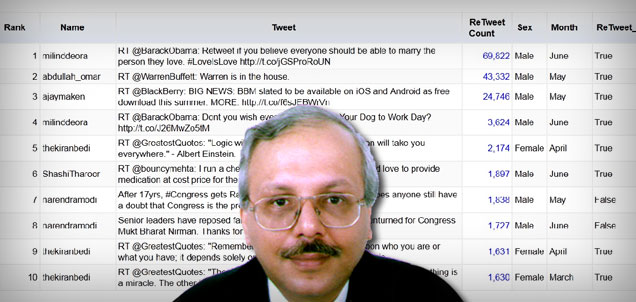
    Our politicians don’t understand social media. They need to take lessons from the likes of an Amitabh Bachchan, Shah Rukh Khan or even the Dalai Lama. Their tweets don’t get retweeted, and the ones that do like those of Milind Deora or Ajay Maken or Omar Abdullah aren’t political in nature.


    For instance, Ajay Maken’s tweet was as follows: RT @BlackBerry: BIG NEWS: BBM slated to be available on iOS and Android as free download this summer. MORE: http://t.co/f6sJEBWrVn . Note it didn’t concern anything remotely concerned with politics. And Omar? Here’s his tweet that got retweeted 43,332 times at the time of writing: RT @WarrenBuffett: Warren is in the house.


    The US internet population is around 170-180 million and that in India is 120-130 million.  There may not be too much of a gap here, but the problem is that in the US of A, 70-80% of the population is internet-enabled whereas in India it’s only 10-20%.


    Also, of the 15% of population that’s internet-enabled, at least 5% will be kids who don’t vote and another 5% from the affluent who have never voted, and possibly never will.


    What we have in balance is a 5% of the internet-enabled janata and I don’t think a swing here or there really matters. Bottomline: Mr Modi and his team may embrace Twitter and Facebook, write blogs, go to YouTube, but all of this will not help him win the 2014 general elections.


    But in 2019, we should have four to five hundred million people on the internet, and only then we could say there will be action on the social media front. Elections 2014 will be the semi-final and it’s important to get our act together for 2019.


    I have been a fair number of videos of the US elections over YouTube. One of them had a mindboggling 43 million views. With that kind of a number, the videos in question can impact a result, and create a stir with the masses. That’s why elections in the US can be fought over Facebook and Twitter.


    There are many issues that the new social order raises and which must be debated. The Election Commission sends people with video cameras to monitor the speeches at political rallies. How are they planning to monitor Facebook and Twitter? If I stand for elections from the Mumbai South constituency, and if you are in the US and you pay Facebook a million dollars for my promotion, how’s the EC  going to monitor that spending?


    Also, a contestant is not allowed to campaign within 48 hours before polling. So can Narendra Modi send a tweet out in that time period? And what if a well-wisher from England sends a hundred thousand tweets hours before voting?


    While one can’t be critical or character-assassinate an opponent, what’s stopping an unnamed supporter from doing that on Twitter, create blogs and go berserk? Suppose I create a million fake BJP Twitter followers and if they start retweeting nasty things about the Congress, wouldn’t it amount to be an election malpractice.


    It’s issues like these that we must discuss, debate and ponder over. The Election Commission must seize itself of these issues and figure what it should do. And if that doesn’t happen, expect mayhem in 2019.


    Battlewatch: BJP wins Facebook, Congress up on Twitter

    If the general elections were to be held today and the voting population comprised Facebook and Twitter users, the BJP would win the elections.


    What works on Twitter however does not necessarily work with Facebook and vice versa. Facebook is more BJP whereas Twitter is leans slightly towards the Congress.


    The million dollar question that no one has been able to answer is how do you rank politicians on Twitter or Facebook in terms of influence which then reflect in how people actually vote. Because there can never be just one answer, we look at how we can slice and dice the data to answer our conclusions.


    In our view the most important parameter on Twitter is not the number of followers you have but the number of Retweets. This is because you can follow someone only once but you can Retweet tweets multiple times. Retweeting is an ongoing process. When you Retweet, you are generally in agreement with that tweet and it is the only way of giving a thumbs up for that Tweet on Twitter. Please visit Vijaymukhis.com and see politicians fare on ReTweets. We update our data at least once a day and everything is interactive (www.vijaymukhis.com).


    Next fortnight: How many of Narendra Modi’s followers are real? And those of Shashi Tharoor?

     

  • Ranjona Banerji: Social prejudices rule in Britain on Murray win

    By Ranjona Banerji


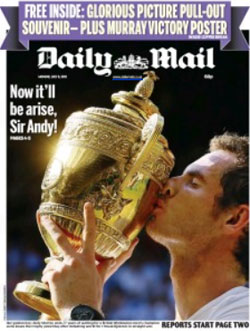
    Andy Murray’s win at Wimbledon has been celebrated across Britain. The Times, London called him “The History Boy”, The Guardian, The Independent and The Scotsman all went with the simple but evocative “Champion”, The Daily Express said he was “Magical Murray”. Some said a knighthood was on its way, “At Last, “Wimbledone”, “Yes!” and “Golden Boy” were some of the others.


    But where there is media, can controversy be far away? It started in fact on Saturday, July 6, just before the ladies singles final was to be played. John Inverdale, a BBC radio commentator had this to say about Marion Bartoli who went on to become the champion, “‘I just wonder if her dad, because he has obviously been the most influential person in her life, did say to her when she was 12, 13, 14 maybe, “listen, you are never going to be, you know, a looker.


    “You are never going to be somebody like a (Maria) Sharapova, you’re never going to be 5ft 11in, you’re never going to be somebody with long legs, so you have to compensate for that.”


    Bartoli is undoubtedly a quirky player with some tennis court rituals that are out of the ordinary (though perhaps Rafael Nadal wins that one). But what her physical beauty has to do with her tennis playing skills was not made clear by Inverdale or anyone else who thinks that female tennis players must be good-looking before they pick up a racquet.

     

    Inverdale’s sexist comments are part of an almost accepted form of conversation as far as the women’s game is concerned. It is possible that he even thought he was being funny, as this is how he explained his remarks: “She is an incredible role model for people who aren’t born with all the attributes of natural athletes.”


    His apology included these remarks: “The point I was trying to make, in a rather ham-fisted kind of way, was that in a world where the public perception of tennis players is that they’re all 6ft tall Amazonian athletes, Marion – who is the Wimbledon champion – bucks that trend.”


    It is unclear however whether these are Inverdale’s thoughts – that all female tennis players ought to be 6 ft tall blondes – or whether indeed, this is true. Of course, the Williams sisters spring to mind seeing as how they have been the most dominant of recent times.


    But if Inverdale’s sexism was bad, things were about to get a lot worse. In the hysteria of excitement at Andy Murray’s victory, the British press sort of forgot that Murray was the first man to win a Wimbledon singles title in 77 years. Since Fred Perry’s victory in 1936, four women have been Wimbledon singles champions. Virginia Wade, who won in 1977, is a prominent commentator and columnist, even if the other three have been forgotten.


    Tennis is the only sport in the world where women play at the same level, in the same tournaments and get paid the same amount of money as men. It is a shame therefore that social prejudices should be reflected so thoroughly in the media which ought to know better. Yes, there is no doubt that in the men’s game, Andy Murray has made a massive breakthrough. But there is surely no need to disrespect the women who have achieved exactly what he has. Yet both The Times and The Telegraph have similar headlines about the end to a 77-year wait for a British win.


    This link from The Guardian makes it clear: http://www.guardian.co.uk/sport/shortcuts/2013/jul/08/virginia-wade-wimbledon-champion-tennis


    Ranjona Banerji is a senior journalist and commentator based in Mumbai. She is also Contributing Editor, MxMIndia. She can be reached via Twitter at @ranjona. The views here are her own


  • Anil Thakraney: Need fresh gas on TV

    By Anil Thakraney


    All the Indian news channels have turned into clones of each other. It’s a pat formula on primetime: Run a quick snippet on a story with a reporter, this lasts for only a few minutes. Cut to the anchor who takes a clear, biased position on the subject. This follows a marathon session involving a ‘debate’ with many faces (always the same set), and the anchor’s key result area is to create friction and sit back and enjoy the gas blast. And hope for a pay rise.


    Why and when did news television become so moronically formulaic? And why are they all doing the same thing? Lack of imagination? Competitive pressures? I suspect it’s both, and also lack of respect for good journalism. I was talking to BBC’s Nick Gowing (for GQ), this is what he said: “Whenever I am invited to participate in a discussion on an Indian news channel, I make it clear that I will not shout at anybody. I think there’s a tendency to jump to a polarized view on air, as opposed to finding a more nuanced middle ground. And I find it interesting how opinionated the presenters can be. I wonder how long that may last. They do certain things which I wouldn’t and can’t do.”


    Mind you, Gowing, being a pucca gentleman that he is, presented a nuanced opinion. Am sure secretly he must be appalled at the way we are going about things. So is there any chance that sanity will happen on our news programmes any time soon? I seriously doubt it. This is because the ‘star’ anchors have grabbed the slots, and they will be reluctant to make way for new blood. There’s too much power and pelf being a TV anchor in India, not easy to delegate. So then what is the least they should do within the existing system? The answer is: Always invite fresh faces in the debates. We must get to hear new voices, and this should be easy, India is a vast country bustling with argumentative people. News production teams have to cut their sloth and find ways to inject new energies into the studios. And I use the word sloth because this is what typically happens: ‘Guys, we need to discuss the depreciating rupee, who can we quickly get as an expert?’ ‘Prahlad Kakar is available, should I call him? Also, Shobhaa De is free.’


    Point being, if we have to be stuck in a gas chamber each evening, can we at least be subjected to fresh gas?


    PS: Haha. So much for all those comments by ‘judges’ on reality shows. I can imagine Lata auditioning for ‘Aye mere watan ke logon’ and receiving this sort of feedback: ‘Energy level thoda kam tha.’ ‘Jyada mushy ho gaya, you need to tone down the emotion’. ‘Rocking performance! Lekin beech mein sur miss ho gaya, aap nervous ho gayeein.’


    Anil Thakraney is a senior journalist and commentator. He is also Editor-at-Large, MxMIndia. The views expressed here are his own. He can be reached via Twitter at @anilthakraney


  • Debrief: Renault Pulse: Pulsating with boredom

    By Anil Thakraney


    On Tuesday I reviewed the crappy census ad, and had said that the bad old nineties are back. As if to prove the point, Renault has signed up Anil Kapoor as brand ambassador for their hatchback called Pulse. Before I proceed further, I must share what Shah Rukh said to me in the year 2007. He said Anil Kapoor used to scoff at him for acting in TV commercials, boasting that he (Kapoor) would never do ads. Soon after the success of Slumdog Millionaire, Anil Kapoor was seen selling Mont Blanc pens, which must have made SRK snigger quite loudly. But at least that was a half decent ad. With Renault, the yesteryear actor has made a complete fool of himself.


    The idea isn’t terribly bad, but the rendition is awful. Kapoor borrows his son’s Renault Pulse, and this, well, sets his pulse racing. And he suddenly starts behaving like a ‘crazed teenager’, in his office and at his home. Extremely poor interpretation of pulse-racing, they could have had so much fun with it. To make matters worse, the direction sucks, the expressions are forced, and Kapoor ends up looking like a bumbling idiot. And because he ends up looking like that, as a viewer, my mind stays focussed on him, and the brand gets completely lost in the process. I don’t know, at the end of the commercial, what it is about the car that will send my pulse racing. Renault Pulse remains at the level of yet another hatchback in the market. In short, a total flop show.


    As for Kapoor, he should practice what he once preached to SRK: Stay away from advertising, more so if this is the kind of creative that sets his pulse racing.


    Rating: (On a scale of 1-5): 0. Poor script. Poor direction.


    Anil Thakraney is a senior journalist and commentator. He is also Editor-at-Large, MxMIndia. The views of the writer are his own. He can be reached via Twitter at @anilthakraney


  • Anil Thakraney: The Great Desi Soap Factory

    By Anil Thakraney


    In a two-part series, I shall examine the key challenges confronting the Hindi GECs, as well as the road map for the future. Today, let’s examine the current scenario.


    As I mindlessly surf the channels, I realize that not much has changed in the last decade plus. For years together so many critics and viewers have been carping about it, but it all seems to have fallen on deaf years. Almost all of the Indian television soaps are still stuck with the same old family dramas, the same old kitchen politics. Each year one channel or another launches a new serial that comes with the promise of freshness, it even starts nicely, but by the tenth episode the story regresses into a family natak, laced with plenty of cat fights.


    To understand this situation, let’s assume for a minute that the channel chiefs know what they are doing, that they aren’t stupid. The easy explanation is that audiences for television soaps essentially constitute housewives, and that these ladies like to watch gharelu khitpit. Well, this could be true to an extent. But then, housewives in America also like to watch Homeland and Prison Break, and by that logic, surely bored housewives out here would like to consume high octane stories. So to blame the viewer, as in ‘we are only dishing out what she wants’, is unfair. Think about this: The same housewife, when she goes to watch movies, prefers zippy, edgy, offbeat content… family dramas are a thing of the distant past in Bollywood. So why would she not want novelty in her soaps? The real problem is that so far, the Hindi entertainment channels have refused to take chances, they have played safe, and this has led to photocopy content across board. So it’s a problem of lack of courage.


    However, in the recent past, winds of change seem to have started blowing. Anil Kapoor is busy doing the desi version of 24. Amitabh Bachchan has begun shooting for a fictional TV show. Anurag Basu wants to create a new TV serial. Ekta Kapoor, the queen of family dramas, has launched the historical Jodha Akbar (though the family squabbles continue here too, not surprising that, Ektaji can’t avoid those!). Soon, other big stars, movie producers and directors will join the party, and that can only be great news for the Hindi GEC audiences.


    So can we look forward to an entertainment revolution on TV? Er, not really. Because the change, even if it happens on a large scale, will present its own set of problems and challenges. On Monday, we’ll discuss these, so have patience. When the subject is soaps, even I must be allowed to serialize the article. 🙂


    PS: Nice press ad from Apple. Good body copy, something that’s now extinct in India. I like how Apple has distilled its entire philosophy into simple words, so that the aam aadmi can connect with it. Another example why Apple is such a loved brand.


    Anil Thakraney is a senior journalist and commentator. He is also Editor-at-Large, MxMIndia. The views expressed here are his own. He can be reached via Twitter at @anilthakraney


  • Anil Thakraney: Saas-Bahu soaps will never die

    By Anil Thakraney


    Last week, we discussed why there’s sameness in the desi soaps, why the channels and producers aren’t able to brush off household fights. I also mentioned that things may finally be looking up, what with bada Bollywood stars and directors wanting to take part in television fictional shows, to produce offbeat content. But can their stuff match up to the best of American television, will they be able to raise the bar? No way, and I will explain why.


    In the last one year, I have watched some truly stunning TV serials from the US. Spartacus, Homeland, House of Cards, Scandal, Prison Break, just to name a few. The budgets are lavish and therefore the quality of production is extremely high. The soaps out there don’t just match the best of Hollywood, they often surpass it. In terms of stories, direction, editing, stunts, special effects, the works. This is what makes the serials magnetic… as a viewer you don’t feel shortchanged, you know you are being rewarded for the time you spend on the serials. This is where Indian producers will take a bad hit, because they simply won’t have access to that sort of funding. So even if the story is interesting, the production quality will make you cringe. Watch Ekta Kapoor’s Jodha Akbar, for example. It’s got tacky written all over it. The sets and the costumes look comical, the acting is third rate and the serious dialogues make you laugh out loud. Am afraid the same fate awaits Anil Kapoor’s copy of 24.


    Monies aside, there’s another grave problem. Almost all the American serials take on the White House, and not in a flattering way. The US Prez gets routinely depicted as a conniving, cheating, diabolical, unfaithful man, and the junta loves the no-holds-barred approach. Try doing this in India, you will get into serious trouble with our insecure politicians. Also, out there, they honestly deal with the issue of terrorism; they don’t shy away from singling out the community whose young men usually take to militancy. This will be impossible in our ‘vote bank’ politics ruled nation. And once you water the content down, you have already killed the excitement. Add to that: No foul language and absolutely no steamy sex, you are taking about utterly boring fare.


    And so that’s why I am not very bullish on the Indian GECs. They will experiment, get poor returns, and return to family dramas with a vengeance. Yes, we are stuck with the saas and the bahu, whether we like it or not.


    PS: How do you promote a cafe that was once a urinal? Well, you have fun with it. And sit back and watch as your act goes viral, resulting in oodles of free publicity. Smart thinking.

    [vimeo width=”400″ height=”220″]http://vimeo.com/68843232[/vimeo]


    Anil Thakraney is a senior journalist and commentator. He is also Editor-at-Large, MxMIndia. The views expressed here are his own. He can be reached via Twitter at @anilthakraney


  • Reviewing the Reviews: Mostly 2.5-3 stars for Bhaag Milkha Bhaag

    By Deepa Gahlot


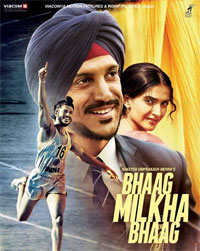
    In our films, the actors often rise above the material. But once in a while there comes a performance that takes a film onto a different plane altogether– and Farhan Akhtar’s turn as Milkha Singh in Rakeysh Omprakash Mehra’s Bhaag Milkha Bhaag is stupendous.


    Most mainline critics, however, found the film too long, melodramatic, unfocussed and fake. Even though the subject of the film is living and participated in the making of the film, it hits so many false notes. It turned the protagonist into a demi-god, but how accurate was the portrayal?


    Bhaag Milkha Bhaag

    (Released: July 12, 2013)


    Key Credits

    Producers:

    Rakeysh Omprakash Mehra, Viacom18 Motion Pictures               


    Director:

    Rakeysh Omprakash Mehra                     


    Writer and Lyricist:

    Prasoon Joshi                  


    Key Cast:

    Farhan Akhtar (Milkha Singh)

    Sonam Kapoor (Nirmal Kaur)

    Rebecca Breeds (Stella)

    Dalip Tahil (Jawaharlal Nehru)


    Music:

    Shankar Mahadevan, Loy Mendonsa, Ehsaan Noorani                


    Cinematography:

    Binod Pradhan                


    Editor:

    P S Bharathi


    Full credits at IMDB: http://www.imdb.com/title/tt2356180/


    The ratings were 2.5 to 3 stars, though the RJ and blogger kind of reviewers gushed unabashedly, one going the whole hog with a 5-star review. How seriously these writers are taken is the question.


    Rajeev Masand of IBNLive.com used the dreaded B word– boring. “The problem with adoring, reverential portraits of real people is that they tend to lack objectivity and quickly become boring. It’s true of Rang De Basanti director Rakeysh Omprakash Mehra’s Bhaag Milkha Bhaag, an ambitious account of the first 27 years or so of celebrated Indian sprinter Milkha Singh’s roller-coaster life….There are moments of great pathos here, and an inspiring lesson on the importance of perseverance and hard work. But it all moves at a snail’s pace, even as the drama of Milkha’s rise on the race track is punctured routinely by too many songs, overlong romantic tracks, and the kind of ‘commercial-movie trappings’ that are counterproductive to a film of this nature.”


    Sukanya Verma of rediff.com commented, “Bhaag Milkha Bhaag fails to achieve that level of clarity or coherence, primarily because of Prasoon Joshi’s faulty screenplay and sleepy editing by P Bharti, which appears both overwhelmed and clueless about putting together the many chapters of a sportsman’s eventful existence. So Bhaag Milkha Bhaag adopts the contrived route wherein everyone competing with the titular hero is entirely nefarious and out to break his legs or bully him like those Rajput dudes in Jo Jeeta Wohi Sikander and everything Pakistan implies hostile like those arrogant tyrants in every second jingoistic Bollywood flick.  Moreover, this indecision to project Bhaag Milkha Bhaag as either a) a man dealing with the painful memories of his childhood in partition era, b) the blossoming of a happy-go-lucky army man into a superstar athlete or c) why an individual doesn’t want to visit Pakistan overlaps too often in this three-hour plus, flashback-within-flashback drama to ruin a potentially promising premise. The last point, especially, makes no sense.”


    Shubhra Gupta of The Indian Express  found it tiresome. “Carefully skirting the tag of a bio-pic, Bhaag Milkha Bhaag manages to tell the story of Milkha Singh, as enacted by Farhan Akhtar, while giving us, tiresomely, all the familiar bells and whistles of a Bollywood entertainer with the naach-gaana, and the rona-dhona.  The story of Milkha Singh is inspirational, doubtless. And Mehra leaves, literally, not one stone unturned (and adds a few of his own, doubtless) in this three hour and some saga…”


    Sanjukta Sharma of Mint wrote, “It is a marathon trudge from cradle to national glory following a win in Pakistan against a Pakistani athlete, who incidentally has an aggressive coach, the film’s only villain. The long narrative rallies around the event that carries emotional charge for Milkha Singh and its details are painstakingly overemphasized. So Joshi hooks Milkha Singh’s story out of the context of Indian sports at the time and puts it under an isolating, personal microscope—an interesting approach if not taken to an extreme, clearly against the tradition of the biopic as a chronology of milestones.”


    Saibal Chatterjee of NDTV.com ranted, “The overlong Bhaag Milkha Bhaag seeks to achieve a dramatic heightening of the effect of a champion athlete’s rousing struggle to break free from the traumas of the past and turn adversity to opportunity.  In the bargain, it reduces the human saga to a loud, melodramatic and over-wrought tale that overstays its welcome.  It is amply clear by the end of the three hours of the film’s running time that the song-and-dance Bollywood form does not lend itself to the simple dynamics of a sporting biopic. Scenarist Prasoon Joshi and producer-director Mehra attempt to squeeze every ounce of emotion out of the real-life Milkha story. Unfortunately, it is reality that seems to be the biggest casualty in this deeply flawed endeavour.”


    Sudhish Kamath of The Hindu nailed the reason why the film may have failed as a biopic, but not as a commercial film. “No, Bhaag Milkha Bhaag is not a boring biopic or a detail-obsessed docudrama on one of India’s greatest sporting legends. It is an old-fashioned Bollywood film that caters to mainstream Hindi audiences. It would be more accurate to call this a tribute film inspired by the life of Milkha Singh than refer to this as a history lesson. The film acknowledges this when it ends with a disclaimer: “Inspired by a true life”.  And yes, it’s a complete sell-out of a film. But no complaints there because the best way to honour a legend is to make a film that a majority of India would watch. In an idiom that they prefer, even if it means exaggeration, melodrama and creative liberties with the hero’s love life. And Rakeysh Omprakash Mehra deserves that artistic licence considering that Milkha did indeed face extreme struggle, rose from abject poverty and had to make peace with his painful past.”


    Deepa Gahlot is an award-winning film critic and one of the seniormost journalists tracking films and entertainment in the country. The views expressed here are her own and the featuring of reviews is not MxMIndia’s endorsement of the views expressed therein.


  • Debrief: Wild Stone: Nailing yummy mummies

    By Anil Thakraney


    Wild Stone soap continues with the promise all male toiletries brands make: Use our product, get the chicks. Must say I have always found this premise a tad amusing. Many of us men use deos and soaps just to feel fresh, there are more interesting ways to patao ladies. But the marketers don’t care about this, and so the ‘safe’ chick caravan chugs along merrily.


    However, in the new commercial, Wild Stone has done two rather ‘interesting’ things. One, they have used an old Hindi film song, which I think is a new one for this category. (Incidentally, filmi classics are in vogue all of a sudden, and the reason for that is paucity of good jingle writers.) Thing is, I wonder what the likes of SD Burman, Naushad and Shankar Jaikishan might feel about their songs being used to sell all sorts of dodgy products. And the worst part is, these ads destroy the original charm of the old favourites. Secondly, Wild Stone has pushed the envelope further, this time our chap wins over young moms. All along it was only babes, then our hero started attracting married women, and that the woman is married was only suggested. Now, it’s open season, every woman is fair game. I guess we’ll soon see aunties and grannies swooning over the dudes.


    The ad itself is stupid and poorly shot. Our man plays football with the kids. He doesn’t win the match, but his topless avatar gets the mommies’ glad eye. My worry is this nonsense might actually be working with a certain section of men, which is why it continues. So please carry on, but can you quit hitting on Hindi film classics? Let at least some things in life remain sacred.


    Rating: (On a scale of 1-5): 0.5 I need to get wildly stoned to appreciate this creative.


  • Anil Thakraney: Reportage must be free of bias

    By Anil Thakraney


    For the benefit of young journalists reading this post, I want to discuss the importance of the play of a story, and I shall illustrate this with a report that the TOI fronted a few days back. This is not to fault the newspaper, undoubtedly they carried the said story with noble intentions, but it’s an interesting example to highlight how the story gets played out is often as important as the story itself. It’s about this lady executive who wears an artificial limb, and the torturous time she had passing through airport security. Here’s the link: http://timesofindia.indiatimes.com/india/Airport-check-of-artificial-leg-leaves-marketing-executive-in-tears/articleshow/21027950.cms


    Now, we have to feel sorry for Suranjana, indeed, our heart goes out to the lady. You suffer from a serious disability, and then you are made to undergo high stress at the airport. Clearly this is not on. However, the problem is this: Because it’s a news report, you expect the story to be objective in nature, after all, this is not an opinion column. The play by the journalist is biased in this case, and the report doesn’t bother to give us an adequate version from the airport security staff. As a result, the reader is left with the impression that the security personnel at airports are heartless, insensitive souls, and this could be far from the truth.


    For example, even as I feel sorry for differently abled passengers, and understand their plight and want them to travel in comfort, I have to say this story actually reassures me. Because this means our airport security personnel are going about their work as per the book and minus any emotion. In short, they are doing their job. We live in terrible times, and canny terrorist can and will look for innovative methods to create trouble. And therefore we need kickass security. When you look at the situation from this angle, your view gets changed. And this particular play of the story would also be incorrect, because this too is a subjective opinion, and has no place in a news report.


    The other concern is, such a biased story in a powerful newspaper would put unnecessary pressure on the security staffers, compelling them to be lenient with those who are differently abled. Is that such a good thing? You know the answer to that one. I know that the Indian media is getting increasingly subjective in its reportage, and television anchors do it every single evening, but I do hope the TOI, a paper that I have read and respected from childhood, doesn’t fall prey to this practice.


    So then what should ideally have happened? In my opinion, report neutrally. And then run a campaign on how the government can help evolve sensitive security procedures for the differently abled, but without compromising safety.


    PS: Brilliant commercial from Land Rover. This is the magic that happens when a talented filmmaker, cinematographer and the agency art director work together to create a sparkling ad. You can watch this one again and again and not get bored.

    [vimeo width=”400″ height=”220″]http://vimeo.com/65104233[/vimeo]


    Anil Thakraney is a senior journalist and commentator. He is also Editor-at-Large, MxMIndia. The views expressed here are his own. He can be reached via Twitter at @anilthakraney


  • Ranjona Banerji: Modi mania in the media

    By Ranjona Banerji


    The big media sensation in India these days is definitely Narendra Modi. Ever since he was made the chairman of the BJP’s election committee – seen as heir presumptive of his party – if the Gujarat chief minister so much as sneezes, it’s time for a political debate on TV and a dissection of the symbolism of a sneeze on opinion-based websites.


    Modi himself – or his publicity machinery – adds fuel to the fire. One day, he is supposed to have almost single-handedly rescued 15,000 Gujaratis from the floods of Uttarakhand, soon after he claims to have felt as bad as a person sitting in a car which runs over the son (or daughter) of a dog – an elliptical reference to the victims of the Gujarat riots. This interview to Reuters spread like wildfire across social media and what is now called mainstream media (acronymed to MSM which does sound like some disease you don’t particularly want). The words used by Modi were translated as “puppy” and the merry-go-round started again.


    Two things are clear from this. One, Modi’s publicity machine is trying too hard. And, two, the media’s focused attention is a double-edged sword, as Anna Hazare, Arvind Kejriwal and the organisers of the anti-corruption movement found out to their horror. Modi now cannot take a step without someone watching, someone tearing it apart and someone else explaining what he meant in excruciating detail.


    Tied to the Modi-in-the-media story is that of the intelligence agencies, people killed in fake encounters and the Gujarat government. The death of Mumbai teenager Ishrat Jahan in 2004 has now overshadowed that of her companions and also exposed a divide in India’s various investigative and intelligence agencies. The media, rather than look at the issues involved objectively, has sided with one or the other investigative agency.


    The problem here is a little different from the “for or against” Modi camps in the media. For years, editors have allowed reporters working on intelligence and police beats to become mouthpieces for those agencies. The logic is that you pick up on inside stories and the senior edit team works out the kinks caused by bias. But life and a newsroom never work that way and the result is that print journals and to some extent news channels just become conduits for intelligence agency politics. Print prides itself on having more filters than TV but as the various headlines, allegations, fights and quite frankly bogus information masquerading as news has shown recently, the filters have been playing hookie.


    I must make my own bias clear here: I lived in Gujarat before and during the 2002 riots. There is little doubt in my mind about state government complicity, whether active or passive. However, that does not mean that everything that happens in Gujarat has to be vilified. It cannot be a “for us or against us” case for the media at least. Modi is a chief minister with a sordid past. But he’s just a chief minister of one state. He is not a superhuman being sent either to destroy or redeem us. Myth-making is a long organic process. It is unlikely that a media with chronic short-term memory loss can be successful at it.


    **


    In the rest of the world, news has had a sort of similar focus. The US has been concerned with the acquittal of George Zimmerman in the murder of Trayvon Martin last year. Zimmerman shot the teenager assuming him to be hostile while on his rounds as part of a neighbourhood watch scheme. Martin, 17, has no weapon on him and his two biggest crimes appeared to be wearing a hoodie and being black.


    As the US grapples with the consequences of this verdict, Britain where I am now, is waiting for the arrival of the “royal baby”. The “due date” (last Saturday) has come and gone and the breathless media has to concentrate on this event. Babies as we all know can be tremendously uncooperative in such matters. But the stories must continue. A special reclining chair for daddy in the hospital suite, also champagne and luxury toiletries, father William playing polo, mummy Kate “putting her feet up” at her parents, the sun shining, no clouds, step-mother letting slip the new due date might be this weekend and other such trivialities occupy the national press.


    Who says the media is different anywhere else?


    Ranjona Banerji is a senior journalist and commentator based in Mumbai. She is also Contributing Editor, MxMIndia. She can be reached via Twitter at @ranjona. The views here are her own


  • Debrief: Binani Cement: Big B at his best

    By Anil Thakraney


    Finally, an ad with Bachchan I like. Binani has used the star intelligently, this isn’t the usual mindless stuff Big B does. They have used the idea of endless parental love, and juxtaposed it with long lasting cement. But the comparison has been done smoothly, with dignity.


    Bachchan is speaking to us from inside his study. He talks about how parents’ love is eternal. Even after they are long gone, their presence gets reflected in our eyes, our mannerisms. In the old pictures and in the everyday things. The star connects this with his own parents, as he fondly caresses objects that remind him of his own family. Binani arrives only in the end, with their punch line: Sadiyon Ke Liye.


    Nice, for many reasons. Cement is a generic category, one brand isn’t really different from the other, and so it makes sense to try and build an emotional bond with the consumers, and the ad does precisely that. Next, the setting is real; Bachchan fits in perfectly given his naturally pleasing demeanour and a strong legacy. And because he doesn’t directly sell cement, the ad feels authentic. The script is heart-warming, the words have a lyrical quality to them, you will discover your own parents in the ad. Full marks to the writer, this is inspired writing.


    Lastly, a pat on the back to Binani for showing everyone how to use a celeb in advertising. Sadiyon ke baad, Bachchan rocks in a commercial.


    Rating: (On a scale of 1-5):  4. Perfect casting. Endearing execution.


    Anil Thakraney is a senior journalist and commentator. He is also Editor-at-Large, MxMIndia. The views of the writer are his own. He can be reached via Twitter at @anilthakraney