
Category: ADVERTISING

  • AbhiBus rolls our new campaign

    AbhiBus, an online bus-ticketing platform, has launched a new ad campaign featuring Tollywood superstar Mahesh Babu and comedian Rajendra Prasad. The ad highlights the last-minute booking that AbhiBus offers.

    Said Rohit Sharma, COO of AbhiBus: “We are thrilled to collaborate with the iconic Mahesh Babu who has been a long-standing brand ambassador of AbhiBus for the past eight years, and the immensely talented Rajendra Prasad for our new brand campaign. While RP is a legend with close to 50 years in the film industry, Mahesh is a household name and a star. The duo has created magic on screens every time they have appeared together and it is this chemistry and humorous energy that we have drawn on in our upcoming series of ads.  Their immense popularity and relatability make them perfect ambassadors to convey our message of celebrating travel and togetherness with your loved ones. Through this campaign, we aim to connect with our audience on a deeper level and reinforce our commitment to providing seamless and joyful travel experiences.”

  • Omaxe Chowk launches ‘Filmy’ campaign

    Omaxe Chowk, the wholesale and retail hub, has released a ‘film dialogue-based’ marketing campaign, which highlights the modern shopping experience in Delhi’s medieval heart, Chandni Chowk.

    Said Jatin Goel, Managing Director, Omaxe Group: “Through this campaign, we aim to highlight the fusion of modern shopping experiences in Delhi’s traditional heart, Chandni Chowk. Through Omaxe Chowk, we aim to re-ignite the magic that Chandni Chowk is known for while imparting it with modern flourish. The eye-catching headlines in the backdrop of uncluttered red background aim to reinforce Omaxe Chowk’s strengths and its relevance for the present and future generations.”

  • Goafest 2024 opens delegate registrations

    Goafest 2024 has announced the opening of delegate registrations for the three-day event scheduled to take place from May 29  to May 31  at the Westin Powai in Mumbai. Early bird rates are valid until May 15, 2024.

    Sam Balsara
    Sam Balsara

    Said Sam Balsara, Chairman of the Delegates Committee – Goafest 2024: “Goafest is a unique platform that brings together industry leaders, creative minds, and aspiring talents to celebrate creativity, exchange ideas, and shape the future of advertising in India. We are excited to welcome delegates from across the country to join us for three days of inspiration, learning, and networking. This year with the event moving to Mumbai, we are sure there will be a substantial increase in delegates from Mumbai.”

  • Ad Club Bangalore launches Inspiration Room

    The Ad Club Bangalore has announced the launche of the Inspiration Room, a new initiative designed to inspire and educate the advertising and marketing community. This series of thought leadership programmes will offer a wide range of formats fostering a dynamic exchange of ideas.

    Said Laeeq Ali, Founder of Origami Creative and President of Ad Club Bangalore: “We are very excited to launch the Inspiration Room series. This initiative is conceived to be a series of high-quality masterclasses, talk shows, discussions and workshops, where creative professionals will get to hear from the experts and interact with the best.”

    The first programme in the Inspiration Room series was a roundtable discussion focusing on Generative AI.

  • Mindshare emerges as Agency of the Year at FOMA 2024

    has been awarded Agency of the Year 2024 at the Festival Of Media Asia-Pacfic awards for 2024. Mindshare won several metals and titles for campaigns with 2 Grand Prix, 7 Gold, 6 Silver and 4 Bronze awards across various categories like Campaign of the Year, Best Branded Content, Best Response Campaign, Best Cause Campaign, Best Viral Campaign, Best Use of Audio, Video, Creative Use of Media, Best Use of eSports or Gaming, etc. In addition to this Mindshare India grabbed the Agency of the Year title.

    Said Amin Lakhani, CEO of Mindshare South Asia: “We are absolutely thrilled and grateful to be recognized as the Agency of the Year at FOMA 2024. This achievement is even more special as it comes from multiple award-winning campaigns across various categories. It’s a testament to the hard work and dedication of our team, and I’m proud to see them being recognized for their efforts. This is a great moment for us, and we look forward to continuing to deliver innovative solutions and drive good growth for our clients in the future.”

    From India, Wavemaker and EssenceMediacom, have also brought seven metals each.

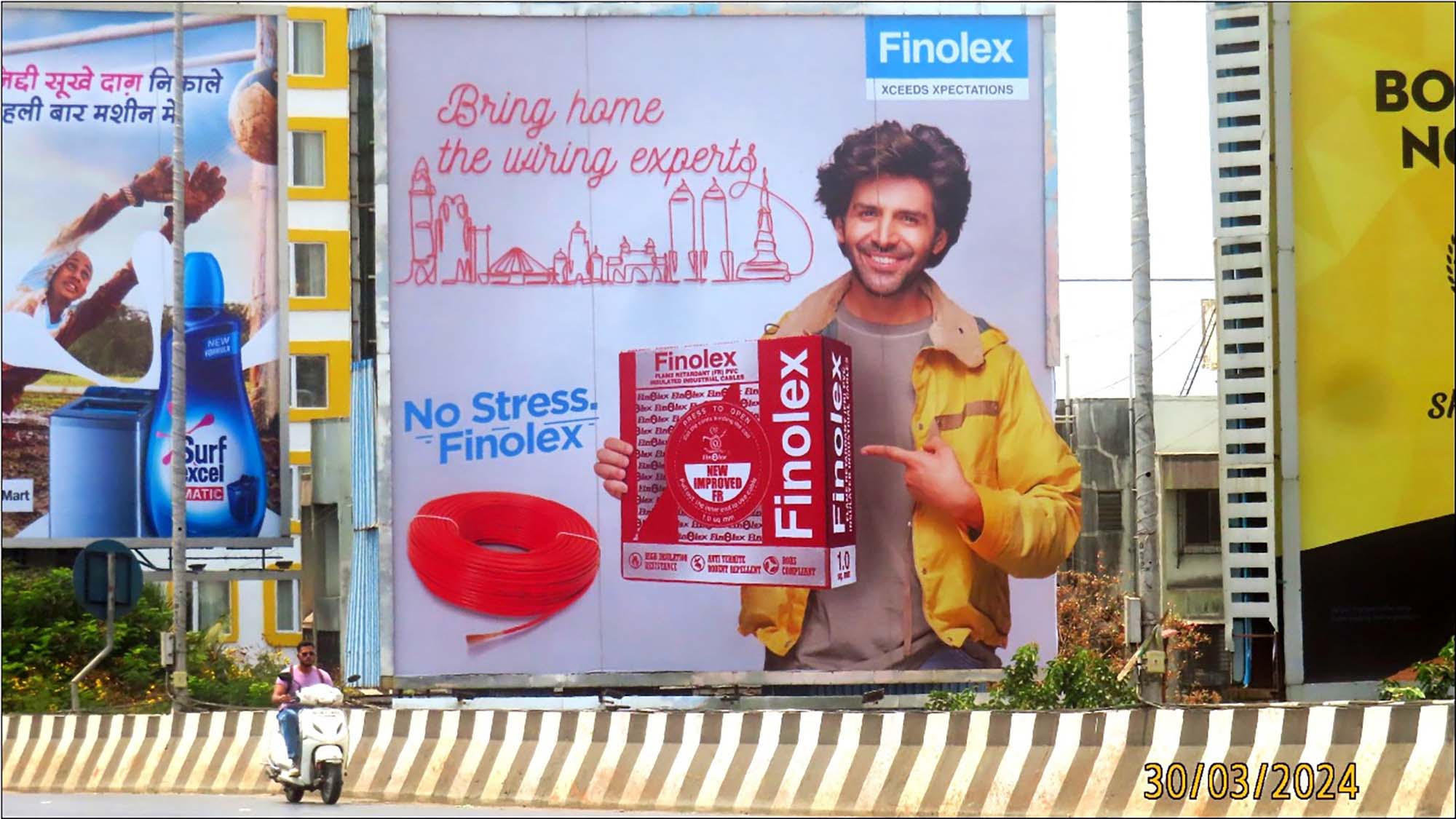
  • Laqshya Media unveils OOH campaign for Finolex Cables

    Laqshya Media Group has unveiled an Out-of-Home (OOH) campaign for Finolex Wiggle ES BLDC Fans and wiring solutions across key cities.

    Said Amit Mathur, President-Sales & Marketing, Finolex Cables Ltd: “In today’s fast-paced digital world, capturing consumer attention requires innovation and creativity. Our ‘No Stress. Finolex’ campaign exemplifies this ethos, with standout hoardings showcasing our dedication to innovation and reliability. These hoardings are not just advertisements; they’re symbols of our brand’s commitment to standing out and making a meaningful connection with our audience. Coupled with our comprehensive 360-degree approach across various channels and marketing activities, we’re confident that Finolex Cables will continue to resonate with consumers, driving brand awareness and engagement.”

    Added  M Amarjeet Singh Hudda, COO of Laqshya Media Limited: “This campaign goes beyond mere visuals; it’s about crafting experiences that leave a lasting impression. By seamlessly integrating motion into our OOH strategy, we grab attention and foster meaningful engagement with our audience. The fusion of technology and creativity has enabled us to create a campaign that resonates with the audience across multiple touchpoints.”

  • More jury chairs named for Abby 2024

    Pallavi Chakravarti
    Pallavi Chakravarti
    Raj Kamble
    Raj Kamble
    Mayuri Nikumbh
    Mayuri Nikumbh

    Pallavi Chakravarti, Founder and CCO of Fundamental, Raj Kamble, Founder & CCO of Famous Innovations and Mayuri Nikumbh, Head of Design at Conran Design, will join as Jury Chairs for the Abby Awards 2024.

    Chakravarti has been appointed Jury Chair in the Diversity, Equality and Inclusion category, Kamble will be Jury Chair for the Out of Home and Ambient category. Nikumbh will Jury Chair in the Design Category.

  • Teens say ‘for you’ algorithms get them right

    Teens say ‘for you’ algorithms get them right

    By Nora McDonald

    Social media apps regularly present teens with algorithmically selected content often described as “for you,” suggesting, by implication, that the curated content is not just “for you” but also “about you” – a mirror reflecting important signals about the person you are.

    All users of social media are exposed to these signals, but researchers understand that teens are at an especially malleable stage in the formation of personal identity. Scholars have begun to demonstrate that technology is having generation-shaping effects, not merely in the way it influences cultural outlook, behavior and privacy, but also in the way it can shape personality among those brought up on social media.

    The prevalence of the “for you” message raises important questions about the impact of these algorithms on how teens perceive themselves and see the world, and the subtle erosion of their privacy, which they accept in exchange for this view.

    Teens like their algorithmic reflection

    Inspired by these questions, my colleagues John Seberger and Afsaneh Razi of Drexel University and I asked: How are teens navigating this algorithmically generated milieu, and how do they recognise themselves in the mirror it presents?

    In our qualitative interview study of teens 13-17, we found that personalized algorithmic content does seem to present what teens interpret as a reliable mirror image of themselves, and that they very much like the experience of seeing that social media reflection.

    Teens we spoke with say they prefer a social media completely customized for them, depicting what they agree with, what they want to see and, thus, who they are.

    If I look up something that is important to me that will show up as one of the top posts [and] it’ll show, like, people [like me] that are having a nice discussion.

    It turns out that the teens we interviewed believe social media algorithms like TikTok’s have gotten so good that they see the reflections of themselves in social media as quite accurate. So much so that teens are quick to attribute content inconsistencies with their self-image as anomalies – for instance, the result of inadvertent engagement with past content, or just a glitch.

    At some point I saw something about that show, maybe on TikTok, and I interacted with it without actually realising.

    When personalised content is not agreeable or consistent with their self-image, the teens we interviewed say they scroll past it, hoping never to see it again. Even when these perceived anomalies take the form of extreme hypermasculine or “nasty” content, teens do not attribute this to anything about themselves specifically, nor do they claim to look for an explanation in their own behaviors. According to teens in our interviews, the social media mirror does not make them more self-reflective or challenge their sense of self.

    One thing that surprised us was that while teens were aware that what they see in their “for you” feed is the product of their scrolling habits on social media platforms, they are largely unaware or unconcerned that that data captured across apps contributes to this self-image. Regardless, they don’t see their “for you” feed as a challenge to their sense of self, much less a risk to their self-identity – nor, for that matter, any basis for concern at all.

    The human brain continues to develop during adolescence

    Shaping identity

    Research on identity has come a long way since sociologist Erving Goffman proposed the “presentation of self” in 1959. He posited that people manage their identities through social performance to maintain equilibrium between who they think they are and how others perceive them.

    When Goffman first proposed his theory, there was no social media interface available to hold up a handy mirror of the self as experienced by others. People were obligated to create their own mosaic image, derived from multiple sources, encounters and impressions. In recent years, social media recommender algorithms have inserted themselves into what is now a three-way negotiation among self, public and social media algorithm.

    “For you” offerings create a private-public space through which teens can access what they feel is a largely accurate test of their self-image. At the same time, they say they can easily ignore it if it seems to disagree with that self-image.

    The pact teens make with social media, exchanging personal data and relinquishing privacy to secure access to that algorithmic mirror, feels to them like a good bargain. They represent themselves as confidently able to tune out or scroll past recommended content that seems to contradict their sense of self, but research shows otherwise.

    They have, in fact, proven themselves highly vulnerable to self-image distortion and other mental health problems based on social media algorithms explicitly designed to create and reward hypersensitivities, fixations and dysmorphia – a mental health disorder where people fixate on their appearance.

    Given what researchers know about the teen brain and that stage of social development – and given what can reasonably be surmised about the malleability of self-image based on social feedback – teens are wrong to believe that they can scroll past the self-identity risks of algorithms.

    U.S. Surgeon General Vivek Murthy discusses the harms teens face from social media

    Interventions

    Part of the remedy could be to build new tools using artificial intelligence to detect unsafe interactions while also protecting privacy. Another approach is to help teens reflect on these “data doubles” that they have constructed.

    My colleagues and I are now exploring more deeply how teens experience algorithmic content and what types of interventions can help them reflect on it. We encourage researchers in our field to design ways to challenge the accuracy of algorithms and expose them as reflecting behavior and not being. Another part of the remedy may involve arming teens with tools to restrict access to their data, including limiting cookies, having different search profiles and turning off location when using certain apps.

    We believe that these are all steps that are likely to reduce the accuracy of algorithms, creating much-needed friction between algorithm and self, even if teens are not necessarily happy with the results.

    Getting the kids involved

    Recently, my colleagues and I conducted a Gen Z workshop with young people from Encode Justice, a global organisation of high school and college students advocating for safe and equitable AI. The aim was to better understand how they are thinking about their lives under algorithms and AI. Gen Zers say they are concerned but also eager to be involved in shaping their future, including mitigating algorithm harms. Part of our workshop goal was to call attention to and foster the need for teen-driven investigations of algorithms and their effects.

    What researchers are also confronting is that we don’t actually know what it means to constantly negotiate identity with an algorithm. Many of us who study teens are too old to have grown up in an algorithmically moderated world. For the teens we study, there is no “before AI.”

    I believe that it’s perilous to ignore what algorithms are doing. The future for teens can be one in which society acknowledges the unique relationship between teens and social media. This means involving them in the solutions, while still providing guidance.The Conversation


    Nora McDonald, Assistant Professor of Information Technology, George Mason University. This article is republished from The Conversation under a Creative Commons license. Read the original article.

  • Sorry, consumers. We’ve failed you!

    Sorry, consumers. We’ve failed you!

    Sanjeev KotnalaDear Customers, I am sorry and guilty as a member of the industry that has collectively, with the government, failed you, the consumer. I say this after Patanjali’s Baba Ramdev got away lightly with just a minor rap on the knuckles… an apology.  I can bet that the debate about Babaji’s Patanjali and its misinformation campaign will not die down quickly enough.


    Apology of an Apology

    Okay, so the size of the apology was increased. But it appeared once in the larger size and once in the smaller size. It is minuscule compared to the total space and time consumed by Patanjali with its misinformation campaign. Hence, expecting the audience to have the same opportunity to see the apology as they had when they saw the campaign is futile. This means that most will remain unaware of the apology and continue to be under the influence of all-powerful misinformation and miscommunication. In a true sense, if we want a real example and deterrent, the apology must appear in the same media (Press-TV-Digital) in the same size and with the same frequency as the misleading campaign. Now, that may be too much to ask, but should that not be justified for a habitual offender brand? And till it happens, the brand should be debarred from communicating in the media. That would have been justice.

    I wonder if they ran a 15-second apology on TV and digital with the same channel and platforms. Logically, they should have.


    The Products are not Bad, the Misleading Information is

    Before you take it otherwise, let me tell you I firmly believe in remedies and the products that Patanjali propagates. However, it is all about the hugely exaggerated, unscientific, unsubstantiated claims the brand has been pushing with heavy media exposure riding on Baba Ramesh Yoga and Ayurvedic Acharya image.


    This is no time for Celebration

    It is not the time to celebrate the victory. This is just a demonstration of the industry and the government’s failure to curb such brand menace.

    No time to rejoice for the apology that the brand was forced to publish.

    This is like any other time- a good time for introspection.

    An industry that expects a celebrity endorser to do a due diligent check on the brand must take the blame when it feels at the creative and media level to question misleading claims. And that is not just about Patanjali, it is about the non-healthy health drinks- the Fair that now Glows and many other such brands.

    It is time to once again call upon every stakeholder and see what genuine efforts are needed so that no other brand dares to create and release misleading communication.


    Two Questions

    One way in which the brand should be penalised for the long-term damage it could have created on the highly influenceable minds of the masses. The courts and the ministry must work together to ensure that even if it is a witch hunt, Baba Ramdev and the brand are made an example of it. Is taking brands off the shelf good enough? Should the brand be asked to mirror the product’s misleading campaign media plan for the apology media plan? Or should we ask the brand to provide 5% of the revenue as a deterrent?


    What about the Future?

    I have often said this – No One Is Worried Of ASCI and the fragmented industry. Recently, ASCI has been trying to act bravely and get some teeth by working with the consumer affairs and information ministry. However, it remains a source of a sparkling array of meticulously crafted guidelines-  which remain what they are: guidelines.  It does not have the power to sanction a brand. And without that, brands are willing to risk litigation delays and what escape routes they can exploit.


    It is Not a New Issue

    I had seen the brand’s damaging approach and attitude many years back. I raised the issue- the year- Baba Ramdev was fighting and defending the brand in court battles with other brands. That year, Babaji was a Guest of Honour speaker at Goafest- the advertising and marketing industry’s flagship festival. I protested that the Baba, who has refused to follow ASCI guidelines, must not be invited as a speaker at an Ad Club and IAA event. I asked the industry associations to stand together against a habitual offender of ASCI guidelines, which every brand should consider sacrosanct.

    But my voice of dissent failed to find enough takers.

    Babaji entered and exited to a standing ovation from the industry.


    Can’t Blame Media

    Many may even want to question the role of media. They knew what they were publishing. Advertising whose promises and claims were questionable. Were they not supposed to be the guardians of audience rights? Well, one should not expect them to start scanning every campaign and sit in the seat of justice. However, the creative and the media planners must answer – what they were doing. Everyone wanted the cream till the party lasted.


    ASCI and Polite Self-Governance/Self-Regulation is Not Working!

    We are the noisy, naughty students in preparatory school who need the teacher in the classroom to enforce discipline. Our attempt at nudging the misguided brands to follow the guidelines has failed. Most brands smoothly side-step and repeatedly flout guidelines- knowing nothing will happen and nothing happens.! ASCI asks for an explanation. The brands take time to provide. Then, if the communication is found fault, the brands silently say sorry, and the business goes on; otherwise, everyone would have learnt their lessons by now. Sometimes, like Patanjali did, the brand takes ASCI to court.

    We need something more. It is not working- it is so broken- we must do something about it. How long can the audience be asked to sacrifice their interest in the absence of some real action?

    The brands that flout the rules are big brands. They understand the legality and how to escape it. They do it knowingly. There is an intent behind every action of the highly paid planners and creative and strategic people. They do it because industry self-governance is toothless and needs to be fixed.


    We failed the Industry & the Audience

    The creative agency, if any, willingly follows the brand directive. It dare not ask for substantiation. It will never refuse the work- because many others are in the line to do it.


    ASCI must get teeth or…

    ASCI must graduate from an industry body of guidelines to something that still constitutes the same way but can enforce discipline. It should be powerful to dictate the terms, and the media and creative industry must accept the ruling.

    It may lead to many court cases. The cases will further clarify what is allowed and what is not. Maybe the Ministry of Information and Broadcasting should foot the bill for these cases.


    Net-net

    ASCI must be given Teeth as the first port of call, or a decision/penalty/guidelines enforcer or some other framework must be created to address it. 

    Trust me, Exaggerated, False, and Misleading Claims will continue to be created and released, putting the public at large at risk because we lack a system to quickly address and nip them in the bud. Patanjali has been doing so for more than a decade- and hopefully, we in the industry know that by allowing a brand this free run, we have not lived up to our duty and responsibility. 

    We, as an industry, have collectively failed the audience.

    Let the recent happenings on the FMCG Health front, and Baba Ramdev/Patanjali be a call to wake up. If we do not self–govern, the law will govern, which may be a sad phase.

    Maybe every marketer, communicator, brand custodian should take a print of the Patanjali apology, frame it, and hang it in their room. Just to remind them not to participate in any process of creating or releasing misleading communication.


    Sanjeev Kotnala is a senior business strategy consultant and educator. He writes on MxMIndia every Wednesday. His views here are personal.
  • MullenLowe Lintas Group commissions study to deconstruct Indian cultures

    MullenLowe Lintas Group has commissioned study titled ‘State of States’ to deconstruct the different Indian cultures. The initiative is undertaken in collaboration with Quantum Consumer Solutions, to partner their clients in helping create deeper meanings for brands at a local/ethnic/cultural/sub-cultural level and win in the marketplace.

    Commenting on the study, S Subramanyeswar, Group CEO – India & Chief Strategy Officer – APAC of MullenLowe Group said: “There is a rise in ethnic nationalism or localism or even ultra localism in India (and in fact, it’s a global phenomenon too), in which identity is defined by perceived genetic, religious, or linguistic heritage beyond the democratic ideals or principles and our timing of this “State of States” study, a marvel of insight and practicality, couldn’t have been better given the ‘Winning in many Indias’ agenda of many organizations in the country. While politicians use this to whip up fundamentalism outlining their terms of engagement, brands can certainly stoke pride, becoming the firms of endearment.”

    Sharing her enthusiasm on the partnership, Anju Joseph, Partner, Quantum Consumer Solutions added:  “Quantum is privileged to partner with a premier advertising agency like Lowe Lintas on this pioneering journey which dares to go beyond cultural stereotypes and seeks to truly and meaningfully understand what makes a culture tick. The findings have been revelatory and insightful. They provide a verdant landscape for crafting powerful brand strategies and creative expressions that resonate deeply with the audience. In retrospect, it is a wonder that no one has embarked on this audacious journey before this. But as Subbu says, everyone is not Lowe Lintas.”

  • Curtains for Ketchum Sampark?

    On April 30, we received a communique from an executive at Ketchum Sampark for a financial services major. The signature in the email said that agency was the winner of PRWeek’s Best Places to Work survey in 2022. For, since then it appears to be a downward slide for the agency that Bela Rajan founded in 1994 and husband N S Rajan joined her to take it to dizzying heights.

    Earlier this week, the teams were told that the agency will shut shop, a majority of the team would need to leave, and a few key folks will service clients as they merge with the network’s PR agency FleishmanHillard (FH). FH doesn’t really have much of a footprint in India, and when last heard some of the staff and clients of Ketchum Sampark were looking elsewhere.

    In its heydays, Sampark was counted among the Top 5 communication consultancies in the country, and in the Top 2/3 in financial and crisis communications. Some of the biggest names in the financial sector were clients of the Rajans. Even corporates like Bajaj Auto swore by Sampark and the Rajans.

    Little wonder that when Omnicom’s Ketchum was looking for a partner in India, the obvious choice was Sampark. In an interview with MxMIndia in December 2011, a few months after acquisition, Rajan told MxMIndia: “We have been working with Ketchum for more than three years now so this tie-up is actually a formalisation of our relationship. We have been very comfortable with the cultural match. I think philosophically, Ketchum and Sampark have always had the same focus in terms of client deliveries, choice of clients, etc so there were a lot of similarities between us.”

    The Rajans quit the agency in 2021, after 27 years of spearheading it. In August, a month-odd before their final goodbye, NS Rajan addressed his teams in a mail: ““Bela and I will surely watch from far and cheer the success of Ketchum Sampark and each one of you.” On Tuesday, when many of his team members were shocked to learn of the inevitable, Bela and NS were on a holiday in distant Scotland. We are sure the evening would’ve ended in a stiff drink to rue the state of their loved one.

    At the time of publication, there has been no communication from Ketchum Sampark, Ketchum or Omnicom. So we don’t really know how the developments are going to be projected and/or dressed up.

    Staff, we hear, have been asked to report to work, and that it will be business as usual for another two months.

  • Infinity gets Satyendra Mallik as CEO

    Satyendra Mallik
    Satyendra Mallik

    Infinity Advertising Services, an integrated advertising and communication organisation, has appointed Satyendra Mallik as its new Chief Executive Officer.

    Said Ajay Adlakha, Managing Director, Infinity: “We are thrilled to welcome Satyendra Mallik in Infinity family. His exceptional leadership skills, coupled with his extensive experience across various industries, make him the ideal to lead Infinity into its next phase of growth.”