Category: ADVERTISING

  • Goafest 2024 & Abby Awards to be held in Mumbai

    Goafest 2024 & Abby Awards to be held in Mumbai

    If the Indian Premier League can happen in South Africa or the UAE, why can’t Goafest take place in Mumbai? Point, and the wise folk at the Adveritsing Agencies Association of India and The Advertising Club, have chosen to organise the 2024 edition of Goafest and the Abby Awards in Mumbai, from May 29 to 31. The venue: Westin Powai, the same place that plays host FICCI-Frames. And was earlier called Renaissance.


    The reason, as per a communique issued: the forthcoming Lok Sabha elections. The decision, conscious and collective as it has been described, is to host the 17th edition of the festival on the same dates that it was scheduled to happen in Goa. It may be noted Goafest will continue to be held in Goa in future, and this, as of now, is just a one-off.


    First let’s read the statements. Later, do read our two-bit.


    Said Prasanth Kumar, President of the Advertising Agencies Association of India (AAAI) and CEO of GroupM, South Asia in a communqiue: “We’re excited to announce that Goafest is happening in Mumbai this year, despite a few logistical challenges. Our collective decision reflects our unwavering commitment to this esteemed event, which has evolved into a cornerstone platform for shaping the future of our industry. It’s become a vital platform for industry, becoming a nexus where industry leaders converge to explore, innovate, and chart the course for a progressive journey. We’re committed to maximizing participation, curating insightful sessions, and ensuring attendees leave with invaluable knowledge. Plus, mark your calendars: Goafest returns to Goa in 2025! Join us for an unforgettable experience at Mumbai Goafest 2024!”


    The communique also adds Rana Barua, President of The Advertising Club and Group CEO of Havas India, South East and North Asia, as saying: “The Abbys has always been a platform dedicated to recognising and celebrating outstanding achievements in the advertising and marketing industry. We look forward to honoring the best work of 2023 at the Abby Awards Powered by One Show 2024 this May, in Mumbai. With Westin Powai as the venue we are working towards putting together a dynamic agenda that  will be announced in due course. We are grateful and thankful to the entire fraternity for their continued support and enthusiasm.”


    The agenda, speakers, the sessions and the all-important sponsors will be announced shortly.


    While all of this was what we gleaned from a communique issued on Friday morning, there’s a little more to what has been issued. According to the info we have received, a cross-section of the powers that be felt that it should perhaps be put off. Yes, no Goafest 2024. That was around the first week of April. When we heard about it and asked some of the Goafest top brass via WhatsApp, there was no clear affirmation or outright denial. However, what we were told was that talks were on to salvage the situation.


    For, Goafest and Abby are meant to be for/of/to/by the industry, and aren’t being organised for profit, save the salaries of the secretariat and build a reserve for the rainy day. The organiser-in-chief doesn’t buy a fancy car after the conduct of the festival. It’s meant to be community service. And of course access to some fun in the sun, and loads of booze in the closed confines of sunny Goa.


    This year, as per our information, there is a problem. The media economy is in bad shape. Look at the number of empty billboards on the Western Express Highway in Mumbai. With just so many days where no government ads happen due to the Election Code of Conduct, and this year twice over given elections in Maharashtra and elsewhere, it’s not exactly ‘achche din’ for media biggies, the primary sponsors of Goafest.


    Colors/Viacom18 has reduced its trade spends. The news channelwallahs (Aaj Tak was one of the main sponsors last year, Times Network before that) are too busy with the elections than humouring agency folk.


    Also, the entire advertising agency business is being rewritten. No longer is there enough money in the bag to fund aircraft-loads to Goa. Even if 50% was being paid by the employee.


    Net-net: there was pressure.


    Abracadabra! All of this can be eliminated if the event happens in Mumbai. Yes, the alcohol is expensive, but one can also ask the Delhi officefolk to airlift those five litres of liquids from Haryana.


    Plus the chances of marketing folk being present is very high, as that number is not really very significant when the event is held in Goa. With the event being in Mumbai, albeit in Powai, the likelihood of people doing the trek to Goafest is good.


    We tried to gauge the sentiment on the decision from some of our connects. While there is an overall happiness that it’s happening and is not cancelled, there is dismay that it means no official fun in Goa. They said you can’t do that in Mumbai.


    And what about all those floral shirts and shorts we bought for Goafest, one regular mused.


    Another point posed to us is that if the elections are the reason and since this is the 17th edition of the fest, why didn’t it get pushed to Mumbai all these years when there were elections. Hmmm.


    Well, right now the story is that Goafest 2024 (and Abby) are happening. We don’t know if that’ll mean Ogilvy will participate, but we do hope it does.


    Meanwhile, a few days before Goafest and Abby, the Zee-sponsored Kyoorius Creative Awards are scheduled to take place. The date is May 24. But that, as we are constantly reminded, is not organised by industry bodies.


    For more information on the festival, follow the Goafest handle at @goafestlive and for ABBY Awards Powered by One Show, follow The Advertising Club at @theadclubindia.

    Better still, read it all on MxMIndia.com.


    Entries for ABBY Awards Powered by One Show 2024 can be submitted at https://abbyawards.com/


  • Confronting the Crisis of Credibility & Trust

    Confronting the Crisis of Credibility & Trust

    Kunal SinhaOnce again, a brand that is a household name has let its users down. Except that the duplicity is remarkable.
     

    A recent report released by Swiss NGO Public Eye and the International Baby Food Action Network (IBFAN) revealed stark differences in the sugar content of Nestle’s baby products across various nations.


    The investigation, which evaluated around 150 baby products from different countries, alleges that Nestle’s products in South Asian (including India), African and Latin American markets contain significantly higher sugar levels than those in Europe. Brands like Cerelac and Nido contained more sugar by as much as 2.7 gm per serving in India and 5 gm in Thailand– compared to developed nations in the West.


    The medical evidence against sugar is clear. Added sugars should not be given to infants, toddlers or very young children because they don’t need it. They get their sugar from natural sources and lactose in their mother’s milk for the first 24 months of their lives. There is a risk that infants will become addicted to sugary foods, which will impact their health from an early age.


    But the same Nestlé’s India operation was ranked joint first in the second India Access to Nutrition Spotlight Index 2020. The index is purported to be an independent national assessment to measure the contribution of India’s largest food and beverage manufacturers toward meeting the health and nutrition needs of Indian consumers.


    In its citation, the ranking states that some of Nestlé India’s strengths include its overall nutrition governance and management systems that are comprehensive with a clear accountability structure, its pledge to reduce fat, salt and sugar in its products, its commitment to address the affordability of its nutritious products and its responsible marketing policies.


    Would you trust the Access to Nutrition Index?


    In Indonesia, Aqua, a bottled water brand made by French consumer goods giant Danone, recently topped a new ranking of Indonesia’s biggest plastic polluters.


    Sungai Watch, a Bali-based environmental non-profit that deploys river barriers all over Indonesia to stop plastic debris from leaking into the ocean, studied the trash they had collected. The non-profit audited 537,189 pieces of rubbish collected from 268 river barriers in Bali and East Java last year, and published the data in its 2023 Impact Report.


    It found Aqua-branded single-use water bottles to be by far the most commonly littered items, followed by products made by Indonesian consumer goods firms Wings Group and Indofood.


    Now, Aqua was the first Indonesian company to be certified by B Lab, a London-headquartered certification scheme which rewards “beneficial corporations”, or B Corps, based on their social and environmental impact. Aqua attained B Corp status in 2018 and was re-certified in 2021. How reliable and authentic would that certification be, in the light of the Sungai Watch report, especially since B Lab has faced scrutiny in recent months for helping companies greenwash their record?


    Trust is ever so important to us

    Trust is a major determinant in all aspects of our life. We seek it in our families, in our neighbourhoods, in our workplace, in the sporting field. Trust is never absolute but is based on situations, memories, experience, contract, perception, emotions.


    From personal relationships, to trade and commerce, politics, society, everything is based on trust.


    Trust is a brain’s neural response based on certain stimuli, both internal as well as external as well as certain mnemonic associations developed over years. Trust is vital to any transaction. Without trust there can be no relationship, institution or nation.


    The impact of trust goes deep. Gartner studies suggest that 81% of customer are not willing to engage with business or make purchases from brands they do not trust. What’s more, 89% of customers say they would end their relationship with a brand if it violates their trust. According to PwC’s 2023 Trust Survey, 92% of business leaders, 92% of consumers and 94% of employees agree that organisations have a responsibility to manage that trust.


    How did we lose trust?

    By definition, trust is as human and messy as the very humans who earn it or lose it. Today, there’s a gaping chasm of societal trust – a “trust deficit,” defined as when there is more distrust than trust between two or more people.


    One would have thought that the Information Age and the widespread rise of different media would eliminate some of this trust deficit. In truth, it has only amplified the problem. Personal agenda, partisanship and bias have clouded dissemination of news and information.


    Opinion has become interchangeable with fact. Fake news, manipulated information (aural, written or video) and coloured views are so common that it is difficult to decipher the real from the unreal. Trust deficit in media explores the lower depths every minute.


    According to futurist Alvin Toffler, “We are increasing the sophistication of deception faster than the technology of verification. The consequence of that is the end of truth. The dark side of the information technology explosion is that it will breed a population that believes nothing, and perhaps even more dangerous, a population ready to believe only one ‘truth’ fanatically and willing to kill for it.”


    Brands and mistrust

    In today’s consumer landscape, trust has become a precious commodity. Scepticism and cynicism are on the rise, leading to a decline in consumer trust across industries. From data breaches to misleading advertising, consumers have become increasingly wary of brands and their intentions. The prevalence of fake reviews is a real problem in the retail world and has further eroded consumer trust. High-profile data breaches and privacy scandals have shaken consumer confidence. Instances where personal data has been mishandled, misused or compromised have resulted in a loss of trust in brands across various sectors.


    Trust is lowest among Gen Z consumers, among whom only 28% trust the brands they do business with. A study from Deloitte shows that consumer trust in a brand can decline by as much as 144% when a customer believes a company is using AI.


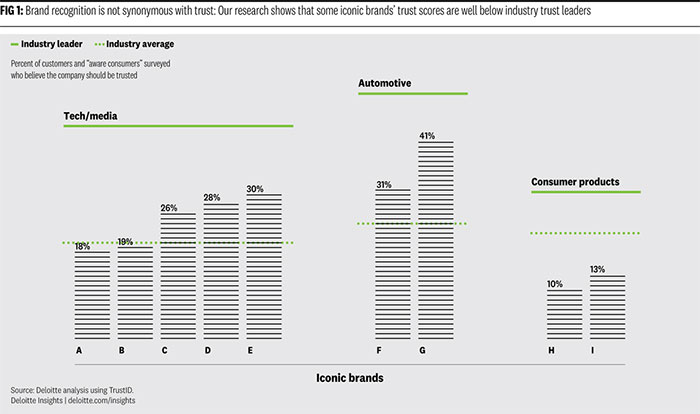
    But iconic brands like Aqua and Nestle regularly show up in annual, high-level trust surveys. While it seems intuitive that large, long-dominant brands with the most customers would also be the most trusted, a study found that many household-name brands fell below benchmark trust scores in many industries (figure 1)—indicating that brand recognition is not synonymous with trust.


    Consumers say that brands’ attempts to engage with them often go wrong when they lack relevance (76 percent) or authenticity (51 percent).


    Regaining brand trust

    While the erosion of trust in recent years presents challenges, brands can regain confidence by prioritizing transparency, authenticity and accountability.


    The need for trust is on the rise. Globally, 71% of people say that it is more important to trust the brands they buy/use today than in the past. (Edelman Trust Barometer 2023).


    By valuing customer privacy, being transparent in communications and practices, aligning with genuine social causes, and consistently delivering quality and value, brands can rebuild trust and establish lasting relationships with consumers. In the era of distrust, brands that proactively address these issues will stand out as beacons of trust, gaining a competitive edge and fostering loyalty in the hearts and minds of their customers.


    But most importantly, they need to be reminded that consumer is not a moron. They are babies who deserve care, not addiction, a plastic-free world, not beaches and playgrounds littered with bottles.


    Kunal Sinha is a senior strategy and foresights executive based in Jakarta, Indonesia. He is the author of several books including The Future of India’s Rural Markets and Raw – Pervasive Creativity in Asia. He writes for MxMIndia every other Monday. His views here are personal.

  • Havas facilitates partnership between Valvoline & LSG

    Havas Play, the specialised sports, entertainment, and content division of Havas Media Network India, has facilitated a tie-up between IPL team Lucknow Super Giants and Valvoline as its Official Lubricant Partner.

    Said Ipshita Chowdhury, Chief Marketing Officer, Valvoline Cummins: “Evidently, cricket holds a significant place in Indian culture, with millions of passionate fans across the country. The IPL, with its colossal viewership and widespread popularity, serves as a prime platform for Valvoline to amplify its brand identity. Partnering with a property as popular as the IPL enables Valvoline to extend its reach to various segments of its target audience, including dealers, mechanics, and other key stakeholders within the automotive industry. The collaboration emphasizes Valvoline’s commitment to quality, performance, and innovation in automotive lubricants. This partnership not only enhances brand visibility but also fosters deeper engagement and loyalty among consumers, solidifying Valvoline’s position as a trusted and influential player in the market.”

    Added Col. Vinod Bisht, CEO, Lucknow Super Giants: “We are thrilled to join forces with a distinguished brand like Valvoline, a true leader in the lubricant market. Valvoline’s unwavering commitment to excellence mirrors our own relentless pursuit as a team. The shared synergies between Valvoline and the Lucknow Super Giants are unmistakable – as we are driven by a common goal of achieving recognition as performance-driven and passionate champions. This partnership, orchestrated by Havas Play, exemplifies the essence of brand relatability and a value-driven proposition.”

    Talking about the collaboration, R. Venkatasubramanian, President – Investments, Havas Media India and MD, Havas Play said: “Leveraging Havas Play’s expertise in experiential marketing and content creation will serve to amplify the reach and impact of this collaboration. By harnessing its proficiency in crafting immersive brand experiences, we will create compelling narratives around the partnership, resonating with fans both on and off the field. Through innovative storytelling and captivating content, Valvoline will cultivate deeper connections with the audience, ensuring that the brand experience extends beyond traditional advertising avenues.”

  • Media.Monks onboards Shouvik Roy

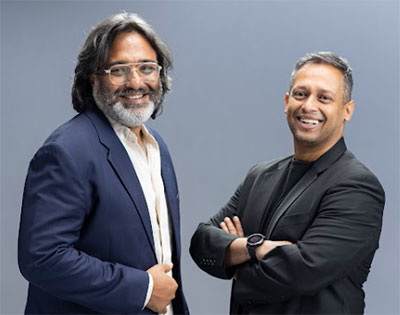
    Shouvik Roy and Robert Godinho

    Media.Monks India has announced the appointment of Shouvik Roy as the leader spearheading business transformation. Roy will be working closely with Robert Godinho, Managing Director at Media.Monks India, who was promoted to drive the company’s renewed focus on growth in the Indian market.

    Said Robert Godinho, Managing Director at Media.Monks India, underscores the strategic significance of Shouvik’s role and said: “Transformative growth isn’t merely a choice but a necessity and Shouvik’s strategic foresight and innovative mindset resonate deeply with our vision for Media.Monks India. Shouvik’s seasoned expertise in fostering boardroom relationships and his proficiency in harnessing data-driven insights tied in with our legacy strengths of Tech and innovations will shape creative solutions and fortify our journey with our clients.”

    Added Matthew Godfrey, EVP, Head of Content, APAC: “In the ever-evolving digital realm, Media.Monks India acknowledges the critical significance of addressing the nuanced requirements of high-value clientele, whose multifaceted demands necessitate tailor-made solutions. Through a concerted focus on this segment, Media.Monks endeavors to reinforce its stature as a top-tier collaborator for brands aspiring to amplify their digital footprint and achieve tangible business objectives. As we further integrate India into the global Monks ecosystem, leveraging the transformative AI capabilities of Flow.Monks and Persona.Flow, we are poised to deliver unparalleled value and innovation on both regional and global scales.”

  • Havas bolsters creative team

    Havas, the creative agency of Havas India, has strengthened its creative team with the appointment of Arjun Jetly, Neharika Awal, Ajitesh Verma, and Monish Gupta as Executive Creative Directors.

    Based out of Gurugram, all four will report to Anupama Ramaswamy, Chief Creative Officer of Havas Worldwide India, and will be responsible for further strengthening the creative offering of the agency.

    Speaking about the appointments, Anupama Ramaswamy, Chief Creative Officer, Havas Worldwide India, said:“Now is the time for our work to shine. And I can’t think of a better team to lead this than Neharika, Monish, Arjun and Ajitesh. I’m delighted to welcome them into the Havas family. They are a dynamic bunch, brimming with new ideas, each having their own individual strengths, which will not just help the brands we work on but also the teams. I believe in their capabilities and mindset to take Havas Worldwide India to newer heights.”

  • Complaint Management: Where bad experiences linger longer

    Complaint Management: Where bad experiences linger longer

    Sanjeev KotnalaWhenever there is a commercial transaction, there is a possibility of a complaint. The processes and responses to handle the complaints by a brand or organisation can transform perceptions, stabilise loyalty, and promote positive repeat purchases and references. However, most brands (including services) do lip-service to the concept. While they may standard operating procedures for complaint management, in most organisations, this department is the hidden face and unwarranted child. Most have a third-party call centre fronting complaints unless they have moved to Bot or IVR-based system, which is a different and equally horrifying story.

    All Complaint Management Systems work on set rules. They have scenario build-up for possible complaints and service delivery issues. The executive fronting the complaints is bound to play by the rule book. They are not expected to think. In fact, diversion from the SOP is not appreciated or encouraged. However, (one hopes) it is considered for future process refinement. The complaint handler is interested in the closure of the issue within timelines as they are evaluated on the number of calls and closures. The calls are mostly recorded for training purposes! Or so it is claimed. And surprisingly at times the complaint management systems suggest crazy solutions to the customer complaints.


    Can’t Find Fault with the Call Centres

    As a consumer, I have many issues and complaints with (some) brands. However, I realise that complaint-handling executives have hardly any leeway or authority to make decisions. Moreover, complaint escalation shows them in a bad light. I aim to register my complaint, hoping someone will look at it and resolve it. In the process, I would be helping the good brand learn and avoid repeating mistakes.

    Sometimes, I question this faulty thinking of mine. 

    Are these call centre executives not representing the brand? Don’t I have the right to a complaint resolution? Whatever the considerations, the interactions affect the customer’s disposition towards the brand and, hence, a critical part of the system.


    Differentiating Experience

    It is not that I have never had an excellent experience in complaint handling or it’s just that I am just a demanding customer. Trust me, a pleasant experience over a complaint or crisis helps create a stronger relationship.

    American Express Credit Cards is one of the brands with excellent timely customer complaint resolution and customer service/relations. The customer-fronting executive genuinely works and aims toward complaint resolution. At least, the impression is that they do, which is important.

    In Central India, at Dinshaw’s (dairy products) from Nagpur, all complaints land up with senior management, and they better be resolved as they are monitored.

    Brands like Make-My-Trip and Indigo (my experience) have good complaint handling. However, they have too many complaints appearing on social media.

    Then there are brands like Axis Bank, which tries to do its best and harness technology interfaces for a better experience. However, the unstable technology or a less than beta version of the apps is not resulting in the best of experiences.

    However, on the other extreme are brands like HappyEasyGo. Tough luck if you have a complaint with them.


    Complaining over Social Media

    A few trigger-happy, fastest-finger-first players use social media as the first port of call for complaint resolution. I believe people pin their complaints on social media when they don’t find a resolution in normal working. And if the complaint is addressed swiftly after it is featured on social media, it is still good as it kills the post. However, customers rarely go back to post a thank you or appreciation post after complaint resolution. I wish more of them would do so that others would know about the actual situation.


    Time To Take Customer Complaints Seriously

    In an idealistic situation, a complaint should not arise. However, as expectations and experiences differ, leading to dissatisfaction and irritation, complaints are a natural outcome. With increased social media interfaces and rising customer expectations in the challenging competitive environment, customers not only expect but demand the best experience and service – which a brand cannot ignore. They do not differentiate between local, regional, MNC, or start-ups. It is time for brands to wake up and take this part of customer complaint resolution far more seriously.


    Net-net

    People don’t buy products; they buy experiences that meet or surpass their expectations. No matter what you are selling, make them always feel better. People remember a bad experience more. They are likely to leave a bad review more than a good review. They will talk to more people about their bad experiences ( 5-10 times) than they will talk about a good experience. The brand has to nudge the customer to talk about a good experience or swift complaint resolution.

    In the new era of democratic voices, emotion and experience sharing, the experiences and the complaint management matter much more.

    ………………………………

    A story of mismanaged complaint handling

    Anupama, a young executive in an MNC firm, stays and works in Pune. Her parents stay in Aurangabad. Recently, on her father’s birthday, she used an urgent delivery service from an online flower and gift service company because she was a day late wishing her father. Forget why she forgot to wish on the day and let’s focus on what happened next.

    She went online- that’s what most people do. Like a new-age customer, she went through the process of ordering an urgent delivery from a reputed company that does flower and cake deliveries. She ordered a simple cake in a flavour that her father liked and a bouquet. She planned to call after the delivery of the make-good products.

    The company called to ask her if yellow wrapping paper would do as they were out of stock in the velvet colour she had chosen. Well, she appreciated their getting back and agreed to a colour change. The company, at this stage, earned a brownie point.

    As the delivery message came on, she called and wished her father.

    And that is when she realised they had forgotten to write on the cake. No message.

    It was the consignment bill that the delivery boy left in duplicate that her father knew who had sent the cake.

    In the phone call, her family told her that she couldn’t remember the date of her father’s birthday and, two, how stupid and careless she was- not to have any message on the cake. Was she so busy that she didn’t have time to add a message: say, dear Papa and wish him a happy birthday?

    It was not the desired experience and not what she was ready for. So she called the company with a. complaint.

    The next day, the front-line executive was all sorry madam- sorry madam for the mistake and then made the blunder of working by the book. The executive offered to send a complimentary cake to her father- this time with a message, not realising that it would amplify the error and make it messy.

    There was no way the diabetic dad was going to have another celebration and bite of the cake. The moment of glory and make-good was lost for the girl. And what was the compensation- well, a complimentary cake.

    Anupama knew there was nothing she could do. However, she made a mental note to refrain from using the company’s services again. She shared her experience on social media and with a few friends at the office. Anupama then deleted the 250 Rs digital voucher the company sent her as a goodwill gesture!

    I don’t know what would/should/could have been the best way to handle the situation. But the complimentary cake was not the right one. Hopefully, the company will review and recalibrate the response for the future.

  • White partners with Rohit Tugnait

    White, the media marketing agency, has announced its partnership with Rohit Tugnait, former Commercial Director of Vice Media Group, to launch ‘White Label’ division to start a new content solution division with the company.

    Expressing his enthusiasm about the partnership Tugnait, who is designated Chief Executive Officer of White Label, said: “Vishesh Sahni (Founder – White) has a clear vision of where he wants to take White as an organisation and what it needs to stand for; which resonates perfectly with what I envision for White Label, so it is a great collaboration together for us. We have got most of the Vice team aboard and are ready to create magic for clients.”

    Speaking on the strategic partnership, Sahni added: “We have grown rapidly as an organisation, by creating some of the industry’s most talked-about experiences. Our profound understanding of culture equips us to offer meaningful, new-to-the-world thinking for our partner brands. Amidst some conscious, strategic moves as an organisation; the next organic step was to round out the integrated marketing approach by bringing Rohit and the team on to start White Label.”

  • MSL appoints Sahil Chopra as COO for Publicis Consultants Asia

    MSL, Publicis Groupe’s strategic communications, has appointed Sahil Chopra as Chief Operating Officer (COO) for Publicis Consultants Asia (PCA).  In his new role, Chopra will be responsible for strategic guidance and oversee delivery of core services to client organisations in the entertainment, consumer and technology sectors. Chopra was until recently Vice-President for Marketing and Communications at Stanza Living.

    Said Amit Misra, CEO, MSL South Asia: “I am super excited to have Sahil join our team back. This appointment is strategic to our business needs at MSL, aimed at accelerating very specific communication and business needs of our clients. I am certain that Sahil will drive modern business communication impact and lead Publicis Consultants Asia to newer heights.”

    Added Viju George, Managing Director, PCA: “Category leaders operate in high-velocity environments and have a very specific way of working that requires specialists to meet their communication needs as these are tied to business outcomes. I am confident that Sahil has the understanding, the commitment to serve diverse needs of client organizations, and I am pleased to have Sahil a part of our team.”

    Chopra, as per his LinkedIn profile, worked with MSL for a little over two years — from June 2016 to July 2018.

  • Drone Destination appoints Dentsu for PR

    Drone Destination has announced its association with Dentsu Creative PR as its official public relations ad investor relations agency. The account will be managed from Dentsu’s Gurugram office.

    Commenting on the association, Sanjeev Anand, President, Dentsu Creative PR said: “We are excited to announce our partnership with Drone Destination. As we embark on this exciting chapter alongside Drone Destination, we are poised to set a new standard of collaboration that stands as a testament to creativity, innovation, and the pursuit of shared success. This strategic collaboration will allow us to service the company with our strategies and innovative ideas that resonate with Drone Destination’s vision and objectives.”

  • Goafest 2024 unveils theme

    The Advertising Agencies Association of India (AAAI) and The Advertising Club have announced the theme for Goafest 2024 – ‘The Age of Adaptability’. The three-day fest is scheduled to take place from May 29-31 at Westin Powai, Mumbai.

    Said Jaideep Gandhi, Chairperson of the Goafest Organising Committee: “The theme for Goafest 2024, ‘The Age Of Adaptability’, was chosen to reflect the current ethos of our industry. Adaptability is at the core of what we do – from adjusting to new media platforms to adopting innovative marketing strategies,” adding: “This festival will not only celebrate creativity but also the ability to pivot and thrive amidst challenges.”

    Added Rohit Ohri, Chairperson Goafest Content Committee: “This year, at Goafest 2024, our central theme ‘The Age of Adaptability’ has a chameleon as a mascot. The chameleon is a creature known for its remarkable adaptive prowess. Like the chameleon, which adjusts its colors to match its environment, our industry too must continuously evolve its strategies and creative approaches to thrive in changing landscapes. This year’s festival will celebrate and cultivate the chameleon-like ability to adapt swiftly and effectively, ensuring our practices remain on the cutting-edge of creativity and relevance. The Age Of Adaptability concept has been created and designed by the young and very talented team at Abnormal Design Studios.”

  • Kulfi Collective appoints Divya Karani as Chairperson and ED of its Board

    Kulfi Collective has announced the appointment of senior adperson Divya Karani as Chairperson and Executive Director of its Board. Most recently, Karni was the CEO of Dentsu Media, South Asia, where she led the agency for over 12 years.

    Kulfi Collective, through its three divisions, Supari Studios, Post Office and Keeda Media, has partnered leading brands and platforms such as Spotify, Red Bull, Netflix, Lego, Flipkart and Zomato to deliver content, experiences and IPs that shape culture.

    Said Advait Gupt, Co-Founder & CEO of Kulfi Collective:”Divya joining the board will help us build the right governance frameworks as we scale globally. Further, her deep expertise will help us build upstream capabilities to bring brands closer to communities and subcultures in music, sports, gaming, entertainment and lifestyle.”

  • Manish Anandani speaks at IAA & ISA’s Retrospect and Prospects

    The India Chapter of the International Advertising Association (IAA) together with The Indian Society of Advertisers (ISA) hosted the IAA & ISA Retrospect and Prospects with Manish Anandani, Managing Director – India, Kenvue (eka Johnson & Johnson Consumer Health) on April 24 in Mumbai.

    In his address, Anandani said: “The Indian FMCG industry has been a key driver contributing to India’s buoyant economy. There have been many factors like a young dynamic India, increasing urbanisation and a rising middle class which are presenting tremendous opportunities for the industry to pivot and scale. Today, we are seeing ‘Many India’s’ with many consumer cohorts, making it imperative for brands to design personalised, customised and immersive campaigns to better engage with these audiences. We are also seeing big shifts in consumer behaviour, with sustainability, purpose, and transparency being prioritised by the conscious consumer . These aspects will continue to shape the marketing agenda. We are excited about these opportunities and what it presents for our iconic brands such as Johnson’s Baby, Stayfree, Neutrogena.”

    Added Avinash Pandey, President, IAA India Chapter and CEO, ABP Network: “IAA has always been at the forefront of activities that benefit the marcom industry. Whether it be the leadership awards which are for the marketers, to having an all advertising jury for our successful creative awards called IndIAA to having an annual programme named the Retrospect & Prospects where a leading marketer gives a perspective of the high and lows of the last year and some crystal ball gazing about the year ahead, we have always done path-breaking initiatives.  And so, in that spirit we have also saluted collaborations and cooperation and had the first IAA and ISA program. I am sure this model will be appreciated and emulated in other programs as well.”

    Said Sunil Kataria, Chairman, The India Society of Advertisers and CEO of Raymond’s Lifestyle Business: “An insightful presentation by Manish Anandani in retospect and prospect session , dwelling  into macro and micro opportunities of the India growth story driven by GDP, demographics, customer sentiments, rapid digitalization, evolving shopping &  consumption behaviors has thrown interesting light on the possibilities ahead. I am confident that our audience from IAA and ISA would have immensely benefited from the session today towards gearing up for the future.”