Category: ADVERTISING

  • A wishlist for Advertising, Marketing, Media & More


    By Sanjeev Kotnala


    Sanjeev KotnalaIt is that time of the year, the first week of the new year, when your resolve not to break a resolution will be tested. Most will fail unless they have no resolutions. I pick my unfulfilled wishlist from the last so many years and lovingly look at it. I have repeatedly failed to find ways to nudge people into helping me. I need the help, as the intent and wishes don’t count, and they mostly need collective initiative.

    My dear friend and mentor, Vermajee, is still recovering from the hectic new year celebrations. He is back from his vipassana experience and promises to share something in the coming weeks. The wait is going to be worth it.


    WISHLIST

    So here is the wishlist. It is advertising, marketing and more, and you are free to discard it or try acting and helping out on at least one front. Trust me, it will make a difference.


    NO FREE PITCHING

    Pitching for business is an integral part of agency life. It is costly and sucks on agencies’ time, efforts and resource deployment. Focussing on it defocusses the agency from existing businesses.

    The brands laugh all the way with new ideas and solid research. Many brands continue to work with the incumbent agency making a mockery of the process.

    I wish agencies start charging a fee for pitching. And the pitch must result in a change of agency.


    INVEST IN CREATIVE DEVELOPMENT

    I have worked with clients who understand the importance and significance of investing in the creative development process in terms of time, effort and funds. They don’t undernourish the creative process to further invest in media and reach.

    Simply put, a better creative needs fewer exposures, thus saving funds and time. It is a different question of why any brand should be willing to expose mediocre creatives that work against the brand in the long term.


    AGENCIES MUST PARTNER WITH THE CLIENT

    The days of agencies being genuine brand custodians and strategic partners are over. The business is tricky, and consultants, advisors and strategic firms have made inroads. The lowest fee syndrome is a reality, and margins are wafer-thin, resulting in exodus and the absence of new talent.

    It is tough to expect the agencies to stop second-guessing the client or delivering what the client wants.

    The respect is lost, and I wish there were ways to win it back.

    At least tell the client what you really think and recommend.

    If the client wants to waste their resources, your drain is as good as any other. However, you still need to decide if you are willing to be a party to this wasteful non-strategic investment from the brand.

    I am hopeful. I know a few agencies that are very clear about what they want to do.


    ASCI IS DISBANDED

    My biggest wish is that the industry has no need for ASCI. And for that to happen, the brand owners and agencies must unite to voluntarily self-regulate. However, I know that prominent brands and repeat offenders will continue to test ASCI guidelines and reactions. We will have new and fresher guidelines before we have foolproof ways to implement the earlier guidelines.


    DIGITAL SPACE LEADS WITH RESPONSIBILITY

    Hopefully, digital and social media will act responsibly. They will do moment marketing with due permission and checks. They will keep the social, cultural, regional and religious sentiments in check. The disclaimer for paid (in cash or kind) associations will be prominently displayed. The warnings and statutory requirements are adhered to and not just executed for the legal framework.


    TRADITIONAL MEDIA FINDS A NEW LEASE OF LIFE

    Traditional media – print, radio, outdoor and television have much more to offer. Someone must work to ensure effectiveness and not just adapt the digital initiatives. Brands can benefit if the agency, client and traditional media work with rationalised rates.

    However, I believe the steady skew towards digital media will continue without many knowing how best to exploit it. Just like the investment in traditional media will decrease, with no one really trying to develop the right creative to enhance efficiency and effectiveness.


    CELEBRITY ENDORSEMENT IS NOT THE IDEA

    Celebrity endorsement seems to be the easy way out for the brands. And for some, the only way out. For many regional brands, it means credibility and a demonstration of success. Unfortunately, the audience consumes it accordingly, and brands keep using celebrities as the idea.

    I have nothing against the rightful use of celebrities or using celebrities as a character. But can we look beyond celebrities or at least use them in the right context and way.


    SOCIAL MEDIA FOR APPRECIATION AND HARMONY

    Social media is full of hate and fake stories. One does not know what to believe or disbelieve. Digital algorithmics keeps serving things one loves to read and react to, thus continuously narrowing thinking. Help make social media a good place to be. Appreciate and share things of community harmony and goodness whenever possible and don’t just react and forward things that you have reason to doubt.


    ONE NATION, ONE LAW

    The most challenging thing to expect. The nation really needs it. Every citizen must be governed, controlled and motivated by the same rules and regulations. Then true secularism will emerge; otherwise, we will continue to see growing communal distrust and hatred.


    RETURN OF PRIVACY. 

    We have sold our souls. We have given all the permissions, and the digital media is busy listening and watching us. The concept of privacy is dead. We are addicted to what we get by selling our information, reactions, location, dreams and desires.

    As individuals, we cannot do anything, and we cannot get out of the system.

    The government and consumer activist groups need to come in. We need stronger privacy laws.


    STOP WASTEFUL GOVERNMENT ADVERTISING

    There is no justification for the multiple full-page advertisements and the poorly produced AV by state governments in print and TV. There may be logic for intra-state advertisements, but hardly any for ads in other states. Even in the state, achievements, plans and projects are covered in the same media. There is no need for money-guzzling advertisements.


    PET-FRIENDLY SOCIETY

    I know how badly we behave and treat pets and animals. Yes, some people are afraid of them, and there are issues. But, instead of using them as an excuse, we must address them. We are responsible for them all, be it the dog, cat, cattle or any animal.

    If you have experienced a pet, you can appreciate changes in the family. How loving and caring becomes a natural behaviour. How pets help closely knit the family.

    Go experience it, and your thinking will change. Think again before raising issues and discussing how we treat pets and animals.


    KNOW YOUR CULTURE, RELIGION, RITUALS AND PRACTICES.

    If the generation next does not know about religion, region, language, culture, rituals and practices. In that case, we are responsible for it. I wish every religion would educate the next generation.

    I have been running #IgnorantHindu blogs to share knowledge and information on Hindu festivals, mythology, rituals and practices. Every practice does not need scientific explanations or logic, and you don’t have to be defensive about your religion. But you must allow everyone to follow their religion without discomforting anyone and following the land of the law.


    NET-NET

    I have too many wishes and know most of them will go unanswered. Nothing would change, even if all of the above were answered. However, I will make efforts from my side. At least open the discussion and perhaps influence and nudge someone towards my idealistic society. It will make a minor difference, but a difference.

     

  • Hypertext Marketing: A Semiotics Viewpoint


    By Ashoke Agarrwal


    Ashoke AgarrwalThe interactive ability of digital and social media has given rise to the concept of Hypertext Marketing. Hypertext Marketing differs from traditional integrated marketing strategy in that it not only integrates a single brand message across multiple media but also draws upon interactive platforms that modify and generate new brand messages.

     

    The integrated brand strategy and management school gathered momentum in the late seventies and early eighties of the twentieth century. It began with the outmoding of Vance Packard’s famous persuasion model of marketing and the resultant “hidden persuader” school of advertising. Instead, brand strategy and management took on a consumer-centric focus on meeting consumer needs rather than manipulating consumer minds through artful advertising.


    This evolving school of marketing then further challenged the notion that rational forces and metrics drive markets. This evolving understanding of consumers, market and culture led to the Marketing Semiotics paradigm.


    Semiotics focused on the role of emotion and creativity in consumer decision-making and on applying these insights to the strategic planning process.


    Marketing Semiotics focuses on three dynamics – a) the semiotic space defined by the product category, b) the relative positions of the competitive brands in this space and c) changing cultural trends that might affect the semiotic space and the positions of brands within this space.


    The dynamic interaction between cultural norms, marketing action, and consumer interaction defines the dimensions of a category semiotic space.


    For example, in formal Western menswear, research in India has shown that two dimensions define the semiotic space – the Elite-Accessible dimension, Trendy -Traditional. In traditional analysis, this leads to four quadrants for available brand positions – Elite and Trendy. Elite and Traditional, Accessible and Trendy and Accessible and Traditional.


    In semiotic analysis, even the negatives of each dimension – Not Elite, Not Accessible, Not Trendy, Not Traditional are considered -leading to ten quadrants of positioning space to be explored. This approach allows for a) more positioning options to emerge, b) for more dimensions to emerge and c), over time, better track cultural shifts affecting the semiotic space as well as brand positions.


    Semiotics can lead to more effective marketing communication. In the communication context, marketing communication is defined by its formal and cognitive properties as a medium of consumer persuasion. Semiotics, however, defines marketing communication from the marketing context – as a vehicle for sustaining brand positioning over time, maintaining its competitive distinction and aligning brand message with cultural change.


    To sum up, Marketing Semiotics is an approach that creates and builds brands as an integrated and interactive part of the product category code and the broader cultural code within the competitive framework and responds to category and cultural code changes over time.


    Combining Hypertext Marketing with Marketing Semiotics allows integration with the ability to respond to interactive platforms.


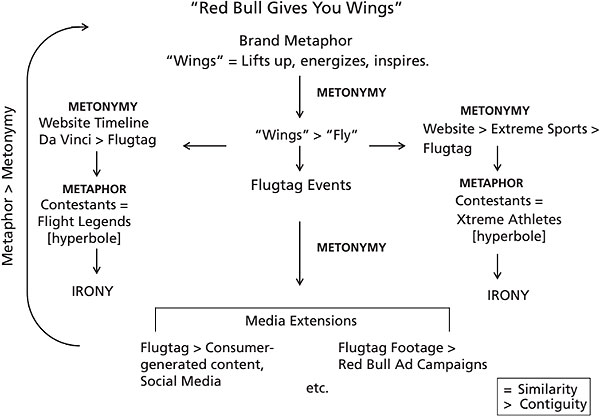
    In her book “Creating Value: The Theory and Practice of Marketing Semantics Research, “ Laura Oswald gives an example of the integrated use of Marketing Semiotics in Hypertext Marketing by Red Bull.


    Red Bull used the brand metaphor of “Wings” to signify its core benefits of “Lifts, energises, inspires” and fashioned the advertising theme of “Red Bull Gives You Wings”.


    Red Bull decided on the brand tone of “irony” because humor was the most engaging content genre with its core target audience – the young. And within humor – irony had the most upmarket appeal.


    Red Bull consolidated its functional position with its consumers by sponsoring extreme sports and high-energy cutting-edge rock music. However, in the Hypertext Marketing context, it needed to find an interactive platform that resonated with its ironic advertising and enhanced the brand’s chosen persona. It did so with the Flugtag events. The basis of Flugtag events was the concept of giving human wings – literally. The event invited teams to build a flying machine solely powered by humans and then demonstrate these at the event by flying over a water body. Most flights lasted less than a minute, with the spectacle of the contestants crashing harmlessly into the water. After a Flugtag event, social media would light up with user-generated content based on videos of the event. The zaniness of the Flugtag event, the ironic advertising on the theme “Red Bull Give You Wings”, and its sponsorship of extreme sports and rock music allowed Red Bull to build and nurture a formidable brand that was equally strong on the functional and emotional dimensions.


    Chart from “Creating Value: The Theory and Practice of Marketing Semiotics Research” by Laura Oswald


    In my decades in the Indian advertising world, I have seen much change. When television emerged as the primary media in the late nineties, the lingua franca of Indian advertising changed from English to Hindi and other Indian languages. Today as the focus of Indian marketing shifts from mass media to digital media, from linear TV to connected TV, from brick-and-mortar to omnichannel, and from Gen X to Millennials and Gen Z, the process of marketing and marketing communication strategy making needs to shift. Many consumer behavior models that today form the basis of marketing and advertising strategy need to be updated. We need to audit and continuously reframe our understanding of the semiotic and cultural spaces that constitute the operational matrix of our products and brands. Finally, we need to reinvent market research from the silos of quantitative and qualitative, ad hoc and syndicated, and move to a more strategic form of analysis and research that integrates across all marketing mix elements and time.


    We must also know and act on the actual value of digital and social media emergence. Most brands across categories solely base their digital and social media strategy on the paradigm of better and more fine-tuned targeting. The big unexploited opportunity that digital and social media platforms offer brands is Hypertext Marketing, which creates a virtuous, brand-building cycle between the brand and the consumer.


  • ASCI extends the deadline for feedback on Dark Patterns to 16th January 2023

    By Our Staff


    The Advertising Standards Council of India (ASCI) recently published a discussion paper titled ‘Dark Patterns in Advertising’ highlighting how certain UI/UX deployed by digital platforms could manipulate consumer choices and consumption patterns to the detriment of consumer interest. The self-regulatory organisation had invited public feedback and comments on the recommendations of the discussion paper which will help ASCI extend its self-regulatory code on objectionable ads to cover dark patterns too.


    Now, ASCI has extended the deadline for the feedback until the 16th of January 2023 based on requests it has received from a few organizations. Submissions by any member of the public or any organization public can be sent to contact@ascionline.in


  • Lowe Lintas wins mandate of brand Lifestyle

    By Our Staff


    Lifestyle, fashion retail company, appoints Lowe Lintas to manage its creative duties. As a part of the partnership, Lowe Lintas Bangalore will be responsible for the brand building mandate of the parent brand Lifestyle and its in-house brands (Ginger, Melange, Code, Forca, Fame Forever, IKSU, Kappa, Bossini, Smiley and Juniors).


    Speaking on the partnership, Rohini Haldea, AVP & Head, Marketing – Lifestyle said: “We are delighted to onboard Lowe Lintas as our new brand building and creative partner. Their sound strategic thinking and path-breaking creative capabilities, combined with fashion expertise make them the perfect partner to lead Lifestyle. With this partnership, we look forward to creating inspiring, and impactful work that lead the consumer and take Lifestyle to the next level of engagement and growth.”


    Commenting on the win, Sonali Khanna, President and Head of Office – South, Lowe Lintas added: “While online shopping ruled during the pandemic, people are keen to return to a more visceral in-shop experience. But the plethora of choices available today, both offline and online, has made it imperative for brands to go beyond the obvious. Merely providing on-trend products or a captivating shopping experience is just not enough; brands have to connect with customers through a deeper meaning by taking a powerful stand that is both inspirational and aspirational at the same time. Lifestyle has always enjoyed a special connect with its consumers, and we believe our new work will stir their souls and reignite their imagination. By focusing on the stand of the Lifestyle brand, we are confident of lifting the Lifestyle experience to even greater heights.”


  • Dentsu appoints Sapna Arora as Chief Client Officer

    By Our Staff


    Dentsu India has announced the appointment of Sapna Arora as Chief Client Officer (CCO).


    In this role, Arora will continue to enhance integrated solutions for existing and prospective clients and drive growth for the network. She will report to Rob Gilby, CEO APAC, and work closely with the leadership as well as teams across Creative, Media and CX.


    Prior to this, Arora was with OLX India as CMO, PRO, Brand Head – Emerging Markets.


    Commenting on the appointment, Gilby said: “We are in a very exciting phase of our evolution with a clear vision and strategy and I am delighted we continue to attract the best industry talent to join us and share their expertise. This is what makes Sapna the ideal fit for today’s Indian dentsu! She brings incredible global expertise that will be invaluable in cultivating pride, employee advocacy, and a sense of collective purpose that will strengthen dentsu India’s reputation among key stakeholders. I would like to extend a warm welcome to Sapna and look forward to working with her.’


  • Second edition of ‘I Lead’ survey alunched

    By Our Staff


    We have our views on the Women’s Chamber of Commerce and Industry but must say that its PR & Digital Marketing National Council, one of the 150-plus Councils the association has, is superactive. The Council has launched the second edition of the ‘I Lead’ Women Leadership Survey. The Advertising Agencies Association of India (AAAI) and Public Relations Consultants Association of India (PRCAI) have joined hands with WICCI to support this survey, notes a communique


    Prof Akshaya Vijaylakshmi, Associate Professor, Marketing, Indian Institute of Management Ahmedabad (IIMA), has been onboarded as Knowledge Partner for the initiative. Said Prof Vijaylakshmi: “We talk about how it takes a village to raise a child but what we also need is an organization to come together to help a mother not just stay at work but also succeed and grow in the firm. This is just one example. The ‘I Lead’ Women Leadership Survey by WICCI aims to get a wholesome understanding of what organizations are doing to help women thrive. This survey is the much needed roadmap that we need for the future.”


    Announcing the launch of the survey, Kavita Lakhani, National President of WICCI PR & Digital Marketing Council said, “It is a known fact that gender equality is key to unlocking greater chances for women to prosper at leadership positions. Through the ‘I Lead’ Women Leadership Survey, we will attempt to understand from CXOs of communications firms firstly on how much they believe in providing equal opportunities, equal respect and equal empowerment.  Secondly what is their formula for an equal future – specific programmes, partnerships and policies within their organization – all designed to support women and to break down any barriers to recruitment, retention, development and leadership.” The  survey can be taken on mobile.  The survey link www.enswype.com.


  • Effectiveness ladder of purpose-led branding in life and business


    By Sanjeev Kotnala


    Sanjeev KotnalaFinally, last Sunday, I visited my dear friend and mentor Vermajee at his Mumbai residence. Last week, he returned from one of the ashrams in Uttarakhand after completing a meditation course that started on December 25, 2022 and ended on January 4, 2023. He was feeling fresh but was not opposed to some drinks in the evening, and the mood was sombre and purpose-led.

    Lintas sent me to a short four-day yoga meditation at Lion’s den Lonavala in the mid-1990s. By Day 3, I was talking to rocks and flowers and ready to leave. I poked Vermajee by telling him that maybe he was now enlightened with a purpose in life and that he had a direction.


    Simplifying Purpose.

    Vermajee spoke. You watch cricket, and you would have watched a purposeful Australian cricket team trying to win against a South African who suddenly realised they had a purpose too. Maybe they were inspired by the suddenly purpose-led Pakistan cricket team on the last day of the test match with New Zealand. The goal of every team is the same. To win and not to lose- to engage their fans. The intent may be stronger if the test series championship is at stake. The strategies and the format may differ, but the purpose remains the same.


    THE PICTURE WAS GENERATED BY DALLE.E


    Purpose In Life.

    Similarly, we all have the same purpose in life. To live by Dharma and keep improving with time by natural evolution or individualistic drive. To repay our debts. The ultimate purpose is Salvation- Mokasha– Nirvana. It is as simple as that. It’s what every enlightened person and preacher has been saying. Do good. Do live and let live. To not only be seen as a good Smartian, a person with Dharma, honesty, love and care, and to behave like one. And being a better person than you were yesterday is the simplest way. Don’t you always send wishes to friends, ‘May your today be better than your tomorrow’. You just need to tweak it a bit. Say, ‘May you be better than what you were yesterday’, and the wishes will not only have a better meaning but a great direction- however, many may not understand and appreciate this change.


    Probing Purpose-Led Business.

    I knew Vermajee was oversimplifying the whole discussion, and it was time to throw a bait and get the maximum out of it.

    I poked further. That would mean that every purpose-led business, brand, and service must have the same purpose. Then what is there with all these purpose-led design and communication purpose-led brands?

    Vermajee smiled, and that smile said that he had been thinking about the subject. He countered, why should it be different for the business.?


    Purpose And Business.

    Vermajee continued, and I started soaking in the Gyan.

    The business purpose is growth. Brand purpose is to create better services and products at a lower and lower cost. What they change for you is the individual company’s outlook. And the purpose of it is to create preference. To evolve with time and adapt to the changing needs, demands, desires, aspirations, and expectations- thus giving the experience that is better than expected. Simple, that is the business purpose.

    There is nothing much to it. Consultants, agencies and researchers are trying to find a purpose for their brand, company, product or service. It is a business purpose, their business purpose. People who don’t understand, explore and realise their life’s purpose are telling the company what its purpose should and could be.


    You Don’t Force A Purpose.

    You start with a purpose, and there is nothing wrong with it. There is even nothing wrong if the purpose gets tweaked with time as it reflects the flexibility and agility of the company. But you don’t create a purpose. However, you may discover a purpose. It is simple: you may have a purpose or don’t. And it is fine if you understand the overall macro purpose of business.

    I have told you the business purpose from a consumer point of view. There is another purpose, which is creating wealth for the stakeholders. Remember, most will replace stakeholders with shareholders, but that is a myopic view. Stakeholders are a broader ecosystem, including Government, business associates, the category, and the consumers. The wealth could be intrinsically monetary and could be emotional.


    Purpose-Led, Purpose Less, Without Purpose And Faking A Purpose.

    Well, it’s the best situation if you have a purpose that defines and directs your decision. And that you are always true to it. It is more demanding than discovering the purpose. But not having a unique purpose for your company, brand and service is not wrong. Purpose does not make a company better or superior unless the company understands the growth, wealth and preference creation purpose of business. Like in life, many of us may not have a defined purpose, but we don’t lead a purposeless life. They are two different things. Such people may be more healthy, emotionally wealthy, and happy.

    The problem is when one fakes the purpose. When one forces a purpose or tries to define everything around a purpose. Where purpose is a mask and not a reality. Or when a purpose is a tool for perception creation. There may not be much wrong, but a fake purpose does not last. All fake purposes are campaign able and time-bound. They are a drag on the company after some time. One gets constrained and controlled by them, and getting out of it becomes tougher and more challenging with time. Because such a purpose does not align with the purpose of business, I shared it with you.

    Many brand or company purposes sold by consultants and agencies, like gender neutrality, wokeism, inner beauty, equality, and saving the world, based and sustenance-led green purposes, are just a mask. They are bound to fail as they are fake and not aligned with the real business purpose of growth, constant improvement and being future-ready.


    Without Purpose A Safer Bet For Brand And Companies

    With a twinkle in his eyes and a self-satisfying smile playing on his lipsVermajee could read the dilemma I was facing. He clarified for my benefit.

    It is better to be without a purpose than to fake a purpose. Faking a purpose is adharma in business. Doing anything for your benefit, manufacturing a purpose, and doing anything not aligned with the business’s long-term purpose is adharma.


    Archetype Masking

    Vermajee continued. I am not saying that the company should not try to explore or discover the purpose. But before adopting it, they must adapt to it across their internal landscape. Understand how the same person wears different masks while interacting with various stakeholders and how that is confusing and detrimental to a uniquely defined image.


    Net-Net

    Vermajee looked at me and continued to sum up the discussion.

    You should understand it is like the archetype-based purpose discovery workshop you do. Or the multiple archetype masking discovery you do for the organisations to align everything towards the same objective, knowing fully well that the objective is a mid-milestone and sometimes masquerades as a purpose.

    Everyone is happy as they discover something collectively which seems to work. But, I will iterate and say it is better to be without a defined purpose than to fake or force a purpose. And defining the purpose is a responsibility of Senior management- How to do that, you understand.


  • Wunderman Thompson India appoints Rajeshwari Rao as Sr VP and ECD

    By Our Staff


    Rajeshwari Rao has been appointed as Senior Vice President and Executive Creative Director (ECD) at Wunderman Thompson India effective 9th January 2023. Based out of Mumbai, Rao will be the creative head on the agency’s Unilever’s business in addition to several other important businesses. Rao’s appointment comes at a time when the agency is strategically looking at bolstering its creative leadership team.


    Rajeshwari will report directly to Anurag Tandon, Managing Partner, Wunderman Thompson Mumbai.


    Commenting on Rajeshwari’s appointment, Anurag Tandon said: “Rajeshwari’s appointment comes at a time when we are looking at strengthening our creative output. We are glad to onboard her at this critical juncture when we are upping the ante on our work. With her vast and and varied experience, Rajeshwari will surely play a pivotal role in understanding the client’s business and translating it into great creative work.”


    On taking up her new role at Wunderman Thompson, India, Rajeshwari Rao, added: “I’m excited to be taking on this role and looking forward to create some good work with the incredibly talented and dynamic team at Wunderman Thompson India. Wunderman Thompson is a legacy agency that commands a formidable standing in the industry with an enviable client roster of long standing relationships. The agency is on an exciting growth trajectory and I am thrilled to be part of their journey.”


  • ASCI releases report on advertising in the EdTech sector

    By Our Staff


    The Advertising Standards Council of India (ASCI) released a comprehensive report on advertising in the education technology sector (EdTech) and the impact it has on parents and students. The report aims to decode the challenges and opportunities for EdTech sector advertising. The report also identifies ways in which the sector can shape a more responsible narrative, and move away from opportunistic advertising which many consider problematic.


    EdTech as a sector holds immense promise in being able to address the infrastructural and learning challenges in India, hence it is critical that the advertising of the sector does not undermine its potential. The study, done with the active participation of both industry and non-industry stakeholders identifies opportunities and challenges and proposes a framework that could guide advertisers to more balanced advertising.


    The EdNext study was undertaken by ASCI with Sprint Studio.ai as the research partner and UNICEF as the knowledge partner. A total of 100 EdTech advertisements across print, TV, digital video and static mediums were analysed by a wide set of stakeholders including parents, students, policymakers, educationists, child development experts, as well as representatives of the industry from the marketing and creative fields. The study was conducted across the cities of Delhi, Bangalore, Indore, Kanpur, Patna, Kolhapur, Warangal and Bardhaman.


    The analysis revealed that:

    Ads have a huge impact on parents’ choice of EdTech platform, with 49% of parents choosing platforms based on advertising

    Like traditional education ads, Ed-Tech ads too, have a huge focus on marks and ranks. Math and science dominated the subjects depicted

    While 81% of parents trust EdTech ads, 73% felt that ads showed high pressure of studies

    None of the endorsers/ role models were from the academic field

    Stereotypes of gender, physical appearances, and mother’s roles crept in to these ads

    The findings also noted some positives. Some of the key positives identified were:

    Ads featuring parents represented them as supporting partners to students, and thereby provided positive role models for progressive parenting (21 out of 23 ads)

    Parents and experts also felt that ads that focused on conceptual learning were progressive and enjoyable


    The EdNext study proposed a framework to elevate the communication around EdTech mindfully. Titled ‘RAISE’, the framework provides stakeholders a set of lenses to evaluate the creatives and develop messages that could be considered more progressive. Following the checklist guide provided in the framework will help marketers and creative experts review concepts at the inception stage of the ad itself.


    The framework is based on five principles which include:

    R – Relationship of the student with learning

    A – Authenticity of situations, promises and claims

    I – Inclusive representation of characters to depict diversity in gender, age, physical attributes, personality types, learning styles and pace along with regional inclusion

    S – Spectrum of pedagogy where there is information on learning methods and how they contribute to holistic learning outcomes

    E – Excellence markers to focus on overall development as a measure of success over ranks and marks


    Manisha Kapoor, CEO and Secretary General, ASCI, said: “EdTech has emerged as a very important sector in recent times, especially in the pandemic era where parents engaged with these companies to supplement their children’s education. Ed-Tech has the ability to solve some fundamental infrastructure and content challenges and revolutionize Indian education. However, given the particular asymmetry between vulnerable parents and students on the one hand, and large organizations on the other, it is critical to ensure that advertising is responsible and does not exploit these vulnerabilities. EdTech advertising has a massive opportunity to build a positive and future-facing narrative, which makes for compelling brand stories that also build confident and multifaceted learners.”


    Mayank Kumar, Chair at Indian Ed-tech Consortium, and Co-founder UpGrad added: “The EdNext report shines light on the sheer scale of the EdTech sector and highlights the need for raising the bar on advertising in the industry along with providing a roadmap on how that can be achieved. The report also shows huge acceptance of the benefits of EdTech products by students, parents and teachers. The in-depth research we undertook along with ASCI will help the industry get a clear picture of how the sector can benefit through responsible advertising, which it is already constantly working towards.”


    Divya Gokulnath, Co-chair at Indian Ed-tech Consortium and Co-Founder BYJU’S said: “The EdNext report highlights that almost all parents are appreciative of the ads which show children enjoying the process of learning, which is something we live by, work for, and showcase in our ads. We prioritize building strong and sustainable relationships based on first principles. While it’s natural for advertisers to highlight the best outcomes achieved by their users, the EdTech industry strives to present a balanced picture at all times. As a nascent industry that is constantly evolving, we must adapt in our effort so that we can make learning effective for everyone. This initiative by ASCI will help us design even more responsible and effective ad campaigns as we continue to grow and improve.”


  • It’s Effie night tomorrow!

    By Our Staff


    The Advertising Club will conduct its annual Effie India Awards 2022 tomorrow, Friday, January 13 at the Taj Lands End in Mumbai, 6.30pm onwards. Effie awards, as we know, are awarded for advertising effectiveness.

    The Effie Awards Effie Awardsis being conducted for the last 22 years, and this year, the Advertising Club reports receiving 986 entries from 53 agencies participating. With 300 marketing professionals and 193 media professionals and planners, Effie 2022 had 493 jury members in all.

    Partha Sinha
    Partha Sinha

    Talking about this year’s Effie, Partha Sinha, President, The Advertising Club, said: “The Advertising Club is a proud advocate to brands and agencies that create impactful innovations. It has been a long pause and we are excitedly expecting to witness some amazing work receive recognition and appreciation. This year at Effie India Awards, we are looking out for meaningful work that reflects effectiveness and efficiency. We are ecstatic and cannot wait to watch the category torchbearers and their work being celebrated at the industry’s most coveted awards event.”


  • Dentsu India releases report: ‘Adoption of XR technology in India’

    By Our Staff


    Dentsu India has released its latest research report titled ‘Adoption of XR technology in India’. The report has been created in collaboration with Recogn – Dentsu India’s research division, and Digital Behaviour Initiative – started by Dr Sumitava Mukherjee at IIT Delhi.


    Digital Behaviour Initiative aims to work as a non-partisan academic research-based information tank in India that engages and informs the public about key aspects of human behaviour or cognition in the digital world. The report has been jointly designed by Dr Sumitava Mukherjee from IIT Delhi and Dr Payel C Mukherjee from IIIT Delhi.


    The report discusses the various aspects of immersive XR technologies that will change the face of business and improve customer experiences. It also addresses consumer attitudes toward extended reality technologies. Additionally, it delves into how businesses can align themselves to implement these technologies in their operations, processes, etc.


    The launch of 5G services in India has only added to the digital landscape’s boom. This is a defining moment in the ease of doing business and will revolutionise the digital sector. It will boost the Indian economy and reform industries such as agriculture, healthcare, education, logistics, transportation, and fintech. 5G services will significantly improve the nation’s digital ecosystem and usher in the next phase of the industrial revolution.


    The initial purpose of using a VR device for users was entertainment like attending concerts, watching movies, or playing games. The level of detail in the Metaverse combined with the ability to network in one platform is set to alter the course of human interaction. The most important aspect of moving on to this phase would be hardware in the form of virtual reality headsets. XR technologies including Metaverse, and VR devices will herald a new era of experience. Businesses will need to raise awareness and develop robust use cases to move customer adoption of this technology from novelty to necessity.


    Simi Sabahaney

    Commenting on the report, Simi Sabhaney, Chief Growth Officer, Dentsu India said: “In the Indian context, an immersive technology such as extended reality needs to gain widespread adoption across multiple sectors , in order to improve efficiencies, collaborations, and innovation. Introduction of 5G services in India, heralds new opportunities. Furthermore, immersive experiences will push us beyond the edge. Investments in this technology will accelerate adoption and innovative applications. The growth of metaverse will boost the adoption of extended reality, and together they will play a role in solving real-world problems. Brands should fast-track their focus toward incorporating these technologies into new strategies to lay a solid foundation for the internet’s future.”


  • Binodan Sarma joins DDB Mudra Group as Head of Digital – North

    By Our Staff


    DDB Mudra Group appoints Binodan Sarma as Executive Vice President – North. In this role, Sarma will lead the digital business for both DDB Mudra and 22feet Tribal Worldwide for the Group’s Gurugram office. Sarma’s appointment will be instrumental in inspiring the teams and clients to visualise digital as an ecosystem to deliver full funnel marketing solutions.


    Speaking on Binodan’s appointment, Ashutosh Sawhney, Managing Partner – North, DDB Mudra Group said: “DDB Tribal – the amalgamation of DDB Mudra & 22Feet Tribal Worldwide in North is coming of age. The idea of blurring the lines between digital and mainstream is a reality today and I am proud to say that at DDB Tribal, we are at its leading edge with clients like Royal Enfield, One Plus, Mars Confectionery and many more. In Binodan, we found not only a digital transformer but also an advertising professional with an astute sense of business and most importantly, a thirst for creating big, creative ideas.”