
Category: ADVERTISING

  • DDB Mudra promotes Meesho

    By Our Staff


    Meesho, the internet commerce platform, has rolled out a digital marketing campaign to deepen engagement with small businesses.


    Commenting on the campaign launch, Lakshminarayan Swaminathan, CXO, Supply Growth, Meesho said: “We have just crossed 6 lakh seller registrations on the platform, recording a 7X increase since April 2021. Nearly 70% of all Meesho sellers hail from tier 2+ cities such as Amritsar, Rajkot and Tiruppur, among others. With the kind of growth we are witnessing on our platform, we are even more focused on making deeper inroads into Bharat. Our two pronged approach ensures that we are reaching out to MSMEs through both digital and on-ground avenues. Through the ‘Meesho Seller Express’, we aim to get up close and personal with our sellers, allowing them to share their insights and opinions.”


    Added Pallavi Chakravarti, Creative Head-West, DDB Mudra: “Getting the right customer pool is critical for any business to grow. Even more so if the business owner is selling on the vast ocean that is the internet. Our campaign seeks to allay the fears that every growth-oriented seller is bound to have and convince him or her that Meesho is the right platform to connect them with customers who seek both great quality and great value. And we’ve done this by painting an interesting picture of perception versus reality.”


  • Kantar launches 2nd edition of  Creative Effectiveness Awards

    By Our Staff


    Kantar, the marketing data and analytics company, has announced winners of the second edition of its now annual Creative Effectiveness Awards. The firm tested more than 13,000 creatives for clients around the world. Around 10% (1300+) of those creatives were tested in India alone. The India report shortlisted over 350 ads, tested across categories, markets, TG’s and media channels.


    Across television ads tested in India, Kantar has awarded standout performers in five product categories- Food & Beverage, Personal Care, Durables, Home Care & Services. Kantar has also included a special segment on social causes and this edition spotlights


    ‘Un-stereotype’ which all about celebrating gender progressive advertising.


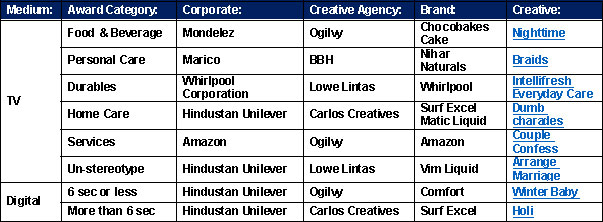
    Here are the Kantar Creative Effectiveness Awards 2022 India Winners:


    Commenting on this year’s winners, Soumya Mohanty, Managing Director and Chief Client Officer, Insights Division, Kantar said, “The spread of ads that consumers have perceived to be both creative and effective is an affirmation of the fact that the space for creativity even in context of marketing ROI is infinite. While there is no magic formula for creating such ads, we can start with the right ingredients and refine them by testing them out with consumers. Kantar is pleased to share the learnings that we have had in the area while working with the leading marketeers in India.”


    Key highlights from this year’s report:


    >> Kantar’s Strategic Sparks identified for effective and creative TV advertising:


    1. Indians love to ride fulfilling story arcs: Stories create room for empathy, engagement, and vivid memories through which one could influence the way in which consumers think & feel about the brands.

    2. Touch of drama helps: Just the right kind and quantity of spice delivered through creative storytelling and filmmaking,  elevates even the repetitive themes, to make them more personal, relevant and aspirational.

    3. License to be extravagant in visualization: Indians are open to suspending their disbelief for the well visualised film

    4. Layer in emotional meaningfulness: Emotive contexts have the potential to make the consumers warm up to even the dry functional categories.

    5. Show, not tell: Integrating brand payoffs as an organic plot event in the script is a timeless approach toward creating vivid and persuasive memories.


    >> Kantar’s Strategic Sparks for effective and creative digital advertising:

    1. Customized and integrated content yields significantly higher ROI​: Carrying forward creative stories and elements from other media amplify the impact of digital assets.

    2. Shoot for instant meaning: Given the attention poor consumers and short window available, it pays to ensure that the consumers are not called to do any additional work for decoding what they are supposed to think and feel about the brand

    3. Ride the moment: Embrace the topical issues and trends, to engage and be relevant

    4. Strike an emotive chord: Well told stories open up consumers for longer format videos

    5. Hook them early:  Promise of a fulfilling story arc, emotive journey and humor help in ensuring that consumers stay invested beyond 6 seconds.


    >> Unstereotyping: Time to mainstream progressive gender portrayal


    Kantar’s collaboration with the Unstereotype Alliance has led to the development of the Unstereotype metric (UM) which Kantar now includes as a measure of gender portrayal in advertising as an integral part of its Link™ communication pretesting solution. Thus, setting a foundation for marketers to review the potential of their creative executions on this dimension to monitor progress over time.


    Unstereotype metric* (UM) in the long term provides learning and context for gender progressive advertisements. UM is now measured for 14,000+ ads across 70 countries, 3,300+ brands and 251 categories.


    :: Unstereotyping in advertisements is predicted to unlock higher marketing ROI. It signifies strong brand equity and is likely to impact short term sales as well. This impact is not only true for women, but progressive male role models also impact business outcomes across categories.

    :: Progressive ads are more effective and trigger positive engagement. They are in general seen to be more enjoyable, relevant, different and even pleasantly surprising.

    :: Unstereotyping affects various aspects of the brand- power, meaningfulness, difference and saliency especially seen in food & beverage, household and personal care categories.

    :: There are clear and present rewards for brands that seek to be at the forefront of embedding progressive gender roles


  • Saare Jahaan Se Achcha


    By Our Staff


    If it was the Olympics, it would’ve merited a call from Prime Minister Narendra Modi. But this is just an advertising festival, where work are recognised for commercial work, so perhaps expecting a call from the PM would be a bit much.


    The victories of the Indian contingent last week though are worthy of that call. Indian creative agencies brought home 47 metals, and this does not include the shortlists.


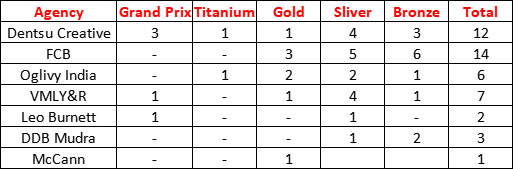
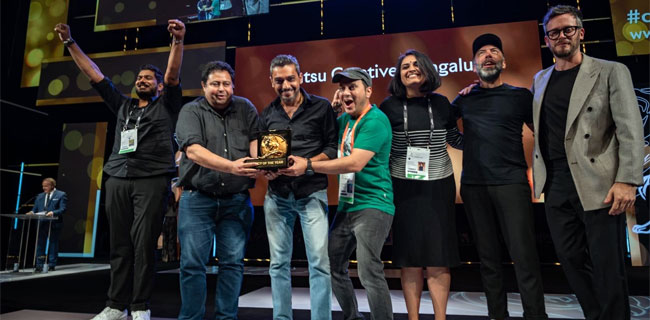
    Dentsu Creative Bengaluru was named Cannes Lions 2022 Agency of the Year, as well as awarded a Titanium, three Grand Prix, two Gold Lions and three Silver Lions for ‘The Unfiltered History Tour’ for Vice Media. This also makes the campaign the most awarded campaign ever. Note: it’s an agency from Bengaluru and not Mumbai or New Delhi NCR.


    Said Amit Wadhwa, CEO, Dentsu Creative India. “When you begin Cannes Lions with a Grand Prix, you think you have already hit a lifetime achievement, but this week just got better and better. It is hard to describe how we feel on receiving three Grand Prix, let alone a Titanium and to top it all off, Agency of the Year – it is a moment to rejoice for each one of us at Dentsu Creative India. The team is just so proud of the work, but also the outcome too,” adding: “We got the world talking about something which really matters deeply, something which will change the way that historically important artefacts are handled in the future, and in turn could change the way that history is taught to millions around the world. Now that is very special indeed.”


    Added Ajay Gahlaut, Group Chief Creative Officer India, Dentsu Creative: “Winning the Agency of the Year is an emotion I cannot even begin to describe. When I used to watch other agencies win the title I often wondered if I ever would get that same honour. What they say is true. Dreams DO come true! I’m over the moon with the Titanium win along with the hat trick of Grand Prix and a whole lot of other metals. Not just me I think no one in the entire Indian ad industry has been part of such a huge haul of Lions ever before. And I do believe we are the first full-service Indian agency to win the title of Agency of the Year. I doff my hat to the entire team responsible for the Unfiltered History Tours. Those who are with us now and those who have moved on. Congratulations all. For now, it’s party time!”


    The other Grand Prix this year went to VMLY&R India’s ‘The Killer Pack’ campaign for Maxx Flash in the Health & Wellness Lions category to Leo Burnett for its ‘The Missing Chapter’ campaign for P&G India’s Whisper. This was a Grand Prix for Sustainable Development Goals Lions, again a first for India.


    Meanwhhile, Ogilvy India also brought home a Titanium Lion for  Mondelez  India’s ‘Shah Rukh Khan My Ad’ campaign. The work also bagged two Golds, a Silver and a Bronze.


    Said Piyush Pandey, Chairman Global Creative & Executive Chairman India, Ogilvy: “I am delighted that the people’s choice is also the jury’s choice. I am very proud of the team that worked on it.”


    As the table indicates, FCB has continued its winning spree and netted as many as 14 metals.


  • Wunderman Thompson Health launched

    By Our Staff


    Wunderman Thompson India has officially launched Wunderman Thompson Health (WT Health) to target the healthcare sector.


    Shamsuddin Jasani
    Shamsuddin Jasani

    Commenting on the launch, Shamsuddin Jasani, Chief Executive Officer, Wunderman Thompson South Asia, said, “We couldn’t have chosen a better time to launch our specialised practice of Wunderman Thompson Health as the healthcare market is poised for exponential growth owing to an unprecedented demand for robust health and wellness solutions. Health and wellness brands are on the lookout for a partner that understands the specific nuances of healthcare marketing, and we believe we can provide business solutions to brands and can unlock growth by leveraging our core strengths of creative, strategy and martech.”


    Srikant Subramanian
    Srikant Subramanian

    Added Srikant Subramanian, Director, Business Development, Wunderman Thompson India: “Advances in technology make the next chapter in healthcare delivery very exciting. In the ever evolving, and digitally transforming eco-system, it’s so important to create tailored communication for each audience, and develop optimized ways to engage with them, be it HCPs, patients, MRs, or pharmacies. Our strategic technology partnerships, leveraged using our in-house medical professionals, allows us to provide truly end-to-end omnichannel healthcare delivery.”


    Samarth Shrivastava
    Samarth Shrivastava

    Said Samarth Shrivastava, Senior VP and Executive Business Director, Wunderman Thompson India: “It’s an incredibly exciting time to be working in healthcare. Healthcare has evolved massively in the last 19 months compared to the last 19 years. Current developments have forced the industry to evolve at an unprecedented pace and have dramatically accelerated digital health’s adoption. With its pedigree in strategy and its complete suite of services, Wunderman Thompson Health has a unique offering which will help clients achieve their objectives in these dynamic times.”


  • Aligning the Brand Chakras


    By Sanjeev Kotnala


    Sanjeev KotnalaDentsu Webchutney is the Creative Agency of the Year at Cannes Lions 2022. It makes all of us in the advertising and marketing industry feel proud. It deserves a round of applause for winning and raising the bar for others to follow. The creative for Vice Media’s ‘The Unfiltered History Tour’ that led the surge is all about an innovative solution where the thought and execution have a complete brand alignment. Such a creative solution needs the client and agency’s alignment across Brand Chakras and commitment.


    A Different Picture

    In the case of regional brands and owner-driven organisations, a consultant needs to make a lot more effort to educate the client. There is a gap in understanding the science, art and craft of communication. The consultants often have to innovate the processes or create shortcuts to drive home a point. We recently worked with two clients to make a point on Brand Alignment. This is that story.


    The Initial, Baby Steps

    The client finally agreed to do a project, an experiment without expectations. However, as the data started coming in, we realised we were on to something good despite the unscientific process. The inferences were directional and of tremendous value.

    It was an eyeopener for the client, who was wary of investing in extensive research. The exercise probed at Brand Archetype, Personification and Brand Alignment across critical stakeholders. The simple exercise helped top management rethink the brand image and the stakeholder perceptions.

    The brand is a dominant regional legacy player in the FMCG category. The rising input cost threatened margins, and active competition finally made the client sign for the experimental study of brand perception and imagery across stakeholder groups at the budget was challenging, if not impossible.


    Personification surprises the Brand Team

    A detailed brand personification exercise threw some interesting results. The exercise involved a wide section of groups, including Top Management, Employees (10 years+ Less than 2 Year and others) cutting across sales, accounts and manufacturing. Additional external segments like retailers, distributors, modern trade and customers were also probed.

    The personification cue card used Bollywood stars of the last 60 years, including actresses, villains, comedians, and character artists. Bollywood was used as respondents could easily associate with it.

    We expected the dominant well-established brand to have some degree of uniformity in personification. However, the results showed how fragmented and inconsistent the imagery was. The brand team and the consultant had enough arguments and explanations for the results.


    Brand Archetype

    This was directional. So, we expanded the scope with Brand Architype. The respondents were unaware of the purpose, thus helping decrease the possible bias and noise in the analysis.

    The team expected the brand to reflect one of the 12 archetypes as the dominant archetype in its core market. Surprisingly, the output showed two dominant archetypes and eight others registering their presence in stakeholders. Clearly, the imagery and understanding were not as sharply defined as the client believed till now.

    Important was the spread of associated brand archetypes across segments. There was no consistency even in the top management, and it took time to sink in. The new employees saw it quite differently than the old employees. The sales, retail, and distributors had different impressions reflecting polarised archetypes.


    Corrective Actions Need Time

    Clearly, the brand alignment and imagery were not consistent. A result of past tactical reactions to market situations. It was easy to hypothesise possible reasons for fragmented impressions and somewhat unwarranted perceptions.

    The brand team and management collective now focus on the brand to reflect the desired archetype through interaction, experience and communication. The management was willing to wait for results. Significantly, another client bought on to the idea and initiated the project to understand brand perception and imagery across internal and external audiences.


    Organisation Brand Alignment Chakra

    This experiment and the results were not unexpected. As the organisation grows, departments become independent silos of power, action and culture. Often, these are not aligned with each other, resulting in a defused image.


    Brand Chakra

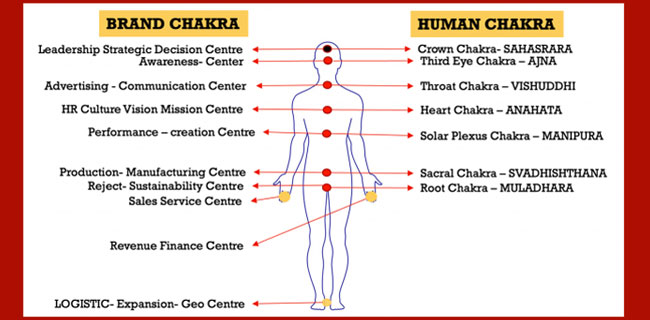
    Most readers would be familiar with the seven chakras. Now, using it as a foundation and treating the organisation as a human being, we can interpret Brand Chakra differently.

    1. CROWN CHAKRAor the Sahasrara Chakra is the Top management. It is the thinking area and area where strategic decisions are taken. Typically also, the head office with Lo and L1 leadership level in direct consultation with the owners.

    2. THIRD EYE CHAKRAor the Ajna Chakra is the research and awareness area. One that scans the market for the probortunies, analyses the situation and feeds to the Crown chakra. This is also the centre that looks inward into capability and capacity build-up and keeps the organisation future-ready. It is also the innovation and product development centre.

    3. THROAT CHAKRAor the Vishuddha Chakra is the Advertising and communication area. This develops campaigns and activities to help achieve the brand’s relevance and impressions.

    4. HEART CHAKRAor the Anahata Chakra is the HR-policy-vision-mission defining Chakra. It is also responsible for the organisation’s culture.

    5. SOLAR PLEXES CHARAor Manipura Chakra is the Power Chakra that comes on the performance of products and services and the financial stability area.

    6. SACRAL CHAKRAor the Svadhisthana Chakra is the place for excitement and creation, including sexuality. The area of manufacturing or production departments are part of it.

    7. ROOT CHAKRAor the Muladhara Chakra is about removing waste products. The power centre works on sustainability and the treatment of waste products.


    Additional Chakras

    In addition, there are three more Brand Chakras for the organisation.

    8. SALES CHAKRA. The right palm is the giver area. It represents the sales department responsible for the experience and expectation brand chakra.

    9. REVENUE CHAKRA. The left palm, receiving area. The accounts and finance department is responsible for the current or future brand revenue.

    10. MOVEMENT CHAKRA.The legs. The logistics and service brand delivery centre. Also responsible for geographical expansion of the markets.


    The Collective Brand Chakra Alignment

    The collective perception is the final summation of the impression on the external audience. It get primarily defined by the interaction of the brand centres with the stakeholders. The Crown Chakra interaction defines financial market impressions. The sales Chakra and third eye chakra determine the consumer reaction, and the retail or trade will be represented by sales and the Revenue Chakra.


    The Alignment Process

    We tried to be extensive and inclusive. In addition, to knowing the archetype and related brand personification at the Brand chakra level, we also looked at how the departments saw each other and the competition. This gave us a matrix of internal and external imagery across power centres – the brand chakras.

    Each department was taken through the findings along with the desired Brand Archetype and personification as agreed with the leadership team. It gives the team individual-level filters to evaluate their contribution toward Chakra alignment. The Idea Harvest workshop provided a platform for a detailed discussion and help determinen the  actionable.

    The brand team is now entrusted with the task of cultivating a dominant brand Archetype reflected across the segments internal and external.


    Net-net

    The Brand Archetype and brand personification exercises are simple, and it is something people can understand easily. Hence, it can always help to define and direct activities.

    A well-aligned active Brand Chakra ensures everyone works toward the same delivery and experience, thus streamlining/aligning their focus and being more efficient and effective.

    I am excited about this low-cost exercise to help the brand re-evaluate and focus on future action lines. Am open to suggestions and interaction with Brands interested in doing this simple exercise.
     

  • Brand Vijay is back!


    By Avik Chattopadhyay


    Avik ChattopadhyayWhen Salim Khan’s Inspector Vijay Khanna appeared on the screen on May 11, 1973, a new brand was born in Indian social fabric from the least expected of places…celluloid. The brand of the ‘angry young man’.

     

    Depicted par excellence by Mr Bachchan, ‘Vijay’ was more than just an upright police inspector out for revenge. The character stood for the young Indian in the early 1970s, disappointed and frustrated. Gone were the days of utopian simplicity of a Raj Kapoor in the 1950s or the romantic optimism of a Rajesh Khanna in the 1960s. The new India was not shaping up as predicted and promised by Nehru and Patel.


    Corruption had seeped into every nook and cranny of life. Politics was not clean and noble anymore. Scandals broke periodically. The rich got richer at the expense of the poor. The mouths to feed were going up exponentially. Questioning was not encouraged, and freedom of speech was at a premium. The grand vision and promises lay torn asunder on the sidewalk. Nation building had given way to nepotism. The white sahib had given way to the brown one!


    In this context rose Vijay Khanna… sceptical, sneering and sardonic. He was symbolic of the state of mind of the young Indian. He was the young Indian. He was tired of the way things were around him. He wanted to change things. He did not necessarily have a clear idea of how to but definitely had a greater goal in mind of finally getting up to take the proverbial bull by the horns. Vijay Khanna was a character that every young Indian could relate to and saw a reflection of self. The angst and explosive action were relevant to all parts of India, urban, rural and villages. ‘Vijay’ became a brand.


    The establishment then thought that Vijay was more of an aberration than the harbinger of the future. The nationwide popularity of the character should have been a clear signal of the mood of the nation wanting correction or change. And change it was!


    The brand kept evolving over the years, manifesting itself in various celluloid roles played by Mr Bachchan right till Vijay Dinanath Chauhan in 1990. Many other celluloid characters were created in various languages mirroring the same purpose, persona and value system of Vijay. Importantly, the parallel or art cinema movement played the perfect foil in creating equally compelling manifestations of the angry young man, right from Gopalakrishnan’s ‘Vishwam’ to Nihalani’s ‘Anant Velankar’.


    Come 1991, India entered a new phase of optimism. The economy opened up. Liberalisation happened and with it came a new form of romanticism. There were things to look forward to in terms of opportunities, prosperity, and social wellbeing. A bit of utopianism creeped back into the mainstream mindset. Just like the first phase of feeling good lasted around two decades, so did the second. Corruption, nepotism and brazen capitalism again raised their ugly heads to overshadow the progress we made.


    2014 was a consolidated and conscious change of course. The old order was overthrown, and new hope was given a chance. Fresh dreams were woven and shared. Awe-inspiring targets were set. Promises galore were made about development for all and with all. Then year after year, initiatives were taken that took a toll on the enthusiasm of the average Indian. Demonetisation. GSR roll-out. CAA and NRC. Farm Laws. Agnipath. The promises of 2014 were nowhere to be seen in 2020 when Covid struck as the proverbial last straw. The young Indian, grudgingly, is angry once more. Yet again, the enthusiasm, energy and optimism has given way to bitterness, frustration, and a feeling of helplessness.


    Paving the way for ‘Brand Vijay’ to come back. In the forms of Pushparaj, Rocky, Advocate Chandru and Komaran Bheem. They are all Vijay in different avatars, in different contexts, fighting different battles. Whether for villagers smuggling timber or social outcastes asserting their right to equal existence. They are full of angst. They have none of the refinements of urban life. In fact, they are caustic about the lives of comfort of a privileged few.


    The sheer popularity of a Pushpa or a KGF is once again a clear signal of the mood of the nation, 50 years later. The youth is on boiling point right now, once again looking for correction or change.


    A brand need not be only a product, service or solution. It can very well be the outcome and a reflection of society. It can be an amplification of a state of mind or the prevailing mood, in the form of a literary or creative character. Vito Corleone is a brand. So is Hannibal Lecter. As well as Forrest Gump.


    As Pushpa tells Shekhawat at the fag end of the movie that a brand is not merely the label on a shirt. The brand is Pushpa himself.


    Just like ‘Vijay”!


  • ASCI tables Annual Complaints Report 2021-22

    By Our Staff


    The Advertising Standards Council of India (ASCI) released its annual complaints report for the period April 2021 – March 20222, during which it processed 5,532 advertisements across mediums including print, digital, and television. With a sharp focus on the digital domain, ASCI saw an overall compliance rate of 94%.


    In 2021-22, ASCI processed 62% more ads compared to the previous year, and 25% more complaints. While television and print ads remained in focus, ASCI broadened its ambit by “proactively” monitoring advertising in the digital landscape. Nearly 48% of the ads processed belonged to the digital medium. With the influencer guidelines coming into force last year, complaints against influencers constituted 29% of the total grievances. Complaints regarding misleading claims in ads featuring celebrities saw a 41% increase out of which a staggering 92% were found to be violating ASCI’s guidelines, notes a communique.


    ASCI continued its proactive surveillance and 75% of ads processed were picked up suo motu. This included the AI-based monitoring that ASCI has set up for digital tracking. Complaints from consumers constituted 21% of complaints, followed by intra-industry at 2% and CSO/ Government complaints at 2%. Of the 5,532 total ads processed, 39% were not contested by the advertiser, 55% of them were found to be objectionable after investigation, and complaints against 4% of ads were dismissed as not violating the ASCI code. 94% of ads that ASCI processed needed changes so as not to violate the ASCI code.


    Given its focus on digital monitoring, emerging categories included the relatively new categories of virtual digital assets and online real money gaming, contributing significantly to objectionable ads at 8% each. Education (33%), Healthcare (16%), and Personal Care (11%) were the Top 3 violative categories.


    Subhash Kamath
    Subhash Kamath

    Talking about the annual report, Subhash Kamath, Chairman, ASCI said: “2021-22 was the year we followed through on our promise of increasingly monitoring the digital media given the way it has been dominating the advertising landscape. We invested heavily in technology and that has worked quite well. We also upgraded our complaints system which has made it very easy for consumers to register their complaints and for advertisers to respond to it. Going ahead, we will continue to be at the forefront in understanding how best to regulate and monitor the digital frontier, even as we keep streamlining our processes to become more responsive, and more proactive.”


    Manisha Kapoor
    Manisha Kapoor

    Sharing her thoughts about the annual report, Manisha Kapoor, CEO & Secretary General, ASCI, said: “The ASCI team, the Consumer Complaints Council, the Honorable ex-high court judges on our review panel, and our domain experts have debated the nuances of advertising and scientific evidence of thousands of ads to ensure that the process and outcomes are fair to both consumers as well as advertisers. Simultaneously, the constant update to our code ensures that we constantly offer guidance and transparency to consumers and advertisers on newer and emerging formats and categories. This helps in keeping self-regulation at the frontier of advertising developments.”


  • Delhi Press holds Motoring Awards 2022

    By Our Staff


    Delhi Presss conducted the Motoring World Awards 2022 on July 1 in New Delhi. Motoring World, now in its 23rd year, tracks the automobile sector.


    Notes a communique: “Every year, the team at Motoring World sits down and takes a good look at all the four and twowheelers that were launched in the previous year, specifically the ones that they have thoroughly reviewed and tested. During this year’s jury round, all the nominees were evaluated and discussed thoroughly by the team, and at the end of this exacting process, they were left with the best automotive products in the country across several categories. For 2022, these were the winners in their respective categories.”


  • Hirol Gandhi named President & Head of Ogilvy Mumbai & Cal

    By Our Staff


    Ogilvy India has announced that effective July 1, Hirol Gandhi has taken charge as President and Head of Office – Mumbai and Kolkata. Gandhi has been with Ogilvy for 22 years across various roles.


    Said Piyush Pandey, Chairman Global Creative & Executive Chairman India, Ogilvy: “Hirol has been a champion of creativity and modern work.  I am happy that our largest office is in very good hands.”


    Said VR Rajesh, Group President, Ogilvy India: “The next three years are the years of transformation for Ogilvy in India. Hirol is an extraordinary future focused leader who also has an astute sense of business. We need a champion like him to accelerate our journey into modernising our largest office.”


    Added Gandhi: “After having successfully partnered brands in their growth and transformation journey, this is an equally exciting and challenging opportunity – chart the next chapter for Mumbai and Kolkata offices, and further accelerate the transformation agenda. I’m really looking forward to my next phase at Ogilvy.”


  • Dentsu celebrates 6th edition of ‘One Day for Change’

    By Our Staff


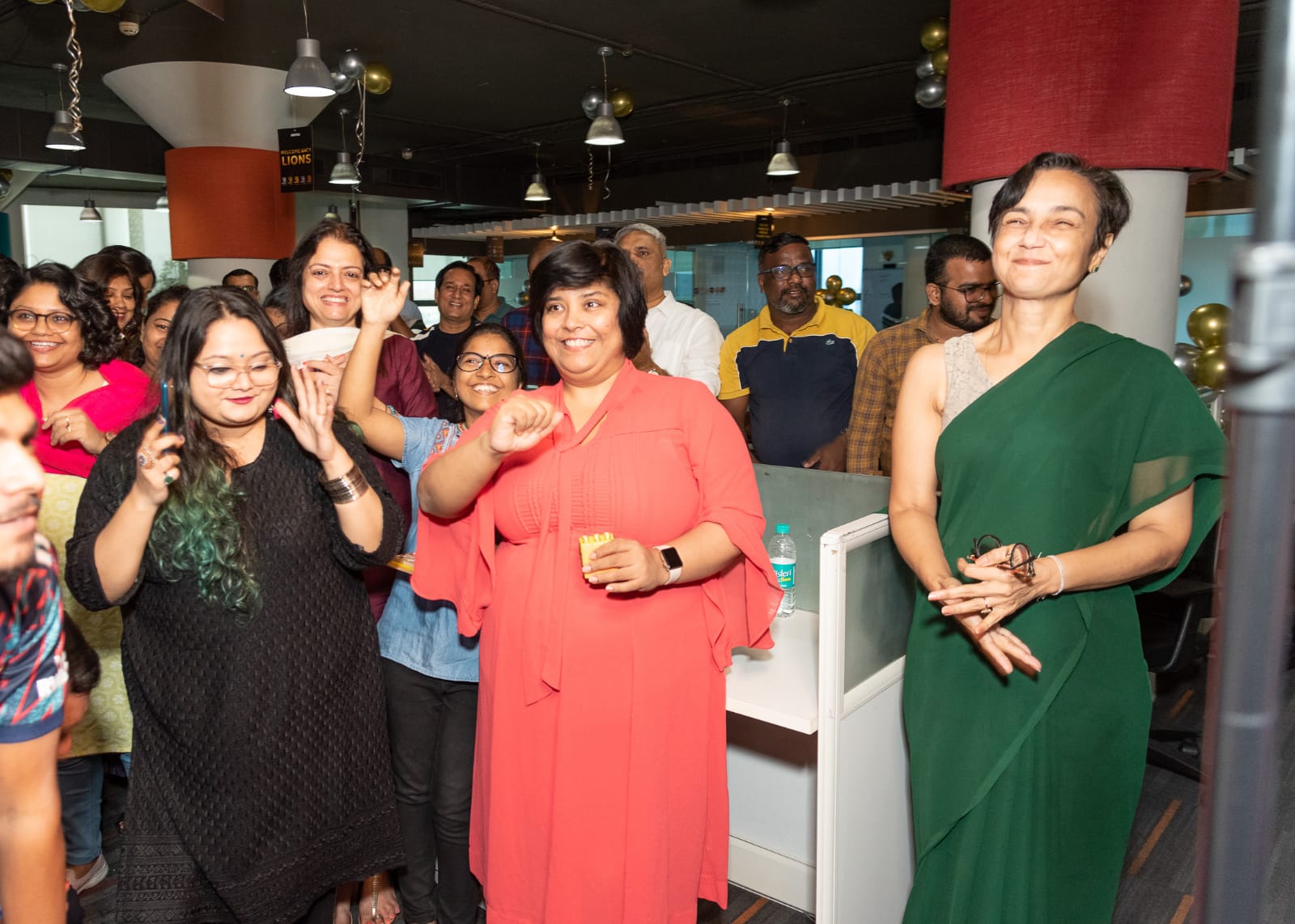
    Dentsu India celebrated the sixth edition of its annual volunteer initiative, ‘One Day for Change’ (ODfC), across offices in Mumbai, Delhi, Bengaluru and Pune on July 1. The day was themed around  ‘Zero Waste in a Sustainable World’ and aimed to build a better environment for the young and underprivileged children, including those with special needs.
     

    Commenting on the initiative, Divya Karani, Media CEO South Asia, Dentsu said, “Our superpower as dentsu is the ability to alter attitudes, shape behaviors, and motivate constructive actions. If we are to succeed in creating a net-zero, restorative, and inclusive world, it begins with us, today. All of us have the chance to make a difference, to rally together as a team on One Day for Change. In doing so, we are all giving a part of ourselves and that is simply invaluable!”


  • Is there a market for sex toys?


    By Sanjeev Kotnala


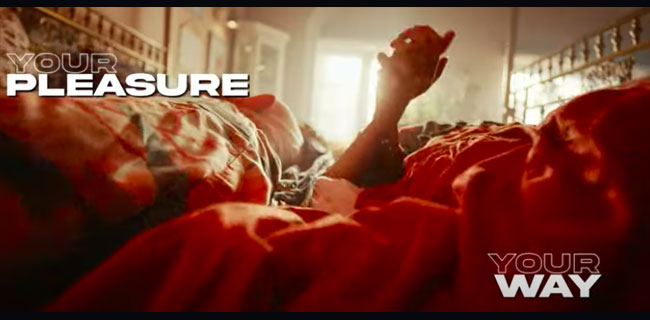
    Sanjeev KotnalaTTK Healthcare launched D2C sexual pleasure fulfilment sex toys e-superstore called Love Depot. The launch campaign #ThePleasureIsAllYours crafted by ‘The Glitch’ was released across select digital platforms. To watch the film, click here. It only plays on YouTube, as it is an age-restricted video (based on Community Guidelines).


    The film showcases the range of sex toys you can buy at Love Depot. It shows a spectrum of pleasure tactics amplified with sex toys. In the process, it highlights individual choices when it comes to sexual pleasure.


    Sexual Wellness Market

    As per earlier  estimates the global sexual wellness market was valued at $74 billion in 2019 and expected to be $108 billion in 2027  and expected to grow at CAGR 4.62% between 2021 to 2027. Sexual wellness includes products like Intimate Hygiene, female & make grooming, sexual wellness, delay sprays, sex enhancer supplements, sex toys  and pleasure products. Another report by Allied market Research places  the sexual wellness market to be $2.09 billion by 2030 this report pegged 2020 market in India at $1.15 billion.


    Lack of Sex Education

    One does not need research in the social and culturally constrained Indian environment where there is a lack of sex education. Even though it is the land of Kamasutra, it is the land of heightened, oppressed and unexpressed sexual fantasies. Forget access to sex toys. Anything other than typical traditional accepted positions and demands – everything else is abnormal, unaccepted and seen as unnatural.

    There is a massive chasm in the expectation and experience of sexual fulfilment. Understanding sex as a duty, a responsibility, and a way of giving birth to the next generation overpowers the need for sexual pleasure.


    Sexual Pleasure slowly getting its Due

    The current generation is slowly breaking these clutches. They are willing to express their individuality and choice and demand a new height of sexual pleasure, even if it includes using sex toys individually or with a partner.

    The TTK survey points out that over 81% of the women are dissatisfied with their sexual life, and 71 never experienced climax. Understandingly the range of products in the Vulva owner section is more. And no doubt there is an equal percentage on the male side that has other problems.

    In the Indian context, there is limited awareness of sex toys, which are considered more for personal use. The film does not miss the opportunity to break the misconception by pointing out that sex toys can even help couples reach a new level of pleasure. A visit to the site has me educated on the range and kind of toys that are available.

    I admire the head of the marketing  Vishal Vyas, TTK Healthcare, categorically introducing a few things while making the statement. He says, “Love Depot is built on one of the cornerstones of sexual wellness that we often let fall between the cracks: pleasure. … everyone deserves to seek and conquer the peaks of sexual fulfilment. It is structured to provide the shopper, regardless of gender identity or sexual preferences – an empowering experience, offering both choice and control. And it’s driven by a single-minded purpose – to close the pleasure deficit in the market”. One single statement that tells the story of the market.


    LoveDepot.com

    The site Lovedepot.com is well-designed. And as expected opens only after over 18 self-declaration. The copy like ‘we ship pleasure you manufacture it’, ‘Invite a little pleasure’, ‘Its official pleasure has an address’ and ‘Invite a little pleasure’ is to the mark.

    Interestingly and rightly, a small quiz helps you choose the right product. I like the way the site asks you a simple question. The choice is, Are you a penis owner or a Vulva owner, instead of the usual Male or Female. And the section Penis love- starts with a cliché- why should girls have all the fun?

    But choosing a sex toy until you have researched or know what you want is confusing. For example, the male section or the penis owners have multiple filters. So decide if you want a toy that is powered, non-powered or rechargeable. ABS plastic or silicon. Brands like Bathmatefifty shades of greySatisfier and Tenga and  Skore. And if you were looking for a masturbator or a penis pump.

    Each product has sections like product details, features, how to use, faqs and user review. I feel it is underplayed and needs more information. Some seem more complicated, and as the how-to-use does not come with graphic visual or illustrative details, it can hold people back.

    The user review seems a suspect, with the reviews’ names and dates looking like more of a copywriter job. And some of the text with Pheromone Activating Spray could be exaggerated and misleading product performance in case it was a press ad. Check it out; it is written well.


    Delivery of Sex Toys

    Love Depot promises attractively packaged products discretely delivered. But is silent on Pick-up space or time slots when the person can get them without worrying about others knowing. A long time back, some company (I don’t recall the name) tried marketing a limited range of sex toys but did not pick them up due to delivery issues. Maybe Love Depot has done the homework. Without a clear explanation of the process, the customer hesitancy will hold much back.
    One has seen some of the sexual wellness products prominently displayed in large medical stores, but that is just awareness build-up.  In a country where buying of sanitary napkins and condoms is still seen as a task, sexual wellness products have a long way to go. The digital platform for discovery- education and purchase will help the category. The  dependence on the street shops for these products will drop with the ease of purchase on e-commerce.


    Pricing is no Issue

    Price is something that will not work as a deterrent in the market. As such, Love Depot has many international brands and its own products offered across a wide range of price points. The brand has always been at the forefront of the male contraceptive brand like Skore– keeping the pleasure component high.


    Educating Prosumers and Consumers on Sex Toys

    There has to be a lot more to address the choice-control and awareness of the toys and their proper usage. The act of getting Dr Tanaya Narendra (@dr_cuterus) on social media to co-create educational content for the consumer is the right step. And the thought that the doctor amplifies is absolutely right, “We must leave shame behind and empower people with what they necessarily have to know about their sexual needs. I am quite excited to be partnering with Love Depot, which will not merely be a product marketplace but will also be a platform that makes all visitors aware of their entitlement to pleasure, and at the same time, educates them on the role of innovative and contemporary pleasure-providing products”.

    However, the prefix doctor educating the consumer makes it a problem. The brand may do itself and its customers good by extending the base and including an easy-to-relate character more like a confidant without a doctor prefix. Unfortunately, the best educator ambassador in this area- Sunny Leone, is with the competition- Manforce.

    The Indian masses are not fully aware of sec toy usage. They are a curious lot, and the curiosity could lead to some mishaps.


    Net-net

    TTK takes another step to be ahead in the business of sexual pleasure. They need a lot more to do to educate the consumer. Initially ensuring discreet deliveries and building on acceptance of the products. Maybe some more product placements in OTT could help. Possibly restricted videos could be of help. But much more must be done to make it gain wider acceptance and drop the stigma of talking about or using it.

    It might help to focus more on individual usage. As couple usage, in a way, hints at some lack of capabilities on the partner’s part to satisfy. Women feel inadequate to suggest, and the man is not inclined to offer anyway. So, it is. Catch-22 situation.


  • Shilpi Kapoor is CMO, Airtel Payments Bank

    By Our Staff


    Airtel Payments Bank has announced the appointment of Shilpi Kapoor as its Chief Marketing Officer. She will oversee the marketing and corporate communication function for the bank.


    Said Anubrata Biswas, MD and CEO, Airtel Payments Bank: “I am very pleased to welcome Shilpi to Airtel Payments Bank’s leadership team. Shilpi’s vast experience across different industries combined with her deep understanding of consumer, digital and business-to-business marketing will play a vital role in further strengthening the bank’s differentiated position.”


    Added Kapoor: “Airtel Payments Bank has been registering strong growth over the last few years. With its unique business model, the bank is able to serve a diverse set of customers with simple, safe and rewarding digital financial solutions. I look forward to working with the team to develop the bank’s robust growth story.”


    In her last stint, she was with American Express as Director of Marketing, where she led the brand strategy and communications. Shilpi is an alumnus of Amity University and has completed special programs in leadership excellence and digital marketing from Harvard Business School and Northwestern Kellogg University.