Category: ADVERTISING

  • It’s Sidharth Rao. The MxMIndia Mediaperson of the Year 2019


    By Pradyuman Maheshwari


    Greetings! It’s D-Day all over again. December 20, 2010. The day when we said we would announce the MxMIndia Mediaperson of the Year 2019. Unlike various other awards and presentations, this is done via MxMIndia, not through an event. So we aren’t dictated by the demands (and exigencies) of sponsors and the constraints that venues and budgets put us under. We like to compare it with the Time magazine’s Person of the Year. Just an online announcement. We are sure you will join us in the celebration of who our 2019 Mediaperson of the Year is.


    First a quick look at how we are different from various other awards/title presentations:


    First, it’s not based on a survey. It’s not based on any industry poll. It is based on a study conducted by us through the year. This makes the decision-making tougher, as we can’t pass the blame on to research. Or the collective view of the industry. Or of a jury.


    Second, it’s an A&M industry study. Agreed CEOs of big clients are important, but we are looking at CMOs and not CEOs of well-marketed organisations.


    Third, we look at performance through the year, and do not base it on the highs of the last two quarters of a year which tend to influence any voting-based process at the yearend.


    Fourth, it’s about performance in the year. The highs and highs achieved in this calendar year.


    Fifth, we give you a clear reason why we have chosen the winner


    Sixth, we are as sincere and honest about the awards as one can get. A few years back there were suggestions that we should make it an on-ground event. But then that comes with its own set of issues (and compulsions). We even had one large media group expressing its interest four years back. But we think it could’ve influenced our decision-making.


    So: the MxMIndia Mediaperson of the Year 2019 is an online presentation. It’s an accolade that’s for the truly well-deserving. And for the True Achiever of 2019 in the Indian Media, Advertising & Marketing arena.


    With the backgrounders done, here’s  how we went about our task.


    We maintain an online notebook that records important developments of the year. It’s also a drill that ensures one can do recaps etc with ease.


    For the Mediaperson of the Year, one reviews names, quarter-wise. This ensures the choice of the winner doesn’t suffer from the recency factor.


    We looked at various names. We couldn’t miss the achievements of the various media biggies as they went on consolidating operations.


    We had also asked our readers for their nominations, and we added these to the come to a shortlist of five.


    Ladies and Gentlemen, We have great pride in announcing that the 2019 MxMIndia Mediaperson of the Year Award is:


    Sidharth Rao

    CEO and Co-Founder, Dentsu Webchutney

    Sidharth Rao

    He was all of 19 when he started a digital agency called Webchutney. He was its co-founder and CEO. Six years back (in 2013), the agency was acquired by the Dentsu Aegis Network and hasn’t looked back ever since.

    Dentsu Webchutney was the most-awarded Indian agency at the Cannes Lions International Festival of Creativity in 2019. And has won numerous awards – at the Goafest Abby, at the Kyoorius Awards and almost everywhere else. The year also saw the release of Rao’s book ‘How I Almost Blew It’


    Rao is also an angel investor, was the co-founder of Network Play, which became one of the largest brand ad network in less than three years and was later acquired by European media conglomerate Bertelsmann AG.


    So how did we arrive at our decision: 


    The year 2019 has been pretty horrible for the media, advertising and marketing ecosystem. Achche Din didn’t happen. In fact the line that’s used is: Burre din kab jaayenge.


    This state of the economy has had a huge impact on the business of media. Profits are down, work has reduced and the bottomlines have been severely impacted.


    So we looked at all the small, medium-sized and large companies that did very well in the year. While there has been a fair amount of great work done despite all the odds, we didn’t find an individual’s achievement striking enough for being a ‘Person of the Year’. There is of course the argument that the very ability to navigate and profit in a tough year is by itself an achievement.


    We couldn’t agree more. So to the media and advertising industry and all the professionals who are part of it: kudos. You are all super-achievers.


    But in all of this, we found Sidharth Rao’s achievements stand out. Digital has been growing over the years, but one of the reasons why it hasn’t grown enough so far is because it’s always been compartmentalised and hence never considered as mainstream advertising.


    Rao’s achievements of the year have changed that. And will do that forever. He’s not your pinstriped suitwallah adperson. He’s not a turtle neck T-shirt wallah techie. He belongs to the breed of industryfolk who have done things quietly and have done it over the years.


    A truly deserving winner of the 2019 MxMIndia Mediaperson of the Year title.



  • Ogilvy & Licious unveil year-end festivities

    By A Correspondent


    Licious has launched the Licious Carol on the occasion of the festive Christmas season. The campaign has been conceived in the form of popular Christmas carol, Jingle Bells.


    Said Sujoy Roy, Executive Creative Director of Ogilvy, Kolkata: “We wanted to do something unique for the holiday season. The point of the exercise was to talk about Licious Spreads, without being too preachy. Besides, it’s meant for the holidays. Why not have some fun with it? The best thing about the musical is that one can hum along with it,”


    Added Manohar Kumar – Business Head, Packaged Food Business, Licious: “Licious Spread is a unique & an innovative offering from Licious. Its India’s 1st Meat spread, a completely new category that currently doesn’t exist in the Indian market. The key marketing task has been not only to drive awareness but also to educate consumers about its usage & consumption occasions. Given the festivity around & popularity of Christmas jingles, it’s an interesting approach of communicating the message in a fun way. Best thing about this musical is that it cuts across age and gender.”


  • BBDO India appoints Jazryk Gill as Vice President

    By A Correspondent


    Suraja Kishore, Jazryk Gill and Nikhil Mahajan

    BBDO India has strengthened its Delhi management team by getting on board Jazryk Gill as Vice President. She will be reporting to Nikhil Mahajan, EVP and Chief Growth Officer. With close to 13 years in advertising and marketing, Gill has worked in Dentsu Marcom, Wieden+Kennedy, Cheil and Lowe Lintas.


    Commenting on the ‘s appointment, Suraja Kishore, CEO, BBDO India, said: “Jazryk is a welcome addition to our leadership team at Delhi. She brings with herself a great blend of purpose and performance orientation to our business. Her sense of ownership is inspiring and her passion is contagious. I am certain she will be add more value in what we have to offer to our partners and she will be an active agent of change that we are championing at BBDO.”


    Added Nikhil Mahajan, General Manager and EVP and Chief Growth Officer – BBDO India: “Jazryk is a new age thinker and a doer. Her effortless understanding and knowledge of ‘Now’ is a great ingredient for shaping the future of our brands and the role we play as brand custodians. She has successfully practiced and demonstrated the power of media agnostic ideas that moves today’s generation and we can’t wait for her to take that to the next level here at BBDO.”


  • Madison BMB appoints Ameet Joshi as General Manager

    By A Correspondent


    Ameet Joshi

    Madison BMB has appointed Ameet Joshi as General Manager. Joshi has over 18 years of experience across advertising agencies and was until recently a Business Head at Creativeland Asia.


    Raj Nair

    Commenting on this appointment to the team, Raj Nair, CEO & Chief Creative Officer, Madison BMB said: “Ameet is a welcome addition to the Madison BMB team as General Manager. He comes armed with nearly two decades of experience of working at leading creative agencies, on diverse industry portfolios. Armed with an infectious enthusiasm to get things done, Ameet will lead all account management functions and conversations with all our key clients. With a focus on adding value on current and new relationships by directing all aspects of business strategy and maintaining consistent strategic inputs and co-creating value for brands and businesses. He will also help in guiding the agency focus on new business development strategy. I look forward to him partnering me in taking Madison BMB to greater success.”


  • Dentsu India Slingshot wins creative mandate for Melorra

    By A Correspondent


    Dentsu India Slingshot, a marketing solutions outfit from Dentsu India, has bagged the creative duties for Melorra. As part of the mandate, the agency will handle all marketing communications, campaign designs, media consulting and demand planning duties for the brand.


    Simi Sabahaney

    Commenting on this partnership, Simi Sabhaney, CEO, Dentsu India said: “This win means a lot to us. It gives us an opportunity to partner with an audacious, ambitious founder like Saroja. Melorra, with its well thought through design sensibilities, is poised to make the women of today fall in love with the idea of wearing jewellery every day. We look forward to creating some great campaigns with them.”


    Saroja Yeramilli

    Added Saroja Yeramilli, Founder and CEO, Melorra: “We, at Melorra, were looking for an integrated and a new-age solution thinking approach towards building our brand.  In Dentsu India Slingshot, we found a team that was well experienced not just in communication but also in media and strategy. Lucky and Kunal’s deep understanding of building digital-first brands convinced us that Dentsu India Slingshot was the right agency to partner with.”


    Kunal Dubey

    In a joint statement, Kunal Dubey, VP & Head of Business, and Lucky Saini, VP Digital & Marketing Solutions, Dentsu India Slingshot said: “Melorra is truly disrupting the jewellery category in India by its trend-inspired business model; and so is Dentsu India Slingshot with its platform-agnostic, solution-first approach in the advertising industry. In association with Melorra, we see an opportunity to build a digital-first and extremely relevant brand for the independent and modern millennial Indian women. We have also adopted the role of their extended marketing team by partnering with them on all aspects. We will now be working on their brand strategy, long term communication plan, media analysis and content strategy.”


  • Kotak Life highlights the Importance of complete life insurance in latest ad film

    By A Correspondent


    Kotak Mahindra Life Insurance announced the launch of its new digital campaign which highlights the importance of complete life insurance plan.


    Said Subhasis Ghosh, Head – Marketing & Group Insurance, Kotak Mahindra Life Insurance Company: “Life insurance is usually purchased with the intent of saving tax and helping family tide over any unpredictable occurrence of death. But what happens in case of a serious illness or disability? It makes the purchased policy cover incomplete. Kotak Life’s #PooraPlan completes the incomplete by going beyond the conventional coverage and providing added benefits that cover disabilities and critical illness.”


    The campaign is conceptualised and executed by Wunderman Thompson. Said Steve Priya, Executive Creative Director at the agency: “Until now, Life insurance as we know it is actually ‘After Life’ insurance. The category is built on taking care of your loved ones, after you’re gone. Death however, is just one of the outcomes. But what happens if you’re critically ill or suffer an accident that leaves you disabled. A tough conversation but one that was necessary. We decided to shake up the category and call any insurance plan that doesn’t cover every eventuality as ‘Aadha Insurance’. Subbu (Vinay Pathak) makes a comeback in a series of logical, practical yet lighthearted commercials and propagates the need for a complete or rather #PooraPlan from Kotak Life Insurance”.


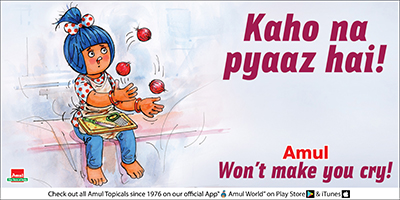
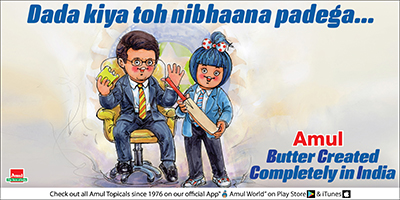
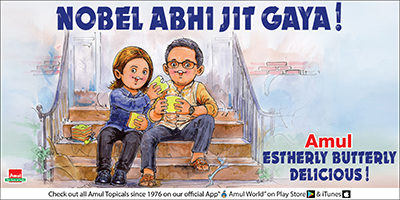
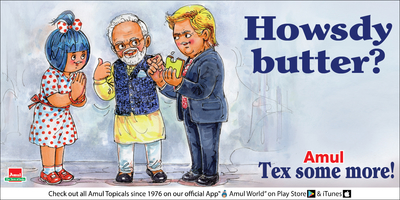
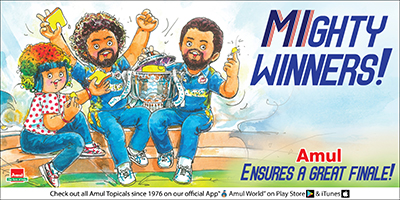
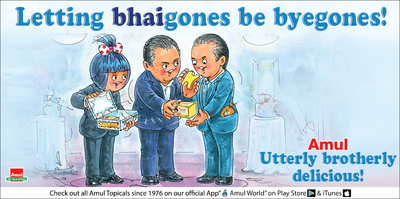
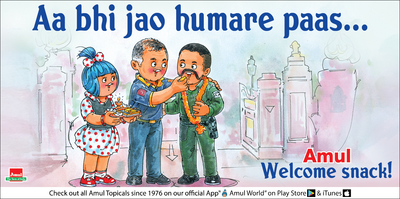
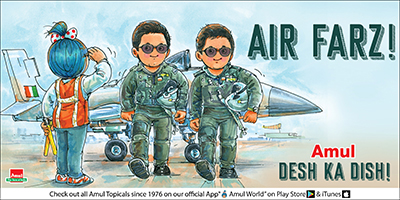
  • Utterly Butterly 2019-icious

    Cropped image of the last of the topicals from Amul in 2018


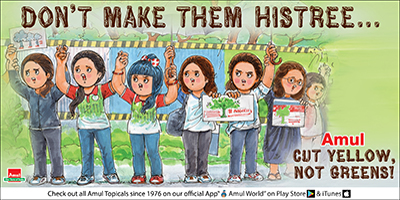
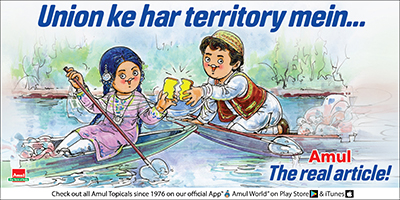
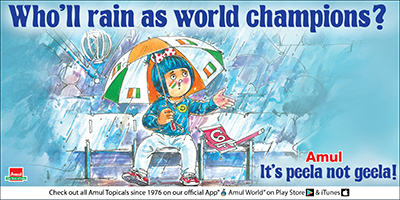
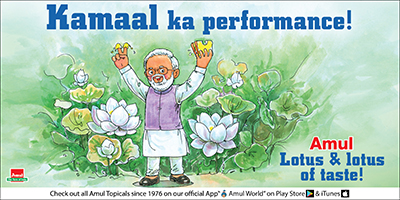
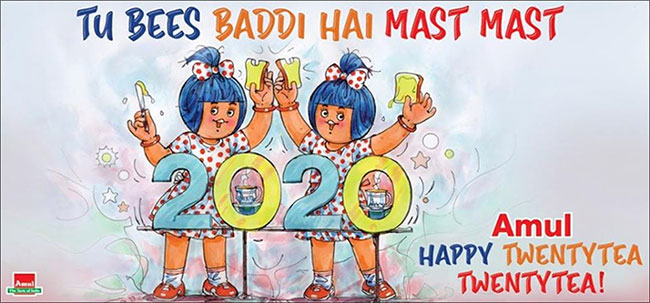
    There are recaps and recaps and recaps. But perhaps the Amul ads which mirror the mood of the masses are the best to look back at the year that has been. Yes, we thought there would be one around the CAA/NRC protests that have impacted the country, but perhaps it was too sensitive to be tackled in an Amul ad. Though there is one around Jammu & Kashmir.

    Do take a look at 19 of the Amul topicals this year. Enjoy


  • Oberoi IBC bags Elleys’ Switches

    By A Correspondent


    Elleys’ switches have appointed Oberoi IBC  to handle its creative duties. The mandate comes after a multi-agency pitch involving  leading  agencies in Mumbai.


    Commenting on the appointment of Oberoi IBC, Manoj Hansraj Gada, Director, Elleys’ Group, said: “We are pleased to associate with Oberoi IBC as our advertising partner. Their passion towards the brand and creative ideas were appropriate for our brand personality. We look forward to successfully driving our brand reputation.”


    Added Suryakumar Singh, Director, Oberoi IBC: “Elleys’ has launched some very innovative products and we will be working on the entire advertising campaign including Print, TV, Outdoor and Digital. The account will be handled by our Mumbai office.”


  • Sanjeev Kotnala: Will The New Decade Be Any Different?

    c`


    By Sanjeev Kotnala


    Welcome, 2020. Two decades of the century are over. The next one starts. Will it be different? The industry shifts and changes are like climate change. We know they are happening. However, seeing the real impact takes time.

     

    LOT HAS CHANGED. YET, NOTHING HAS CHANGED. 

    The brands continue to work hard experimenting with new approaches in the era of information. Brands are busy finding an original purpose to create positive perceptions in the consumer’s mind.

    Till date the record is dismal. Most brands with purpose have failed to align the whole organisation with the purpose. The result: they have been unable to deliver the same language across every touchpoint or experience. Many brand purposes are non-strategic and have a short life. The consumer quickly sees through the brand’s opportunistic behaviour. It leads to dissonance. The consumer continues to expect the brands to speak to them in a simple language. Be aligned and in-sync through the experience while delivering the best solution for the covert or overt need.

    Today, information access and placement is easy. And the audience is unable to separate the true from the false. The information available on the internet is questionable. Consumers continue to react with limited or misinterpreted information. In real terms, perception is adulterated with reality.

    The herd mentality is a reality. The audiences tend to hook on to a leader, subject or even information and blindly follow it. There is a churn within the influencers. They are being questioned for their impact and intent. The consumer is no longer sure if they can trust the peer and consumer reviews, which are simply polarised. The review industry is course-correcting by making them more genuine sounding.

    The product margin continues to drop, and service expectations continue to rise. The efficiency of templated SOP continues to be tweaked. The products and services keep getting threatened with new technology and business models.


    CMO AND AGENCIES.

    The fight between Traditional and Digital continues. Agencies, CMOs and Media owners continue to have a non-polarised point-of-view.

    The life of a CMO is getting more marginalised. The CMO’s tenure is further shortened by complexities of the environment and misplaced expectations. The CMO’s vision has been narrowed down from annual to QSQT and in many places restricted to the next project or the next month. Some CMOs gamble with bold, innovative experimentative consumer connect, some remain risk-averse. No one knows what the best practice is.

    Innovation and insight continue to be mismanaged and ill-defined. Communication and Marketing seem to be teamwork run by the idea and budget dictators. People fail to understand that marketing is not always about what you are doing but equally important is what you sacrifice, what you decide not to do.


    INDUSTRY AND INDUSTRY ASSOCIATIONS.

    The role of the agencies and advertising business continues to evolve and redesigned under newer threats. The blame game continues. Neither is the idea plagiarism dead, nor is the idea shopping.

    ASCI seem to be gaining strength. Ad Club and AAAI continue on a template path. Regional Ad Clubs keep to their turf. IAA keeps surprising with multiple high impact programmes. The media covering the advertising and marketing industry keeps finding enough content to fill spaces.

    The awards, across media, business and creativity, keep multiplying. The issue of scam advertising remains unresolved. There is no unanimous celebration of excellence. The new breed only complains, and most remains uninterested in taking a position of responsibility within Industry associations. The camps within the industry keep their amniotic behaviour.


    SOCIAL MEDIA

    People who sold their privacy to the devil we know as social media now want protection. They still continue to take on apps and services, carelessly signing un-read contracts and saying ‘I Agree’. The charm of free-of-cost service or membership to a loyalty circus continues to come at a hidden cost. The trap is already shut.

    The social platforms are unable to secure user data. Everything is threatened and watched. The CCTV cameras that give you a false sense of security and confidence comes at the cost of privacy at private and public places.

    The trolls continue to troll and cribbers continue to crib. The audience remains confused.


    POLARISATION CONTINUES TO CAST ITS SHADOW.

    The grey between the black and white is slowly but surely getting erased. The need to take a polarised stance is forcing people to make comments and statements they may later regret. There is a cost associated with all this, but that can wait.


    EVOLVING MEDIA.

    The traditional media keeps on fighting for its share of the pie. New OTT platforms continue to surprise and entertain. The discount model at e-commerce continues in its aim to get the loyalty of buyers. The digital media continues to be under a cloud of non-transparency and issues that no one has any solutions. The measurement matrices keep getting finer but remain under scrutiny. New buzzwords are coming and exiting faster than winter fashion.

    Arnab Goswami continues to make up his mind and be the judge in his debates. Every channel on the set-top-box breaks breaking news. Newspapers try holding to their credibility and trust. Digital still gets quotes as emerging and new media. Entertainment TV keeps dishing the similar content of Saas-Bahu, Naagin, reality shows and contests.

    BARC keeps evolving and promising new edge data and insights. IRS continues to walk on the edge, trying to find balance by keeping everyone happy. It continually improves the research methodology and implementation. Yet, they failed to promise a date calendar for the release. The industry willing accepts it.

    Radio and OOH is lost in the way keep chugging without any real measurement matrices. Big players try surrogate measurement, but a syndicated study remains elusive.


    EVOLVING AUDIENCE.

    The new digital native population is questioning education. There is a muted response to national pride, its rich history and culture. Consumers are talking heath, patriotism and social issues. They find fault with everything they experience. The voice is of crib and disappointment is overpowering the limited view of appreciation and joys. The politicians are busy serving the vote bank policy. The parliamentarians keep abstaining from essential debates. The will of the voters is crushed under political alliance and greed.


    STRAINED SOCIAL FABRIC.

    Women empowerment continues to remains on the agenda. There is no social revolution, but only strategic trending hashtags. Safety of women continues to come under strict ‘Terms and conditions apply’.

    Regionalism, languages and religionist keep fragmenting the nation. Law and order remain an issue. The economy remains questionable, and frauds keep happening. The protectors of law and order are threatened to the extent they need protection.


    TECHNOLOGY

    Big Data remains under a cloud of mystery. Agencies are doing a lot of work in this area. Digital remains the centre of attraction and the new toy and tool for the industry. Bitcoins keep finding new buyers. Blockchain promises a few solutions. AR and VR wait for full exploitation continues. Research and research methodologies are argued while the sample sizes keep shrinking with the rising cost. Intrinsic research continues to wait for scaling up.

    It is becoming easier to create a TVC or DVC. The creative dependent on edit and effect machines for changes, corrections and enhancement. Everything seems possible. The distances are being curbed, but the value of face-to-face interaction remains unchallenged.


    WILL THERE NEVER BE A CHANGE?

    No, it will be wrong to say the change has not happened. Like everyone else, the industry cannot afford to not-be-impacted with the changes happening in its surrounding business and social environment. Yet, the difference is unrecognisable.

    There is a hope and a firm belief that in the new era, we might see more changes that we will immediately identify. They will be more innovative and disruptive. Their impact will be sharper and more pronounced.

    People may take a stance only after knowing the fact. They may be equally gracious in appreciations as aggressive they are in their complaints. People may finally use their judgement and share or forward things only after deliberation. People definitely will be more inclusive in their opinion and lives. However, whatever you may do, the WhatsApp group will time to time surprise you with your popularity and the size of your well-wishers. They will be full of wishes, motivational quotes and season greetings.


    CHANGE STARTS WITH SELF.

    There is no point in continuing the discussion. Each one of us in the position of responsibility and accountability must take a stance and correct our behaviour. Things will change, and I believe they will. And by the next year, this may be seen as total gibberish.


    Sanjeev Kotnala is a senior marketing and strategy advisor and educator. He writes for MxMIndia every Wednesday. His views here are personal


  • Prabhakar Mundkur: Remembering Alyque


    By Prabhakar Mundkur


    Thou know’st ’tis common; all that lives must die,
    Passing through nature to eternity.

    — Hamlet, William Shakespeare


    When I first met Alyque back in 1976, I felt so exhilarated after meeting him for a musical part in “Man of la Mancha” (the screen version had Peter O’Toole and Sophia Loren )  that I regretted having declined his offer for a part in Jesus Christ Superstar a few years before.  But graduate studies had taken precedence.  He was tall and towering physically, just like his personality and reputation. A slight hunch made him look distinctive. It was the kind of hunch that tall people develop when they are young, when they want to compensate for their height and want to appear a little shorter, to make other people more comfortable.

    I was immediately taken up by this enormous personality and talent.  But talent alone can’t take you places. Alyque was extremely committed to whatever he was doing and for a creative person surprisingly organised.  For example, he would be constantly be making notes during our rehearsals with a small pad that was parked in the small of his back. Whenever he thought of something, he would pull out that note pad and make some furious notes, which he would recall in detail later.

    Like most stars, Alyque created volumes of folklore around him, typical of great personalities.   Even if you never worked in Lintas, any advertising person who worked during that time, would regale you with stories of God (as Alyque was affectionately and appropriately known) and Pope (his secretary whose real name was Jenny Pope).  They were all very funny and you couldn’t help a guffaw after hearing the punchline in the end.

    But it was not just people who worked with him that looked upon him with great respect. I worked at a competitive ad agency and although Alyque was the main competition, I daresay we were all overawed by him.  Seeing him at a pitch, for example made me terribly nervous.  Because in many ways, it was not just his advertising talent and creativity that had to be overcome but his personality and his showmanship.  Clients were equally awed by him. Somehow, I could imagine clients just eating out of his hands while we would go through several iterations of a creative idea until it was too dumb to produce.  I don’t think anyone would dare to argue with his advertising judgment. In fact, I was often asked by clients a rather uncomfortable question, “Who is the equivalent of Alyque in your agency?” I did not have a ready answer in spite of having painstaking pondered over it. In an era when suits became CEOs, after plodding for several years, Alyque proved that it was easy for a creative person to head an agency, something that is more fashionable today. What struck me most about him was that he was a perfectionist.  He was never happy with anything less than the best. Every imperfection made him angry and sometimes it was followed by string of expletives.

    He created many famous campaigns but perhaps some stood out more than others in public memory.  For example, the entire Liril campaign became the most talked about in the 80s and so did the Lalitaji campaign for Surf. Also, the first campaign for Kama Sutra condoms, which made a few waves in an India that was just coming out of the closet at that time and of course Cherry Blossom, Hamara Bajaj and many others.   He once grudgingly admitted that Lalitaji was inspired by his own mother who has a building named after her called Kulsum Terraces, the family home on Walton Road, a sleepy little lane in Colaba.  This was also where we rehearsed most of Alyque’s plays for the Theatre Group in the 70s.

    Alyque belonged truly to the Bombay of yore, so vastly different from the Mumbai we know now. When he spoke about the past, he would recall going to Olympia on Colaba Causeway for a ‘chai’ with Sylvester DaCunha because he was stressed out about something.  It somehow brought back images of an old Bombay flooding to your mind, with a young Alyque and a young Sylvester.

    About ten years ago we met at a party.  He was doing readings from Shakespeare then.  So, I couldn’t but help mention that Shakespeare wrote in Iambic Pentametre which is the same metre that the ‘blues’ is written in. He wouldn’t believe me.  So, I had to tell him that it was not my theory, but I had picked it up from none other than Leonard Bernstein, the famous American composer and musician in his speech on the “History of Jazz”.  Forever curious, Alyque invited me to his home for a demonstration of how Shakespeare could be sung to the blues. He found it remarkable and immediately ended his Shakespeare shows with a famous soliloquy sung to the blues, roping me in to accompany him on the guitar.

    Alyque was not just a star. He was an icon both for the advertising and the theatre industry.  And he showed us all that true creativity and leadership was multi-dimensional. Most people were shattered when they heard the news of his passing away on Saturday. Somehow, he had lulled all of us into thinking he was immortal.


  • Prabhakar Mundkur: Advertising loses another Great

    By Prabhakar Mundkur


    The week was full of tributes from all the people who knew and worked with him, including the famous Shelley Lazarus, one-time global CEO of Ogilvy and now Chairman Emeritus, who at one point of time was the only woman amongst seven men in the Advertising Hall of Fame.

    I never knew Ranjan personally although I did bump into him a few times in Shunu Sen’s offices at the Levers office at Backbay Reclamation in the early 1990s, when he would dash in from Singapore. We would both be required to present to Levers our latest views on the Lever competition which typically meant P & G and Colgate.

    Ranjan Kapur

    While I never worked with Ranjan, I did have a competitive perspective on him because Ogilvy and JWT were both vying for Sir Martin Sorrell’s attention after being acquired by WPP – JWT was acquired in 1987 and Ogilvy a little later in 1989.  Rumour had it those days that Sir Martin might have overpaid for Ogilvy, although in retrospect I am sure it was a wonderful decision. As one of the Lever agencies, we never considered Ogilvy a serious threat to the Lever business those days.  Then came a major storm called Ranjan Kapur.

    Since he joined in 1994, he seemed to have led a serious business transformation at the agency (before the word business transformation was to become popular). This included a huge emphasis on its creative product which he believed would lead to both fame and fortune.  By 2004, when Ranjan retired from Ogilvy, it was an awesome agency that had not only built itself a great solid reputation but was also sniffing at the heels of JWT which was always considered the #1 in revenue in the country.  Without IMRB’s revenue, Ogilvy was already bigger than JWT as I remember it back in 2004, while pouring over the annual reports of both agencies.

    Since I observed Mike Khanna, the erstwhile CEO of JWT from close quarters, I knew Mike always thought of Ranjan as a good friend, but he was more than aware of Ranjan also being the formidable competitor.  As luck would have it in 2005, I was one of the invitees for an Kolkata Ad Club function along with Ranjan.  And I was fortunate enough to catch him and wife Jimi at the airport where our flight had a miserable delay of a few hours.  This was my first real meeting with Ranjan and Jimi and I found them a warm and lovable couple.  We exchanged notes on a number of things including the quirks of our neighbourhood, since we both stayed at Prabhadevi.

    There are some whom you meet and you wonder why fate hadn’t brought you together earlier. Ranjan was one of those people.  As tributes pour in from every corner of the country, one can see how much he is being missed.


    Patriotic Branding

    I don’t think we have ever had a formal study of  patriotic brands in India, although several brands have pledged their patriotism,  but in the US where brands are continuously studied for their degree of Patriotism,  brands like Jeep, Hershey’s, Coke, Levis, Ford, Wal-Mart, Campbell’s and others  have stood out as patriotic brands. An annual research study finds out which brands were most associated with the value of patriotism. Quite often when we say American icon I guess what we are really referring to are patriotic brands. Largely, it has to do with being an American company or really being made in the U.S.A.  In the  2016 research, a national sample of 4,750 consumers, 16 to 65, evaluated 248 brands across a collection of 35 cross-category values. Consumers identified the following brands as leading 2016’s patriotism parade. Percentages indicate brands’ emotional engagement strength for the individual value of patriotism.

    1. Jeep/Disney (98%)
    2. Levi Strauss (96%)
    3. Ralph Lauren (95%)
    4. Ford (94%)
    5. Coca-Cola/Jack Daniels (93%)

    In India, Bajaj has always been known for its patriotic branding right from the days of the old Bajaj scooter with “Hamara Bajaj”.  Many brands pledged their patriotism this Republic Day but I thought one brand did it really well.  And no prizes for guessing.  It was Bajaj with its Invincible Indians ad.  It told stories of brave Indians who were serving society at large with the help of their Bajaj motorcycles.


    Advertising Ideas are not Intellectual Property?!


    Most ideas of any kind today are getting copyrighted both in the arts and the sciences. Create a piece of music and you can copyright it.  Create a piece of art and you can copyright it.  Create a scientific invention and you can copyright it.  Write a great advertising baseline, and consider it given away for free, forever. And be prepared to be forgotten. When Idea Cellular changed its agency from Lowe to BBDO late last year, the industry was left in suspense about what would happen to all the great properties created for Idea including “What an idea, Sirjee” which became a part of colloquial lingo in the country over the years.


    So when Shashi Shankar CMO of Idea Cellular recently said “The tagline belongs to the brand; it doesn’t matter who coined it”, I can see a copywriter cringing in a corner somewhere, about why he joined a profession where a client can say he doesn’t matter.  After all, that is not the tradition.  Most people are given credit for the good work they have done on a brand even if they lose the business over a long period of time.


    So, did the new work justify the change of agency from Lowe to BBDO.  I am not so sure.  I thought the new Idea commercial lacked the zing, and the intrusive personality the brand had built up over all these years. Somehow, the new commercials felt like they were for an older, soberer brand, unless it was intentional. In addition, the famous baseline “An idea can change your life” felt like it had been relegated to the background, along with its erstwhile agency.  The line preceding the baseline “A video can change your life” felt forced and idealess.


    But such is life in advertising.  You can slog your butt off for decades on a business and be forgotten forever!


  • Prabhakar Mundkur: Does Comparative Advtg Work?

    By Prabhakar Mundkur


    The Bajaj Dominar 400 has come out with a string of commercials which use the metaphor of the elephant to connote heavy, old technology bikes – the obvious reference is of course Royal Enfield and even Harley to a lesser extent is in the same group, although Harleys typically fall into a more expensive price bracket.


    In overseas markets, it is a well-known fact that on any yardstick of performance Japanese bikes outclass a Harley.  That is much the same for the Royal Enfield in the Indian market, which at best has only made marginal improvements to the original version of the Royal Enfield that rolled off the production floors in Redditch, Worcestershire, more than half a century ago. No wonder the Royal Enfield websites refer to the motorcycle as a ‘modern classic’. After all, just to take one example it sports a carburetor which is a relic of old technology instead of a fuel injector that is found in modern cars and motorbikes.


    But what Bajaj is not accounting for is that the old heavy bikes have very strong ‘genes’ and strong emotional attachment. There is something in every Indian biker that tells him he must own a Royal Enfield at some point of time in his life.  And while they may not be fast, not great at picking up speed, or great at handling, there is some undefinable quality about sitting on top of a Royal Enfield that a string of commercials may well find it difficult to overcome. Obviously Royal Enfield is making giant strides in this market, and that’s the reason for this response from Bajaj.


    Which brings us to the eternal question on comparative advertising: does it really work?


    In a study conducted by Dr Fred Beard, professor of advertising in the Gaylord College of Journalism and Mass Communication at the University of Oklahoma, Dr Beard says “the potential for negative outcomes of [comparative advertising] are a very real possibility when prominent brands choose to go head to head using strictly comparative advertising campaigns.”


    Heineken India’s Generation Campaign is a good adaptation of international work

    The generation gap and particularly how to appeal to millennials has been every marketers challenge for some time now.  When Heineken launched their #OpenYourWorld campaign overseas last year, the premise was to test if two strangers divided by their beliefs ( political and social )can overcome their differences. That seems to have hit the right note amongst consumers abroad.


    No wonder then that Heineken considered adapting the same campaign to India but with a twist. Instead of two strangers, the campaign decided to capitalise on the generation gap between parents and children.  By finding the gap between how parents think about what their children should be and what children really want to be they have found an interesting idea right in the middle of this gap. The campaign idea expresses the parent’s traditional career expectations of children as a base and then uses interaction between the parent and child  to break down barriers.


    By using a comedian to present the unique social experiment, the Indian version adds a layer that perhaps makes the campaign work better.  But I wonder if the campaign lags the trend a bit ; Indian parents have been opening up to letting their children choose new age professions for some time now.  I see so many parents open to their children becoming musicians, fashion designers, disc jockeysetc, and joining emerging new sectors like media and retail that one hardly comes across the traditional parent forcing his child to become a chartered accountant, engineer or doctor.


    That is the only thing I found a trifle jarring about the campaign was the fact that India has passed the stage of being closed to new professions; the world has opened up both for Indians and people around the world.


    The Super Bowl Zeitgeist

    Jeff Weiner CEO of LinkedIn in a post this week said: “ If Super Bowl commercials are a barometer for the prevailing zeitgeist, interesting to note the number of inspiring, inclusive, and positive messages during this year’s game.”


    Whilst the Super Bowl does seem a very competitive space that brings out the best of brands one of my favourite spots that took me by surprise was the Amazon spot featuring Jeff Bezos for the first time in a commercial.   Various celebrities try and substitute for Alexa who has lost her voice.


    The other commercial I really loved was done by Droga 5 for Sprint and capitalised on  Artificial Intelligence and all the TV series we have been fed from Westworld to Extant to real life expressions from Sophia the Robot.


    The commercial does an excellent and laughable take-off  by portraying hyper-intelligent robots who have discovered that paying twice as much for Verizon isn’t smart.  The robots have a good laugh at their creator for being stupid.