Category: ADVERTISING

  • Been bullish on India for years…


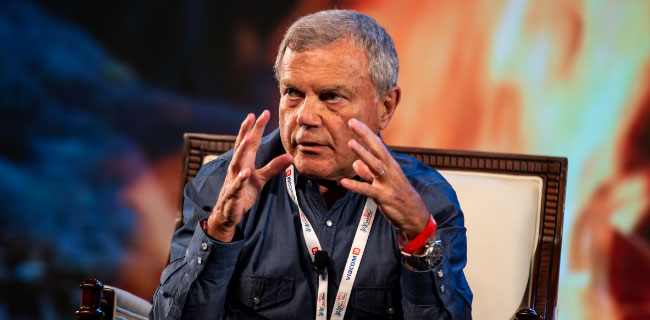
    Former WPP CEO Sir Martin Sorrell has always been bullish on India. And he continues to be that as Executive Chairman of S4 Capital, which is building a new age, new era, digital advertising and marketing services platform for clients.

    Sorrell was CEO of WPP for 33 years, building it from a £1 million “shell” company in 1985 into the world’s largest advertising and marketing services company. Prior to that, Sir Martin was the Group Financial Director of Saatchi & Saatchi Company PLC for 9 years. S4 Capital PLC recently merged with MediaMonks and MightyHive, and is listed at the London Stock Exchange under SFOR.

    We had a quick chat with Sir Sorrell on the sidelines of Day 1 of the IAA World Congress (Feb 20)


    So you’ve been making frequent trips to India in the recent past.

    They are no different to normal.

    Earlier the normal was different…

    But I would say that no dissimilar frequency. I wouldn’t differentiate particularly.

    And the million dollar question is—

    Only a million?

    Well, billion actually, given the acquisitions that you’ve made globally. But are you looking at furthering your business interests with S4 in India?

    Organically, quickly and by acquisition as quick as we can… so we’d be doing both in India.


    Any clues on your wishlist?

    No, I’ve got a wishlist but I mean whether in term vision reality is other question and whether what people tell you and what is there is another question as well.

    Is old friend Sam Balsara’s Madison still on your radar?

    Our operation, you must remember, is focused purely on digital.


    Right, but when you launched you were looking at digital content, data, media planning and buying?

    No, not media planning. First party data and informing digital content and digital media planning which is programmatic.

    The traditional media agency doesn’t come under your radar?

    Well as defined by that, no.

    But at the end of the day it’s all about relationship with clients, right?

    Yes, but that’s a very old-fashioned way of looking at the business. I mean I would turn the question around you and ask you, is it? I mean it may well be that faster, better, cheaper is becoming more important. It may be that people are looking at doing things in a more transparent way. It may be the clients felt that they want to take back control of some of these things. So may well be that they are worried about the height of the gardens in, the height of the walls in the old garden.

    You say that things are not transparent in the traditional media agency model that you created?

    Well I would say that the Indian market tends to be less transparent than other markets.

    It’s often said the media agency business is not all that transparent because of what’s happening?

    Yes, I think, sometimes there’s been a perception of that and sometimes clients or associations of clients you know have been pushing that line unfairly. Sometimes I don’t know they obviously have come across situations, one hopes given by what they said. They come across situations which they didn’t think were fair. But what I would say you can compare India to other markets, I think there is scope for a more transparent model.

    Back to acquisitions. So are these around digital agencies? But there aren’t too many options out there, right?

    No they are small.

    Small?

    Yes because we are at the beginning of the journey. So they are growing bigger.

    But no many of them are doing really all that well, right?

    That broad, sweeping generalisation is probably unfair. There are some that are doing ok. Yes, the ones I’ve seen are doing ok.

    Is there a timeframe for these acquisitions?

    We’ve never had a timeframe…

    Given that you know you are coming here often enough. You are meeting people.

    The cheapest way of doing things is organically.

    But time to get to the market is longer?

    Yes, it takes longer time.

    Have the organic operations started?

    Yes, in the process of starting.

    Any people you’ve hired already?

    Yes.

    Could you reveal the name?

    No.

    You bought Media Monks last July, Mighty Hive in December. What next?

    Well we started in Tokyo and Japan. We are going to start shortly in India. So the one other market we’ve identified is Germany. I would like to do something in Germany and may be France, Spain and Italy at some point in time. But I think that geographically for the moment we know that India would be I think our 15th country.

     But the biggest market place is US?

    Yes I mean US, by and large US is about a third of worldwide advertising. But don’t undersell India.

    Of course.

    Yes, we will the most populous country in the world. Bigger than China, may be not the wealthiest on a per capita basis or absolute basis. But it is growing and I got more faith, probably more faith than you that it is going to grow more faster.

    And you’ve fairly very close to the Indian market, you know the, clients, you know the business?

    I’ve been bullish on India for years.

    Since you are so bullish about India, could you give an indicator of what you’d think would India be as part of your foot print in percentage terms?  

    It’s impossible to say. I mean it depends, if we get traction from a model. The data-driven content and media model could be very significant. Because the other thing that happens here is, you got lot of BPO, back-office type work being done here and so the nuance to the  Indian operation, it’s not just sort of a front office operation, back office operations as well. And the people are so talented. I mean if you said to me, what is the attraction of India? I would say scale and quality of people. Despite the scale, which usually the bigger you are, the more average you get. Despite the quality of the people here is outstanding. Look at the quality of the WPP people – Srini and his colleagues I mean they are superb, yes superb.

    You miss them?

    Listen, I always miss talented people. And as I have said pretty much every time I have come here, if we had the same quality of people outside India that we have in India, I could have retired a long time ago.

    The retirement question keeps coming up.

    Well, I will retire on the job.

    Since you are betting so big on digital, people like P&G’s Mark Pritchard have cast aspersions on the transparency in digital?

    Our operation includes one significant P&G brand, P&G Braun. Our operation plays exactly to what Mark Pritchard has been saying. The willingness to experiment, try different models, faster better cheaper, unitary structure, focus on digital. It plays exactly to what he wants.

    You had mentioned last year, in fact on the day when you announced S4, that you want S4 to be run the way consulting firms work. Given their access to CEO, the Board. Is S4’s operations like them?

    Well I’d love S4 to have a relationship. We want the consulting practices   which gave us that sort of fourth dimension. So you’ve got data driving  content and media making for the three dimensions. The fourth one would be that access. Yes, we do have access to the C-Suite. We do. We can get in there, we do get in there but you know, do clients I mean, this would apply to the Big 6, but do clients really takes seriously our ability to digital transformation or digital disruption? I think the honest answer is no.

    But the consultants have access to the C-Suite

    Having access to the C-Suite and being able to execute is two different things.

    They are buying agencies, right?

    But they are buying small, they are buying bits of pieces and if you got the 100 billion or 40 billion dollar company buying a two or three million dollar company and buying four of them, compounds the felony four times. You know it’s eight times more difficult to integrate four, two or three million dollar operations or even a 100 million dollar operations.

    You were bullish on the way a firm like Accenture was doing. Now you are more critical

    I don’t think I was bullish

    You had said the advertising industry needs to align like the?

    I think I am saying the same thing. They do have that access and I think we have the access as well. But, clients don’t believe that we can put together digital transmission jobs. I mean the claims Publicis, for example, make around digital transformation are unrealistic. If you and I were CEOs of a big business which had a transformation issue or disruption issue in digital and we saw presentations  from Publicis  or from Accenture, I don’t think we would choose Publicis or Deloitte. I don’t think we’d choose Publicis. Likewise I think if we were competing Publicis, we were competing  against Accenture for the implementation of digital marketing job. I don’t think there would be a pro Accenture. So they are all complementary strengths. All I am saying is the way the consultancies can get those complementary strengths is not by tinkering with a dozen small acquisitions. You won’t move the needle.



  • Diageo shines spotlight on gender in advertising on eve of International Women’s Day

    By A Correspondent


    Diageo India eleased a short film about gender balance in advertising on the eve of International Women’s Day. The film discusses the role of advertising in shaping culture, the misrepresentation of women in advertising and strategies and partnerships to support more progressive gender portrayal in content.


    The film also focuses on the importance of diversity in the advertising industry itself –highlighting the organisations working to address imbalances behind the camera and in creative departments.


    Said Diageo CMO Syl Saller: “Through the millennia, culture has been shaped by the stories we tell and if you think about it advertising is telling stories that are backed by billions of dollars to have them heard. I am convinced we can normalize gender equality with what we choose to show in our ads, and who we choose to make them. We strongly believe that diverse teams create all kinds of different stories, stories which portray men and women as they really are, stories that are eminently relatable.”


    Said Julie Bramham, CMO at Diageo India: “India is continuously evolving, and it is the diverse and vibrant voices of the nation that are driving progress. Hence it is important to tell authentic stories which celebrate the connection that not just men, but also women have with our brands. We are committed to showcasing a progressive and gender-balanced world in our communication and also drive parity behind the camera because equality is for life, not just for International Women’s Day.”


  • Tangrams aligns with Spikes Asia

    By A Correspondent


    Tangrams, the APAC strategy and effectiveness awards, has announced the alignment of the awards key dates with Spikes Asia awards in 2019. This year, the Tangrams Strategy & Effectiveness awards will open for entries on April 15, on the same day as Spikes Asia awards. The new arrangement allows entrants to submit campaigns into both awards and have them recognised for strategy and effectiveness as well as creative excellence.


    Commenting on the alignment, Joe Pullos, Festivals Director, said: “We want to transform Spikes Asia into a holistic festival & awards program that not only serves as a benchmark for creativity excellence, but also for marketing strategy and effectiveness in our industry and brings together brands and agencies alike.”


    Judging of both awards will take place simultaneously during Spikes Asia Festival of Creativity. The Tangrams Strategy & Effectiveness awards show will be presented on all three days at the Spikes Asia Festival of Creativity.


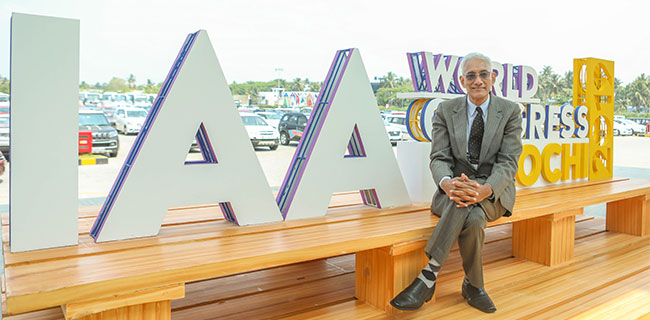
  • India can be proud of staging IAA World Congress: Srinivasan K Swamy


    Impossible is not a word that you’ll ever find in the books of Srinivasan K Swamy, Chairman and World President of the International Advertising Association (IAA). Hardly had the IAA World Congress at Kochi got over, he was busy working on plans for the next few projects. And of course achieving his dreams for IAA across the world.

    The Chairman of the RK Swamy Hansa Group, Swamy took on the global charge in October. A quick chat with

    Srinivasan K Swamy on the success of the IAA World Congress and what’s next on the IAA calendar. A slightly shorter variant of this interview appeared as part of a pull-out published with Business Standard today, March 12. Compiled by MxMIndia. Published and conceived by The Resource 24×7


    You had set yourself near-impossible targets for the IAA World Congress. Now that the Congress is over, and the feedback received indicates that it was very successful, what are your own thoughts? Are you happy with what you set out to achieve?

    Frankly, during the last few days prior to the Congress, it all came together. Of course the speakers were done and dusted well in advance. A few cancellations in speakers were always expected and we had some options that we exercised, without compromising on what we set out to do. The only reason we settled for Grand Hyatt Lulu Convention Centre in Kochi was because only this venue could host a capacity of 2500 delegates in India, that too in style. Our target for participation at the Congress was set at 2500, the full capacity, and we exceeded that too thanks to the enormous support we received from Kerala delegates.  We also felt the evenings is what would make the event memorable and these were executed to perfection. All our international delegates were overawed by the scale and the grandeur of the event, and India can certainly be proud of staging this spectacular international event in India.


    And we now hear that the next IAA World Congress is in St Petersburg, Russia next year. How will you better the really high benchmark that you’ve set with Kochi?

    St Petersburg is a beautiful city with many palaces and historical monuments. It  starts off with that advantage straightaway. The event is going to be conducted in late May 2020, when the sun never sets. It will be a new experience for many delegates during these ‘white nights’. Further, it will be more easily accessible from many European cities, so more international delegates will be a natural consequence. And last but not the least, the Governor of St Petersburg, the City Administration and the Federal Russian Government are fully backing the Congress and are very keen to ensure that the event will be a world-beater in both content and entertainment. We have already formed a committee of experienced people to finalise all details and I am sure the St Petersburg Congress will in no way fall short of the benchmark we have set for ourselves in Kochi.


    Pre-event, you had mentioned that the real work on the Congress happened only in the last six-odd months. Given that all of you amongst the key organisers have other businesses to look into, what were the challenges that you faced?

    The actual work for the Congress started well over 18 months ago. Many of the speakers were finalised well in advance. As is always the case, the momentum builds in the last few months when strong marketing efforts are put in for delegates to sign up. When we are organising an important event like the World Congress, our business demands do take the backseat. And fortunately, none of the core committee members complained in this regard and tirelessly plugged along.


    The IAA World Congress in India is just a one-off event. Do you have plans to harness the momentum that the IAA franchise gained in India over the next few months?

    We have many good global events coming up. We will have the Africa Rising conference taking place in May 2019 at Accra, Ghana. In June, we will be in Cannes, France having our own leadership sessions. In October, we plan on our third edition of the IAA Global Conference in Bucharest on Creativity4Better. There are couple of other things on the anvil which will be announced once the plans/dates are finalised. Events apart, we are putting enormous emphasis on Education. We have already accredited 44 institutions on marketing/ advertising courses and we want to provide active support to them, apart from expanding our accredited institutions base to twice that large over the next two years.


    The IAA is of course a lot more than the World Congress, and in your presentation at the opening ceremony, you spoke about the work that you intend undertaking in the field of digital privacy? It’s a huge ask given the extent of intrusion that has taken place. What are your specific plans?

    Privacy in the digital world is a matter of concern for everyone. No wonder the governments of various countries are stepping in to protect their Citizens. IAA believes that over-regulation may not necessarily be in the interest of the consumer, because it could impair on the efficacy of well-targeted communication. As a strong promoter and defender of advertising self-regulation, IAA is of the view that a strong data privacy regulation would actually act against the interest of the consumers. Advertising after all is a major source for economic growth. It promotes competition, thereby innovation, improves product quality, promotes choice, reduces prices. Excessive privacy laws would make targeted advertising difficult making the cost of advertising very high impacting on all the benefits of advertising listed.  With 43% of the global advertising budget going to digital, regressive privacy laws will change the business of advertising as we know it. IAA is therefore trying to speak to all the stakeholders – advertisers, agencies, media, digital companies, technology companies etc – to hopefully arrive at a self-regulation code we all can subscribe to and also develop a mechanism to oversee this. The response from the people I have reached out to has been overwhelming and I am sure many of what we need to do, will be based on further consultation with multiple stakeholders. As they say, watch this space!


    The India chapter has been super-active ever since you helmed it. Do we see you inspire other country chapters to also become as active as the India chapter?

    IAA Chapters are only as active as the leaders leading them. And another ingredient that is needed for this is the quantity of members. Our focus at IAA will be on both these fronts. We have already made some changes in our by-laws which will aid in membership-building. We have put in place some guidelines to check the health of the Chapters. And we do want to get Chapters to adopt certain common events from the vast repertoire of events we have in many of our Chapters. We have some distance to cover in this but I can say the journey has begun!


    A slightly shorter variant of this interview appeared as part of a pull-out published with Business Standard today, March 12. Compiled by MxMIndia. Published and conceived by The Resource 24×7


  • Ranjeev Vij joins Ogilvy Delhi as Managing Partner

    By A Correspondent


    Ogilvy has announced the appointment of Ranjeev Vij as Managing Partner of its Delhi office. In his new role, Vij will report in to Kapil Arora and will be responsible for the running of the Delhi office operations along with recently appointed Managing Partner, Amarinder Butalia.


    Said Arora: “I am glad to welcome Ranjeev into the Ogilvy family. With his rich and varied experience, he brings to the table a great combination of brand building capability and modern marketing knowhow, both skills that will greatly benefit our clients in Delhi.”


    Added Vij: “Ogilvy is like homecoming for me. The energy and the enthusiasm each person in the organisation has for creativity and craft is exceptional and I have unshakable faith in its talent. I believe with my hybrid work experience, I will be able to add value to our clients and deliver on the One Ogilvy vision – that helps bridge the gap between traditional and digital landscape and envisages an integrated offering built around client needs.”


  • VMLY&R India appoints Kevin Lobo as ECD 

    By A Correspondent


    Kevin Lobo

    VMLY&R has announced the appointment of Kevin Lobo as Executive Creative Director, VMLY&R India, adding to the rapidly expanding creative team put together by Venkatgiri Rao, CCO, VMLY&R SEA & India. He joins VMLY&R from Leo Burnett.


    Lobo brings more than a decade of experience driving campaigns for global and Indian brands such as Diageo, Unilever, Bajaj Motorcycles, Bajaj Allianz, Parle, Maybelline, Parachute, Cadbury’s and Adidas.


    Said Rao: “Kevin is a delightful, creative thinker and a sharp strategic brain, with a focus on work that works – a rare and powerful combination. His experience on bold, new-age campaigns is why he is perfectly suited for an idea-first agency like VMLY&R, which leads with digital thinking while doing integrated work for brands. Also, the sheer energy and learning he brings to the game every day is inspiring. Making him a perfect mentor for our young talent looking to learn the business.”


    Commenting on his new position, Lobo added: “VMLY&R is consistently in the Top 10 on Adage’s Agency A-List, rubbing shoulders with the best of the best in the world, so it was a no-brainer for me to join. The lines between mainline and digital advertising are blurring fast, and at VMLY&R, I see that at work every day. Young creatives here are not just creating integrated campaigns for local brands but for top brands in Singapore and Indonesia as well. The energy is infectious! With solid tech and innovation capabilities and great ambition, I hope I can contribute to VMLY&R India joining the A-list soon.”


    Said Tripti Lochan, Co-CEO, VMLY&R Asia: “Kevin brings an inspired view to every piece of work, and with experience leading teams to success, I am confident that he is a great addition to VMLY&R. As we build our presence in India, we are excited to have his perspective and expertise driving success for our clients.”


  • L&K Saatchi appoints Trishay Kotwal and Arthi Basak

    By A Correspondent


    Arthi Basak & Trishay Kotwal

    L&K Saatchi & Saatchi has announced the appointment of Trishay Kotwal as Executive Creative Director. In his new role, he will report to Kartik Smetacek, Joint National Creative Director, L&K Saatchi & Saatchi. Over the past fifteen years he has worked in New Delhi and Mumbai, across a number of creative agencies including, Lowe, McCann Erickson, and Draft FCB.


    Also, Arthi Basak erstwhile AVP, FCB Interface has joined L&K Saatchi & Saatchi as VP – Strategy and Planning. In her new role, she will be reporting to Snehasis Bose, Executive Director-Planning, L&K Saatchi & Saatchi.


    Anil Nair

    Said Anil S Nair, CEO and Managing Partner, L&K Saatchi & Saatchi: “I am very excited to welcome two exceptional talents Arthi and Trishay to L&K Saatchi & Saatchi. Both have immense experience & fantastic skills in their respective fields which will be of great value to our wide range of brands across many categories. I look forward to them raising the bar even higher for us.”


  • On Purpose beefs up leadership team

    By A Correspondent


    On Purpose, a creative communications consultancy, has made three senior hires strengthening its team and offering for clients in strategic media counsel, crisis communications, digital media, capacity building and content solutions.


    Meera Krishnan joins as Consulting Partner and will be partnering with Founder and Managing Partner, Girish Balachandran. Meanwhile Diksha Sethi has joined as Head of Strategy after a short sabbatical and Neha Mathrani has joined as Content Lead.


    Commenting on the new hires, Balachandran, said: “We’re excited about being able to attract such experienced talent from both within and outside the industry. Our hiring strategy is rooted in what we’re hearing from both brands and organisations working in social change and those wanting to articulate brand purpose authentically.”


  • ASCI urges consumers to take action against misleading ads

    By A Correspondent


    It’s World Consumer Rights Day today (March 15) and on the occasion, the Advertising Standards Council of India (ASCI) is urging consumers to not just be vigilant but also take action against misleading advertisements by informing ASCI via a WhatsApp message on +91 77100 12345.


    Said D Shivakumar, Chairman, ASCI: “Consumer is the king or queen and has a voice today, thanks to the digital medium. ASCI encourages consumers to reach out to ASCI using our WhatsApp number, it’s as simple as that.”


  • Kantar’s report delves into gender targeting in advertising

    By A Correspondent


    Marketers are reinforcing rather than helping to eradicate harmful gender-based stereotypes. That’s according to the latest AdReaction report released by Kantar, which reveals the disconnect between consumer and business opinions of gender portrayals in advertising. While the clear majority of marketers globally think they are avoiding gender stereotypes, 76 per cent of female consumers and 71 per cent of male consumers believe that the way they’re portrayed in advertising is completely out of touch.


    The latest AdReaction report from Kantar includes analysis on advertising creativity and media effectiveness both globally and in India. This is based on a comprehensive analysis of how women and men are portrayed in ads, and how they respond differently to marketing. The report aims to guide marketers on their gender progress journey and help brands grow, by Getting Gender Right.


    Commenting on the study findings, Vishikh Talwar- Managing Director- Kantar Millward Brown, South Asia, said: “Gender is a sensitive topic – one that society is currently renegotiating across social, cultural, political and commercial spheres. The India leg of the survey comes at a very pertinent time as the subject of gender portrayal has gained immense importance both globally and closer to home. The report highlights that the bulk of ads in India are targeted at women; but marketers appear to be targeting them led more by stereotypes. Gender targeting should not be an either/ or decision and we need to challenge these outdated assumptions. From a portrayals perspective, more emphases need to be made towards aspirational and authoritative roles. The industry as a whole needs to be more aware than ever that things need to change.”


  • Hemal Bhuptani joins Network Advertising as Senior VP

    By A Correspondent


    Hemal Bhuptani has joined Network Advertising as Senior Vice-President, Client Services.


    Said Vinod Nair, Managing Director of Network Advertising: “To further our belief that Holistic Brand Solutions is the only way to nurture brands in today’s disintegrated world, we are fortunate to have an integrated communications professional like Hemal on board”.


    Added Bhuptani: “I have always been fascinated by the process of building brands in a 360-degree manner. I am keenly looking forward to my role in Network Advertising which is a truly integrated communications agency and will give me the opportunity to provide the right solutions for the brands we handle”.


  • Tata stays as Interbrand #1


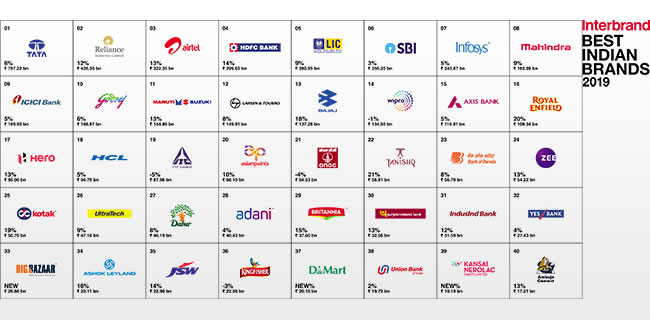
    Interbrand, the Omnicom-owned brand consultancy has named Tata, Reliance and Airtel as the three most valuable Indian brands of 2019. In its sixth year, the Best Indian Brands ranking saw retail make its presence felt in the league table, which was otherwise dominated by Automotive, Diversified Businesses & Financial Services sectors. Interbrand, it may be noted, only looks at the homegrown Indian brands, so the MNC brands are missing, even though they are popular, bestselling and trusted.


    The Auto sector shifts gears to drive top growth. Mirroring the brave global brands more than any other sector, the auto brands showed the way to the rest this year. Royal Enfield, Bajaj Auto, Ashok Leyland, Hero, Maruti Suzuki and Mahindra demonstrate growth higher than average.


    This year’s table features three new entrants. Big Bazaar joins at #33 (INR 26.86 Bn), DMart at #37 (INR 20.15 Bn) and Nerolac Paints enters the table at #39 (INR 19.19 Bn) for the first time. On the other hand, Reliance Group (R-ADAG; last on in 2017, INR 46.56 Bn) and Canara Bank (last on in 2017, INR 19.73 Bn) exited the list this year.


    The combined value of the Top 40 brands was INR 5.03 trillion, which represented a 5.2% growth in value over the previous year. Tanishq, Royal Enfield, Kotak, Bajaj Auto, Ashok Leyland and Britannia were amongst the fastest growing brands.


    Ever since its inception, Tata has continued to hold the top position in the Best Indian Brands table. However, Tata’s brand value grew by a modest 6.5% – contributed significantly by its tech services business TCS. In the same vein, Reliance, which after taking over the #2 spot from Airtel last year, consolidated itself as a strong #2 with a growth in brand value of 12%. This performance was bolstered by the phenomenal growth of JIO. HDFC Bank, LIC, State Bank of India, Infosys, Mahindra, ICICI Bank and Godrej round off the Top 10.


    Financial Services and Auto contributed the most to this year’s Top 40, at 27% and 13% of value.


    Said Ashish Mishra, Managing Director, Interbrand India: “Most Indian businesses looked at change as a big risk to their existence. But to them we would say: Risk is no longer in changing. But in not changing. And challenge is no longer just the competition or the ever-changing business environment. It’s our own inertia. Our fear of the new, of the unknown. And yet, most inevitably fight that change, trying to bend a fast-changing world to their obsolescence. What’s really encouraging is that we are now seeing the progressive few accept that the world is changing and making attempts to change. They acknowledge the new consumer preferences. They accept the new desire for experiences and respond positively. Replacing complacency with competitiveness. To reinvent themselves before they reinvent their categories. And remain unafraid of the change to drive brave growth. That, in sum, is the secret behind this year’s Top 40’s success.”


    Providing a global perspective on the Best Indian Brands 2019, Rebecca Robins, Interbrand’s global Culture and Learning Officer, added: “In a fast-changing world, brands are the only assets that companies can fall back on, to navigate the challenges. Indeed, brands are the crucial interface between technology and consumers, that channel an organisation’s efforts to engender growth. Globally, the one category that has managed this well, to constantly evolve; to lead new ecosystems; to craft highly personalised and meaningful micro-experiences while still being rooted in a larger purpose, is luxury. No wonder then, that the world’s and India’s top change drivers are taking a leaf out of the luxury playbook, to grow by adopting a “luxury mindset”