Category: ADVERTISING

  • AdEx to grow 16.4% in 2019: Madison


    By A Correspondent


    Media agency network Madison is bullish about 2019 and expects a growth of 16.4% taking the total AdEx to Rs 70,888 crores. “The reasons for our high forecast are upcoming Parliamentary elections, increase in government spending to showcase its achievements, the upcoming ICC Cricket World Cup 2019, growth of OTT, increased spending in rural and India moving to a consumption society,” notes a communique, adding: “In 2019, we believe highest growth will come from Digital at 33%, followed by Cinema at 30% (although on a very small base), followed by TV (18%), Radio (12%), Outdoor (11%) and Print (5%).”

    Adspends have grown from Rs 53,138 crore to Rs 60,908 crore, an addition of  7,769 crores, the highest addition in one year in the last decade. The growth rate of 14.6% achieved in 2018 is almost double the growth rate achieved in 2017, notes the Pitch Madison Advertising Report 2019 release on Wednesday.

    Television still continues to be the largest contributor to Adex with 38% share, followed by Print at 32%, Digital at 19%. Outdoor, Radio and Cinema share has remained steady at 6%, 4% and 1% over the last 3 years.


    Figures at a glance:

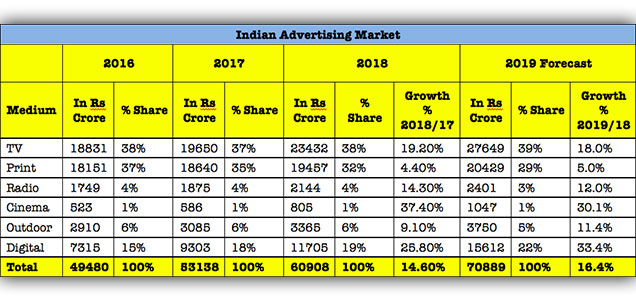
    Indian Advertising Market
    2016 2017 2018 2019 Forecast
    Medium In Rs Crore % Share In Rs Crore % Share In Rs Crore % Share Growth % 2018/17 In Rs Crore % Share Growth % 2019/18
    TV 18831 38% 19650 37% 23432 38% 19.20% 27649 39% 18.0%
    Print 18151 37% 18640 35% 19457 32% 4.40% 20429 29% 5.0%
    Radio 1749 4% 1875 4% 2144 4% 14.30% 2401 3% 12.0%
    Cinema 523 1% 586 1% 805 1% 37.40% 1047 1% 30.1%
    Outdoor 2910 6% 3085 6% 3365 6% 9.10% 3750 5% 11.4%
    Digital 7315 15% 9303 18% 11705 19% 25.80% 15612 22% 33.4%
    Total 49480 100% 53138 100% 60908 100% 14.60% 70889 100% 16.4%


    Other findings of the report, as per the communique:


    1. TV:
      • TV grew by an unbelievable 19% to reach close to the   Rs. 23,500 crore mark, reinforcing regular Advertisers’ unshakable faith in this medium, no doubt aided by the robust measurement mechanism set up by our Industry.
      • This is the highest growth TV has witnessed in last 3 years. In terms of absolute numbers, TV advertising has grown by Rs. 3,782 crore in 2018.
      • And its share in the Adex pie stands at 38%. Whilst its share has declined over the decade from 43% in 2009, it is significant that since 2015 it has increased its lead over Print and now the gap in share is as much as 6 percentage points.
      • The main categories that have fueled the overall growth of Rs. 3,782 crores in 2018 are the evergreen FMCG (Rs. 1,660 crores) and Auto (Rs. 360 crores). E-commerce category too grew dramatically by 29% to reach Rs. 1,100 crores from Rs. 850 crores in 2017.
      • FMCG continues to rule the roost contributing as much as 50% to the total Television Adex, followed by Telecom at 12% and Auto at 8%.
      • Increase in FCT has also been a big contributing factor to the overall increase of 19% in the TV Advertising Market. The overall FCT demand in 2018 has increased by 12% led by growth in frequency channels and new channel launches.


    1. Print
    • India probably is the only major market where Print Adex is actually growing year on year.
    • Print grew by 4.4% during the year, marginally lower than our projection of 5%.
    • However, Print continues to be 2ndhighest contributor after Television with a share of 32%. And this share of Adex is also the highest in the world.
    • The resilience of Print is brought out in the fact that it has 200,000 Advertisers and the number is growing, compared to TV which has only 12,000 Advertisers.
    • Nearly 75%, of Print’s growth of Rs 820 crores is accounted by just 5 categories – FMCG, Education, Auto, Retail & E-commerce.
    • In terms of Volume, Hindi publications continue to be ahead of English publications contributing 35% of the total volume, while share of English publications dropped by 2% and now contributes 25%.


    1. Digital
    • The digital advertising market had an impressive growth of 26% in 2018. It has been growing at a compounded annual growth of 30%+ for last 10 years and 24% for last 5 years.
    • The continued growth of digital is fueled by mobile, online video and social media, which are increasingly attracting more advertising investment.
    • One of the key reasons for this growth has been the proliferation of OTT platforms. The OTT playing field has seen a 3.5x increase in number of players from just 9 players in 2016 to 30 players now.
    • Digital Adex at Rs. 11,705 crores is now 19% of Adex in 2018. It was only 9% in 2013.
    • Google and Facebook continue to dominate digital spends cornering 80% of the total digital pie.


    Says Mr. Sam Balsara, Chairman, Madison World, “After two dull years, 2018 has seen significant growth in Television and Digital and we expect the momentum to continue in 2019. With this growth, India has regained its pole position of being the fastest growing advertising market in the world and is expected to retain this position even in 2019.


    There is no doubt that for Advertisers, Media has become a complex subject and they need competent and experienced, creative media planners, working in enabling environments, provided by good media agencies to build their Brands.”


    If you would like a full copy of the Report, please email rj@madisonindia.com 


  • GroupM forecasts 14% adspends growth


    By A Correspondent


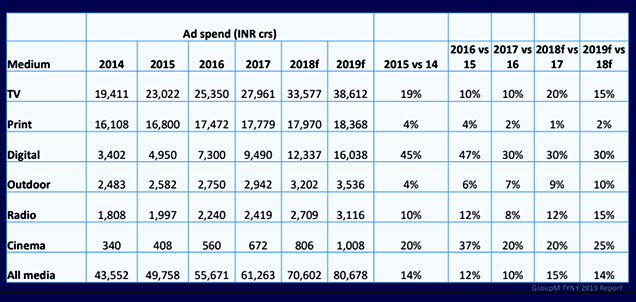
    GroupM, the media investment group of WPP, announced its advertising expenditure (AdEx) forecasts for India for the year 2019.  As per the ‘This Year, Next Year’ (TYNY) 2019 report, India tops the list as the fastest growing major ad market in the world. TYNY forecasts India’s advertising investment to reach an estimated Rs. 80,678 crores this year. This represents strong estimated growth of 14%, for the calendar year 2019 (approx 2x of the GDP growth).


    India will be the third highest contributor to the incremental ad spends, only behind China and USA and the tenth fastest growing country with respect to ad spends across the globe.


    The Cricket World Cup and Elections in 2019 are expected to boost adspends. FMCG, Auto, Retail, e-commerce, Tech/Telecom are expected to contribute to 2/3rd of the AdEx. According to GroupM, the special events of the year (World Cup Cricket and Elections) will add around 3 per cent to the 11 per cent organic growth forecast for the year.


    Speaking on the TYNY 2019 report, Sam Singh, CEO – GroupM South Asia said: “While we are estimating the global advertising expenditure to grow at 3.6%, India would be witnessing the fastest growth at 14% and reach an estimated Rs.80,578 crores. This would be approximately 2x of the estimated GDP growth in India. This also makes India the third largest adex growth to the worldwide ad spends. We expect sustained and stable media investment growth across categories in India”


    This year 37% of incremental ad pends will go towards digital advertising including mobile. The scale at which we are witnessing this digital transformation, GroupM estimates the Digital Adex to continue to grow by 30% in 2019 to Rs. 16,038 crores.


    Added Prasanth Kumar, Chief Operating Officer – GroupM South Asia: “Indian adspends CAGR between 2014-2018 is at 13% and 2019 expected to witness a higher growth. India is unique among key markets and will witness growth in all media segments and not just digital. Offline media is poised to continue to grow and will contribute to being around 80% of ad spends in 2019.”


    Television will continue to grow at a steady pace. This year, the growth rate for TV is estimated to be 15%.


    Print is estimated to grow by 2.2% and the share of print to all media is expected to be at 23%. While it is expected for both English and regional languages to grow, regional will see slightly higher growth. Vernacular will continue to thrive on both TV and print.


    This year radio is expected to grow at 15% which is higher than the last couple of years. Cinema will grow at 25% in 2019, as 2018 saw more titles winning audience at the box office. In 2019 GroupM expects cinema to shift from title-based advertising to continued advertising through the year. Lower tax on cinema tickets is expected to drive more footfalls to theatres.


    GroupM also presented some of the biggest trends that will shape the media Industry in India in 2019. The trends presented were around emerging technology, data, content creation and distribution put the consumer at the center and underline the theme of digital driving the change across all formats of media. The trends touched upon the TRAI tariff order implementation as well its potential impact of increasing original programming and investments on content across broadcaster networks.


    Said Tushar Vyas, President Growth and Transformation – GroupM South Asia: “With the surge of technology, better insights and relevant engagement across different platforms, we are expecting marketers to build superior consumer connections for brands. 2019 will witness a faster growth in digital and we are expecting digital to be at 20% media mix. As we are witnessing one in every three Indians digitally connected, we can expect the convergence of data, digital and content to deliver seamless and powerful solutions to brands as well as constantly adding inventive practices into the market.”  ESP Properties head Vinit Karnik also spoke on the occasion.


    TYNY 2019 Media Handout

  • Publicis Sapient unveils new brand positioning; appoints global CEO

    By A Correspondent


    Publicis Sapient has announced that it is positioning the company for growth through a focus on global digital business transformation opportunities; the ongoing delivery of best-in-class capabilities across strategy and consulting, experience, and engineering; and the attraction and development of the best industry talent.


    Effective immediately, Nigel Vaz will become the global Chief Executive Officer of Publicis Sapient.


    The announcements are designed to advance Publicis Sapient’s position as a leader in the digital business transformation space and deliver consistency across global markets and industries. Further, they signal Publicis Groupe’s on-going commitment to placing consulting, creativity and technology at the service of our clients’ transformation, to advance their business performance and sustained market relevance during a time of unprecedented digital disruption.


  • ACT Fibernet unveils new brand identity

    By A Correspondent


    Atria Convergence Technologies’ ACT Fibernet has launched its new brand identity with the unveiling of the logo and tagline ‘Feel the Advantage’. The rebranding initiative is a strategic component of Act Fibernet to becoming the most admired in-home entertainment and interactive internet services provider in India.


    As part of the activity, ACT Fibernet will partner with content partners like Zee 5 and Sony Liv amongst others to strengthen its content offerings. Within the next six months, ACT Fibernet plans to launch its broadband internet connection plans in multiple cities across North and West India, thereby expanding its footprint in the country. The company will also be launching a 24×7 call centre and a unified call centre number to address customer queries in real time.


    Speaking on the launch, Bala Malladi, CEO, Atria Convergence Technologies (ACT) Ltd said: “We have always believed in providing our customers the best solutions through our products and services. Today, consumer needs and usage behavior is continuously evolving. Newer technologies are constantly being adopted and becoming mass-scale by the day, be it streaming or gaming or smart homes. It is therefore our responsibility to work in conjunction with the rapidly evolving customer’s expectations and find feasible ways to serve them. We strongly believe that our new brand identity reflects this value and commitment we have towards our customers.”


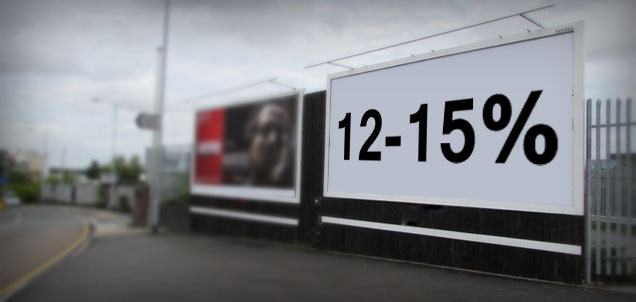
  • Posterscope predicts 12-15% growth for OOH in 2019


    By A Correspondent


    It’s the season for adspend forecasts. And here’s for OOH only from Dentsu Aegis Network arm Posterscopre. The 2019 is expected to be another important and exciting year for OOH in India, it notes expecting growth rate to be anywhere between 12-15 per cent.


    Posterscope India predicts disruptive growth this year on the back of important events like the upcoming General Elections, Cricket World Cup, and the Indian Premier league among other marquee events.


    It notes that digital out-of-home (DOOH) inventory will continue to increase and reach the levels of respectability it deserves while its share of revenue will see a significant rise. New categories of advertisers will come to the fore and dislodge some traditionally strong advertising categories. Meanwhile, newer infrastructure will provide varied and interesting advertising options.


    Here are some of the key developments that Posterscope believes will continue to drive OOH’s rapid evolution:


    Data-driven OOH: Campaigns will be driven using data that go beyond demographics to online behaviour, card transactions, app usage and location analytics to decide where the OOH ads should appear.


    ROI-led OOH: ROI will be the driving force in the next 12 months. Posterscope India expects to see boundaries in OOH being pushed through digitisation, automation, scientific planning tools, machine learning and cross-media collaborations to drive and achieve returns that are in line with other media offerings.


    Growing digital OOH: With DOOH inventory increasing, advertisers can now unlock at scale the flexible capabilities of DOOH by running creative bespoke to key triggers such as time, audience and weather. Posterscope’s ROOH digital OOH exchange is pioneering efforts in this space.


    Cluttered event calendar: The year being a particularly busy one in terms of large ticket events from sports, entertainment and even elections, we believe there will be a surge of investments from a varied base of advertisers.


    Location intelligence: As locations-based marketing specialists, Posterscope India believes in its ability to act as a common thread to tie multiple data sets together to create a clear OOH story about what’s changing the way out-of-home is being offered.


    Smart cities: A new area of urban development is upon most major cities globally, and in India, this is coined under the ever-ambiguous term and scope of ‘Smart Cities’. The way in which technology will redefine everyday tasks, transport and logistic services is now becoming a reality. Via partnerships with leading smart city development organisations, The Digit Group and DG Cities, Posterscope India is creating opportunities and encouraging brands to lean in, learn and redefine how this investment can last a lifetime.


    Disruptive OOH: Consumers are now always connected with more than 90% of OOH consumers using their phone whilst OOH in each week. In addition, we spend over two hours every day on social and messaging platforms sharing the things we stumble across and catch our eye in the OOH space. Now more than ever, disruptive innovations can deliver attention and engagement far beyond where it stands in the real-world through digital sharing.


    Said Fabian Cowan, Director, Posterscope India: “In a fast-paced ever-changing out-of-home ecosystem, having informed intelligence of what are going to be the drivers of change is critical to our offerings and client associations. We firmly believe that we have the leading technology platform, the best planning tools, the strongest data and analytics capabilities, the most advanced automation programme, the broadest and most diversified view of the out-of-home channel and, most importantly, the best people to manifest and deliver the best ooh solutions.”


    Added Haresh Nayak, Group MD, Posterscope – South Asia: “As industry leaders we are driving change across the medium. Our predictions are not only based on year-long research and a close watch on trends but also based on our understanding of how cities and consumers transform with advancements in technology, access to data, infrastructural developments and evolved travel patterns. 2019 is poised to be a very exciting year for OOH and our predictions depict that amply.”


  • Indian Ad Industry: Are Happy Times Really Here Again?


    By Indrani Sen


    Indrani Sen

    Last week, the advertising and media industry probably had an overdose of data and information to chew, both GroupM and Madison released their annual reports on industry AdEx “This Year Next Year” (TYNY) 2019 and “Pitch Madison Advertising Report” (PMAR) 2019; Dentsu Aegis Network’s arm Posterscopre released a forecast for only OOH industry followed by the TAM AdEx Report and the results of the DD Free Dish e-auction held from February 11 to 14, 2019. It will not make any sense to discuss the implications of all the reports together. Let me today take a look at TYNY 2019 and PMAR 2019 released by GroupM and Madison.

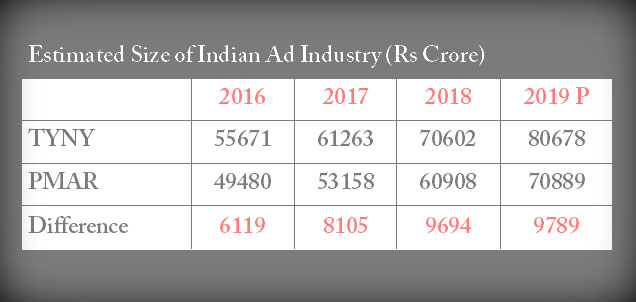
    By now, industry professionals are reconciled to the reality that there is a big gap in the estimation of the size of the Indian Ad Industry by the two agencies. However, as an academic I find it difficult to explain the reasons of the same to my students. I was alarmed to find earlier that since 2016, the gap in real terms increased year on year till 2018 as shown in the chart below. It is reliving to find from the recent reports that the same is not increasing further in the estimates made for 2019 by GroupM and Madison. We can probably hope that in another few years the difference between the two estimates will be reduced to 4% to 8%, the acceptable statistical margin of error at the 95% confidence level.

    Estimated Size of Indian Ad Industry (Rs Crore)
    2016 2017 2018 2019 P
    TYNY 55671 61263 70602 80678
    PMAR 49480 53158 60908 70889
    Difference 6119 8105 9694 9789


    A comparative analysis of the 2018 adspends by media made in the two reports show that the main bone of contention between the two is in the estimated size and share of TV media. Apart from TV, the differences in the estimated size in rupee value of Print, Digital and Radio fall within the acceptable margin of error ranging from 4% to 8%.The estimated size in rupee value are very close for OOH and same for Cinema. The detailed analysis is given below:

    Indian Ad Industry 2018: Estimated Size (Rs Crore) & Share (%)

     Rs. Crore 2018 f   2018  
    Media TYNY %share PMAR %share
    TV 33577 48 23432 38
    Print 17970 25 19467 32
    Digital 12337 17 11706 19
    OOH 3202 5 3365 6
    Radio 2709 4 2144 4
    Cinema 806 1 805 1
    Total 70602 100 60908 100
    Growth over last year 11%   12%  


    In terms of forecasts for 2019, the growth rates predicted by TYNY for different media are lower than the growth rates predicted by PMAR, apart from Radio where TYNY has predicted a higher growth rate than PMAR. Both the reports agree that the highest growth rate will be in Digital media fuelled by mobile, online video and social media, followed by Cinema though on a very small base. In terms of overall growth, TYNY has pegged it at 14%, 2.4% lower than the prediction of PMAR at 16.4%.

    Indian Ad Industry Forecast
    2019p 2019p
    Rs Crore TYNY %  Share Growth % PMAR % Share Growth %
    TV 38612 48 15 27649 39 18
    Print 18368 23 2 20442 29 5
    Digital 16038 20 30 15612 22 33
    OOH 3536 4 10 3750 5 11
    Radio 3116 4 15 2401 3 12
    Cinema 1008 1 25 1047 1 30
    Total 80678 100 14 70889 100 16.4


    Both the agencies have cited upcoming Parliamentary elections and ICC Cricket World Cup 2019 as major contributor to the growth in ad spends in 2019. While Madison have cited increase in government spending to showcase its achievements, the growth of OTT, increased spending in rural sector and India moving to a consumption society as the other reasons for predicting a high growth for the ad industry, GroupM has highlighted major trends like emerging technology, availability of data, content creation and distribution, etc. as factors contributing to the growth in advertising expenditure. There is no doubt that after two bad years in 2016 and 2017, Indian advertising industry has turned around in 2018 and is poised for further growth in 2019.

    Let me turn around and play the role of Devil’s advocate musing over what can disrupt the rosy dreams of advertising industry during next year. Over the last four days all of us are reeling under the effect of the terrorist attack in Pulwama killing 40 CRPF jawans. The entire nation wants revenge and our expectations have increased since the last surgical attack. Such attacks and counter attacks may lead to unforeseen developments affecting our economy and business.

    After the results of the last round of state elections, many political analysts think that BJP may have to depend on coalition with other political parties to run the Government in Centre after the next General Election which may affect smooth functioning of the Government. The gross overspending (Rs. 99610 crores over approved expenditure) by the Union Government as reported recently by CAG may have a diverse effect on various government approved projects in future as well as rural development.

    If RBI falls in line with the directives of the Finance Ministry, then India’s financial ratings may suffer globally and rupee may face further devaluation in its foreign exchange rate. There could be changes in the domestic as well as foreign policies of US which will have far reaching effect on the entire world and India will not be an exception. To sum up, we are living in very uncertain times when any significant change in internal or external political situations or foreign/ economic policies can adversely affect the growth of our advertising industry. Let us keep our fingers crossed and hope that the predictions for the growth in advertising in 2019 made by TYNY and PMAR will be realised without any major disruption.


    List of my articles related to this topic over last three years:


    Feb 20, 2018 Mind the TV AdEx Gap

    Feb 20, 2017 What is the real size of the Indian Ad Industry

    Nov 21, 2016 Post Demonetisation, it’s boom to doom for ad spends

    Feb 15, 2016 Boomtime for Media: A Review of Pitch Madison Advertising Report 2016


  • Laqshya Media launches tool to measure OOH

    By A Correspondent


    Laqshya Media Group (LMG) has launched SHARP (Strategic Hyperlocal AI-powered Reach Planner), a planning tool for measuring the effectiveness and media value of outdoor campaigns.


    The OOH tool uses machine learning to deliver AI-optimised metrics and recommendations, notes a communique. The system is fed with data received from more than 50,000 geo-tagged sites comprising of billboards, BQS sites, mall facades, pillars and poles across 26 cities.


    Said Alok Jalan, Managing Director, Laqshya Media Group: “As an Industry leader, it was but natural that we had to resolve client concerns about the lack of measurement metrics in the OOH Industry. SHARP has been the outcome of months of hard work & is unmatched in its ability to give a scientific rationale for an OOH campaign.  A massive immersion of data and technology has been done to generate the right algorithms for Machine learning. In addition, APIs of numerous consumption economy platforms have been integrated with the software to have a dynamic tracking of consumer interest points. While planning marketing budgets for a campaign, OOH usually gets a lower share of the pie; SHARP is set to change this. With better data and targeting, brands will be better assured of return on OOH investment, which in turn has the potential to alter the share of wallet for the medium.”


  • 10 reasons why the IAA World Congress @ Kochi is the place to be in


    The 44th edition of the IAA World Congress starts in Kochi today. It’s billed as the biggest convention in the marketing services world. With a budget of Rs 20-plus crore, the scale is indeed up there. Here are 10 reasons why the IAA World Congress @ Kochi is the place to be in


    1. God’s Own Country

    If you are from outside of India, remember you are in God’s Own Country. In the next three days, you’ll get a better idea of why Kochi was the preferred destination for global traders. You are in India, and try and get up-close with the unique cuisine and culture of our amazing land. And if you are from within the country, enjoy the sights, sounds and tastes of Kochi.


    2. IAA, like no other

    The International Advertising Association is an industry body that is unique in every possible way. And we now have Srinivasan K Swamy at the helm who will raise the bar in every possible way, globally. He did that when he helmed the India chapter for four years. If the IAA World Congress is any indication, we can expect a lot of action. So if you aren’t a member yet, perhaps you need to do that soonest.


    3. It’s the IAA World Congress!

    It’s taken 80 years before the World Congress could happen here. But the time is possibly just right. India has been shining over the last few decades and an indicator of this is the number of Global CxOs in international corporations who hail from here. And our marketing services business is throbbing.


    4. Galaxy of Speakers

    We would’ve exceeded the airline baggage had we got all the books that some of the IAA World Congress speakers have written. There’s a lot of toil that has gone on to curating the three-day Congress. So look at networking only in the breaks and the evenings. Sit glued to your seats through the day.


    5. Shining Stars

    Along with all the gyaan from industry biggies and thinkers, there is a generous sprinkling of stars through the three days. And we aren’t talking of the glamset from the evenings… they could well be giving you a tip or two on business and life.


    6. Evening Entertainment

    Much effort has been invested in ensuring the evenings are enjoyable for all delegates and guests. And each night is being presented people who know it best – whether it’s Kerala culture and cuisine, fashion and films.


    7. Network till you Drop

    When you have two to two-and-a-half thousand people in the house, can you manage to work with just a few dozen business cards. If you haven’t got enough, get your folks back home to courier a few to you. It’s the place to network till you drop. Serious.


    8. What’s Coming Next?

    Now if that’s a question that you are asking yourself for opportunities on the job front, good to dress up your LinkedIn profile soonest. The IAA World Congress could well take you places.


    9. Kochi – attractions

    There is so much to see in Kochi: the Chinese Fishing Nets, the Mattancherry  or Dutch Palace, the Pardesi Synagogue, the Elephant Training Centre in Kodanad, St Francis Church, Loafer’s Corner. We suggest you do a check on the time you have and hire a car to do the sightseeing and shopping. Pssst! You should’ve stayed on for another day!


    10. Spices, banana chips… lots to buy for family and the office

    Spices, banana chips, coir products, coconut shell stuff, Kathakali masks, snakeboat models, silk and sarees, the traditional lamp… the list is endless. Perhaps time to plan your next trip to Kochi and LuLu-land.


    This article first appeared in a special pull-out compiled by MxMIndia for The Resource 24×7. The supplement appeared with Business Standard today (Feb 20, 2019)


  • Agnello Dias in Ad Club Calcutta’s Hall of Fame

    By A Correspondent


    The Advertising Club Calcutta has inducted Agnello Dias, co-founder and Chief Creative Officer – Taproot Dentsu, into its Hall of Fame for the year 2019.


    The other recipients who have been inducted earlier include Alyque Padamsee (Lintas), RK Swamy (BBDO Advertising), Ram Sehgal (Contract), Simone Tata (Trent Ltd), Mohammad Khan (Enterprise), Mike Khanna (HTA), AG Krishnamurthy (Mudra Communications), Arun Nanda (Rediffusion DY&R), Dr. VJ Kurien (Amul), Roda Mehta (O&M), Aroon Purie (India Today), Ranjan Kapur (WPP India), Sam Balsara (Madison India), Prem Mehta (Lintas), R Balki (Lowe), Prasoon Joshi (McCann) and Piyush Pandey (Ogilvy & Mather) amongst others.


    Speaking on being inducted into the Hall of Fame, Dias said, “It is a privilege to be in the shadow of giants and I am grateful that an institution as respected as the Ad Club of Calcutta considered me worthy of this honour. It feels a tad intimidating to be honest and am truly grateful to the many hands that guided me along this journey.”


  • Thumbs up for Congress in Kochi


    By A Correspondent


    The weather was typical of what one can expect from Kochi in February: warm and sweaty. But all that was left behind as one entered the Lulu Bolgatty Convention Centre which played host to the 44th IAA World Congress.


    Around 2000-odd attendees from 25 countries were present, set to witness the 40-odd speakers and partake in the entertainment cultural nights.


    The inauguration was marked by the lighting of the ceremonial lamp, albeit digitally. Reliance Industries CMD and Chairperson of the World Congress Mukesh Ambani couldn’t make it due to some other pressing engagement, but ensuring a packed house was the presence of actor Amitabh Bachchan and spiritual guru Sri Sri Ravi Shankar. Bachchan spoke at length and Sri Sri got the audience to meditate. Also present at the inaug were:. Srinivasan Swamy Chairman & World President, International Advertising Association, Punit Goenka , MD & CEO, Zee Entertainment Enterprises Limited, IAA India President and Kaushik Roy , Vice President/Area Director, Asia Pacific, IAA Global and MV Shreyams Kumar, Joint MD of the Mathrubhumi group and Global VP of IAA were present for the inauguration ceremony.


    In his opening address, Goenka stressed on the ‘Brand Dharma’ theme of the World Congress, as the basic principle a brand should follow, to connect with its customers and society at large. “what matters at the end of the day is the deep connect a brand establishes with the audience and the language, dialects in which the brand speaks with the audience,” he said, adding: “Also, how purely and honestly does the brand believe in the culture and value system of the audience.”


    Bachchan spoke passionately on the topic of Brand Dharma. He mentioned that “Customer’s hard-earned money is Dharma, and a brand should sell their products accordingly, that should become brand’s Dharma.  He internalised the theme and said that “My face is present on over 24 product’s packaging. Not endorsing tobacco and alcohol products, that’s my Dharma.”


    Sri Sr Ravi Shankar said that If you believe in your product’s quality, it is Dharma. He spoke about the dangers of the virtual world that had resulted in personality disorders in young children. “Video games per say encourages violence in children. Too much of screen exposure to kids impacts their central nervous system and hence the screen usage shall be controlled,” Shankar said.


    One of the star sessions was that of Nandan Nilekeni, former Chairman, UIDAI and co-founder and Non-executive chairman Infosys. In the session titled “How India uses Digital Technology”, Nilekani spoke about how Aadhar has been essential to provide everyone a digital ID.  He also asserted Aadhar was not a data gathering instrument and rather uses minimal data to fulfil two key requirements of providing a basic and unique identity document as well as to ensure welfare benefits reach the right person.


    In other sessions, Hans Paul Burkner, Chairman BCG spoke on the topic ‘Tech for Good’ and how personalisation is possible and doable and is absolute must for most companies as new consumers are really expecting personalisation of information and now companies have the tech to make it work. He indicated the fact that in today’s society, privacy is dead but security is a big issue and both these are interlinked as there is need of respecting privacy and security needs of the customers. “There is an issue of collecting data stealthily and utilising for the benefit of select enterprise,” he said.


    Penny Baldwin, Senior VP and CMO, Qualcomm Technologies spoke about how Mobile is the world’s largest tech platform in the history of mankind and how Brand Dharma of Qualcomm is innovation.   According to Baldwin, mobile is the largest technology platform with 8 BN connections all over world and There’s a huge opportunity for marketers and advertisers to reach their audience even in remotest areas with the rise in data consumption.


    D Shivakumar, Group Executive President-Strategy & Business Development, Aditya Birla Group, introduced the audience to the DUCA (Digitally Unacceptable Content and Attitude) World. He mentioned that digital has become mainstream and in the digital world, consumers are more aware and more cynical and more distrusting. “In a digital world it is society not your stakeholder and not your board that matters. If you need to build trust you need to build that trust in society,” he said.


    Jonas Kjellberg, Lecturer, author, venture investor who was also associated with Skype, talked about three key gears building game changing companies and deploying capital. He spoke about customer acquisition, customer delight and zero cost innovation. Said Kjellberg: “what a customer loved before, today it has become commodity so there is need to spend time and energy on tomorrow ‘s delight through innovation and not only about today’s efficiency and functionality. Innovation in business model should be zero/ no cost innovation like Airbnb, Uber and Alibaba  as these businesses gained from innovating and not imitating.”


    Also part of the Congress Day 1 was a chat that PayTM’s Madhur Deora had with journalist-anchor Mini Menon and Boris Eremin, President, IAA Russia Chapter welcomed delegates to St Petersburg, Russia for the 45th IAA World Congress in 2020.


    The highlight of the second half was a fireside chat with media strongman, yet-again-entrepreneur with S4 Capital and former WPP CEO Martin Sorrell conducted by journalist Anant Rangaswami. “Transparency in data is important in India,” Sorrell said, adding: “


    The position of the media industry is much better than what it was 10 years back and it’s a good business to get into. Our biggest clients are tech. Our recruits are really excited about technology. We are more attractive to population than ever before.”


    The evening ended with a window to the local culture and cuisine curated and sponsored by the Mathrubhumi Group.


  • Biz with Purpose on Day 2 @ IAA-WC


    By A Correspondent


    The second day of the 44th edition of the IAA World Congress organised by the International Advertising Association (IAA) saw several star speakers addressing a packed audience of professionals, practitioners, academics and students. The joint themes of ‘Brand Dharma’ and ‘Tech for Good’ were what everyone spoke on or discussed.


    It was also time for felicitations and awards. Yusuf Ali, Chairman and Owner, Lulu Group, was felicitated by Srinivasan Swamy, Chairman & World President, International Advertising Association. In his speech, keeping with the theme of the conference, Ali reiterated to all the marketing and communications stakeholders to act responsibly towards the society and stay true to their business values.


    The IAA Golden Compass Awards were conferred to Marc Pritchard, Chief Brand Officer, Procter & Gamble and Andrew Robertson, President & CEO, BBDO Worldwide. The IAA Inspire Champion Awards was conferred to Raj Nayak, senior media professional and former Chief Operating Officer at Viacom18. The IAA Inspire Honorary Life Member Award was conferred to Ranil De Silva from Sri Lanka.


    In the first session of the day, Paul Polman, President of the ICC, Chairman of the B-Team and Vice-Chair of the UN Global Compact. CEO Unilever made a passionate plea to companies to run their businesses by heart, because he felt that businesses can’t succeed in a society that fails.


    Polman stated that value and trust are two important elements for a company. However, currently, trust is low in the industry because of fake news, frauds, unethical employment practices, sexual harassment etc, he said.


    As advertisers, we should look and hear from a consumer’s viewpoint since consumers judge us by what we do, not by what we say, Polman said, adding: “You cannot run business with freedom without responsibility. If we don’t protect it, we won’t have a future.  Partnership is important to work on sustainable growth. A partnership, which is for a common good. Putting other’s interests before ours is very important because although we have the resources to help the society, all we are missing is human will power. Tech has connected us better with people, but has also given us loneliness.” He ended his speech by urging the audience: “If you belong to 2% of population, think about 98% population and live responsibly.”


    Next up was Simon Kahn of Google APAC on the Future of Digital Immersion. According to Kahn, the next wave of technology will assist us, augment our experience and will help us accelerate things we need to get done.


    The digital tech has started to help us in all practical areas, most progress which we have seen is in the area of speech recognition. We are now up to near human quality in speech recognition.  In India recently, we worked with Flipkart when wanted to add the experience of haggling for the big billion day sales and it the result was many millions interaction with the tool with average time of engagement for min 6 minutes. Communication is also about gesture and nonverbal cues, hence we are training computers to replicate the same hence breaking down physical world barriers


    This was followed by a panel discussion. Tom Doctoroff, Business Leader and Global Brand Builder on Derisk the future in conversation with Michael McQueen, Trend forecaster and Author and Tim Reid, Comedy Writer and Innovation Expert. Said Reid: “Best ideas come as jokes make your thinking as funny as possible. What makes is laugh are two things, first is the truth (as it is relatable) and the second is surprise, we experience, when something doesn’t quite fit in in the normal trend. Truth with the twist is the biggest thing that make us laugh. In an idea session, if we can get people to say something which has point of truth with an element of surprise and you will probably see a genius idea there somewhere and hence there is a science behind it creativity works better with humour.


    Mcqueen, who has done a lot of work with millennials on what are they thinking and what are they looking at, shared his insights on decoding the millennial mindset and how one can bridge gaps. There are 34% millennial population in India, which is very important numerically and economically as they will enter spending peak by 2026. McQueen advised the marketers to market their products through them and not to them.


    There was much anticipation for the session of Marc Pritchard, Chief Brand Officer, Procter & Gamble. After screening the latest ad campaign from his company in India, Pritchard started the conversation with the proposition of ‘What if brand could be force for good and a force growth’. He emphasised on living the brand’s purpose and not just talk about it. He stressed on the need of brands to align themselves with a purpose. He covered three major problems faced in the business diaspora; Gender Equality, Sustainability and Technology.


    People expect more from brands, he said. They want the brand to take a stand on the social issues. 9 out of 10 consumers want brands to live with their values, they want brands to take stand. In sustainability there is a difference between what people say and do. 67% of the population talks about sustainability but only 30% of them actually act on it. Sustainable goals are equally good for the growth of the brands, he sai. He spoke about how P&G is doing its bit by using technology is work on a product that can eliminate need of water in cleaning,


    “I urge to reduce renew and recycle water, energy and waste. It will be nice if all brands can come together.”


    Later, Chris Tung , CMO, Alibaba, spoke about the Alibaba model and how it has built for itself an ecosystem for brand-builiding. Mark D’Arcy, VP of Global Business Marketing and Chief Creative Officer, Facebook was in conversation with Hungama founder and digital pioneer Neeraj Roy. India is the second-largest market for Facebook. D’Arcy asked mainstream brands to be always being interesting and relevant in reference to content marketing. The journey from attention to action is interesting, he said. All touchpoints in the journey should be engaging and seemless. FB is deeply committed to innovation too. We have curiosity of constantly learning as an organisation is important. It helps in growing the business and help improve the culture.


    The following session had Rahul Welde, EVP Digital Transformation, Unilever and Lindsay Pattison, Chief Client Officer, WPP in a chat with Ralph Simon.


    The biggest change in marketing and technology sector is speed, Welde said. The results are quick which enables faster changes meeting the needs. Apart from technology, the most important assets in marketing are skills and talent. To make a greater impact, one needs to have a skilful leadership and talent pool in the organisation.


    Said Pattison: Disruption is affecting everybody and every brand. India has a 14% ad spent growth which is highest in the world, making it the most potential market for the advertisers.


    After some serious business truths, the audience witnessed an extremely engaging session by Jacques Seguela, Co-Founder of RSCG & Vice President of Havas Media where Seguela underscored the need for storytelling and emotions to not get disconnected in our pursuit of technology.Seguela, who was celebrating his 85th birthday on Thursday, receive a standing ovation. His session was followed by that of Ed Pank of Warc who spoke on ‘Tech for Good, Innovating for Social Impact’.


    The final session of the day was by Ogilvy Chief Creative Officer and celebrate adperson Piyush Pandey offered a perspective on ‘Brand Dharma’ that made people sit up and take notice. “A lot of people spoke about sustainability, climate change and everything. I would like to draw your attention to sustainability of human emotions that are under threat in the digital world… Sustainability in environment is to make life longer but sustainability in relationships is to love and enjoy life.”


    The evening entertainment for the day was interestingly titled ‘Fashion & Flavours of India’. After a day packed with high energy session, the winding down was well-deserved.


  • Dentsu Aegis Network SEA acquires digital marketing agency Happy Marketer

    By A Correspondent


    Dentsu Aegis Network SEA announced the acquisition of the Happy Marketer Group, a data-driven digital marketing agency headquartered in Singapore. Post-acquisition, it will be rebranded as Happy Marketer, a Merkle company. Established in 2009, Happy Marketer has digital marketing delivery centres in Bengaluru, Kolkata, and Mumbai in India with over 40 employees and handles clients such as Practo, Urban Ladder, Standard Chartered Bank, and Amity University.


    Sid Phil Teeman, CEO of Dentsu Aegis Network Southeast Asia and Singapore: “Southeast Asia is a critical growth driver for Merkle’s expansion.With this acquisition, the delivery and management of data analytics and customer experience marketing, which are Happy Marketer’s key competencies, will take the front seat, helping Dentsu Aegis Network reinforce itself as a key player. This also translates into greater opportunities to penetrate new and existing clients’ ecosystems in the Indian subcontinent.”


    Added Zhengda Shen, President, Merkle Asia Pacific: “Bringing Happy Marketer into the Merkle family is critical to our Asia-Pacific expansion strategy. The acquisition will significantly accelerate Merkle’s ability to bring its full suite of services to the Southeast Asian market. Happy Marketer has positive brand recognition and a strong reputation. Its data-driven and customer experience enablement approach, strong core service offerings, and dynamic culture align closely with Merkle.”


    Joining the leadership team from India are Happy Marketer Managing Partner, Prantik Mazumdar, and Founder and CEO Rachit Dayal, who will report to Ted Bray, Managing Director and Chief Growth Officer of Merkle Asia Pacific.


    Added Rachit Dayal, Founder and CEO at Happy Marketer, and Prantik Mazumdar, Managing Partner of Happy Marketer: “Our business has rapidly scaled in the last 10 years, and it’s been an absolute blast forming a #HappyTribe of clients and employees who look forward to mastering the next disruption. And as we look on to the next 10 years, we are excited to partner with Merkle and Dentsu Aegis Network to help more businesses drive into the future. We intend to work closely to create a winning playbook to capture market share through our data-driven, technology-led, people-based marketing solutions.  Merkle’s incredible story of passion for technology, and Dentsu Aegis’s global presence with Asian values are a huge source of inspiration for us. We feel an instant cultural fit and look forward to be part of their transformation journey. This is one of the best gifts we could have imagined as part of our 10-year celebration.”