Category: ADVERTISING

  • ZenithOptimedia wins media duties of HomeShop18

    By A Correspondent


    ZenithOptimedia has won the media planning and buying mandate of HomeShop18, India’s leading television shopping channel. ZenithOptimedia with its strong presence in the interiors of the country will focus on maximizing the presence of HomeShop18 in the emerging markets.


    Hari Krishnan, Managing Director of ZenithOptimedia says, “This is a sizeable win for ZenithOptimedia India. There are millions of homes that consume content through television, but may not have access to the internet. Home shopping will continue to deliver in mass reach and volume sales, as the cable and satellite footprint expands in the country. HomeShop18 pioneered the concept of shopping from home in India, and made consumers aware of the comfort attached to it. It is a matter of great pride for us, to be partnering with them.”


    Vikrant Khanna, Chief Operating Officer Homeshop18 commenetd, “HomeShop18 has a diverse customer base with a fairly expansive reach through the television channel as well as its web and mobile presence. To reach out to our customers across the country, ZenithOptimedia seemed like an obvious choice based on their trenchant understanding of the Indian market and the ability to tap the burgeoning home shopping segment. We look forward to a rewarding partnership with them.”


  • Push Integrated wins creative mandate for Dhanuka Agritech Limited

    By A Correspondent


    Dhanuka Agritech Ltd has awarded the creative duties and the entire gamut of integrated communications mandate to Push Integrated Communications Pvt. Ltd. The account was awarded to Push on the strength of its strategic and creative excellence.


    The work for Dhanuka Agritech will encompass product and corporate communication, rural branding in the form of campaigns and collaterals as well as internal communication and branding. In the coming months, Push Integrated will also conceptualize and produce bespoke films for the company. The mandate will provide a perfect platform for the agency to explore rural marketing and gain critical insights into rural India. The Dhanuka account will be serviced from the Bengaluru & Mumbai offices of the Agency.


    Sharing his thoughts on the association, Ashok Mahajan, Senior General Manager, Dhanuka Agritech added: “Push Integrated brings wholistic solutions to a marketing challenge. Their team brings on board a brand of communications that will empower our product narrative within the farming community across the nation. They bring in unique insights that help us connect with the farmer as well as our marketing channels. To add to this, they have a great working relationship with our brand ambassador, Mr. Amitabh Bachchan.”


    Commenting on winning the mandate, Anil Rajgopal, Chief Executive Officer of Push Integrated Communications said, “Dhanuka Agritech is a company that empowers the ‘engine of our economy’, the farming community. A company whose products help the farmers maximize their yield; a company whose credibility is built on protecting the interests of our farmers. More than a business win, I view this as an honour. This is an opportunity to converse with the farmers through the might of Dhanuka’s product lines; and an opportunity to spread the aura and ethical standards of a noble enterprise. And to team up with the indomitable, inspiring and iconic Mr. Amitabh Bachchan!! This is a huge responsibility.”


    With a strong product portfolio of over 80 brands with 100 per cent domestic sales, Dhanuka Agritech’s products are used by over 10 million farmers across India. It has the second largest rural distribution network in India with over 8,600 direct dealers selling to over 80,000 retailers. Mr. Amitabh Bachchan is the Dhanuka Brand Ambassador.


  • Can any of the Indian ad honchos do this?


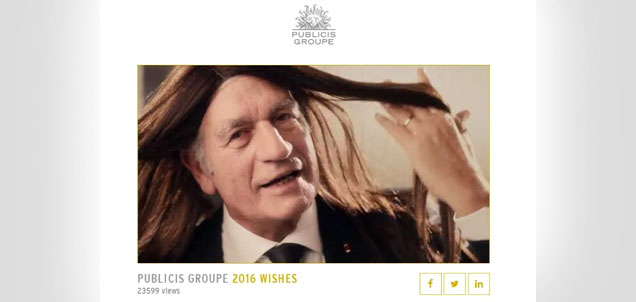
    Okay, given the fact that most of our biggie ad gurus belong to international networks, it may be tough to do this, but you’ve got to hand it to Publicis Group bossman  Maurice Lévy to present his annual Christmas message in a fun way. As the Guardian commented, he is “well known for delivering a bit of a tongue-in-cheek Christmas video message, but this year he’s outdone himself”. Indeed he has.

    Here’s the link: http://publicisgroupewishes2016.com/


    In the video, Levy (whose coffee mug says “Yes… I am the BOSS”), talks about the times being tough.  He says that normally people like to skip the ads and watch the content, but here’ they should skip him and watch the ads.


    We recommend watch the entire message as is, without clicking on ‘Skip Maurice’. Refresh the screen. And then click ‘Skip Maurice’ as it plays on.


    Now will someone from our own country do something like this?


  • Mindshare and FoxyMoron unveil campaign for Moto 360

    By A Correspondent


    Motorola’s new digital campaign #MotoGraph360, launched for its smartwatch Moto 360 (2nd Gen) highlights the exquisite features of the watch in the form of five different stories. Conceptualized by Motorola’s digital marketing agency Mindshare in partnership with FoxyMoron for digital creative duties, the campaign has been brought to life by using cinemagraphs that are essentially a fusion of living photography and video where just one or two elements are in motion. The stories involve five influencers from different walks of life to capture the Moto 360 (2nd Gen) in their daily routine while showcasing the different features of the watch. The campaign is being promoted via social media platforms including Facebook, Twitter and Instagram.


    Speaking about the campaign, Rachna Lather, Marketing Head, Motorola India said, “With the launch of Moto 360 2nd Gen, we wanted to give our customers the ‘power to choose a watch that makes time’ for them. It does so by freeing them from constant notifications and disturbances and pay attention to what really matters in life i.e., their passions and relationships. Our agencies, Mindshare and FoxyMoron suggested an interesting way that could depict the usage of the watch in our target buyers’ lives. The result was motographs 360, a beautiful collection of 5 stories told via cinemagraphs that bring out the features of the smartwatch and passions of those involved. We’ve been using innovative tools and campaigns to reach out to our customers and are glad to be the 1st brand in India to use this innovative technology.”


    Vinod Thadani, Chief Digital Officer, Mindshare said, “We at Mindshare thrive on exploring innovative ways of keeping our consumers engaged. In the limited attention span of consumers on social media today, the best way to break clutter is a disruptive format innovation. So we didn’t adopt trends but set the trend in true Motorola style. Cinemagraphs allowed us to capture the essence of Moto 360 watch and showcase the wide range of features it has to offer. Through the #MotoGraphs 360 campaign, our aim is to break the clutter and emphasize on what is really important to the consumers. The results seen are in keeping with the theme ‘Watch that makes time for you’ and make for a beautiful launch for the Moto 360 (2nd Gen).”


    Pratik Gupta, Co-founder, FoxyMoron said, “Brands today are constantly looking out for content that would halt your thumb from scrolling down your news feed. And I think cinemagraphs has that power to do so.  From mesmerizing movements to compelling contexts, it has brought a creative edge to visual storytelling. While globally it has been around for quite some time, this intriguing piece of content will become the next phenomenon in India.”


  • Key Trends in Digital and Analytics: PwC


    Although these are not specific trends for Media and Entertainment, but given the reasonably significant role of telecom and digital and analytics in the media, we bring you this trends report by PwC India (eka PricewaterhouseCoopers).

     

    By Sudipta Ghosh


    Key trends in 2015

    Real-time Customer engagement/interactions – There is shift from determining the proactive offers / next best offers from simple cookie based or click stream based analytics to more valued, analytical, data enriched analysis. This integrates the customer behavior patterns coming from other data sources / historical transactions. There is a wave of technology adoption for responding customers in real-time with more meaningful offers. The trend needs powerful processing platform with capability to handle high volume of data with very high velocity. Enterprises are either evaluating or adopting the big data platforms for the same. We will see more adoption of the big data platform in 2016.


    Cashless payments and related analytics – There is a great adoption of cashless payment methods (online, payment wallets, etc.) in India. The adoption will improve over time. Most of the cashless payment methods have ability for further improve the customer acquisition by extending appropriate offers. Analytics will play a great role in determining the offers that can be extended to these methods.


    Telecom transformation due to 4G – Introduction to 4G services will cause disruptive adoption of mobile internet in India. Companies like Bharati and Reliance are geared up to swipe the 4G market. The introduction of the 4G services provide a great challenge to the service providers to handle the generated huge volume of data effectively. It is estimated that there will be around 30-40 TB of data that will get generated on daily basis. Telecom service providers need to gear-up to manage and handle this data and use it for their benefits. The QoS parameters and analytics will also play a great role from regulation perspective to ensure the quality of service.


    Shift from ‘Data as a Service’ to ‘Analytics as a Service’ – The trend started with off-loading the data processing services to the private cloud or to the hosted environment and then derive the intelligence in local data center using Analytics solutions. Customers are now looking to avail the analytics as a service solutions. Niche companies or the companies with rich domain expertise are now providing analytics as a service in collaboration with IaaS vendors.


    Adoption of Big Data platforms – During past couple of years many customers evaluated the new/emerging technologies/platforms required to handle the structure and unstructured data. During second half of 2015 we observed that many customers start adopting the big data solutions/platform. The trend will continue and grow further in 2016. Many customers also have adopted the ‘Data Lake’ strategy for starting the Big Data initiatives. Customer are taking the staggered approach to build the data lakes and at the same time identifying the analytics initiatives that can be derived out of data collected in the data lake.


    IoT Devices, Human and Machine Interface – There were many enquiries and evaluation happening on adoption of data generated through IoT devices like Fitbit, Nike Fuelband, Apple Watch, Heat Sensors, etc. The blueprints are getting defined for integrating the IoT data into generic Analytics platform and derive meaningful intelligence out of it. Customers are also evaluating the scope KPO automation through Human and Machine interfacing solutions. The solutions use the technology for audio, video, images, text and other unstructured data analytics.


    Key Trends in 2015: Retail Analytics

    Retailers are increasingly using omni channel marketing to improve the customer experience as they shop across various channels like store, web and mobile platforms. There has been a huge growth in cross channel data volume and now Retailers have access to variety of data which include not only the demographic information but also past purchases, call centre interaction, social media interaction etc. Retailers are leveraging analytics tools to enhance customer loyalty by creating a personalised shopping experience that customises coupons and offers to match customers’ needs. Retailers are increasingly using segmentation based on purchase patterns, price sensitivity and customer lifestyle to identify the most relevant customers for targeting, which results in more relevant offers. Segmentation helps focus marketing on the customers who will most likely buy the products or services and avoid markets which will not be profitable. Retailers are adjusting their product mix from store to store-based on the preferences of their customers. This  help retailers improve their inventory allocations by understanding customer demand and their choice patterns resulting in increased revenues and margins


    Using analytics, retailers are able to determine the optimal pricing of products and services. The price elasticity not only help in only finding identifying the products that are most and least price sensitive but can also be used with optimisation to identify the optimal pricing. Increasingly number of companies are adopting open source analytical tools to provide descriptive, prescriptive and predictive analysis of the fast increasing volumes of data which are both structured and unstructured in nature in order to reduce the total cost of ownership


    More retailers are introducing mobile apps for integrated loyalty programs. Consumers no longer have to clutter their wallets with physical cards anymore. Instead, they can use their smartphones to track and redeem their rewards through mobile applications.


    Emerging Trends to watch out for in 2016: Retail Analytics

     Fraud detection and prevention will be an important concern for retailers  looking to build security and preserve consumer trust. Using analytics, retailers can identify unusual patterns of product and inventory movement.

     Radio-frequency identification (RFID) tags and readers will increasingly provide substantially more data on product movements and locations for retailers to analyse. Retailers will be using analytics to optimise their inventory and reduce their transportation costs.

     Workforce analytics will help organizations effectively plan their future workforce needs to increase labour efficiency and improve schedule effectiveness. Analytical tools would be used for workforce acquisition and labour scheduling based on when customers are most likely to visit a store.

    ï‚· Retailers will increasingly adopt multiple IoT technologies in the coming years to reshape the customer experience, to drive loyalty and to focus on inventory. The use cases in retail will include sensors on products, interactive consumer engagement, automated store lighting, shopper intelligence, perishable tracking, fleet operations tracking etc.

    ï‚· There will be an increase in video analytics as powerful processors are becoming available at affordable price points to video surveillance manufacturers. Video surveillance with analytical models can be used for effective in store promotions, stock out analysis and tracking customer movement inside the store.


    Rise and growth of e- commerce or digitisation of retail has been one of the key trends in the retail sector. As this digitisation continues in the new year, companies will turn to analytical solutions to both manage and make sense of the huge amount of data being churned from these transactions. Companies will require insights into the consumer behaviours to try and personalise user experience as competition will hot up between various e-commerce retailers. These companies are already investing in significant social media management to promote their services and will also turn to analytics to gain insight from that data regarding their product perception and target market. App based analytics solutions will be at the forefront of this growth as the market will shift from laptop to smart phone based solutions. New age analytics solutions like using CCTV for eyeball tracking, Planogram optimisation, single view of customer to create shopper profile and anticipate needs better, analysing supplier and employee performance and compliance (attrition analytics, workforce planning),  are all seeing an uptake in the Indian market.


    Sudipta Ghosh is Partner, Data and Analytics at PwC
     

  • Fountainhead Mumbai comes together under one roof

    By A Correspondent


    Fountainhead Entertainment, one of India’s leading experiential marketing agencies, has shifted its Mumbai headquarters to asingle office in Matunga West. Boosting the spirit of creativity and collaboration, the agency’s five specialized business divisions – Events, Activations, MICE, Digital and Intellectual Properties supported by the business enabling functions of Creative, HR, Finance, Administration and IT, have now come together under one roof.


    The 21-year old agency, which recently became a part of Dentsu Aegis Network, commenced its journey of building brands with delightful experiences from Pali Village inBandra, Mumbai. Over the years, it saw an organic growth at rapid pace while spreading its wings and gaining expertise in various verticals which started operating from different locations.


    Neale Murray, Group COO of Fountainhead, said, “It’s a proud feeling to have 200+ Fountainheaders together under one roof. The new office represents the energy which sparks great creativity in a vibrant environment, best suited for young minds. With an emphasis laid on collaboration and a dream of expanding even bigger, this move will help us achieve the mission to become the most comprehensive experiential offering in India.”


    The company recently conducted a formal inaugural ceremony in which Annie Rickard, Global Chairman of MKTG, lit the lamp. It was followed by ‘The Curtain Raiser’ Party for employees which was attended by Ashish Bhasin, chairman and CEO South Asia, Dentsu Aegis Network, Brian Tellis, Group CEO Fountainhead, Neale Murray, Group COO Fountainhead and Co-Founders Otis D’ Souza, Owen Roncon, V. G. Jairamand Pradeep Guha.


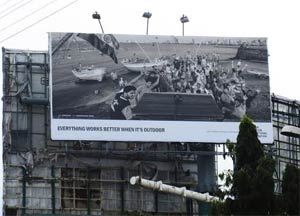
  • Everything is better when it’s Outdoor, says new campaign for IOAA

    By A Correspondent


    In September 2007, leading Out-Of-Home companies with national or, at least, multi-regional presence came together to form the Indian Outdoor Advertising Association (IOAA), a ‘not-for-profit’ company with limited liability.

     

    The primary objective of the IOAA is to promote, protect and advance the rightful interests of outdoor media, outdoor advertising media companies and associated businesses. IOAA also provides a common platform for the industry to take up issues at various government and non-government forums.


    In August this year, a campaign was launched during an outdoor industry gathering OAC (Outdoor Asia Convention) where around 400 industry leaders across India had gathered, which highlighted the ‘Power of Outdoors’. Conceptualized by Taproot and brought to life by PrashantGodbole, the campaign serves to reinvigorate the outdoor medium.This team had earlier partnered last year to create the Cannes Lion winning campaign ‘Hated by Some’ for Mumbai Mirror.


    At any given point many billboards across the country are empty, either with the media owner’s logo or phone number, we wanted them to utilize that space to communicate to the brands, advertisers, media planners etc in interesting way by putting this campaign up on their empty billboards to benefit the outdoor industry, hence the campaign was launched in front of this community during the OAC in August,


    The campaign was shot in different parts of India like the Rann of Kutch, Wai etc. to bring out the pan-India flavor.


    Santosh Padhi, Chief Creative Officer & Co-Founder, Taproot Dentsu said:“The idea comes from a simple human behavior of seeking shared experiences when outdoors. A fact abundantly observed across India, where a TV or Radio when kept outdoors always attracts a large gathering of people. That the power of the outdoor medium transcends regular boundaries and does wonders for other mediums too.”


    “It has been observed in the last decade that people have been spending more and more time out-of-home. Unfortunately, OOH in India has not yet capitalized on this insight. So it was imperative for us to reach out to advertisers & planners through a very powerful advertisement campaign to highlight the strength of the Outdoor medium. We feel this campaign brings out the message loud and clear in a very simple way,” said Noomi Mehta, Chairman – IOAA.


  • ‘Tis the time for crafting ads for awards!


    By Jagdish Acharya


    Happy days are here again. Although Goafest is in April, its shadow looms longest over December, generally considered the last month for entries to be submitted. Going beyond the wham-bam-thank you scams, here is a look at some of the archetypes of the awards season.

     

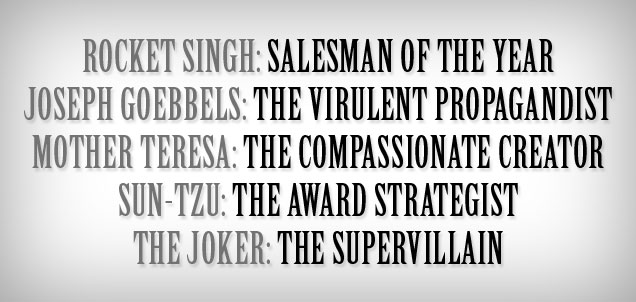
    1. Rocket Singh: Salesman of the year

    His maxim? Every ad has a client. He could be the most reticent member of the team, but come December, he creates his dream ad and before one can say ‘scam’, makes it legit by selling it to a second-hand bookshop, a pet store or that Chinese dhaba down the road. Duly approved and paid for by the newfound advertiser.


    2. Joseph Goebbels: The virulent propagandist

    This is a seniors’ avatar, of the creative chiefs who subject their subjects to a barrage of jingoistic mails and butt-kicking one-liners. Everyone comes with his own, one better than the other. Sample these: ‘I don’t give a rat’s ass how you get’ em (the awards) as long as you get’ em’. Or ‘Be the bride or the groom at the (awards) show, not a dancing baraati’. Or even ‘Doosron ke liye taali bajaane mein bahut dard hota hai’.


    3. Mother Teresa: The compassionate creator

    You could never tell during the year how much this guy feels for the dying in Syria. He stands tall for a cause which itself might change from child labour in one awards season, to blood donation in the next. He avers he couldn’t care less if his work doesn’t pick up an award. The jury is still out on that though.


    4. Sun-Tzu: The award strategist

    Sheer genius, this guy. He won’t enter that well-known commercial for a telecom services provider under the telecom category. He knows there’s too much competition in that space. He will go figure the number of spoofs and jokes on the ad that filled Facebook, Whatsapp and Youtube, estimate the value of free exposure for the brand, and enter the commercial in the Public Relations category.


    5. The Joker: The Supervillain

    He’s the spoofy prankster, the party-pooper. His biggest thrill on Earth comes from tracking the sources of inspiration from across the globe and making public a listicle of his fellow creatives who seem to have been thus inspired in their awards entries. He’s the one everyone tries to keep away from. For a month at least, his agency is his Gotham.


    Jagdish Acharya is Founder and Creative Head, Cut The Crap. The views are his own.


  • Contract brings Sunil Shetty as Strategic Planning Head, Mumbai

    By A Correspondent


    Contract Advertising, announced the appointment of Sunil Shetty, as Senior Vice President & Head, Strategic Planning at Contract, Mumbai.


    Sunil, who joins in from FCB Global, Kuala Lumpur, Malaysia, is a seasoned planner, skilled in delivering effective brand and communication solutions with leading global advertising agencies & corporates.


    Announcing his appointment, Rohit Srivastava, Chief Strategy Officer, Contract Advertising said, “Having been on the client’s side, Sunil brings with him a larger marketing & business perspective, which will be an asset, as we plan forward & growth strategies for our clients and their brands. His wider exposure to markets beyond India ensures a fresh, outside-in thinking that we are excited about tapping into, as we forge new forms of communication & engagement to reflect the changing realities of the consumer & media landscape.”


    Sunil has successfully led the planning function across offices in India and South East Asia, in an individual capacity and as a team leader. Sunil’s last assignment was working as Strategic Planning Director in FCB Kuala Lumpur, Malaysia; prior to which, he was Head of Planning for FCB Ulka, Mumbai. He has also worked with Ogilvy and RK Swamy BBDO in his previous role. Sunil has also been on the client’s side, has worked with companies such as Philips Lighting & ICICI Securities.


    Sunil has done his Masters in Marketing from Jamnalal Bajaj Institute of Management Studies, Mumbai and brings with him, over 14 years of marketing and communications experience.


  • L&K Saatchi & Saatchi appoints Meraj Hasan as VP – Planning

    By A Correspondent


    Meraj Hasan has been appointed VP – Planning at L&K Saatchi and Saatchi. He joins the agency from Reliance Industries Limited – Jio (4G initiative). He has over 15 years of experience across agencies like Lowe Worldwide, Y&R, Ogilvy, TBWA& McCann in the past. He will be based out of the Mumbai office of the agency.


    He has worked on brands like TATA Sky, Airtel India & Sri Lanka, Idea Cellular, Reliance Jio (4G), Unilever (Pepsodent, Close-Up), Colgate Palmolive, Parle biscuits & confectionaries, Nivea, Standard Chartered Bank amongst others.


    Anil S Nair, CEO and Managing Partner, L&K Saatchi & Saatchi, said, “Meraj’s appointment is part of a significant ramp up in our strategic planning division. Our sincere attempt is to make each and every brand at L&K Saatchi & Saatchi a Lovemark and hence give it the highest possible strategic input.Meraj comes as a leader who will drive this agenda across as many brands in the Mumbai office.”


    Meraj said, “An opportunity to strategically steer some of the best global as well local brands in the country is what pulled me towards L&K Saatchi & Saatchi, when I wanted to do my ‘Gharwapsi’ of sorts to Advertising. A few meetings with Anil and the gang and exposure to the rocking work that they are doing confirmed that this is perfect place to do so. We found our fit in each other.”


  • Genesis Burson-Marsteller announces leadership appointments for 2016

    By A Correspondent


    Genesis Burson-Marsteller has announced senior leadership appointments, which will be effective from January 1, 2016.


    Nikhil Dey is now President, Public Relations & Public Affairs. He will continue to play a key role overseeing the firm’s client growth strategy in addition to scaling up the recently launched Centres of Expertise and will now also focus on mentoring the public affairs business.


    Atul Sharma has been promoted as Chief Operating Officer and will now be a part of the India Management Team at Genesis Burson-Marsteller. Having spent over twelve years at Genesis Burson-Marsteller, Atul has counseled diverse businesses, Indian and multinational, on corporate reputation and brand reputation programmes. In his new role, Atul will focus on improving the operational excellence of the firm while continuing to serve as India Practice Chair, Telecom & Technology.


    Vandana Sandhir, currently India Practice Chair, Corporate & Financial, is moving to a new leadership role in the WPP network after ten years with the firm. Sanjay Arora, who has been with the firm for over six years, will take on the India Practice Chair role from Vandana. With a total of sixteen years of experience, Sanjay has led corporate reputation management campaigns for many of the firm’s Fortune 500 companies. As the India Practice Chair, Sanjay will be responsible for ensuring business growth of the Corporate & Financial business in line with the firm’s strategy, providing leadership and guidance to the teams to ensure high quality of service delivery and customer satisfaction.


    Former journalist Ajit Sahi, who joined the firm last year as Director, Thought Leadership will now take on the mandate of Public Affair. With nearly three decades of in-depth and extensive experience in journalism, ranging from being an investigative reporter to heading newsrooms at TV news stations, newsmagazines, news agencies and newspapers, Ajit brings with him a thorough understanding of the Indian and international political environment. This experience is crucial as the requirements of clients pertaining to government relations, advocacy and stakeholder outreach continue to grow with the maturing of the regulatory and compliance environment in India.


    As the firm is strengthening its focus on the Technology domain, it will now have two separate leaders driving Business-to-Consumer (B2C) and Business-to-Business (B2B) Technology domains in 2016. Piyal Banerjee and Shivaram Lakshminarayan have been appointed as the new domain leads.


    Piyal will be Managing Partner with a focus on B2C Telecom & Technology Practice, nationally, as it is a fast-growing area. In addition, she also takes on the mantle of Business Leader, Step Up, a unique offering focused towards helping start-ups to take the next leap by narrating their story through creative communication campaigns. With over twelve years of experience, Piyal has brand and corporate communications experience across top Asian markets including India, China, Malaysia and Singapore. She brings strong leadership skills to this new position given her credentials in the Consumer Technology space. Piyal will continue to co-anchor the Corporate & Financial Practice for West.


    An old Genesis Burson-Marsteller hand, Shivaram has been with the firm in Bengaluru for over a decade and has served as the technology lead in the southern markets. Shivaram will now be the Head of the B2B vertical of the Telecom & Technology Practice, nationally, given his strong credentials in the IT & ITeS space. In addition, Shivaram is also taking over the stewardship of the Corporate & Financial Practice for South and will be working closely with Sanjay Arora.


    Prema Sagar, Vice Chair, Burson-Marsteller, Asia Pacific & Principal/Founder said, “Over the last twelve months, the consultancy has reinvented itself into a new-age communications firm to meet the growing requirements of our clients. As the year draws to a close, I am happy about the great leaps we have taken in 2015 and excited about the opportunities that lie ahead. To support the continuing growth of our firm in 2016, we are promoting our talented and experienced leaders who have demonstrated that they make a difference to our clients business. I am confident that these leaders will further strengthen our India leadership team.”


  • M&E Sector Outlook 2016 by Deloitte


    We were a little surprised receiving this from Deloitte’s communications agency. Normally consulting firm presentations come with PowerPoint decks or PDFs justifying the words, but this one had only prose. But, guess, it works for those not interested in the numbers and projections.


    The media and entertainment sector has evolved over a period of time and even though it has many sub-segments, the industry overall is growing at a fast pace. Certain segments of this sector have grown exponentially whereas other have grown at a steady pace. This sector is growing 10% annually over the past five years. If one has to list the sub-segments of this sector then it would include television, advertising, social media, print, film, radio, music, gaming, animation and OOH, among other smaller sub-sectors.


    Television and print media continue to shine by contributing the largest share of advertising revenue. In future the same trend is expected to continue. Digitisation has helped improving the customer experience by improving the viewing quality. Digitisation is also leading to segmentation of the television content. Regional channels are growing at a faster pace. Print industry is a fragmented one, with both national and regional players in the market. Aggressive campaigns like Make in India, Swacch Bharat etc. have heavily spent money on the print medium. Regional editions have been steadily growing.


    Digital and mobile platforms are becoming preferred mediums for advertising after the television and print mediums. Internet has grown gigantically from 10 million users to 100 million in a decade and from 100 to 200 million in just three years. The stakeholders are analyzing the user/customer behaviour on the web and accordingly are targeting and customising the advertisement content. Recently, there is a trend of using videos for advertising over the digital platform as they seem to be more effective than just words and images. Apps can do everything that websites can, but in a more intuitive and a convenient way. Mobile adverti through various apps and mobile sites is now gaining momentum. The highest traffic on mobile platform is drawn by the social media sites. Large population of India is active on social media. It is also noted that there is an increasing trend observed for the number of people in the age group of 35 to 65 years who are downloading apps for social media.


    The Indian film industry is the largest producer of films globally. Revenue from overseas market is growing and will continue to do so. Indian movies are now also available on Netflix app. Regional movies too are becoming popular. Domestic exhibitors are willing to give more screen space to regional content. The limited shelf life of films has resulted in the film being premiered on the television within three months of its’ theatrical release. The number of screens in Tier 2 and 3 cities still remains limited as compared to urban areas.


    Radio has also seen a good growth rate as well. New upcoming sectors like E-commerce have aggressively advertised to gain market and have used radio extensively in their ad campaigns. Advertisers no longer see Radio as an add-on medium but it has become an integral part of their media plans. This medium also gained attention of many as a mass medium with popularity of PM’s address to nation through his show “Mann Ki Baat”.  The Phase 3 license auctions have also given a boost to the industry – the reach and competition, both, have increased tremendously.


    India’s recorded music business will nearly double in size over the next five years. The number of music apps and streaming apps will steadily increase on the mobile platform over the next few years.  The revenue business models for these will also evolve over the period. People are getting ‘hooked’ onto these apps and thus CDs too soon are on their way out.  The transformation in which music is consumed will result in many iconic music stores closing shop – e.g. Rhythm house in Mumbai.


    Gaming has benefited and grown, thanks to the mass availability of smart phones in the country. Android and iOS offer a low-cost alternative to expensive gaming systems. Monetisation of games is difficult as pay model for downloads is not a preferred mode.  Thus gaming will have limited growth as compared to the other sub-sectors.


    Presence of VFX industry is felt in all segments i.e. films, television and advertisements. Few movies that were nominated for Oscars had the VFX work been done in India. The demand for local animation content has been rising over the past few years. Popularity of “Hanuman”, “Chota Bheem”, “Pakdam Pakdai”, is increasing amongst the younger generations.


    We spend a lot of time outside our home – getting from one place to another. Therefore, outdoor advertising is still here to stay.OOH advertising such as at airports, malls, metro stations etc., has gained popularity. With digital use, digitized hoardings have changed the traditional OOH platform.  Here too centralized feeds and monitoring of eyeballs etc. will help ‘specific-target’ campaigns and will help fuel the growth trend in OOH.