Category: ADVERTISING

  • Indian adspends to grow 18.4% next year: Magna Global


    By A Correspondent


    In its latest report on the global advertising marketplace, market services conglomerate IPG’s strategic research arm Magna Global estimates that media spends will grow 18.4 percent in 2016. Media owner advertising revenues grew by +3.2% in 2015 to $503 billion. This is lower than the previous forecast (+3.9% in June 2015) and represents a slowdown compared to the 2014 growth (+4.9%).


    Erosion in shares is a reality even for television: Venkatesh S 

    Like every year, we posed a few questions to Venkatesh S, EVP, Director Intelligence Practice on the basis of the numbers and report posted by IPG’s Magna Global


    16.3 percent this year as against your forecast at this time last year for 2015 being 13.3 percent. And now a forecast of 18.4 percent growth next year? Way too optimistic, na?

    In 2015 both television and digital has seen unprecedented utilization. In the case of television, supply restrictions have been breached even by the networks which were following earlier. On Digital, E-commerce, M-Commerce, other services like Housing and Quikr and auto aggregators have increased their spends


    Digital will see a one off blip in revenue in 2016 thanks to opening of new advertising platforms from Instagram and Twitter. Content creators like AIB and TVF have seen success in audience acceptance. Native advertising is another format which will start contributing to the overall pie.


    Television adspends are going to be down further next year as per your forecast. What would you attribute this to?
    From +18.5% to +15.1% is because of the NRS (non-recurring spends) getting neutralised. 15.1% is a very healthy growth when globally TV is diminishing


    The total market share of all digital has just got into two digits even though growth is very high. Your comments
    Digital is still 1/10th of traditional spends and traditional is still growing even at its current scale. 17% market share in 2016 will give this category scale and by 2020 we expect the shares to equal print.


    From the 12th largest in 2015 to the 7th largest in 2020. Given that we have a population of a billion-plus and are the world’s largest democracy with a not-down-in-dumps GDP, this rise from #12 to #7 is pretty slow, right?
    India is in the bottom of the Ad Spend per capita ranking (at $7 compared to APAC at $40 and Global at $87). I think we have made progress in making media accessible to the entire populace through cable digitisation, mobile penetration, radio privatization, publishers expanding their edition network etc. On the measurement front too TV has expanded. This will aid media owners to monetise their audience and in turn grow the advertising economy.


    So guess the biggest headline forecast is that India will see market share of digital equalling that of print by 2020?
    This was expected to happen one day and not that print has stopped growing but digital volumes are attaining scale.  While globally digital is going to be the number one category in two years, India will take a long time to achieve this.


    You hope that IRS or some such study will help print win back market share in 2016. Since it doesn’t appear to be happening as of now, is the erosion here to stay?
    Erosion in shares is a reality even for television. Measurement permanency will help reduce the intensity of this and gives an opportunity for the 2nd and 3rd rung publications to get their due advertising share.


    So which sector was the biggest advertiser in 2015 (sports, e-comm, telecom, polls…)? And which do you expect to be in 2016?

    Sports have been one of the marquee content because of ICC World Cup. In 2015 while E-commerce has been the major driver of growth in 2016, E-commerce and Telecom will fight out for a larger share of media space.


    As China is slowing down ((slightly), India has become the most dynamic economy among BRICs and among all the large nations monitored by Magna. Real DGP grew by +7.3% in 2015 and will grow again by +7.5% in 2016 according to the IMF, with consumer price inflation at around 6% per year. In that context advertising spending grew by +16.3% in 2015 to 487 billion rupees (approx. $8 billion) allowing India to become the 12th biggest ad market in the world at the expense of Russia.


    In 2016, ad revenues will be boosted by economic stabilisation and the incremental spending generated around non-recurring even-year events (US Presidential and General elections, UEFA Football championship in Europe, Summer Olympics in Brazil). Magna Global is hence predicting ad sales to grow by +4.6%, marginally less than its previous forecast. Neutralising the impact of non-recurring events (NREs) in 2014, 2015 and 2016 (generating approximately 0.9% of extra growth in even-numbered years), the global ad market would have grown by +4.1% in 2015 and +3.7% in 2016, which suggest no real 2016 acceleration in the underlying ad demand, beyond the cyclical drivers.


    In terms of geographies, Asia-Pacific was the most dynamic region (+6.5%). Latin America and Central and Eastern Europe, once the fastest-growing regions, are both suffering from dramatic economic slowdown reflected in ad spend cuts (-3% in CEE, +3.8% in Latam). Meanwhile, Western Europe continues its recovery (+2.9%), while North America is slowing down (+2.0%).


    Of the 73 countries analysed by Magna Global in this update, 62 experienced ad revenue growth this year and eleven (incl. Russia, Finland, France, Greece, Peru, Singapore) suffered a decrease. The biggest contributors to the 2015 slowdown are the two BRICs countries affected by severe economic difficulties: Russia, where ad revenues are now expected to decrease by -12% (previously -11%), and Brazil (+4.4%, unchanged). On the other hand, the 2015 growth estimate for China, India and the US have increased. For 2016, only four markets are expectred to remain in the red while 69 (including Russia) will experience some level of growth.


    Asia-Pacific: this year +5.6%, Next Year +5.2%

    Media owners ad revenues increased by an estimated +5.6% in 2015 to $146bn, making APAC the second-largest region with nearly 30% of global spend. This is down slightly from previous expectations of +6.3%, despite the fact that growth was slightly stronger than expected in two of the region’s biggest markets (China +9.9%, India +16.3%).


    Growth in 2016 is expected to be slightly weaker, at +5.2%, due to continuing slowing of the region’s economy. APAC is now the second-largest global region, behind North America, having passed EMEA, with 29% of global ad revenues generated in the region. Given the high growth rates expected in APAC going forward compared to EMEA, the region will become increasingly critical to global advertising spend growth, notes Magna Global.


    APAC’s GDP growth is expected to be +6.5% in 2015 according to the IMF, down from +6.8% in 2014. Economic growth will again slowdown slightly in 2016 to +6.3% as China continues to transition to a consumer economy while India accelerates. Despite concerns about APAC growth weakness and the spillover to the global economy, it’s important to keep in perspective that it’s only modest slowdown and APAC growth remains significantly ahead of most of the western world, notes the Magna Global report.


    India: this year +16.3%, Next Year +18.4%

    Advertising revenue increases by INR 68 billion to touch INR 487 billion in 2015.  On the back of increased volumes, Television revenue will add +18.5% (Dec 2014 +11.9%) to reach INR 200 billion.


    While television market share is up by a percentage point (41%) Print goes down from 41% to 38% to touch INR 183 billion (growth of +7.7%). In 2016 Television is estimated to grow +15.1% and Print +8.2%.


    Digital formats continue to grow the maximum at +49% to touch 57 billion rupees and thereby increase its market share to 12%. Ad sales generated from Video and Social increasingly will be through mobile impressions while Desktop in the near future will still be the domain for Search and Display. Share of mobile from 32% will be close to half the pie in 2016. Programmatic outside of Search will grow +5.7%.


    Newer formats and revenue streams (Twitter and Instagram opening up new advertising and influencer management platforms), bandwidth expansion through 4G launch and traditional advertisers increasing their digital budgets will contribute to the growth of +67.3% in 2016.


    Radio with a market share of 4% will grow +14% in 2015. Through the expansion of foot print and there by volume is estimated to add +16% in 2016. OOH will grow +11.9% in 2015 and by another +10.4% in 2016.


    Magna Global estimates total advertising revenue to touch 576 billion rupees in 2016.


    The T20 World Cup, encouraging response from audience to non-cricketing leagues, state elections, 4G launch are some of the drivers for the advertising economy in 2016. E-commerce will continue to pursue GMV’s, most action will be seen in the telecom sector followed by Auto and FMCG advertising.


    Digital television and expansion of the measurement panel will allow advertisers to reach more consumers and broadcaster to better monetize their audience in 2016. While so far India is bucking the global trend of declining spends on Print by growing at a high single digit rate, Digital market shares are projected to equal Print by 2020. Magna Global hopes the 2016 round of data will get the currency out of the data dark period and aid the category to fight market share erosion. The second round of the Phase III auction, commissioning of the new stations won in the first round of bidding will keep radio top-of-mind, the report adds.

     

  • Mullen Lowe Lintas Group, India wins its 75th award for the year

    By A Correspondent


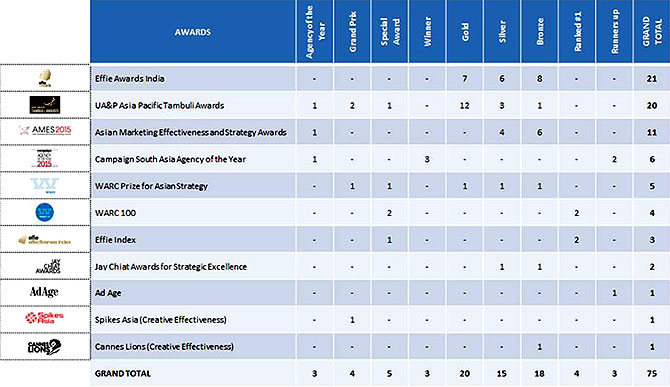
    In a huge achievement for the agency, Mullen Lowe Lintas Group, India picked up its 75th award for the year last night. Ironically for an agency that does not enter creative awards, it has emerged as the “most awarded agency” in India in 2015. All 75 awards were won either for market/campaign effectiveness or on overall agency performance.


    Beginning from the Effie India 2014, to the recently concluded Campaign South Asia Agency of the Year awards, Mullen Lowe Lintas Group has won a total of 75 honours this year. It began with the agency winning 7 Golds at Effie India announced in Jan 2015. It was the most by any agency for the year and beat the Gold tally of all other agencies put together. It went on to win another 6 Silver & 8 Bronze metals at the event. It followed this performance by winning the ‘Agency of the Year’ title and Carmencita Esteban Platinum Award at UA&P Asia Pacific Tambuli Awards. In all, the agency won 2 Grand Prix, 14 Golds, 3 Silvers, and 1 Bronze at the Tambuli awards this year.


    The crowning moment for the group came when WARC 100, an annual report from World Advertising and Research Council ranked Lowe Lintas India as the No. 1 Creative Agency in the world while Kan Khajura Tesan (KKT) was adjudged the Best Marketing Campaign in the world. Further, at the Asian Marketing Effectiveness Awards, the agency was declared Effectiveness Agency of the Year and went on to win 10 awards, including four Silver and six Bronze awards.


    On the Effie Index front, Mullen Lowe Lintas Group went on to win the title of the Most Effective Agency in India and Asia Pacific. It was also adjudged the third most Effective agency globally. At the Cannes Lions 2015, KKT won a Bronze award for Creative Effectiveness while at Spikes Asia Festival of Creativity, it won the Grand Prix for Creative Effectiveness – the only such accolade for India.


    At the Warc Prize for Asian Strategy, the group won a Grand Prix, a Gold, a Silver & a Bronze. The year culminated for the agency with a fine performance at the Campaign Asia Agency of the Year awards show where it was declared the ‘Best Creative Agency of the Year’ and also won the Best New Business Development Team of the Year, Best Strategic/Brand Planner of the Year and Best Account Person of the Year.


    Awards Scorecard 2015 of MLLG:


    Joseph George

    Commenting on the agency’s strong performance on the awards front, Joseph George, Regional President|South & Southeast Asia & Group CEO|India said, “It’s been a milestone year for us in India. We are glad to have ended the year on the same high that we started it. All this recognition is a result of all our key people putting up their hands, wanting to be counted and bringing value to the table. And this happened only because everyone thought of themselves as key stakeholders of the company. ”


    What made the honours this year even more special were a few special awards that were firsts for India. Noteworthy mentions include: The Local Hero Special Award for Havells at the Warc Prize for Asian Strategy; being declared Runners-up AdAge International Agency of the Year – again a first for an agency from India; and at the 4A’s Jay Chiat Awards – the award for strategic excellence where the best of Madison Avenue competes with the world – the agency did an unprecedented feat of consecutive double wins, two years in a row.


    Arun Iyer

    Adding his views on the agency’s achievement, Arun Iyer, Chief Creative Officer, Lowe Lintas India said, “I’m proud of the consistency with which each of our offices has churned out some great work across a large and diverse client set. Our work has excelled on a portfolio that’s a combination of classical and progressive brands, from young upstarts to large market leaders. 2015 serves as a reminder of how setting the bar high, is an everyday pursuit, and how successful teams are greater than the individuals.”


    Amer Jaleel

    Amer Jaleel, Chairman & CCO, Mullen Lintas India said, “The best barometer of our work being appreciated is when it manages to bring about a shift in perception and thought among the people. That’s what we achieved with few of our brands that went on to redefine the way a campaign should be approached and which ended up winning awards that were unique in nature. Special accolades for Indian brands such as Havells, Tata Tea and the others were something that no agency had ever received before and we are proud to have set a trend by being the first.”


  • Crayon Data enters Indian market in alliance with GroupM / Mindshare

    By A Correspondent


    Mindshare, along with GroupM, announced that they will bring their global alliance with Crayon Data, among the most innovative global big data start-ups, to Indian enterprises.


    This comes hot on the heels of the announcement last week, of Ratan Tata’s investment in Crayon Data. Together, GroupM, Mindshare and Crayon Data aim to map the taste of millions of Indian consumers, which will allow enterprises to target consumers more precisely.


    “GroupM is changing the way marketers approach the business of media. Together with the WPP data alliance, bringing the Crayon Data proposition to India reflects our ambition to know more deeply than anyone else the tastes of Indian consumers and use that to help our clients target them better,” says CVL Srinivas, India CEO of GroupM.


    Commenting on this, Prasanth Kumar, CEO of Mindshare South Asia said, “Through this alliance, Mindshare’s proprietary data and research are further enriched with Crayon Data’s analytics. This will help us bring in both agility and adaptive solutions for our clients. Understanding the tastes and mind-set of consumers is extremely important and will be a great advantage for us especially since there is a strong focus on digital. In our journey to understand our consumers even better, this will be a great advantage.”


    Suresh Shankar, founder of Crayon Data, said, “As life goes digital, and choices proliferate in every aspect of our life, we will move to a world centred around personalisation, where companies understand tastes and preferences at an individual level, and use that to make choices simple and relevant for their consumers”.


    In India, the GroupM and Mindshare partnership with Crayon Data, will create a unique data coalition across media agencies and media owners, to deliver the vision of offering personalised choices to millions of Indian consumers.


  • Dabur, Thums Up to be sponsors of the Pro-Wrestling League

    By Arka Bhattacharya


    After the successes of the IPL, the ISL and the Pro-Kabaddi League, corporates have queued up to become sponsors of the brand-new Pro-Wrestling League, scheduled to start on December 10.


    Kartik Sharma

    Kartikeya Sharma, CMD, Pro-Sportify Ltd, which started the PWL, says that they have four main sponsors for this year. The title sponsorship has been picked up Dabur Chawanprash while Thums Up is the ‘Powered By’ Sponsor. Other sponsors associated with the league this year are Jaguar Lighting and Dabur Red Toothpaste. The cumulative amount of sponsorship that has poured in is estimated to be around Rs 22 crore.


    Says Sharma, “When one of the largest brands, Coke has sponsored you, you know it is going to be big. Year-on-year, we’re looking increase the marketing spend and we’ll change the way brands derive ROI from sporting properties and the way they want to get value out of sports.”


    The success of the existing leagues in India has convinced the founders of the PWL that the league will be immensely successful in the years to come. Sharma said that the sponsorship for season 2 is already being planned and is estimated to show an 81% increase to Rs 40 crore.


    The net marketing spend for the league is upwards of Rs. 20 crore. Vishal Gurnani, Director, Pro-Sportify says that almost 70% of this budget has been poured into television media, and the rest mainly into radio, print and outdoor campaigns. Gurnani says that they have about 600,000 seconds of inventory footage for the promotion of the league and massive outdoor campaigns have been undertaken in Bombay, Delhi, Gurgaon, Ludhiana.


    When asked if the league would expand next year, Gurnani replied in the affirmative. He said, “The PWL might add two franchises next year. A lot of cities and a lot of corporates have shown interest this year, but due to logistical challenges, we decided to restrict the number of teams to six. We are looking ahead to next year, where we are expanding this to eight teams with the most likely cities being Ahmedabad and Hyderabad.”


    Pro-Sportify are also looking at introducing merchandising post the league’s completion. Gurnani said, “We’ll looking at building up the brand during the league and selling our merchandising at online platforms and airports afterwards. We’re coming up with interesting and quirky merchandising with lines like ‘Real Men deal with it on the mat’ and ‘Asli Mard Akhade Waala Baaki Sab Chauhare mein’.”


    The other partners of the league include the hospitality partner – Picadilly hotels, Radio partner – Big FM, Outdoor partner – Bright Outdoor and Ticketing partner – BookmyShow.


    Source:The Economic Times

    Copyright © 2015, Bennett, Coleman & Co. Ltd. All Rights Reserved

    Licensed to republish


  • Praveen Sathaye to lead Gurgoan ops for FoxyMoron

    By A Correspondent


    Praveen Sathaye

    FoxyMoron has roped in Praveen Sathaye to spearhead its Gurgaon office. Praveen has spent over 17 years in the marketing industry with a focus on digital media and technology. In his previous role, he was leading the in-house creative agency at Ericsson. Prior to that, he was a part of corporates such as Royal Enfield, The Times of India Group, Tata Interactive Systems and Tata Infotech.


    His role at FoxyMoron entails strengthening the existing client roster and driving the agency’s aggressive and ambitious growth plans for the market.


    Commenting on the appointment, Pratik Gupta, Co-founder, FoxyMoron said, “We are thrilled to have Praveen on board. For us this signals, the beginning of a new growth story at FoxyMoron Gurgaon. While we have a lot of new businesses in the pipeline, we needed someone like Praveen, with a proven track record and wealth of diverse experience with leading brands and agencies, who brings a marketing perspective to a digital setup. This will not only help our growth agenda, but will also contribute immensely to FoxyMoron’s expansion in the North.”


    On his new role, Praveen Sathaye, Head – Operations, FoxyMoron, Gurgaon said, “I’m excited to work with some real creative geniuses who want to take the digital and creative space to greater heights. In my role at FoxyMoron, I see myself working towards synergizing energies of digital and brands to build solutions for the future. The intent is also to ramp up the capacity here and address newer industries as well as clients.”


  • Kotak Life puts the focus on retirement with ‘Ab Meri Baari’

    By A Correspondent


    Kotak Life Insurance has rolled out a new digital campaign, ‘Ab Meri Baari’ for their latest Active Retirement plan. It has launched with an inspiring digital video commercial that speaks about the life of a layman and his dreams. The campaign is conceptualized by WATConsult, the full service digital agency from the Dentsu Aegis Network.


    The video starts with a college going boy convincing his mother to let him go on a bike trip to Ladakh. The mother doesn’t allow as she believes that the trip will ruin his studies and ultimately career. The boy has to give up on his passion for completing the classic life goals of a common man: education, career, marriage etc. However, the video ends on a happy note when it shows how the boy follows his passion after retirement by going on that bike trip. The message, in turn, enforcing the active retirement plan by Kotak Life Insurance.


    Elizabeth Venkataraman

    Elizabeth Venkataraman, Executive Vice-President & Head- Marketing, Kotak Mahindra Old Mutual Life Insurance Limited (KLI) said, “Through our #AbMeriBaari digital campaign, we want to motivate people to start planning early (35-40 years) for retirement. This will help ensure a better retirement corpus for individuals. Interests and passion are not tied to age as they once were. There is a growing focus on fitness and as a result people look and behave young and need money to fund that.  With technology and social media being as accessible to the ‘retired and retiring’ generation as it is to the youngsters, there is immense scope to connect with the audience online. We believe this video will connect with our audiences across the chosen platforms.”


    Rajiv Dingra

    Commenting on the campaign, Rajiv Dingra, Founder and CEO, WATConsult said, “Life after retirement is an important topic yet handled with a laidback attitude. With ‘Ab Meri Baari’ campaign we target those who aren’t following their passion due to the responsibility of earning livelihood. The campaign starting with a DVC (digital video commercial) is followed by a complete digital promotion with contests, social posts etc. We are sure to drive conversation around active retirement with the campaign.”


  • How Redesign can work for legacy brands!


    By Ashwini Deshpande


    Most often, we give less-than-due credit to iconic Indian brands. And there are quite a few, in every category of the FMCG sector. Tata Salt, Thums up, Parle G, Santoor, Good Knight, Britannia Marie Gold, Bisleri, Saffola, Real – the list goes on and on.

     

    These brands have a large market share. In most cases, they have remained in a leadership position despite the entry of competing international brands and changing consumer preferences. These brands can, therefore, be called ‘legacy brands’. They have managed to have loyal consumers for a sustained period; they are a part of their users’ lives, and they are irreplaceable for those who opt for them.


    Some Rebranding Challeng

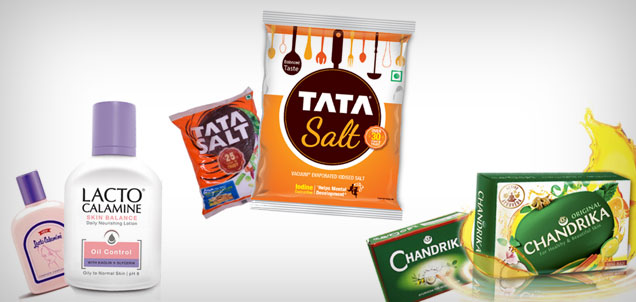
    1. While Lacto Calamine had established credence with the woman who equated beauty with simplicity, it was time to ladder up to a larger and aspirational space; It was time to connect with a ‘self-assured’ woman who makes informed decisions. The brand needed alignment with the new positioning, without losing its core of simplicity. The challenge for Elephant was to create packaging that carried forward the simplicity from the past, but also looked believable as an advanced skincare solutions expert with a growing portfolio.


    2. Chandrika has been a trusted Ayurvedic soap for generations in India. The brand needed to reach out to a younger audience, while staying true to Ayurveda as its core story. Here, the challenge was multi-fold. Ayurveda was not associated with a contemporary lifestyle. And, as a concept, has been dogged by several misconceptions, one of them being slower efficacy. ‘Active Ayurveda’ as a proposition, resolved some of these issues. Ingredients like neem, lemon oil, patchouli oil etc were showcased to help demystify Ayurveda. Colours were changed to a fresher, more natural palette.


    3. Tata Salt, an undisputed leader and pioneer in the category, was ready for change as the brand needed to align with the progressive homemaker. We set out to solve two major challenges. One was to take up the position of being a ‘friendly’ expert, and another was to shake off the ‘me-too’ players who had completely emulated all the codes of Tata Salt packaging over years. First, the typography of the word ‘salt’ was humanised to add a layer of warmth to the trusted Tata logo. To reiterate confidence of the leader, images of food, people and such were removed from the earlier packaging, and a fresh outlook of a modern lifestyle was depicted through visuals of a modern kitchen setting. The colour palette was made more vibrant, but in alignment with its earlier portfolio. Graphics and mnemonics were designed to communicate relevant benefits in a clean and contemporary manner. This has clearly been very well accepted, as is evident from the market success as well as rankings of a recent survey of Most Trusted Brands, where Tata Salt has gone from No 16 to No 2.


    Legacy brands tend to set the standards in the marketplace. They are the very benchmarks for quality because of their emotive communication, for the rich history they continue to build on and, more importantly, for the way they keep up with emerging consumer expectations. Well before “we broke the internet” became a thing, a chant among marketers, these brands invoked conversations and active consumer voices. Their stories become folklore in the world of advertising and marketing.


    What is rarely discussed, however, is the way these legacy brands transform their visual identity to align with young, progressive Indians and their high-lifestyle aspirations today. So how do they manage this alignment? How often do they change, and to what extent or degree?


    Packaging is the first moment of truth for any FMCG brand, and the transformation or alignment basically starts with visual identity and packaging change. It is a huge responsibility when legacy brands like Good Knight or Wagh Bakri tea ask us to redesign their brands’ packaging experience, so that they stay relevant to their existing and intended audience. In such cases, the migration needs to be evolutionary, perceptible and must conform to their leadership status. And then there are the legacy brands like Chandrika or Lacto Calamine, that need to transform themselves, either to get back in the reckoning or reach a completely new audience altogether, without alienating their loyalists.


    Packaging is the most crucial link of closing the loop between maintaining legacy and getting a new conversion going. However short, packaging lives its moment of glory. Great packaging design makes that moment meaningful and relevant to the consumer. It is very exciting to know that you might be reaching a billion hands if you do it right. Or you may just get discarded if the evolution is not based on relevant insights. The approach to packaging design is, therefore, always viewed through several lenses: That of users, of shoppers, of non-buyers, of trends, of technology and so on. Most importantly, discovering and defining what kind of dialogue the brand needs to have at that point in its existence, becomes the pivotal clause. A client once told me we must believe that every square millimeter on the pack can do the job of a billboard. How true!


    Whether you decide to add a message, icon, colour or image on every available surface, or you decide to leave breathing space, you land up communicating something one way or another. So one has to be extremely careful about adding or removing elements. Because what matters is the story you are telling.


    Great design aims to delight the user ahead of expectations. If we use a simple tool of three questions that need to be answered by packaging design — Who am I? What do I do? And how do I do it? — we are mostly home in terms of communication. We notice elements of packaging in the following order: Colour, shape, Illustration/ picture/ texture, and words. These really are the semiotic principles for designing any visual expression. We use these for adding sensorial layers to the basic communication.


    While on the one hand, the quest is to get more legacy brands to stay relevant, on the other it is to help more start-up brands like Paper Boat establish a legacy. Indeed, it gives you an amazing rush when you see carefully-crafted packaging find its rightful place – in the shopper’s basket!


    Ashwini Deshpande is an author and co-founder/Director of Elephant, a leading multidisciplinary design consultancy with offices in India and Singapore. A part of this article first appeared in dna of brands dated


  • Sudhir Menon & Atul Hegde join hands to launch Rainmaker Ventures

    By A Correspondent


    Sudhir Menon and Atul Hegde, two very prominent industry figures have announced the launch of Rainmaker Ventures. Sudhir Menon is the Chairman & Managing Director, Dorf Ketal, a Rs 2000 crore global corporation specializing in the development, commercialization, marketing and application of specialty engineered chemistries for the refining and petrochemical industries. Atul Hegde is one of the pioneers of the Indian digital media industry and was previously part of the Astro group of Malaysia funded – ToTHENEW ventures, running Ignitee Digital, a leading digital marketing firm.


    Rainmaker Ventures with presence in India, USA, Brazil and Singapore launched with an early stage start-up fund of $US50mn and will aim at identifying competent tech-startups and invest not only seed-capital, but also, the partners’ collective expertise of growing successful businesses.


    Atul Hegde, Co-Founder, Rainmaker Ventures spoke on the launch, “Rainmaker by the modern definition is somebody who makes a significant difference to an organization or a group. We strongly feel that early stage startups need full time mentoring as much as they need capital. I have seen most startup businesses fail to move on to the next stage due to lack of real life business experience. Simply infusing capital is not the only requirement. That’s where Rainmaker Ventures come in. We want to create a value-establishment – one that creates and nurtures real businesses in today’s virtual world.”


    Sudhir Menon, Co-Founder, Rainmaker Ventures added “Today, capital seems to be chasing anything that is in the garb of a tech startup. This scenario will get a reality check very soon. In the end, its real business that counts, both to the startup founders & the investors. Rainmaker ventures will focus on helping budding entrepreneurs to build a strong business on the ground. We believe that is the only way to ride & survive this start up wave”


    Rainmaker Ventures will look at mentoring 10-12 early stage startups in its first year of operations. Expansion will also be enabled with more senior professionals from varied sectors joining the company as full time mentors.


  • Clear Channel Mudra rebranded to Ignite Mudra

    By A Correspondent


    Gour Gupta, CEO at erstwhile Clear Channel Mudra and former CEO at Platinum Outdoor, has acquired Clear Channel India’s stake in the JV which has been rebranded to Ignite Mudra. An outdoor industry veteran with more than two decades of experience, Gour has a rich experience in building organizations in this space.


    Ignite Mudra will focus on brand solutions through OOH, Promotions and Retail marketing. In a complex marketing environment where iconic brands have acknowledged the power of the experiences and engagement, this agency will help ‘Ignite’ it’s clients’ presence across these touch points.


    Commenting on this venture Gour Gupta said, “It is an exciting time to be a part of the marketing services industry. The success we have achieved as Clear Channel Mudra has given me the confidence to take the next step in our growth journey. Along with the team, I am excited at the prospect of what lies ahead for Ignite Mudra. We have already begun initiatives in emerging areas like sports and youth marketing. I would also like to express our gratitude to our clients whose faith in us has been a key driver of our success. Also, we are where we are today because of the team that has contributed to our success and has grown along with the organization.” Additionally he said, “Ignite Mudra is a future ready organization, being ‘digitally enabled’ seems to be buzzword that is thrown around when actually it is now a part of the basic hygiene checklist for any organization, as has been the case with Ignite Mudra. We are here to ensure that we deliver brand solutions that solve our clients’ business challenges in the most effective and efficient manner possible.”


    Ignite Mudra will continue working with the clients of erstwhile Clear Channel Mudra which includes – Bata, Budweiser, Clinton Health Access Initiative, Dunkin Donuts, Godrej, Healthkart, Honda, ITC, Michelin, Patanjali, Pepsico, Puma, Reliance Jio, Snapdeal, Sony, Telenor, Vodafone and Worldwide Media.


  • Dentsu Webchutney appoints Gaurav Soi as EVP

    By A Correspondent


    Dentsu Webchutney has roped in Gaurav Soi to head its new business operations, nationally. Soi joins as Executive Vice President and will report to Sidharth Rao – CEO, Dentsu Webchutney.


    As part of his new mandate, Soi will identify and channelize new opportunities for the agency across its offices in Mumbai, Delhi and Bengaluru. Prior to this, Soi was Senior Vice President – Havas Worldwide, Mumbai.


    Commenting on his appointment, Soi said, “The most commonly used word in conversations today is digital. It is no longer the future. It is here and now! Denstu Webchutney has a proven track record and is associated with very prestigious brands. Known for its quality product and forward thinking, I am extremely proud to be a part of this team.”


    “The company is aggressively focusing on growth; and yet, we will need to retain the quality of our product across client offerings. It is this balance that will make the road ahead a very exciting one,” he added.


    Commenting on the appointment, Sidharth said, “Dentsu Webchutney has now entered its next phase of growth and it’s absolutely essential for us that we use the right kind of experiences to steer this growth forward. Gaurav comes in with immense experience and exposure across clients and categories. And his appointment will only further catalyse the strength that already holds the Dentsu Webchutney fort so strong. I am extremely happy to welcome him on board.”


    With more than 15 years of experience, Soi has worked with agencies including The Grey Group (Mumbai), Ambience Publicis, Metal Communications and most recently Havas Worldwide. He has also been part of the events and activations industry through Line Communications.


  • IAA Mentorship Webinar Series to be held in Mumbai

    By A Correspondent


    International Advertising Association (IAA) India Chapter has invited Anish Shah, Group President (Strategy) for the Mahindra Group for its next webinar on Google Hangout on 17th December 2015 between 3 and 4 pm. Anish Shah’s key focus areas are strategy development with focus on digitisation and analytics, driving international growth especially in the US and Africa. The Group Strategy office also enables synergies across Group companies. Anish was earlier President and CEO of GE Capital and has had a stint with Bank of America, Bain & Company, and Citibank. Anish is a PhD from Carnegie Mellon’s Tepper School of Business and is alumni of IIM–A.


    Srinivasan K Swamy

    Srinivasan Swamy, President, IAA India Chapter & Vice President-Development, IAA Asia Pacific said, “With the changes in technology and growth in digital, major business houses have to adopt and evolve rapidly. This webinar series will have Indian and international experts take us through their brand/company journeys and offer insights for others to learn and adapt from”.


    Abhishek Karnani

    Abhishek Karnani, Director, Free Press Journal said, “Creativity and storytelling must now be paired with algorithms to capture the attention of consumers in the era of high decibel digital communication. Navigating this landscape can be daunting. Anish’s experience with global digital initiatives will explain the omnichannel approach needed to win and retain consumers. This is the first mentorship webinar we have added to the IAA platform.”


    Charulata Ravikumar, CEO, Razorfish  said, “True Business Transformation happens when the organization changes itself from the core with a vision to always lead the path of Innovation for life impact. The IAA has always carried out initiatives to bring such Transformation to the forefront so that the larger audience can be inspired by it”


    You can also submit questions for Anish Shah through the IAA India Chapter facebook page – https://www.facebook.com/IAA.IndiaChapter/


    The hangout will be broadcast live on our YouTube channel https://www.youtube.com/user/IAAIndiaChapter on 17th December, 3pm IST.


    The webinar series has already hosted industry stalwarts like Sanjeev Kapoor, CMO, Citi (India); Ashish Hemrajani, Founder and CEO, Bookmyshow.com; Rajan Anandan, MD, Google (India); Nishant Rao MD, Linkedin (India); Ajit Balakrishnan, Founder, Rediff.com and Julie Roehm, Chief Story Teller, SAP; Tushar Vyas, Managing Partner, GroupM South Asia; Sanjay Mehta & Mr Hareesh Tibrewala Joint CEOs, Social Wavelength et. al.


  • 5 trends to watch in Telecom in 2016: PwC


    While traditional media cannot be wished away, given the growing sales of mobiles – especially smartphones and the internet – fixed or mobile, the world of advertising and marketing is getting influenced considerably by telecom.


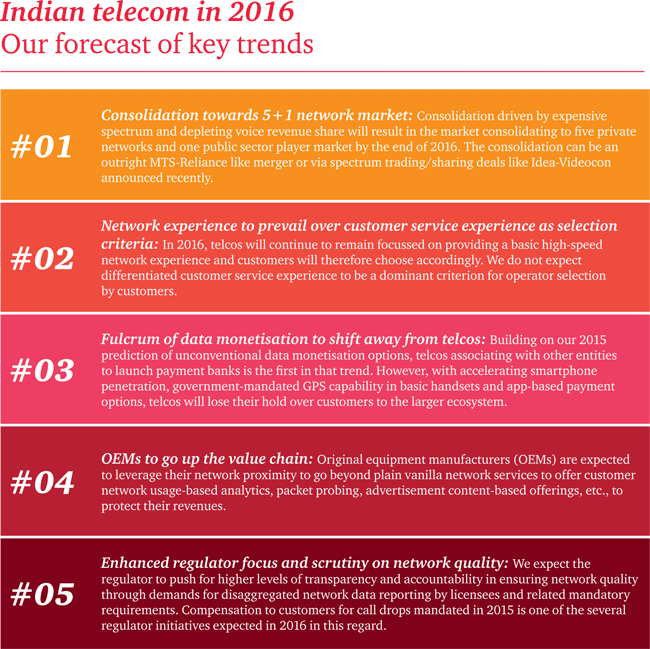
    We present a trends report (and forecast) on telecom presented by leading consulting firm PwC (eka PricewaterhouseCoopers).


    Here goes the forecast for 2016.


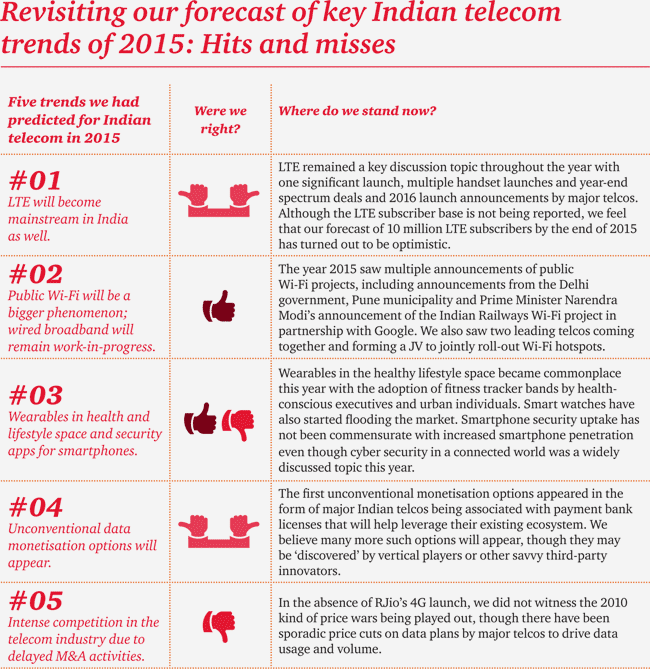
    Interestingly, PwC has also revisited its forecast for 2015 and what’s worked and what hasn’t. Here goes: