Category: ADVERTISING

  • Havas Media wins digital mandate of Turtle

    By A Correspondent


    Havas Media has won the digital mandate of Turtle Limited. The Turtle mandate includes media planning and buying and digital solutions including social, search and mobile. The account will be lead out of Havas Media’s Kolkata office.


    Turtle has a pan India presence with its own Turtle Stores as well as TurtleOnline.com. It also retails through leading online and store-in-store outfits which also includes the large format stores.


    Shitanshu Jhunjhunwalla

    Shitanshu Jhunjhunwalla, Director Turtle Limited said, “Turtle is young and ambitious. We are on a high growth path and looking to expand our pan India footprint. At our core is delivering value, variety, quality and a great experience to our customer. Havas Media shares the same passion and philosophy of being meaningful. Their understanding of the category and customised digital strategy are in line with our growth plans and we look at them as long term partners.”


    Anita Nayyar

    Anita Nayyar, CEO, Havas Media Group India and South Asia explained, “Turtle is in a fast growing, interesting and challenging category. Today’s Indian male is always on the move, has a sense of style, likes choice and dresses for the occasion. We look forward to partnering with Team Turtle to scale their offering to the digitally engaged mobile Indian male.”


    Mohit Joshi

    Mohit Joshi, Managing Director, Havas Media India, continued, “This is a good win – a great brand and team to work with. Havas has been on a winning spree of mandates with digital focus. We are glad that clients find us as the go-to brand keyed in on their marketing plans. The win further boosts our Kolkata operations.”


  • Eeksaurus bags award at Annecy IAFF 2015

    By A Correspondent


    In a first for India at Annecy, France’s prestigious International Animation Film Festival Eeksaurus has bagged the Annecy Cristal Award in the Commissioned Film Category for their film on child labour for Rotary International titled ‘Fateline’. The jury at Annecy was impressed with the campaign calling it a film that was a fantastic mix of technique and aesthetics. The festival received a total of 2,604 films from 95 countries this year, of which 199 films made the official selection and Eeksaurus emerged the winner in the Commissioned Film Category.


    The campaign which is based on the concept of a young child labourer determined to break free from the bonds that hold him down, is a simple yet effective rendition of how the impossible can be made possible when people join hands in working towards a cause. Working with the team of JWT, Eeksaurus had outlined the hands of the palm drawing in from the concept of fate or ‘haath ke lakeer’ combined with the use of strong imagery and music to lay emphasize on the sensitivity of the situation.


    Suresh Eriyat

    Speaking on the win, Suresh Eriyat (Founder and Creative Director – Eeksaurus), said, “This is the first time ever that any ad campaign from India has ever won at this prestigious festival which is a matter of great pride us to have represented India on an international platform. We thank all those who have put in tremendous efforts to bring this campaign to life especially our fantastic in-house team of animators, Rajat and Taufiq, Chester, Arun Crasto and the lovely children from Govandi who lent the soul to this film. The core ethos of this campaign was to reach out to the masses hence no caste, gender or creed was highlighted which has been possible through the use of 2D animation in the film. It is extremely heartening to be recognised for your work at Annecy which gives us a tremendous boost to further explore the scope of animation in India.”


    Concentrating on the design centric approach to weave distinct stories for every brand, Eeksaurus looks forward to working on many more such campaigns which truly challenge the definition of communication with the masses.


  • Piyush is not a grumpy old man. Neither am I. WPP chief Martin Sorrell on retirement plans for the Ogilvy India boss and himself

    By Shephali Bhatt


    Piyush Pandey

    We caught up with WPP’s chief Sir Martin Sorrell on the last day of Cannes Lions 2015, to talk shop and to clear the air on some rumours. The latter first: Piyush Pandey, the executive chairman and creative director of Ogilvy & Mather (O&M) India and South Asia (a WPP company), celebrated his 60th birthday in Goa earlier this year. While David Mackenzie Ogilvy, the founder of O&M, retired at the age of 62; the industry has been abuzz for quite some time about Pandey’s imminent retirement plans.


    Is he finally retiring, we ask Sorrell. And he says: “I read an article featuring Maurice Saatchi, Jeremy Sinclair (founders of Saatchi & Saatchi and M&C Saatchi) and Bill Muirhead (executive director, M&C Saatchi) highlighting that these men were ruling their organisations at the age of 68-69. They said that the grumpy old men are going to carry on. Piyush is not a grumpy old man. He’s not dead yet. Neither am I.”


    On being questioned about the succession plan for both Pandey and him (since he’s 70 himself), Sorrell says, “We have succession plans across the top 200 employees, but I’m not going to discuss that with you.”


    Sorrell’s biggest concern

    His biggest concern about this business is that clients are too short-term focused. They think about the bottom line, and not the top line, especially since the Lehman Brothers crash that heralded the financial crisis of 2008. “Clients have been very focused on cost and not on developing brands and top line, for understandable reasons,” he says. The global GDP growth rate has been slow at 5% nominal and 3-3.5% real. There’s very little price inflation. “As a result you see the rise of procurement department on the client’s end. They get to their numbers, they’re focused on cost rather than developing the revenue. Which is why the irony that people are looking for growth from Western Continental Europe when that’s the one part of the world that hasn’t supplied growth for seven years, since Lehman basically,” he explains.


    Running a business between disruptors and investors

    Sorrell talks about running a business where on one end you have disruptors like Uber and Airbnb (in the old days it was Google and Facebook, and still is to an extent), on the other end you have zero-based budgeters like 3G, Valeant and Endo. And in the middle are investors like Bill Ackman and Nelson Peltz running a legacy business. “The businesses that do best are those that get the concentration of ownership,” he notes. “Indian oligarchs control the ability to make decisions which is good,” he adds.


    Narrowing gap between fast and slow growth markets


    At the moment, there’s focus on cost because growth is hard to come by. The fast growth markets still give you more growth than the slow ones but it’s getting more difficult, he says. “The gap has narrowed.”


    Why clients needs to shift focus from cost

    If you were a client faced with slower top line growth, no pricing power, the disruptors on one end, zero-based budgeters on the other, and the activist investors in the middle, there’s no running away then, Sorrell points out.


    “What you can do is map the top brands in every region using valuation techniques and you’ll find out that people who invest in brands grow their top line faster (which is logical, you would expect that). The biggest driver of total shareholder growth is revenue return, organic revenue growth,” he says.


    Trying to get someone to act on that when it’s for the long term is very difficult when everyone is thinking short term, he rues. “What we have to do effectively, is spend money on an online+offline campaign, which clearly lays out the argument that marketing is an investment not a cost.”


    Investing in tech, data and content – to differentiate the business meaningfully

    WPP has been focusing on bolstering their portfolio across technology – with AdNexus (ad tech for targeted marketing) and Xaxis (programmatics software); data – with Rentrak, Comscore and Kantar; and content — with Media Rights Capital (producer of ‘House of Cards’, ‘Ted’ and ‘Elysium’), refinery29, Snapchat, Truffle and more. “To differentiate the business meaningfully, to win businesses for factors beyond just the talent of the presenter and the price, we have to get the client to focus on these,” he asserts.


    On tech companies

    “Tech companies have gotten very active. Google may have got softer because of some regulatory issues but Facebook is more aggressive than ever. In a non-constructive way I’d think because they feel more ballsy about catching up to Google on Mobile. Yahoo is very hungry, constructively so. Apple is much more open now. Microsoft is much more coordinated. Twitter, LinkedIn and BuzzFeed have interesting opportunities as well.”


    Source:The Economic Times

    Copyright © 2015, Bennett, Coleman & Co. Ltd. All Rights Reserved

    Licensed to republish


  • Thinking Big with The Social Street


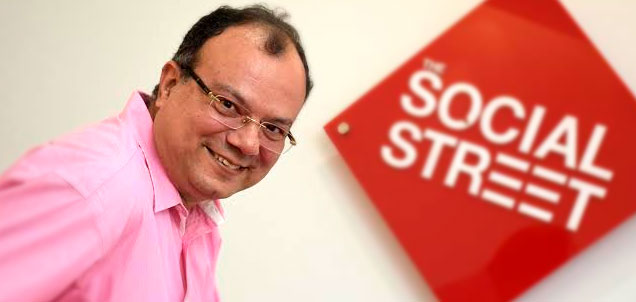
    If you drive around the arteries of Mumbai, the billboards – some fifty of them – tell you the story. Pratap Bose, former Chief Operating Officer of the DDB Mudra group, has moved to the fast lane. And with a bang. Last Monday, Bose announced that he along with outdoor and experiential specialist Mandeep Malhotra, Arjun Reddy an entrepreneur who owns and runs a diversified portfolio of businesses, and Pradeep Uppalapati, who was Senior Director and India Lead for Global Corporate Development Team at Accenture have teamed up to launch ‘The Social Street’, billed as India’s maiden advertising conglomerate. Positioned as a digitally driven agency, traditional creative advertising, digital and social media will be added on to the bouquet of offerings by the end of the financial year along with more offices across the country.  In an interview with Pradyuman Maheshwari and Dyanne Coelho, Bose that he believes starting big, with multiple types of businesses, several offices and many big-ticket clients, all within a few months.


    What’s the journey been like from the time you left DDB Mudra. And when did you start thinking about this venture?

    To be honest, when I left at the end of April last year, the natural tendency was to reach out to headhunters, and find out what the offerings and options were.


    So you had nothing in hand when you left?

    No. I had no inkling that I was going to start my own agency. That’s a thing you do when you’re still working. The thought was there, but honestly when I left, the first thing was that headhunters started calling within the first 10 days [with offers].


    And you were getting offers until as late as December 2014?

    Yes, in fact, I was getting calls until I announced the venture. I was flying to Malaysia, Hong Kong, Singapore, New York for meetings. But on one flight back from Singapore, after an interview that went very well and the company pretty much confirmed me for a regional position, I asked myself: do I really want to do the same thing for another day? You live month by month, not even quarter by quarter. It’s all about the numbers at the end of the day. I sort of snapped and decided that I don’t want to do this again. I’ve done it for 24-odd years, and if there is a better option, then I’ll look at it. I got a few client calls as well which were interesting, but at the end of the day it’s one client, a few brands, and it didn’t excite me enough.


    So when did you actually think of setting Social Street?

    Mandeep and I went to Cannes in June, and on one drunken afternoon we went to that love bridge and proclaimed our undying love for each other and the business. When we came back, we said it’s probably a good idea that we should start something of our own. But at that point of time, we had no inkling of how we were going to do it.


    You went to Cannes on your own?

    Yeah, I have been going there for some years. All the global heads and CEOs were there and I had a lot of meetings and interviews lined up. That was two months after I’d left, so the time was also right. But around then my mother was detected with cancer. That was in July. I brought her to Mumbai and was looking after her, but then she passed away a day before my birthday. That shattered me and any thoughts I had of starting anything on my own, fell by the wayside. At the end of October, given that my gardening leave and contract with Mudra ends in December and I need to move now. That’s when I sort of started putting things together. I envisaged what sort of agency I wanted and met every probable Venture Capital firm in the country, because I needed a certain amount of money to start up.


    I heard from VCs that you were asking for loads of money…

    Yes I was asking for a lot of money because I’m not the type of person who’s going to start with 10 people, build an agency, win your first client, then grow with it and add people. I think if you’re really serious, start big and take the risk. If you’re sure of your business model and you know your numbers, then there’s no point in starting small. Also, because of the kind of businesses we are in and the clients we chase want scale. Large clients want scale in terms of ideas and capabilities. The fact that we’re opening up three offices simultaneously, which not many people do, and then scaling up to 140-150 people within a year or less, needs a considerable amount of funding. I spent a lot of time trying to work out the business model. You can have any number of great launches, but at the end of the day, you have to have a business that works. I spent a lot of time looking at areas that are high-growth margin businesses, or those that have the potential to grow for the next 10 years in the space where we are.


    Let me give you an example, in the rural space. I don’t think there are more than four rural agencies in this country. It’s virgin territory, with no competition. That’s the space to be in, because that is the future. If you’ve got a great offering, I think there’s a lot of money to be made, especially with not too much competition. So it makes it easy to grow. Why will I not be excited about digital? There’s no finite definition of what is digital, and technologies are changing so fast. So I will not start and build a digital agency; it doesn’t make sense. I will go and acquire somebody.


    And finally you got somebody who is not a typical VC…

    Yes, so I decided two months after meeting every VC, that I was just making them more knowledgeable about my business. VCs come with a huge chip on the shoulder saying ‘since I’m giving you the money, I’m your Lord and master’, and they contribute very little to the business. I decided that VCs are not the route I want to take. Therefore, I went around looking for like-minded individuals who trusted and believed in the business that I was in, and were prepared to stay with me for the long term. I ended up with a short list of about three or four people who were happy to fund me.


    So how active are Pradeep and Arjun going to be in the business?

    So Pradeep has worked for 11 years with Accenture. I think he spent eight years in Australia, and three in India. Obviously he’s the CFO/analytics/strategic investor, and Arjun is the part of a larger conglomerate. He owns hotels and varied businesses, and is on the retail side of the business.


    Have you also put in any money?

    Yes.


    Is this a long-term investment or will your investor-partners and yourself sell out eventually?

    No I don’t think you start a business with the idea that you’re going to sell out. If someone is starting a business with the idea that he is going to sell out, then I don’t think he should be starting a business in the first place. Does that thought occur to you? I’d be lying if I said no. But I think right now that’s far from anyone’s thought.


    So this happened April-end, May first week. How many people have joined you from DDB Mudra?

    I’ve lost count. But I think the media is making too much of an issue of it.


    Come on, there is an issue.

    There isn’t (laughs).


    Okay, but what you’ve started is like a MudraMax, right?

    I think people make that comparison. But I’ve already been there and done MudraMax. I don’t want to create MudraMax 2; that’s not my intention.


    Things like content, digital and social is pretty big for us and will become very big, but was never part of MudraMax, nor was branded content or entertainment, sports marketing etc. We’re looking at the businesses very differently and, unfortunately, not very many people are able to actually see a USP. So we’re in this space, and I’ve been in this business long enough, and the one guy who really taught me what the real power of integration is with clients was Ranjan Kapur.


    Did you go to him for funding, because he is also a VC in his personal capacity?

    No. Ranjan has always been my boss and mentor. I have the most immense respect for him as an individual, so I did talk to him in his personal capacity.


    Given that you are an outdoor-experiential business guru, isn’t that’s going to be your mainstay?

    No, it won’t. We have all the operations right. We have all of the skillsets. So we into out-of-home, rural, events, promotions, trade marketing, retail, shopper, youth marketing, media, branded content etc.


    The way I see it, in the next three years, I think retail, sports, branded content are going to be the big players and not the other businesses. Because the big money and opportunity are in those areas. The retail industry is probably five times bigger than the entire communications and advertising business. Sports entertainment is massive. Exhibitions, though we’re not into it, is part and parcel of the experiential and retail business. It’s probably bigger than anyone can imagine.


    These are areas that you’ve not typically been specialists in…

    No, but I’m saying that’s the opportunity. At the end of the day, most agencies see themselves as B2B and never B2C; they’re never in direct contact with consumers. I think with the offering that we have, and the use of technology and the ability on great ideation, for me the biggest challenge would be in the B2C area.


    So Social Street isn’t going to an outdoor specialist?

    No, outdoor is a medium, as much as digital is a medium. It’s part of a media plan. It never works in isolation. Twenty-five years ago, I brought the specialisation into this country. I created the AOR concept. I started my career with it and I’m very proud of that.


    But outdoor is or was 12-15 per cent of DDB Mudra’s revenues?

    It always has been profitable. It was an extremely profitable part of Ogilvy when I was there. I’m not saying that that is not going to be a part of my business, it is. I think what’s important is the positioning in which we go with clients. It’s not that we’re experts in all of those areas. I think the biggest USP for us is that we’re able to string it together with a team that is a combination of excellent creative people within those tiers. Not typical agency people who are making print and TV ads. Everyone’s asking me why I have media in this whole business. I think people don’t realise that media for me is the kind of glue that binds everything together.


    Do [clients] take advice from people from a creative consultancy or from a marketing consultancy service like yours?

    Only if you really understand his/her business as well as he does, then are you a trusted partner. You can never do it across clients. You can do it with a select number of may be eight to 10 large clients. But it positions you as far more than just an advertising agency. And the kind of businesses I am, I’m looking at marketing budgets of clients, not advertising budgets. Sometimes marketing budgets are much bigger than advertising.


    How did you come up with the name?

    Actually the biggest problem was that no one had ever talked about finding the name of the agency.


    Getting Josy and Bobby to help was interesting…

    So I came up with about 150 names, and we were struggling for about 45 days to come up with a name, so names from Wasabi, to Deep End Purple and all floated around like those names, but once Mandeep just went to meet Josy and told him we’re struggling for a name. So Josy asked what are the businesses you’re going to be in. So he rambled off some things and Josy just came with The Social Street within like 10 seconds. If you’re in advertising you try and look at the sexiest names. So the name social in terms of what we do, and also the brand manifesto that we wrote out, it fitted, it was kind of very apt for what we did.


    So when was the name finalised?

    About four to five weeks ago.


    Moving on, are your partners ready for the vagaries of the business?

    They understand the business. I think a lot of people ask me because the businesses that are in it, are also very spread out. I’m not risking it; I’m not just a digital or advertising agency where, if something goes wrong, I’m screwed. Because I have so many verticals, even if just three or four fire, I’m home on the numbers.


    You obviously have a lot of senior people and more will come. When are you getting your creative head?

    I think it’ll be a while before I have a creative head, since I’m not an advertising agency. First of all, I don’t think there’s anyone qualified to be a Creative Director for all of the businesses that I have. So I’m not looking at a typical Chief Creative Officer profile.


    So how many clients have you had on Day1? Is the meter running?

    The meter is running, the clock is ticking, the taxi is moving. I would say we have about 15 to 20 clients on board.


    One or two names?

    I don’t want to talk about it.


    But you will eventually?

    Of course I will. I’ll be releasing saying that streetsmart Social Street wins  creative duties of xxx.


    Any targets to yourself? What do you want to achieve?

    I think the role I see — apart from driving business — is to build a strong people-driven agency. A sense of ownership is something that I’m currently driving. I use the word ‘our’ and ‘we’ all the time and every single person that I’ve spoken to I’ve told it’s your agency, our agency.


    So numbers purely in terms of business and revenue targets — any ball park figures?

    I will have about 140-150 people by the end of year, or within nine months of operation. We’ve already hired about 50-odd. We’re across three offices, not just one. If I broke even in 14 months, I’ll be a very happy person.


    And how much will it take to break even?

    You can ask the question in as many ways you want to ask (laughs). When I moved from Ogilvy to DDB, we made huge investments. With no business, we probably hired about 120 people overnight. We broke even in 12 months.


    So do you think you should achieve a Rs 100-200 crore you’re looking at Rs 100 crore in year one or nine months, in billings?

    Yes, billings will be about 250 crore. But billings is not an indication of what your revenue is. However, 250 crores we will definitely do, easily.


    It helps being a finance person to run a business?

    It does, at the end of the day numbers bring a lot of happiness because you can invest and go to exotic locations for conferences. You can go to Barbados, you can go to Port of Spain, you can go to Hawaii, you can only do that if you have profits, you can’t do that if you have no money.


    One last question: Can you, in 140 characters, tell us what ‘The Social Street’ is all about and how are you different?

    It’s difficult to say it in 140 characters. I believe in brevity, so you need to be able to say it on one slide. But because we are so many different businesses, we’re not just one digital or advertising agency. I think we want to be seen as the best-in-class digitally-driven social agency.


    A shorter version of this appeared in dna of brands dated June 29, 2015

     

  • Mindshare is #1 as per latest RECMA ratings

    By A Correspondent


    Leading marketing services agency Mindshare emerged as the No 1 media agency in India as per RECMA’s latest qualitative assessment for all leading media agencies in India. Mindshare has scored high on the parameters of Client Profile, Momentum, Competitive Pitches and Resources to emerge as the leading agency in India.


    Said Ashutosh Srivastava, Chairman, Emerging Markets at Mindshare: “I’m pleased to see this endorsement from RECMA for the agency’s position in India. Mindshare continues to be at the leading edge there – in harnessing data to power more creativity and innovative use of media platforms for marketers, and bringing to life its proposition of Adaptive Marketing”.


    Gowthaman Ragothaman, Chief Operating Officer, Mindshare Asia Pacific added, “I am particularly satisfied with the recognition on structure and vitality. We continuously re-engineer our teams in line with the changing demands from our clients as well as the media and marketing landscape. Our suite of services now reflect a full-fledged marketing communications company”


    Speaking on the new ratings by RECMA, Prasanth Kumar, CEO, Mindshare South Asia said, “This is a win for each and every member of the Mindshare team. Mindshare has always been the leader in innovation, and we believe it is extremely vital for us to prepare ourselves and our clients for a relevant tomorrow. With our adaptive marketing philosophy, we have ensured our clients have the competitive advantage, and their communication is superlative. We are grateful for their belief in us, to deliver on our common goals of brand building. We are proud of the fact that our clients continue to work with us on initiatives that are continuously pushing the boundaries of media investment and communication, as we successfully redefine the media industry in India.”


    The RECMA country Qualitative Evaluations offer an extensive and up-to-date assessment of the media agencies based on a set of performances indicators.


  • AdStrat: DDB Mudra executes a new campaign for Vento

    Objective

    The objective of the campaign was to showcase the New Vento as a complete package of thoughtful design and purposeful style.


    Campaign Idea

    From in-depth consumer research, it was evident that the New Vento buyer was a family person, who appreciated both substance and design. He would not compromise on what is best for his family or on his ride. The New Vento is the car he was long waiting for. With its thoughtful design and blend of style, it is sure to make the owner feel the love it has been crafted with and ensure that he passes it on to his near and dear ones.


    Creative Execution

    The media rollout consisted of a clutter-breaking 30-second TV commercial, along with print innovations in leading dailies. This was supplemented by OOH, digital & other interactive initiatives.


    The TVC is a tale of the love received from the car being radiated. The key protagonist; in this case, the young guy is seen seemingly grooving inside his beautiful New Vento much to the amusement of passersby. What the viewers realize later is that all his funny gestures were to charm and amuse his cute chuckling toddler safely tucked out of view in the backseat. The narrative in true Volkswagen style brought a pleasant twist in the story and along with it, the twinkle in the eye moment, now synonymous with Volkswagen films.


    Quoting on the campaign, Rahul Mathew, Creative Head, DDB Mudra West said, “Going the family way is often seen as going away from all that’s fun. But actually that’s a choice, not the rule. The new Vento makes sure that it’s a choice you don’t have to make when it comes to your car. And that’s what we tried to capture in the commercial. A man who sees the fun side to the responsibilities of a father.”


    “The Vento has always been among our best received products in the market and with the changes made to the New Vento we wanted to do something unique for this carline. The DDB Mudra team has worked very well on the brief and the final outcome is fantastic” said Kamal Basu, Head- Marketing & PR, Volkswagen Passenger Cars, Volkswagen Group Sales India Pvt. Ltd.

  • Zarif Tapia appointed as Head of Cream Events at Edelman

    By A Correspondent


    Zarif Tapia

    Edelman has announced the appointment of Zarif Tapia as head of its specialty company Cream Events, an experiential marketing unit. Based in Mumbai, Tapia will lead Edelman India’s events business and will report to Rakesh Thukral, managing director of Edelman India, effective immediately.


    With over 20 years of experience in experiential marketing, Tapia joins Cream Events from Brand Activation, a division of Wizcraft International Entertainment. In addition to regional leadership, his profile at Brand Activation included developing integrated experiential marketing solutions across multiple platforms, including events, digital, PR and TV/radio.


    “We are delighted to have Zarif on board,” said Thukral. “He brings to the table strategic thinking, experiential innovation and the ability to drive business growth – skills honed over long years. His proven track record of delivering experiential excellence across sectors will strengthen our integrated offering for our clients. We welcome him to the Daniel J. Edelman India family.”


    Over the years, Tapia has counselled a wide range of Indian and multinational clients across the corporate, consumer, lifestyle and luxury sectors. More recently, he spearheaded Wizcraft’s venture into exposition and exhibition management, running prestigious projects such as the MCHI Property Expo, the largest property expo in India, and the IIFA Expo.


  • Joy opts for Happy

    By A Correspondent


    Following a multi-agency creative pitch, Kolkata based Joy Cosmetics has appointed Happy Creative Services, Bangalore to lead the creative mandate for them.


    The portfolio consists of multiple variants of face wash, face scrubs, face packs, creams, lotions and shampoos, catering to different personal care requirements. The annual marketing spend on the portfolio is estimated to be around Rs 50 crore.


    The retail footprint of the brand includes both general and most notable modern trade outlets across 23 Indian states. Rajasthan, Madhya Pradesh & Uttar Pradesh are the strongest markets. The brand is also available in Nepal, Bangladesh, Pakistan, Afghanistan, Sri Lanka, Middle East & Africa.


    Bollywood actor Anushka Sharma has been endorsing Joy Skin Fruits Face Wash range since 2012.


    Poulomi Roy

    Poulomi Roy, Head Marketing Joy Cosmetics said, “The personal care market in India is still at a nascent stage in comparison to the developed countries and there is ample growth opportunity in years to come. Joy perhaps being one of the very few Indian companies who is purely into the personal care space and is here to stay as a prominent player. Keeping this objective in mind year 2015-16 is a crucial year for the company; some strategic alignments have taken place within the organization and also with our partners, having Happy on board is a part of this process. We believe the young energetic team of Happy will play a vital role to help brand JOY achieve its defined milestone.”


    Kartik Iyer

    Speaking on the association, Kartik Iyer, CEO and Co-Founder of Happy Creative Services said, “It’s an honour to be chosen with a brand like Joy Cosmetics. The fact that they were open minded about working with an agency based in another city itself proves that they are a forward thinking organisation. We look forward to breaking some category codes and giving birth to a fresh new brand in the personal care space. And if you haven’t cracked the Happy-Joy joke yet, we already have.”


  • AAAI to present Lifetime Achievement Award to Bobby Sista

    By A Correspondent


    The Advertising Agencies Association of India announced that this year’s AAAI Lifetime Achievement Award will be given to Shambhu Venkatrao Sista popularly known as Bobby Sista. This Award is the highest honour to be given to an individual in India for his/her outstanding contribution to the Advertising Industry.


    Bobby Sista has been one of the stalwarts of Indian Advertising. Known for his professional integrity, he constantly fought to ensure ethical business practices in a fiercely competitive profession. In 1970, after brief stints in Suhrid-Geigy and Readers Digest, he took charge of Sista’s Private Ltd, an agency founded by his father, the late Venkatrao Sista, a pioneer of Indian Advertising and one of the first Indians to establish a full-fledged advertising agency, in 1934.


    Always committed to the growth of the Advertising profession and its image, Bobby Sista has held important offices in many industry bodies. He was Vice-President of the Advertising Agencies Association of India (AAAI) for two terms. During his association with AAAI, Bobby played an important role in liaising with the government on numerous industry matters. He was also the founding member of Advertising Club Bombay!


    After his innings in the advertising industry, Bobby has been associated with a variety of social causes like ActionAid (an U.K. based Charity and the parent organisation of Partners in Change) , Sukhi Pariwar – an integrated Health Services and Family Planning Programme working successfully in Pune district, Citizens Council for a Better Tomorrow (CCBT), Mumbai. He is an Executive Committee Member of the Council for Fair Business Practices (CFBP), Mumbai. He also helped to set up the first Jaipur Foot Centre outside Jaipur. This was under the aegis of the Anga Karunya Kendra in Bangalore of which he is the Founder-Trustee. Currently as an Executive Trustee of Population First, he is actively pursuing the task of enhancing communications component of Government programmes and mobilizing the communication industry and media to create a people’s movement for social development and gender sensitization through his ‘Laadli’ initiative.


    Making the announcement, Dr. Ambi M G Parameswaran, President, AAAI, stated that “Bobby Sista is an industry veteran whose agency did some truly pioneering work in the 70’s, 80’s and 90’s. It is admirable that even after leaving the advertising business he has tirelessly worked for numerous worthy causes for social development. He is an inspiration to all of us!”


    The AAAI Lifetime Achievement Award will be presented to Mr Sista on 31st July 2015 in Mumbai.


  • Who’s Afraid of ASCI?


    By Sanjeev Kotnala


    Normally communication is not given high enough an importance and it’s common to point out that it is just a small part of the whole system. Right. But when it comes to brand image and perception, suddenly all fingers starts pointing at it. In case of an erroneous advertisement called to attention by the media or a consumer, communication and the stakeholders in the process become direct scapegoats. It is a situation that could be avoided with proper planning and sensitising people involved in the process.  Unfortunately, we have a whipping boy ASCI; the designate self-regulatory body – the Advertising Standards Council of India, which keeps low, and no one is afraid of.


    There are many things that go against ASCI, including their own processes and lack of willingness to be in focus other than infrequent press reporting in some remote page position. It fails to have an effective impact in brand and consumer life.


    The Time Trap or Time Warp. ASCI suffers because of its dependence on processes that were designed for a non-digital, non-instant and highly non-intrusive era. These processes designed to create fairness in hearing of a complaint and the gap between council meetings creates buffer that are more than sufficient for the brand-at-fault to take advantage of.


    Though ASCI has been at it and has done wonderful work in streamlining the processes, I submit they have been inadequate. Even an ‘express’ system is not fast enough for current times.


    There is a need to have council members who are passionate about ASCI’s role. Have rules that allow council members to consider, remarks and vote from a remote location. Maybe create a larger bank of council members so that not much pressure is exerted on their time and always there are available a set of members that will complete the quorum.  How nice it would be to get a direction and a verdict within 48 hours of complaint submission!


    If the brand has willingly strategies to create the ad, that has been produced, the background support should be available at the flick of a button or a click of the pad. Time we did away with that long time given for brands to reply.


    The Soft Velvet Touch treatment. No smart Brand manager is afraid of ASCI. When the max penalty for releasing a misguiding advertisement is just withdrawal, it makes life so simple. It’s easy to take advantage of this window between complain and resolution. In fact some brands can even plan the release to increase the window of opportunity.


    What needed is to give ASCI the power it deserves. At least the penalties awarded must be complied with before re-evaluation in legal system is entertained.  And during this readdressing of verdict, the default communication must remain caged.


    The wish to have ASCI as nodal autonomous body with final verdict may be far-fetched and full of legal loopholes. In current digital era when so much rides on communication, it should not be left to chance.


    May be it’s time we went a bit rough on defaulting brands. On first default, the brand should be asked to withdraw the communication. This is also the current practice. For a second default by Brand (even if a different communication), it must be forced to run a corrigendum in same size, duration in three main media. Vehicle used for the misguiding communication. For the third such act, the brand should run a corrigendum and be debarred form advertising in the media where the misguiding communication had appeared.


    Meanwhile like DND phone numbers, ASCI should create an easy to access archive of defaulting communication and brands. It must get its member media access and power to deny releasing a defaulting brand communication. May be in addition to the RO, brands must also provide a statement of ownership and confirm that the claims are not objected by ASCI or there exist sufficient data or reports to support the claim.


    Media B2B Communication: Something that is very near to the ASCI governing members. And maybe for media B2B communication a directional advice can be given to the brands through remote voting without waiting for defending the brand’s answer.


    I would want to see a situation where a brand is prevented from lodging any fresh complaints for a pre-decided time period if the last two complaints by it have not been upheld. Also, a brand against which complaint has been upheld should not be allowed to advertise for some period. I know this will never happen.


    Creative Agencies Becoming Mini-Regulators: There is a definite need to sensitise creative and media agencies. They must willingly and as ask their client clarification or detail in case the claims and supports do not match.


    There is even a pre-release checking facility at ASCI, where the brands can get an initial non-negative check done wrt the claims and representation. I am not sure how many are aware of and how many have availaed fo the service.


    Trust me, the era of taking things for granted is over. The offended brands are not going to remain silent. The common man – the ultimate consumer – now knows his/her rights and is willing to challenge brands on their promises. Social media is acting as a sword with twin edges.  Time to cultivate habit of self-regulation at every possible checkpoint. Time to have sub-regulatory teams in client office, in agencies and in media. Time to be far more transparent and vocal against the offending brands and to give ASCI decisions and progress a wider reach.  Or let us be ready for the alternate, which is a terrifying thought.  A new nodal agency thrust upon this industry. Then we know nothing will remain impossible.


    Sanjeev Kotnala is Founder and Head Catalyst at Intradia. A Brand, Marketing and Management Advisor. He conducts specialised workshops in the area of IDEATION (Harvest and Liberate) and Innovation (InNoWait). His focus energy in enhancing client’s internal team’s potential and capabilities. In process decreasing their dependence  on external resources. To contact email sanjeev@intradia.in  or tweet at s_kotnala visit www.intradia.in  www.sanjeevkotnala.com.


  • Madison Media wins Media AOR of Shaadi.com

    By A Correspondent


    Madison Media Sigma has won the media mandate of Shaadi.com, one of the largest matchmaking portals in India. Madison Media Sigma was chosen after a multi-agency pitch. The account will be handled out of the agency’s Mumbai office and the estimated size of the account is Rs. 50 crores. Earlier, the media buying duties for the brand were with Havas Media.


    Shaadi.com, one of India’s best known brands and the world’s largest matchmaking service was founded with a simple objective – to help people find happiness. The company pioneered online matchmaking in 1996 and continues to lead this exciting category for more than a decade. By redefining the way Indian brides and grooms meet for marriage, Shaadi.com has created a world-renowned service that has touched over 30 million people.


    Says Aditya Save, Chief Marketing Officer, Shaadi.com on selecting Madison Media, “We believe that great marketing work requires able agency partnerships & hence are delighted to have Madison Media Sigma as our media partners. We are looking forward to working with them to do some innovative & disruptive media work.”


    Sam Balsara

    Sam Balsara, Chairman & Managing Director, Madison World said, “I am delighted that Shaadi.com has found Madison Media to be worthy of handling their unique business. We are thrilled to be associated with Shaadi.com. Matchmaking in itself is challenging and partnering with World’s No 1 Matchmaking Service is a big responsibility. With our strong experience of clutter-breaking, engaging communication campaigns across industries, we are confident of taking the brand to greater heights.”


    Madison Media Group has been on an account winning spree, having won a host of new businesses in 2015 including Snapdeal, Viber, Lenskart.com, Zivame.com, Metro Cash & Carry, Gaana.com, Cricbuzz.com, Amul Hosiery, DHFL and Bandhan Bank, amongst others.


  • 20:20 MSL wins multiple clients in H1 2015

    By A Correspondent


    20:20 MSL has announced a series of new business wins across India. Teams from 20:20 MSL across Delhi, Mumbai, Bangalore, Pune, Chennai & Hyderabad collectively won 24 new business pitches over the past two quarters, demonstrating its creative and strategic leadership in delivering insight based integrated approach deigned to generate business impact for clients.


    Chetan Mahajan

    Commenting on the new business wins, Chetan Mahajan, Managing Director, 20:20 MSL & Co Managing Director MSLGROUP India, said: “Today brands need a strategic partner who can co-create and deliver effective result oriented campaigns. The investments we made in building integrated capabilities over the last couple of years have started to pay off. This, alongside our focus on building capabilities in research and insights makes us more relevant than ever, and the series of new wins stand as a testimony that more and more clients trust us to help them stay ahead of the curve”


    The wins include handling brands of Marico, Dimension Data, Swift Key, Saavn LLC etc.