Category: Ad Agencies

  • The Rise of the Holding company


    By Prabhakar Mundkur


    Prabhakar MundkurWhen WPP won a large part of the Coca-Cola business worth $4 billion, it was an affirmation that the holding company once looked upon as just a holding company that does nothing but inspects individual company, P&Ls had transformed themselves into an integrator of their individual companies.


    True integration has eluded the ad agency business for over two decades now, if not more. Sir Martin Sorrell took the lead for integration by pitching for large businesses globally. Mark Read has followed quickly in his footsteps by employing the same methods to win the global Coke business easily one of the top advertisers in the world for a long time.


    Conflict of Interest

    Once upon a time, agencies got bogged down by conflict of interest to handle more than one account in the same category.  This is because the traditional agency was unable to build an effective firewall that convinced clients that conflicting accounts could be handled without a leak of confidential information within the agency. No longer.


    Because holding companies have been able to put together special teams hand-picked from each of their operating companies offering a wide range of disciplines for mainline advertising to digital, to form individual units that handle each conflicting account, it promises a very effective firewall which means that clients are no longer worried about conflict. WPP’s GTB for Ford, Red Fuse for Colgate-Palmolive and now Open X for Coke are just examples of how these specialist units can operate.


    While it may seem like an innovative way to handle clients, the Japanese have been doing this for the last many decades. If you have been to the Dentsu or Hakuhodo buildings in Tokyo, you will notice that there can be as many as three or more automobile accounts being handled by these agencies, with each agency unit being located on a different floor.


    For example, Nissan could be on the 13th floor, Honda on the 17th, Suzuki on the 20th and Toyota on the 25th. The beauty of this structure is that employees working on a particular floor do not have access to any floor but their own therefore providing an effective firewall that ensures confidentiality of the individual account.


    WPP’s Coke win includes creative media and marketing technology business for 200 countries so it is a fully integrated business. I quite liked the Open X name for the WPP unit which handles the Coke integrated business.  Unusual for Coke who has been hesitant to commit themselves to any agency in the past although IPG has had the longest run.  I remember a time when Coke thought that it did not need their creative agency McCann and began flirting with individual Hollywood producers for their commercials.


    It’s a pity that the major new creative platform of Real Magic was launched just two weeks before the WPP announcement.  While I thought that the Real Magic commercial worked well, initial feedback from the gaming community suggests that it has put the brand back by a few years.  Tim Crow sports and eports advisore says, “Gaming is not a divided world. They are a big tribe that doesn’t need Coke’s help to connect with each other because they already are. Games are about fun and the competition brings people together… Coke [came off as] tone deaf about gaming and what it is. They’ve put themselves back years with the gaming community with this globally.”


    It would be interesting to see how WPP takes this theme of Real Magic forward.



  • Arvind Sharma to be conferred with AAAI Lifetime Achievement Award 2021

    By Our Staff


    The Advertising Agencies Association of India today announced that AAAI Lifetime Achievement Award for 2021 will be conferred on advertising veteran Arvind Sharma.


    Sharma, an alumnus of IIM Ahmedabad (1975-77), led Leo Burnett for 21 years in a three decades-long association with the agency. He has led most A&M industry organisations and is now a serial investor and mentors to many entrepreneurs.


    Making the announcement, Anupriya Acharya, President, AAAI, said: “Mr Arvind Sharma has been a true pioneer. Apart from singlehandedly making Leo Burnett a top agency and a force to reckon with he has also groomed some of the finest talents in our industry. But more than that he has made a tremendous contribution to our industry across both the art and science of advertising. He is truly deserving of this honour.”


    Added Ashish Bhasin, Chairman of the AAAI Lifetime Achievement Award Selection Committee: “Arvind is a deserving winner of this prestigious honour. Not only has he been a successful advertising professional, he has also contributed significantly to the industry in various capacities, including as President of AAAI and a key driver in launching Goafest. I am pleased to say that the entire committee was unanimous in conferring this award upon Arvind.”


    Some of the past winners of this award include Subhas Ghosal, Alyque Padamsee, Mike Khanna, R K Swamy, Piyush Pandey, Sam Balsara, Prem Mehta, Roda Mehta, Ram Sehgal, Madhukar Kamath and others.


    Although AAAI hasn’t announced the date, according to information received, the award event is likely to be held in Mumbai on December 16, 2021.


  • Merkle B2B & Bloomberg Quint launch ‘The Media Guide’

    By Our Staff


    Merkle B2B, the Dentsu India agency, partnered with Bloomberg Quint to produce a study through Greyhound Research. The study was conducted with Indian CIOs and IT decision-makers to identify their concerns, issues and preferences about a brand, product or solution while making a purchase. The aim being to understand the world of evolving Indian tech buyers and the factors influencing their decisions.


    Key highlights of the report:


    :: Increasingly, CEOs/MDs are personally getting involved in the technology decision-making process. They are seeking business leaders and external parties (analysts/consultants) to gain deeper insights and better bargains from the existing and new vendors.


    :: Traditional (80%) and startup (73%) organisations prefer to use local podcasts and videos along with their global content pieces to strengthen context.


    :: 73% of respondents from traditional organisations continue to value conferences and events, while only 53% of startup organisations prefer them as part of the new technology buying decision-making process.


    :: 60% of traditional organisations and 100% of startup organisations find online technology magazines to be effective in their technology buying decision-making process.


    :: 40% of startup organisations and 23% of traditional organisations find global video content to be helpful while identifying a technology vendor.


  • Havas Prosumer Report: on future of e-commerce

    By Our Staff


    Havas Group announced the launch of its Prosumer Report, a global perspective on the future of e-commerce that captures information and insights on the sector, done through the network’s proprietary research tool. Drawing on responses from 3,000 consumers from India, Brazil, China, France, the United Kingdom, and the United States, the survey examined the upcoming trends in the e-commerce experience.


    Pritha Dasgupta
    Pritha Dasgupta

    Talking about the report, Pritha Dasgupta, CMO, Havas Group India, said: “Prosumer is Havas Group’s global report that is released 3 to 4 times every year, each one covering a specific topic. It is one of the longest-running thought leadership properties of Havas Group that has become instrumental in predicting emerging trends in consumer behaviour,” adding: “Over the last two years, digital adoption has been extremely fast and has become a way of life. If we specifically look at the e-commerce sector, it has become a breeding ground of innovation and in the last two years every leading company in this sector has grown aggressively. Our latest Prosumer Report gives a clear direction to the industry of where this e-commerce sector is headed, and also identifies trends of the sector.”


    As per a communique, the study notes that throughout the pandemic, e-commerce has clearly established itself as the new retail norm as more than eight in 10 prosumers say they prefer the online shopping experience over the traditional format of in-store purchasing. However, one out of three respondents claim that their e-commerce experiences are quite boring. Havas Group’s Prosumer report came up with a few ways to upgrade the e-commerce experience by:


    :: Focusing on new rules of eCommerce: This includes free shipping & returns, seamless & fast delivery, customer ratings, loyalty discounts and purchases recommendations.


    :: Having a purpose beyond clicks: e-commerce must be about more than just access, it is about curating products that are good for society.


    :: Being on the right side of data history: Privacy is gaining momentum so data education should be mandatory.


    :: Expanding from a place to buy to a place to socialise: As e-commerce is becoming more human and is moving to social, making the experience more community-driven will bring results.


    The report threw light on some India-specific trends:


    :: The rise in community shopping experience: Post-pandemic, the desire to replicate in-store/mall experience has led prosumers to seek community shopping experiences from the e-commerce industry. In this context, we see a spike in demand for services such as the ability to shop on social media (66%) and the ability to interact with fellow shoppers (68%).


    :: The era of Transparency: Contrary to popular euphemism, consumers are not averse to data sharing. In fact, they demand transparency regarding what data is being collected. In this context, we see 97% of the prosumers rating privacy as the key attribute and 83% ready to boycott brands that do not have a transparent data collection policy.


    :: Personalised experience: 68% of Prosumers expect their e-commerce shopping experience to be tailored through personalisation and AI.


    :: Rise in responsible e-commerce practices: 95% of prosumers demand eco-friendly packaging and 69% want to see e-commerce organisations commit to sustainable practices across the value chain.


    The Havas Group Prosumer report notes that e-commerce is no longer just about business transactions; it’s about customer empowerment and with the e-commerce market touching $84 billion in July 2021, this is a sector one just can’t ignore. Meeting the needs of consumers will ensure that the e-commerce sector moves from strength to strength. It’s where the future is.


  • GroupM restructures Central Trading Group leadership

    By Our Staff


    GroupM India has announced a restructure of its media buying function- Central Trading Group (CTG).


    Sidharth Parashar
    Sidharth Parashar

    Said Sidharth Parashar, President – Investments and Pricing, GroupM India: “This restructure is a part of evolving transformation for GroupM. We constantly recognise and invest in talent across functions for our team members who have helped evolve key areas like the media buying practice. The relentless commitment to delivering value to its client’s business is what truly defines team CTG, and I am privileged to lead a multi-dimensional team of leaders who are passionate about media and our client’s business. I am delighted to see these leaders grow and take on larger responsibilities in shaping the GroupM CTG transformational journey.”


    Rahul Satoskar
    K Srinivas Rao
    Muralidhar T
    Pratik Rathod

    Pratik Rathod who has been successfully leading buying for Wavemaker will be taking on an elevated group-level role of National Broadcast Head, GroupM India.


    Muralidhar T is taking on an elevated role of leading buying function for the whole of Mindshare.


    K Srinivas Rao takes over the Wavemaker buying mandate from Rathod. Rao has been leading the Mediacom buying function for the past few years.


    Rahul Satoskar, currently the region buying lead for Mindshare west, gets elevated to lead Mediacom buying nationally.


  • Are Brands Alive to the Gen S Potential?


    By Sanjeev Kotnala


    Sanjeev KotnalaBrands have rarely targeted senior citizens, the Generation S. For some categories, they would be a perfect target and make a difference. An article in Ad Age refers to the possibility that 70+ senior audiences can be gamechangers for brands. The situation in India is not different. India is home to the second largest ageing population in the world. By 2025, India’s 50-plus population (Generation S) is estimated to be between 17.5 in 2030 and 30 crore in 2050, outnumbering the under-15 age group and almost equalling the United States population.

     

    This Generation S can be categorised as 50-60 pre-retirement, 60-70 after retirement and 70-plus as the extended retirement segment. In my brand and marketing consultant avatar in the last seven years, I have yet to see a purposeful objective psychographic study of this segment, which is estimated to be worth Rs 43,000 crore.


    As the Covid relaxations were announced, Mr Bhist, an ex-army person in Uttarakhand, started planning a vacation abroad. Mt Talegaonkar, staying in Pune wanting a peaceful life and pursuing his religious move, started looking for a house near Shirdi. Mrs Agarwal was planning her daughter’s wedding and scanning the jewellery brands. Mrs Chandola, a pensioner who took to digital late in her life, now consumes OTT more than television and plans to buy the new iPhone. Mr Goswami decided to celebrate his 40th wedding anniversary in style at a destination in Rajasthan and is planning to ultimately buy the diamond he promised and never gave to his wife. Mr Biswas, an ex-cricketer, has started investing in coaching young sportsperson, runs an online yoga class, and takes online education. A group of young senior bikers are planning a Manali-Leh trip. They are searching for someone who could help them with it. Mr Iyer in Bengaluru with kids abroad is in search of proper housing with senior care.


    Having lived their lives saving for the future and avoiding the EMI traps to build an after-retirement life, the senior population now wants to live their lives purposefully. And this 60-plus senior segment is willing to spend. They are the ones who have set up their life with investments and are already out of the instalment and loan trap. Their children are well-settled, and the seniors are mostly living in an empty nest. Almost 17% of these elderlies are living independently. They have time and will to define what they want for the rest of their life.


    They are adapting fast to the changes in the social structure, technology and are more active. Having saved through their working life, they not only have money but are money and time-wise. They have dedicated their lives to their children, and now their spirit of adventure is finding new avenues to express.


    As per the senior consumer market study of September 2019 by CII, the potential value of the senior consumer market in India is enormous. Home care: 1,165 crore, Diagnostic: ~5 crore, entertainment 1,086 crore, tours and travel 26,004 crore, e-commerce lifestyle products – 39,488 crore, groceries 64,826 crore and so on for health and life insurance, financial services, medical products and housing- some 2,40,000 units. The report may have been tabled in 2019, but it remains relevant with the brands not awakening to this reality.


    The brands should consider this widely ignored segment. They need a different approach than the brand communication primarily targeted at youngsters or at the 35-45 age bracket. These are adults who have seen all the possible ups and downs in their life. They are thus mature and sensitive to their bodies and future life. Their emotional needs addressing potential barriers ad fears are different.


    There is every indication that this senior consumer market will grow and is up for grabs. But, are the brands sensitive to their needs and creating products and services especially targeting them. Maybe it is time the brands wake up to address this largely untapped market.


  • Essence report for unlocking social commerce potential

    By Our Staff


    GroupM agency Essence has unveiled its first social commerce report which investigates the rapidly growing trend of consumers buying products and services directly on social platforms.


    The report illustrates the significant opportunity brands have in social commerce, with three out of four people surveyed saying they are likely or highly likely to buy through social media in the future. Social commerce is forecast to account for 13% of total ecommerce sales in China this year.


    According to the Essence survey, 41% of respondents worldwide made purchases or intend to make purchases involving social platforms. While social media platforms have always provided an environment for buyers and sellers to interact, the survey demonstrates a shift towards organised commerce on platforms. Increasingly, social commerce enables discovery, browsing and purchasing to take place on one platform without the need to interact with any external websites or applications. Ultimately, it creates a seamless experience with fewer clicks and higher potential revenue and conversion rates.


    China, unsurprisingly, is the leader in social commerce, which is forecast to account for 13% of total ecommerce sales in 2021. According to the Essence survey, almost 80% of consumers in China purchased items on social media. Singapore, India and Indonesia followed with 50%, 49% and 48%, respectively.


    France, Germany and Japan showed the lowest purchasing intent via social platforms at 22%, 27% and 24%, respectively. But despite that low percentage, interest in social commerce is growing in Germany. Almost half (44%) of Gen Z customers in Germany indicated that they purchased or intend to purchase using social platforms.


    In most countries, the average transaction value on social commerce is higher than the average transaction value on ecommerce transactions. Respondents in Japan recorded the highest average transaction value, between JPY11,001 and JPY55,000 (USD96.74 to USD483.67) for social commerce, followed by the United States, which had an average transaction value between USD101 and USD200. China, on the other hand, had a lower average transaction value between CNY201 and CNY500 (USD31.48 to USD78.30).


    The higher value transactions look to be driven primarily by men (35%) and by millennials in the 25 to 44 age segment (72%). Both the male and the 25 to 44 age segments are skewed towards the purchase of higher value categories such as hardware, home cleaning, luxury and furniture.


    Social innovations have propelled the growth of virtual shopping. Live shopping and conversational commerce experiences increase the propensity to buy on social media. Four out of five respondents are likely to buy on social media if they have watched a livestream or participated in conversational commerce. Livestreaming has emerged as a major factor in luxury social ecommerce.


    While the use of livestreaming in ecommerce was primarily centred in the Asian market, it is now commonplace worldwide. Luxury brands including Hermès, Louis Vuitton and Burberry all launched their Fall or Winter 2021 shows by livestreaming worldwide. Brands such as L’Oréal are also driving growth in the luxury beauty segment, partly because social media enables the brand to interact with consumers, influencers, beauty advisers and salespeople on the same platform. These innovations and collaborations are driving sales of luxury items both online and offline.


    The research indicates that most consumers enjoy the livestream shopping experience, with almost half (43%) of respondents claiming to have enjoyed it and 39% of respondents highly enjoyed it. These statistics held up not only in China, but also in other markets where social commerce is still in its infancy. Globally, 85% of the respondents who watched shopping livestreams report that they are more likely to purchase via social media.


    Aniket Basu

    Said Aniket Basu, Senior Director, Technology and Ecommerce, at Essence: “We expect that the future of online shopping – and not just social commerce – will be discovery-driven. Customers tend to be exposed to new and innovative products as they browse more on social media or encounter algorithmically mediated recommendations from friends and family on social platforms. Ecommerce is maturing as a field, with social media giving brands and retailers new ways to reach audiences and new growth opportunities. In this environment, social commerce serves as a key future-proofing method for the next five years and beyond.”


  • Ogilvy tops WARC Creative 100

    By Our Staff


    Ogilvy is proud to announce that the World Advertising Research Centre (WARC) has named Ogilvy the most creative agency network in the world. On Wednesday, WARC released the results of its annual Creative 100 ranking of the most creative agencies, networks, and campaigns in the world. In addition to Ogilvy ranking as the #1 Agency Network, Daivd Miami was named the #1 Creative Agency and Burger King’s “Moldy Whopper,” a creative collaboration between DAVID Miami and INGO Stockholm, ranked as the #1 Creative Campaign. The WARC Creative 100 is the definitive benchmark for creative success based on results from the most prestigious global and regional industry competitions.


    Said Liz Taylor, Ogilvy’s Global Chief Creative Officer: “Topping the WARC Creative 100 speaks to the borderless creativity that unites Ogilvy’s global creative network, and what’s possible when creative thinking stretches across departments, geographies, and cultures to become a shared mission. What makes us most proud of this achievement is that it recognizes work delivered during a year where creativity helped us deliver through unimaginable circumstances. Our sincerest thanks to every person who works at Ogilvy for their passion and ingenuity, and to our brave clients for their partnership, trust, and collaboration.”


    Ten Ogilvy offices were ranked among the world’s Top 50 individual creative agencies contributing to the network’s success with David Miami ranked #1, Memac Ogilvy Dubai at #7, INGO Stockholm at #8, David Madrid at #17, Ogilvy Sydney at #19, Ogilvy Bogotá at #21, Ogilvy UK at #24, Ogilvy Toronto at #31, Ogilvy Singapore at #36, and Ogilvy Islamabad at #38. Additionally, Ogilvy’s offices in Sydney, Mumbai, and Bogotá ranked among the top agencies on the WARC Effective 100.


    Thirteen Ogilvy-created campaigns were among the most awarded campaigns of the year, seven of which were among the top 25. Campaigns recognized include: “Moldy Whopper” for Burger King from David Miami and INGO Stockholm (#1), “Stevenage Challenge” for Burger King from David Miami and David Madrid (#2), “Courage is Beautiful” for Dove by Ogilvy UK and Ogilvy Toronto (#12), “The Book that Will Change Your Life” for IKEA from Memac Ogilvy Dubai (#15), “Please Arrest Me” for RIT Foundation from Ogilvy Singapore (#16), “Naming the invisible by Digital Birth Registration” for Telenor Pakistan from Ogilvy Islamabad (#17), “Michelin Impossible” for KFC by Ogilvy Sydney (#25), “Buy With Your Time” for IKEA from Memac Ogilvy Dubai (#36), “Secret Menu” for KFC from Ogilvy Sydney (#44), “Burn That Ad” for Burger King from DAVID São Paulo (#64), “Mother Blanket” for Fundación Vivir & CCPDA from Ogilvy Bogotá (#48), “NarcoStore” for Fundación Colombia con Memoria from Ogilvy Bogotá (#75), and “Every Drop Counts” for Miyahuna from Memac Ogilvy Amman (#96).


  • Havas India restructures creative leadership

    By Our Staff


    As part of the ongoing restructuring of the senior leadership team at Havas Worldwide India, Havas Group India has elevated Arindam Sengupta and Prashant Tekwani to new profiles. Prior to this, Manas Lahiri was elevated as Managing Director and Ravinder Siwach as ED & National Creative Director of Havas Worldwide India, respectively.


    Rana Barua
    Rana Barua

    Said Rana Barua, Group CEO, Havas Group India: “Despite the challenges of the last two years, as a network, we have witnessed unprecedented growth through new business wins, acquisitions and extending several global expertise to India. All of which has helped us build a marquee list of new clients and partnerships. Havas Group India has emerged as one of the strongest integrated networks in India, offering our clients effective solutions through collaboration and coming together of the best talent and expertise. I am confident both Arindam and Prashant will continue to drive excellence and take us to greater heights.”


  • TV still accounts nearly half of large marketer budgets…


    By Our Staff


    Earlier this week, GroupM unveiled its global end-of-year forecast of adspends. The WPP advertising clongomerate also publishes its India-specific numbers, so we are not doing a detailed look right now, but here are highlights of the This Year Next Year study, and a special focus on television thereafter.


    Excerpted from the GroupM report:

    The overall industry forecast:

    • 2021 growth: 22.5% (excluding U.S. political advertising), an upward revision from June’s prediction of 19.2%.

    • 2022 growth: 9.7% (excluding U.S. political advertising), an upward revision from June’s prediction of 8.8%.

    • Many underlying trends appear to be disproportionately concentrated in the U.S., the U.K. and China, which together account for approximately 70% of all the industry’s growth, despite making up about 60% of the total market.

    • Looking at the top 10 advertising markets over the next five years, growth should get back to the mid- to high-single digits:

    ° France, Germany, Australia and the U.S. all poised to grow in a range of 4-5% annually, on average, over the next five years.

    ° India, the U.K., Brazil, Canada, Japan and China are forecast to grow between 6-8% annually, on average.


    Here are the major areas considered in detail as we reach the end of 2021:

    Digital advertising: likely end 2021 growing by 30.5%, up from June’s forecast of 26% growth.

    ° Digital advertising accounted for 64.4% of all advertising in 2021, up from 60.5% in 2020.

    ° Alphabet, Meta and Amazon account for 80-90% of the global total.

    • Television advertising:forecasted to grow by 11.7% in 2021, up from June’s estimate of 9.3%. Given 2020’s decline of 13.7%, the industry is not expected to return to 2019 levels until 2023.

    ° Subsequent years will be roughly flat—up 1-2% per year through 2026—for television advertising in most major markets around the world, as the largest advertisers continue to incrementally shift spending.

    ° Overall, Connected TV+ will account for about 10% of total TV advertising in 2022 ($17 billion of a total of $171 billion) and is expected to double by 2026.

    • Audio advertising: Expectations for audio are that it will grow 15.6% in 2021 and 6.4% in 2022. In subsequent years, we assume a reversion to historical trends: largely flat.

    OOH advertising: Outdoor advertising is expected to grow 17.1% in 2021 and 14.9% in 2022. In subsequent years, we assume a reversion to historical trends: mid-single digit growth.


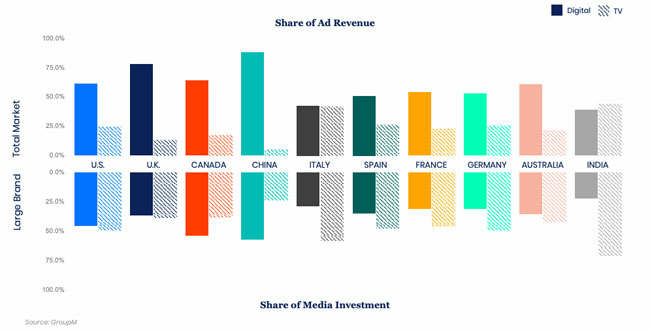
    Now, a superficial read of the data included in This Year, Next Year might leave one with the impression that because 64% of the world’s advertising revenue is generated by digital media and 21% goes to TV, that marketers are allocating 64% of their budgets to digital media and 21% to TV, on average. This would be a mistaken interpretation, because many advertisers—especially small ones and those whose businesses operate entirely online—often allocate all or nearly all of their budgets to digital media while large businesses typically allocate higher shares of their budgets to television.


    For smaller businesses, a high digital skew could occur because digital media’s precision targeting capabilities and automated sales platforms are uniquely capable of absorbing advertising budgets that are measured in hundreds or thousands of dollars. Larger advertisers that spend 100% of their budgets online might typically be doing so because their operations are entirely transactional or direct-to-consumer. For them, too, digital media platforms offer unique advantages connecting a budget for advertising with a tangible near-term outcome and the potential for active “growth hacking” strategies, which can work well, at least up to a certain scale.


    However, the world of media also includes businesses whose marketing goals are set around brand-building. They often do this by associating their products with top-tier video-based content or otherwise focusing on goals that are not most efficiently achieved through digital media. Further, for many, the combined use of different types of media can be synergistic in ways that are difficult to quantify. For example, we can reasonably assume that a strong brand should drive better performance of an e-commerce-focused advertising campaign versus the alternative of having a weak brand, although the factors that can drive a brand to accomplish this outcome can involve uncountable numbers of variables over many years or even decades


    Given our own focus as the world’s largest agency group, servicing larger brands primarily, we wanted to better assess the typical large advertiser media mix. To do this, we looked to GroupM’s own data to find useful illustrations of the ways in which different marketers allocate their budgets around the world. In studying these trends, we primarily focused on two dominant groupings of media, television and digital platforms, and then limited our analysis where possible to a subjectively defined group of large marketers on a like-for-like basis (meaning that we included only the same marketers in each period) within each of our Top 10 markets.


    The most accurate benchmark for large brands to consider is that in a typical large country during 2021, a large brand is allocating 47% of its advertising budget to television, including digital video extensions, and 35% to internet-based media, excluding those digital video extensions. For reference, in 2019, television typically accounted for 48%, while digital media typically accounted for 28%. These figures reflect wide gaps between the shares of revenue that media generates, with the difference driven by the wide range of brands that spend money in a given territory.


    For individual marketers, we recognize that this data may provide useful information about what other marketers are doing. However, the goal should not be to mimic them. Instead, we present this information to help spur questions about the right allocations for your brand. Well-developed media plans account for a marketer’s unique goals, apply some creativity to achieving those goals and consider what worked well for others who faced similar circumstances. It is our hope that the data presented here leads to the creation of more media plans that meet these criteria.


  • Leo Burnett wins creative mandate for Roposo

    By Our Staff


    Leo Burnett India has won the integrated communications mandate for Roposo a creator driven, live, entertainment commerce platform and has created the first campaign for the brand – announcing the new brand identity. The brand which is a business unit under Google-backed Glance, an unconsolidated subsidiary of InMobi Group will be handled by the agency’s Delhi office.


    Speaking about the partnership, and the new campaign, Mansi Jain, Vice President & General Manager, Roposo said: “We are at an exciting juncture for the brand where we are creating an innovative and meaningful offering for both content creators and users. Our aim to is to build a single platform for creators, content, and commerce to come together, within a live virtual mall like environment. Leo Burnett has demonstrated an excellent understanding of the cultural pulse and consumer behaviour and translated it into impactful ideas for the brand.”


    Added Dheeraj Sinha, CEO and Chief Strategy Officer – South Asia, Leo Burnett: “Roposo not only has the homegrown advantage, it is one of the few premium hybrid apps that is bringing commerce and entertainment together through their tech and product innovation. This gives us the perfect  platform to build a data driven strategic approach for the brand, using relevant cultural insights to build a powerful narrative that resonates with its audiences. Our first piece of work reflects this as we bring together some of India’s most powerful content creators to introduce the brands refreshed offering. We are very excited to partner with team Roposo on this exciting journey and look forward to charting the brands success story together.”


  • Grapes appoints Priyank Narain as ECD

    By Our Staff


    Grapes, the marketing agency, has appointed Priyank Narain as its new Executive Creative Director. He will be based out of the agency’s Delhi office and will report to Chief Operating Officer and Strategy Head, Shradha Agarwal. Narain will look after the agency’s creative responsibility across all brands, nationally. Previously, Narain was associated with McCann Worldgroup as a Senior Creative Director for more than two and a half years, where he was managing some of the biggest brands.


    Said Agarwal: “We are excited to welcome Priyank to the Grapes family as we look to accelerate our business and deliver ground-breaking work for our clients. He has rich creative experience on a varied section of brands and categories. His unique creative approach in designing digital experience is a perfect fit for our company.  I am extremely delighted to have him on board.


    Commenting on his new role, Narain added: “It’s wonderful to be onboard with Grapes, an integrated agency with a great vision and several interesting brands. I look forward to creating some disruptive work that drives brands and businesses forward.”