Leo Burnett has won the mandate for relaunching one of Nepal’s alcohol brand – Khukri Rum. The brand, which has been around for more than six decades, is set to reposition itself for a larger audience as well as create a stronger connect with its existing customer base.
Leo Burnett will be strategic partners to the brand from revamping the brand image to breathing a new life in the consumer base for the brand through innovative communication including a robust digital strategy. The mandate will be shared by Leo Burnett and Indigo.
Dheeraj Sinha
Speaking about the win Dheeraj Sinha, Managing Director India, Chief Strategy Officer, Leo Burnett South Asia said: “Khukri is an iconic brand with great lineage and we are very excited to get this opportunity to be a part of the brands growth story. It has potential across geographies to truly grow as a global brand and we are looking forward to creating some great work together.”
Speaking about the new partnership Sharad Kr Tibarewala, Managing Director, Nepal Distilleries Pvt Ltd said: “We are looking forward to working with Leo Burnett. For a legacy brand, such as ours, we wanted the best. We have high expectations from team Leo Burnett, in terms of creative and strategic guidance to make Khukri Rum scale great heights and are confident they can do it.”
Havas Group India has appointed Shivaji Dasgupta as Chief Strategy Officer. In his new role, Dasgupta will lead strategy across all disciplines, which includes – creative, media, health and digital and will report to Rana Barua, Group CEO, Havas Group India.
Commenting on the appointment, Barua said: “The appointment is a critical step forward for the Group in India towards the evolution of its ‘Together’ strategy that brings together all the verticals under one roof known as Havas Village. Shivaji will further strengthen our integrated product offering and help further strengthen the collaboration between Havas and Vivendi companies in India.”
Commenting on the appointment, Bobby Pawar, Group Chairman & Chief Creative Officer, Havas Group India added: “Shivaji’s vast experience and planning expertise will help clients in building an integrated approach which will aim to create a unique and valuable brand experience. His appointment is a step forward in our endeavor to provide clients with a more agile and holistic approach to deliver a seamless experience cemented by a deep strategic understanding of brands that will further elevate our creative offering.”
This is the first after a long, looooong time that we have got some news on Brand David. Health food company, Soulfull has appointed Ogilvy group’s Brand David India as its official advertising and branding partner. The account was won, following a closely contested multi-agency pitch.
To be handled out of Brand David, Bengaluru, the account scope entails building brand campaigns and strategy for the entire portfolio of Soulfull – Ragi Bites, Muesli and Smoothix.
Speaking on the appointment of Brand David, Prashant Parameswaran, CEO & MD, Soulfull said: “Appointing an advertising and branding agency is a strategic move for us as we aim to position Soulfull and its products as a differentiator in the healthy snaking category with power of millets. We strive to create awareness about millets, which is not just a superfood but is a smart food. As Soulfull expands its footprint across India, this partnership will help provide the right positioning of the products in consumer’s mind. We look forward to working with Brand David in our journey of building Soulfull in this competitive space”.
Corian Design has mandated Mirium India to manage its digital and social media platforms and focus on analysing the buying and consideration journey of core intermediaries and developed a content strategy that targets them using social, digital, and mobile technologies.
Said Abhishek Goyal, Market Development Leader – Asia Pacific, Corian Design: “Digital Marketing is the new-age way of communicating with the target customers to connect well with them as a brand owner. In addition to reaching out to a wider set of target audience, digital marketing provides loads of data which can help the companies optimize their campaigns and deliver better ROI. While looking for a digital marketing partner we evaluated various agencies and found Mirum most suitable, both from the perspectives of domain knowledge as well as the flexibility to try out different approaches. We look forward to working together with Mirum and deliver to the expectations of the business.”
Added Sanjay Mehta, Joint CEO, Mirum India: “As an agency, we are committed taking on new challenges and diversify our portfolio with well-known brands from across the globe. DuPont provides us with another great opportunity to showcase our expertise in the field of creativity, media, and content and we’re looking forward to some great work in the months to follow.”
Said Arvind Nair, Branch Head – North India, Mirum India: “Digital is constantly evolving in terms of both customer experience and direct sales, and we are working towards connecting DuPont with their customers in this evolving market. DuPont is an iconic brand and we’re really excited to be partnering with them take their digital first approach forward.”
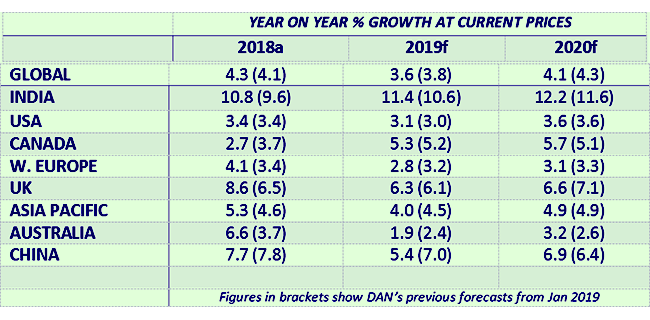
Dentsu Aegis Network’s latest advertising spend forecast, based on data from 59 markets, predicts global growth will reach +3.6% in 2019, following growth of 4.3% in 2018, taking total investment to US$609.9 billion. In Asia Pacific, there is a predicted +4.0% growth in 2019, following +5.3% in 2018, taking total investment to US$216 billion.
Geographically, Asia Pacific is the leading contributor to the global increase of US$20.9 billion in 2019 compared to the previous year, contributing 39% of the global increase, closely followed by North America 34%. Comparatively, Western Europe is forecast to contribute 14% to new ad dollars with Latin America at 11% and Central and Eastern Europe at 3%.
In Asia Pacific, forecasts have been revised downwards (-0.5%) from January following market softness at the beginning of the year particularly for TV, the lack of major events scheduled was also a contributory factor. China continues to be the leading contributor to Asia Pacific and global ad spend and will continue to grow in 2019 by +5.4% to reach RMB 671 billion, a surprisingly healthy and stable growth rate, which remains on track despite the headwinds from trade tensions with the U.S.
The global forecast reflects softening growth across 9 of the top 13 advertising markets worldwide, with India and Brazil bucking the trend with accelerating growth in 2019. Some markets saw downward revisions from January 2019 forecasts including Italy and Russia with both markets seeing GDP slow alongside ad spend.
Said Takaki Hibino, Executive Chairman, Dentsu Aegis Network Asia Pacific: “Asia Pacific has long been the melting pot of digital and technology developments. Though we have been facing a tougher economic environment, our ad spend forecast has shown that digital connectivity in APAC remains at its peak and consumer adoption rates have leapfrogged. Our business is built for the digital economy and we’re at the forefront of this growth, working alongside our clients to provide integrated solutions and build long-term sustainable growth for their brands.”
Key market trends
:: Australia:2019 is expected to grow by 1.9% to AUD$16.6 billion, which is a modest increase in overall spend from 2018. Majority of the growth is expected to come from Digital and Video channels. Digital continues to drive advertising revenue growth and is expected to increase by 6.8% in 2019 representing roughly half of total media spend (54%). Online Video is a key driver for Digital spend and is expected to increase by 28.4% in 2019. Video is the golden child of digital with strong momentum making up a large proportion of general display. This positive trend is backed by publishers as brands continue to seek premium environments in which to showcase their offerings.
:: China: thead market continues to be a leading contributor to global ad spend and will continue to grow in 2019 by +5.4% to reach RMB 671 billion but at a lower growth rate than the +7.0% growth forecast in the January 2019 report. Growth for the market in 2019 has been revised downwards due to higher than expected decline in TV spend at the start of the year. Digital is still the biggest driver of growth in total ad spend in China with the biggest share (63.6% in 2019) and growth rate. E-commerce is growing consistently and strongly, taking the biggest share within Digital. The decline of TV advertising (-6.8% in 2019) has affected the total market trend. Within TV, ad investments in CCTV and provincial satellite TV are still on an increasing trend, while ad investments in Provincial and Local TV channels have declined significantly.
:: India: forecast double-digit 2019 growth of 11.4%to reach INR 696.9 billion (up from the 10.6% forecast in January and 10.8% growth in 2018) with the Cricket World Cup putting growth on the front foot. Lok Sabha Elections are also set to increase spend in 2019. Digital media spend is forecast to grow by 32.7% in 2019 to account for INR 144.1 billion, making up 21% share of total spend. Infrastructure has propelled the growth in digital consumption. TV continues to be the leading media in 2019 and will contribute 39% share of total spend. Despite digital growth, TV continues to be dominant as it enjoys unmatched share of audiences. With 40% allocation of advertising spends, TV is forecast to expand in 2019 by 9.5% to reach INR 271.4 billion.
Global media trends
:: Digital continues to power ad spend growth and is forecast to grow 11.5% in 2019 to reach US$249.7 billion and 41.8% of global share. Growth is steady into 2020 putting digital’s share of ad spend at nearly 45% by the end of the year.
:: Mobile is the fastest growing platform within digital and is forecast to grow 21.4% in 2019. Powering this growth is the increasing consumption of video on mobile – from Instagram Stories, TikTok and Snapchat to YouTube and VOD – with online video in general set to grow 20.5% in 2019.
:: TV ad-spend is forecast to shrink slightly in 2019 (-0.1%) with a return to modest growth in 2020 of 0.6%. Into 2020 growth will be driven by more dynamic TV opportunities and innovation as the penetration of smart TVs continues.
:: The decline of traditional print has accelerated from our January 2019 forecasts (Newspapers -7.7% and Magazines -7.4%) as digital continues to dominate.
:: Out of Home sees continued growth and an upwards revision from January to 4.3% in 2019 to reach 6.3% share. Growth is driven by innovations in DOOH.
Figure 1: Growth in global advertising spend 2018-20f
Year on year % growth at current prices
2018a
2019f
2020f
GLOBAL
4.3 (4.1)
3.6 (3.8)
4.1 (4.3)
NORTH AMERICA
3.3 (3.4)
3.2 (3.1)
3.7 (3.6)
USA
3.4 (3.4)
3.1 (3.0)
3.6 (3.6)
CANADA
2.7 (3.7)
5.3 (5.2)
5.7 (5.1)
W. EUROPE
4.1 (3.4)
2.8 (3.2)
3.1 (3.3)
UK
8.6 (6.5)
6.3 (6.1)
6.6 (7.1)
GERMANY
0.2 (1.0)
0.4 (0.5)
0.5 (0.5)
FRANCE
5.3 (3.6)
3.6 (3.1)
3.0 (2.5)
ITALY
2.0 (1.6)
-1.6 (0.8)
0.6 (1.6)
SPAIN
2.1 (1.8)
0.5 (1.2)
0.4 (0.8)
C&EE
8.6 (8.6)
4.9 (5.8)
5.6 (6.2)
RUSSIA
12.3 (12.0)
4.5 (6.9)
5.8 (6.7)
ASIA PACIFIC
5.3 (4.6)
4.0 (4.5)
4.9 (4.9)
AUSTRALIA
6.6 (3.7)
1.9 (2.4)
3.2 (2.6)
CHINA
7.7 (7.8)
5.4 (7.0)
6.9 (6.4)
INDIA
10.8 (9.6)
11.4 (10.6)
12.2 (11.6)
JAPAN
2.2 (0.2)
1.2 (0.6)
1.8 (2.4)
LATIN AMERICA
7.9 (9.9)
9.1 (7.9)
6.1 (8.6)
BRAZIL
7.1 (7.1)
8.8 (3.6)
4.5 (6.2)
Figures in brackets show our previous forecasts from Jan 2019
Figure 2: Share of global ad spend by media, 2018-20 (% y-o-y)
2018a
2019f
2020f
Television
34.9 (35.4)
33.6 (34.1)
32.4 (33.2)
Newspapers
8.0 (8.0)
7.1 (7.1)
6.3 (6.3)
Magazines
5.0 (5.0)
4.5 (4.5)
4.0 (4.1)
Radio
6.2 (6.2)
6.1 (6.0)
5.9 (5.8)
Cinema
0.6 (0.6)
0.6 (0.6)
0.6 (0.6)
OOH
6.3 (6.3)
6.3 (6.3)
6.3 (6.2)
Digital
39.0 (38.5)
41.8 (41.4)
44.5 (43.8)
Figures in brackets show our previous forecasts from Jan 2019
iProspect India has roped in Abhishek Balsara and Vineet Sawant as AVP – Analytics and Director of Technology, respectively. Based out of Mumbai, both Balsara and Sawant will report to Karan Jaitapkar, EVP – Technology, to strengthen the agency’s martech division.
Commenting on the agency’s latest appointments, Rubeena Singh, CEO, iProspect said: “At iProspect, we believe in delivering data-driven integrated marketing solutions to our clients. And with Abhishek and Vineet joining the martech team, I believe we are now a force to reckon with. Both bring with them a rich experience in digital technology and will play an integral part in our next phase of growth.”
Strong work, weak industry. With the Cannes Lions International Festivity of Creativity under way this week, many of the world’s creative and media agencies will deservedly receive accolades. However, it will be difficult to not notice the contrast between the high quality of the work on display against the weak business conditions of the industry which produced it. We previously explored some of the reasons behind those conditions and some alternative ways to analyse them in a note which can be found here: https://www.groupm.com/news/agencies-basis-optimism
A key topic we did not explicitly review in that previous assessment, but which overlaps with the factors we described (and which serves as a basis for negativity among those with bearish views on the industry), is the insourcing of work commonly provided by agencies to marketers.
In-housing was once the default option for all marketing-related activities before agencies came along. At least as far back as the mid-19th century, marketers could contemplate whether or not some of the labour required to produce the work they required should be performed by their own employees or by external specialists. By the late 20th century, most creative and media activity from large brands was outsourced to agencies. However, marketers still continued to perform many functions in-house. In many industries, without formally declaring the formation of an inhouse agency, large marketers commonly oversaw the development of creative assets as well as some media buying, especially in print). Media owners often served as partners in these processes, and agency involvement could be minimal.
Biddable media, access to data and changing needs encouraged some marketers to revisit insourcing in the past decade. In more recent years, several factors caused many marketers to revisit what they insource vs. what they outsource. Those factors include:
:: The rise of search and self-service buying platforms in general
:: The anticipated emergence of other forms of biddable media
:: Access to sensitive customer data that could be used in trading integrated with other non-media functions and
:: The increasing need for tighter time frames in accomplishing tasks.
While costs or fee concerns (or sometimes, relatedly, fee transparency) might have been cited by some marketers as they considered revisiting in-housing, those who ultimately followed through typically did so because they believed the choice presented strategic advantages. Some who have explored in-housing ultimately chose not to do so, while some who have in-housed have reversed their choices.
Others have found hybrid models to be a preferred approach and now work with agencies differently than they did in the past. Some who have followed this path have taken ownership of more of their contracts, used creative agency production decoupling services or engaged with their media agency’s programmatic consulting services to complement in-housed efforts.
Knowing how much money has flown in-house is difficult (if not impossible) to assess. Knowing the advantages agencies offer is much clearer. Attempting to quantify the scale of any shift towards insourcing is tricky at an industry level, largely because marketers never publicly disclose spending on the agency-like activities they perform in the first place. Further, companies merge, demerge, grow and decline over time, making it particularly difficult to make reasonable historical estimates. It’s safer to recognize that there always has been a significant amount of work performed in-house and there likely always will be.
By contrast, the reasons why marketers benefit from using agencies are much clearer. At the risk of appearing promotional – although what is the advertising industry about if not that? – it is always worthwhile to be mindful of the advantages that agencies provide to marketers when marketers choose to outsource:
:: Lower fees on a like-for-like basis for most inputs vs. what the marketer can realize on its own, such as technology licenses or non-biddable media
:: Application of learnings and best practices, many of which can lead to meaningful cost savings vs. not applying them. For example, a media agency will typically have superior knowledge on aspects of campaigns (such the optimal length of a campaign flight on a given medium for a given type of advertiser) which can lead to lower overall costs even where like-for-like media inventory costs are identical
:: Better access to talent, both because of the breadth of the experience talent can receive and the career paths those individuals are more likely able to pursue
:: Development of proprietary products for use by multiple clients who can then take advantage of an agency’s scale
:: More institutional experience working with tools, such as data analytics products
:: Application of insights from across any one media channel to any other channel (for example, assessing the impact of a TV campaign on search effectiveness and vice versa)
:: Prioritization from partners (such as media owners and technology vendors) both because of scale but also because of presence of greater numbers of staff with relevant technical expertise
:: Better visibility on the critical issues facing the industry and thus a louder potential voice on topics that vendors and marketers should focus on. This can help inform the product roadmaps for media owners to better meet client needs.
The development and execution of world-class ideas will not necessarily be a growth business in any one year. As well, the work performed by agencies needs to be put into context of other priorities that marketers have, which could include driving short-term costs down or tightening the integration of agency-like-work into core operations in order to better achieve business goals which go well beyond what agencies might be able to help with. Consequently, it’s not a given that every marketer will always want to work with agencies in the future. But for those who do, it’s reasonable to assume that they will benefit from the generally superior capabilities that they will durably possess.
Published on GroupM website at: https://www.groupm.com/news/agencies-and-now-commercial-break
To coincide with the start of Cannes Lions International Festival of Creativity, marketing intelligence and research firm WARC has released ‘Anatomy of Effectiveness’, a white paper for brand marketers and advertising agencies alike, highlighting five key priorities for brands seeking greater impact.
The report has been created by distilling evidenced best thinking, expert opinion and real case studies, all combined with 30 years of WARC’s experience on helping the industry advertise effectively.
Says Paul Coxhill, Managing Director, WARC: “Poor marketing wastes money, time, attention and resource. All of which we can ill-afford in this fast-moving, resource constrained world. With ‘Anatomy of Effectiveness’ we provide five lessons to help combat this and make marketing more effective.”
Data suggests that advertising, in its current forms, is not driving the growth it should be. Advertising spend is not having the intended impact, and, at its worst, it is alienating the people it is supposed to be engaging:
:: A study by the Advertising Research Foundation found that 69 per cent of all US TV commercials receive no visual attention (putting up to $40 billion of investment at risk in the US alone); 27 per cent air in an empty room.
:: A focus on short-termism has halved the business impact of creativity, according to researcher Peter Field.
:: Only 12 per cent of supposedly ‘viewable’ ads are actually noticed by consumers, according to Lumen Research
:: Nielsen reported that only 53 per cent of the impressions served in the UK reached their intended target.
:: More than 600 million devices now have ad blocking, in what US journalist Doc Searls called the biggest boycott in history.
Says David Tiltman, VP Content, WARC: “Against this background, we wanted to pull together the best thinking from around the world on effectiveness. This white paper examines what the current range of evidence shows, and where it is being challenged by a fast-changing industry.”
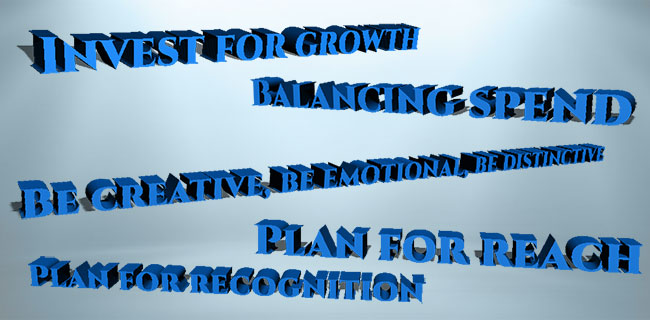
WARC’s ‘Anatomy of Effectiveness’ highlights the following five priorities for brands who want to improve the impact of their advertising:
:: Invest for growth: Covers the wide range of factors that marketers need to consider when drawing up budgets, setting objectives and working out what they want a campaign to deliver.
:: Balancing spend: Sets out the frameworks for investment between brand-building and performance marketing.
:: Be creative, be emotional, be distinctive: Analyses the arguments for investing in creativity – including the power of emotional communications and the importance of distinctiveness.
:: Plan for reach: Discusses the factors to be considered when planning media spend.
:: Plan for recognition: Focuses on the need for strong brand assets in an era of short-form ads to ensure consumers know whose ads they are seeing.
Adds Tiltman: “While it sounds simplistic, none of these concepts is easy to apply. Every element involves trade-offs and hard decisions on where to invest. And, of course, insights and creative thinking are required to bring it all to life – that’s what makes marketing such a dynamic industry. The five priorities are not a linear process. We increasingly live in a world where media selection and creative development go hand in hand, where creativity can be at the heart of business strategy, and where real-time feedback can allow strategies to evolve during the campaign. We hope this report promotes the evidence that exists to help advertisers – and ultimately their consumers.”
For each of the five key priorities on how to advertise more effectively, the white paper includes evidence, what’s changing, common mistakes, examples, and expert commentary from industry experts including Paul Dyson, founder of Data2Decisions; Les Binet, Head of Effectiveness at Adam&Eve DDB; Peter Field, Marketing Consultant;, Faris Yakob, Co-founder of Genius Steals; and Jenni Romaniuk, International Director of the Ehrenberg-Bass Institute.
Food product company Apis India has awarded its media mandate to Dentsu X India. Speaking on the association, Pankaj Mishra, CEO, APIS India said: “The Dentsu X team has impressed us with their consumer and market insights, their appreciation of consumer connect and driving experiences. We are very happy to announce our association with Dentsu X.”
Divya Karani
Commenting on the appointment, Divya Karani, CEO, Dentsu X said: “This is a testimony to the value Dentsu X brings to the business. When clients who have experienced our work, reach out to award us new business, it is very gratifying. In a year when we have clinched large new business wins, awards and accolades from the industry, this is the cherry on the cake.”
Network Advertising has launched its latest ad campaign for homegrown lifestyle brand, Ellementry.
Shayondeep Pal
Said Shayondeep Pal – Chief Creative Officer, Network Advertising: “In our everyday life, we tend to play down the importance of aesthetics in mundane things. The campaign rides on this insight and turns it on its head to talk about the larger philosophy of making everyday beautiful. The idea was to revive the power of print and attempt a ‘slow down and sit back’ approach to advertising that matches the brand ethics – ‘life is beautiful’”.
Ayush Baid
Added Ayush Baid – Founder, Ellementry.com: “From Day 1 we have built our brand on six core pillars – Form & Function, Fusion, Culture Revival, Food Safe, Sustainability and Hand Crafted. Each of the pillars has been carefully chosen because in some manner or other they make each and every day beautiful for us, our people, our consumer and the environment. However, being a young brand, not many people knew about us or our philosophy. That’s where the ‘Everyday beautiful’ campaign created by Network fits perfectly well to inform the consumer about our brand, our philosophy and our brand pillars.”
South India’s leading brand of sweets and confectionary, Dadu’s has appointed Konnections as its strategic communication partner post a multi-agency pitch process.
Said Rajesh Dadu, Owner of Dadu’s: “We were looking for an integrated consultancy that could support our communication requirements. We identified Konnections as our partners as they hold strong credentials and are known for their expertise in handling cross industry clients. We are confident about their ability to execute strategic communications plans that will align with our business objectives. ”
Added Mukta Kumar, Director Communications, Konnections: “It is a great opportunity for Konnections to be associated with Dadu’s which has been a household name of hand-crafted, traditional Indian sweets and confectionary in South India. With our proven expertise in handling hospitality business and our focus on client relationships we are confident that we will support and strengthen Dadu’s expansion strategy and brand journey in future.”
Publicis Media India appointed Anil Pandit as Head of its Programmatic Practice.
Anil Pandit
Pandit is tasked with accelerating the growth of Publicis Media’s programmatic capability across the agencies. He will oversee the central programmatic team – providing agency teams access to expert data, technology capabilities and solutions – that will deliver superior client value through greater effectiveness and media efficiency. He will also work with the global team to bring in the full Precision capabilities to India.
Anupriya Acharya
Said Anupriya Acharya, CEO Publicis Media India on his appointment: “We couldn’t be more thrilled to have Anil’s expertise and leadership in this crucial role as we focus on further consolidating our overall programmatic presence and bringing in PM Precision capability to India. Our group has been a pioneer in programmatic and with Anil’s leadership, we will look to fast- forward the full launch of the Precision capability in the market. Maintaining our competitive advantage on all aspects of digital and ensuring that we continue to deliver best-in-class capabilities and growth for our clients is key to our continued success.”
Added Pandit: “Programmatic is witnessing a phenomenal rise both in India and globally. About a third of India’s ad inventory is already programmatically traded. I’m excited to get this mandate of expanding PM’s central capabilities in future platform innovation, audience strategy, data consulting and precision excellence. I would like to bring into my role, sharp client lens coupled with operational ad -tech experience and look forward to collaborating with our agencies and marketplace partners to deliver faster and more scalable impact for our clients.”