Category: Ad Agencies

  • Clients are happy to pay wherever one demonstrates value


    It’s been a year since GroupM merged its two leading media agency networks – Maxus and MEC. We spoke with Kartik Sharma, CEO-South Asia of the merged entity called Wavemaker on how the business has been in the past year, the credo of ‘Rapid Growth Planning’, winning awards, talent and more. Excerpts from Part Two of an interview with Kartik Sharma… (Part One of the interview can be accessed at http://www.mxmindia.com/2018/11/we-cant-sit-on-past-laurels/)


    One of the challenges in attracting young talent specially at the entry level is the low salary levels in media agencies.

    We relooked at how we attract talent. This is not just about Wavemaker, but we worked with the GroupM leadership team and the composition revisions have already happened. Also, my genuine belief is that while people may talk about compensation, the real reasons why people stick is obviously due to the people they work with. Second thing is if you have a great purpose. It’s easy to rationalise and say I don’t get money and move out of an organisation. Also when you go deep and we sit in exit interviews and we find out that people largely leave for two reasons. Either you have a lousy boss or you are not able to connect with a purpose or not able to see a purpose of what you are doing. As long as you are able to address these two factors well, I think people want to stick much, much longer.


    In the light of the various changes in the media landscape, digital gaining ground and as we enter the new year, do you see a dramatic shift in the way the media agency business is going to be? Also, will be there be a change in the current commissions-/fee-based structures

    See the way the compensation structures were done, because commission-based compensation structure was actually invented more than 100 years ago. Agencies or as they were called agents and we started selling it. But markets are maturing, clients are maturing. Agencies are maturing. I can’t talk for the entire industry but surely wherever one can clearly demonstrate value, clients are happy to pay. Wherever you cannot show value, why should the customer pay?  So there have been many, many instances where we are able to get our fair share based on the work that we produce which often is loosely termed that we are more costly. But its value, the value creation for the business is demonstrated and that job is on us to show and demonstrate why we are asking for whatever compensation. It’s not easy but in many, many instances those are happening even today.


    So, would you be able to give an indicator on what is the kind of increase that you get from your existing clients in terms of percentage?

    It increases when we are able to show value.  I can’t speculate any number. I can’t share anything else…


    Broadly. Are the big clients paying you more?

    Big clients see value and they pay more. Even small clients. Big or small is not the point. We have been able to ask for a reasonable compensation which when compared to many other competitors would be higher. It’s a guess. If and whenever we are given that kind of feedback based on that we deliver. Whenever there is value, clients will pay.


    You were among the early players looking at startups and looking at non-legacy businesses. But now you have grown as an agency.  Do you find that you are still as hungry for those start-up kind of clients?

    Absolutely. We have recently conducted a startup connect in Bengaluru where we invited a couple of good startups which we believed in. We invited some of our media partners and creative partners what they are seeking is kind of, if they were to launch their product and services in the market, what should they be doing. It was an experimental project and has done exceedingly well for us. Some clients are signing up. Once that is done we will announce the name. Some other startups have also started talking to us so I think the hunger to be in that space is very high.

    What startups do is they kind of come with a very different point of view compared to the larger, well-established players. They want growth faster. They want to look at the product and services differently and it challenges us. Recently we have got one very big startup. We will announce once the contract is closed. Our solutions have been so different! Had we not pitched for that business. We have to constantly think that maybe what we could have done different or a standard mode is not what is going to work. It helps us to also think afresh. The solution of the client is very important.


    I know it’s an integrated agency now… but how is the MEC part of the business doing?

    All the clients are doing very well as brands and as categories most of them are doing very well. For eg., Netflix is a case in point. There are other clients. Eureka was an MEC relationship which we have. Today it doesn’t matter if it is Maxus or MEC, it’s a client we are working or. Whatever we have promised to a client we have to deliver on that. Overall, I think all the business that have come from NEC they are all in good space.


    As you go forward to the next year, any specific target or sentiments that you would like us to look at.

    I’m an eternal optimist. I think next year will have its own set of challenges and opportunities. What I am seeing is more use of technology and technology-based solutions. It could be in the area of analytics and actually creating new technologies for clients. That’s broadly where it is. Of course all the traditional media business or use of media will continue but there are many opportunities in the way that we use technology where I am seeing early trends.




  • Santosh Padhi & Harshit Jain to judge at One Show

    By A Correspondent


    The One Club for Creativity has announced that Santosh Padhi and Harshit Jain will serve as judges for The One Show 2019. Nearly 200 highly qualified creatives representing 26 countries will judge work from around the world.  While Jain, Chief Growth Officer, McCann Worldgroup, currently in London, will be a judge for Health Wellness & Pharma category, Santosh Padhi, Co-founder and Chief Creative Officer, Taproot Dentsu, Mumbai will judge enties in Print & Outdoor.


    “The quality of jurors has long been a hallmark of The One Show”, said Kevin Swanepoel, CEO, The One Club for Creativity. “This year’s gender balanced juries consist of the industry’s top tier of creative thinkers and doers from around the world. They will judge work through the lens of creativity of ideas and quality execution, and use our robust judging platform featuring proprietary, state-of-the-art voting and scoring technology.”


    For the first time this year, The One Show will accept submissions for the coveted Green Pencil, recognizing excellence in environmentally-conscious advertising and design. In past years, the award was based on nominations.


  • A&O Realty appoints Fruitbowl Digital as its digital agency

    By A Correspondent


    Real estate developer A&O Realty has entrusted its media mandate to Fruitbowl Digital after a multi-agency pitch.


    The 360-degree directive will include site branding, creative and media strategy, social media, SEO, ORM, mobile and content marketing, and search engine marketing (SEM) across digital platforms, for existing and upcoming projects across Mumbai, including f.Residences Ghatkopar, f.Residences Malad, Bellevue, Palazzio, Excellenté and Eminenté.


    Rahul Patel

    Commenting on the association, Rahul Patel, Director, A&O Realty said: “When they came to us, they brought some ideas that we had never even thought of, and the confidence to execute the ones that we already had in mind. Their fresh perspective towards what real estate communication can be, is definitely helping us stand out in an industry where the competition is never sparse.”


    Dedeepya Reddy

    Added Dedeepya Reddy, Co-Founder, Fruitbowl Digital: “We want to have conversations beyond elevation, carpet size, and cost per square foot. We want future home-owners to see, imagine, and live the experiences that the brand promises and delivers time and again. The average Indian home buyer has evolved. In our current world of communication clutter, you can’t sell to them; you have to grab their attention. In the time that you read this article, at least 2 more real estate ads will have found a space in Mumbai. Our city is plastered with them but how many do you really remember?”


  • Isobar begins Lanka ops

    By A Correspondent


    Isobar has expanded its operations to Sri Lanka. Last year, Dentsu Grant Group launched Dentsu Aegis Network in the country and now it has launched its full-service digital agency, Isobar.


    Shamsuddin Jasani

    Shamsuddin Jasani, Group Managing Director – Isobar South Asia said, “I am very excited to launch Isobar in this amazing country. Sri Lanka is a rising mobile economy with smartphone penetration growing by over 20 per cent and mobile penetration growing over 120 per cent year-on-year. With the launch of Isobar Sri Lanka we are looking at creating a leading agency for the digital age that follows a true full service model. Under the guidance of Neela and her team, I am sure we will be a force to reckon with in this market in the years to come.”


    Neela Marikkar

    Speaking on the launch of Isobar Sri Lanka, Neela Marikkar, Chairperson – Dentsu Grant Group and Dentsu Aegis Network Sri Lanka added: “We are thrilled to be introducing such an iconic brand into the Sri Lankan advertising industry. We are fortunate to be working so closely with our global and regional offices; we are confident that we will be able to use their global knowledge and skills to help develop business opportunities for our clients as well as help the digital economy of the country and accelerate through Isobar’s experience led transformation and brand commerce expertise.”


  • India becomes first Asia office for FCB’s FuelContent 

    By A Correspondent


    Sébastien Desclée

    Sébastien Desclée, Chief Executive Officer of Fuel Content – the  content production arm of the FCB Global Network – announced its expansion into India. With offices in Delhi, Mumbai, Bangalore, Chennai, Kochi and Kolkata, this new venture builds upon FuelContent’s existing hubs in Canada (Fuel Canada) and South Africa (Fuel SAF).


    Said Desclée: “Since its inception in 2016, FuelContent has been steadily gaining momentum to become a robust global network. This latest addition in India is the next piece in the puzzle, providing a rich market in which to tell ‘Never Finished’ stories to new audiences. Forging a larger FuelContent network adds value to our clients’ businesses and provides the opportunity for us to strengthen our offerings in Asia and continue to grow our global footprint.”


    Fuel India will be led by Debarpita Banerjee, President North and East, FCB Ulka, and the India operation will offer content creation solutions in an end-to-end format.


  • Five iconic ads created by Alyque Padamsee

    By A Correspondent


    We are sure there are many, many more ads created by Alyque Padamsee, and we are sure there are many more that we may find trendsetting. But here’s a list of our favourite five.


    Surf

    Watch this ad starring the Lalitaji character and you relive the good old days when the ad would air on Doordarshan. The ‘samajhdaari’ line that Lalitaji makes is what Padamsee’s mother once told him, and we guess that’s what made this commercial so very effective.


    Bajaj Auto:

    If there are many who think the brand is Humara Bajaj and not Bajaj or the company is Humara Bajaj and not Bajaj Auto, blame it on this commercial. Even before the nationalistic times set in, these ads would give you the goosebumps.


    Liril:

    The millennials may wonder what’s the fuss about this ad, but ask anyone who watched this ad in the 1970s, and you’ll be told how much they would wait for an airing on telly… just to watch Karen Lunel under that waterfall.


    KamaSutra

    Skin and such emotions aren’t uncommon in 2018, but when we saw this ad for the first time in 1991 and in that very special edition of Debonair magazine, there was, ah, well, magic. For the brand, we mean.


    Cherry Blossom

    The Cherry Blossom brand was already very popular, but this ad starring actor Rajesh Puri worked wonders for the brand, and was indeed one ad that people would look forward to.

  • HIL promotes Birla Aerocon in new brand campaign

    By A Correspondent


    Birla Aerocon, the green building solution brand from the house of HIL Ltd, has announced the launch of its new campaign ‘Naam Birla Dekhke Lena’. The TVC showcases the superior quality that Birla Aerocon offers in the category to its customers.


    Conceptualised by Ogilvy, the TVC is a take on the problems caused by leaking pipes. Said Dhirup Roy Choudhary MD & CEO HIL Ltd: “Birla Aerocon Pipes and Fittings, from the house of HIL, is a world-class product that is made with TrueFit Technology which ensures leak-proof pipes and fittings. Our latest campaign for Birla Aerocon pipes and fittings showcases the trust Birla as a brand entails, which is world renowned and is associated with top quality products. Our products cement the same trust amongst all our channel partners through our superior quality of pipes and fittings. Through the campaign, you can see how together with our products we are building the trust and happiness amongst customers and plumbers alike.”


    Added Nilay Moonje, Group Creative Director, Ogilvy Bangalore: “When it comes to repairs or fitting pipes we rely on the word of the experts in the field, the plumbers. We thought, what if, we made the plumber our hero who is a victim at the hands of an ordinary pipe and so, in turn, communicate the reliability and assurance of Birla Aerocon Pipes. We stumbled upon this hilarious idea of a plumber who literally puts his name and reputation on the line and the consequences he faces as a result of his reliance on an ordinary pipe. The message of the story is meant to hit, in this case, both ends of the pipe – the plumbers and the home owners too.”


  • Finally, J Walter put to rest!


    By Prabhakar Mundkur


    J Walter Thompson the agency which was first established in 1864, and celebrated its 150th anniversary with aplomb in 2014 is finally putting James Walter Thompson the founder to rest. In 2005, the agency tried to rid itself of any connection with its founder by rechristening the agency to its initials JWT, which involved a logo change from the earlier famous signature of its founder.  That seemed like an effort to tear away from its past.  In the process it might have lost some of its charm.  But on its 150th anniversary good sense prevailed and Sir Martin Sorrell decided to rechristen the agency as J Walter Thompson because he thought the name was immensely powerful.

     

    Now finally with the merger announced yesterday by WPP with Wunderman to make it Wunderman Thompson, the ad agency finally puts the first two names of its founder to rest.  In some ways, the merger and the double-barreled name reflect changing times for the ad agency business.  It is no coincidence that the merged entity has been named Wunderman Thompson rather than Thompson Wunderman.  Neither is it a surprise that Mel Edwards earlier CEO of Wunderman is the global CEO of the merged entity and will have operational control of the merged entity. And Tamara Ingram the global CEO of JWT has been relegated to the position of Chairman of the combined entity, always a less active and more ceremonial role.   It is a clear signal to the marketing industry that the ad agency is now playing second fiddle in the communication business.


    WPP earlier did the same with Y & R when it merged it with VML a digital marketing agency in the WPP group.  By calling the new entity VMLY&R it reiterated that the ad agency was probably no longer as important as it earlier was.


    But with this new merger and name change, we lose over 150 years of the J Walter Thompson heritage.  Its culture, its many innovative firsts in the advertising business, its prominent place as the University of Advertising and last but not least its status as the inventor of strategic planning thanks to the famous Stephen King.


    So, what does the future hold?


    Certainly, it does seem that Wunderman will lead the merger.  Wunderman was founded in 1958 by the Wunderman brothers and has over the years transformed itself from a direct marketing shop to a modern digital agency. Mike Reed now CEO of WPP, is known to have steered Wunderman to its current position of ‘creative driven, data inspired’ in his earlier stint as CEO of Wunderman.  His affection for Wunderman is therefore quite natural given his earlier acquaintance.   He once defended the onslaught of the consulting businesses into the communication arena by differentiating Wunderman as, “We are different from Accenture. We are creative”.


    In many ways, the new merger in theory at least would be a very powerful entity with both digital and traditional marketing skills.  But the advertising business has yet to prove beyond doubt that integrating balance sheets necessarily lead to integration of diversity in communication skills. Sir Martin’s famous coinage of “horizontality “has remained more or less an admirable mission rather than transformed into regular practice.


    One can’t therefore help but wonder if JWT and Wunderman continue to operate as two different silos under one merged name.  It would certainly be a pity if it did.  What is intriguing is that if this is the model of the future for communication businesses, will the other large groups like Publicis, Denstu Aegis, Omnicom and Interpublic follow?  That’s a million-dollar question.


    We will need to wait and see!


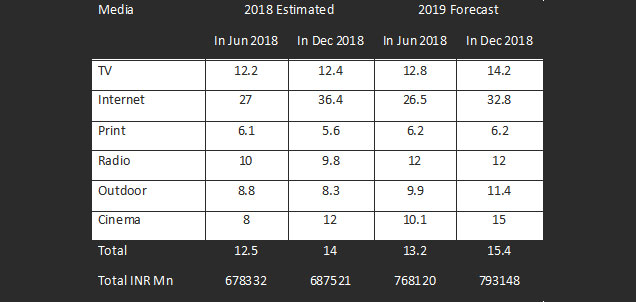
  • Magna Global too forecasts Achche Din: 15.4% adspend growth in 2019


    India faced headwinds from two successive regulatory distractions in the form of de-monetization (Nov 2016) and Goods & Service Tax (July 2017). This held back the economic growth to 6.7% in 2017 (8.2% in 2015 and 7.1% in 2016) and its lingering effects continued in the early parts of 2018. With the negative impact fading, the economy is on the recovery mode and IMF has forecast a growth of 7.3% in 2018 and a consistent 7+% growth till 2023 in its October 2018 report. Advertising expenditure per capita continues to grow from ₹ 515.3 in 2018 to ₹ 586.7 in 2019.


    Said Shashi Sinha, CEO, IPG Mediabrands: “India is the only market in the world where Print continues to be dominant and is growing in all aspects – circulation, readership and geography. The medium is growing strongly on the back of language which has led to the growth in the number of language newspapers. Secondly, print is growing because of the credibility it offers in this era of fake news. There is no denying that there are platforms causing strain on Print but the attributes of well researched, in-depth content and authenticity can only be endorsed by Print and that makes the medium more credible and hence relevant for advertisers. In 2019 print will further emerge as a dominant force because of all the state elections and the general election and we expect the growth rate to be higher than 2018.


    2018:+14%

    Good monsoon backed by minimum support price for crops boosted consumption in rural markets. Consumers got the benefit of lower tax incidence post GST. Digital access got easier and device penetration made a significant positive impact on sectors like e-commerce, auto etc. This growing consumption is attracting the attention of the marketers. Measurement of rural media consumption by BARC and IRS is encouraging advertisers to invest. With economic activity resuming full throttle, overall industry is brimming with positivity and all sectors including Media and Entertainment has shown buoyancy and growth.


    Marquee events like IPL was a major revenue spinner despite aggressive acquisition cost. Extended festive period helped advertisers justify higher marketing investments. Magna estimates the ad market in 2018 to accelerate further compared to previous estimates and exit with a +14% growth (+1.5% higher than June 2018) notwithstanding the restraint caused by the natural calamity in southern part of India


    2019:+15.4%

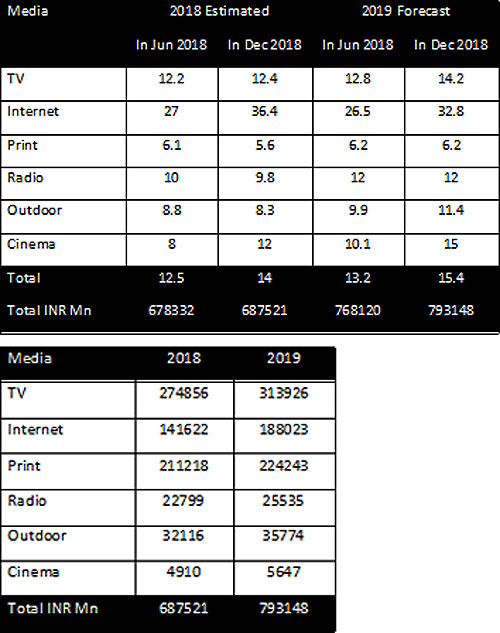
    Digital is stimulating overall growth.  High-speed broadband and online video is driving elementary changes.  Though it is still a duopoly of Google and Facebook attracting >70% of the revenue, this will change the balance as OTT and E-commerce ad platforms are gaining scale and are increasingly attracting advertising monies. Advertiser’s confidence in the medium is very strong despite Face Book’s strategy to declutter ads on news feed followed by a rate increase and YouTube doubling rates for their premium assets. The market share of Digital will go up from 21% to 24% of total advertising spends with revenues touching ₹188 Bn in 2019.


    Added S Venkatesh, SVP, Magna India: “Digital is leading with +32.8% growth in 2019. Massive expansion in smartphone usage is shifting the consumption from collective to discrete. Streaming video will be the biggest gainer in terms of format and is estimated to double its revenue in 2019. Total revenues will grow from INR 687.75 Bn to INR 793.1 Bn.


    Television has immense headroom to grow with 34% of the homes still being Non-TV as per BARC. While organic growth is absolute, cyclical events like ICC World Cup and National elections will generate strong advertising demand. Healthy distribution realisation with digitization gaining momentum will reduce dependence on advertising and aid broadcasters demand better yield. Despite digital growth, TV continues to be dominant as it enjoys unmatched tor of audiences. With 40% allocation of advertising spends, TV will expand+15.4% in 2019 and will continue to grow CAGR +12.5% till 2023


    Print: Physical news delivery compared to global trend of negative growth has grown CAGR +1.9% in the last 5 years till 2017 as per ABC. Also the fact that readership has grown across age groups establishes print’s dominance, relevance and growth. English newspapers are facing stiff competition from Digital platforms and this drop in readers is offset by the growth in languages. Publishers are also gearing up to move beyond pure-play print revenue stream.  Print will attract a larger pie of the political campaigning and Government spends because of elections. Real Estate and Education advertising reaching its earlier peak will help achieve growth of +6.2% in 2019.


    “Lot of investment is going on Print digital properties including Google’s product Navlekha. The digital edition measurement from IRS when reaches scale will help publishers monetize both forms of readership”, added Venkatesh.


    Radio segment is facing surplus inventory because new station launches, in addition, music streaming apps have become easy to access because of fall in data prices. Fearing drop in listenership base, radio stations have cut down advertising load to increase engagement.  While some of the networks have been able to increase rates, this approach is affecting topline growth with advertising revenue witnessing a jump of +12% in 2019. Automobile, finance, real-estate and E-commerce are primary contributors to growth with Government and political spends increasing during the election window


    For OOH it will be a promising year with major contributions from OTT and Mobile Apps along with Telecom and E-commerce. Government’s promotion of welfare schemes and Election spending will sustain this momentum. Estimated to recover with a +11.4% growth the category continues to be data scarce and shall hold 4-5% share of total spending.


    Key Figures:

  • DS Group takes humorous rote for Pass Pass Pulse

    By A Correspondent


    Pass Pass Pulse, the candy from DS Group, has rolled out a set of three ad films promoting the product. This takes forward the ‘Pran jaaye par Pulse na jaaye’ narrative that was introduced with the release of the first TVC.


    The TVCs have been conceptualised by J Walter Thompson Company and the three commercials being released are titled, Astronaut, the Swing and the Bedroom. Each commercial showcases how the protagonists upon seeing a Pulse Candy in their proximity reach out to grab it, even in unfavorable situations.


    Speaking on the brand, Shashank Surana, VP, New Product Development, DS Group, said: “The Pulse candy has retained number one position, second year in row due to its irresistible taste heightened by tangy twist. The communication of Pulse is hinged on the temptation to seize a Pulse candy, whatever the circumstances. This three film campaign also highlights the extend people go to get one in ‘Pran jaaye par Pulse na jaaye’, situations presented in comical and eccentric plots.’’


  • JWT Amsterdam & India partner Jimmy Nelson to highlight diminishing cultures

    By  A Correspondent


    Photographer Jimmy Nelson has launched a bid to preserve cultural diversity by issuing the caution ‘Blink. And they’re gone’. A campaign has been conceptualized and created in a joint effort between the India and Amseterdam offices of J Walter Thompson.


    The campaign kicked off with a short film that is made using over 1500+ photographs taken by Nelson during his journeys across the world. The film was directed by JWT India’s Chief Creative Officer, Senthil Kumar, working closely with JWT’s Global Creative Lead, Bas Korsten, who is based in Amsterdam.


    Said Nelson: “If we let the cultural identity of the indigenous people disappear now, it will be lost forever. It’s literally a case of BLINK and they’re gone. And if this happens, we will lose one of the most valuable assets we have – our rich human cultural diversity and heritage. The depth and wealth of our humanity will shrink. This must not happen. Our collective cultural identity is too valuable to be destroyed by homogenization. We must unify and fight to support indigenous cultures and take personal pride in the myriad of their cultural traditions that are still to be found on the planet today.”


    Added Senthil Kumar, Director of the film & Chief Creative Officer, J Walter Thompson India: “It was a huge honour to collaborate with legendary photographer Jimmy Nelson and direct this all important film. It was life-changing to travel far and wide across the indigenous earth, through each one of Jimmy’s stunning photographs. The ambition is to share the cultural evolution of these remote and ancient indigenous cultures in a mind blowing form, which will move every viewer to share the experience with the world.”


  • 1 Minute View: Future Shock for Ad Agencies?

    1 Minute ViewMxMIndia columnist and veteran adperson Prabhakar Mundkur has very effectively pictured the state of affairs as they exist in the advertising business. His article appears on MxM today at: http://www.mxmindia.com/2019/01/future-still-fuzzy-for-communication-agencies/

    The advertising business in India has had one of its worst years last year. We don’t know if the state of the economy is the cause (demonetisation, GST etc) or it’s a global phenomenon where digital and consulting firms are taking over the business, but the future, as Mundkur writes, is indeed fuzzy for creative agencies. The going is set to be tough for media agencies as their role gets diminished by the Accentures of the world as well as standalone and more agile digital shops.

    So is it a cul-de-sac for advertising? Perhaps, if one looks at things from the traditional prism. However, one must remember that people hire the services of advertising agencies for creativity. Creativity in creative work produced, creativity in the form of innovative ideas and creativity in the form of strategy and effectiveness.

    If creativity continues to be be the primary driver of an advertiser-agency relationship, the path ahead for creative agencies needn’t be fuzzy. In fact it could well be fun.