Category: Ad Agencies

  • Jagran’s RK Agarwal wins big at the FE CFO of the Year Awards 2017

    By A Correspondent


    RK Agarwal, Group Chief Financial Officer of Jagran Prakashan Ltd, has been awarded as the CFO of the Year in Large Enterprises – Services Category (Bronze) at The FE CFO of the Year Award 2017.


    Said Agarwal: “The Jagran group has always believed in creating exceptional value for all its stakeholders, whether it is in delivering amongst the highest shareholder returns in its decade long presence as one of the few listed media entities in the country or in advertiser value or in being possibly the most aggressive player in the M&A space in media, having done three large and significant acquisitions in the last few years. I am pleased to accept this award on behalf of the group and all those who have contributed to its success.”


  • Rejig time at Publicis Worldwide


    It was the day of the Effies. A few days before the announcement, we had received indications that it could happen. But then it was an announcement that was long overdue.

    At the Effies itself, the new boss ensured that he’s not seen just as head of one of the arms that he led thus far.

    We’re talking about Publicis Communications and Saurabh Varma. On December 16, it was announced that Varma, the Leo Burnett Group CEO South Asia, would be incharge of Publicis Communications for India.

    The announcement assumed significance as Varma would also be incharge of three other major agencies: Publicis Worldwide, L&K Saatchi & Saatchi and MSLGroup and their respective subsidiaries.

    While MSL wasn’t going to be much of a problem with Amit Misra being at the helm after the exit of joint head Chetan Mahajan and he would report to Varma, there could be a problem at the other two. The communique sent to us then said that Nakul Chopra, the head of Publicis Worldwide for some years and Praveen Kenneth, head of L&K Saatchi & Saatchi will not report to Varma, even as Varma was to be incharge of the agency. Hmmm.

    But later it became clear. While Chopra continued to be in his position, he was no longer head of business (or overseeing the P&L).

    In the case of Kenneth, his commitments with Publicisare reported to end soon. The picture will get clearer on that front in the next two quarters.

    For Varma, the job on hand was tough.

    Having done a clean-up at Leo Burnett, getting an all-new team (okay, okay, we are euphemising the exiting of the old guard), integrating Indigo and Orchard into the system in a bigger way, it was time to look at Publicis Worldwide.

    A press release sent to us confirms the intent. Though the mainstay of the story has been tucked in at the end: Nakul Chopra, CEO, Publicis South Asia, will now be the Senior Advisor at Publicis Communications India. Chopra has spent over 20 years helming Publicis in India. He is currently President of the Advertising Agencies Association of India (coincidentally when Varma took charge at Leo Burnett, CEO Arvind Sharma was also President of the AAAI).

    But along with the overhaul, there is also the announcement of the entry of Marcel from the group’s international shores to Mumbai. Marcel is a combo of a digital agency and creative boutique. Its clients include Uber, Instagram and Ray-Ban, but these aren’t coming to India with it for now.

    Said Charles Georges-Picot, Global CEO, Marcel: “We are thrilled to open a new office in Mumbai. Marcel is a precious brand that we only share with like-minded people. I know that together we will create amazing work. It is what drives us at Marcel.”Marcel has offices in Paris, Sydney, New York and Sao Paolo. In India, it will be headquartered in Mumbai.

    But while Marcel is good news on any day, here’s what make the March 30 announcement significant, other than the official announcement of Chopra’s advisory role: Currently, Publicis Worldwide has three agency brands – Publicis Ambience, Publicis Capital and Publicis Beehive. This will change with immediate effect.  Now, Publicis Ambience and Publicis Capital will become Publicis India. It will continue to build on the momentum of creating shareworthy ideas that impact share of wallet.

    And Publicis Worldwide will have a new leadership at the helm. Srija Chatterjee (Managing Director) and SudeepGohil, (Chief Strategy Officer and Managing Partner) will join forces with Bobby Pawar, (Chief Creative Officer and Managing Director). They will run all the Publicis Worldwide operations in India, including Marcel, and report to Saurabh Varma, CEO, Publicis Communications, India.

    We aren’t yet sure of who will have have the P&L responsibilities, because there’s got to be one clear leader for PublicisWW.

    Speaking about the new developments, Varma said: “I believe it is the right time for Marcel to come to India. ‘Lead the change’ can only happen through a disruptive model and a world-class International-Indian team. The leadership team has been carefully put together to deliver on our ambition for Publicis Worldwide, in India.”

    Chatterjee joins from MullenLowe Singapore, where she was the Global Business Director. On her new role, Chatterjee said: “When I met Saurabh and discussed the plans for Publicis, the potential and ambition for the agency left me both, excited and nervous. With its mantra of ‘Lead the Change’, and the focus on true integration across all our different platforms, I believe that Publicis is now at a crucial juncture, poised for exponential growth and recognition. I look forward to being part of this journey with Bobby, Sudeep and the team here.”

    Gohil moves from 72andSunny LA, where he consulted on the agency’s Asia-Pacific plans, and led the Adidas business globally. On his appointment, Gohil said, “The Publicis team really impressed me with their bold ambitions, tenacious attitude and passion for great work – they have great clients and an enviable team. The opportunity to work with Bobby, Srija and Saurabh was a big part of my belief and excitement for the plan ahead for Publicis. All of this combined with the bold mandate for the business both locally and in the region made it an offer I couldn’t refuse.”

    Echoing Varma’s sentiments on the evolution of Publicis Worldwide, Pawar added, “I am really excited for our people and our clients. We’ve been doing some cool work. With the addition of the world-class talent and global experience of Sudeep and Srija, I’m sure we will take it up a few notches. It’s game on.”

    Meanwhile, Publicis Beehive will stay focussed on offering holistic marketing solutions to Indian entrepreneurial clients. SanjitShastri continues as the CEO of Publicis Beehive and will report directly to Saurabh Varma. Paritosh Srivastava, the COO at Publicis Ambience, is now COO at Marcel.

    Next stop: L&K Saatchi & Saatchi.


  • Arun Adhikari appointed Non-Exec Chairman for Neilsen South Asia

    By A Correspondent


    Neilsen has announced that Arun Adhikari will assume the role of Non-Executive Chairman for Nielsen South Asia. Adhikari spent more than three decades at Hindustan Unilever and parent Unilever in various markets in senior roles across executive leadership, sales, marketing, and consumer research. As head of Personal Care business for HUL in India, he was inducted into the Management Committee, before joining the Board as Managing Director for Home and Personal Care. During this time, he was also involved in managing external relationships with the government and media, investor relations, risk management, and corporate governance.


    Currently, Adhikari is engaged with Mc Kinsey & Company in India as a Senior Advisor supporting the firm’s Consumer Practice. He is also an independent Director on the Boards of UltraTech Cement, Viacom18 and Aditya Birla Retail.


  • 6 SXSW trends & how they implicate brands


    South by Southwest (SXSW, in short) is an annual congregation of nteractive, film and music professionals who assemble for a slew of conferences and festivals that typically happen mid-March in Austin, Texas in the United States. SXSW was established in 1987 and has grown considerably over the years. According to the ‘About Us’ section on sxsw.com which we recommend you access, “SXSW proves that the most unexpected discoveries happen when diverse topics and people come together”. Hmmm.


    The 2017 edition – the thirtieth in the series – took place on March 10 to 19. The 2018 edition dates have been announced: March 9 to 18. Even if you can’t make it to an SXSW, it’s always good to keep track on what happened and who said (and did) what. Presenting here a ‘trendwatch’ by the folks at MullenLowe Group, which in India, as we know, is called the MullenLoweLintas Group. Read on…


    (Note we haven’t erred in not putting a space between Mullen and Lowe… that’s how it’s written)


    By MullenLowe Group


    SXSW was born in 1987 when an intimate group of thinkers and music lovers recognized a need to discuss the future of entertainment and media. That first year, 150 registered attendees unexpectedly grew to 700 on opening day, and the undeniable charm of Austin set the stage for what is now one of the preeminent events at the intersection of the interactive, film and music industries, with over 72,000 people in attendance.


    Being able to attend SXSW is both a privilege and a necessity. The quality and diversity of learning opportunities is only limited to the number of hours you want to spend in talks, meet-ups or workshops, armed with an open mind, a notebook, a backup battery and lots of water and snacks on hand. From our time in Austin we’ve identified six trends and how they implicate brands. Virtual Reality, voice recognition interfaces and robotics sparked the hunger and amazement that technology feeds us, while activism, emotions and ethics kept us feeling inspired and connected as human beings. Each of these topics will dramatically change the way consumers engage with brands moving forward.


    #1. Smartphones as a gateway for bigger experiences


    Like last year’s conference, Virtual Reality dominated the entertainment conversation at SXSW. In addition to several entertainment-focused activations, one of the biggest developments was an influx of content showing VR’s potential as an empathy tool. But clunky, expensive hardware and lacking streamlined distribution still remain big hurdles standing between the hype and the reality of mainstream consumer adoption for more immersive, interactive experiences. Affordable options like Google Cardboard and Samsung Gear provide lighter-weight virtual experiences by simply opening a VR app and sliding your phone into the goggles. The result? The phone is instantly transformed from a distracting text messaging, email and newsfeed machine to a conduit for an uninterrupted, 360-degree environment creating a heightened emotional connection.

    In addition to lightweight VR, the phone emerged as a tool for adding real world value through the abundant augmented reality apps on the SXSW tradeshow floor. Apps like Aurasma make it possible to trigger a video or additional content by holding your phone over printed collateral or an OOH board. Other mobile apps like Seek are taking the route of Pokémon Go and creating scavenger hunt-like experiences where consumers can unlock exclusive content and prizes by holding the phone over objects in the real world. The week before SXSW, Shazam announced its partnership with Zappar, an augmented reality technology that will trigger 3D holograms with a Shazam code without requiring another AR app to be installed on the mobile device, creating a simpler consumer experience that has real scale.


    IMPLICATION

    Innovation around smartphones has been flat-lining, but 360-degree video and augmented reality are creating new opportunities to leverage smartphones as a conduit for bigger experiences. Thinking of ways to leverage the smartphone as a means for creating bigger mixed reality experiences vs. just as one of a three- or four-screen strategy is something all brands and marketers should be doing. And for brands in the travel or entertainment category, 360-degree video is a means of creating undistracted emotional connections with consumers on a device that typically makes it harder to capture attention. Even if you don’t have a 360-degree video production capability in place, there are plenty of publishers who are already creating content in this category that you can sponsor or integrate with, and new platforms like Facebook 360 are making it possible for wider 360-degree video distribution


    #2. Interfaces everywhere


    Even before SXSW, the rise of conversational interfaces was a rising 2017 trend, making huge waves in January at CES when Amazon Alexa announced integration into hundreds of products and promised to change the landscape of how consumers access information. But there was also no shortage of content around other nonscreen-based interactions at SXSW. One of the most popular devices was Levi’s smart jacket where the sleeve serves as a remote control allowing you to navigate music playlists and accept or decline phone calls easily while, for example, biking. Lampix, a smart lamp technology, can turn any surface into a smart surface, so — a piece of paper into a functioning computer screen or your floor into a multiperson game. Rotex, a smart tattoo technology, enables you to interact with virtual reality environments without the use of a control by applying the tattoo to your arm during gameplay.


    IMPLICATION

    While not applicable to every product or service, brands should be thinking about ways they can evolve or add value to their products by incorporating useful digital interfaces. From a media standpoint, brands who think beyond paid impressions on a screen will be better prepared for a world where consumers are accustomed to diverse interfaces.


    #3. The rise of emotional data


    The topic of big data is no stranger to SXSW (or any other tech or brand conference for that matter). Wearables have created an influx of personal data collection, like heart rate, blood pressure and body temperature, but technologies that capture and respond to emotional data were more prevalent this year. IBM showcased an alpha product that will create customized original musical compositions based on a consumer’s taste and mood. Lily, an emerging fashion chatbot, provides fashion advice by understanding emotions, perceptions and aspirations about your body to make more personalized fashion recommendations.


    IMPLICATION

    Highly personalised experiences at every brand touchpoint will soon be table stakes for consumers. While many brands already have a strong programmatic strategy in place for their marketing programs, they should also be thinking about how all consumer touchpoints can be better curated, from a first visit to a retailer’s website to customer service. And as artificial intelligence continues to grow, there is greater opportunity for importing data into AI platforms to make recommendations in conversational interfaces (e.g. chatbots or Alexa Skills).


    #4. Humans become robots and robots become human


    It may seem like a paradox, but these are two clear trends. On one hand, there’s a race to make humans a better version of themselves, giving them machinelike features and skills by applying technology to overcome traits or limitations intrinsic to the human being. For example, we now have access to technology that can literally edit our DNA, and that presents the possibility of modifying the development of the human race. We are also experiencing the human brain as the new explorer’s frontier, where brain coding will take human intelligence to unprecedented scenarios: robotics at the service of movement, vision and language. As Bryan Johnson from Kernel suggested, the technology to become superhumans should be accessible to everybody as another human right, the human right of evolution. However, on the other hand, there is a race in emerging technologies to inject natural human skills into machines, that is, to make artificial intelligence more human. Technology is being applied to program robots with emotional awareness, empathy, intuition, compassion and sensitivity, as a means of making them more efficient, useful and agile machines. At the same time, humans are expecting more intimate and meaningful relationships with machines, which will be built upon their humanlike reactions but also their humanlike appearance. Marc Sagar, two-time Academy Award winner, and CEO/co-founder of Soul Machines Ltd, amazed us with his pioneering project of giving face and embodiment to virtual agents that can learn through social interaction. The future of intelligence, should that be biological intelligence, brain intelligence, or computing intelligence is just starting to be shaped.


    IMPLICATION

    As artificial intelligence, conversational UIs and machine learning become mainstream, brands have to remember, more than ever, that we are in the business of people. Humans’ need for connection and humanized relationships will always be at the core of our basic needs. Humans, or superhumans, for that matter, will connect with humanized brands — brands that tap into human truths and build significance and meaning people can connect and engage with


    #5. And technology brought ethics back


    Technology is not an instrument at the service of society anymore. As we have seen in many of the talks at SXSW, technology and technologists are defining the world we are going to live in. We have also seen that technology has no limits, that nothing is impossible. As Andrew Grove from Intel said, “A fundamental rule in technology says that whatever can be done, will be done.” Technology will, sooner or later, do it. As the role of technology expands, the need for ethical awareness grows with it.

    Current topics such as security and privacy, the information bubble, identity, smart cities and autonomous driving spur an ethical debate. But the level of ethics involved when we are defining the future should encompass a broader spectrum. The future of employment, identity, health, sports and the human race urgently calls for ethical expertise. An ethical expertise that can shape the world and the society we want to live in, with technology contributing accordingly.


    IMPLICATION

    This new ethical framework will have an impact on consumers’ frame of reference, and they will look at their world differently. It will also increase their suspicion of the world around them, including brands. It is a great opportunity for brands to ensure transparency and honesty in their relationships with their customers, and especially in addressing ethics as part of their business model.


    #6. Activism as a contribution to the future


    Even if SXSW congregates a large number of “liberals” dedicated to the most progressive industries, never before have politics and activism taken such a big chunk of the SXSW agenda. SXSW went political this year, as if there was a need for the progressive thinkers to go through a group catharsis to ventilate, do some internal evaluation and overcome the trauma of the current political climate. Beyond that, this boost of activism proves that technology and humanity are very much intertwined. Technologists who are working hard to improve the world of the future have proven to be as concerned about the world in the present. There is a sense that democracy, and therefore humanity, is in danger. And activism is as much a way to contribute to the world of the future as it is to the world of the present.

    There was plenty of Trump. CNN’s Van Jones captivated the audience by turning the conservative threat into an opportunity for liberals to work for the world they want to live in. But there was much more than Trump. Women, gender, refugees, homelessness and the overarching claim of equality were stronger topics. Jessica Shortall from Texas Competes had a very emotional and provocative talk on how to build a business development case to gain LGBT+ rights in Texas.


    IMPLICATION

    As seen at SXSW, activism is now a part of culture. If brands want to be a part of culture too, they cannot ignore this. Brands that don’t get involved will be left behind. There is a new consumer mindset. Consumers know that buying a brand can be activism in itself. Buying into a brand implies buying into the brand’s beliefs and principles. A brand with purpose is a brand with a very clear signpost. But consumers want that purpose to turn into action; they are asking brands to become activists.


    Republished with permission

    The original can be accessed at http://sxsw2017recap.mullenlowegroup.com/files/SXSW2017_Recap.pdf

    For more on SXSW, please visit sxsw.com
     

  • Small is big and impactful: Santosh ‘Paddy’


    Santosh Paddy isn’t his real name. It’s Santosh Padhi. But the dual identities are just in the name… he’s always very forthright and clear in his views, not shy to show his emotions and passion for his work, and as this chat with Pradyuman Maheshwari shows, happy to put his win in perspective…


    #2 last year with a much smaller team than some of the biggies. And this year #1. As they ask sometimes on news television: kaisa lag raha hai aapko… how does it feel?

    I think we’ve been mostly in Top 2 over the last seven years and we ended up becoming #2 agency at Goafest when Ogilvy was there in 2012. Over the last few years we’ve been #2 and on a couple of occasions we were #3. But mostly we’ve been in the Top 3 and I think consistency is what we believe in strongly… We’ve always aimed for the top slot and we were pretty sure these 2-3 solid campaigns may take us to that top slot. I’m glad we’ve finally achieved this. But I’m not happy just being the #1 this year. I think if we can retain this for a couple of more years, we’ll be really happy. It’s easy to reach somewhere but difficult to retain the position. I’ll definitely make sure we’ll retain this title for a couple of years.


    For an agency that’s less than 10 years old, what does this win mean to you?

    I think it’s pretty big if you think it seriously. I’ve been telling my team that there have been agencies with 1000 people and competing for years and haven’t achieved this and we have. It’s everyone’s individual contribution. Thanks to our Delhi team. Because this year they’ve also contributed in a big way.


    Well, that’s a Dentsu agency that has metamorphosed into yours right?

    Though technically it was announced some time back but we have been working with them for close to 8-9 months. There are some very intelligent and sharp youngsters who’ve taken the Taproot philosophy ahead, so thanks to them as well to contribute to the tally because with one office of 30-35 people we can only stretch to a certain extent. But the minute we added one more office, we can see the result…


    We’ve also seen Social Street has done very well. Your agency is 8 years old. You have Social Street which is #2 or #3, depending on the way you rank agencies. Obviously it’s not important to be a 50-100-year-old agency to be maxing at Goafest.

    Absolutely. This is an era of small agencies and small is big and impactful these days. Look at the number of golds that smaller agencies have won this year. There are 15-odd agencies that have won gold here and 12 of them are all young agencies. They’re very specialised agencies, focusing on a few businesses but doing justice to a lot of them.


    You have an agency like Open Strategy and Design which have done 11 and 4 are Gold.

    Absolutely, they, Autumn Winter, Umbrella… many!


    Does that worry you?

    Absolutely not. I always think competition is healthy. Competition makes you better, sharper, more creative. It keeps you on your toes and I love that challenge. We want that competition. Then only the industry can get better.


    In the light of what you said, there’s always a sentiment that you’ve come on top without the top agencies participating. Your comments?

    I don’t think a great piece of work will get impacted whether there are two or 20 agencies. That work will get celebrated. Adidas Odds has won in a big way at Adfest. It’s won here as well. If there were five more agencies, I’m sure Odds wouldn’t have got impacted because great people will appreciate great work. I’m not worried about that. Having said that, if you look at our past international wins, in four out of eight years, Taproot has topped at Cannes where all the big players were there. It’s unfortunate some of the key big agencies are not there at Goafest. It’s very unfortunate because I believe that if you have the Australias and South Africas of the world playing cricket with you, you always lot better. You are on your toes, you want to push, you want to contribute. So, the challenges are good. And unfortunately these guys have not been coming and staying away from Goafest which is also not a good, healthy sign for the industry. I’d request these guys to come together and have all our differences killed and do whatever is needed especially for the youngsters of the agency. Winning a gold and a couple of metals for smaller agencies is a boost. They will do lot better work next year. When we were young, someone gave us this platform. It’s our duty to ensure one big, healthy award festival happens in whatever form it takes.


    Why speak about other agencies. Even Aggie (Agnello Dias) doesn’t come for the Goafest and the Abby?

    You know Aggie well, he’s a shy guy. He always shies away from such events where there are more than 40-50 people. I’m scared that if there are more than 80 in Taproot, he might not come to office also(laughs). So, he’s a shy guy and in spite of pushing him, pulling him…


    You more than make up for that.

    We try to, but as you know Aggie is Aggie.


    You are aware of the body of work that was produced last year in in India. If you had to put include the agencies who haven’t participated, how do you think you would’ve fared?

    I think the boundaries are getting blurred in terms of the mediums. I’m so glad that lots and lots of new age ideas are coming forward or being done for brands. We’re no more a traditional country which does TV, Print and Outdoor. I’ve seen a lot of design work, activation ideas, a lot of direct ideas, lot of digital, mobile ideas being done. So, I think, we’re living in a world where you can’t say this is an agency doing well or is expected to do well. I think today there are specialist guys coming and contributing. I’d love to give the Jonty Rhodes example. Without even coming to bat, by just fielding, he scored 25 runs for his team by fielding so well. That’s the kind of specialty agencies in India are getting into. There are all great performers. So, it’s not that if the Top Performers are here, these guys will stop performing or winning. I think the country is in a fantastic state with a lot of new contributors adding to it and we should applaud these things.


    Do you think you’d still be No. 1 had the others been there?

    I think we would have won the same no. of metals but I think we wouldn’t be #1 or #2 because the moment a big agency with six offices comes in, it will obviously override the work our two offices have done. But having said that I don’t think we’ve seen work from agencies as powerful as Adidas Odds, but I think we’re really proud of that piece of work. And another piece of work we’re equally proud of is the Open Network campaign, Unfortunately, that didn’t pick up many metals. But I’d be a little happy had it picked up more metals.


    I know this is a celebratory mood. But since we don’t do these interviews too often, lemme ask: One of the things said about your work is that while you are a creative hotshop, in terms of effectiveness you don’t win too many awards. How would you react to a charge like this?

    To be frank, we didn’t enter effectiveness awards the way we should have entered. It’s a format. Somebody has to take that format seriously. We’re creative guys, so we have been entering creative work. Early on, we didn’t even enter creative awards. So, to be frank, we have been only entering Effies, and not the APAC awards. Some of the pieces of work we have produced have huge chances of winning at APAC level also. For example, Open Network or Adidas Odd*, I’m sure these will win big time but I don’t think we’re that gung-ho about entering effectiveness awards. There are some agencies who believe in effectiveness. We believe that if you create a great piece of creative campaign, it’s going to effect in a positive way. Maybe it’s an effective campaign, that’s why clients are buying it, it’s been celebrated. It’s a matter of cutting that case study in a way that it impresses the Effie judges, and we’ve not done that. We haven’t put our energy behind pleasing those juries. So, it’s a matter of getting those numbers and charts and XYZ, which I think being a small agency we haven’t done…to be frank.


    One last question, since we are on awards. Typically Taproot doesn’t participate at Kyoorius, is that going to change?

    There is a reason. We always believe there has to be a single award. We enter Cannes which is the biggest international award. We skip Cleo, D&AD and many other awards because one has a limited budget to invest. You can’t enter all 20-25 award shows happening across the world. So, you have to choose your battle carefully and we always believe after years of battle, the industry decided here is an award we all should be proud of, we should be entering. And we’ve been entering since the last eight years….


    You are on the Kyoorius jury this year and Aggie was there last year. So, you have nothing against it?

    Yes. Correct. It’s a matter of deciding you have 10 units. Whether you want to divide and put 5 in both places or gun for one and put all 10 units in one place. Because it’s an expensive affair. You can’t put two, two places. It becomes really expensive. So, nothing against it. I think Kyoorius is getting better year-on-year. There are more Indian juries this year compared to the last two years. Because, if it’s a local award, Indian jury will do far more justice compared to an international jury and somehow Rajesh has been taking care of those small things that make the festival better and they are getting better.


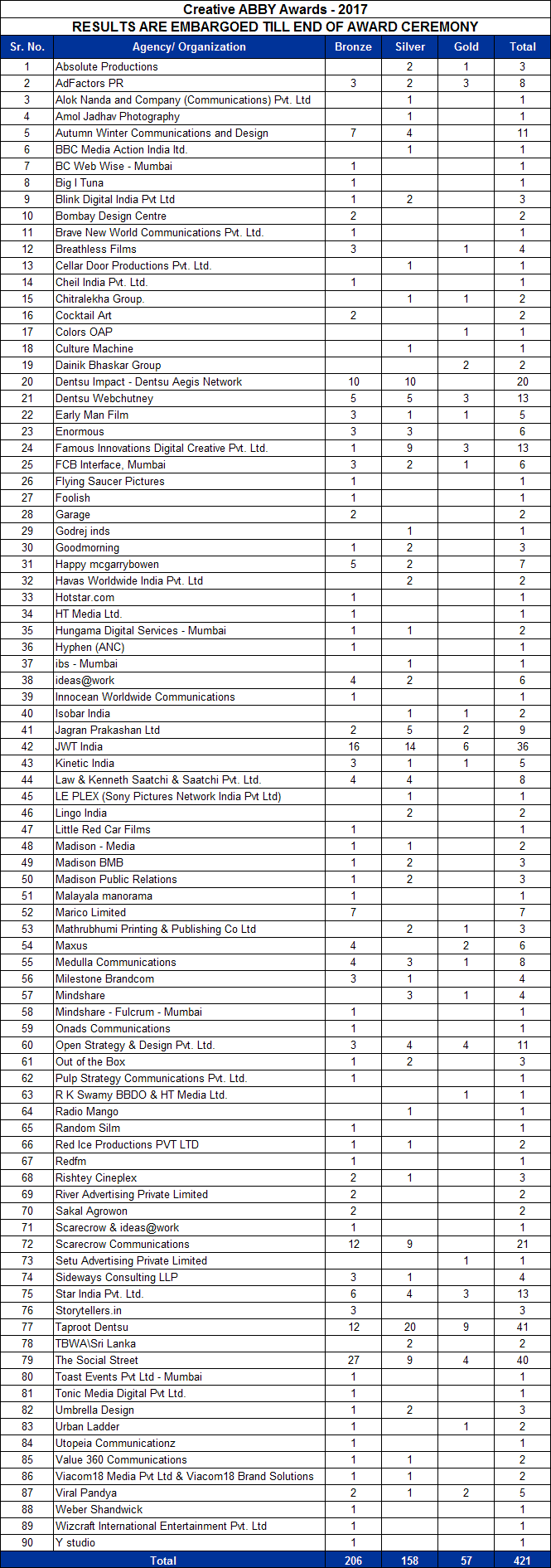
  • Entrants-wise tally – Creative Abby 2017

    And this is how the various entrants stacked up in the Creative Abby… note we have used the word entrants and not agencies, because some of the entries have been submitted by clients/advertisers directly.

  • All the Creative, Media & Special Awards


    Here is a list of all the awards given away on all three days


    Special Abby 2017

    Creative Abby – III (awards given away on Day 3)

    Creative Abby – III (awards given away on Day 2)

    Creative Abby – I (awards given away on Day 1)

    Media Abby 2017 (awards given on Day 1)


  • JWT works up a humorous tale for Pulse candy

    By A Correspondent


    Pass Pass Pulse, the candy from DS Group, has rolled out its first TV commercial with a tag line of ‘Pranjaaye par Pulse najaaye’, with quirky and humorous examples of how far people can go to save their favourite Pulse Candy.


    The first TVC, conceptualised by J. Walter Thompson Company, is the master commercial that outlines the length to which people will go to hide their Pulse Candy and also the extent people will go to get their hands on a Pulse Candy.


    Speaking on the brand, Shashank Surana, VP, New Product Development, DS Group said, “Pass Pass Pulse has been a category disruptor and was an instant hit with the consumers across age groups since its launch. Thus, the idea was to create a campaign, which can reiterate the love of consumers for the Pulse candies. The TVC beautifully showcases this emotion, demonstrating the popularity of the candy. With the launch of this humorous TVC, our endeavor is to take the brand’s popularity to the next level and further strengthen the consumer connect.’’


    Said Shujoy Dutta, Vice President and Executive Planning Director, J. Walter Thompson Company:“It’s well-known that candy is an impulse purchase and normally we would assume that this would appeal to the children. But when we were commissioned to work on the brand we discovered that the appeal of the candy spanned all age groups. Consumers enjoyed it so much that they were also buying them in jars – and during the development of the campaign we heard that the demand outstripped the supply and it became difficult to get your hands on the candy.”


    Speaking about the TV commercial, SundeepSehgal and Siddharth Prasad (Executive Creative Directors, J. Walter Thompson Company) said: “The challenge of working on a candy campaign is that the category has already seen a large volume of work and expectations from candy advertising are high. We were looking for a unique, fresh take that would give people yet another reason to love Pulse. We noticed that people in office wouldn’t keep Pulse on their tables, but in a drawer or behind a book or something. A little game of hide and seek was playing out right in front of us, and that’s where the campaign idea came from.” Commenting on the line ‘PranJaaye, Par Pulse Na Jaaye’ they said “it’s a quirky reflection of how people protect their Pulse candy.”


  • Grey advert for ITC challenges the consumer’s belief about fruit juices

    By A Correspondent


    Grey Group has unveiled a TVC-led campaign for ITC Food’s recently launch B Natural.


    The commercial, conceptualised and executed by Grey India, challenges consumer’s longstanding notion that every juice they pick up is pure.


    Said Sanjay Singal, Chief Operating Officer, Dairy & Beverages, ITC Limited:“Team Grey has really addressed the challenge of communicating a product story in a refreshing and engaging manner using the yoga concept and leveraging our new brand ambassador”


    Added Gautam Bhasin, Senior Creative Director – Grey Group Bangalore: “The creative challenge was to deliver a strong message about other juices containing concentrate in an entertaining and effective way without losing its core essence. And having Shilpa Shetty add a twist to how we know yoga became the answer.”


    Added Vishal Ahluwalia, Vice President – Grey Group Bangalore: “The task for Grey was dual, launch B Natural 100% Pomegranate juice and bust the myth around juices with concentrate.  The common category belief is that all juices are made from fruit pulp. While we were disrupting the category the execution also had to be disruptive and visually delightful for the consumers to take notice. The campaign is surely going to make us think on how we perceive and receive juices and hopefully resolve the conflict by sipping onto a new pack of B’Natural 100% Pomegranate juice!”


  • Dinshaw unveils new look & campaign

    By A Correspondent


    Nagpur-based Dinshaw’s Dairy Foods has unveiled a new brand architecture for all its products as well as an all-new campaign. Intradia World and Lokus Design have worked on the brand architecture for all products and the new packaging is based on research conducted by Ormax.


    Said Zervin Rana and Jamashp Bapuna of Dinshaw’s Dairy Foods: “The pre-packed cone format is one of the largest contributing formats in ice-creams and we selected brand ‘Dil-Hi-Toh’ as our offering in the segment to spearhead our consumer communication. The packaging re-design banked on interesting insight delivered by Ormax (Mumbai) and creative strategy came by triangulating mother Brand Dinshaw’s long-term vision, Brand Dil-Hi-Toh format specific consumer insights and the real-time consumer expectations.”


    Speaking on the strategy, Sanjeev Kotnala, founder, Intradia World said, “While developing their Summer 2017 strategy for ice-creams, Dinshaw’s looked at getting back to consumer celebration of togetherness moments with ice cream and to basics of ice-cream fundamentals. We decided to stay away from over-saturated use of seduction, overt enacted happiness and took on ‘Heartfelt Togetherness’ as the foundation. We were cautious of the fact that the name may overtly suggest romance, which is not the intention and hence believe that the creative agency, Curry Nation has done a great job”.


    Said Priti Nair, founder, Curry Nation: “We were very happy to get a decently focused brief that was not another ice-cream seduction or happiness approach. It allowed us to connect the brand in the real terms and work with the youth segment and connect with them in an emotional & engaging manner. The tag line ‘Dil Ki Dosti Pighalti Nahi’ works at multiple levels. Truly, truly happy to be associated with a brand that has been so much a part of our growing years. I still hum the Dinshaw’s ice cream yum yum…”


    RK Swamy is entrusted with the traditional media planning and buying focusing in it core markets of Maharashtra, Madhya Paradesh, Chattisgarh and AP / Telengana, where the brand enjoys high emotional connect and preference. Tonic Media is implementing the digital part of the activity


  • Pick and choose service as FCB Ulka sets up Bushfire for startups

    By A Correspondent


    Team Bushfire- (L-R) Pradeep Saini, Garima Chandelkar, Disha Bhattacharya, Romit Nair, Noor Mohd. Sana, Surjo Dutt and Rohit Ohri.

    Leading agency network FCB Ulkahas announced the launch of a highly-hybridized service Bushfire, billed as a one-stop shop for start-ups.


    The premise: With the emergence of start-ups, there cropped up the need of a specialized agency model to comply to their needs. Since these set- ups require select services, the need to break the conventional organization structures complimented with agility formed the premise of the prototype - Bushfire. epic shit. without bullshit.


    So instead of a regular retainer fee model, the services are offered in a menu format, with each service having a card rate. The Bushfire team includes a mix of profesionals from across departments ranging from art, crafting, planning, film making and execution without the conventional shackles of three vendor quotes or the likes akin the ‘Shapeshifters’.


    Commenting on the launch, Rohit Ohri, Group Chairman and CEO of FCB India, said: “Startups are looking for ways to prove traction to investors and are generally operating on borrowed capital with a short runway – time is always of the essence and results are imperative for their survival. They are looking for an agency with a different mindset.”


    Surjo Dutt, NCD, FCB Ulka, doubles up as the NCD for Bushfire and will be closely working with Romit Nair, Creative Head, Bushfire. In his role, Nair will report to Dutt.Bushfire’s CRM division will be managed by Satish Ramachandran.


    Commenting on the launch, Surjo Dutt, National Creative Director, FCB Ulka and Bushfire says, “While the re-energised and rebooted FCB ULKA charges forward with its agenda for clutter breaking, market moving work on its massive brands, the need for another offering with a different set of objectives and offerings has become more and more apparent. Which is why Bushfire. A small, agile, multi-skilled and deeply hybridized team of creative strategists, put together to partner startups primarily and clients looking for mould breaking solutions as projects, secondarily.”


    Operations for Bushfire have commenced.


  • Happy Finish completes 5 years in India

    By A Correspondent


    Creative production house Happy Finish has completed five years in India. Headquartered in London, the agency branched out to Mumbai with a studio of eight people, mainly with an intention to provide support to international clientele of Happy Finish. Today, the team has grown into a business of 30 artists in interactive mediums of media serving colients.


    Happy Finish India started as an outsourcing agency with 95 per cent of its clientele coming in from the global markets. The business was majorly execution-oriented and handled by a team of producers and artists trained in UK. Later, the focus was to localize talent and align expectations to special needs of the unique Indian market. Subsequently, the man force which was entirely locally-sourced accounted for the biggest milestone for Happy Finish India in terms of business and scale of operations, thus reducing its dependence on off-shore creative mandates.


    Remarking at the announcement, Ashish Limaye, CEO APAC, Happy Finish said, “Market for creative duties have exponentially multiplied. And brands constantly seek newer ways to engage their audience. In India, marketers are gradually learning of interactive media and the increasing impact of creative post production. Technology has enabled a forward-push in thinking as well as computing power. Creating digital assets such as CGI and image retouching for brands has become far more important today than earlier. Nowadays, even short form content utilizes 360° formats for brand engagement.”


    Founder and Global CEO, Stuart Waplington commented further on the successful milestone, saying, “When home-grown talent grows out of sheer dedication, it amazes me how it becomes one with its environment. Happy Finish India has become that very fabric of the environment. The entire man force in India is locally employed and we are seeing a certain rise in preference for our innovative uses of technology.”


    Happy Finish India has worked with clients like Hindustan Unilever, Tata Motors, Renault, Maruti Suzuki NEXA, Nissan, Nike, Vogue India, Smirnoff, Nokia, Ferrari, Bulgari, Jaguar Land Rover, Mother Dairy, ITC, Bisleri, Baskin Robbins, and L’Oreal to name a few.