Category: Ad Agencies

  • Penguin celebrates its thirtieth year of publishing in India

    By A Correspondent


    Penguin has turned 30 this year and the celebrations begin at the Jaipur Literature Festival. Currently, the largest English language trade publisher in the subcontinent, Penguin was started in 1985, and publishing began in 1987 with the first six books. The anniversary festivities will kickstart at the Jaipur Literature Festival with the Keep Reading campaign – an idea to promote reading anywhere, anytime, and provide a variety of reading content across genres to reading enthusiasts.


    The publisher will launch a whole new range of Penguin collectibles and quirky merchandise – bookends, tea coasters, magnets, passport holders, mugs, and bags among others. Penguin will also be the first publisher to introduce its iconic orange Pop-up Cart, a mobile treasure trove of some of the most loved books and the merchandise, at the festival.


    Being introduced in India as part of Penguin’s Keep Reading initiative, the Pop-up Cart will be a hub of 30th anniversary activities throughout the year, starting with the Jaipur Literature Festival. The 30th anniversary logo will be unveiled at the festival and your favorite Penguin Tent will also don a new avatar this year.


  • GroupM acquires majority stake in MediaCom India


    By A Correspondent


    At mid-morning on Tuesday, Sam Balsara tweeted a clip from The Economic Times of last week where Madison Media had announced a tie-up with Bangladesh’s independent media agency Mediacom. Mediacom, the report noted, is part of Bangladesh’s industrial conglomerate Square Group and handles media planning and buying for Perfetti Van Melle, Asian Paints, Ispahani Group, Singer and some products categories of the parent company. As a part of the deal, Mediacom will have access to Madison Media’s tools and operating software.


    Less than 10 hours after this tweet, came in this missive from the GroupM headquarters in north-west Mumbai: The media services network had announced that it will be acquiring a majority stake in MediaCom India, a joint venture between GroupM India and Sam Balsara, the principal shareholder of the Madison Media group. While MediaCom India will continue operating as an independent brand, the agency will have the advantage of access to GroupM’s global infrastructure. This acquisition continues WPP’s strategy of investing in fast growth markets, new media and digital. The news on the Bangladesh tie-up and what happened closer home had of course no connection. Except the timing of Balsara’s tweet.


    “The majority acquisition of MediaCom in India represents a significant evolution in one of the world’s fastest growing economies. As India becomes a very attractive business hub for global clients, we are confident our talented team in India will deliver exemplary growth and results for all stakeholders.” said, Stephen Allan, CEO, MediaCom Worldwide.


    Speaking on the acquisition, CVL Srinivas, CEO, GroupM South Asia said, “MediaCom India has won several prestigious clients, developed a strong digital presence and has delivered award-winning campaigns for clients. As a network, we have taken giant strides globally and in India towards a more Data and Tech-led core to our business. MediaCom India can harness our world-class media infrastructure to provide more value to its clients and people.”Interestingly, the Mediacom Bangaladeshtieup allows that agency to dig into Madison’s tools and infra.


    Flashback to April 2008 when Balsara announced with much fanfare that he had acquired 51 per cent stake in MediaCom India. And also the coveted P&G business. Over the last eight years, MediaCom India has established itself as one of the Top 5 media agencies in terms of marketshare (Source: RECMA ratings 2015). In 2016, WARC ranked MediaCom India’s Mumbai office as one of the top 10 media agencies in the world based on performance in effectiveness and strategy impact for its clients.Its client roster includes Proctor & Gamble, Tata DoCoMo, Future Group Retail, Shell, Dell, Makemytrip.com, SAB Miller, Subway, Bose,Vespa and Urban Ladder amongst others.


    Industry observers meanwhile don’t read too much into the development. Although Mediacom may technically have been owned by a majority by GroupM, over the last few years, GroupM is said to be representing its interests very actively. And while MediaCom India ought to be part of the Madison Media, the two agencies have fought pitches including recently for Coca-Cola India.


  • Exclusive: Sam Balsara on GroupM acquiring 76% in MediaCom India: In today’s world, you can be a partner and competitor to the same entity…


    By A Correspondent


    Sam Balsara

    In today’s world, you can be a partner and competitor to the same entity. That’s how MadisonWorld founder and chairman Sam Balsara sums up the new arrangement in the joint venture with GroupM on media agency MediaCom’s India operations.


    As per the original agreement, WPP’s GroupM reportedly had the right to acquire a majority stake after a period of eight years, which they just did.


    Earlier, Madison owned 51 per cent and GroupM 49 per cent. Now, GroupM has bought 25 per cent, making its total stake to 76 per cent. For Balsara and team, it’s matter of great pride that the jv was a success for the last eight years.


    And does this mean anything at all on possible ownership of mother ship Madison? “There’s no connection whatsoever,” Balsara laughed it off underscoring that this was a completely independent transaction.

    ~~


    At mid-morning on Tuesday, Balsara tweeted a clip from The Economic Times of last week where Madison Media had announced a tie-up with Bangladesh’s independent media agency Mediacom. Mediacom, the report noted, is part of Bangladesh’s industrial conglomerate Square Group and handles media planning and buying for Perfetti Van Melle, Asian Paints, Ispahani Group, Singer and some products categories of the parent company. As a part of the deal, Mediacom will have access to Madison Media’s tools and operating software.


    Less than 10 hours after this tweet, came in this missive from the GroupM headquarters in north-west Mumbai: The media services network had announced that it will be acquiring a majority stake in MediaCom India.


    While MediaCom India will continue operating as an independent brand, the agency will have the advantage of access to GroupM’s global infrastructure. This acquisition continues WPP’s strategy of investing in fast growth markets, new media and digital, notes a commuique. The news on the Bangladesh tie-up and what happened closer home had of course no connection. Except the timing of Balsara’s tweet.


    Stephen Allan

    “The majority acquisition of MediaCom in India represents a significant evolution in one of the world’s fastest growing economies. As India becomes a very attractive business hub for global clients, we are confident our talented team in India will deliver exemplary growth and results for all stakeholders.” said, Stephen Allan, CEO, MediaCom Worldwide.


    CVL Srinivas

    Speaking on the acquisition, CVL Srinivas, CEO, GroupM South Asia said, “MediaCom India has won several prestigious clients, developed a strong digital presence and has delivered award-winning campaigns for clients. As a network, we have taken giant strides globally and in India towards a more Data and Tech-led core to our business. MediaCom India can harness our world-class media infrastructure to provide more value to its clients and people.”Interestingly, the Mediacom Bangaladesh tieup allows that agency to dig into Madison’s tools and infra.


    Flashback to April 2008 when Balsara announced with much fanfare that he had acquired 51 per cent stake in MediaCom India. And also the coveted P&G business. Over the last eight years, MediaCom India has established itself as one of the Top 5 media agencies in terms of market share (Source: RECMA ratings 2015). In 2016, WARC ranked MediaCom India’s Mumbai office as one of the top 10 media agencies in the world based on performance in effectiveness and strategy impact for its clients.Its client roster includes Proctor & Gamble, Tata DoCoMo, Future Group Retail, Shell, Dell, Makemytrip.com, SAB Miller, Subway, Bose,Vespa and Urban Ladder amongst others.


    Industry observers meanwhile don’t read too much into the development. Although Mediacom may technically have been owned by a majority by GroupM, over the last few years, GroupM is said to be representing its interests very actively. A scenario which Balsara says was fine given that it was all for the good of MediaCom.


  • Publicis Media wins over Rs 100 cr biz over 9 months

    By A Correspondent


    The last nine months have been action-packed for Publicis Media India which has added over Rs1000 crore in billings, according to a communique. Publicis Media India through its brands Starcom, Zenith, Performics.Resultrix and Performics.Convonix will now handle a number of new accounts which includes Parle Products, Mars, Fiat Chrysler, Citibank, OnePlus, Singapore Tourism Board, Fox Media amongst others. Publicis Media also won multi-agency pitches to retain its two key accounts, Micromax and Sun Pharma. Sun Pharma has in fact, added to the mandate, digital duties as well.


    Said Anupriya Acharya, Group CEO of Publicis Media India: “It‘s a great beginning for the Publicis Media proposition in India.  Under the new structure, we have a great team of very energetic and highly talented leaders that run very motivated teams. We have been able to also focus our product and services to better serve our clients’ requirements and priorities. Our refreshed narrative on scale and added synergies on best in class data, tools and insights have all been well received by our clients. And I believe that these account wins are also a testimony tothe same. As we move ahead in 2017, our focus will be on scale, and future ready services like Performance marketing, Data and Analytics, Content, that provide business transforming solutions. We are already some of these services to markets like the US and the UK and this international hub helps us to scale up talent in these areas quite quickly.”


  • SBI propagates benefits of going cashless with DDB Mudra


    State Bank o India SBI has been offering different modes of digital payments even before demonetisation. It introduced ‘State Bank Buddy’, a digital wallet in August 2016.Given its ambition of a cashless society across the nation, the concept of #CashKiAadatBadlo was conceived by DDB Mudra West. The intent of the campaign is to promote the ease of cashless transactions via various facilities of SBI and thus to make cashless transactions a habit for every SBI account holder.


    The campaign #CashKiAadatBadlo is being led by three TVCs which have also transpired on the digital medium. The campaign also consists print activation over the coming months. The three 20-seconder films showcase SBI’s various digital/ cashless products namely State Bank Buddy- a mobile wallet, State Bank Debit Card, and SBI Pay. The films pull a slice of life and take the viewers through various real life situations where people can adopt to cashless mode of payments, which are simple and safe, for all their daily needs and change their habit.


    Speaking about the campaign, Dinesh Menon, Chief Marketing Officer, SBI said, “Given its stature and responsibility the SBI brand carries with it, it was only natural that the brand took the initiative of being the harbinger of change in the backdrop of demonetisation. The #CashKiAadatBadlo campaign is an effort to encourage people to adopt SBI’s digital payment solutions such (SBI Buddy and SBI Pay and Debit Cards) by communicating its simplicity and safety of use. Through this campaign we intend to bring about a pre-disposition to adoption of digital currency among those consumer segments that are habituated to using cash. Early feedback has been encouraging, both from an awareness and response perspective. This campaign has also generated most engagement with Twitter users as rated by the Brand Equity ‘Twitter index’.”


    Talking about the campaign, Sonal Dabral, Chairman and CCO, DDB Mudra Group added: “Post demonetisation, cashless economy is becoming the order of the day and is impacting everyone in a variety of ways.  SBI’s various offerings are a great aid to the consumers across the country for carrying out the day to day transactions. With this campaign, we intended to drive home the ease and comfort of doing cashless transactions with SBI’s various digital products through simple, to the point communication that is informative and engaging at the same time.”


  • Leo Burnett Orchard appoints Mahuya Chaturvedi as COO

    By A Correspondent


    Mahuya Chaturvedi

    Leo Group has appointed Mahuya Chaturvedi as Chief Operating Officer of its second agency, Leo Burnett Orchard. She takes over from Kaizad Pardiwalla who quit the agency as COO in November 2016. Meanwhile, the Leo Group has elevated the status of the agency as the second agency in the group and not just as a subsidiary of the Leo Burnett India.


    The core management team of Saurabh Varma, Rajdeepak Das, Chief Creative Officer, Leo Burnett, South Asia, and Dheeraj Sinha, Chief Strategy Officer, Leo Burnett, South Asia, will oversee both the agencies in their respective capacities.


    Said Saurabh Varma, Chief Executive Officer, Publicis Communications, India: “Both the agencies will have the same DNA and will work to further the core philosophy of HumanKind that is so distinct to The Leo Group. In the last three years, the group has invested in assets like Indigo Consulting, IndigoiStrat, Leo Burnett Experience, and Greenhouse. These core offerings will be deployed by both agencies to create integrated solutions for their clients. Leo Burnett Orchard will also access MSL Group, Publicis.Media and Sapient in India to offer transformative solutions to its clients.”


    Meanswhile, Chaturvedi will be based in Mumbai and will report to Varma. Rohitash Srivastava has been appointed as National Head of Strategy at Leo Burnett Orchard. He comes in from Sapient.Nitro, where he was the Strategy Planning Lead – North India. Rohitash will be based out of Bengaluru. AmodDani has joined the agency as the Executive Creative Director, Mumbai. Daniis a multiple award-winning creative powerhouse with 10 years of solid creative knowhow. He has worked across agencies like Sapient.Nitro and Publicis, and has spent over five years in Leo Burnett, during the course of his career.


    Sharmine Panthaky will continue to be the Branch Head at Leo Burnett Orchard, Mumbai. Partnering her will be Amritraj Thakur, who has joined as the Vice President – Brand Strategy, Mumbai. Amod will work closely with Sharmine and Amritraj to further the creative product from the west region.


    Ganga Ganapathi, Branch Head, Leo Burnett Orchard, Bangalore will continue to work closely with Neel Roy and Vinod Eshwer, Executive Creative Directors, Bangalore. Additionally, Rina Francis, Finance Director, and Reena Nair, the People & Culture Manager and Head of HR at Leo Burnett Orchard, will oversee respective functions across the Mumbai and Bangalore offices. With this, the key leadership structure at Leo Burnett Orchard is now in place.


    On her new role, Chaturvedi said:“I am extremely excited to be a part of Leo Burnett Orchard, especially to lead over a 100 people across Mumbai and Bengaluru. I couldn’t have come in at a more opportune moment, when the agency is seeing such dynamic momentum and is handling some of the most marquee brands in the country. My vision isn’t to just make Leo Burnett Orchard the fastest growing agency, but to also create some incredible integrated work using the ‘Power of One’ and harnessing the Group’s cutting-edge specialist functions.”


  • Titan goes to Madison. Now all eyes on ITC…

    By A Correspondent


    Madison Media has reportedly bagged the coveted Titan account. GroupM agency Maxus was the AOR until now. We use the word reported, because while we have had it confirmed, no one has gone on record. The account is estimated to be in the region of Rs 200 crore.


    Meanwhile, all eyes in the industry are on the ITC pitch. The final presentations happened last Saturday in Bengaluru and four agencies have pitched for the account: incumbent Madison, GroupM, IPG Mediabrands and Publicis Media.


    ITC is Madison Media’s biggest account and any movement of that could be a huge blow to agency. However, the FMCG major is not known to change agencies on a whim so Madison could well retain the business even as there is some very strong competition from the other three.


  • Taproot Dentsu appoints Farah Bashir as VP – Strategic Planning


    Taproot Dentsuhas strengthened its planning prowess with the appointment of Farah Bashir as Vice President, Strategic Planning. She will be based out of Taproot Dentsu’sGurugram office and will work closely with AnandMurty – head of planning at Taproot Dentsu. Prior to joining Taproot, Farah was General Manager – Planning at Cheil India, where she led the insights division.


    Armed with more than 13 years of experience, Bashir has worked as a journalist with Reuters, as a marketing professional with Unilever Asia (across India, Singapore, Vietnam, Thailand, Philippines, Indonesia and Brazil), as a research analyst with Quantum Market Research and as a strategic planner with DDB Mudra and Lowe Lintas. She has worked on various brands including Samsung, Wills Lifestyle, OLX, Hindustan Times, Volini, Revital, Reckitt Benckiser, NDTV, Hindustan Times, MTS, Microsoft, Singapore Health Promotion Board (HPB), Singtel, Zopper, Twinings, Cisco, GPI and Dabur.


    Commenting on her appointment, UmeshShrikhande, CEO, Taproot Dentsu, said, “Farah brings with her wonderfully eclectic influences and perspectives, thus adding more power to our ability to think different. Given that good ideas come from interesting questions, we are truly happy to have strong minds such as hers amongst us.”


    “At Taproot Dentsu, the endeavour is to consistently add value to the brands entrusted on us. Strategic planning can help inform the creation of powerful, motivating work that Taproot is known for and also provide clear, incisive counsel to clients with respect to the brand and business challenges they face. Farah’s track record and skill set is an asset to our team and we look forward to an exciting year ahead,” said AnandMurty – Head of Strategy, Taproot Dentsu.


    Speaking on joining Taproot Dentsu, Bashir said, “Taproot Dentsu, well-known as the creative powerhouse, is equally focused on the rigour and thinking on brands that it works on. Very rarely does the archetype of a planner and agency converge. Basis the last couple of weeks and the collaborative culture of this place, the times ahead look exciting, stimulating and a lot of fun. Delighted to be a part of it.”

  • Zaheer Travadi appointed Partner, Mindshare Fast, SE Asia

    By A Correspondent


    Zaheer Travadi

    Mindshare has appointed Zaheer Travadi as Partner for Mindshare Fast, South East Asia. In this role, Travadi will report into Maneesheel Gautam, Digital Leader of Mindshare South East Asia. He will focus on establishing Mindshare as the champion in digital targeting with data and measurement, enabling the agency’s portfolio of brands to adapt to ‘Fast’ digital growth models, that are unique to the region.


    Commenting on the appointment, Himanshu Shekhar, CEO of Mindshare South East Asia said:

    “It is great to have Zaheer back in Mindshare family. He is an outstanding professional and is uniquely qualified in the field of data, content and technology. He will champion our unique approach to Adaptive Marketing in South East Asia. With his extraordinary energy and imagination, I am certain Zaheer will continue to create inspirational work for our clients.”


    Travedi started his career with Mindshare Fulcrum in Mumbai in 2003, when he worked on digital and mobile promotions for Unilever brands. He then spent nearly a decade at IBM and did a short stint at Microsoft before that.


    In 2014, Travadi joined Hindustan Unilever as Manager Digital Media & Marketing Services. He successfully drove the Cannes Lion-winning mobile marketing campaign (KaanKhajuraTesan) and set up Unilever’s first digital media command centre as also establishing Hindustan Unilever as a content marketing leader in the market, notes a communique.


    In his last venture with Crayon Data at Singapore, he worked closely with Mindshare Fast Singapore hub to develop a Programmatic Audience Targeting product.


  • DDB Mudramax executes the FIFA U-17 World Cup mascot launch event

    By A Correspondent


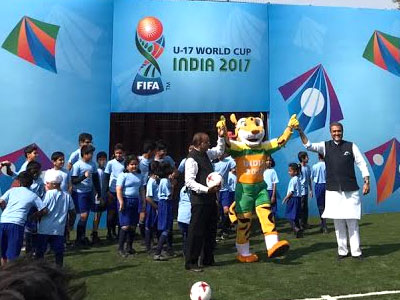
    With just over 200 days  to go until the start of the FIFA U-17 World Cup India 2017, the official mascot of the tournament was revealed at New Delhi’s Jawahar Lal Nehru Stadium recently. The mascot launch event was conceptualised and executed by DDB MudraMax- Experiential.


    The FIFA U-17 World Cup India 2017 is the first global football event that will take place in India (from October 6 to 28). Following a multi- agency pitch win, DDB Mudra Max was entrusted the task of conceptualising and executing the launch event which resonated with this idea. The objective was to create a remarkable recall value for the FIFA U-17 and set the ball rolling for the sporting revolution this event will trigger.

    In a ceremony attended by Minister of Youth Affairs and Sports Vijay Goel and the Chairman of the Local Organising Committee, Praful Patel,  a Clouded Leopard nicknamed ‘Kheleo’ was introduced to hundreds of fans and media representatives. The Clouded Leopard is a wild cat that has descended from the Himalayan foothills through mainland Southeast Asia with a total population suspected to be fewer than 10,000 individuals. The character represents the agility, vigour, uniqueness and potential for the game.

    Following a high spirited event, the seven-foot tall mascot ‘Kheleo’ was introduced to the global football community; as it emerged through two splitting LED screens on stage. The mascot interacted with the young football fans and was cheered on enthusiastically by huge crowd turnout and the media at the unveiling event.

    Quoting on the brand’s experience of working with DDB MudraMax, Joy Bhattacharya, Project Director, FIFA U-17 World Cup India 2017 said, “The show that DDB MudraMax has pulled off cannot be the easiest thing. It is a launch that involves World Football Association, Local Football Association, Ministers making it simply difficult to put a timeline in place.”

    Quoting on the agency’s association with FIFA U-17 World Cup India 2017, Sanjay Shukla, President- DDB Mudra Max said, “2016 was a great year for DDB MudraMax. We gained a lot of momentum and it is great to see the momentum carrying forward 2017 as well where the first marquee event we are pulling off is a part of Indian sporting history. It is a matter of pride and honor for us to be associated with the 2017 FIFA U-17 World Cup India 2017 Mascot launch. The local organising committee are client partners in every sense of the word. I am extremely proud of the team that won this business and pulled off the event.”


  • Quick chat with CVL Srinivas & Sam Balsara on the adspend forecast by GroupM & Madison World respectively


    A quick chat with CVL Srinivas, CEO, GroupM South Asia and Sam Balsara, Chairman, MadisonWorld on the adspend forecast by their respective agency networks


    Writing has been on the wall on digital: CVL SrinivasTaking time off a string of interviews after the presentation of the TYNY report on Monday,  CVL Srinivas, CEO, GroupM South Asia spoke with PradyumanMaheshwari on whether the adspend forecast portends ‘achche din’ for A&M-land


    It’s the type of question we love to ask you: given the forecast of 10% AdEx growth in 2017, would you say it’s achche din or good days for the industry?

    In the current circumstances I would say good days, because of all the gloom doom projections going around in the media for a while… actually 10% is not a bad number.


    In October when we met last around Diwali, it was somewhere around 14%, and which now got from 10 to 12%, what would you have anticipated the growth this year to be?

    Well, it is such a dynamic world that nothing is a constant today. Everything from global commodity prices, to petroleum prices, to local economic political factors, to sectoral factors, to media-related factors. I mean there are just too many variables one is juggling with these days, so I don’t think any study or any estimate, can be a one-time number. We obviously have to keep looking at the numbers, and revisiting the hypothesis may be every quarter going forward, giving the kind of change going on.


    Would you think the numbers could possibly change after the UP election results?

    I won’t want to commit on this particular event, but there is no denying the fact that these numbers could go up or down depending upon the various factors. Which is why TYNY as a study is done twice a year, the first time its basis estimates for the 12 months, and the second time we do it is in the middle of the year around July-August when we have the actual data for the first 6 months…


    Would you say the first few weekshave been fairly decent in terms of spends?

    The first month hasn’t been very good at all and we see this continuing till April. In fact the first quarter is going to be pretty tight, things are going to start picking up fully from April onwards, and that’s the way we built up the report.


    Post-demonetisation therehas been a bit of a scare for media owners with some publications shutting down, some publications shaving off lot of staff. Television has also been down in sales.What do you see is the environment for media owners? Given that you are predicting only a 10% growth, is that good tidings for them?

    I think the big story coming out of all this is that we are living in an age which is so dynamic and which is getting so, I would say, which is all converging towards digital so fast that organisations have to kind of somewhere let go completely off the rules of the past when it comes to doing business… I think the base of change is so rapid that sometimes we are not able to kind of make adjustments and we are forced to kind of take some very very massive decisions in a very short span of time. I think if organisations are more on the ball, look at reality and start taking hard calls more often, things won’t reach a state that they have reached today. For example, the writing has been on the wall that digital is going to eat over the shares of traditional media companies for some time now. It’s not a new development. I don’t think demonetisation has anything to do with it. The consumer has moved to digital many years ago for consumption of various kinds of content.


    Do you think people are using demonetisation as an excuse too…?

    To an extent, I think so. I think there are so many other factors which are at play and even in this day and age there are organisations whether it’s in the media sector or whether it’s in other sectors who are continuing to do well because I think they have just been better prepared. I think they have been able to futureproof their business a lot better. For example, in our own case, we diversified our revenue streams many years ago. Today, given the presence we have across areas like content, sports marketing,  data analytics actvations and so on, we haven’t really felt as much of an impact because of the slowdown of the media sector than perhaps some of the more traditional agencies. And I guess the same holds true for other organisation and other sectors as well.


    In terms of the overall numbers that you see, as per your predictions which sector of the industry has the brightest future?

    See, these things change almost year to year. This particular year we are looking at auto, we are looking at BFSI, we are looking at one part of Ecomm which is Ewallets. We are looking at the media sector and we are looking at the government sector –


    And FMCG continues to be around 27%-28%.

    FMCG’s  contribution to the total AdEx will still remain around 27% or so.


    One of the sectors which was not included in the entire study is the SME sector and that’s where the future of the country is and what’s where everybody is saying that the growth is in terms of advertising. If you were factored into that do you think your final numbers could have been little different?

    Infact we factored in the overall base of advertisers. So that would include the long tail or the SME sectors as you call them as well. In fact a lot of the digital growth is not only coming from the established players but…


    SMEs

    …The first-time advertisers. We are finding in the last couple of years, first-time advertisers moving straight to digital because the entry costs are low because they are able to target the consumers a lot better and also measure the return. We see them continuing in the short- to medium-term.


    2016 growth would’ve been 16% had there been no demonetisation: Sam BalsaraTalking to Labonita Ghosh on the sidelines of the Pitch Madison Advertising Report presentation, Madison World Chairman Sam Balsaraspoke on the dangers of depending too much (or only) on data, on e-commerce advertising and why he thinks the 13.5% growth is realistic


    Some might say your forecast of 13.5% growth of AdEx or adspends in the year 2017 is very optimistic, especially since we had GroupM telling us just yesterday that it estimates growth to be 10%. Your comments on how realistic the growth estimate is…

    Obviously we think it’s realistic otherwise we wouldn’t have put it up. Asyou’ve seen, last year, growth was very low, which has made us bring us forecast down. We do recognise that in the period from January to April, growth will below and that is whyour forecast is 13.5%, otherwise it would’ve been higher.


    Tsunami is an interesting way to describe the impact of demonetisation. Had demonetisation not happened, what would you say the growth would’ve been last year?

    The growth would’ve been 16%. And that is almost exactly what our prediction was in February 2015. It’s because the market de-grew by 8% in the months of November and December, that growth is down to 12.5%.


    Your forecast on digital touching 43% growth is in line with the way it’s been growing in the last five years. Why do you think it wasn’t impacted by demonetisation?


    Ofcourse it was. But digital also looks at leads, and search and all that stuff.Also, FMCG [advertising] is very low on digital, the lowest [of all media]. We’re not saying digital was not affected, but we’re saying that it was much less affected by demonetisation.


    You have also said that January to April is going to be down. But this is also the time when we have elections. So no real impact of election spends?

    Assembly elections don’t pull in that much money. And I think that these elections, coming on the back of demonetisation, have been a bit of a dampener, if I may say so. I don’t think political parties were as flush with funds as they normally are. I think we are seeing a more conservative approach by most political parties in these elections


    ‘Don’t over-depend on media data to support business decisions. Use data as a guide and not as a crutch.’ Now that’s quite a statement from a media agency veteran who has been and led most industry forums. Do you really think there is too much dependence on data?


    What I meant to say was, don’t use data as a crutch. Don’t close your eyes and just blindly go by data. Use your common sense to question whether that data might be wrong or if it even makes sense. Take a holistic look at your plans, and don’t only say this is the data, so it must be like that, so let’s go with it.

    I think there is not enough lateral thinking bring applied to data. And I think a lot of plans are routine, andthey get mechanically done. There is a belief that as long as the GRPs and TRPs are met, I’ve donemy job. But it is possible, that despite all these being met, the brand doesn’t do well. And I think we’ve seen quite a few examples of that.


    E-commerce, as we have seen, has hit the adspend bottomlines. Madison has its own share of e-commerce clients and one of these which has been a big budget advertiser. Do you expect it to go down or up?

    I think e-commerce spends are guided more by the penchant of the investors, and I think investors in e-commerce behave in a very erratic manner. So I wouldn’t like to hazard a guess on what e-commerce investors are thinking of, or will think tomorrow


  • Happy mcgarrybowen wins creative mandate for Duroflex

    By A Correspondent


    Following a multi-agency pitch, Bengaluru based mattress brand Duroflex has appointed Happy mcgarrybowen, now part of Dentsu Aegis Network, as the agency on record to lead the communication mandate.


    Duroflex has focussed on offering superior sleep and comfort experience to its consumers by developing innovative products. Today, it has a portfolio of over 30 different products, catering to distinct sleep patterns and comfort requirements of the consumers. Duroflex is also India’s largest exporter of sleep and comfort products.


    Mathew Joseph

    Happy mcgarrybowen has been bought on board to manage the integrated communication mandate for Duroflex& fuel the brand’s aggressive growth plans.


    On the partnership, Mathew Joseph, Director (Marketing) – Duroflex said, “Over the next few years, we have a range of new and innovative products made for the Indian market that we wish to introduce. It was therefore imperative for us to find a partner who could do justice to the vision we had for these products. We are happy to have found Happy mcgarrybowen, an exciting dynamic partner with who we are confident of achieving what we set out to do.”


    Kartik Iyer

    Kartik Iyer, CEO – Happy mcgarrybowen said, “Duroflex is almost like the Amul of mattresses when it comes to its legacy in India. The founders shared with us their plans and vision to absolutely disrupt the category. Nothing excites us more than that. We thank the young team of third generation entrepreneurs for placing their trust in us. We look forward to some exciting new launches in the coming year.”