Author: mxmadmin

  • Hoshie Ghaswalla takes charge as CEO, Cybermedia

    By Archita Wagle


    The winds of change are blowing at premier technology publishing company Cybermedia India. Senior mediaperson and old company hand Hoshiediar Ghaswalla has been appointed Chief Executive Officer. When MxMIndia spoke to Mr Pradeep Gupta, chairman and managing director of Cybermedia, about the reorganisation, he said: “Earlier only the information and communication technology (ICT) and speciality media group had been reorganised. But now our entire media business has been reorganised and Mr Hoshie Ghaswalla is now CEO of Cybermedia.”


    Earlier this year, Cybermedia had reorganised its information and communication technology (ICT) and specialty media group (SMG) in four units Mr Ghaswalla’s charge. The move was for better functioning, faster decision-making and better customer interaction and the new organisational changes were to come in effect from April 1.

    Said Mr Ghaswalla on his appointment, he said: “CEO is just a title, but I am certainly glad to be given this opportunity to head the entire  media business. These are challenging but extremely exciting times for the media industry”.


    On his plans, Mr Ghaswalla said: “We had hired a leading consulting firm last year  that worked with  various internal and external stakeholders to come up with a plan  for the future which  I will now focus on executing.  For the immediate future we are going Digital first – we will provide content to our audiences where they want it, when they want it and in the format they want it. For advertisers and sponsors, we will be moving a lot more towards the solutions approach. As a group we have always innovated and are therefore looking at some game changers which will give us tremendous scale in the mid-term.”


  • [PR] We’re still a bunch of pimps: Vinod Nair, Clea

    There was a time when a client didn’t have to think twice when it came to selecting an agency of choice to handle their PR account as there was only a single name that was a dominant force then – Clea PR. That was about two decades ago. But much has changed since then and the PR industry has undergone a tectonic shift that has given rise to newer and challenging agencies offering a range of solutions. But even now Clea doesn’t hesitate to go on record saying that most of the CEOs of today have been former trainees of Clea. Such has been the inspiration that it has cast on the sector over a period of time.


    But times have changed and after a brilliant run the agency has pulled back and is going slow with its run in India. But the differentiation still exists, as Vinod Nair, Chairman & Managing Director of the agency assures MxM India. In conversation with Johnson Napier of MxM India, Mr Nair opens up on the agency’s past, on the state of the industry today, on the issue of talent, on his new venture and forecasts his mantra for the future. Excerpts:


    Q: Clea has had a spectacular past so to speak, but how would you sum up the agency’s standing in the marketplace today?

    Clea PR started as a division of Clea Advertising and Marketing. Over a period of time we built it into one of the largest PR agencies in the space. In those days, even though there were many other PR agencies much older than us we were the ones that were responsible for bringing in a “planned approach” to the business. Also, we were the ones that started the concept of Brand PR in this country. We were handling some of the biggest brands at that time and slowly as the company grew bigger, I bought over the company from the promoters and moved out from the fold. We are into our 17th year right now. In due course of time, after having attained size and numbers I guess I lost interest and the business became a bit boring for me. So we decided to pull back and thereby cutback on our size and clients as a result of that.


    Q: What were the factors the led you to pull back and move away from the authoritarian grip that you once commanded in the space?

    I don’t think that PR has progressed the way I would have liked it to progress. As a tool being used by a marketer or as a corporate strategist, we are still media release peddlers. I call ourselves a bunch of “pimps” who are still calling up editors and pushing for a press release or some interview to be featured. Also the fact is that Clea was also the place that every single person who is heading a PR agency today has been a former trainee. What was happening was that the knowledge that one had, which was the USP of a planned approach of how to do brand PR etc – once these guys started going out they started doing it on their own accord. What I observe from the client’s end is that when it comes to paying a PR agency everybody starts shitting bricks. I stopped working for a paltry Rs 50-60,000 a month almost a decade ago and today, you still have big agencies who continue to charge that rate. Also, what has been happening is that anybody who realizes that he is good in this space, they venture out and start their own business. So one witnessed a sudden burgeoning of 1-man, 2-man PR agencies in a short period of time. At last count, there are more than 2000 PR agencies existing in India today. This sudden mushrooming of agencies has led to undercutting of rates between agencies.


    Q: While such is the commotion that exists in the marketplace, what is the equation that Clea shares with its clients?

    With Clea, you’ll see that the average age of my client is minimum eight years. Some have been around for even a longer time. So we have clients to whom we have been delivering quality services day in and out. Therefore we have never felt the need to go out and compromise retainer fees with clients etc. In fact I must be one of the few agencies that actually reject business. Also, we were amongst the first that actually started telling clients to pay us for taking part in a pitch and also insisted on asking for a retainer budget that matched our expectations. What was happening is that despite all the efforts that were being put in all it boiled down to was what was the rate that was going to be charged. That was one of the reasons that I cut down on chasing clients aggressively.


    Today the effort that we are putting in is by providing value-added services to our clients. Today we handle over 100 brands and for most of them we are part of the marketing planning team. So before a marketing plan is in place and a company finalises it, we are consulted for it. There are many other innovations that we do too, but that doesn’t mean that we ignore traditional media; we also do that and it will continue to remain integral in our plans.


    Q: As an agency, how are you scattered throughout important markets across India and which are the disciplines that are in hot pursuit by you?

    Our key branches are spread across six cities and for the rest we use stringer networks. The other advantage that we have is that we have 30-odd branches around the country where we have our own people. So they are involved in a more personal way than most other agencies do. Today, 90 per cent of our clients are brands. One of the trends that has caught the fancy of clients is e-tailing. We’ve bagged four new e-tailing clients recently and I think that is going to be the game-changer as far as PR is concerned. While there are many clients who already offer this service, the difference can come in the marketing and positioning strategy.


    Q: While e-tailing is a burgeoning trend what do you gather from the impact that digital is casting on the medium of PR?

    Around five years back when digital hadn’t become as big, I had started Clea Digital that was based out of the US. We were able to offer our clients facebook and twitter strategies even before it was known here. But I think that digital is a big bubble. Let me tell you why. If you see today, there are two professionals with whom you can never argue: doctor and lawyer. That is because you are scared of them. And when you are afraid of something you are willing to pay anything. And so, social media is just a hype today. Nobody understands the medium; suddenly a viral becomes a hit and everybody wants to imitate that instantly – that is not possible. I genuinely believe that the medium is just hype and I do not think it is delivering the kind of value that it should. Today I could easily get about 10 clients who could pay me loads of money to do nothing except set up a fan page, do some mobile blogging, do tweets, some youtube and that’s it. That’s not what it is really about; it’s got to do more about analytics etc.


    Q: Tell us a bit about your new venture Talentube?

    Talentube.com is going to be India’s largest community of talent. So whether you are a singer or an actor or a dancer or a lyricist etc you become a part of the community. On the other end, I have tied up with some of the biggest directors in Bollywood like Sudhir Mishra, Mahesh Manjrekar etc and then we will produce movies. We will be employing talent only from this community. We’ve already got $12 million funding for the first two years. The project will be officially flagged off in the first or second week of April.


    Q: What according to you is the solution for the rising attrition rate that currently confronts the medium of PR?

    Talent is one area that I consider Clea to be heads and shoulders above everybody else simply because we have never poached anybody from any other PR agency ever. Whereas every single employee from Clea has been poached by other agencies. Therefore I keep making this statement that 9 out of 10 CEOs of PR agencies today have been trainees from Clea PR and almost all of them have come from non-communication backgrounds. Clea has seen attrition that you cannot even imagine. That’s because the training programme by Clea is considered the best in the industry. Since our inception, more than 3000 people have gone through then annals of Clea and most of them are leaders in the industry today. So Clea has always seen attrition and today if I require say 10 people I hire 25 people because I know half of them will quit because they won’t be able to handle pressure and some even may be useless. So I know that by the time the churn happens, I am still left with around 8-10 and these will be effective for me. At Clea, there has never been a botheration at the top level; they have been with me for a very long time. It is only at the mid and entry level that we face attrition issues.


    Q: To what do you attribute the highly disorganised state of the industry?

    I keep saying that if you pay peanuts you will get monkeys and the other thing is that the client deserves what they are asking for. But if you decide to go to a one-man army because they are charging some 10 per cent lesser than the others then why do you expect to get miracles from them. It is actually the fault of the bigger agencies because they haven’t been able to address this issue. In fact every industry across the world goes through a consolidation phase but PR industry has never seen that happen. I’ve never seen bigger agencies buy out smaller agencies like the other sectors. When it comes to selling they quote over-the-moon rates; each one of us is aggressive, over-confident, self-assured and egoistic people.


    Q: What is the growth that you are looking at as you move forward?

    My growth every year is only going to be between 18-20 percent. I want to beat inflation. That’s been my growth for the past seven years. At the earlier stages we were growing over 100 percent and above but after I pulled back every year it’s going to be nothing more than 18-20 percent.


  • Anil Thakraney: The Big Sachin Bash

    By Anil Thakraney


    I caught glimpses (on NDTV) of that mega party Mukeshbhai and Neetaben threw for Shri Tendulkar. And no, that it was held at that deeply repugnant structure called Antilla didn’t prompt me into hitting my remote control as deftly as Sachin would, in his hey days, heave Shoaib Akhtar over fine leg. It was the master being felicitated after all, so one was expected to pay attention.


    Here are some random observations: A whole lot of huge names from all walks of life… industrialists, politicians, movie stars, sports stars, etc, were in dutiful attendance. I wonder if the allure had to do with the blaster or that the invite went from Mukeshbhai. I suspect it was the latter… no one in his/her right mind would wish to offend India’s richest man.


    Mr & Mrs Ambani are enormously poor public speakers. They may know how to turn stone into gold, but the duo lacks the ability to keep you from yawning miserably. Two options: They can get other speakers to do the honours. Or, they can enroll for a public speaking course. Don’t think it costs much.


    Abhishek Bachchan, on the other hand, is a far better public speaker than he is an actor. Small B needs to attend acting classes, but that’s another story. Priyanka Chopra as the anchor was perfect. Though, quite disappointingly, she turned up over-dressed. Aamir Khan was at his professional best. Guess he rehearsed his speech for the 100th 100 time before driving out for Antilla. Salman Khan mumbled a lot. No one understood what he said, but people laughed all the same. Given the macho star’s fiery temper, that’s always a good idea. But his little dig at SRK was delightful. By the way, wonder why Shah Rukh failed to turn up. Had he arrived, he ought to have been seated next to Sallu bhai. TRPs would have gone through the Antilla roof.


    Sachin tried his best to sound cool and humorous. Didn’t really work. Partly because of his recent angry, arrogant outburst at a press con, where he was (quite rightly) questioned on his retirement plans.


    [youtube width=”400″ height=”200″]http://www.youtube.com/watch?v=KGU45aNm-C4[/youtube]

    Lastly, the high point of the show was Lata tai singing “Tu jahaan jahaan chalega, mera saaya saath saath hoga.” Total paisa vasool. Mukeshbhai should now felicitate her just for that.


    ***


    PS: Nissan India has produced a five minute ‘movie’ starring Ranbir Kapoor. And it’s been created in full filmi shtyle, with all the romance, passion, colour and noise our flicks pack in. This blockbuster will officially be released this month. You saw it here first!


  • The Anchor: Nagesh Alai on 6 ways advertising & promotion can prosper in the new fiscal

    By Nagesh Alai


    #1 Economic Situation:

    This is one of the prime factors driving advertising and promotions. In a challenging economic environment, which the GDP downtrend seems to be indicating, ensuring brand recall and staying top of mind with the consumers will be a necessity. While the sluggishness in anticipated growth started showing signs on the back of inflation, high interest, falling currency, etc., in the second half of last year, in a research conducted by our Group’s consulting arm, Cogito Consulting, the bold Report 2012 (available on www.cogitoconsulting.com) shows that CEOs and CMOs of leading companies have predicted a slightly more positive outlook this year with a marginally higher growth rate than earlier years. Some see it as the beginning of a slow return to the high growth rates in the past. My expectation is that the more aggressive companies will take advantage of this trend and try and be the early drivers of growth in their respective categories, thereby investing ahead of their competition to establish an early lead.


    #2 The London Olympics

    Usually there is very little interest in the Olympics and more often than not this event slips by the advertisers radar. However, this year there is some interest in Men’s Hockey, Boxing, Wrestling, Badminton, Tennis and the firing range etc….which might pull in a larger number of sports hungry Indian audiences as they search for heroes beyond their usually preferred cricket


    #3 CAS and Digitisation will lead to better segmentation and availability of more robust data about the audience, this will encourage companies as they will be able to measure the efficacy and coverage in a more systematic manner. The recent Star-Zee combine efforts and push for ensuring real reporting of actual subscribers should also give a further fillip in capturing better viewership data, as will the industry bodies ( IBF, ISA and AAAI ) coming together on BARC.


    #4 Blockbusters on TV

    As everyone knows, movies are a big, big draw in India. Nearly 40-50% of total content on TV is directly or indirectly based on films. The entire movie distribution model has changed. Unlike in the past, now blockbuster movies come on TV within weeks of their release in theaters, instead of months earlier. DTH, Pay TV and Video-on-Demand are shortening the time frames dramatically. This is also drawing audiences and therefore attracts higher spends by advertisers, ultimately helping grow the advertising industry


    #5 New/Dormant Categories getting active

    The general anticipation (though some call it sheer optimism) is that the government will open up new categories like retail. An upward trend to the economy would also help drive spends in financial services etc. The government is keen on generating funds for development by diluting it stake in several public sector companies. It is also a reality that there is a huge pent up queue for IPOs planned by various private sector companies as well….an improving economic situation will encourage companies to go public to raise funds and thereby spur the need for corporate campaigns and IPO advertising which will expand the industry further.


    #6 And lastly, but not the least, the increasing “through-the-line” emphasis, whereby communication concepts are conveyed to target audience/consumers seamlessly through print, TV, out-of-home, activation, internet, social media, etc. will ensure that advertising and promotion will prosper. At the end of the day, it is all about building the brands and the clients better see advertising and promotion as an investment (which prudent clients do) and not as a cost – it is important to have long term view of brand building and not be blindsided by quarter pressures.


    Nagesh Alai is the Director – Draftcfcb Ulka Group India Operations and the President, AAAI.


  • Focus on increasing number of formats: Govind Shrikhande, Shopper’s Stop

    As was predicted of the sector, retail did take a beating at the hands of slowdown, especially the second half of FY 2011-12 where growth was difficult to come by. But the downturn is not as bad as it seems and good tidings are being predicted for the medium for 2012-13. Much will depend on how the large players will be geared to tackle this difficult phase including undertaking risky yet calculative decisions that will either see them in the red or see them walk away with pots of money.


    Govind Shrikhande, Customer Care Associate & Managing Director, Shopper’s Stop Ltd is all set to take his company to new heights and feels that expanding its product offerings across the country could work in favour of the company as there are always new markets and consumers who are waiting to savour variety. Mr Shrikhande opened up to Johnson Napier of MxM India on the sidelines of Mindshare-Brand Equity Compass 2012 on how his company is geared to tackle the challenges of the future and what the retail industry needs to do to overcome the downfall scare that’s had everyone on tenterhooks.


    Q: It’s been a shaky 2011-12 for the retail industry in India. How is Shopper’s Stop handling the slowdown conundrum?

    2011 has been a mixed year for us – the first half went pretty well, but Q3 which is the biggest quarter for the retail sector witnessed a slowdown. We expect some recovery to take place in the second half of 2012-13 while the first half of 2012-13 will be a little slow.


    Q: How have you grown organically across the multiple formats that you are present in?

    We have grown very fast in the last one year. We added around 13 stores in the main format; overall we added more than 20 stores in all the big formats that we have. So it’s been a very fast-paced expansion drive for us. Going ahead, we plan to add atleast eight stores every year. I’d like to state here that the opportunity for retail community in the future is big, so it’s important that you expand today. Though there could be some short-term difficulties of sales growth not being as high as one expected it would be but if one prepares oneself so well that the model is good, the consumer traction is strong and the assortment is very good then one can be in a good position to perform well and really be ready to face challenges of the future.


    Q: Are you contemplating expanding your product offerings apart from the staple departmental and hypercity formats that you currently cater to?

    We have enough formats today like Shopper’s Stop in the department store format, Hyper-City in the hyper-market format, Crossword in the books store format…so we have enough formats currently by which we can expand and we are doing that.


    Q: What do you derive from the changing FDI stance between the government and the retail industry?

    I think FDI is getting a new meaning every season now. The Indian government did announce FDI in multi-brand retail and took it back. Also, the concept of cash-and-carry has been around for some time but now it’s getting into a different kind of a situation. I think the industry as such is waiting for the government to come up with some concrete plans around FDI but yes, once it does come in it will definitely help the whole retail industry to expand faster than what it has been able to do right now.


    Q: What is the impact that digital will cast on the retail sector? A lot of brands are taking the e-tailing route to increase product traction…

    Digital will help drive growth of retail because it is has been found that globally, a lot of consumers first check details on the internet and then go to a shop to buy stuff. It plays a support role where shopping is concerned. The fact is that almost 30-40 per cent of shopping that happens in a physical store has already been researched about before by people on the digital platform. So I do not see it posing any competition or threat; it would be self-supporting.


    We too have started our own websites for Shopper’s Stop and Crossword which will further ensure that a customer will get a multi-channel delivery whether through physical store or a digital store.


    Q: Apart from talent, what is the other big challenge facing the retail industry as of today?

    Apart from people, the other big challenge for the retail sector is the availability of quality space and rental. This in fact is a bigger challenge than people. As for the people challenge that we face, we are trying to overcome that by building new programs like Fashion Associates, which should help us to face this crisis in a much bigger way. But availability of quality retail space at reasonable rent is still a big challenge.


    Q: As you move forward, what would be your main objective for 2012?

    We have enough happening in the company right now. The key driver would be expanding into more cities and growing the total number of formats rather than getting into new formats.


  • Jagran announces NaiDunia acquisition

    It’s now official. Kanpur-based Jagran Prakashan Limited has announced that it has acquired Suvi Info Management (Indore) Private Limited. Naidunia Media Limited is a subsidiary of Suvi and is engaged in publishing the leading daily NaiDunia in Madhya Pradesh and Chhattisgarh.

    Launched in 1947, NaiDunia has over the years become a major player in the Central Indian states. It has multiple editions — from Indore, Gwalior, Jabalpur and Bhopal in MP and Raipur and Bilaspur in Chhattisgarh.

    Said Mr Mahendra Mohan Gupta, Chairman and Managing Director of Jagran, “This was a logical market expansion for us and enables  us to strengthen our presence in Central India. Nai Dunia is a newspaper with a very strong team and has demonstrated editorial excellence over the last decade.”

    According to a Jagran communique, NaiDunia’s current circulation base is around half a million copies per day with the readership growing 2.6 times over the last five years.

    For the cash-rich Jagran group, the NaiDunia acquisition follows that of Mid-Day two years back. The inorganic growth process will continue, a source close to the development had told MxMIndia last week. “We are well on our way towards implementing our strategy for inorganic growth through mergers and acquisitions as on the one hand it allows to begin with a sizeable scale with much lesser investment and on the other hand, it saves long gestation period typical of print industry. The acquisition will enable us to leverage our existing network and will have significant operating synergies.”

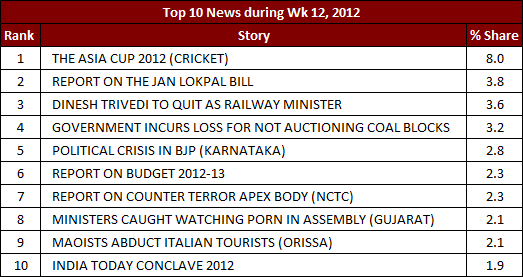
  • TAM NCT Data Wk 12 ’12


    Source: News Content Track – A service of TAM Media Research Pvt. Ltd
    Channels: Aaj Tak, CNN IBN, Headlines Today, IBN 7, India TV, NDTV 24/7, NDTV India, Star News, Times Now, News 24 & Zee News
    Period: Week 12 – Mar 18 to March 24, 2012
    Note : Analysis is based on the Telecast duration


    About TAM Media Research


    TAM is a joint venture between Nielsen Company & Kantar Media Research. Besides measuring TV Viewership, TAM also monitors Advertising Expenditure of Television, Print & Radio through its division AdEx India. Since 2004, it extended its presence in the PR Measurement & Analysis space for Corporate/Marketing Clients by setting up a separate division Eikona PR Measurement.


    In 2007, the joint venture introduced RAM (Radio Audio Measurement) service to track Radio Listenership for the Indian Radio Broadcast Industry. In year 2009, TAM launched a division, called TAM Sports that specializes in monitoring Sports Sponsorship ROI.


    TAM Media Research’s objective is to fuel media insights that will drive the growth of the Indian Media Industry.

  • Digital, Growth mantras to drive agenda at 3-day Event

    By Shruti Pushkarna


    Asia’s largest convention in the business of entertainment is here. FICCI Frames 2012 will be held at The Renaissance, Powai in Mumbai from March 14 to 16. In its 13th year, Frames is a three-day global convention covering the entire gamut of media and entertainment ranging from films to broadcast, which includes television and radio, to digital entertainment, animation, gaming and visual effects.


    The Summit will be inaugurated by Government of India’s Information & Broadcasting Secretary, Mr Uday Kumar Varma while Senator Chris  Dodd, Chairman, Motion Picture Association of America will deliver the keynote address at the inaugural session.


    Japan is the partner country at FICCI Frames 2012 and will be present with a high-powered delegation comprising key stakeholders from the  Japanese media and entertainment industry.


    Frames 2012 will present opportunities for business networking, lobbying, and creative and financial collaboration and partnerships. There will also  be a series of workshops and master-classes that will be conducted by venerated global gurus who will be busy highlighting the way forward to the assembled delegates. Nearly 2000 Indian and 800 foreign delegates are expected to attend the event.


    The who’s who of the Indian media and entertainment industry will join hands with the global industry leaders and experts to discuss and debate  and to announce new initiatives at FICCI Frames 2012. Mark Hollinger, CEO, Discovery, Carolyn Everson, VP Global Marketing Solutions, Facebook, Cameron Bailey, Co-Director Toronto International Film Festival, Bruce Beresford, Director of Oscar-winning movie Driving Miss Daisy, Silas Hickey, Regional Creative Director for Animation at Cartoon Network, Max Howard, Global Animation Consultant and Lecturer on Producing Independent Animated Feature Films for the International Markets, Oscar-winner Harvey Lowry, Hollywood’s Special Effects Guru, and John Bashford, Vice Principal, LAMDA (The London Academy of Music & Dramatic Arts) are some of the globally well-known names who will be delivering keynote addresses, conducting workshops and master classes, and joining the panel discussions in various sessions at Frames.


    Other eminent speakers from the world of television, radio and print that would be present include television czar Ekta Kapoor, Barkha Dutt and Vikram Chandra of NDTV, Sunil Lulla of Times TV, and Puneet Goenka of ZEEL. Print will be represented by Shekhar Gupta, Editor-in-Chief of the Indian Express Group and T.N. Ninan, Editor of Business Standard.


    Bollywood too would be adequately represented through eminent faces such as Yash Chopra, Karan Johar, Vidya Balan, Kamal Haasan, Imtiaz Ali, Anurag Kashyap, Farah Khan and Zoya Akhtar.


    The theme of this year’s event is ‘Embracing the Digital World’. Dr J S Sarma, Chairman, Telecom Regulatory Authority of India (TRAI) and Mr. Uday K Varma, Secretary, Ministry of Information & Broadcasting, will identify and address immediate asks for successful implementation of the digital switchover and also on what’s next in the regulatory and market framework to enable and sustain the transition.


    The move to embrace digitization in Cable and Satellite TV services has become imperative as such services have grown exponentially in India in the last 17 years. A separate session at FICCI Frames 2012 will deliberate on ways to maximize the power of digital distribution. Industry leaders will share their experiences with Frames delegates, their perspectives on how funding challenges have been overcome in other jurisdictions and the takeaways for India. The panelists include Vivek Couto, Founder, Media Partners Asia; Anshuman Mishra, MD, Turner International India; Vikram Chandra, CEO, NDTV; Jagi Mangat Panda, CEO, Ortel; Prof Jonathan Askin, Professor of Law, Brooklyn School of Law, Former Senior Legal Advisor, FCC; Anita Wallgren, US Department of Commerce.


    The FICCI-KPMG study on Indian Media & Entertainment for 2012 will also be released on the occasion. Strong growth in tier 2 cities, the continued march of regional media and the rapidly expanding new media business helped the media and entertainment industry log a 12 percent increase in revenues to Rs.729 billion in a troublesome 2011, according to the report. Overall, the industry is expected to grow at a compounded annual growth rate (CAGR) of 15 percent to a size of Rs.1,457 billion by 2015.


  • Indian M&E Industry set for good times ahead

    BY A CORRESPONDENT


    WHILE the effects of the economic downturn were felt across sectors and industries last year, it was a steady year for the Indian Media &  Entertainment (M&E) industry that registered a growth of 12 percent over 2010, to reach INR 728 billon. According to the FICCI-KPMG report, the growth trajectory was backed by strong consumption in tier 2 and 3 cities, continued growth of regional media, and fast increasing new media business. Overall, the study predicts the industry to register a CAGR of 15 percent to touch INR 1,457 billion by 2016.


    But despite the positive numbers recorded, the report agrees that 2011 has indeed been a challenging year not just for the Indian M&E industry, or even the Indian economy, but for the larger world economy. While India is still expected to grow at a healthy pace, growth is projected to be lower than expectations.


    The report notes that television continues to be the dominant medium while sectors such as animation & VFX, digital advertising, and gaming are fast increasing their share in the overall pie. Radio is expected to display a healthy growth rate after the advent of Phase 3. Print, while witnessing a decline in growth rate, will continue to be the second largest medium in the Indian M&E industry. Also, the film industry had reason to cheer, with multiple movies crossing the INR 100 crore mark in domestic theatrical collections, and INR 30 crore mark in C&S rights.


    Advertising spends across all media accounted for INR 300 billion in 2011, contributing to 41 percent of the overall M&E industry’s revenues. Advertising revenues witnessed a growth of 13 percent in 2011, as against 17 per cent observed in 2010.


    In terms of performance, 2011 proved to be a year with mixed results in terms of growth across different sub sectors. The traditional media businesses experienced a slowdown compared to last year, especially in the second half of the year. However, the new media segments like Animation and VFX, Online and Gaming businesses witnessed phenomenal growth rates.


    Highlighting some visible trends spotted in the report, Dr. Rajiv Kumar, Secretary General, FICCI said, “The key highlights are rise in digital content consumption, launch of diverse content delivery platforms, strong consumption in tier 2 and 3 cities, rising footprint of the players in the regional media, rapidly increasing new media business and regulatory shifts.”


    Putting forth a more pragmatic outlook, Jehil Thakkar, Head of Media and Entertainment, KPMG said, “The Media & Entertainment industry  landscape is undergoing a significant shift. Cable digitization, the promise of wireless broadband, increasing DTH penetration, digitization of film distribution, growing internet use are all prompting strategic shifts in the way companies work. Traditional business models are evolving for the better as a host of new opportunities emerge.”


    Key trends and industry drivers:

    – Growth in digital content consumption across media

    Digital technology continues to revolutionize media distribution – be it the rapid growth of DTH and the promise of digital cable, or increased digitization of film exhibition – and has enabled wider and cost-effective reach across diverse and regional markets, and the development of
    targeted media content.


    There has been increased proliferation and consumption of digital media content – be it newspapers and magazines, digital film prints, and online video and music or entirely new categories such as social media. Accordingly, online advertising spends have seen a spurt in growth vis-a-vis spends on traditional media.


    Key Highlights –

    Print: The print industry grew by 8.3 percent from INR 193 billion in 2010 to INR 209 billion in 2011. The growth was slightly lower than our expectation of 9.5 percent last year due to the challenging macroeconomic environment and reduced advertising spends.

    Television: The over-all television industry is estimated to be INR 329 billion in 2011, and is expected to grow at a CAGR of 17 percent over 2011-16, to reach INR 735 billion in 2016. The share of subscription to the total industry revenue is expected to increase from 65 percent in 2011 to 69 percent in 2016. The TV industry continues to have headroom for further growth as television penetration in India is still at approximately 60 percent of total households.

    Films: With several high budget Hindi releases lined up across the year, 2012 is expected to sustain the growth momentum witnessed in 2011. The Indian film industry is projected to grow at a CAGR of 10.1 percent to touch INR 150 billion in 2016. The industry is estimated to be INR 93 billion in 2011 indicating a growth of 11.5 percent vis-à-vis 2010.

    Music: While 2010 was the year of structural shift from physical formats to digital ones, 2011 provided users viable options of music consumption through different digital platforms. The Indian music industry achieved revenues of INR 9 billion in 2011, registering a growth of 5 percent over 2010.

    Radio: Overall, the industry grew 15 per cent in CY 2011 to reach INR 11.5 billion, compared to INR 10 billion in CY 2010. Volume increases in certain markets and rate increases for the leaders in metros drove growth.

    New Media: Digital advertising is expected to grow at a CAGR of 30 per cent from 2011-16; digital adspend reached approximately 5 per cent of total M&E industry advertising revenue in 2011. Growth is largely driven by increase in internet penetration and proliferation of new devices.

    Animation & VFX: Animation, VFX and Post Production industry achieved estimated revenues of INR 31 billion in 2011, a robust growth of 31 percent over 2010. Growth was achieved on the back of increased contract work, higher VFX content in movies, 2D/3D conversion projects.

    Out of Home: The OOH sector was hit relatively harder by the global economic slowdown than other sectors of the Advertising industry. The sector registered a Y-o-Y growth of 7.6 percent.

    – Rise of new age user devices

    Smart phones, tablets, PCs, gaming devices, etc. all form the foundation of a new wave in media usage. This is gradually impacting the way content is being created and distributed as well. Multiple media including TV, films, news, radio, music etc are being impacted with this change.


    – New age consumers adapting themselves to the newer technologies

    As Indian consumers evolve, there is a heightened need to engage them across platforms and experiences. There is a greater need for integration and innovation across traditional and new media, with changing media consumption habits and preferences for niche content. Media companies today have no choice but to provide more touch points to engage with audiences.


    – Regionalisation

    Regional television and print continued its strong growth trajectory owing to growth in incomes and consumption in the regional markets. National advertisers are looking at these markets as the next consumption hubs and the local advertisers are learning the benefits of marketing their products aggressively.


    – An advertising revenue dependant industry

    The ARPU (Average Revenue Per User) for television, average newspaper cost for print and average ticket price for films continue to be low on account of hyper competition in these industries. Segments like Radio and a significant portion of online content are available free of cost to consumers. Owing to this, the Indian consumer is still not used to paying for content and hence the industry players are sensitive to the impact of  the slowdown which affects the budgets of advertisers.


    – Awaited regulatory shifts

    Lastly, apart from the shifts in consumer preferences, company strategies and business models, one big change awaited for the next growth wave is the implementation of recently enacted and regulations on digitisation for cable, implementation of Phase 3 and copyright for Radio and the roll out of 4G. These shifts are expected to be game changers in terms of how business is being done currently and what could be the path going forward.


  • Pathetic radio ads

    By Anil Thakraney


    OKAY, so I have ‘upgraded’ to 94.3 Radio One and have chucked all my CDs into the Arabian Sea. Spending time in the car, despite Mumbai’s
    horrendous traffic conditions, has become fun once again. And I must say the RJs don’t ramble much, and the music collection is superb. A good mix
    of new stuff and retro. So far so good.


    The only problem is the bloody ads. Most of them are sick, boring and nerve wrecking to hear. And each ad enjoys high frequency because radio is
    an inexpensive medium. Imagine what a downer it is to listen to rubbish in the middle of Cold Play and U2. This is like a tapori waiter on duty at the
    Zodiac Grille. Doesn’t work. So who’s at fault here, can we blame the radio station? Ideally, 94.3 should be picky about the sort of ads they
    broadcast, so that the overall ambience of the station doesn’t get screwed. They cannot disown the ads completely. But private FM radio stations
    are bleeding in India, so we really can’t blame them for lapping up whatever ads they can get their hands on. They have to survive, no? So I guess
    the station can be forgiven.


    What cannot be forgiven is the sad quality of the radio ads. I cannot understand why, after all these years, agency creative directors don’t get this
    fantastic medium. At a very low cost, one can produce award winning work in this space. With no dependence on visuals, the listeners’ imagination
    can be fired, they can be left to fit in their own images. And how very tantalizing that can be! I suspect the key reason radio advertising continues
    to languish is that the entire attention of the ad agencies is focused on TV commercials. And perhaps radio spots are still being written by bored
    copy trainees, who must be treating it as a chore rather than as a creative challenge.


    Come on, dear Creative Directors. It’s a fab medium and a huge opportunity. Don’t waste it. And I would also appeal to the clients not to accept
    garbage scripts. They must put pressure on their agencies to come up with sparkling radio spots. Even if the spots cost less, money is being spent
    on them, so they better be paisa vasool. If the brand managers quietly accept mediocrity, then that’s what will be dished
    out to them.


  • DEAR MR. FM…

    Rakesh Jariwala, partner and tax expert, Ernst & Young and one of the finest minds in determining the taxing truths for the Indian media and entertainment sector, presents his budget wishlist to MxMIndia


    – High entertainment tax burden on industry that showcases Indian art and culture to the world is totally unjustified. Hence, the entertainment tax structure across the country should be rationalized by bringing down rates of entertainment taxes in important states like Maharashtra, Delhi, UP, West Bengal, Gujarat, Haryana and others.


    – Film producer generates revenues from theatrical and non-theatrical rights both of which are liable to service tax. Separately, various State Governments classify ‘copyright’ as goods thereby levying Value Added Tax on transfer/ licensing of copyright on non theatrical streams. To prevent multiple taxation, the government should exempt ‘copyright in theatrical distribution of cinematograph films’ from service tax levy and continue this exemption in the negative list.


    – The Government should take a cue from steps taken by federal/ state governments across the world such as Singapore, UK, Germany, South Africa, US and incentivise the film industry through a well defined plan, for both, content creation and infrastructure. This will help the industry parallel its western counterpart.


    – The concessional rate of 10% on gross basis, as prevalent for non-resident sportsperson for participation in any sport in India should be extended for taxation of foreign artists, performers and entertainers.


    – An alternate mechanism for obtaining Income-tax Clearance Certificate (‘TCC’) for clearance or a monetary threshold for triggering TCC provisions is provided as the current set up provisions and administrative burden discourages foreign talent to shoot in India.


    – A clarification from the government that the payment for grant of distribution rights to foreign telecasting companies is not for the ‘copyright’ in the content and hence, is not in the nature of royalty thereby preventing protracted litigation.


    – Entry into premises such as films, theaters, amusement parks could be liable to service tax under the negative list based service tax legislation. Since these activities are already liable to high entertainment taxes by states, entry into premise where entertainment is held should be excluded from service tax levy.


    – The Government should grant relief from levy and collection of service tax on subscription charges received by cable operators and DTH operators since these charges are already subject to entertainment tax.


    – Rakesh Jariwala is Partner and Tax Expert, Ernst & Young. Please log on to mxmindia.com on Saturday, March 17 for our budget special.


  • Debrief: eBay: Simplicity works

    By Anil Thakraney


    You want to patao that supermodel? You want to be a beauty queen? No worries. You can do it all via eBay.


    The promise in eBay’s new TV campaign seems to be simple enough. I watched two commercials. In one, Ms Jabalpur desires to become Ms India. And she easily gets what it takes on eBay. In another ad one rather seedha saadha banda is able to win over a hot babe by buying her scintillating goodies on eBay. Simple enough and very massy concepts. And it works. Only because the communication is single minded.


    eBay only tells you that if you desire it, it’s here. And there’s no clutter of additional promises forced into the advertising. Also because the promise isn’t really earth shattering, the execution has to play a very important role. And must say the ads are done nicely. Although the humour isn’t really strong, they do leave you with a smile. So that’s fine.


    [youtube width=”400″ height=”200″]http://www.youtube.com/watch?v=kTKyVR3RfAI[/youtube]

    All said, it’s done well. And they can produce many ads with this theme. Just one suggestion: What will make the communication work even better is if people are shown to desire bizarre stuff. AND they get them too. Just to give you an extreme example: A man wants to kill himself, but doesn’t know how to go about it. Till eBay comes to his, er, rescue. Of course, it’s macabre. But you get the idea!


    Rating: (On a scale of 1 to 5): 3. Focused and effective.