Author: mxmadmin

  • LinkedIn announces B2B Connect for Ind marketers

    By A Correspondent


    LinkedIn India has announced B2B Connect 2012 – a first of its kind event, exclusively for Indian marketers to be held on Tuesday, 17th April, 2012 at the Grand Hyatt, Mumbai. The inaugural by-invitation event will bring together leading global marketers and advertising industry stalwarts to discuss the current and future marketing potential of the online space and will seek to establish digital and social media as a core channel for B2B marketing.


    LinkedIn India has lined-up a stellar list of speakers and panelists from India and abroad for B2B Connect 2012 led by Jeff Weiner, CEO, LinkedIn, who will give the first keynote address. B2B Connect 2012’s second keynote speaker will be globally renowned B2B marketing strategist David Meerman Scott who will present on the New Rules of B2B Marketing. Arvind Rajan, Managing Director & Vice President, Asia Pacific and Japan – LinkedIn, Future Brands’ CEO Santosh Desai, Microsoft South East Asia’s Simon Mouyal and Philips Korstiaan van Wyngaarden will also address the audience at B2B Connect 2012. For more information and updates on speakers, please visit http://www.linkedinsolutions.in.

    Announcing the launch of B2B Connect 2012, Hari V Krishnan, Country Manager, LinkedIn India, said, “Indian B2B Marketers are finding that their traditional channels aren’t scaling or providing the measurability they desire. At B2B Connect 2012, we aim to bring together some of the best minds from across the globe to share their knowledge and expertise on how B2B brands can capitalize on the digital medium. The rise of social media has helped brands with the ability to reach the right audiences, and in the right context. In such a dynamic environment, it is critical for brands to be where decision makers are engaging with each other and influencers. At B2B Connect 2012, industry leaders will discover valuable insights and should leave inspired with a path forward for their brands to better market themselves in today’s connected world.”

    LinkedIn, with over 150 million members worldwide of which over 14 million are in India, has evolved into a preferred platform for marketers in the country. It is also the platform of choice for B2B marketers in many leading economies. Approximately 57% of LinkedIn members in India are decision makers. In 2011, 149 Million business leads were driven on the platform by professionals in the country. This potent member base has equipped brands including CISCO India, SAP India, Huawei Enterprise Business Group, Polycom and Trend Micro, with an opportunity to lead engagement with the right audience. LinkedIn Marketing Solutions entails a host of customizable solutions with tools including LinkedIn Audience Targeting, LinkedIn Personal Messaging Unit, LinkedIn Custom Groups, LinkedIn Company Pages, LinkedIn Content Ads and LinkedIn Partner Messages.

    “Indian brands have successfully leveraged the power of the LinkedIn professional network to reach an audience comprising of highly educated individuals in decision making capacities. This has become possible due to our approach of helping brands tailor their marketing approach as per their requirements. The combination of an empowered audience supported by unique tools and an emphasis on insights helps brands achieve a strong conversion rate and provides measurable results. At LinkedIn we provide marketers access to a product suite that caters to not only their short term tactical needs, but also long term strategic objectives,” said Dhiman Mukherji, Director, Marketing Solutions, LinkedIn India.

    Regular updates on B2B Connect 2012 will be posted on the official website and on Twitter (@LinkedInIndia).


  • Utterly Butterly Tondulkarlicious: 25 Amul ads that tell the Tendlya story

    By A Correspondent

    While the news media reflects on current affairs and trends, one wouldn’t be incorrect in saying that the Amul Butter billboards are an excellent mirror of what’s top-of-mind in urban India. So even as headlines and captions in print do their jobs well, there’s nothing like the Amul ad, crafted by Rahul da Cunha and his team at da Cunha Communications for the Gujarat Cooperative Milk Marketing Federation Ltd.


    From the time he started out in the late ’80s, Sachin Tendulkar has been at it… breaking virtually every record at the book and regaling us with his splendid performance and commitment on the field. And off it.


    Last week, MxMIndia brought you the Amul ads with Rahul Dravid… here are a silver bunch of Amul ads telling you the Tendlya story. For his feats on field, and some off the field too. Enjoy!


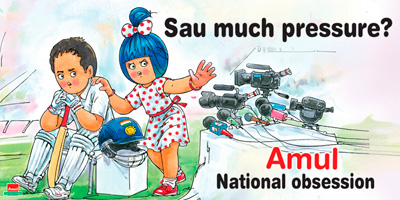
    Sau much pressure?

    India’s obsession with Sachin Tendulkar’s 100th hundred  (January 2012)


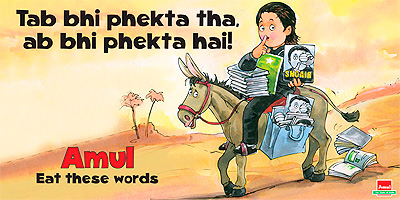
    Tab bhi phekta tha, ab bhi phekta hai

    Former Pakistani fast bowler Shoaib Akhtar’s ouburst against Sachin Tendulkar in his autobiography (September 2011)


    Sachincredible appetite!

    Sachin Tendulkar, the first batsman to score 50 test centuries (December 2010)


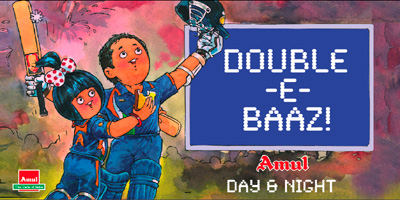
    DOUBLE -E- BAAZ!

    Sachin Tendulkar scores a double century against South Africa in the second one-dayer (February 2010)


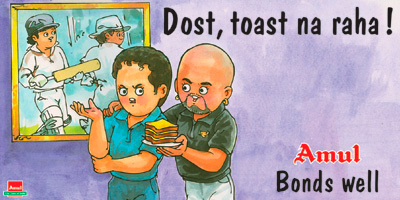
    Dost,toast na raha!

    Controversy surrounding the friendship of Sachin Tendulkar and Vinod Kambli (July 2009)


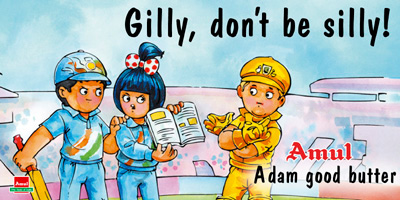
    Gilly, don’t be silly!

    Controversy surrounding Adam Gilchrist accusing Sachin Tendulkar of not having a sporting attitude & being a liar, in his about to be released autobiography (October 2008)


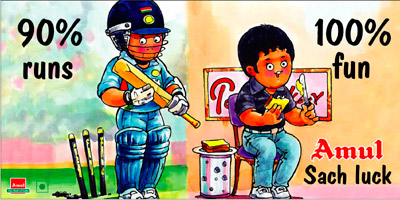
    90% runs 100% fun

    Indian master blaster Sachin Tendulkar missing century in cricket one-dayers.(November 2007)


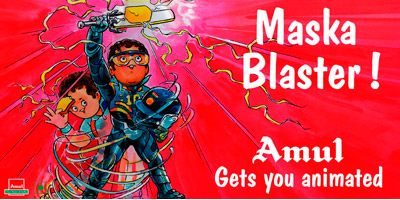
    Maska Blaster!

    Indian batting maestro Sachin Tendulkar – the Master Blaster to appear as superhero in a new range of comic books, animation and games (March 2007)


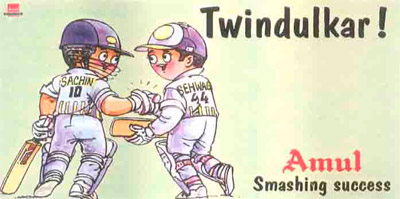
    Twindulkar

    Celebrating the smashing Sachin-Sehwag partnership


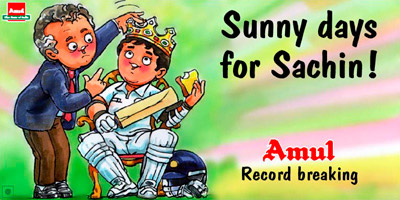
    Sunny days for Sachin!

    On master blaster Sachin Tendulkar’s 35th Test Hundred making him the highest century maker in the history of Test Cricket (December 2005)


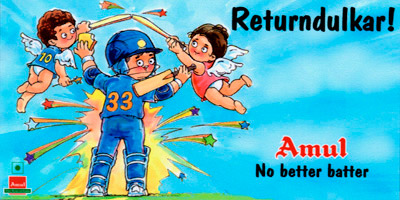
    Returndulkar

    Sachin Tendulkar marks his return to international cricket with a sparkling knock (October 2005)


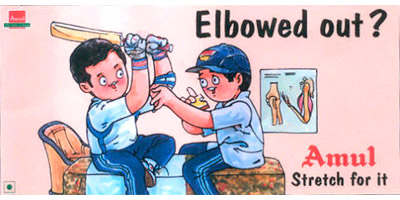
    Elbowed out?

    On Indian star batsman Sachin Tendulkar’s tennis elbow aliment which has kept him out of cricket (October 2004)


    What’s his duty?

    On the waiver of import duty on the Ferrari gifted to Sachin Tendulkar (September 2002)


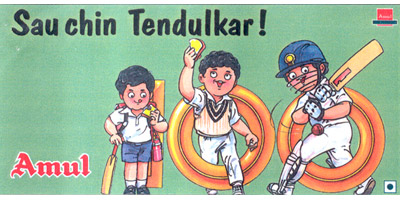
    Sau chin Tendulkar

    On Sachin Tendulkar playing his 100th Test Match (September 2002)


    Stunnedulkar!

    Sachin Tendulkar accused of ball tampering (November 2001)


    Madenness!

    Mike Denness finds Sachin Tendulkar guilty of ball tampering (November 2001)


    Unfeet?

    On Sachin Tendulkar’s foot injury (July 2001)


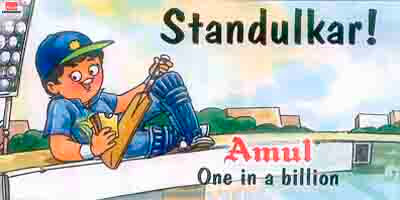
    Standulkar

    On a stand in a cricket stadium being named after Tendulkar and signing a billion rupee contract – May 2001


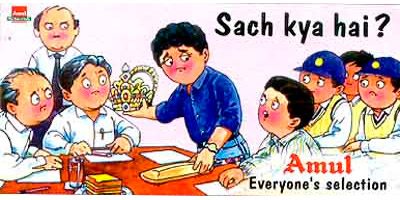
    Sach kya hai?

    Questions being raised on the resignation of Sachin Tendulkar from the captaincy of the Indian Cricket Team.” (Feb 2000)


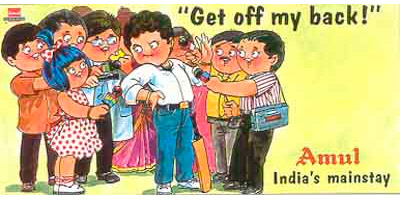
    Get off my back!

    Media speculations on Sachin Tendulkar’s back trouble affecting his future career (September 1999)


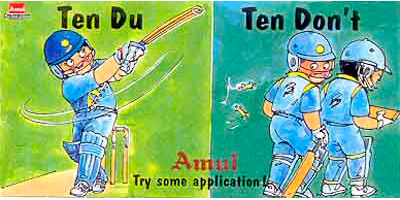
    Ten Du Ten Don’t

    On the lone success of Sachin Tendulkar, while his team-mates keep failing


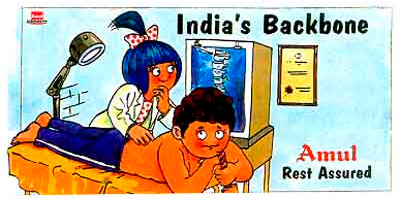
    India’s Backbone

    Sachin Tendulkar’s back injury


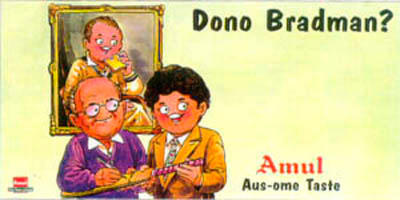
    Dono Bradman?

    About the similarities between Don Bradman and Sachin Tendulkar


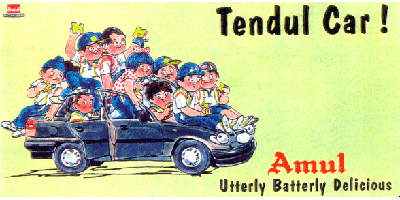
    Tendul Car!

    On Sachin Tendulkar winning a car for the cricket finals between India & Australia


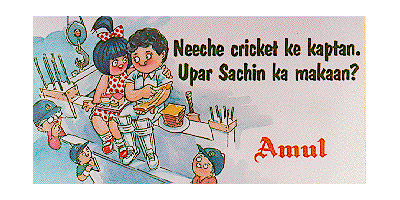
    Neeche cricket ke kaptan — Upar Sachin

    Ajit Wadekar wants Wonderkid Sachin Tendulkar to be given a flat in Sportsfield – a highrise specially built by the Government for sportsmen – as a gesture of appreciation


  • 12 ‘must-do’s when engaging a celeb for your brand

    By Anujita Jain


    #1 First, the key is to identify the need for a brand ambassador ­ whether it is to get noticed, or to catapult to a leadership position, or to change image or create demand, or other.


    #2 Think of a brand endorsement as a mid to long term investment. Quick successes or failures of endorsements are not representative. Riding on the equity of a known personality is a strategic call. By itself, the decision cannot guarantee success, it needs correct usage. For instance, an endorser doesn’t come at the cost of a good creative.


    #3 Go with a mindset to alter the script or storyline of a advertising creative if required, while approaching an endorser. While the communication strategy is brand objective dependent, the storyline may need to be re-thought with the chosen endorse in mind. Neither should the endorser be ideally selected with just one script in mind. The investment on an endorser often deserves and asks for that.


    #4 Match endorser motivations with your brand motivations, to get more out of the endorsement than what the contract promises. This may not just yield in the celebrity commitment to brand but also in the ripple effect the communication may create.


    #5 If as a brand manager, you are looking for a deal or a quick bargains, the only way is not in going for smaller names, but may also be about bigger names who are looking for new dimensions in their own stated personality. Match that need, and you may have a deal! While top end luxury brands have always had this advantage from even A-lister celebrities, this is often true for many other brands with respect to some potential endorsers.


    #6 Plan out how you will use the endorser days thoroughly, so that you don’t end up with expensive days you struggle to use within the year, a common issue with the bulk of endorsement deals. The first few days are often easily utilised through shoots etc., but the balance 2-3 days end up being hurriedly utilised for sub-optimal activation that doesn’t get the right ROI for the day cost.


    #7 Always have alternatives in mind while approaching endorsers. Options not only in the same grade of celebrities, but also pan grades and genres. This not only allows more creative thought for utilisation of the celebrity days, but also results in smarter value-benefit deals.


    #8 Unless you have 4X budget for media and magnification, don’t put more than X for the endorser.  If amplification is the chief reason for using the endorser, it defeats the purpose to cut corners in the resources put behind it.


    #9 Modern-day endorsements are best approached not only in terms of day count, but also digital or equity usage rights.  This again means a clear strategy of endorser usage, clear ideas of utilization of celebrity equity beyond just his/her days, and a strong plan


    #10 If the brand works its communication around the endorser, the likelihood of the endorser working their schedules around the brand is that much more. An endorser, being a human brand, is highly likely to value good planning by the brand, and go that extra mile to deliver.


    #11 Sharper the brand focus versus the category, the better the endorser choice.  So think of the brand positioning and attributes that define brand image, and then create your endorser consideration set. Often brands approach endorsers from the point of view of their category, failing to then translate an edge in their communication, resulting in a diluted or under-utilised endorsement.


    #12 Often, especially for mid-segment brands, considering a set of niche endorsers may bring more value than going for a single mid-range endorser. This de-risks the brand, at the same time allowing them to ride on to a cluster of icons that have a deep and strong, albeit smaller follower base. Today, there is a whole new breed of such celebrities, who have a die-hard loyal following in their chosen fields, who work as strongly as special interest channels do versus a general entertainment one, for the relevant brands.


    Anujita Jain is Founder & COO, Alchemist Talent Solutions.


  • [MJR – Noosemakers] Will typists and babblers leave Sachin alone?

    By Ranjona Banerji


    Bill Dwyre in The Los Angeles Times, in a recent comment on Roger Federer, dismisses trigger-happy journalists of print, web and broadcast as “typists and babblers”. But far more often than tennis great Roger Federer has cricket legend-in-his-lifetime Sachin Tendulkar had to face the firing squad. If the poor man doesn’t score a century every time he plays, out come the guns. O, now he should retire. O, actually, MS Dhoni, Sreesanth, Irfan Pathan, Akhilesh Yadav and Emraan Hashmi are all better than him. O, India never wins when Sachin scores a century. O, he’s just a selfish beast. Babble, babble, blah blah. The typists and babblers, having no sense of history (or if it comes to that, geography) can’t really compare him to Gary Sobers or Viv Richards or even Sunil Gavaskar. Instead, they cast their beady little eyes around and catch the first person they see. The canteen teaboy, for instance, had he been a cricketer and played for India and scored 99 centuries.


    The last few months, especially after India’s scintillating performance against Australia in Australia, have been good for the knife-sharpening brigade. And all focus was on Sachin Tendulkar scoring his 100th century. This nunber was far more important than anything else in the world. The pain of our losses in Australia would have been wiped out if the great man (or selfish beast) had done it. As it happens, no one even has close to 99 centuries in International cricket and getting 100 does not constitute some significant cricketing milestone. But the typists and babblers (thank you, Bill Dwyre) picked on this and stuck to it. “Sachin fails again” were common headlines. Former greats like Kapil Dev called for him to retire.


    And then the man goes and does it. No one could believe it at first, so the whiners and those with bad digestion (some bran flakes in the morning a good idea to improve the mood?) got in first: O, it was only against Bangladesh. It would have been better if it had been against another team. (By that reckoning, do the record books discount all India’s victories against Bangladesh or do we hang on to them happily?).


    Soon after however, the joy and accolades took over. All the hyperbolic praise poured out as if the last few months had not happened. Kapil Dev appeared on TV with the “greatest” and whatnot pouring out of his mouth in his own brand of English. He ducked the retirement question, heh heh. Other former cricketers made it clear that Bangladesh was a legitimate Test playing country. Former England captain Nasser Hussain pointed out that it wasn’t just about a century against Bangladesh but the other 99 against every top team and top bowler in the world. The headlines now said, “Sachin, Thanks a Ton”, “Man of the Century” and “God of All Things”.


    The biggest winner however was Union finance minister Pranab Mukherjee whose lacklustre budget got forgotten.


    Knowing the tiny thinking capacity of the typists and babblers however, there can be no doubt that they’ll begin soon once again. Sachin Tendulkar however knows that he will recover and decide for himself. As Ayaz Memon quoted from Shakespeare in The Times of India on Monday to describe Tendulkar, “I might call him a thing divine; for nothing natural I ever saw so noble.”


    Yes, typists and babblers, you can look up Shakespeare on Wikipedia but don’t read it for too long or your little brains will hurt.


  • MxMIndia Comment: Let market forces decide ad duration

    By Pradyuman Maheshwari


    There is no denying that the Telecom Regulatory Authority of India (TRAI) has done some splendid work in the world of telecom. It’s also done its homework well on the recommendations for digitized delivery of broadcast signals. The sunset dates (especially for the four metros) are very ambitious, but TRAI is determined to cleanse the system, and this could well help do that.


    However, there are some areas where TRAI has failed, and come up with outlandish recommendations. For instance, its advisory that only All India Radio news feeds be used on FM private radios. It’s bizarre. When all and sundry players are allowed to air news on television – via satellite and cable, why not have news on radio? I believe that radiowallahs are also to blame for this delay and somewhere the fact that most of them are also in television and print is impacting pushing this agenda.


    Then there’s the issue of cross-ownership. I am aware of the problems that owning various media has, but just following what was implemented in developed nations eons ago is not right. Also, strategic tie-ups between media groups can happen to ensure that they further their collective agenda. An example being of Star and Zee getting together to set up distribution arm MediaPro.


    The newest in TRAI’s proposals which has now asked stakeholders to present views is on the duration and display of ads on channels. Surely we knew that the TRAI was working on it, but the timing was interesting. It’s happening at the end of a tough fiscal, but more importantly, the industry bodies have matured in their outlook and are taking necessary steps to get their acts together (like they did on self-regulation). So why not ask the IBF and NBA to get together and deliberate?


    [youtube width=”350″ height=”200″]http://www.youtube.com/watch?v=8QGcFHfF6kE[/youtube]

    But the issue here is different, should the government really get into the act of regulating ad durations and displays? Let market forces decide (see video alongside where Sunil Lulla, Times TV Network CEO and VP, IBF and NBA board member, advocates the same to my colleague Shruti Pushkarna on the sidelines of the CASBAA convention yesterday). We have already had several instances when broadcasters have dropped ads to up viewership and ratings. Ad breaks on films have been tweaked much to achieve this. I am sure all sports channels know that they can’t play around with the amount of screenspace ads take because it impacts the viewer experiences. News channels go without a break for hours whenever they are pursuing a huge story.


    More than regulations, market forces will help decide all of this. The government must have as much, say, in the matter of ad duration as it has in, say, a Hindustan Lever’s pricing of Dove soap. Tracking the policies in other countries makes for good reading, but is not necessarily a good idea. Broadcasters have appointed top marketing and research talent to think through this. Let them do their jobs… they know what’s good for their channels and their viewers.


    The problem is that the Indian public doesn’t like to pay for content. They wouldn’t mind paying a few hundred rupees per head on going to the cinema for the movies, but will hesitate to pay even 1/10th that for a month’s subscription of a pay movie channel. Broadcasters are largely to blame for this, but that doesn’t mean that they need to pay so heavily for their mistakes.


    The damage is not done yet. I am certain that all stakeholders will damn the proposals and ensure that these regressive policies don’t come in to being.


    MxMIndia opposes them, and recommends a liberal broadcast regime. Let market forces rule.


  • [MxM Journalism Review] When media got taken for a ride

    By Ranjona Banerji


    One of the best examples of the way the media was taken for a ride lies in the Bhattacharyas versus the Norwegian child welfare services story. Without a thought for the facts, Indian television plumped up with rage and immediately pulled out the racism card. The parents of the children who had been removed from their care wept on television. Theories were put up about how the Norwegians did not understand the cultural traditions of Indian parenting – feeding with your hands, cuddling, the whole family sleeping together. These cold, hard, unfeeling people invaded the Bhattacharyas’ home and decided that they were bad parents. We were told that Norway’s child welfare services did this regularly, particularly to people of colour. Other Norwegians appeared on television and told us that they also lived in constant fear of their children being snatched away by the state.


    As the jingoistic cries of “India done wrong” grew louder, the case became a diplomatic incident. Indian politicians – notably Brinda Karat of what is left of the Left Front – held protests against Norway, demanding that the Indian government do something. Newspapers just followed the television line. Our thin Indian skins bristled with outrage that someone had dared to accuse an Indian couple of being bad parents.


    Now the story has taken a bizarre and potentially tragic turn. The father of the children now says that his children were taken away because of his wife’s psychological condition. In fact, he says he has left her after a violent incident. It turns out that it was not a “cultural misunderstanding” that led to the drastic act of removing the children. The little boy’s teachers found his behaviour to be strange and that is when the child services entered the Bhattacharyas’ home. Charges of malnutrition were also added to this.


    To make matters worse, the children’s uncle, designated as guardian, now says that the children are “flourishing” and happy in child care. He fears what will happen to them when he brings them back to India and his sister-in-law’s family tries to claim them.


    The husband says his wife got carried away with the media attention. So, probably, did he.


    In all this, the media asked no questions. They took the Bhattacharyas at face value and instead of getting a “story”, editors and reporters allowed their own personal feelings of outrage to guide them.


    Few if any efforts were made to dig a little deeper. There was a clue that I can remember. The children’s mother had said on TV that the Norwegian child welfare services had not taken into account the effects of post-partum depression in their analysis.


    A journalist who does not ask questions, as many as possible, sooner or later lands up with egg on the face. In this case, it is not just about embarrassment. It is about the life and happiness of two children.


    And no matter whether it makes good TV or not, we have to stop behaving as if the world is out to insult us. Sometimes, it is quite possible, that some Indians are not perfect.


  • Anil Thakraney: Don’t kill Kohli

    By Anil Thakraney


    Young Virat Kohli must be pleased as punch. Not only did he manage to do the unthinkable – eclipse Sachin’s 100th 100 – the hot, new sensation is sitting on a goldmine. Imagine the excitement inside corporate boardrooms, as brand managers salivate at the prospect of signing multi million dollar contracts with the lucky dude. And also inside the buzzing rooms of editors and programming heads, as they plan huge spreads for the new found hero. What works even more for Kohli is that he looks reasonably good, unlike most desi cricketers. This makes him a huge media and ad property.


    I must quickly add here that I personally have very little respect for brand managers who piggyback on celebrities. This is their way of acknowledging that they are idea-less and want someone else to save their skin. But that’s a debate for another day. I have a larger worry at this point of time.


    Not every cricketer is mentally as strong and sorted as Tendulkar. Too much adulation and quick riches could easily go to Kohli’s head; he’s still very young, a 23-year-old lad. We have finally found a real match-winner in the cricket team, a player who doesn’t get intimidated by huge targets, and it’s in the nation’s interest that we carefully nurture this rare talent. We need to give the guy some space and time to mature (he’s got a long way to go), and both, the media and the marketers, must go easy on the young man. Hold the mega praises and the fat endorsement contracts for a bit, people. Let’s not kill the golden goose. We must think India first.


    Having said all of the above, I am equally aware that I am wasting my time out here. Our celeb-obsessed media and our idea-starved brand managers will pay no attention to this. They will go for the kill. What to do, we are like this only. All I can say is, one hopes Virat Kohli stays grounded. And keeps his head screwed on. Else, he’s finished. Like one Vinod Kambli.


    ***


    PS: Must read. An interesting profile of Imran Khan. From his playboy days to his new avatar as a devout Muslim. From captaining a difficult cricket team to the burning ambition to lead a ravaged nation. And of course, his recent bonhomie with dodgy mullahs and terror groups.


    Link: http://www.guardian.co.uk/world/2012/mar/04/imran-khan-pakistan-cricketer-politician


  • Levi’s WaterLess initiative for World Water Day

    By A Correspondent


    On World Water Day, March 22, the clothing brand Levi’s is challenging people to go WaterLess. This is a social media initiative by Levi’s to help give more to people in need in association with water.org.


    The official communiqué from Levi’s states, “Nearly a billion people don’t have access to clean drinking water and we’ve decided to do something about it. Our hope is that you will too. Beginning March 22, in honour of World Water Day, the Levi’s brand and Water.org will partner to encourage people to ‘Go WaterLess’ and experience what life is like for the one billion people around the globe without clean water. Go WaterLess challenges people across the globe to take water saving steps to help provide water to those without.”


    This is an engagement activity where people can log on to www.levi.in/waterless and learn more about the global demand for clean water and small actions they can take each day to use less and give more. Each action completed ‘unlocks’ WaterCredits and ultimately supports Water.org’s work to provide life-saving clean water worldwide.


    The Levi’s brand has also introduced its WaterLess jeans collection in India. The average pair of jeans uses 42 litres of water in the finishing process, while Levi’s WaterLess products say they reduce the use of water in the finishing process by up to 96 percent for some styles. The Levi’s brand, the communique said, has already made more than 13 million WaterLess products and saved more than 172 million litres of water. This is water saved equivalent to 726,600,812 8-ounce glasses of drinking water which is enough for 157,000 people for one year.


  • UTV Indiagames launches cricket games on iPhone, iPad

    By A Correspondent


    Gaming company UTV Indiagames has announced the launch of ‘WorldCup Cricket Fever’ for the iOS platform. WorldCup Cricket Fever is the first ever game to have special responsive and intuitive touch controls which provide a cricketing experience with ‘as good as real’ shots on the iPhone &iPad.


    With vibrant graphics, outstanding visuals and ultra-realistic animation, the game offers a cinematic experience with TV broadcast style-cameras.


    Speaking on the launch of WorldCup Cricket Fever, Vishal Gondal, CEO, UTV Indiagames said, “UTV Indiagames has always churned out the best of cricket games in the country. WorldCup Cricket Fever is the first ever cricket game developed with motion capture animation. This technology will give the user a ‘real’ experience of the sport with a wide variety in batting and bowling options. This cricket season, with a host of cricket games available, this game will surely stand out in terms of gameplay, graphics, precision and sound.”


    There are three game modes to choose from – Quick Match, Power Play and World Cup Championship. The game includes 14 teams, 6 stadiums (with day/night option) and three difficulty modes – which can all be customized.


    WorldCup Cricket Fever will soon be available on the Android, Windows and Java platforms as well.


  • Varun Kohli joins Mogae Media as Chief Monetisation Officer

    By A Correspondent


    Varun Kohli has joined Mogae Media as Chief Monetisation Officer, reporting to Sandeep Goyal, Chairman, Mogae Media. In his new role, Mr Kohli will be responsible for overseeing the sales of mobile, DTH (direct to home) and other inventory.


    “This is a great time for mobile marketing, especially in a country such as India. Mobile, as a medium, offers unique experience and lot of opportunities for advertisers. I am really excited and elated to be a part of Mogae Media, where I would be able to grow this media,” Mr Kohli said.


    Prior to this, Mr Kohli was with the India Today group as Associate Publisher for Mail Today for a year and a half.  He brings experience of over 18 years to Mogae. He had begun his career in 1993 with Indian Express and has worked significantly in the print industry with brands such as Amar Ujala, Deccan Chronicle, Hindustan and DainikBhaskar. Kohli is a management graduate from SIMS, Ghaziabad.


  • The Anchor: 4 reasons why radio needs content innovation

    By Amitabh Srivastava


    #1 Emerging Technologies:

    Keeping in view the emerging technologies, it is very important that everything is taken into consideration; for instance social media can be of great help in terms of getting more interactive with listeners.


    #2 To Engage Listeners:

    These days the maximum listenership is through moving vehicles, so if there is some innovation catering to those audiences, then it would be a very good option.


    #3 Rise of Internet Radio:

    Internet radio is fast growing all over the world, and India is no exception. Internet radio will be emerging as the big thing very shortly.


    #4 Two-Way Communication:

    This is most important because the moment you get interactive there will be an increase in participation from the listeners also.


    Amitabh Srivastava is the Country Manager – South Asia, Radio Netherlands Worldwide.


  • @AIMA Congress: ‘Marketing is always a challenge’

    By Shruti Pushkarna


    RK Swamy BBDO’s SK Swamy @ AIMA 2nd World Marketing Congress
    [youtube width=”400″ height=”200″]http://www.youtube.com/watch?v=WQ-UK3vd3v8[/youtube]
     Maruti’s Mayank Pareek @ AIMA 2nd World Marketing Congress
    [youtube width=”400″ height=”200″]http://www.youtube.com/watch?v=xKv0XlDoh8A[/youtube]

    Yashwant Sinha, Former Union Minister for External Affairs and Member of Parliament, summed up the crux of all discussions at the two-day marketing congress appropriately when he said, “Marketing, as a function will always remain a challenge to marketers because it is an art and a science that will continue to grow.” In the several sessions over the two-day congress, the concept of marketing was expanded to include spheres as diverse as politics, corruption, business and spirituality. Leaders from all walks of life converged at the congress to understand the nuances of marketing and how to leverage the power of marketing.


    The AIMA 2nd World Marketing Congress was held in New Delhi on March 2-3. The two day conference saw a panel of eminent speakers from various sectors who exchanged their thoughts on the changing dynamics of marketing. The theme of the conference this year was ‘Exploding Marketing Power. Speaking of the theme, World Marketing Congress Chairman & Chairman and Managing Director, BBDO RK Swamy, Srinivasan K Swamy said, “Marketing is the only thing that can deliver disproportionate results. Finance, manufacturing etc can only reduce cost to some extent, whereas marketing can provide excessive revenue and it has the power to bring on exponential return, that’s why we have this theme of exploding marketing power.” He also said, “The AIMA World Marketing Congress this year has raised the bar from last year to explore various dimensions of marketing not just in India but globally. The basic concepts of marketing have not changed in the last few decades but their implementation has. Marketing strategies start even before the product is launched, through the purchase and by means of post purchase offers.”


    This was also the third year running for the AIMA-RK Swamy High Performance Brand Award. This year the award was won by Wipro Technologies, with Axis Bank as the first runner up and Voltas Ltd as the second runner up.


    Staying relevant to the consumer

    In the session on ‘Extracting Full Value of Marketing Investments’ both Virginia Sharma, Vice President & CMO, IBM India and Aditya Ghosh, President, Indigo Airlines stressed on the need to stay relevant to the consumers. Ms Sharma said, “You have to stay relevant to the consumer and that’s the toughest job as a marketer. Brand visibility and awareness can be bought- you can plug your logo anywhere and everywhere but what you can’t buy is relevance. So what we need to do is to build authentic advocates for the brand because advocacy shapes belief.”


    Mr Ghosh said that all employees at Indigo are brand ambassadors for the airline. He said, “We need to ask ourselves how do we stay relevant to the customer and what is the customer really willing to pay for. Our aim is to concentrate on the product which remains relevant to the customers. Marketing does not define our business strategy but plays an important support role in pushing it further. Our marketing spend is less than 1 percent of our revenues. We create new innovative experiences and find various touch points with our customers that transcends into all our products and offerings.”


    Mr Ghosh also shared three strategic guidelines that Indigo follows.

    • Stay true to the brand value
    • Carefully curate every possible touch point
    • Make a buzz-worthy yet credible impression

    Mr Ghosh also said that a one-way marketing blast is not always necessary. It is important however to keep innovating the techniques of how you push your message across to the consumer.


    Stretching the product life cycle

    Nita Kapoor, EVP Marketing & Corporate Affairs, Godfrey Philips India Ltd chaired the session on ‘Stretching the product life cycle or product extensions’. In her opening remarks, she said, “Product extensions are fundamental to business strategy. Product extensions have a framework and their simple objective is to maximize revenue and create entry barriers.”


    Alok Bharadwaj, Senior Vice President, Canon talked about product life cycle management as something that is more to do with creating values for the brand rather than a marketing gimmick. He said that it is important to create and add value every time there’s a product extension. He said, “There are two compelling business drivers in product life cycle management. One is innovation, which helps provide new propositions for product extensions. The other is marketing, which makes these propositions relevant to the customer.” He also added that since change is happening globally especially due to fast changing technology, management of product life cycle has to be done globally as well.


    Mr Bharadwaj cited examples from technology products’ business cycle. He said, “Technology products have a slow start but they move up to the peak rapidly, staying at the peak only for a short while, they drop down quickly. Life cycle of these products is less than a year. So to make up for the loss in the second half of the product life cycle, a marketer has to capitalize by the time the product is reaching its peak and push for it to peak a bit higher. This is when product extensions come in.”


    Understanding the rural consumer

    The session on ‘Extracting the full power of Rural Marketing’ was chaired by Manisha Lath Gupta, CMO, Axis Bank and the keynote address was by Siva Nagarajan, MD, Mother Dairy. Ms Gupta started the session with a stress on the need to differentiate a rural consumer from an urban consumer. She said, “The needs of a rural consumer are very different from the needs of an urban consumer. As marketers we need to start innovating for the rural market.” She also said that the word ‘extracting’ had negative connotations attached to it, and as marketers one should really look at ‘serving the rural customer’. She said, “We should serve rather than exploit. We have to give back as much as we take. As marketers, we should be looking at developing sustainable livelihoods in rural areas.”


    Mr Nagarajan agreed with Ms Gupta on the need to redefine the rural consumer. He said, “We don’t even have a proper definition for rural. For us, anything that is not urban is rural. Rural consumer is not a poor urban consumer. Speaking of winning strategies for extracting the full power of rural marketing, Mr Nagarajan said, “Rural India holds a big opportunity for marketers. It is extremely important for marketers to understand rural mindset, their income & spending patterns, penetration of various products in the market and most importantly give value back to the producer. For brands to set up a strong base in a rural market it is essential to realize that the rural consumer is not a poor urban consumer. Marketers need to have an interdependent eco-system which involves players like Government, NGO’s, Banks etc. We cannot look at price-led innovation, rather we need to look at product value. Apart from vivid demos, rural marketing and brand building involves educating the trade and the influencers and not just regular above-the-line activities.”


    Making brands more meaningful

    The session on ‘How to make brands meaningful and powerful’ saw Mayank Pareek, Managing Executive Officer, Maruti Suzuki India Ltd. and Vishnu Mohan, CEO-Asia Pacific, Havas Media, debate and deliberate the need to make brands more powerful and the ways to achieve that.


    Mr Pareek said, “For marketers to make brands more powerful and meaningful, the biggest challenge faced by them is the buyers. Brands need to be relevant to what people are and what they want.” Citing examples of brands like Apple and Beetle, Mr Pareek emphasized on the need to create brands which ‘speak’ to prospective customers and go beyond just being ‘physical’ products.


    Mr Mohan cited some findings from a Havas study which pointed out that 70 percent of brands have no life, which means that if they were to disappear today, customers won’t care about them. The study also says that people in the Asia Pacific region are more concerned about environmental, health and social issues, and they are also more attached to brands as compared to the western world. The study also indicated that people’s expectation of companies’ responsible behaviour have risen over the past two years.


    So in a scenario where consumers recognize that environmental/social problems have an impact on their lives and that’s why they are willing to pay more for responsible products, the challenge for the marketer is to see if his/her brands are contributing to improve the lives of consumers.


    Speaking of what makes brands meaningful, Mr Mohan pointed out three key pillars


    • Personal well being- The customer wants to know how the brand impacts him/her, what are the personal outcomes
    • Collective well being- How does the brand impact the collective outcomes of people, society
    • Communications- Brands need to be able to talk to consumers, make them think and trust


    Mr Mohan concluded, “To be ‘valued’, brands need to transform from ‘value’ to ‘values’.”


    Making it ‘interesting’

    In the session on ‘Exploiting the power of Creativity’, R Balakrishnan, Chairman & Chief Creative Officer, Lowe Lintas India was at his creative best. He engaged the audience by playing some of the best TVCs to reinforce his idea that there are several ways of making things ‘interesting’. He said, “Marketing a brand is all about solving a problem as interestingly as possible after carefully understanding the need of the customer. Interesting can come in different ways, it can make people laugh or cry, or just make them say ‘wow’. Creativity today fundamentally revolves around making the boring seem interesting to the target audience. It can be done in various ways; by making a person feel like the hero of his own life, finding interesting insights about the new generation and translating it onto the advertisement or by giving an idea in a commercial which people can employ in real life.” Balki added, “You can’t teach people about creativity in a structured manner. However, structured thinking is required to make anything interesting.”


    Distribution is about managing the mind of the market

    The session on ‘Distribution/Channel Dynamics- Enhancing result’ was chaired by Paritosh Joshi, Chief Executive Officer, Star CJ Network India with an address by Amrit Thomas, CMO, United Spirits. Mr Joshi said, “Most people’s war stories that I have heard are to do with distribution. In a country like ours, availability comes before choice. Even before you get to choice, you have to arrange for availability. Also as distribution channels have evolved, the nature of the choice of marketers and the choice of customers has also become complex.”


    Mr Thomas said that brands are like ideas in our minds. He said, “The role of advertising is to plant that idea. Having planted that idea, you need to convert the idea into acts- sales. The big shift we are seeing in marketing is the new technology- web and mobile. These have made the propagation of ideas easier.”


    Speaking about enhancing results through distribution, Mr Thomas said that it is important to understand the mind of the market. He said, “The mind of the market is shaped by consumer, shopper, sales team and customer. Word of mouth/influence plays an important role in building brands and driving growth. Marketers need to understand and leverage touch points through consumers and shoppers interact with brands. Marketers also need to understand shopper and shopper occasions and make interventions to build competitive advantage at the point of purchase.”


    Conclusions

    The marketing congress ended with a valedictory address by Yashwant Sinha, who drew a parallel between the roles of a marketer and a politician and said that politicians try to market themselves continuously and if they stopped doing so, there would be no hope left for them in politics. He also said that he was surprised that not much technical work is done when it comes to marketing political ideologies.


    Speaking of a sudden upsurge in demand in India, he said, “We are seeing not ‘exploration’ of the market but ‘explosion’ of the market. So capacities will have to be increased in order to meet that demand.” He urged marketers to contribute a lot more towards rural India as he said, “A great deal needs to be done in the area of rural marketing.” He stressed on the need for marketers to ‘innovate’, to craft their messages in a way that will meet their target groups. He concluded, “Marketing, as a function will always remain a challenge to marketers because it is an art and a science that will continue to grow.”


    At the closing, World Marketing Congress Chairman & Chairman and Managing Director, BBDO RK Swamy, Mr Srinivasan K Swamy shared five personal takeaways from the congress.


    • Marketing is all about single-mindedness- He referred to the Indigo strategy cited by Mr Aditya Ghosh, President, Indigo Airlines, where they stress on not just flying planes on time but punctuality is woven into everything that they do at Indigo, even if it’s about starting meetings on time.
    • Value is more important- It is not that customers are looking for cheap products but they are looking for value for money.
    • Consumers are willing to pay- If companies are ethical, if they have CSR initiatives and they provide environmentally sensitive products, then the customers are willing to pay a higher price for their products.
    • It’s all about being interesting- Consumers like interesting things, interesting people and interesting products.
    • Intuition is passé- Today intuitive decision making is passé because there is so much one can do based on response driven marketing.