Author: mxmadmin

  • 10 years of Max Stardust Awards

    By A Correspondent


    Max, the premium Hindi movies and special events channel, is bringing for the audience an unforgettable night with the 10th Kamla Pasand Max Stardust Awards 2012 on February 26 at 8pm. This award ceremony is a salute to the new talent of the film industry.


    This year the awards are even more special as Kamla Pasand Max Stardust Award celebrates its tenth year and pays a tribute to Hindi cinema.

    The evening will witness many entertaining acts by hosts Vir Das, Kunal Roy Kapoor and Shreyas Talpade and some scintillating dance performances.


    Shahid Kapoor will enthrall the audience with his performance on a medley of hit songs including ‘Munni Badnam Hui’; Bollywood beauties Kareena Kapoor and Bipasha Basu will dance to the songs of their latest movie releases and Anushka Sharma will sway to the tunes of evergreen Hindi songs.


    The ever-ravishing Rekha will bring the evening alive with her harmonious singing to the tunes of ‘Oo La La’ as she receives a special MAX Stardust award: “Role model of the industry”.


    The lavish sets for the awards have been infused with archaic and arty structures ofParis, including the iconicEifelTowerand coupled with lasers, special effects, lighting and acoustics.


    The winners list:


    New Talent Awards

    Superstar of Tomorrow:

    Male: Ali Zafar (Mere Brother Ki Dulhan)

    Female: Parineeti Chopra (Ladies vs Ricky Bahl)


    Breakthrough Supporting Performance

    Male: Vidyut Jamwal (Force)

    Female: Poorna Jagannathan (DelhiBelly)


    Standout Performance by a:

    Music Director: Krsna (Tanu Weds Manu)

    Lyricist: Ashish Pandit (Dhinka Chika/Ready)


    New Musical Sensation

    Male: Ash King (Te Amo/Dum Maaro Dum)

    Female: Neha Bhasin (Dhunki/Mere Brother Ki Dulhan)


    Best Debut Producer: Atul and Alvira Agnihotri (Bodyguard)

    Best Debut Director: Ali Abbas Zafar (Mere Brother Ki Dulhan)


    Achievers of the Year

    Drama

    Best Actor: Hrithik Roshan (Zindagi Na Milegi Dobara)

    Best Actress: Vidya Balan (The Dirty Picture/ No One Killed Jessica)


    Comedy/Romance

    Best Actor: Akshay Kumar (Desi Boyz)

    Best Actress: Anushka Sharma (Ladies Vs Ricky Bahl)


    Thriller/Action

    Best Actor: Ajay Devgn (Singham)

    Best Actress: Bipasha Basu (Dum Maaro Dum)


    STAR OF THE YEAR

    Male: Salman Khan (Ready & Bodyguard)

    Female: Vidya Balan (The Dirty Picture & No One Killed Jessica)


    Dream Director: Rohit Shetty (Singham)


    Film of the Year: The Dirty Picture


    Stardust Searchlight Awards (Small Budget, High Concept Films)

    Best Actor: Gulshan Grover (I Am Kalam)

    Best Actress: Shraddha Kapoor (Luv Ka The End)

    Best Film: Ragini Mms

    Best Director: Tigmanshu Dhulia (Saheb Biwi Aur Gangster)


    Style Icon of the Year: Deepika Padukone


    Pride of the Industry: Tanuja

    Role Model of the Industry: Rekha


    Max,India’s No. 1 Hindi Movie channel, backed by Sony Pictures Television International (SPTI), provides its viewers with the biggest and best of Hindi Movies and Special Events. It is the exclusive broadcaster of the world’s biggest entertainment extravaganza, the DLF Indian Premier League (DLF IPL). Some of the on-air movie properties of Max, such as ‘Ab Tak Bachchan’, ‘Maha Movie’ and ‘Mera Movie’ have become a staple diet of millions of viewers across India. Max has also been widely acclaimed and distinguished in the media marketplace with a host of awards recognising leadership and marketing excellence.

     

  • 5 print media innovations one would like to see

    By A N Chorrea


    01. Credibility: A newspaper that’s credible. In the good ol’ days, one would say ”we read it in the papers”. Now can you?


    02. Feel-goodness. More good news. The best thing we like about the channel NewsX (among other things) is  its programme airing feel-good news. It’s sad that we need to call it that, but there’s so much of bad khabar all around.


    03. Competitor-friendly: Can we have newspapers cover the activities and good things that competitors are doing. The women’s marathon from DNA is a brilliant concept. But will you ever read it in Times of India or HT?


    04. Support small biggies: There’s news that the Dainik Jagran group is gobbling up Nai Dunia. Earlier it acquired Mid-Day. Sad to see the regional biggies selling out. Hey, advertisers and readers, please support the small, big guys. We need more voices.


    05. Talent hunt: Better talent working and writing in newspapers. Every mass comm student wants to be Barkha Dutt or Rajdeep Sardesai. And wants to whip politicians like Arnab Goswami does. Sob sob, but few want to be the next Newspaper or Mag X editor (except of course if the magazine is Maxim :-). Can the printwallahs attract talent? They must!


    A N Chorrea (ANCHOR-rea) is a senior media professional who wants to hide under the veil of a pseudonym


  • Nokia, Reckitt etc outsource @Twitter to woo consumers

    By Shelley Singh


    Abhishek Roy, a 25-year-old commerce graduate from Delhi University and a diehard believer in social media, has more than 100 followers to his Twitter account. But that’s not the only account the heavy-metal addict operates on the social networking and micro-blogging service. Mr Roy also tweets for a living.


    As an employee of Bloggers Mind, a social media-focused start-up that promises to ‘multiply your brand buzz’, Mr Roy spends his working day putting out tweets that typically promote products and services of companies. One of the companies that keeps Mr Roy busy is Nokia, which has outsourced its Twitter handle to Bloggers Mind.


    “A great app to become an amazing cook! bit.ly/zo6bvd. Here’s a review of the app from @mynokiablog,” is just one of Mr Roy’s tweets that go out to some 15,000 followers of Nokia India.


    In Mumbai, 26-year-old Upasana Sanyal’s typical day is no different. Ms Sanyal, who joined technology services provider Mahindra Satyam six months ago, sends out 300-400 tweets a month. A recent one was on the company’s quarterly results.


    Q3, Re dip gains mixed; volatility high,” was the cryptic but crisp message to the twitterati following the company. “Tweets spike around results time or key announcements. It’s a good deviation from the mundane,” said Ms Sanyal, a consultant with Mahindra Satyam.


    At Dell India, Suyesh Shankar, 39, a marketing manager for consumer and small- and mid-sized businesses, spearheads the US firm’s social media agenda, which comprises a Twitter team that sits out of the company’s Bangalore-based Social Media Command Centre.


    Roy, Sanyal and Shankar are the communicators with the mandate to capture consumer attention in 140 characters. While Mr Roy is with a specialist social media services provider, the latter two are key members of in-house Twitter teams.


    Across India Inc, Twitter has fast transformed from an individual tool into a key platform to create and sustain brand buzz. The communications range from customer feedback and new jobs announcements to customer grievances and no-holds barred promotional blitzes.


    While companies such as Nokia India, Kotak Securities, Reliance Digital, Reckitt Benckiser and TripAdvisor outsource their Twitter handles, others such as ICICI Bank, Dell, IBM and Flipkart manage it in-house. Other agencies, such as Bloggers Mind, that provide third-party tweets include Convonix, Interactive Avenues and OgilvyOne.


    Twitter for most corporates is one link in an integrated marketing chain. “Our Twitter team is an extension of our ‘khayaal aapka’ effort and brings to life our commitment to be where our customers are,” said Anita Pai, senior general manager, ICICI Bank. In a typical month, ICICI Bank monitors 200,000 social media mentions, out of which 70,000 are tweets.


    Handset major Nokia India manages between 400 and 700 tweets a month via Bloggers Mind. “We use Twitter to engage with consumers on a real-time basis, share tips, information and address feedback or queries,” said Viral Oza, director (marketing), Nokia India. Bloggers Mind has a nine-member team for Nokia and four for Reckitt Benckiser.


    Aditya Vaidyanathan, account director for Nokia at Bloggers Mind, said: “We have a weekly planner with clients as to what messages to send out and how to address queries.” This includes promotional trivia such as: “Did you know that 360,500 text messages are sent out from Nokia phones every second”; or answering queries like: “How do I add new dictionary words to Nokia Lumia?”


  • The King in troubled waters

    By Ranjona Banerji


    Whoever picked the guests for the Kingfisher segment of the Newshour last night, obviously did not gauge TimesNow editor Arnab Goswami’s mood right. More than half the panel spoke out in favour of the besieged airline while Goswami was adamant that no one owed Kingfisher anything for its bad management practices. Even worse, the people of India had been inconvenienced (or at least the flying public) and that was unacceptable.


    Vijay Mallya on TimesNow was quite a departure from his normal braggart self as he petulantly explained that he was dying to pay everyone but couldn’t since the income tax department had frozen all Kingfisher accounts. He did acknowledge that he did have some tax dues but…


    From all the par-for-the-course studio histrionics, one thing was clear – some urgent analysis of the aviation industry is required.


    Obviously, television cannot provide it…


    The first edit in The Economic Times seems to feel that a government intervention or bailout is unacceptable and Kingfisher has to sort out its own problems. It even calls for a suspension of licence. This is in keeping with Goswami’s line but does not follow that of Kingfisher’s well-wishers within the travel and aviation industry who keep bringing Air India into the picture. As ET points out, “The state of the industry and the fate of Air India should not be allowed to cloud the issue.”


    **


    The alleged rape of a woman in Kolkata gets curiouser and curiouser. The behaviour of West Bengal chief minister Mamata Banerjee and her minister Madan Mitra – blaming the victim and claiming a conspiracy to destablise the government – has been roundly criticised. Indeed, Mitra’s comments about the woman being out drinking deserve wider condemnation – he should surely be treated on par with the Andhra Pradesh police officer and Karnataka minister for making such sexist and dangerous remarks.


    **


    In The Indian Express, Abhijit V Banerjee, Ford Foundation International Professor of Economics at the Massachusetts Institute of Technology and director Abdul Latif Jameel Povery Action Lab makes an impassioned plea for allowing the British government’s Department for International Development continues its “good work” in India and for India not to get carried away by nationalism. This is a subject which needs to be debated more stringently in India. Do we still need foreign aid, does aid work and should not India manage its own problems. My instinct is not to agree with Banerjee and to side with the nationalists…


  • FM players expect boom in small-town India


    By Robin Thomas


    Radio has come a long way since the transistor era. Today, listeners have multiple access to FM radio through mobile phones, in-car listenership, particularly during drive time, restaurants, coffee shops and public transport to name a few, an FM radio phenomenon that’s peculiar to urban India.


    In addition to this, FM stations are said to earn huge chunk of their advertising revenues from the metros. But all this could change with the soon-to-be-launched Phase 3 that will witness the addition of 839 FM stations in nearly 300 new cities having a population of one lakh and above. This is expected to further increase the reach of private FM stations across the country, which, in turn, will lead to a spike in the advertising share of the medium.


    While the metros are saturated with radio players and with advertisers looking for options to widen their nets, industry observers are of the view that the next phase of growth in FM radio will come from the tier 2 and tier 3 cities. This phenomenon, they say, will explode in a big way once Phase 3 becomes a reality.


    But before one proceeds to identify how lucrative these markets could turn out to be, it would be ideal to verify the effectiveness that radio stations at these small cities and towns display and whether they carry a certain edge over the other sought-after mediums, television and print, in these markets?


    MxMIndia spoke to various industry players, including media agencies, to find out their views on the effectiveness of FM radio in Tier 2 and Tier 3 cities.


    Most industry players are of the view that time spent on radio in small towns and cities is much more than in metros like Mumbai and Delhi. Besides, most of the non-metros are said to face a lot of power cuts, hence more time is spent on listening to radio, which becomes an alternative source of entertainment and information.


    “Radio is extremely effective in Tier 2 and 3 cities. In the smaller towns, the share of radio is higher than what it is in the bigger towns. In some markets, the share of radio is as high as 20 per cent of the print market. This is a reflection of the effectiveness of radio” said Prashant Panday, CEO, Radio Mirchi.


    With such effectiveness in the smaller towns and cities, most big advertisers these days are shifting their focus beyond metros, particularly towards the rural markets. Radio is believed to play an effective and constructive role in delivering better ROIs (Return on Investment) for brands in these markets, particularly as other mediums are either too expensive or do not provide good reach.


    “Since the level of activity in these markets is lower than in metros, people have more time to spend with themselves. This is where radio fills the gap. An increase in number of FM-enabled handsets has further increased the consumption of radio,” pointed out Harrish M Bhatia, CEO, MY FM.


    “Radio measurement surveys conducted by RAM have proved that the average time spent listening to radio per day is 244 minutes in Nagpur and 206 minutes in Jaipur as compared to 127 minutes in Mumbai and 124 minutes in Delhi (Source: RAM Sweeps 1.0),” he added.


    According to Narendra Kumar Alambara, Vice President, Starcom Mediavest Group, Chennai, both retail and national brands will gain by using radio in the smaller markets. While retail will be able to gauge the efficacy of the medium in the market, national brands will be able to tap into these markets with more focus. “Radio is as good as any medium in smaller towns. Given the smaller geographies and the relative newness of FM in these markets, it has that edge, but ultimately the medium has to transcend from being just an entertainment/information media into being a medium that can deliver results for the brand.”


    While national advertisers are increasingly flocking to the tier 2 and tier 3 markets, local advertisers such as retail outlets, education institutes, real estate, auto outlets and others are also said to be increasingly advertising on radio. While metros may bring a significant chunk of revenues for larger FM stations, it is learnt that the advertising revenues from tier 2 and tier 3 markets are growing significantly year on year.


    The challenges, too, are many for FM radio in these growth markets. The challenges relate to filling up the entire available inventory. Local businesses are not strong enough to fill it up. So radio stations have to rely heavily on business from national clients. Apart from this, for some stations there is the constant battle to keep profitability intact.


    R Venkata Subramanian, Senior Director-Investments, MPG India noted: “The is no strong local media in many of these tier 2 and 3 cities, and this is where radio has the potential to be a highly effective and reach building medium. The challenges, however, include the emotional connect with the RJs and how effective the FM station actually is. There is a need for better radio commercials. One other challenge for the radio industry in these markets is the lack of a good credible measurement system, which will measure the effectiveness of radio commercials and listenership.”


    But a Big FM spokesperson countered: “The radio, as a medium, enjoys much higher visibility and it is the only medium that people can relate to as it is customized to those markets and hence it will have a much better appeal.”


    Nowadays, a lot of advertisers use television and print as a lead reach medium whereas radio is used as an amplifying medium. Industry observers are of the view that after Phase III expansion, radio is likely to be seen by advertisers and marketers as a reach medium, especially for the national advertisers. As a result more advertisers are likely to use radio-led advertisements instead of using it just a complementary advertisement medium.


    But Mr Alambara is of the opinion that most FM station in the markets have not been able to create and sustain a distinct local identity while maintaining their overall brand persona. “Media brands work best when they can relate to, and bond with, the local populace seamlessly,” he said.


    But the real magic of FM radio, its reach, effectiveness in metros, mini metros and rural markets is likely to be seen only after the launch of FM Phase III. As of now, the cities which do not have private FM radio are eagerly waiting to experience the medium.


    Big story image from Clipart, Microsoft Word


  • GroupM awarded 2nd Best Employer Brand 2012

    By A Correspondent


    GroupM, the leading media planning and investment agency of the country, was awarded the 2nd Best Employer Brand of India 2012, on February 18, at the Employer Branding Awards. GroupM improved its last year ranking of 7th to 2nd this year. Backed with a string of people initiatives in talent management, attraction and retention, GroupM clinched this position beating several biggies of the corporate world!


    GroupM bagged awards in most of the categories, making them one of the top contenders for the top 2 spots. GroupM was given Awards in Innovation in Recruitment, Talent Management, Excellence in Training, Best HR Strategy in line with Business, Innovative Retention Strategy, Excellence in HR through Technology, Continuous Innovation in HR Strategy at Work, Global HR Strategy and Innovation in Career Development.


    “It has become a cliché to say that people are our strength. At GroupM we are proud to walk the talk on this truism. We have been investing steadfastly in talent development. It feels wonderful to move from 15th to 7th to the 2nd best employer brand over the past three years”, said Vikram Sakhuja, CEO, GroupM, South Asia.


    “GroupM’s HR team has worked relentlessly over the last 3 years, working towards building a nurturing culture and innovation in Human Resources practices, walking alongside the business,” said Sonali Vaidya, Human Resource Head for GroupM India.


  • Hindustan Times begins campaign for Noida

    By Akash Raha


    Hindustan Times has renewed its Noida focus with increased local coverage for residents of Noida and Greater Noida. The Noida Special, which greeted residents on February 20, will start off with a special series on what Noida should be proud of, followed by a survey on Noida specific civic issues on February 24. The Noida Special reinforces HT’s commitment to local readers.


    Speaking about the Noida initiative, Shantanu Bhanja, VP Marketing, HT Media Ltd, said, “Noida is today a world-class city. It has top-notch educational institutes, leading MNCs, a thriving film city and outstanding infrastructure . Hindustan Times’ increased Noida focus bears testimony to the growth the city has witnessed. Our Noida-focused approach, in which we will take up news stories and issues that matter to the resident of Noida, will benefit both readers and advertisers.”


    As part of this effort, Hindustan Times has also launched its Noida First initiative, aiming to help Noida truly embody its promise of a ‘City of Hope’. Apart from its superb infrastructure, Noida is an education and corporate hub and is also home to affluent HNIs who’ve chosen to live in this bustling metropolis. The editorial team at HT has lined up a series of articles that will explore the various facets of Noida. In addition, the paper has planned cultural events across the city in the month of March.


    “Hindustan Times has been the voice of Delhi for the last 87 years. With the city’s expansion into Gurgaon and Noida, we’ve gone hyper-local and tried to give our readers a flavour of the entire national capital region. The renewed focus on Noida is a step towards helping the city realize its potential,” said Sanjoy Narayan, Editor-in-Chief, Hindustan Times.


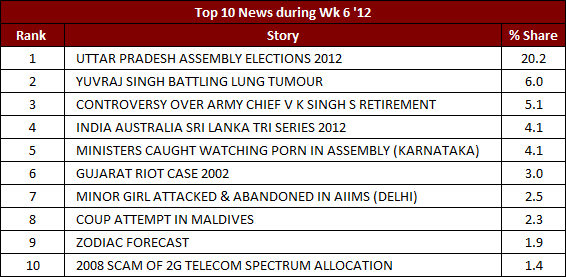
  • NCT Data Wk 6 ’12


    Source: News Content Track – A service of TAM Media Research Pvt. Ltd
    Channels: Aaj Tak, CNN IBN, Headlines Today, IBN 7, India TV, NDTV 24/7, NDTV India, Star News, Times Now, News 24 & Zee News
    Period: Week 6 – Feb 5 to Feb 11, 2012
    Note : Analysis is based on the Telecast duration


    About TAM Media Research


    TAM is a joint venture between Nielsen Company & Kantar Media Research. Besides measuring TV Viewership, TAM also monitors Advertising Expenditure of Television, Print & Radio through its division AdEx India. Since 2004, it extended its presence in the PR Measurement & Analysis space for Corporate/Marketing Clients by setting up a separate division Eikona PR Measurement.


    In 2007, the joint venture introduced RAM (Radio Audio Measurement) service to track Radio Listenership for the Indian Radio Broadcast Industry. In year 2009, TAM launched a division, called TAM Sports that specializes in monitoring Sports Sponsorship ROI.


    TAM Media Research’s objective is to fuel media insights that will drive the growth of the Indian Media Industry.

  • Anil Thakraney on 9 reasons why KFA must shut shop

    By Anil Thakraney


    Dr Vijay Mallya is in no mood to entertain talks about shutting down his messy airline. He is a proud man, and it would hurt his pride if his pet project got killed. But there’s no place for ego and emotion in business, every die hard dhandhewala knows that. Here’s why I think it’s better to ground Kingfisher Airlines Limited (KFA).


    1. Dr Mallya doesn’t get this business at all.


    2. Running an airline is not the same thing as running a liquor company. Or sailing on a private yacht. Or anchoring Page 3 parties. Or owning an IPL cricket team.

    Totally different sets of rules apply.


    3. Kingfisher’s continuing crisis has badly hurt Dr Mallya’s own image as that of a man who can do no wrong. This is damaging his credibility as an industrialist.


    4. Because it’s a brand extension, the airline’s very poor image in the market could harm UB group’s cash cow beer brand, Kingfisher Lager. It’s not a risk worth taking anymore.


    5. Even if Dr Mallya decides to run KFA as a totally low cost, zero frills airline to slash operating expenses drastically, it will backfire as this strategy doesn’t gel with the stated brand position of ‘Good Times’. So it makes no sense to be around from the marketing point of view either.


    6. The huge inconvenience and financial losses Kingfisher has been causing to thousands of flyers across the nation because of cancelled flights will have seriously eroded brand preference. And this situation in the hospitality industry has a cascading effect. Loyalty once lost is very hard to gain back. Just to give you can example: GoAir once cancelled a flight I was booked on at the nth hour, and I have sworn never to touch them again.


    7. The KFA staff is highly demotivated. I don’t even want to discuss the ramifications if the airline’s maintenance engineers don’t do their jobs with care.


    8. There’s not much hope in his son and heir to the throne, young Sid Mallya. The way he dives into verbal clashes with aggrieved KFA flyers on Twitter is a clear indication that the dude does not fit in with the service business.


    9. Dr Mallya doesn’t get this business at all.


    * * *


    [youtube width=”400″ height=”200″]http://www.youtube.com/watch?v=OuiEKm5dDrY[/youtube]

    PS: Not a very recent commercial, but a must watch in case you missed it. Super one from Playstation. Fantastic understanding of the target audience, and totally exciting creative.


  • Coke & Pepsi to sizzle summer with more drinks

    By: Ratna Bhushan


    Forget the Cola war; Coca-Cola and PepsiCo are heading for a high-pitched battle in the flavoured soft drinks segment this summer.


    Soon after reviving lemon drink Citra, Coca-Cola has decided to give fresh lease of life to orange drink Crush and tonic water Schweppes, said an industry official aware of the development.


    Rival PepsiCo, which has rolled out two variants of orange drink Mirinda and revived lemon drink Duke’s after a seven-year hiatus, plans to launch more flavours under its clear-lime brand 7Up, said trade insiders.


    Both are responding to the changes in consumption patterns in India’s Rs13,000-crore soft drinks market, said experts. “Flavours are growing faster than colas…heightened focus is recognition of the demand,” said Ravi Jaipuria, PepsiCo’s biggest bottler in South Asia.


    Crush For the Masses

    Coca-Cola plans to revive Crush and Schweppes, which it bought along with clear lemon Canada Dry as part of a global acquisition of Cadbury Schweppes soft drink business in 1999. Crush, like Citra, may target the low-income group with a lower price tag than Coca-Cola’s own Fanta orange drink, said an official familiar with the development. “That way, both brands can co-exist.”


    Schweppes tonic water and premium soda will be taken national across more than 10,000 outlets, and will be packaged in cans, the official says. Currently, Schweppes is available only in non-returnable glass bottles in a few restaurant channels and select modern trade stores.


    A Coca-Cola spokesman declined comment on the forthcoming launches of Crush and Schweppes, but said: “A combination of our ‘occasion, brand, pack, price, channel’ architecture along with brand activation plans and route to market focus will help us capitalise on the existing opportunity in the flavours segment.”


    Coca-Cola is already in the process of reviving Citra, which it had acquired from Ramesh Chauhan two decades ago, priced about 20 per cent cheaper than existing lime lemon drinks, Sprite and Limca, mainly to fight smaller regional B-brands.


    Unprecedented Rush

    Devendra Chawla, president of food and FMCG businesses at the country’s largest retailer Future Group, said launch of so many flavours and brands in one season is unprecedented in the industry. “While there would be some casualties among these by end-season, it’s good for the industry as India’s share of throat of soft drinks is minuscule; this engagement will grow consumption,” he added.


    Some experts say that a key factor that helped flavours outgrow colas is the widespread belief among Indian consumers that flavoured soft drinks are less harmful to the body than colas.


    Ruchira Jaitley, PepsiCo’s executive VP marketing, beverages (flavours), said flavours are growing in high double digits, without sharing exact numbers.


    But surprisingly, the new Mirinda flavours will be around only for three months and go off the shelves before peak season of May-June.


    Late last year, PepsiCo had relaunched its age-old Duke’s range of beverages, mainly as a regional brand in Mumbai, in lemon, raspberry and gingerale variants. It bought Duke & Sons in 1995. The rush for flavours is in the packaged juice segment as well.


    Source:The Economic Times
    Copyright © 2012, Bennett, Coleman & Co. Ltd. All Rights Reserved
  • ad:tech 2012 set to kick off today

    By Shruti Pushkarna


    The biggest digital marketing, media and advertising event is here. ad:tech 2012 kicks off in New Delhi today. The three-day event is being held at The Leela Kempinski, Gurgaon, Delhi NCR from February 22 to 24.


    This year’s event will have participation of over 70 digital marketing companies, more than 2500 delegates and experts from the digital marketing fraternity. (see Disclosure)


    Speaking to MxMIndia, Event Chairman, ad:tech India and Founder, CEO & Managing Director, Rammohan Sundaram said, “We have over 100 speakers this year and more than 3000 delegates, combined both in the expo and at the conference. We’ve grown more than 50 per cent from last year in terms of participation.”


    The event is set to showcase 7 ground breaking keynotes. A line-up of global thought leaders for 2012 edition includes, Mr. Shiv Singh, Global Head of Digital, Pepsico Beverages; Mr. Gian M Fulgoni, Executive Chairman & Co-Founder, comScore Inc.; Mr Arvind Rajan, Managing Director & Vice President, Asia Pacific and Japan, LinkedIn; Mr Kent Wertime, Chief Operating officer, Ogilvy Asia Pacific; Pete Blackshaw, Global Head of Digital Marketing and Social Media, Nestle; Satyan Gajwani, Director-New Media, BCCL; and Richard Dunmall, Vice President, Global Accounts & Agencies, Microsoft Advertising.


    The agenda includes two parallel tracks of insightful panel discussions with 18 sessions conducted by experts from advertising, marketing and media industry. There will be three panel tracks on Brand Strategy, Performance and Venture Capital.


    Mr Sundaram believes that the star attraction for ad:tech has always been its keynotes and marketing masters. But the expo this year will also be a huge attraction and expos he believes tend to create a vibrant atmosphere. He told MxMIndia, “The expo is going to see a lot of action this year. We have ten more participants this year, with over 15 international companies participating.”


    Talking of slow economic growth because of the severity in European markets, Mr Sundaram believes that there is rising pressure on marketers today. So participants, he feels, are looking forward to some smart gains at the event.


    Expectations of participants are also high, given the line-up of speakers and huge delegate turn-out. Speaking to MxMIndia, Karl Gomes, Co-Founder at AgencyDigi said, “I have high expectations… for me it’s about meeting people, listening to perspectives and maybe help and evangelize the medium.” ad:tech he believes, “…is a nice meeting place for like-minded people. Delegates and speakers get a chance to chat, evangelize. While it’s essentially about marketing and technology, but other mediums also come in. Digital is part of every medium today, TV has become digital, radio is anyway interactive…so digital can actually help other mediums.”


    As the largest gathering of online marketers, the event promises to showcase leading Indian and global brands, including, Pepsi, Coca Cola, Nestle, Hindustan Unilever Limited, Facebook, Dell, Ford India, IBM< Nokia, Sony Entertainment Television, Bharti Airtel, LG Electronics, MTV, LinkedIn, Homeshop 18, Godrej appliances, comScore, Ogilvy, Avaya, mydala.com, Yatra.com, Kotak Mahindra Group, Tata Teleservices, MotorExchange, IndiaMART.com and Domino’s Pizza.


    ad:tech 2012 has a lot in store, as Mr Sundaram said, “Marketers can expect intense and thought-provoking discussions on wide-ranging topics from industry veterans and thought leaders.”


    More details about the event are at http://www.ad-tech.com/newdelhi/.

    Disclosure: MxMIndia is a media partner of the event.


  • Retailers Mahindra group, Godrej Interio, Reliance Retail hire specialists to up sales

    By Writankar Mukherjee


    Whenever Mahindra Group decides to set up a new store for its speciality mother and child retail venture Mom & Me, it first looks out for ‘super moms and dads’ . These are experienced parents or grandparents who have the experience of raising a child and can offer customers, especially first-time parents, advice on choosing the right product and its usage.


    At last count, the Mahindras had appointed more than 60 super moms and dads across India, at a much higher salary than what its customer care executives earn. In the process, it is reaping huge business benefits. The conversion at the Mom & Me stores is more than 50 per cent, double the industry average.

    Conversion rate is the measure of the number of people who visit a shop making a purchase – a key indicator of a store’s success.


    “The last-mile service helps in increasing conversions, especially in tough times like this,” said Saloni Nangia, president of management consultancy Technopak Advisors. “The consumer experience also improves, and it builds a long lasting connect with them. In fact, such specialised talent will guide buyers to meet their specific requirements so that they are satisfied,” she added.


    In an emerging trend in the country’s Rs 20,000-crore organised retail sector, retailers are increasingly hiring specialists who can influence shoppers, provide personalised shopping advice and thereby increase conversion. As a result, shop floor jobs, earlier reserved for plus-two and general stream graduates, are now seeing a growing influx of specialized graduates or domain experts.


    Retailers see such specialised shop floor employees as critical to success in the current economic scenario, when consumer sentiments are down. Key retail categories like apparel, furniture and electronics are seeing far less trading, prompting retailers to spice up demand backed up by heavy discounts and promotions.


    Several studies have said consumer sentiments have been down for the past two to three quarters due to rising interest cost and inflation, though it improved in the urban markets from mid-January.


    Diamond jewellery chain, Orra, has started appointing designers at the shop floor to help customers in their purchase decision. The company has also started an extensive training programme for such designers on the various types of jewellery, gold and other precious stones.


    The company has hired one designer for each of its 33 stores. “The conversion rate has jumped by 10 per cent. We are now planning to increase the number of such specialised designers in the shop floor,” said CEO Vijay Jain. A 10per cent jump in conversion is no mean number, considering the per sq ft revenue in jewellery retailing is one of the highest in retail, as much as Rs20,000 per sq ft per month.


    Godrej Group’s furniture retailing arm, Godrej Interio has started training its existing shop floor employees on interior design and is also hiring specialised interior designers for its premium venture, U and Us, where consumers can design their own furniture.


    Hiring such specialists and training them is aimed at helping the sales force evolve as consultants, said COO Anil Mathur. Reliance Brands, a wholly-owned subsidiary of Mukesh Ambani’s Reliance Retail , which runs a chain of 55 premium stores for global brands like Diesel, Timberland, Ermenegildo Zegna, Paul & Shark and Steve Madden, has been hiring talent from fashion institutes to run the stores.


    This year, Reliance Brands hired 32 people from National Institute of Fashion Technology and three to four designers from London College of Fashion. The company refers to its store employees as ‘sales consultants’. Reliance Brands pays at least three times more salary to such employees compared with those in its other lifestyle formats. “We need such specialised talent, since a person buying a jeans for Rs15,000 at Diesel would require specialised knowledge on the product, design and far more engagement with the brand. Similarly, the average selling price at Paul & Shark is Rs24,000 and that at Ermenegildo Zegna is Rs 54,000. Selling such high-value products requires specialised skills,” said Reliance Brands president and CEO Darshan Mehta.


    The specialised hiring strategy also works for the employees as a second career opportunity. Mahindra Retail’s supermom and superdad concept, for instance , helps professionals coming from a break or as a post-retirement job opportunity . The super moms and dads have no sales targets either. The customer connect adds to the store’s sales; some of them end up dealing with sales worth as much as Rs 70,000, said Mahindra Retail CEO K Venkataraman.


    Architect Anjali Kar (name changed on request), joined Future Group’s furniture and home decor retail venture, Home Town in Kolkata, to gain experience in sales. “The selling experience and directly dealing with clients is a plus in career growth, more so if someone were to start up their own firm,” said Ms Kar.

    ‘Supermom’ Preeti Jhingran (46), joined Mahindra’s Mom & Me store in Bangalore after a stint with Genpact. She says the unique nature of the job impressed her. “I play the role of a mother to would-be parents,” she said. “In cities like Bangalore, where most young couples have nuclear families, all they need is some trustworthy advice which we provide by meeting their needs at the store,” she added.


    Similarly, pharma industry veteran Ganapathy Sankarnarayan (69), joined Mom & Me as a superdad, post-retirement . A soon-to-become grandfather with his children settled abroad, Sankarnarayan says he has already enjoyed being a grandfather at the store.


    Several new parents even leave their children with him while completing their shopping in the store. Retailers have started drawing career progression plans for specialised professionals . “The best way to dirty your hands in retail is on the shop floor. Such professionals can then move up the ladder,” said Mr Mehta. All in all, it’s a win-win for both.


    Source:The Economic Times
    Copyright © 2012, Bennett, Coleman & Co. Ltd. All Rights Reserved